



Abstract
Background
Community Health Workers (CHWs) play a critical role in supporting the delivery of health services globally. Competency-based learning programs can improve the transfer of learning to practice. This scoping review aims to characterize the published literature on competency-based education as an instructional and curricular strategy in community health worker training programs. We conducted a scoping review of the literature to identify how, by who, and in what ways CHWs are trained using competency-based education; and to characterize the extent of available evidence, as well as the gaps in that evidence.
Methods
We conducted a review of the peer-reviewed literature on CHW competency-based education and training published between January 2010 to March 2023, drawing from four databases: EMBASE, OVID Medline, Web of Science, and CINAHL. We followed the PRISMA guidelines for scoping reviews. A total of 713 articles were reviewed and 236 were included for extraction based on the inclusion and exclusion criteria. Due to methodological heterogeneity, results were analyzed and synthesized only through a descriptive approach.
Results
The literature on competency-based CHW education and training is most voluminous in high income contexts, primarily the USA. Overall, the included studies described very small-scale training interventions. Study types included observational (qualitative, quantitative, mixed methods, case studies) intervention or experimental studies, systematic or scoping reviews, and literature reviews. The most common practice area included was ‘promotive and preventive services’, whereas ‘personal safety’ was the rarest.
Learning programs tailored to CHWs with low-literacy, content tailored to local cultural contexts, and curricula that were co-designed with CHWs were identified in the literature as effective strategies for converting learning to practice.
Information on institutional support for CHWs was not provided in most of the articles reviewed. While the focus of our review was on education and training and not broader supports for CHWs, we still found it notable that training was usually discussed in isolation from other related supportive factors, including professionalization and career progression.
Conclusions
We found considerable academic interest in utilizing competency-based education to support CHWs and improve their work, yet this exploration was largely limited to smaller, ad hoc programs, in high income settings.
Learning programs should be tailored to the realities and practice requirements of CHWs. Further work should illuminate the extent to which the design and delivery of education and training activities lead to acquiring and maintaining the requisite competencies.
Supplementary Information
The online version contains supplementary material available at 10.1186/s12913-025-12217-7.
Keywords: Community Health Workers, Education, Training, Competency-based Education, Scoping Review, Health Workforce
Introduction
Considering the anticipated shortage of about 10 million health workers by 2030 [1], and the urgency to achieve the goals for Universal Health Coverage and Sustainable Developmental Goals, countries are increasingly prioritizing Primary Health Care-oriented approaches to health service delivery. This has direct implications on the health workforce. Universal Health Coverage relies on a health workforce that is responsive to the communities they serve.
Community Health Workers (CHWs), when embedded in and adequately supported by primary care teams, can play a critical role in supporting the delivery of health services globally. Evidence from published literature has established CHW effectiveness in improving maternal and child health outcomes [2, 3], as well as controlling non-communicable [4, 5] and infectious diseases [3, 6]. Countries like Brazil, Ethiopia, India and Nepal have shown demonstrated success across the care continuum [7–9].
The diversity of health system needs and contexts has resulted in a broad variety of CHW roles and qualifications. There is wide variation in training duration as well – from two years for a behvarz in Iran to 5 days for a Community Health Volunteer in Ghana [10]. Previous reviews have noted a lack of information on best practices for CHW education due to the difficulty of obtaining education content, compounded by the complexity of synthesizing varying education approaches and designs across diverse contexts [11–13].
While traditional educational approaches focus largely on knowledge retention, competency-based education centers on continuous, real-world application of learning, such as problem solving and decision making [14]. Competency-based education has been recommended as an effective approach to preparing health workers to respond to evolving scopes of practice and deliver patient-centered care [15], and has been observed to improve clinical performance [16].
When competency-based education programs are designed together with communities, education can prepare CHWs to better meet the needs of the populations they serve, through adapting to emerging health challenges, tailoring their approach to address specific community needs, and responding dynamically to evolving health priorities, ensuring a more agile and responsive healthcare workforce [17].
In recognition of the reported challenges and paucity of evidence and recommendations for CHWs, in 2018 the World Health Organization (WHO) published guidance on health policy and system support for CHW programs, including on competency-based pre-service CHW education that would help countries formalize CHWs into the health system architecture and help sustain their impact. However, many countries are yet to integrate these recommendations, and continue to face broader challenges related to supervision, retention, low motivation, and funding. These critical factors must also be considered in the design of education programs that are tailored to what is feasible for CHWs to do [12, 18–21].
With the renewed recognition and prioritization of CHW programs following the adoption of a dedicated resolution at the 72nd World Health Assembly in 2019 [22], countries have begun to accelerate their efforts to expand the number of CHWs in the health workforce. This will require investments in contextually relevant pre- and in-service education and training with relevant, reliable, and consistent support measures.
Therefore, there is a need to move towards competency-based education (CBE) and lifelong learning [17]. Competency-based education improves the application of learning to practice and helps learners perform within their own health system contexts [23]. To inform the development of a CHW competency-based prototype curricula guide, we conducted a scoping review of the existing body of scientific literature on competency-based education for CHW programs. This review focused on how CHWs are trained using competency-based education, and where the evidence is lacking. This aim of this scoping review was to characterize the published literature on competency-based education for CHWs and draw out instructional and curricular strategies from these learning programs.
We aimed to characterize who was providing the training in the literature, what was covered in the training, and how trainings were delivered. We also aimed to characterize the evidence on connections between competency-based trainings and broader supports for CHWs, such as career progression. We cast a wide net, aiming to collect all published articles on CHW competency-based training that contained details about what was being taught, by whom, and how.
Methods
Our rapid scoping review was guided by the steps outlined by Arksey & O’Malley and the Joanna Briggs Institute for scoping reviews [24, 25]. We made modifications to this methodology to facilitate timely completion of the review, in accordance with rapid review methodology suggested by the Cochrane Group and others [26, 27] for reviews conducted within a time frame of less than a year. We report our findings using the Preferred Reporting Items for Systematic Reviews and Meta-Analyses Extension for Scoping Reviews (PRISMA-ScrR) by Tricco et al. [28] (Annex 1).
First, we implemented a search strategy on CHW competency-based training. Subsequently, teams of researchers developed the inclusion and exclusion criteria, conducted the title and abstract screening, and conducted the full-text screen and extracted data onto the data charting form. Once data was charted, groups of researchers processed the charted data for analysis. For the purpose of the search strategy, we considered the terms ‘education’, ‘training’, ‘education and training’, and ‘learning programs’ as closely related to indicate teaching of any kind directed towards CHWs, given the variable meaning associated to these terms in the underlying literature.
Search strategy
We implemented a search strategy to identify articles on CHW competency-based training across four databases: EMBASE, OVID Medline, Web of Science, and CINAHL. The search was conducted to identify papers published from January 2010 to March 2023 to capture the most recent practice in CHW training from preprint and published articles with empirical designs (observational or experimental) and review articles.
The search strategy was developed in collaboration with research librarians working at Johns Hopkins Bloomberg School of Public Health’s Welch Library. CHW search terms were derived from The International Labor Organization definitions of a CHW in the International Standard Classification of Occupations (ISCO) 2008 code ISCO-08 3253, and cadre names mentioned in existing systematic reviews on CHWs [13, 29–33], as well as a CHW systematic review Protocol [34]. In addition to 100 + terms aimed at identifying CHW related papers, terms were added to narrow our scope to education or training. These educational terms were created mainly through discussions with research librarians about our goals, and following subject headers and categories (e.g., MeSH) trees to identify all related words for each individual database. Our search strategy is detailed in Annex 2.
Article screening and data collection
The title and abstract screening was conducted using Rayyan. A small sample of abstracts were reviewed individually and from conversations about these decisions, a rigorous inclusion and exclusion rubric was created and used for the rest of the screen (Annex 3). Included articles were of empirical design, in the English language, and focused on the training of Community Health Workers that was competency-based.
Each abstract was screened by two reviewers. Each reviewer made their decisions independently, without seeing the decision of the other reviewer. During weekly group calls the ‘blind’ mode was turned off to compare reviewer decisions and reconcile any conflicts.
In the full-text screen an additional criterion was added, stating that in order to be included, an article must describe a competency-based training. To meet our definition of competency-based training, the article had to include at least two of the following dimensions: knowledge, skills, attitudes, behaviors. These dimensions were drawn from the definition of competency-based education (CBE) that was proposed by WHO as ‘an outcomes-based approach to curricular design, development and implementation that emphasizes the mastery of learning, and the application of knowledge, skills and attitudes in the context of performance, rather than the process of learning and the acquisition of knowledge, skills and attitudes [35]. The fourth dimension was used to identify articles that emphasized applied learning, as this is a specific requirement of CBE [35].
A data charting form for published literature was developed in Microsoft Excel. Data extracted from the articles selected for full-text review included contextual study information (i.e., authors, year of publication, study type); the training curriculum and assessment described; information about the CHWs; curricula contents; and structural support around the training (Annex 4).
The curricular domains used to categorize training content were informed by the domains stipulated in WHO's guideline on health policy and system support to optimize community health worker programmes [1]. However, after review of existing competency frameworks it was decided that some curricular domains could be stratified into smaller but relevant domains. Before extracting data from the literature, all the 12 curricular domains were defined in terms of the CHW tasks and relevance for training in this practice area. The definitions of CHW tasks for each domain were utilized by data extractors to identify domains from the content described in the training curriculum description, using their best judgement, regardless of whether the articles mentioned the domain by name. As these domains are not discrete and were often integrated in practice, we identified domains based on the training curriculum itself, as described in the article. Multiple domains could be identified from a single article. For example, if training on a specific preventive health service covered the social determinants of health, we would identify both “promotive and preventive services” and “social and environmental determinants” as domains.
Synthesis methods
Once the extraction was completed for all records, data was processed for analysis. Processing included standardizing inputs, transforming multifaceted columns into binary columns, and creating binned categories of certain variables.
Data was quantitatively analyzed to determine counts of key variables, and to provide descriptive statistics describing the distribution of those variables. Sometimes we stratified the descriptive statistics to provide additional information (for example, to compare training modalities described in high income countries to those described in low and middle income countries). Processing and analysis were done using Microsoft Excel, Python on jupyterlab, and STATA.
For the key findings column, which generally consists of free text from the findings or conclusion of the article or article abstract, this group of reviewers created a codebook using both inductive and deductive methods. Each reviewer coded 5 articles for key findings, and the group came back together to discuss and iterate the codebook. Once the codes were decided on, the entire dataset was divided for coding, which was done directly in Microsoft Word, with results pulled into an Excel sheet.
Critical appraisal (‘risk of bias’ assessment) of individual studies was not conducted, given the heterogeneity in the study designs and the fact that this is an optional step in scoping reviews [36]. Similarly, an assessment of risk of bias across the body of evidence (all included studies) was not performed, given that this is not congruent with the aims of a scoping review [36].
Results
Selected articles
Three thousand seven hundred seventy seven records were identified in the comprehensive search conducted in March 2023. 1393 were determined to be duplicates, and 2384 unique abstracts were screened based on our exclusion criteria (Annex 3). After abstract screening, 728 articles remained. These were sought for retrieval and 713 unique full-text articles were able to be found. After full-text screening, 236 articles were selected for data charting and analysis (Fig. 1) [37].
Fig. 1.

PRISMA diagram of database search
Features of included articles
Included articles by year
There has been an increase in literature that met our inclusion criteria on competency-based CHW trainings over time, with the largest spike in 2020. In general, more studies were included from recent years (Fig. 2). The lower volume of search results from 2023 reflected the search being conducted in March of that year.
Fig. 2.

Count of included articles by year of publication
Study design
The most common study design in the included articles was intervention studies (n = 115). Almost as common (n = 102) were observational studies, where a training was conducted and described, but there was no explicit comparison group. Reviews (n = 13) and methodological reports (n = 6) were also extracted.
Regions and income levels
The included articles, as shown in Fig. 3, were overwhelmingly focused on the American Region (AMR, n = 102), which occurred in the literature at almost twice the number of the second most occurring region (AFR, n = 54). The region with the least results was Europe, with only 3 included studies.
Fig. 3.

Count of included articles by WHO region
Articles from higher-income countries were more common in our search compared to articles from lower-income countries (Table 1). Income and region were highly correlated with countries in the Americas (85/102) and Europe (2/3) tending to be high income, SEAR (39/47) mostly LMICs, and AFR mainly lower income (31/54).
Table 1.
Count of articles by World Bank country income level (2021 designation)
| Income Designation | Count |
|---|---|
| High Income (HIC) | 92 |
| Lower-Middle Income (LMIC) | 64 |
| Upper-Middle Income (UMIC) | 37 |
| Lower Income (LIC) | 31 |
| Multi-Country (MC) | 12 |
| Total | 236 |
The most common lower-income country in the literature was Malawi (n = 13). India was the most common lower-middle income country (n = 25), and South Africa the most common upper-middle income country (n = 14). The USA (high-income, n = 84) was the most common country in the literature, across income levels.
Who trains CHWs?
CHW trainers
The studies reviewed used three main approaches as to who would carry out CHW education and training. One approach was to have training sessions conducted and facilitated by subject matter training experts, trained mentors, and tutors [38, 39]. These training topics were often focused on very specific content and were frequently one-off. A second approach was for trained peers to conduct the trainings [40, 41]. These CHWs sometimes possessed prior experience in training or had undergone specialized training to instruct fellow CHWs [42]. This “train the trainer” approach allowed standardized capacity strengthening in an efficient way. A third approach was self-learning, in which CHWs embarked on self-guided learning journeys by engaging with available training resources [43, 44].
CHW Program management type
A significant portion of articles did not specifically include information about the entity conducting the CHW training and therefore that information could not be extracted (n = 77). The entities conducting the training intervention described in the remaining articles were governments or government collaborations (n = 69), followed by non-governmental organizations (NGOs) (n = 49), with a lesser number of academic institutions (n = 19). A total of 22 articles reported the collaboration of two or more institutions in conducting training interventions.
Scope
Most articles included in our analysis describe a single, ad hoc training intervention, and in these instances, we captured how many trainees were included in the training intervention. Overall, our studies described very small-scale training interventions. The outlier was a large-scale study that included 45,700 Lady Health Workers (LHWs) throughout Pakistan [45], almost half of the LHWs in the country at the time. The smallest training program described was in Senegal [46] with just one trainee. Of the articles where the number of trainees trained was readily available, the average number of trainees was 393, falling to 132 without the outlier of the one LHW study. Not all articles provided a specific count of the trainees discussed, as they focused on detailing the training in existing CHW programs rather than emphasizing a specific training intervention [47].
What are CHWs trained in?
Training curriculum
Given the diversity of roles and responsibilities CHWs are expected to have in practice, it can be challenging to compare various training content [48]. In 2018, based on a critical appraisal of globally available evidence, WHO suggested a set of six “core” and one “additional” curricular domains for pre-service training of CHWs, assuming that these are relevant to the expected roles within their contexts [49].
The prevalence of specific curricula content in the reviewed articles was mapped to these seven domains (Fig. 4), using details of the training from the article, ideally the curriculum itself. Four domains were used as indicated, namely personal safety; interpersonal skills related to confidentiality, communication, community engagement and mobilization; providing psychosocial support; and social and environmental determinants of health. Two of the core domains included multiple distinct components, each big enough to comprise a domain of their own. The domain called “promotive and preventive services, identification of family health and social needs and risk” was subdivided into its three component parts: 1) promotive and preventive services, 2) identification of family and social needs, and 3) identification of health risks. The domain called “integration within the wider health care system in relation to the range of tasks to be performed in accordance with CHW role, including referral, collaborative relation with other health workers in primary care teams, patient tracing, community disease surveillance, monitoring, and data collection, analysis and use” was divided into its five component parts: 1) referral support; 2) collaborative work with other health workers; 3) patient tracing; 4) community disease surveillance; and 5) monitoring data, collection, and use. If a training described in an article covered multiple domains, it was coded with all those domains.
Fig. 4.

Count of WHO Curricular Domains (one article may have multiple domains mentioned). *indicates domain as indicated in 2018 WHO CHW Guideline [49]. **indicates domain subdivided from larger domains
Relevance to the CHW curricular domains
The most common domain included in CHW trainings from our literature review was ‘promotive and preventive services’, followed by ‘interpersonal skills’ and ‘identification of health risks’. ‘Personal safety’ was the rarest training domain, indicating a gap in the literature on training for personal safety.
In addition to the above domains, we also found studies documenting trainings focused on equipping CHWs with research skills including community based participatory research [50] and research fundamentals [51, 52] as tools to improve factors like quality of care or job performance. One training program found that providing training in research fundamentals facilitated the ability of researchers to better communicate with CHWs and CHWs with their communities; similarly, another training program that integrated research fundamentals underscored the importance of continuous mentoring and coaching for CHWs [53, 54].
CHW Curricular domains by income and region
Across nearly all incomes and regions (except Europe), ‘promotive and preventive services’ was the most common curricular domain covered in the trainings reviewed. This reflects the centrality of this role for CHWs across the globe.
There were differences between the frequencies of domains found in articles describing trainings from HICs versus LMICs. ‘Personal safety’ was found in a higher proportion of articles in HICs (8/92) than in articles in LMICs (1/64) or LICs (1/31). The ‘social and environmental determinants of health’ domain was not identified in any articles describing trainings from low-income countries, but was sometimes included in articles describing training in HICs (16/92) and UMICs (4/37). In the literature, the trainings described in LMICs tended to to focus less on the larger structural and systemic issues that contribute to health outcomes, focusing instead on immediate skills and practices. ‘Interpersonal skills’ featured in 50% or more of articles describing trainings across income levels, but were most common in articles describing training in HICs (65/92, 71%). Curricular content related to this domain was included in all 3 articles about trainings based in Europe.
Often, curricular content related to ‘personal safety’ and ‘social and environmental determinants of health’ featured in articles with no reference to a specified health service.
Health services
We also categorized the articles by the broad topics of the trainings they provided to CHWs (Fig. 5). The most frequently cited content specific to a health service was Reproductive, Neonatal, Maternal and Child Health (RNMCH) – although this accounted for less than 25% of all articles. For 44 studies, a specific health service could not be extracted.
Fig. 5.

Count of top 15 Health Services Extracted (one article may include multiple health services)
We found that education and training programs described in these articles often linked multiple health services. There were no strong trends in which particular combinations of health services were trained together in these articles. However, more common groupings included training asthma, heart disease, or nutrition along with diabetes; RNMCH along with Water, Sanitation and Hygiene (WASH); and palliative care along with rehabilitation.
Health services trained, by income and region
Health services covered in the trainings described in these articles varied by both country income and region. The most common health services covered by CHW trainings in the articles in high income countries were cancer (19/92), diabetes (8/92), and mental health (7/92). Cancer and diabetes were not identified in any trainings based in lower income countries in the articles we reviewed, but mental health services appeared in similar proportions as in HIC contexts (3/31).
In lower (10/31) and lower-middle income (24/64) countries, the vast majority of trainings in the articles focused on Reproductive, Neonatal, Maternal and Child Health (RNMCH).
Regionally, South-East Asian countries had the largest proportion of trainings focusing on RNMCH in our review (18/27), followed by Africa (20/53), while in the Americas the proportion of trainings focused on RMNCH was much lower (10/102). In Africa the second most common health service covered in the articles, after RMNCH, was malaria (5/53). In South-East Asia it was mental health (5/27).
Our extraction did not capture any trainings specifically for neglected tropical diseases, another large gap in the literature reviewed.
How are CHWs trained?
We captured considerable variability in teaching and learning methods described in the articles about CHW trainings across different contexts. Although training methods varied widely, there was a common thread in the articles to contextualize trainings to important factors such as CHW background.
Training length
The length of the education and training programs in our sample varied greatly (Fig. 6). Differences in the way the information was reported in the articles made it difficult to compare studies directly. However, some general trends were apparent. Almost half of education and training programs (41.8%) described in the articles were a week long or less, and 12% were between 2–4 weeks long. 11.4% of trainings ranged from 1–6 months, but it should be noted that many trainings in this category were not full time, consisting of intermittent contact with CHWs. Very few exceeded one year (2.1%).
Fig. 6.
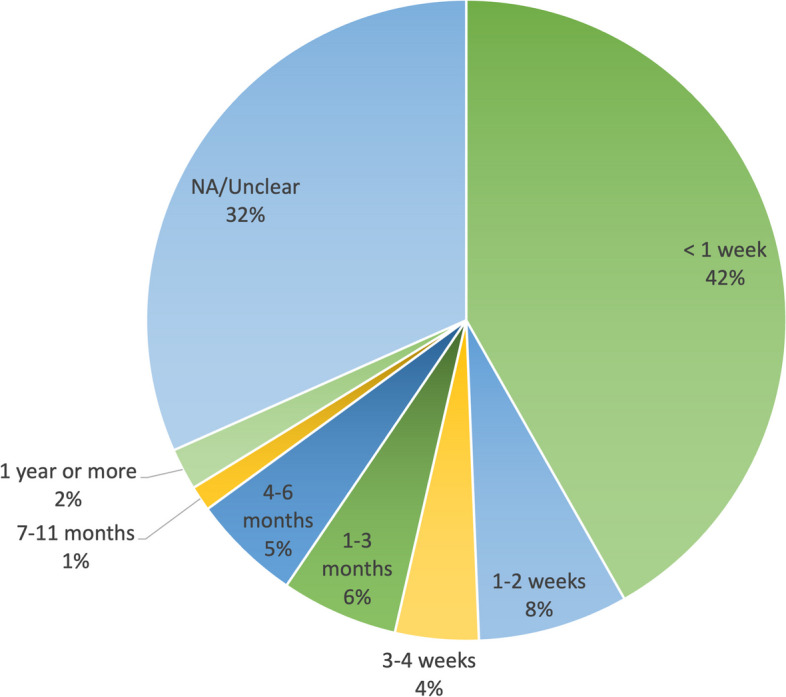
Training Duration (n = 236)
Training modalities
In-person trainings are commonplace in the literature in addition to other modalities. Most articles in our review referred to CHW education and training delivered via in-person methods [50, 55] using teaching modalities such as seminars and workshops. For subjects necessitating the acquisition of clinical knowledge and skills, such as Integrated Management of Childhood Illnesses, skilled birth attendance, breastfeeding, and asthma management, the articles predominantly described traditional classroom-style instruction. These pedagogical approaches included lectures, practical demonstrations, skill practice sessions, group discussions, instructor feedback, and collaborative problem-solving among peers [51].
The literature also contained examples of using a “blended” approach, combining both online and in-person and/or self-paced offline components [52, 56] allowing in-person contact hours whilst also increasing flexibility and reducing the burden on CHWs to attend exclusively in-person trainings. Distance education was considered a feasible approach for some CHWs in geographically isolated regions [57, 58]. Online training was found to have value in increasing reach, but may not be feasible in all environments [59].
Pedagogical approaches
The focus of competency-based education on cultivating practical skills and knowledge acquisition relies on tailored instructional methods that emphasize mastery of specific competencies and educational strategies that cultivate abilities for real-world application. Interactive, practical sessions mirroring real-world scenarios emerged as a prevailing strategy for skill reinforcement in the literature. In these articles, learners were encouraged to actively participate in discussions and contribute to peer-to-peer learning, thereby enhancing the application of learning. Additional pedagogical approaches to utilize and/or replicate real-world scenarios included experiential learning [60], home visits [61], and role play [62]. Additionally, practical tools such as checklists and pocket guides were found to be helpful in serving as memory triggers during service delivery [63, 64].
Articles described considerations for trainings to accommodate different learning styles, with programs incorporating elements to target a variety of learning approaches. An in-service training of promotoras on stress reduction targeting individual behavior change among Latina immigrants in the U.S. used active learning styles including visual, kinesthetics, affective, and cognitive styles [55]. A training for CHWs elder care in the Philippines provided a wide variety of training content and activities with intentional consideration for diverse learning styles [65].
Our review yielded multiple ways to tailor training methods for low-literacy CHWs [50, 59, 66–69]. One training program in Zambia, for example, adopted a simplified curriculum for neonatal resuscitation protocol and administration of oral antibiotics for traditional birth attendants with limited literacy and numeracy skills, improving their knowledge and skills [70]. Other articles for low-literacy CHWs employed pictorial, action-based checklists [66, 71], educational videos [67], and hands-on mannequin-based practice [68]. A number of articles discussed pedagogical approaches designed to tailor content to be relevant and effective to the context in which CHWs work and live. There were multiple articles focusing on including cultural sensitivity in trainings [50, 53, 72, 73] and culturally tailored curricula [51, 52, 74–77].
The pedagogical approach underlying many CHW training programs in our sample adhered to the principles of popular education [38, 76, 78–87]. Popular education is an epistemic approach that draws on the expertise of trainees and can empower individuals and communities [88]. These programs featured participatory methodologies and emphasized values related to equity and social justice.
Co-design and lived experience
Many articles noted the importance of including community health workers, community members, and other key stakeholders in the development of the training [55, 89–91]. Co-development was found to help ensure cultural relevance [91, 92], a factor noted as essential to program success [51, 52, 74–77]. A study which integrated the lived experiences of CHWs in a cancer education training program in Alaska, USA found that by centering the experience of communities in the training, CHWs improved their abilities to communicate about cancer risks, recommend cancer screenings and even improve their own health behaviors for cancer prevention [70].
Training assessment
Trainee assessments described in the articles were most often pre-post surveys to determine change in demonstrated knowledge and skill level before and after the education and training program. The Kirkpatrick Model of Evaluation [93], a training evaluation framework that emphasizes real-world applications of content learned, was used in some studies [43, 81, 94–97]. Of those that employed the Kirkpatrick Model, evaluations were largely focused on the immediate first and second levels, with little follow-up for longer term impact. Some studies included clinical assessments or shadowing of CHWs in the field post the education and training intervention, but this was relatively uncommon [98, 99].
Most studies measured the effect of training on increasing CHW knowledge, skills and/or attitudes and found a positive change. Studies that showed mixed results tended to show an increase in knowledge post-training but no change in skills [78, 100, 101]. Fewer studies looked at outcomes on clients, or the health system. The few that did focused on increased levels of care-seeking by community members from CHWs [102, 103].
What are the institutional supports for CHWs?
Formalized credentials and licensing for CHWs
The majority of articles (n = 208, 87.8%) did not report information on if and how CHWs were licensed as a result of the training. Of those that did report this information, the majority provided a certificate to CHWs who had completed the training program [45, 63, 81–84, 92, 104–112]. Due to the wide variability of the education and training programs reviewed, there was heterogeneity in terms of issuing credential and licensing characteristics (e.g., a certificate of completion from an implementing partner versus formal recognition from an accrediting institution of the health system). In some cases, CHWs were required to take an exam to qualify for certification [47, 60, 110, 113]. For example, in one training program in the U.S., CHWs had to take the Certified Asthma Educator (AC-E) exam to become nationally licensed [60]. In Bangladesh, CHWs received skilled birth attendant training and received recognition from the Bangladesh Nursing Council as skilled providers [51]. CHWs in training programs implemented in South Africa and Guatemala were provided ID cards upon completion of training [113, 114].
Remuneration for training
Similarly, the majority of articles (n = 198, 83.5%) did not mention whether CHWs were renumerated for training. 27 articles reported some form of payment to CHWs – either as stipend, allowance, or in the form of transportation reimbursements [44, 45, 47, 52, 55, 59, 74, 80, 87, 94, 97, 112, 115–128]. Most of these articles were about training in the U.S. (n = 16), where CHWs were paid between $20-$250 USD for completing trainings [52, 55, 59, 80, 87, 112, 116–118, 120, 126]. In Taiwan, CHWs were provided monetary certificates worth $200 USD for completing oral health-related training [119]; in Cambodia, CHWs received $5 USD for diabetes prevention training [124]; and in Grenada, CHWs received $150 per training sessions around cervical cancer and HPV [115]. Some CHWs in the studies reviewed, mostly in LMICs, received transportation reimbursement for attending trainings [39, 60, 129–131]. In Tanzania, HIV-focused CHWs received $20 USD for integrating maternal and child health-related training [123].
Career progression for CHWs
The majority of studies did not mention any kind of career progression pathway related to CHW training. Five articles [51, 60, 84, 113, 132], reported on the pathway and potential of career progression of CHWs – though exact pathways were not described in detail. In South Africa, emergency first aid responders (EFAR) could be promoted to an advanced EFAR position [113], and in the US, CHWs known as ‘birth sisters’ could be promoted, though there was no information on the details of that progression pathway [132]. Other types of career progression identified included CHWs becoming trainers [51], CHWs receiving job placement support [84], and CHWs becoming licensed though a national body [60].
Additional support for CHWs
As mentioned earlier, the majority of the articles reviewed described pre-service trainings. Yet multiple articles stressed the importance of continual support, such as refresher trainings [75, 98, 133], especially for health workers with limited formal education. Several articles also emphasized the need for ongoing mentoring and supportive supervision within and post-training also emerged as a facilitator for CHW success [74, 134, 135].
Embeddedness and integration
Embeddedness—linking the education and training of CHWs to the needs of the communities that they serve—emerged as a theme in the findings or recommendations of 10 studies. Areas of practice for which making such linkages was common were mental health services [91], health promotion and prevention [136] and health education [80]. Ensuring that training was aligned with the existing CHW responsibilities as well as community priorities was considered relevant for sustaining training outcomes. Three studies highlighted the anticipated benefits of embedding CHW training into existing programs [71, 116, 119]. Benefits included enhanced community capacity [71], improved needs assessments [116], and improved access to care [119]. Another three studies mentioned the need of embedding training into existing programs [136–138]. Specifically, they emphasized the need for sustained program support with the goal of achieving improved service accessibility and uptake after completion of the training [136–138]. One article pointed out that program support can support the adoption of evidence-based practice, teamwork, and innovative roles [137]. Another illustrated that institutional support for CHWs doing this complicated work is integral to the success of the program [47].
There were very few studies that clearly described integrated training, defined as training on health promotion for various health services being supported under the same care package. Yet, there were some notable examples of trainings that did explicitly prioritize integration [38, 47, 102, 139–141], with many of these being NGO-led CHW programs in the USA.
Certainty of the evidence
Given the heterogeneity of the education and training programs reviewed, the lack of robust evaluations in the articles, small sample sizes in terms of CHWs trained with a focus on small-scale training programs and training programs in high income settings in the articles reviewed, we characterize the certainty of the evidence in this review as very low in all domains. Given that most articles reviewed were describing training programs of several hundred or fewer CHWs, and it is likely that most CHWs trained globally are given such training as part of large-scale national programs, there is strong reporting bias in this literature.
A full list of the articles reviewed is included in the Supplemental Material (Annex 5).
Discussion
Limitations
This review was completed to inform the development of a competency-based curriculum guide for CHWs. Therefore, we extracted articles that described training content, but not those that exclusively evaluated a training without providing information on content.
We used the definition of competencies detailed in the World Health Organization Global Competency and Outcomes Framework for Universal Health Coverage [35] in order to identify articles on competency-based education and training, but we are aware there are many other definitions. Competency-based education is sometimes regarded as a catchphrase, with differing interpretations and applications across training programs; so not all programs that incorporate competency-based principles explicitly identify as such, while some self-described ‘competency-based’ programs may not align with the definition we applied in our review.
This analysis was done to gain a better understanding of the scope of published literature; it seems from this work that the published literature is likely not particularly representative of the true scope of CHW competency-based training. Our results can only highlight features of trainings that were reported in the literature.
We found considerable academic interest in utilizing competency-based education to support CHWs and improve their work, yet this exploration was largely limited to smaller, ad hoc contexts. While the literature predominantly describes trainings that took place within large-scale national programs, it is important to note that the education and training initiatives described often targeted only a subset of these CHWs, with limited descriptions of the comprehensive curriculum offered to the broader CHW population.
Our findings suggest that interest in competency-based education for CHWs is growing, although papers documenting such trainings over represent higher-income contexts. Furthermore, the majority of the trainings in our review were small-scale intervention designs, with limited evidence of incorporating competency-based education into formal CHW programming. The disproportionate number of articles describing high income contexts and articles describing trainings given to a relatively small number of CHWs, limits our ability to draw inferences on CHW training and practice globally. We had difficulty finding consistent key details across different articles, leading to heterogeneity in the completeness of various datapoints collected. We did our best to mitigate bias by employing rigorous study design and implementing standardized protocols, but the variability in information presented in the articles nonetheless led to inconsistent information for some key variables. For example, due to heterogeneity in how articles reported training content, curricula domains could only be extracted across articles by best judgement, and this could have biased our comparisons between various types of training programs. There may have been cases when a training, in practice, included domains and competencies that were not reflected in the article regarding the training. However, we extracted to the best of our understanding based on the described training content contained in the article. Furthermore, publication bias may have resulted in underreporting in the literature of some of the features that are actually implemented by training programs.
Interpretation
Few scoping or systematic reviews have explored CHW competency-based education and the learning outcomes of those education programs. One systematic review of existing reviews reported that training impacted CHWs’ motivation, job satisfaction, and community confidence, but that training duration and frequency did not show a consistent effect on CHW efficacy [32]. The authors recommended a knowledge and skills-based training approach to improve CHW self-efficacy and skill levels, with supportive supervision and mentoring. Another systematic review of CHW training programs for cardiovascular disease management in low- and middle-income countries reported that pre-post knowledge tests were inadequate to ensure practical application of knowledge gained, recommending validated mechanisms for evaluating CHW training programs [142]. A scoping review of CHW programs emphasized the importance of appreciating CHW perspectives and experiences following training to determine impact of the training program, as the traditional evaluation metrics of numbers trained, hours of training, and scores achieved were inadequate to assess effectiveness [11].
In the articles identified in our review, trainings for CHWs largely follow traditional North–South burden of disease paradigms that emphasize infectious and “tropical” diseases and maternal child health in poorer settings [143] and non-communicable diseases in high-income contexts. This is likely in part because CHWs in low- and middle-income countries have an appropriately greater focus on infectious disease and maternal-child health given the burden of disease in their settings. However, given the increasing burden of NCDs in many low- and middle-income countries, there is a need for more evidence on competency-based trainings in NCDs tailored to CHW work in low- and middle-income contexts.
There was no consistency in our findings with respect to factors like training duration or curricular fundamentals. This is understandable given the diversity of CHW roles, yet a basic set of universal competencies that could be adapted across settings might support regularization of standards to establish and strengthen quality of care globally. This analysis could further aid in developing a prototype curricula guide that includes universal, as well as context- and role-specific, competencies and practice activities for CHWs globally.
Crucially, while the way CHWs are trained matters, focusing narrowly on curricula alone is insufficient for transformative change. There was little information in the articles in this review on whether CHWs were formally recognized, credentialed, or provided career development opportunities after completing competency-based training programs. This suggests that there is scope for research exploring the relationship between competency-based trainings and broader supports. This is an especially important area for further research given that many CHW programs continue to be made up of women with heavy work responsibilities and low remuneration. The literature also focused predominantly on pre-service training with limited evidence for refresher trainings or on-the-job supervision, despite the fact that these are recognized as important support mechanisms for community health workers [21, 144]. There is therefore a need for additional research on continuing education for CHWs.
Lastly, the disease-specific nature and small scale of the trainings in our review revealed that the evidence base focuses largely on relatively fragmented approaches to train CHWs. Much focus, in the literature, has been given to what training CHWs can do for communities, and there remains a need to explore what being a trained CHW does for the individual.
Implications for policy, practice and future research
Well-trained, competent, and well-supported Community Health Workers are an integral component of health workforce teams best placed to achieve Universal Health Coverage. Countries of all income levels will require substantial investment and intentional planning to adequately transition to competency-based education [15].
Broadly speaking, this review illustrates that CHWs can be successfully trained in a broad range of competencies, including for complex tasks like research. Exploring how some of the smaller scale interventions such as those found in our review could be replicated in more large-scale CHW programs could further improve understanding.
The need to tailor trainings across factors like culture, language, and education level was well-documented in our review, with ample creative approaches available to inform curricula design. We also saw evidence for the value of co-design to strengthen curricula. CHWs bring unique expertise as members of the communities they serve; this echoes other calls to invite individuals with lived experience to inform global health curricula [145]. Trainings tailored to the realities of CHW programs are important and can help illuminate for program planners what activities are truly reasonable to expect at various levels of remuneration, supervision, and professionalization, underlining the value of systematic support for CHWs.
Although care for non-communicable diseases (NCDs) is increasingly part of CHWs’ responsibilities globally, our literature identified few articles on competency based-trainings for NCDs in low- and middle-income countries. This suggests the need for work on effective strategies to train CHWs to address the “triple burden” of disease [146] at the intersection of infectious disease, chronic conditions, and broader structural determinants. It also highlights the continued need for research strategies beyond short-term, disease-specific training approaches [147].
We suggest that researchers publishing about trainings provide details on the context of the CHW program. Some key context to report would include program management, the educational requirements of trainees, career progression for trainees, and remuneration for training. More evidence on what educational approaches work in various contexts is needed.
There is a clear need for further published research on effective competency-based education in large-scale CHW programs in low- and middle-income countries with an emphasis on national CHW programs; these programs employ millions of workers and are critical in care provision globally. Yet literature on training programs for these programs is sparse. In particular, there is evidence needed on learning and course outcomes of the current training programs employed in these large-scale programs. Building this evidence base can be a key way of supporting broad-based Primary Health Care.
Supplementary Information
Supplementary Material 1: Annex 1. PRISMA Scoping Review.
Supplementary Material 2: Annex 2. Detailed Search Strategy.
Supplementary Material 3: Annex 3. Exclusion Criteria for Abstract and Full-Text Screening.
Supplementary Material 4: Annex 4. Data Charting Columns.
Supplementary Material 5: Annex 5. Included Articles Title, Author, Country, Income Level and Region.
Acknowledgements
We thank the Technical Advisory Group of this project for their helpful input. Jacob White provided extremely useful advice in creating the database search terms for this scoping review.
Abbreviations
- CHW
Community Health Worker
- NGO
Non-governmental organization
- WHO
World Health Organization
- PRISMA-ScrR
Preferred Reporting Items for Systematic Reviews and Meta-Analyses Extension for Scoping Reviews
- ISCO
International Standard Classification of Occupations
- AMR
Region of the Americas
- EUR
European Region
- EMR
Eastern Mediterranean Region
- SEAR
South-East Asian Region
- AFR
African Region
- LMIC
Lower-Middle Income Country
- LIC
Low Income Country
- UMIC
Upper Middle-Income Country
- UIC
Upper Income Country
- NCD
Non-communicable disease
- RNMCH
Reproductive, Neonatal, Maternal and Child Health
- WASH
Water, Sanitation and Hygiene
- LHW
Lady Health Worker
- AC-E
Certified Asthma Educator
- EFAR
Emergency first aid responder
Biographies
Giorgio Cometto
is staff member of the WHO. The authors alone are responsible for the views expressed in this article.
Siobhan Fitzpatrick
is staff member of the WHO. The authors alone are responsible for the views expressed in this article.
Onyema Ajuebor
is staff member of the WHO. The authors alone are responsible for the views expressed in this article.
Authors’ contributions
MS, EM, GC, OA, AE, HP, KS, and SC contributed to the design of the study. SC and AE managed the study team. MS, EM, RT, SS, AK, JYS, and SP contributed to the article screening and/or extraction. MS, NG, YM, AE, AK, IP, YY, and RK conducted the data analysis. SC, MS, EM, YM, RK, SS, AK, NG, GC, SF, and OA drafted the manuscript. All authors reviewed the manuscipt.
Funding
Funding for this review was provided by the Susan Thompson Buffett Foundation through a grant administered by the World Health Organization. The funders had no role in the study conceptualization, design and delivery. The WHO staff and the Johns Hopkins team collaborated in the definition of the research question, conceptualization of the manuscript and reviewed and provided inputs on successive drafts of the manuscript.
Data availability
All data generated or analyzed during this study are included in this published article and its supplementary information files.
Declarations
Ethics approval and consent to participate
Not applicable.
Consent for publication
Not applicable.
Competing Interests
The authors declare no competing interests.
Footnotes
Publisher’s Note
Springer Nature remains neutral with regard to jurisdictional claims in published maps and institutional affiliations.
References
- 1.Boniol M, Kunjumen T, Nair TS, Siyam A, Campbell J, Diallo K. The global health workforce stock and distribution in 2020 and 2030: a threat to equity and “universal” health coverage? BMJ Glob Health. 2022;7(6):e009316. [DOI] [PMC free article] [PubMed] [Google Scholar]
- 2.Gilmore B, McAuliffe E. Effectiveness of community health workers delivering preventive interventions for maternal and child health in low- and middle-income countries: a systematic review. BMC Public Health. 2013;13(1):847. 10.1186/1471-2458-13-847. [DOI] [PMC free article] [PubMed]
- 3.Assefa Y, Gelaw YA, Hill PS, Taye BW, Van Damme W. Community health extension program of Ethiopia, 2003–2018: successes and challenges toward universal coverage for primary healthcare services. Glob Health. 2019;15(1):24. [DOI] [PMC free article] [PubMed] [Google Scholar]
- 4.Neupane D, Kallestrup P, McLachlan CS, Perry H. Community health workers for non-communicable diseases. Lancet Glob Health. 2014;2(10):e567. [DOI] [PubMed] [Google Scholar]
- 5.Jeet G, Thakur JS, Prinja S, Singh M. Community health workers for non-communicable diseases prevention and control in developing countries: Evidence and implications. PLoS ONE. 2017;12(7):e0180640. [DOI] [PMC free article] [PubMed] [Google Scholar]
- 6.Miller NP, Milsom P, Johnson G, Bedford J, Kapeu AS, Diallo AO, et al. Community health workers during the Ebola outbreak in Guinea, Liberia, and Sierra Leone. J Glob Health. 2018;8(2):020601. [DOI] [PMC free article] [PubMed] [Google Scholar]
- 7.Wakabi W. Extension workers drive Ethiopia’s primary health care. Lancet. 2008;372(9642):880. Available from: https://www.thelancet.com/journals/lancet/article/PIIS0140673608613811/fulltext. [DOI] [PubMed]
- 8.Panday S, Bissell P, van Teijlingen E, Simkhada P. The contribution of female community health volunteers (FCHVs) to maternity care in Nepal: a qualitative study. BMC Health Serv Res. 2017;17(1):623. 10.1186/s12913-017-2567-7. [DOI] [PMC free article] [PubMed]
- 9.Perry H, Zulliger R, Scott K, Javadi D, Gergen J. Case Studies of Large-Scale Community Health Worker Programs: Examples from Bangladesh, Brazil, Ethiopia, India, Iran, Nepal, and Pakistan. 2013 [cited 2023 Nov 8]; Available from: https://www.mchip.net/sites/default/files/mchipfiles/17_AppB_CHW_CaseStudies.pdf.
- 10.Méllo LMB de D e, Santos RC dos, Albuquerque PC de. Community Health Workers: what do international studies tell us? Ciênc saúde coletiva. 2023;28:501–20. [DOI] [PubMed]
- 11.O’Donovan J, O’Donovan C, Kuhn I, Sachs SE, Winters N. Ongoing training of community health workers in low-income and middle-income countries: a systematic scoping review of the literature. BMJ Open. 2018;8(4):e021467. [DOI] [PMC free article] [PubMed] [Google Scholar]
- 12.Cometto G, Ford N, Pfaffman-Zambruni J, Akl EA, Lehmann U, McPake B, et al. Health policy and system support to optimise community health worker programmes: an abridged WHO guideline. The Lancet Global Health. 2018;6(12):e1397–404. Available from: https://www.thelancet.com/journals/langlo/article/PIIS2214-109X(18)30482-0/fulltext. [DOI] [PubMed]
- 13.Olaniran A, Smith H, Unkels R, Bar-Zeev S, van den Broek N. Who is a community health worker? – a systematic review of definitions. Global Health Action. 2017;10(1):1272223. Available from: 10.1080/16549716.2017.1272223. [DOI] [PMC free article] [PubMed]
- 14.Gruppen LD, Mangrulkar RS, Kolars JC. The promise of competency-based education in the health professions for improving global health. Hum Resour Health. 2012;10:43. [DOI] [PMC free article] [PubMed] [Google Scholar]
- 15.Sargeant J, Wong B, Campbell C. CPD of the future: a partnership between quality improvement and competency-based education. Med Educ. 2018;52:125–35. [DOI] [PubMed] [Google Scholar]
- 16.Imanipour M, Ebadi A, Monadi Ziarat H, Mohammadi MM. The effect of competency-based education on clinical performance of health care providers: A systematic review and meta-analysis. Int J Nurs Pract. 2022;28(1):e13003. Available from: 10.1111/ijn.13003 [DOI] [PubMed]
- 17.Frenk J, Chen L, Bhutta ZA, Cohen J, Crisp N, Evans T, et al. Health professionals for a new century: transforming education to strengthen health systems in an interdependent world. The Lancet. 2010;376(9756):1923–58. [DOI] [PubMed] [Google Scholar]
- 18.Maes K. The Lives of Community Health Workers: Local Labor and Global Health in Urban Ethiopia. Taylor & Francis; 2016. p. 189.
- 19.Closser S, Shekhawat SS. The family context of ASHA and Anganwadi work in rural Rajasthan: Gender and labour in CHW programmes. Global Public Health. 2021;0(0):1–13. 10.1080/17441692.2021.1970206. [DOI] [PubMed]
- 20.Ballard M, Odera M, Bhatt S, Geoffrey B, Westgate C, Johnson A. Payment of community health workers. The Lancet Global Health. 2022 Sep 1 [cited 2022 Dec 7];10(9):e1242. Available from: https://www.thelancet.com/journals/langlo/article/PIIS2214-109X(22)00311-4/fulltext#articleInformation. [DOI] [PubMed]
- 21.Schleiff MJ, Aitken I, Alam MA, Damtew ZA, Perry HB. Community health workers at the dawn of a new era: 6. Recruitment, training, and continuing education. Health Res Policy Syst. 2021;19. [DOI] [PMC free article] [PubMed]
- 22.World Health Assembly 72 Update. [cited 2023 Nov 8]. Available from: https://www.who.int/news/item/22-05-2019-world-health-assembly-72-update.
- 23.Zodpey S, Negandhi H, Yeravdekar R. Frontiers | Future Directions for Public Health Education Reforms in India. [cited 2022 Dec 3]; Available from: 10.3389/fpubh.2014.00068/full. [DOI] [PMC free article] [PubMed]
- 24.Arksey H, O’Malley L. Scoping studies: towards a methodological framework. Int J Soc Res Methodol. 2005;8(1):19–32. 10.1080/1364557032000119616.
- 25.Levac D, Colquhoun H, O’Brien KK. Scoping studies: advancing the methodology. Implementation Sci. 2010;5(1):69. 10.1186/1748-5908-5-69. [DOI] [PMC free article] [PubMed]
- 26.Garritty C, Gartlehner G, Nussbaumer-Streit B, King VJ, Hamel C, Kamel C, et al. Cochrane Rapid Reviews Methods Group offers evidence-informed guidance to conduct rapid reviews. J Clin Epidemiol. 2021;130:13–22. Available from: https://linkinghub.elsevier.com/retrieve/pii/S089543562031146X. [DOI] [PMC free article] [PubMed]
- 27.Coates A, Fuad AO, Hodgson A, Bourgeault IL. Health workforce strategies in response to major health events: a rapid scoping review with lessons learned for the response to the COVID-19 pandemic. Hum Resour Health. 2021;19(1):154. 10.1186/s12960-021-00698-6. [DOI] [PMC free article] [PubMed]
- 28.Tricco AC, Langlois EtienneV, Straus SE, Alliance for Health Policy and Systems Research, World Health Organization. Rapid reviews to strengthen health policy and systems: a practical guide. Geneva: World Health Organization; 2017 [cited 2023 Sep 18]. Available from: https://apps.who.int/iris/handle/10665/258698.
- 29.Blanchard AK, Prost A, Houweling TAJ. Effects of community health worker interventions on socioeconomic inequities in maternal and newborn health in low-income and middle-income countries: a mixed-methods systematic review. BMJ Global Health. 2019;4(3):e001308. Available from: http://gh.bmj.com/content/4/3/e001308.abstract. [DOI] [PMC free article] [PubMed]
- 30.Madeleine Ballard, Paul Montgomery. Systematic review of interventions for improving the performance of community health workers in low-income and middle-income countries. BMJ Open. 2017;7(10):e014216. Available from: http://bmjopen.bmj.com/content/7/10/e014216.abstract. [DOI] [PMC free article] [PubMed]
- 31.Perry H, Rassekh B, Gupta S, Wilhelm J, Freeman P. Comprehensive review of the evidence regarding the effectiveness of community–based primary health care in improving maternal, neonatal and child health: 1. rationale, methods and database description. J Glob Health. 2017;7(1):010901. [DOI] [PMC free article] [PubMed]
- 32.Scott K, Beckham SW, Gross M, Pariyo G, Rao KD, Cometto G, et al. What do we know about community-based health worker programs? A systematic review of existing reviews on community health workers. Hum Resour Health. 2018;16(1):39. 10.1186/s12960-018-0304-x. [DOI] [PMC free article] [PubMed]
- 33.Steege R, Taegtmeyer M, McCollum R, Hawkins K, Ormel H, Kok M, et al. How do gender relations affect the working lives of close to community health service providers? Empirical research, a review and conceptual framework. Soc Sci Med. 2018;209:1–13. Available from: http://www.sciencedirect.com/science/article/pii/S0277953618302375. [DOI] [PubMed]
- 34.Gadsden T, Jan S, Palagyi A. A systematic review of discrete choice experiments with community health workers. International Prospective Register of Systematic Reviews. 2020. Available from: https://www.crd.york.ac.uk/prospero/display_record.php?ID=CRD42020210990.
- 35.World Health Organization. Global Competency and Outcomes Framework for Universal Health Coverage. World Health Organization; 2022 p. 116.
- 36.Tricco AC, Lillie E, Zarin W, O’Brien KK, Colquhoun H, Levac D, et al. PRISMA Extension for Scoping Reviews (PRISMA-ScR): Checklist and Explanation. Ann Intern Med. 2018;169(7):467–73. 10.7326/M18-0850. [DOI] [PubMed]
- 37.Page MJ, McKenzie JE, Bossuyt PM, Boutron I, Hoffmann TC, Mulrow CD, et al. The PRISMA 2020 statement: an updated guideline for reporting systematic reviews. BMJ. 2021;372:n71. Available from: http://www.bmj.com/content/372/bmj.n71.abstract. [DOI] [PMC free article] [PubMed]
- 38.Ruiz Y, Matos S, Kapadia S, Islam N, Cusack A, Kwong S, et al. Lessons learned from a community-academic initiative: the development of a core competency-based training for community-academic initiative community health workers. Am J Public Health. 2012;102(12):2372–9. [DOI] [PMC free article] [PubMed] [Google Scholar]
- 39.Adhikari B, Tripura R, Dysoley L, Callery JJ, Peto TJ, Heng C, et al. Glucose 6 Phosphate Dehydrogenase (G6PD) quantitation using biosensors at the point of first contact: a mixed method study in Cambodia. Malar J. 2022;21(1). [DOI] [PMC free article] [PubMed]
- 40.Jones R, Kirenga B, Buteme S, Williams S, Van Gemert F. A novel lung health programme addressing awareness and behaviour-change aiming to prevent chronic lung diseases in rural Uganda. Afr J Respir Med. 2020;14(2):2–9. Available from: https://research.rug.nl/en/publications/a-novel-lung-health-programme-addressing-awareness-and-behaviour-
- 41.Otiniano AD, Carroll-Scott A, Toy P, Wallace SP. Supporting Latino communities’ natural helpers: a case study of promotoras in a research capacity building course. J Immigr Minor Health. 2012;14(4):657–63. [DOI] [PubMed] [Google Scholar]
- 42.Ebbs D, Benson O, Jasicki S, McCollum S, Cappello M. The Laro Kwo Project: A train the trainer model combined with mobile health technology for Community Health Workers in Northern Uganda. medRxiv. 2022. [DOI] [PMC free article] [PubMed]
- 43.Holcomb J, Ferguson G, Thornton L, Highfield L. Development, implementation, and evaluation of Teach Back curriculum for community health workers. Front Med. 2022;9. [DOI] [PMC free article] [PubMed]
- 44.Sharpe PA, Wilcox S, Stucker J, Kinnard D, Bernhart J, James KL. Community Health Advisors’ Characteristics and Behaviors, Role Performance, and Volunteer Satisfaction in a Church-Based Healthy Eating and Physical Activity Intervention. J Community Health. 2020;45(1):88–97. [DOI] [PMC free article] [PubMed] [Google Scholar]
- 45.Shaikh BT, Chaudhry A, Yousaf I, Ali N. Engagement of Lady Health Workers for COVID-19 Home-based Care in Pakistan: An Example of Task Shifting. J Coll Phys Surg Pak. 2023;33(2):227–31. Available from: https://pubmed.ncbi.nlm.nih.gov/36797636/ [DOI] [PubMed]
- 46.Sarli L, Enongene E, Bulgarelli K, Sarli A, Renda A, Sansebastiano G, et al. Training program for community health workers in remote areas in Senegal. First experience. Acta Biomed. 2010;81(1):54–62. [PubMed] [Google Scholar]
- 47.Javanparast S, Baum F, Labonte R, Sanders D, Rajabi Z, Heidari G. The experience of community health workers training in Iran: a qualitative study. BMC Health Serv Res. 2012;12:291. [DOI] [PMC free article] [PubMed] [Google Scholar]
- 48.Mutamba BB, van Ginneken N, Smith Paintain L, Wandiembe S, Schellenberg D. Roles and effectiveness of lay community health workers in the prevention of mental, neurological and substance use disorders in low and middle income countries: a systematic review. BMC Health Serv Res. 2013;13(1):412. 10.1186/1472-6963-13-412. [DOI] [PMC free article] [PubMed]
- 49.World Health Organization. WHO guideline on health policy and system support to optimize community health worker programmes. 2018. Available from: https://www.who.int/publications-detail-redirect/WHO-HIS-HWF-CHW-2018.1 [PubMed]
- 50.Gill CJ, Guerina NG, Mulenga C, Knapp AB, Mazala G, Hamer DH, et al. Training Zambian traditional birth attendants to reduce neonatal mortality in the Lufwanyama Neonatal Survival Project (LUNESP). Int J Gynecol Obstet. 2012;118(1):77–82. [DOI] [PMC free article] [PubMed] [Google Scholar]
- 51.Curry D, Islam MA, Sarker BK, Laterra A, Khandaker I. A novel approach to frontline health worker support: a case study in increasing social power among private, fee-for-service birthing attendants in rural Bangladesh. Hum Resour Health. 2023;21(1):7. [DOI] [PMC free article] [PubMed] [Google Scholar]
- 52.Klimmek RK, Noyes E, Edington-Saunders K, Logue C, Jones R, Wenzel J. Training of community health workers to deliver cancer patient navigation to rural African American seniors. Prog community health partnersh. 2012;6(2):167–74. [DOI] [PMC free article] [PubMed]
- 53.Tancred T, Mandu R, Hanson C, Okuga M, Manzi F, Peterson S, et al. How people-centred health systems can reach the grassroots: experiences implementing community-level quality improvement in rural Tanzania and Uganda. Health Policy Plan. 2018;33(1):e1-13. [DOI] [PubMed] [Google Scholar]
- 54.Dumbauld J, Kalichman M, Bell Y, Dagnino C, Taras HL. Case study in designing a research fundamentals curriculum for community health workers: a university-community clinic collaboration. Health Promot Pract. 2014;15(1):79–85. [DOI] [PMC free article] [PubMed] [Google Scholar]
- 55.Green MA, Perez G, OrnelaS IJ, Tran AN, Blumenthal C, Lyn M, et al. Amigas Latinas Motivando el ALMA (ALMA): Development and Pilot Implementation of a Stress Reduction Promotora Intervention. Calif J Health Promot. 2012;10(2):52–64. [PMC free article] [PubMed]
- 56.Sranacharoenpong K, Hanning RM. Diabetes prevention education program for community health care workers in Thailand. J Community Health. 2012;37(3):610–8. [DOI] [PubMed] [Google Scholar]
- 57.Collins R, Hammond M, Carry CL, Kinnon D, Killulark J, Nevala J. Distance education for tobacco reduction with Inuit frontline health workers. Int J Circumpolar Health. 2013;72. [DOI] [PMC free article] [PubMed]
- 58.Komaromy M, Ceballos V, Zurawski A, Bodenheimer T, Thom DH, Arora S. Extension for Community Healthcare Outcomes (ECHO): a new model for community health worker training and support. J Public Health Policy. 2018;39(2):203–16. [DOI] [PubMed] [Google Scholar]
- 59.Chen WJ, Zhao S, Stelzig D, Nimmons KM, Dhar SU, Eble TN, et al. Family Health History-Based Cancer Prevention Training for Community Health Workers. Am J Prev Med. 2021;60(3):e159–67. [DOI] [PubMed] [Google Scholar]
- 60.Becker EA, Schwolsky-Fitch E, Mantle J. Pilot community health worker preparatory course for AE-C exam. J Asthma Allergy Educ. 2013;4(3):123–33.
- 61.Neto JBF, de Moraes GLA, de Souza AJ, Giacomin KC, de Melo LP, Sempe L, et al. Building the capacity of community health workers to support health and social care for dependent older people in Latin America: a pilot study in Fortaleza. Brazil BMC Geriatrics. 2021;21(1):1–9. [DOI] [PMC free article] [PubMed] [Google Scholar]
- 62.Sohail S, Wajid G, Chaudhry S. Perceptions of lady health workers and their trainers about their curriculum for implementing the interventions identified for essential package of health services for Pakistan. Pak J Med Sci. 2021;37(5):1295–301. [DOI] [PMC free article] [PubMed] [Google Scholar]
- 63.Nelson BD, Ahn R, Fehling M, Eckardt MJ, Conn KL, El-Bashir A, et al. Evaluation of a novel training package among frontline maternal, newborn, and child health workers in South Sudan. Int J Gynaecol Obstet. 2012;119(2):130–5. [DOI] [PubMed] [Google Scholar]
- 64.Boisits S, Abrahams Z, Schneider M, Honikman S, Kaminer D, Lund C. Developing a task-sharing psychological intervention to treat mild to moderate symptoms of perinatal depression and anxiety in South Africa: a mixed-method formative study. Int J Ment Health Syst. 2021;15(1). [DOI] [PMC free article] [PubMed]
- 65.Siongco KLL, Nakamura K, Seino K, Moncatar TJRT, Tejero LMS, De La Vega SAF, et al. Improving Community Health Workers’ Attitudes toward Collaborative Practice in the Care of Older Adults: An In-Service Training Intervention Trial in the Philippines. Int J Environ Res Public Health. 2021;18(19). [DOI] [PMC free article] [PubMed]
- 66.Langston A, Wittcoff A, Ngoy P, O’Keefe J, Kozuki N, Taylor H, et al. Testing a simplified tool and training package to improve integrated Community Case Management in Tanganyika Province, Democratic Republic of Congo: a quasi-experimental study. J Glob Health. 2019;9(1). [DOI] [PMC free article] [PubMed]
- 67.Reeves H, Grandjean Lapierre S, Razafindrina K, Andriamiadanarivo A, Rakotosamimanana N, Razafindranaivo T, et al. Evaluating the use of educational videos to support the tuberculosis care cascade in remote Madagascar. Int J Tuberc Lung Dis. 2020;24(1):28–35. [DOI] [PubMed] [Google Scholar]
- 68.Arabi AME, Ibrahim SA, Ahmed SE, MacGinnea F, Hawkes G, Dempsey E, et al. Skills retention in Sudanese village midwives 1 year following Helping Babies Breathe training. Arch Dis Child. 2016;101(5):439–42. [DOI] [PubMed] [Google Scholar]
- 69.Wilson A, Gallos ID, Plana N, Lissauer D, Khan KS, Zamora J, et al. Effectiveness of strategies incorporating training and support of traditional birth attendants on perinatal and maternal mortality: meta-analysis. BMJ [Internet]. 2011;343:d7102. [cited 2023 Nov 9] Available from: https://www.ncbi.nlm.nih.gov/pmc/articles/PMC3228291/. [DOI] [PMC free article] [PubMed]
- 70.Kuhnley R, Cueva M. Learning about cancer has brightened my light: cancer education for Alaska Community Health Aides and Community Health Practitioners (CHA/Ps). J Cancer Educ. 2011;26(3):522–9. [DOI] [PubMed] [Google Scholar]
- 71.Fehling M, Nelson BD, Ahn R, Eckardt M, Tiernan M, Purcell G, et al. Development of a community-based maternal, newborn and child emergency training package in South Sudan. Public Health. 2013;127(9):797–805. [DOI] [PubMed] [Google Scholar]
- 72.Moore-Monroy M, Wilkinson-Lee AM, Verdugo L, Lopez E, Paez L, Rodriguez D, et al. Addressing the information gap: developing and implementing a cervical cancer prevention education campaign grounded in principles of community-based participatory action. Health Promot Pract. 2013;14(2):274–83. [DOI] [PubMed] [Google Scholar]
- 73.Bone LR, Edington K, Rosenberg J, Wenzel J, Garza MA, Klein C, et al. Building a navigation system to reduce cancer disparities among urban Black older adults. Prog community health partnersh. 2013;7(2):209–18. [DOI] [PMC free article] [PubMed] [Google Scholar]
- 74.Matthew RA, Orpinas P, Calva A, Bermudez JM, Darbisi C. Lazos Hispanos: Promising Strategies and Lessons Learned in the Development of a Multisystem. Community-Based Promotoras Program J PRIM PREV. 2020;41(3):229–43. [DOI] [PubMed] [Google Scholar]
- 75.Saravanan S, Turrell G, Johnson H, Fraser J, Patterson C. Traditional birth attendant training and local birthing practices in India. Eval Program Plann. 2011;34(3):254–65. [DOI] [PubMed] [Google Scholar]
- 76.Garcia K, Morrison B, Savrin C. Teaching Guatemala Midwives About Postpartum Hemorrhage. MCN. 2012;37(1):42–7. [DOI] [PubMed] [Google Scholar]
- 77.Hoens S, Smetcoren A, Switsers L, De Donder L. Community health workers and culturally competent home care in Belgium: A realist evaluation. Health Soc Care Community. 2022;30(5):e1966–76. [DOI] [PubMed] [Google Scholar]
- 78.Kienen N, Bittencourt L, Pelloso SM, Consolaro ME, Castle PE, Partridge EE, et al. Cervical Cancer Screening among Underscreened and Unscreened Brazilian Women: Training Community Health Workers to be Agents of Change. Prog community health partnersh. 2018;12(1):111–9. [DOI] [PubMed] [Google Scholar]
- 79.Riley K, Delp L, Cornelio D, Jacobs S. From agricultural fields to urban asphalt: the role of worker education to promote California’s heat illness prevention standard. New Solut. 2012;22(3):297–323. [DOI] [PubMed] [Google Scholar]
- 80.Cupertino AP, Saint-Elin M, de Los Rios JB, Engelman KK, Greiner KA, Ellerbeck EF, et al. Empowering Promotores de Salud as partners in cancer education and research in rural southwest Kansas. Oncol Nurs Forum. 2015;42(1):15–22. [DOI] [PMC free article] [PubMed] [Google Scholar]
- 81.Lee L, Ruano E, Fernandez P, Ortega S, Lucas C, Joachim-Celestin M. Workforce Readiness Training: A Comprehensive Training Model That Equips Community Health Workers to Work at the Top of Their Practice and Profession. Front Public Health. 2021;9. [DOI] [PMC free article] [PubMed]
- 82.Rajabiun S, Baughman A, Sullivan M, Poteet B, Downes A, Davich JAW, et al. A Participatory Curricula for Community Health Workers and Supervisors to Increase HIV Health Outcomes. Front public health. 2021;9(101616579):689798. [DOI] [PMC free article] [PubMed] [Google Scholar]
- 83.Lautner S, Garney W, Nimmons K, Macareno B, Harvey IS, Garcia K. Delivering Tobacco Cessation Through Community Health Workers: Curriculum and Training Considerations. Fam Community Health. 2019;42(3):197–202. [DOI] [PubMed] [Google Scholar]
- 84.Wennerstrom A, Johnson L, Gibson K, Batta SE, Springgate BF. Community health workers leading the charge on workforce development: lessons from New Orleans. J Community Health. 2014;39(6):1140–9. [DOI] [PubMed] [Google Scholar]
- 85.Majee W, Anakwe A, Johnson L, Rhoda A, Frantz J, Schopp L. A Self-Management Training Intervention: Perceptions and Practices of Community Health Workers in South Africa. HEALTH PROMOT PRACT. 2020;21(6):983–92. [DOI] [PubMed] [Google Scholar]
- 86.Martin MA, Mosnaim GS, Rojas D, Hernandez O, Sadowski LS. Evaluation of an asthma medication training program for immigrant Mexican community health workers. Prog community health partnersh. 2011;5(1):95–103. [DOI] [PubMed] [Google Scholar]
- 87.Luque JS, Mason M, Reyes-Garcia C, Hinojosa A, Meade CD. Salud es vida: development of a cervical cancer education curriculum for promotora outreach with Latina farmworkers in rural Southern Georgia. Am J Public Health. 2011;101(12):2233–5. [DOI] [PMC free article] [PubMed] [Google Scholar]
- 88.Wiggins N. Popular education for health promotion and community empowerment: a review of the literature. Health Promotion International. 2012;27(3):356–71. Available from: 10.1093/heapro/dar046. [DOI] [PubMed]
- 89.Kauye F, Chiwandira C, Wright J, Common S, Phiri M, Mafuta C, et al. Increasing the capacity of health surveillance assistants in community mental health care in a developing country. Malawi Malawi Med J. 2011;23(3):85–8. [PMC free article] [PubMed] [Google Scholar]
- 90.Uriarte JA, Cummings ADL, Lloyd LE. An instructional design model for culturally competent community health worker training. Health Promot Pract. 2014;15(1):56S-63S. [DOI] [PubMed] [Google Scholar]
- 91.Black CJ, Berent JM, Joshi U, Khan A, Chamlagai L, Shrivastava R, et al. Applying Human-Centered Design in Global Mental Health to Improve Reach Among Underserved Populations in the United States and India. Glob Health Sci Pract. 2023;11(1). [DOI] [PMC free article] [PubMed]
- 92.Andreae SJ, Andreae LJ, Cherrington AL, Lewis M, Johnson E, Clark D, et al. Development of a Community Health Worker-Delivered Cognitive Behavioral Training Intervention for Individuals With Diabetes and Chronic Pain. Fam Community Health. 2018;41(3):178–84. [DOI] [PMC free article] [PubMed] [Google Scholar]
- 93.Kirkpatrick D. Kirkpatrick J. Evaluating Training Programs: The Four Levels. Berrett-Koehler Publishers; 2006. p. 399. [Google Scholar]
- 94.Abdel-All M, Thrift AG, Riddell M, Thankappan KRT, Mini GK, Chow CK, et al. Evaluation of a training program of hypertension for accredited social health activists (ASHA) in rural India. BMC Health Serv Res. 2018;18(1):320. [DOI] [PMC free article] [PubMed] [Google Scholar]
- 95.Naal H, Mendelsohn R, Brome D, Noubani A, Nabulsi D, Muhieddine D, et al. Evaluating a capacity building program on women’s health for displaced community health workers in fragile settings in Lebanon. Hum Resour Health. 2021;19(1):37. [DOI] [PMC free article] [PubMed] [Google Scholar]
- 96.Seneviratne S, Desloge A, Haregu T, Kwasnicka D, Kasturiratne A, Mandla A, et al. Characteristics and Outcomes of Community Health Worker Training to Improve the Prevention and Control of Cardiometabolic Diseases in Low and Middle-Income Countries: A Systematic Review. Inquiry. 2022;59(171671):469580221112834. [DOI] [PMC free article] [PubMed] [Google Scholar]
- 97.Josiah Willock R, Mayberry RM, Yan F, Daniels P. Peer training of community health workers to improve heart health among African American women. Health Promot Pract. 2015;16(1):63–71. [DOI] [PMC free article] [PubMed] [Google Scholar]
- 98.Fung A, Hamilton E, Du Plessis E, Askin N, Avery L, Crockett M. Training programs to improve identification of sick newborns and care-seeking from a health facility in low- and middle-income countries: a scoping review. BMC Pregnancy Childbirth. 2021;21(1):831. [DOI] [PMC free article] [PubMed] [Google Scholar]
- 99.Hernandez S, Oliveira J, Jones L, Chumil J, Shirazian T. Impact of Standardized Prenatal Clinical Training for Traditional Birth Attendants in Rural Guatemala. HEALTHCARE. 2018;6(2). [DOI] [PMC free article] [PubMed]
- 100.Araujo ES, de Freitas AK, Urnau D, Pagnossin DF, Wen CL. Community health worker training for infant hearing health: effectiveness of distance learning. Int J Audiol. 2013;52(9):636–41. [DOI] [PubMed] [Google Scholar]
- 101.Billah SM, Hoque DME, Rahman M, Christou A, Mugo NS, Begum K, et al. Feasibility of engaging “Village Doctors” in the Community-based Integrated Management of Childhood Illness (C-IMCI): experience from rural Bangladesh. J Glob Health. 2018;8(2):1–12. [DOI] [PMC free article] [PubMed] [Google Scholar]
- 102.Nsona H, Mtimuni A, Daelmans B, Callaghan-Koru JA, Gilroy K, Mgalula L, et al. Scaling up integrated community case management of childhood illness: update from Malawi. Am J Trop Med Hyg. 2012;87(5):54–60. [DOI] [PMC free article] [PubMed] [Google Scholar]
- 103.Gebremedhin S, Astatkie A, Amin HM, Teshome A, Gebremariam A. Changes in care-seeking for common childhood illnesses in the context of Integrated Community Case Management (iCCM) program implementation in Benishangul Gumuz region of Ethiopia. PLoS ONE. 2020;15(11). [DOI] [PMC free article] [PubMed]
- 104.Awasthi S, Kesarwani N, Verma RK, Agarwal GG, Tewari LS, Mishra RK, et al. Identification and management of young infants with possible serious bacterial infection where referral was not feasible in rural Lucknow district of Uttar Pradesh, India: An implementation research. PLoS ONE. 2020;15(6). [DOI] [PMC free article] [PubMed]
- 105.McCarthy M, Barry K, Estrada C, Veliz B, Rosales D, Leonard M, et al. Recruitment, Training, and Roles of the Bilingual, Bicultural Navegantes: Developing a Specialized Workforce of Community Health Workers to Serve a Low-Income, Spanish-Speaking Population in Rhode Island. Front Public Health. 2021;9:666566. [DOI] [PMC free article] [PubMed] [Google Scholar]
- 106.Suen JJ, Han HR, Peoples CY, Weikert M, Marrone N, Lin FR, et al. A Community Health Worker Training Program to Deliver Accessible and Affordable Hearing Care to Older Adults. J Health Care Poor Underserved. 2021;32(1):37–49. [DOI] [PMC free article] [PubMed] [Google Scholar]
- 107.Nebeker C, Kalichman M, Talavera A, Elder J. Training in Research Ethics and Standards for Community Health Workers and Promotores Engaged in Latino Health Research. Hastings Cent Rep. 2015;45(4):20–7. [DOI] [PubMed] [Google Scholar]
- 108.Ndaba T, Taylor M, Mabaso M. Training and evaluation of community health workers (Chws): Towards improving maternal and newborn survival in an urban setting in kwazulu-natal. South Africa Open Public Health J. 2019;12(1):406–13. [Google Scholar]
- 109.Boulle TM, Cromhout P, August K, Woods D. Skills2Care: An innovative, cooperative learning programme for community health workers in South Africa. Afr J Prim Health Care Fam Med. 2021;13(1):e1-10. [DOI] [PMC free article] [PubMed] [Google Scholar]
- 110.Siribie M, Ajayi IO, Nsungwa-Sabiiti J, Afonne C, Balyeku A, Falade CO, et al. Training Community Health Workers to Manage Uncomplicated and Severe Malaria: Experience From 3 Rural Malaria-Endemic Areas in Sub-Saharan Africa. Clin Infect Dis. 2016;63:S264–9. [DOI] [PMC free article] [PubMed] [Google Scholar]
- 111.Ferguson WJ, Lemay CA, Hargraves JL, Gorodetsky T, Calista J. Developing community health worker diabetes training. Health Educ Res. 2012;27(4):755–65. [DOI] [PubMed] [Google Scholar]
- 112.Alolod GP, Gardiner H, Agu C, Turner JL, Kelly PJ, Siminoff LA, et al. A culturally targeted eLearning module on organ donation (promotoras de Donación): Design and development. J Med Internet Res. 2020;22(1). [DOI] [PMC free article] [PubMed]
- 113.Sun JH, Wallis LA. The emergency first aid responder system model: using community members to assist life-threatening emergencies in violent, developing areas of need. Emerg Med J. 2012;29(8):673–8. [DOI] [PubMed] [Google Scholar]
- 114.Amerson R, Hall-Clifford R, Thompson B, Comninellas N. Implementation of a training program for low-literacy promotoras in oral rehydration therapy. Public Health Nurs. 2015;32(2):177–85. [DOI] [PMC free article] [PubMed] [Google Scholar]
- 115.Richards C, Thomas-Purcell KB, Vemulapalli KC, Primus-Joseph M, McBurnie-James A, Standifer M, et al. Woman to Woman: Implementation of a Cervical Cancer Education Training Program for Grenadian Lay Health Advisors. J Cancer Educ. 2020;35(3):557–62. [DOI] [PubMed]
- 116.Maxwell A, Young S, Rabelo Vega R, Herrmann A, See C, Glenn B, et al. Training Mixtec Promotores to Assess Health Concerns in Their Community: A CBPR Pilot Study. J Immigr Minor Health. 2014;16(2):310–3. [DOI] [PMC free article] [PubMed] [Google Scholar]
- 117.Almeida R, Lopez-Macha A, Dugatkin T, Joseph G, Duron Y, Hurtado de Mendoza A, et al. Community research collaboration to develop a promotores-based hereditary breast cancer education program for Spanish-speaking Latinas. Health Educ Res. 2021;36(3):319–36. [DOI] [PMC free article] [PubMed]
- 118.Johnson J, Hayden T, Taylor LA. Evaluation of the LIGHT Curriculum: An African American Church-Based Curriculum for Training Lay Health Workers to Support Advance Care Planning, End-of-Life Decision Making, and Care. J Palliative Med. 2022;25(3):413–20. [DOI] [PMC free article] [PubMed] [Google Scholar]
- 119.Hsu YJ, Peng WD, Chen JH, Lin YC, Chang CS, Chen T, et al. Evaluating the effect of a community-based lay health advisor training curriculum to address immigrant children’s caries disparities. Caries Res. 2015;49(2):147–56. [DOI] [PubMed] [Google Scholar]
- 120.Williams LB, McCall A, Joshua TV, Looney SW, Tingen MS. Design of a Community-Based Lung Cancer Education, Prevention, and Screening Program. West J Nurs Res. 2019;41(8):1152–69. [DOI] [PubMed] [Google Scholar]
- 121.Wang GH, Nesbit C, Rankin S. Voices of home-based palliative care community health workers in rural Malawi: A mixed methods study on factors affecting role and sustainability. Prog Palliat Care. 2020;28(6):346–53.
- 122.George G, Mudzingwa T, Horwood C. The cost of the training and supervision of community health workers to improve exclusive breastfeeding amongst mothers in a cluster randomised controlled trial in South Africa. BMC Health Serv Res. 2020;20(1):76. [DOI] [PMC free article] [PubMed] [Google Scholar]
- 123.Shelley KD, Frumence G, Mpembeni R, George AS, Stuart EA, Killewo J, et al. Can volunteer community health workers manage multiple roles? An interrupted time-series analysis of combined HIV and maternal and child health promotion in Iringa. Tanzania Health Policy Plan. 2018;33(10):1096–106. [DOI] [PubMed]
- 124.Wagner J, Keuky L, Fraser-King L, Kuoch T, Scully M. Training Cambodian Village Health Support Guides in Diabetes Prevention: Effects on Guides’ Knowledge and Teaching Activities Over 6 Months. Int J Behav Med. 2016;23(2):162–7. [DOI] [PubMed] [Google Scholar]
- 125.Ashworth D, Sharma P, Silverio SA, Khan S, Kathuria N, Garg P, et al. The PROMISES study: A mixed methods approach to explore the acceptability of salivary progesterone testing for preterm birth risk among pregnant women and trained frontline healthcare workers in rural India. BMJ Open. 2021;11(1). [DOI] [PMC free article] [PubMed]
- 126.Gu J, Maxwell AE, Ma GX, Qian X, Tan Y, Hsieh HC, et al. Evaluating the Training of Chinese-Speaking Community Health Workers to Implement a Small-Group Intervention Promoting Mammography. J Cancer Educ. 2019;34(4):705–11. [DOI] [PMC free article] [PubMed] [Google Scholar]
- 127.Saad-Harfouche FG, Jandorf L, Gage E, Thélémaque LD, Colón J, Castillo AG, et al. Esperanza y Vida: training lay health advisors and cancer survivors to promote breast and cervical cancer screening in Latinas. J Community Health. 2011;36(2):219–27. [DOI] [PubMed] [Google Scholar]
- 128.Brown N, Vaughn NA, Lin AJ, Browne R, White M, Smith P. Healthy families Brooklyn: working with health advocates to develop a health promotion program for residents living in New York City housing authority developments. J Community Health. 2011;36(5):864–73. [DOI] [PubMed] [Google Scholar]
- 129.Taylor C, Nhlema B, Wroe E, Aron M, Makungwa H, Dunbar EL. Determining whether Community Health Workers are “Deployment Ready” Using Standard Setting. Ann Glob Health. 2018;84(4):630–9. [DOI] [PMC free article] [PubMed] [Google Scholar]
- 130.Nirisha PL, Malathesh BC, Kulal N, Harshithaa NR, Ibrahim FA, Suhas S, et al. Impact of Technology Driven Mental Health Task-shifting for Accredited Social Health Activists (ASHAs): Results from a Randomised Controlled Trial of Two Methods of Training. Community Ment Health J. 2023;59(1):175–84. [DOI] [PMC free article] [PubMed] [Google Scholar]
- 131.Bonilla ZE, Morrison SD, Norsigian J, Rosero E. Reaching Latinas with Our Bodies, Ourselves and the Guía de Capacitación para Promotoras de Salud: Health Education for Social Change. J Midwifery Womens Health. 2012;57(2):178–83. [DOI] [PubMed]
- 132.Mottl-Santiago J, Herr K, Rodrigues D, Walker C, Feinberg E. The Birth Sisters Program: A Model of Hospital-Based Doula Support to Promote Health Equity. J Health Care Poor Underserved. 2020;31(1):43–55. [DOI] [PubMed] [Google Scholar]
- 133.Kachwaha S, Nguyen PH, Tran LM, Avula R, Young MF, Ghosh S, et al. Specificity Matters: Unpacking Impact Pathways of Individual Interventions within Bundled Packages Helps Interpret the Limited Impacts of a Maternal Nutrition Intervention in India. J Nutr. 2022;152(2):612–29. [DOI] [PMC free article] [PubMed] [Google Scholar]
- 134.Charle-Cuéllar P, López-Ejeda N, Traore M, Coulibaly AB, Landouré A, Diawara F, et al. Impact of different levels of supervision on the recovery of severely malnourished children treated by community health workers in mali. Nutrients. 2021;13(2):1–14. [DOI] [PMC free article] [PubMed] [Google Scholar]
- 135.Horwood C, Butler L, Barker P, Phakathi S, Haskins L, Grant M, et al. A continuous quality improvement intervention to improve the effectiveness of community health workers providing care to mothers and children: a cluster randomised controlled trial in South Africa. Hum Resour Health. 2017;15(1):39. [DOI] [PMC free article] [PubMed] [Google Scholar]
- 136.Sranacharoenpong K, Praditsorn P, Churak P. Developing a diabetes prevention education program for community health care workers in Thailand: translation of the knowledge to at-risk people. J Public Health. 2018;26(5):515–22.
- 137.Dynes M, Buffington ST, Carpenter M, Handley A, Kelley M, Tadesse L, et al. Strengthening maternal and newborn health in rural Ethiopia: early results from frontline health worker community maternal and newborn health training. Midwifery. 2013;29(3):251–9. [DOI] [PubMed]
- 138.Chen LS, Zhao S, Stelzig D, Dhar SU, Eble T, Yeh YC, et al. Development and evaluation of a genomics training program for community health workers in Texas. Genet Med. 2018;20(9):1030–7. [DOI] [PubMed]
- 139.Ingram M, Chang J, Kunz S, Piper R, de Zapien JG, Strawder K. Women’s Health Leadership to Enhance Community Health Workers as Change Agents. Health Promot Pract. 2016;17(3):391–9. [DOI] [PubMed] [Google Scholar]
- 140.Rosenthal EL, Wiggins N, Ingram M, Mayfield-Johnson S, De Zapien JG. Community health workers then and now: An overview of national studies aimed at defining the field. J Ambul Care Manage. 2011;34(3):247–59. [DOI] [PubMed] [Google Scholar]
- 141.Mupara LM, Mogaka JJO, Brieger WR, Tsoka-Gwegweni PJM. The Extent of Integration of Community Health Worker Programs Into National Health Systems: Case Study of Botswana. Inquiry. 2022;1–13. [DOI] [PMC free article] [PubMed]
- 142.Abdel-All M, Putica B, Praveen D, Abimbola S, Joshi R. Effectiveness of community health worker training programmes for cardiovascular disease management in low-income and middle-income countries: A systematic review. BMJ Open. 2017;7(11). [DOI] [PMC free article] [PubMed]
- 143.Brown TM, Cueto M, Fee E. The World Health Organization and the Transition From “International” to “Global” Public Health. Am J Public Health [Internet]. 2006;96(1):62–72. [cited 2023 Nov 12] Available from: https://www.ncbi.nlm.nih.gov/pmc/articles/PMC1470434/. [DOI] [PMC free article] [PubMed]
- 144.Westgate C, Musoke D, Crigler L, Perry HB. Community health workers at the dawn of a new era: 7. Recent advances in supervision. Health research policy and systems. 2021;19:114. [DOI] [PMC free article] [PubMed]
- 145.Sbaiti M, Streule MJ, Alhaffar M, Pilkington V, Leis M, Budhathoki SS, et al. Whose voices should shape global health education? Curriculum codesign and codelivery by people with direct expertise and lived experience. BMJ Global Health. 2021;6(9):e006262. Available from: https://gh.bmj.com/content/6/9/e006262. [DOI] [PMC free article] [PubMed]
- 146.Frenk J, Gómez-Dantés O. The Triple Burden: Disease in Developing Nations. Harv Int Rev. 2011;33(3):36–40. Available from: https://www.proquest.com/docview/928971046/abstract/8F42E3D8AAE048DEPQ/1.
- 147.World Health Organization. Global strategy on human resources for health: Workforce 2030 [Internet]. World Health Organization; 2016. Available from: https://www.who.int/publications/i/item/9789241511131.
Associated Data
This section collects any data citations, data availability statements, or supplementary materials included in this article.
Supplementary Materials
Supplementary Material 1: Annex 1. PRISMA Scoping Review.
Supplementary Material 2: Annex 2. Detailed Search Strategy.
Supplementary Material 3: Annex 3. Exclusion Criteria for Abstract and Full-Text Screening.
Supplementary Material 4: Annex 4. Data Charting Columns.
Supplementary Material 5: Annex 5. Included Articles Title, Author, Country, Income Level and Region.
Data Availability Statement
All data generated or analyzed during this study are included in this published article and its supplementary information files.