



ABSTRACT
Objective
The Broset Violence Checklist (BVC) can stratify the risk of violence and aggression in EDs. The aim of the present study was to report the initial uptake of introducing this checklist and associations with unplanned alerts to potential or actual violence in two EDs.
Methods
The BVC was recommended in all patient care episodes. This retrospective review included routinely collected data from an adult tertiary referral hospital and a suburban mixed paediatric and adult ED over a 12‐month period. The primary outcome variable was completion of at least one BVC score and the secondary outcome was unplanned alerts to potential or actual violence episodes within the EDs.
Results
There were 121 330 presentations, of which 108 274 were included in the present study. The BVC was completed for 42 675 (39.4%) presentations. Using a cut‐off score of 3, BVC had a specificity of 99.2% (95% confidence interval [CI] 99.1–99.2) and a sensitivity of 15.6% (95% CI 12.5–19.3) for unplanned alerts to potential or actual violence events. Completion of a BVC was independently associated with more unplanned alerts to potential or actual violence events (adjusted odds ratio 1.37; 95% CI 1.12–1.66).
Conclusions
The BVC was highly specific for violence and aggression but had low sensitivity. Completion of the BVC was associated with more frequent unplanned alerts to potential or actual violence events, suggesting that high‐risk patients might be identified intuitively, without formal scoring. Further exploration of the utility of the BVC in the ED is indicated with a focus on strategies to prevent violence and aggression.
Keywords: aggression, agitation, Broset, emergency medicine, occupational violence
The Broset Violence Checklist (BVC) score had high specificity for unplanned alerts to potential or actual violence events. Completion of a BVC was independently associated with more unplanned alerts to potential or actual violence events, suggesting that experienced clinicians may identify violence and aggression traits without the need for formal scoring.

Key findings.
After introduction of the Broset Violence Checklist (BVC), it was completed for 39.4% of presentation.
The BVC score had high specificity for unplanned alerts to potential or actual violence events.
Completion of a BVC was independently associated with more unplanned alerts to potential or actual violence events, suggesting that experienced clinicians may identify violence and aggression traits without the need for formal scoring.
Introduction
Patient aggression is a common problem in EDs. Violent outbursts threaten the health, safety and well‐being of other patients and staff. 1 Nurses are at particularly high risk of being targeted. 2 The management of aggression and violence is a key component of clinical practice, and emergency clinicians perform a wide range of interventions to modulate the context and interaction with potentially violent patients. The timely use of preventive measures is based on early risk assessment. Therefore, accurate and objective risk prediction may allow targeted interventions. 3
Several attempts have been made to introduce accurate measures for predicting the risk of occupational violence and aggression in healthcare settings. Such prediction tools can be sub‐grouped into two categories: Risk prediction methods and prediction models derived from patient observation. 4 , 5 Risk prediction models predict risk from the presence of statistically derived risk factors like age, gender, psychopathological state, diagnosis, etc. 6 Most studies using this method found that patients who had exhibited violent behaviour in the past were substantially more likely to become aggressive during a new hospitalisation than those with no history of aggressive behaviour. The main criticisms of these methods are that they disregard the experience of the staff currently caring for the patient, that they perform less well in non‐forensic or acute settings and that they require the collection of data that may not be readily available in acute care settings. 7 , 8
Clinical prediction models based on patient observation use different approaches, considering factors such as psychopathological states. 9 One approach is based on overt patient behaviour. The Broset Violence Checklist (BVC) is such a tool, which was initially validated in Norway and Germany, and more recently in emergency medicine settings. 10 , 11 , 12 , 13 , 14 The reported discriminatory ability is good with a correct prediction rate around 85%. 15
Alfred Health Emergency Service implemented the BVC to enable the early identification of the risk of violence and aggression. It was postulated that this would provide the opportunity for staff to institute strategies to manage violence and aggression and mitigate escalation. The aim of the present study was to report the initial uptake of this initiative and associations with unplanned alerts to potential or actual violence episodes in the ED.
Methods
Setting
The Alfred Hospital is a tertiary, adult, inner urban, level 1 trauma centre with statewide speciality services and an annual ED census of approximately 70 000. Sandringham Hospital is a mixed paediatric and adult ED in a suburban setting. It has an annual census of approximately 45 000 and capacity to admit adult patients for medical, surgical and obstetric care.
Implementation of BVC
The BVC was implemented as part of routine patient observations in March 2022. It was recommended, but not mandated, that the BVC be completed for every patient presenting to the ED, at the time of the nursing primary survey, as opposed to restricted to certain patient groups. The BVC was added as a field in the electronic medical records. The format for recording the observation was similar to that of routine vital signs observations in the ED. It could be completed at any frequency and recommended every time vital signs were recorded, but at least once every shift to prioritise safety in all parts of the department and the patient journey. The BVC is considered the equivalent of a vital sign. Outside of the formal BVC assessment, informal monitoring of each person's presentation was recommended at all times so that potential for violence and aggression is identified and responded to as quickly as possible.
The BVC measures six behaviours as present or absent. Behaviours include confusion, irritability, boisterousness, verbal threats, physical threats and attacks on objects. Each behaviour present is scored at 1 point. The final score is the sum of these points – a score of 0 indicates that the risk of violence is low; a score of 1–2 indicates that the risk of violence is moderate and a score of 3–6 indicates that the risk of violence is high. The BVC only rates as positive, items that are different to a person's known baseline presentation. For example, where a person's baseline presentation includes a degree of confusion, this is considered to be part of the static risk, and only incidents of increased confusion above the baseline are scored as positive on the BVC.
It is expected that upon identification of potential risk, clinical staff would intervene through behaviour‐related alerts, assess and mitigate triggers for challenging behaviours, identify and implement known strategies that alleviate challenging behaviours and where available, act on existing risk or management plans.
Data sources
The eligible population were all presentations to The Alfred and Sandringham Hospital EDs over a 12‐month period between 1 July 2022 and 30 June 2023. We excluded patients who were initially assessed in dedicated areas of the department that received patients with potential agitation, as such patients were received by a multidisciplinary team of senior clinicians including the emergency psychiatry service and security personnel. We also excluded patients <13 years old, as the response to potential violence or aggression by young children is expected to be markedly different.
Data on patient demographics, time of presentation, Australasian Triage Scale categories, and BVC completion were extracted from the hospital database. Unplanned alerts to potential or actual violence events episodes (Code Grey and Code Black) were recorded by the hospitals security database and linked to patient presentations. Only episodes within the EDs were included.
Outcome measures
The primary outcome measure for the present study was the proportion of patient care episodes where the BVC was completed. Among patients where the BVC was completed, we explored the association of BVC scores with unplanned alerts to potential or actual violence events. These codes, termed a Code Grey within our health service, trigger an organisation‐level response to actual or potential violent, aggressive, abusive or threatening behaviour, exhibited by patients or visitors, towards others or themselves, which creates a risk to health and safety. We further explored the association of completion of the BVC with unplanned alerts to potential or actual violence events. It was hypothesised that by earlier recognition of the risk of violence and aggression through use of the BVC and interventions, the completion of BVC would be associated with a reduction in unplanned alerts to potential or actual violence events.
Statistical analysis
Demographic data were categorised and summarised using counts and proportions. Proportions were compared using the chi‐square test. The association of BVC scores to alert to potential or actual violence episodes were assessed using specificity and sensitivity and reported with 95% confidence intervals (CIs). We used a cut‐off of a BVC score of 3 to indicate moderate to high risk of violence. The association of BVC completion to unplanned alerts to potential or actual violence events was assessed using multivariable logistic regression analysis. All available variables that demonstrated an association with the outcome variable were entered into the model, and results reported using adjusted odds ratios with 95% CIs. All analyses were conducted using stata version 18.0 (College Station, TX, USA).
Ethics committee approval
The study was approved by The Alfred Hospital Human research and ethics committee (Project ID 606/23). The requirement to seek informed consent from patients was waived.
Results
There were 121 330 presentations, of which 108 274 were included in the present study. Among included patients, the BVC was completed for 42 675 (39.4%) presentations (Fig. 1). A comparison of variables associated with BVC completion is listed in Table 1. The BVC was completed more frequently for females and patients of non‐binary gender, and for older patients. Additionally, completion of the BVC was more common for patients with Australasian Triage Scale (ATS) category 2 or 3, for patients presenting after‐hours and when the patient presented to The Alfred Hospital. BVC completion rates were not associated with a presenting complaint of pain.
Figure 1.
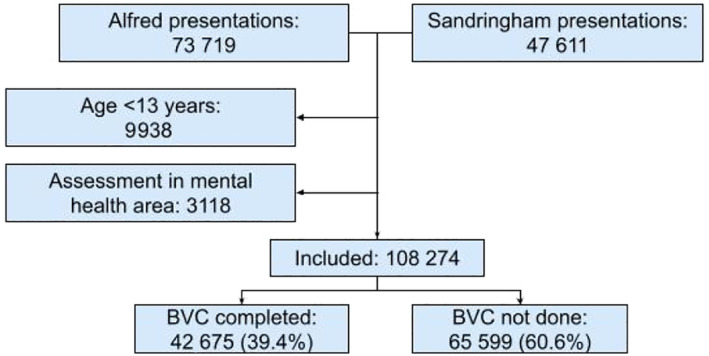
Inclusion of patients. BVC, Broset Violence Checklist.
TABLE 1.
Variables associated with the Broset Violence Checklist (BVC) completion
| BVC completed (n = 42 675) | BVC not completed (n = 65 599) | P | |
|---|---|---|---|
| Age (years) | |||
| 13–18 | 862 (2.0%) | 4507 (6.9%) | <0.001 |
| 19–35 | 10 284 (24.1%) | 21 491 (32.8%) | |
| 36–49 | 7171 (16.8%) | 12 336 (18.8%) | |
| 50–65 | 8672 (20.3%) | 12 519 (19.1%) | |
| >65 | 15 686 (36.8%) | 14 746 (22.5%) | |
| Gender | |||
| Female | 21 219 (49.7%) | 31 616 (48.2%) | <0.001 |
| Male | 21 394 (50.1%) | 33 892 (51.7%) | |
| Non‐binary | 62 (0.15%) | 91 (0.14%) | |
| After‐hours presentation | 18 244 (42.8%) | 23 679 (37.9%) | <0.001 |
| Pain | 22 968 (53.8%) | 19 707 (46.2%) | 0.11 |
| ATS category | |||
| 1 | 293 (0.7%) | 806 (1.3%) | <0.001 |
| 2 | 8439 (19.8%) | 5887 (9.4%) | |
| 3 | 22 499 (52.7%) | 18 553 (29.7%) | |
| 4 | 11 177 (26.2%) | 30 060 (48.1%) | |
| 5 | 261 (0.6%) | 7147 (11.4%) | |
| Presenting hospital | |||
| Alfred | 31 090 (72.8%) | 38 328 (58.4%) | <0.001 |
| Sandringham | 11 585 (27.1%) | 27 271 (41.6%) | |
ATS, Australasian Triage Scale.
Among patients who had a BVC completed, 4098 (9.6%) scored >1. The BVC was repeated in 13 092 (30.7%) patients. There were 464 (0.43%) presentations who had at least one unplanned alert to potential or actual violence event in the ED. The association of BVC score and unplanned alerts to potential or actual violence is illustrated in Figure 2, demonstrating higher frequency of unplanned alerts to potential or actual violence episodes with higher BVC scores. Among patients who scored 6 on the BVC, there were no unplanned alerts to potential or actual violence events. Using a cut‐off score of 3, BVC had a specificity of 99.2% (95% CI 99.1–99.2) and a sensitivity of 15.6% (95% CI 12.5–19.3).
Figure 2.

Broset Violence Checklist (BVC) scores and unplanned alert to potential or actual violence.
In the overall population, variables associated with unplanned alerts to potential or actual violence events are listed in Table 2. Completion of the BVC was independently associated with unplanned alerts to potential or actual violence events. Other variables associated with unplanned alerts to potential or actual violence events were being male or of non‐binary gender, an after‐hours presentation, a presenting complaint that did not include pain, being triaged to higher triage categories and presenting to The Alfred Hospital.
TABLE 2.
Variables associated with unplanned alerts to potential or actual violence events in the ED
| Variable | Univariable association, OR (95% CI) | Adjusted association, OR (95% CI) |
|---|---|---|
| BVC completion† | 2.30 (2.00–2.65) | 1.37 (1.12–1.66) |
| Age (years) | ||
| 13–18 | Ref | Ref |
| 19–35 | 2.73 (1.39–5.36) | 1.28 (0.65–2.52) |
| 36–49 | 3.99 (2.03–7.86) | 1.89 (0.96–3.74) |
| 50–65 | 2.06 (1.03–4.11) | 0.91 (0.45–1.82) |
| >65 | 2.10 (1.06–4.15) | 0.72 (0.36–1.44) |
| Gender† | ||
| Female | Ref | Ref |
| Male | 1.57 (1.30–1.90) | 1.38 (1.14–1.68) |
| Non‐binary | 6.04 (1.91–19.11) | 4.34 (1.35–13.98) |
| After‐hours presentation† | 1.74 (1.45–1.10) | 1.41 (1.17–1.70) |
| Pain | 0.36 (0.30–0.44) | 0.37 (0.30–0.45) |
| ATS category† | ||
| 1 | Ref | Ref |
| 2 | 0.49 (0.30–0.78) | 0.85 (0.52–1.38) |
| 3 | 0.26 (0.17–0.42) | 0.52 (0.32–0.83) |
| 4 | 0.12 (0.08–0.20) | 0.33 (0.20–0.53) |
| 5 | 0.07 (0.03–0.14) | 0.16 (0.07–0.37) |
| Presenting hospital† | ||
| Alfred | 9.11 (6.18–13.44) | 5.99 (4.03–8.91) |
| Sandringham | Ref | Ref |
Variables demonstrating statistically significant associations after adjustment.
ATS, Australasian Triage Scale; BVC, Broset Violence Checklist; CI, confidence interval; OR, odds ratio.
Discussion
Despite substantial research and quality improvement efforts, prevention of occupational violence and aggression in healthcare, and particularly within EDs, remains difficult. Our findings confirm that the BVC has high specificity for detecting violence or aggression, and is consistent with previous reports. 12 A low sensitivity, however, limits the utility of BVC scores, particularly in centres with relatively high volumes of potentially violent patients.
This pragmatic observation of non‐mandatory introduction of BVC within a large emergency care system suggests that assigning risk scores was not associated with reduction of unplanned alerts to potential or actual violence events. On the contrary, an increase in unplanned alerts to potential or actual violence events was observed. The most likely explanation for this finding is clinician intuition, where clinicians completed the BVC on patients more likely to exhibit violence or aggression. It is well recognised that situational awareness is a key variable to predicting violence, but cannot be easily predicted through or correlated to risk scores. 16
Therefore, our findings suggest experienced clinicians may identify violence and aggression traits without the need for formal scoring. Early warning scores are being increasingly mandated in clinical practice in an effort to quantify risk. However, it has been observed that many early warning scores in clinical use have methodological weaknesses and could even have a detrimental effect on patient care, and require stakeholder engagement for successful implementation. 17 , 18 , 19 Despite intensive education, the overall uptake of Broset scoring by triage nurses was less than 40%. The acceptability of a further risk score to complete within the triage period by busy clinical staff requires further thought. Combined with the observed low sensitivity of the BVC, our results question the utility of routine use of the BVC in EDs.
Higher level of evidence for disinvestment from clinical risk scores for occupational violence could be confirmed through clustered randomised controlled trials. A priority for future research therefore appears to be the economic impact of disinvestment from risk scores in favour of clinical reasoning to plan and implement patient‐centred strategies for preventing violence and aggression. The key concepts of providing non‐pharmacological comfort measures, addressing concerns and graded restraints are proven strategies for managing potentially agitated patients, but implemented variably. 13 , 20 , 21 The varied factors associated with occupational violence and aggression also demand that combinations of strategies are used and tailored to individual circumstances. 22
The challenges of associating individual variables to occupational violence are further highlighted by this dataset. We used the variables of hospital designation, age, sex, triage categories and pain as presenting complaints to adjust for potential confounders for the association of BVC and violent episodes. However, these are surrogate markers for the underlying root cause and by themselves, do not provide insight into the causative factors of occupational violence and aggression. Uncontrolled pain has been previously associated with occupational violence. 23 However, in our study, the absence of pain as a presenting complaint was associated with potential or actual violence. A possible explanation for this finding is that a higher proportion of patients who presented without pain had mental health or behavioural issues that predisposed to violent behaviours but were not identified as their presenting complaints. Similarly, we observed that those presenting after‐hours and those presenting to the major referral hospital had unplanned alerts to potential or actual violence, that reflects the patient demographics rather than causative factors.
This retrospective assessment using routinely collected data has multiple limitations. It was confined to a single network, that serve different populations, but have similar staff and processes. The large sample size provides some protection against unmeasured confounders, but it remains possible that there were changes to occupational violence and aggression rates within the study period. As we only had access to hospital‐level administrative data and patient level data were not available, more granular analysis of presenting complaints was not possible. Additionally, the management of patients after identification of potential violence or aggression, with or without use of the BVC is an important intermediary step that would impact on unplanned alerts to potential or actual violence episodes. Objective analysis of such processes is required and presents opportunities to reduce violence and aggression within EDs.
Conclusions
The BVC performed with high specificity for occupational violence and aggression within the ED. Introduction of the tool appeared to be associated with the tool being completed preferentially for patients at higher risk of occupational violence or aggression. The role of early warning scores in the prevention of violence and aggression in the ED requires further study before widespread implementation.
Acknowledgements
The authors thank The Clinical Performance Unit and Security Services at Alfred Health for providing the data and Ms Cassandra Yankoff for assistance with data extraction. Open access publishing facilitated by Monash University, as part of the Wiley ‐ Monash University agreement via the Council of Australian University Librarians.
Competing interests
BM and PAC are section editors for Emergency Medicine Australasia and were excluded from the peer‐review process and all editorial decisions related to the acceptance and publication of this article.
Data availability statement
The data that support the findings of this study are available on request from the corresponding author. The data are not publicly available due to privacy or ethical restrictions.
References
- 1. Nikathil S, Olaussen A, Gocentas RA, Symons E, Mitra B. Review article: workplace violence in the emergency department: a systematic review and meta analysis. Emerg. Med. Aust. 2017; 29: 265–275. [DOI] [PubMed] [Google Scholar]
- 2. Parrish E. Violence against nurses: increased awareness. Perspect. Psychiatr. Care 2019; 55: 139. [DOI] [PubMed] [Google Scholar]
- 3. Allen J. Assessing and managing risk of violence in the mentally disordered. J. Psychiatr. Ment. Health Nurs. 1997; 4: 369–378. [DOI] [PubMed] [Google Scholar]
- 4. Dolan M, Doyle M. Violence risk prediction. Clinical and actuarial measures and the role of the psychopathy checklist. Br. J. Psychiatry 2000; 177: 303–311. [DOI] [PubMed] [Google Scholar]
- 5. Snowden RJ, Gray NS, Taylor J, MacCulloch MJ. Actuarial prediction of violent recidivism in mentally disordered offenders. Psychol. Med. 2007; 37: 1539–1549. [DOI] [PubMed] [Google Scholar]
- 6. Steinert T. Prediction of inpatient violence. Acta Psychiatr. Scand. Suppl. 2002; 106: 133–141. [DOI] [PubMed] [Google Scholar]
- 7. Palmstierna T, Wistedt B. Risk factors for aggressive behaviour are of limited value in predicting the violent behaviour of acute involuntarily admitted patients. Acta Psychiatr. Scand. 1990; 81: 152–155. [DOI] [PubMed] [Google Scholar]
- 8. Steadman HJ, Silver E, Monahan J et al. A classification tree approach to the development of actuarial violence risk assessment tools. Law Hum. Behav. 2000; 24: 83–100. [DOI] [PubMed] [Google Scholar]
- 9. Cabilan CJ, McRae J, Learmont B et al. Validity and reliability of the novel three‐item occupational violence patient risk assessment tool. J. Adv. Nurs. 2022; 78: 1176–1185. [DOI] [PMC free article] [PubMed] [Google Scholar]
- 10. Abderhalden C, Needham I, Dassen T, Halfens R, Haug HJ, Fischer J. Predicting inpatient violence using an extended version of the Broset‐Violence‐Checklist: instrument development and clinical application. BMC Psychiatry 2006; 6: 17. [DOI] [PMC free article] [PubMed] [Google Scholar]
- 11. Almvik R, Woods P. Short‐term risk prediction: the Broset Violence Checklist. J. Psychiatr. Ment. Health Nurs. 2003; 10: 236–238. [DOI] [PubMed] [Google Scholar]
- 12. Partridge B, Affleck J. Predicting aggressive patient behaviour in a hospital emergency department: an empirical study of security officers using the Brøset Violence Checklist. Australas. Emerg. Care 2018; 21: 31–35. [DOI] [PubMed] [Google Scholar]
- 13. Quinn JM, Koopman JM. Violence risk assessment in the emergency department. J. Emerg. Nurs. 2023; 49: 352–359.e1. [DOI] [PubMed] [Google Scholar]
- 14. Senz A, Ilarda E, Klim S, Kelly AM. Development, implementation and evaluation of a process to recognise and reduce aggression and violence in an Australian emergency department. Emerg. Med. Australas. 2021; 33: 665–671. [DOI] [PubMed] [Google Scholar]
- 15. Woods P, Almvik R. The Brøset violence checklist (BVC). Acta Psychiatr. Scand. Suppl. 2002; 412: 103–105. [DOI] [PubMed] [Google Scholar]
- 16. Ilarda E, McIlveen P, Tynan A, Senz A. Emergency department staff experiences of the Bröset Violence Checklist. J. Adv. Nurs. 2023; 80: 2027–2037. [DOI] [PubMed] [Google Scholar]
- 17. Gerry S, Bonnici T, Birks J et al. Early warning scores for detecting deterioration in adult hospital patients: systematic review and critical appraisal of methodology. BMJ 2020; 369: m1501. [DOI] [PMC free article] [PubMed] [Google Scholar]
- 18. Morris ME, Haines T, Hill AM et al. Divesting from a scored hospital fall risk assessment tool (FRAT): a cluster randomized non‐inferiority trial. J. Am. Geriatr. Soc. 2021; 69: 2598–2604. [DOI] [PMC free article] [PubMed] [Google Scholar]
- 19. Cabilan CJ, Johnston ANB, Eley R. Engaging with nurses to develop an occupational violence risk assessment tool for use in emergency departments: a participatory action research inquiry. Int. Emerg. Nurs. 2020; 52: 100856. [DOI] [PubMed] [Google Scholar]
- 20. Knott J, Gerdtz M, Dobson S et al. Restrictive interventions in Victorian emergency departments: a study of current clinical practice. Emerg. Med. Australas. 2020; 32: 393–400. [DOI] [PubMed] [Google Scholar]
- 21. Cabilan CJ, Meyer A, Elmore R, Nash T, Eley R, Tuckett A. Sensory devices for older adults with behavioral disturbance in the emergency department: a descriptive study. J. Gerontol. Nurs. 2021; 47: 22–27. [DOI] [PubMed] [Google Scholar]
- 22. Cabilan CJ, Eley R, Snoswell CL, Johnston ANB. What can we do about occupational violence in emergency departments? A survey of emergency staff. J. Nurs. Manag. 2022; 30: 1386–1395. [DOI] [PubMed] [Google Scholar]
- 23. Bruns D, Disorbio JM, Hanks R. Chronic nonmalignant pain and violent behavior. Curr. Pain Headache Rep. 2003; 7: 127–132. [DOI] [PubMed] [Google Scholar]
Associated Data
This section collects any data citations, data availability statements, or supplementary materials included in this article.
Data Availability Statement
The data that support the findings of this study are available on request from the corresponding author. The data are not publicly available due to privacy or ethical restrictions.