



Abstract
This study examines cost control challenges in prefabricated building construction, focusing on the design, production, transportation, and installation phases. A conceptual framework was developed through a literature review, and structural equation models were constructed using SPSS and AMOS based on data from Chinese prefabricated building firms. This study provides a holistic perspective on cost control in the prefabrication construction phase. The findings reveal that increased investment in design significantly reduces costs in subsequent phases, with design having the greatest impact on cost control. Production and installation have similar effects on overall costs, while transportation has the least impact. Key factors influencing cost management include prefabrication efficiency, IT proficiency, production scale, loading strategy, and installation complexity. By emphasizing the strategic role of design and production investments, this study delivers novel insights and practical recommendations for optimizing costs, offering decision-making support for improving cost efficiency in prefabricated buildings. These findings make a significant contribution to advancing research and industry practices in prefabricated building cost management.
Keywords: Prefabricated Building, Cost dynamics, Structural equation model, Impact mechanism
Subject terms: Engineering, Civil engineering
Introduction
As environmental sustainability becomes increasingly integral to architectural practices, green building has progressively been adopted in numerous projects. In the context of rapid urbanization, the surge in large-scale construction projects has significantly amplified building-related energy consumption, necessitating a shift in production methodologies to alter the current paradigm1. Prefabricated buildings not only conserve labor resources and diminish construction costs but also mitigate environmental pollution, aligning with the principles of sustainability and “low-carbon” design. Global prefabricated buildings market size reached USD 234.17 billion in 2023 and forecast to reach USD 331.36 billion by 2028, nevertheless, prior to reaching economies of scale, the construction costs associated with prefabricated methods substantially exceed those of traditional construction techniques2. Prefabricated building entails factory-based manufacturing which incurs expenses related to production line establishment, equipment acquisition, technical training, and workforce management. These preliminary investments are considerably higher than those of conventional construction approaches. Fabricating and assembling prefabricated components require specialized techniques and machinery, increasing production costs3. Additionally, the logistical aspects of transporting and installing these components during construction are costly, given their considerable size and weight. The installation phase also requires specialized construction crews and technical guidance, augmenting the overall installation expenses. Before reaching economies of scale, low production volumes of prefabricated buildings hinder standardization and industrialization4. This results in reduced manufacturing efficiency and increased resource wastage, thereby escalating construction costs.
The construction of a prefabricated edifice typically encompasses four pivotal stages: design, production, transportation, and installation5. These stages are closely connected, so cost control in one phase can directly or indirectly impact the others financially. Excessive cost-cutting in the design phase can compromise architectural integrity, material quality, or functionality, harming the efficiency and costs of production6. Using cheaper materials may increase machining complexity and time, lower component quality, and lead to higher rework and maintenance costs7. Moreover, decisions rendered during the design phase can significantly impact transportation costs. Overly complex or bulky components can increase logistics costs, including transport mode selection, route planning, and transit insurance. Furthermore, the design phase exerts considerable influence on the expenses associated with the installation phase. A design that overlooks site and installation specifics can increase challenges, reduce efficiency, and raise costs8. For example, poorly conceptualized component junctions may necessitate unforeseen adjustments and modifications during the installation process, prolonging the duration and escalating labor costs.
This study focuses on cost control during four key stages of prefabricated building construction: design, production, transportation, and installation. By narrowing the research focus, this study aims to investigate how cost management decisions in early stages, particularly in design and production, propagate through transportation and installation stages. This targeted approach avoids dilution of the findings and ensures that the study delivers practical insights directly applicable to the prefabricated construction process.
While previous studies have focused on cost management in isolated stages such as design or production, this study provides a comprehensive analysis of cost dynamics throughout the entire lifecycle of prefabrication. Most existing studies predominantly focus on isolated cost control strategies within single phases (e.g., design or production)9 or, to a lesser extent, multi-phase strategies, such as the interplay between production and installation costs10. However, limited attention has been paid to the holistic investigation of the dynamic cost interdependencies across all stages of prefabricated construction. Specifically, there is insufficient understanding of how early-phase cost control decisions propagate through subsequent phases, potentially generating compounding cost effects. Furthermore, while several studies have explored the benefits of standardization and modularization, there is a lack of in-depth exploration into how these strategies can be optimized across the entire lifecycle of prefabricated construction to maximize cost efficiency and minimize resource wastage. These gaps highlight the need for a more comprehensive and systemic approach to cost management within the prefabricated construction industry.
Thus, the enactment of cost control within any singular phase of a prefabricated building’s construction necessitates a holistic assessment of its potential repercussions on subsequent stages. Cost management in one stage can trigger a domino effect on other stages. Effective cost control and benefit maximization for prefabricated buildings require analyzing interdependencies and cost changes across all stages. A comprehensive cost analysis covering all stages of prefabrication remains largely unexplored. This study bridges this gap by proposing a systematic cost optimization framework—especially during the decision-making, design, and production stages—affect subsequent phases such as transportation and installation. This integrated approach seeks to bridge the identified research gaps by providing actionable insights into the transfer mechanisms of cost influences, ultimately contributing to a more robust framework for cost optimization in prefabricated building construction.
The research framework of this study is structured as follows: The first section introduces the background, motivation, and contributions of the study. The second section reviews relevant literature and develops a theoretical framework with five hypotheses related to cost control in prefabricated construction. The third section outlines the research design, including data collection, testing procedures, and model specification. The fourth section presents the data analysis results, focusing on reliability, validity, confirmatory factor analysis, and hypothesis testing. The fifth section discusses prefabricated construction cost control strategies based on the research findings. The sixth section summarizes the theoretical and practical implications of the study. The seventh section explores research limitations and future research directions. The final section provides a summary of the key findings.
Literature review and hypothesis development
Decision & design and production
The cost of the decision & design stage refers to expenses related to feasibility studies, architectural and engineering design, cost optimization planning, and stakeholder consultations to establish an efficient and cost-effective project framework. Yuan and Bai highlights that this stage serves as the cornerstone of prefabricated building projects, emphasizing the importance of labor, feasibility assessments, and technological advancements in achieving project goals11,12. The design team must work closely with production and construction units to ensure design feasibility, often requiring multiple revisions and increasing costs13. Moreover, during this initial phase, architects and structural engineers are tasked with meticulously specifying the dimensions, configurations, and materials of the prefabricated elements, in alignment with project mandates and regulatory standards14. These critical design specifics invariably influence the configuration of the factory’s production line, the selection of machinery, and the procedural workflow. Existing research emphasizes that impractical or flawed designs can lead to significant resource wastage and reduced operational efficiency15, thereby underlining the necessity of rigorous evaluation during the design phase. The design stage must assess production feasibility and efficiency to ensure a smooth transition from concept to product. The following hypothesis is proposed:
H1: More investment in decision and design cost can better control production cost.
Decision & design and transportation
The conveyance of prefabricated components significantly deviates from the transportation norms associated with conventional goods16. Owing to their substantial size and weight, the transportation process mandates the utilization of specialized loading apparatuses, vehicular transport, and meticulously planned routes17. This may require permits, experienced drivers, and advanced loading machinery. Transportation costs in prefabricated projects, as outlined in the literature, are influenced by logistics such as packaging, loading, and specialized equipment, and often constitute a significant portion of project budgets18. To mitigate the risk of damage en route, the components must be adequately packaged and safeguarded, an element that also contributes to the cumulative transportation costs19. Scholars have noted the critical role of the design phase in influencing transportation costs, particularly through decisions on component dimensions, mass, and transportability20,21. Concurrently, designers must engage in close collaboration with the transportation team to ensure the design proposals are congruent with transportation capabilities, thereby minimizing the risks and expenses associated with transit22. The following hypothesis is proposed:
H2: More investment in decision and design cost can better control transportation cost.
Decision & design and installation
The Installation stage cost covers expenses for labor, on-site equipment, temporary supports, alignment adjustments, and safety measures required to accurately assemble and install prefabricated components, research emphasizes that the installation process requires high precision and specialized skills to ensure safety and structural stability23. Expenses for this phase include site preparation, equipment rental, labor, safety oversight, and necessary onsite adjustments24. The construction cadre must possess particular competencies and experience to guarantee a seamless and secure assembly procedure. Given that prefabricated buildings are erected at a more rapid pace compared to traditional edifices, the imperatives of construction oversight and synchronisation are accentuated to forestall delays and supplementary expenses25. The deployment of prefabricated elements must adhere to a prescribed sequence and technique to assure the structural stability and security26. Luo and Xiao underscore that the design phase must ensure compatibility with installation conditions, taking into account safety, site-specific challenges, and topographic or climatic factors27,28. The following hypothesis is proposed:
H3: More investment in decision and design cost can better control installation cost.
Production and transportation
The production stage cost encompasses expenditures for raw materials, labor, machinery, energy consumption, and quality control during the standardized manufacturing of prefabricated components, production processes in prefabrication are highly reliant on automation, precision, and innovative technologies, which influence downstream phases like transportation29. The costs associated with production encompass not merely the expenditure on raw materials but also the creation of molds, depreciation of equipment, energy utilization, quality assurance, and labor compensation30. For unique projects, customized production lines or specialized materials may be needed, significantly increasing costs31. A high-caliber manufacturing process further demands ongoing investment in technology and innovation to enhance efficiency and minimize wastage32. Zhang highlights that decisions on component dimensions, mass, and volume during production significantly affect transportation costs and logistics33. The dimensions and mass of these elements inherently dictate the selection of transport mechanisms and the orchestration of logistical routes. Concurrently, the quantity of components influences the number and regularity of transport iterations, which, in turn, impacts the overall transportation efficiency and expenditure34. The following hypothesis is proposed:
H4: More investment in production cost can better control transportation cost.
Production and installation
The influence of the production phase on the installation phase is predominantly manifested in the quality and precision of the components35. Scholars have observed that higher-quality manufacturing processes contribute to reduced rework and improved safety during installation36. Quality defects or inaccuracies in components can lead to installation issues, such as adjustment difficulties and weak connections, affecting the building’s safety and stability37. Furthermore, the production stage can facilitate cost reductions in both the transportation and installation phases through the optimization of manufacturing processes and technological innovations38. For instance, advanced packaging methods and comprehensive installation guides have been shown to streamline both transportation and assembly processes39,40. Consequently, the following hypotheses are posited:
H5: More investment in production cost can better control installation cost.
The theoretical framework of this study is established as shown in Fig. 1.
Fig. 1.

Research hypothesis framework.
Research design
Measurement
The correlation structure and its measurement items are shown in Table 1. The decision design phase contained 3 items, the production phase contained 4 items, the transportation phase contained 3 items, and the installation phase contained 4 items. All variables were measured on a 5-point Likert scale, with 1 representing strong disagreement and 5 representing strong agreement. The measurement items for each phase were selected based on theoretical frameworks in cost management and prior empirical studies in prefabrication (in Table 1). For example, the decision design phase indicators reflect the early-stage factors that significantly influence cost outcomes, while the production phase focuses on factors such as standardization and technology, which are critical for production efficiency. Additionally, the selection process involved a comprehensive review of industry reports and expert consultations to ensure practical relevance. These items comprehensively address the theoretical and practical aspects of cost management in prefabricated building projects, providing a robust basis for model development.
Table 1.
Facets measurements.
| Facet | Number | Item | Sources |
|---|---|---|---|
| Decision& Design Cost | DC1 | Designer level | 10,13,25 |
| DC2 | Precast scheme and prefabrication rate | ||
| DC3 | Information technology level | ||
| Production Cost | PC1 | Component standardization degree | 11,23,33,27 |
| PC2 | Production scale | ||
| PC3 | Production worker skills | ||
| PC4 | Advanced technology and equipment | ||
|
Transportation Cost |
TC1 | Loading scheme | 18,30,31 |
| TC2 | Transportation program | ||
| TC3 | Distance between project location and component origin | ||
|
Installation Cost |
IC1 | Site plan layout | 23,28,25 |
| IC2 | Site management level | ||
| IC3 | Installation technology | ||
| IC4 | Workers’ technical level |
Research sample
Between October 15, 2022, and January 8, 2023, we conducted a series of carefully structured surveys to compile a comprehensive dataset relevant to our research. During the preliminary phase, we communicated the study’s objectives, methodologies, and data collection timeline to senior executives from 25 large prefabricated construction companies, emphasizing confidentiality and voluntary participation. To ensure a representative sample, we employed a multi-stage sampling method. First, we selected organizations that met specific criteria, including substantial experience in prefabricated construction, involvement in large-scale projects, and a structured project management system. Within these organizations, participants were chosen based on predefined eligibility criteria, targeting prefabricated project managers and prefabrication technology supervisors due to their key roles in decision-making and project execution. To minimize selection bias, respondents were randomly selected from the nominated individuals, ensuring a diverse and representative sample. Throughout the data collection process, we implemented specific milestones to monitor survey progress, regularly analyzed response trends to identify potential biases, and sent timely reminders to participants who had not yet submitted responses. This systematic approach ensured the efficiency, completeness, and reliability of our dataset.
In order to analyze the cost and control measures of prefabricated buildings, this study distributed 402 questionnaires, the recipients of which were mainly design, construction, production, scientific research and related staff in the field of prefabricated buildings in China, and 378 were returned. The recovered questionnaires were processed to remove the questionnaires with incomplete information and irregular answers, and there were 334 valid questionnaires, and the proportion of valid questionnaires was 83.08%. Of these, 83 were recovered from construction organizations; 61 from consulting organizations; 41 from prefabricated component factories; 60 from research institutes; 44 from owner organizations; and 45 from design organizations. The descriptive statistics of the sample are shown in the Table 2.
Table 2.
Sample descriptive statistics.
| Category | Quantity | Frequency % | |
|---|---|---|---|
| Gender | Male | 249 | 74.6 |
| Female | 85 | 25.4 | |
| Work Unit | Construction unit | 83 | 24.9 |
| Engineering consultation unit | 61 | 18.3 | |
| Prefabricated component factory | 41 | 12.3 | |
| Research institute | 60 | 18 | |
| Owner | 44 | 13.2 | |
| Design unit | 45 | 13.5 | |
| Working experience | > 10 years | 119 | 35.6 |
| 5–10 years | 163 | 48.8 | |
| 3–5 years | 30 | 9 | |
| < 3 years | 22 | 6.6 | |
| Professional title | Senior engineer | 112 | 33.5 |
| Intermediate engineer | 189 | 56.6 | |
| Junior engineer | 33 | 9.9 | |
Data analysis and results
Reliability and validity test
To address missing or incomplete responses in the questionnaire data, we adopted a systematic approach to ensure the integrity and reliability of the analysis. First, data were screened for patterns and extent of missingness, distinguishing between random and systematic missing data. For cases with minimal missing values (< 5%), mean imputation or the expectation-maximization (EM) algorithm was applied, depending on the data’s distribution and the nature of the missingness. For cases with substantial missing values, listwise deletion was considered to avoid biasing the results. All decisions regarding handling missing data adhered to established statistical guidelines and were informed by the study’s theoretical framework to minimize potential distortions in the findings.
The reliability of the questionnaire was examined using Cronbach’s alpha coefficient, which ranges from (0, 1), with values close to 1 indicating that the questionnaire is very reliable in terms of reliability, and close to 0 indicating that there is a problem with the reliability of the questionnaire and the questionnaire questions need to be adjusted41. The specific range of reliability values is shown in Table 3. The reliability data of the questionnaire was examined using SPSS version 25 software.
Table 3.
Scale Cronbach alpha value.
| Latent variable | Observed variable | Cronbach’s α | Reliability | |
|---|---|---|---|---|
| Decision & Design Cost | DC1 | 0.877 | 0.842 | Reliable |
| DC2 | 0.735 | |||
| DC3 | 0.704 | |||
| Production Cost | PC1 | 0.89 | 0.922 | Very reliable |
| PC2 | 0.881 | |||
| PC3 | 0.898 | |||
| PC4 | 0.925 | |||
| Transportation Cost | TC1 | 0.668 | 0.831 | Reliable |
| TC2 | 0.758 | |||
| TC3 | 0.850 | |||
| Installation Cost | IC1 | 0.795 | 0.838 | Reliable |
| IC2 | 0.831 | |||
| IC3 | 0.746 | |||
| IC4 | 0.811 | |||
Composite reliability (CR) is used to measure measurement variables reliability combination, reflecting consistency between indicators, the larger value represents the better consistency, 0.7 is the lowest indicator42, average variance extracted (AVE) is used to calculate explanatory power of potential variable variance, if AVE higher, it means construct has a higher reliability and convergent validity level, in principle, its standard value should be greater than 0.543, 0.36–0.5 is the acceptable values range44. As shown in Table 4, CR ranged from 0.839 to 0.925, which is greater than the criterion of 0.7, AVE ranged from 0.574 to 0.756, each measurement question item’s factor loading ranged from 0.576 to 0.951, satisfies requirement of greater than 0.5, the measurement model has high explanatory power.
Table 4.
Reliability and convergent validity of measurement model.
| Latent variable | Observed variable | UNSTD | S.E. | T-Value | P | STD | CR | AVE |
|---|---|---|---|---|---|---|---|---|
|
Decision & Design Cost |
DC1 | 1.000 | - | - | - | 0.640 | 0.850 | 0.659 |
| DC2 | 1.503 | 0.121 | 12.394 | *** | 0.855 | |||
| DC3 | 1.615 | 0.133 | 12.181 | *** | 0.914 | |||
|
Production Cost |
PC1 | 1.000 | - | - | - | 0.918 | 0.925 | 0.756 |
| PC2 | 1.088 | 0.043 | 25.242 | *** | 0.894 | |||
| PC3 | 1.036 | 0.042 | 24.819 | *** | 0.887 | |||
| PC4 | 0.985 | 0.053 | 18.555 | *** | 0.772 | |||
|
Transportation Cost |
TC1 | 1.000 | - | - | - | 0.951 | 0.840 | 0.643 |
| TC2 | 0.797 | 0.059 | 13.542 | *** | 0.778 | |||
| TC3 | 0.605 | 0.052 | 11.605 | *** | 0.647 | |||
|
Installation Cost |
IC1 | 1.000 | - | - | - | 0.835 | 0.839 | 0.574 |
| IC2 | 0.624 | 0.057 | 10.938 | *** | 0.576 | |||
| IC3 | 1.049 | 0.060 | 17.469 | *** | 0.926 | |||
| IC4 | 0.555 | 0.045 | 12.456 | *** | 0.641 |
The matrix of Pearson correlation coefficients for each facet is shown in Table 5, with the diagonal numbers is AVE square root for corresponding facet and off-diagonal numbers is Pearson correlation coefficient. The values on horizontal and vertical lines are greater than Pearson correlation coefficients, there is good discriminant validity between the facets in this study.
Table 5.
Latent variables’ discriminant validity.
| Latent variable | Installation Cost | Transportation Cost | Production Cost | Decision & Design Cost |
|---|---|---|---|---|
| Installation Cost | 0.758 | - | - | - |
| Transportation Cost | 0.409 | 0.802 | - | - |
| Production Cost | 0.630 | 0.468 | 0.869 | - |
| Decision & Design Cost | 0.500 | 0.630 | 0.603 | 0.812 |
Structural equation modeling analysis
Structural equation modeling (SEM) was selected for this study because it offers distinct advantages over traditional statistical methods such as regression analysis and analysis of variance (ANOVA). Unlike regression, which primarily assesses direct relationships between variables, SEM enables the simultaneous estimation of complex interdependencies, including both direct and indirect effects, making it particularly suitable for examining mediation and moderation mechanisms within theoretical frameworks. Moreover, SEM integrates measurement and structural models, thereby accounting for measurement errors and enhancing the accuracy of parameter estimates—an advantage not typically provided by standard regression techniques. Compared to ANOVA, which focuses on group differences rather than relational structures, SEM allows for the analysis of latent constructs and hierarchical data structures, ensuring a more nuanced and comprehensive understanding of the underlying relationships. These capabilities make SEM an optimal choice for studies involving intricate, multidimensional constructs that require rigorous model validation and theoretical testing45.
Build and modify first-order model
In this study, we use maximum likelihood estimation method and iterative method to fit first-order model, and plot structural equation model in AMOS. In order to ensure research model quality, we need to test the model and remove the roadmap between observables and latent variables in measurement model and structural model whose path coefficients do not meet the requirements. The test standard is shown in Table 6. The preliminary model path coefficients before modification are shown in Fig. 2.
Table 6.
Path coefficients standard and model description.
| Latent variable vs. Latent variable | |
|---|---|
| Path coefficient | Model description |
| < 0.2 | Influence relationships between latent variables are small and can be disregarded. |
| 0.2–0.4 | The effects between latent variables are general and need to be considered. |
| 0.4–0.6 | The influence between latent variables is relatively large and needs to be considered. |
| 0.6-1.0 | The effects between latent variables are significant and must be considered. |
| Latent variable vs. Observed variable | |
| Path coefficient | Model description |
| < 0.6 | Observed indicators do not explain latent variables well, low confidence, deleted. |
| 0.6–0.7 | Observed indicators explain latent variables better, high confidence, need consider. |
| 0.7–0.8 | Observed indicators explain latent variables well, high confidence, need consider. |
| 0.8-1.0 | Observed indicators explain latent variables well, very high confidence, must consider. |
Fig. 2.

First-order confirmatory factor analysis model.
The standardized model was validated and analyzed using Amos 24.0 software. Result shows, x2/df = 4.925, GFI = 0.863, AGFI = 0.8, TLI = 0.887, IFI = 0.911, CFI = 0.911, RMSEA = 0.109. As shown in Table 6, these values indicate model does not meet estimation test requirements46, therefore, the model needs corrected to meet appropriate evaluation criteria.
In the research, the model undergoes refinement with the primary objective of diminishing the chi-square statistic through the conversion of constrained parameters within the model to unconstrained parameters, thereby enhancing the model’s fit. The focal parameters of the model, namely covariance, variance, and path coefficients, serve as the basis for this refinement process.
Within the scope of this analytical structure, the interconnections among e11 and e13, e8 and e14, e8 and e9, e7 and e9, e3 and e16, as well as e2 and e13 have been precisely identified. The establishment of these linkages is in strict accordance with the principles underlying structural equation modeling theory and is consistent with the empirical evidence obtained from the thematic investigation, thereby rendering them as rational correlations. Moreover, the aggregate fit indices derived from these correlations are in compliance with the established benchmarks, as systematically presented in Table 7. The modified model is shown in Fig. 3.
Table 7.
Model revision indicators.
| Variable 1 | Variable 2 | M.I. | Par Change |
|---|---|---|---|
| e14 | Decision & Design Cost | 10.805 | 0.023 |
| e14 | e17 | 6.251 | -0.009 |
| e13 | Decision & Design Cost | 11.590 | 0.034 |
| e13 | e16 | 6.876 | -0.016 |
| e12 | e13 | 9.878 | -0.014 |
| e11 | e13 | 34.861 | 0.026 |
| e11 | e12 | 5.573 | -0.007 |
| e10 | e15 | 5.350 | -0.013 |
| e10 | e14 | 4.404 | 0.005 |
| e10 | e13 | 16.472 | -0.015 |
| e10 | e12 | 16.130 | 0.010 |
| e9 | e14 | 13.442 | -0.012 |
| e8 | Decision & Design Cost | 4.890 | 0.020 |
| e8 | e17 | 4.646 | -0.010 |
| e8 | e14 | 64.145 | 0.030 |
| e8 | e9 | 34.567 | -0.025 |
| e7 | Decision & Design Cost | 15.376 | -0.028 |
| e7 | e17 | 7.376 | 0.009 |
| e7 | e14 | 7.233 | -0.008 |
| e7 | e9 | 21.917 | 0.014 |
| e6 | e14 | 8.084 | -0.016 |
| e5 | e13 | 4.886 | -0.017 |
| e4 | e10 | 5.300 | -0.010 |
| e3 | e16 | 22.322 | 0.036 |
| e3 | e13 | 7.749 | -0.021 |
| e3 | e10 | 12.055 | 0.016 |
| e3 | e9 | 8.454 | -0.017 |
| e3 | e8 | 5.826 | 0.016 |
| e3 | e4 | 6.289 | -0.022 |
| e2 | e13 | 25.418 | 0.032 |
| e2 | e10 | 15.136 | -0.016 |
| e2 | e6 | 4.075 | 0.017 |
| e1 | e14 | 17.635 | 0.018 |
| e1 | e7 | 13.888 | -0.016 |
Fig. 3.

Modified first-order confirmatory factor analysis model.
The results showed that the 95% CIs for standardized path coefficients ranged from [0.21, 0.56], confirming the robustness of our findings. The use of CIs allowed for an assessment of estimation precision, ensuring that the observed effects were unlikely to be driven by random variation.
To validate the stability of the SEM results, a bootstrapping analysis with 5,000 resamples was conducted, generating bias-corrected CIs for all path estimates. The results remained consistent across resampling iterations, with limited variation in path estimates. The bootstrapped standard errors for all paths ranged from 0.07 to 0.34, further reinforcing the stability of the model. These results suggest that our SEM estimates are not overly sensitive to sample-specific characteristics, thus enhancing the generalizability of the findings.
The modified overall model fitness is shown: x2/df=2.07, RMSEA=0.057, GFI=0.946, AGFI=0.914, TLI=0.969, IFI=0.978, CFI=0.978, each model fitness meets requirements. These modifications were guided by both statistical criteria and theoretical considerations, ensuring that model adjustments improved explanatory power while maintaining the integrity of the research framework.
The statistical results of the parameter estimate of the latent variables are shown in Table 8, where the standardized parameter estimates of the latent variables remained between 0.141 and 0.561, with a significance level of P < 0.05, which indicates that the assumptions made previously are fully valid and that there is a correlation between the variables. The cost impact factors and significance levels across the four stages of prefabricated construction are detailed in Fig. 4.
Table 8.
Parameter Estimation of latent variables.
| Latent variable | Standardized parameter estimate | standard error | critical ratio | P | Hypothesis is valid or not |
|---|---|---|---|---|---|
| Production Cost ← Decision & Design Cost | 0.561 | 0.042 | 10.086 | < 0.001 | H1 valid |
| Transportation Cost ← Decision & Design Cost | 0.549 | 0.074 | 8.162 | < 0.001 | H2 valid |
| Installation Cost ← Decision & Design Cost | 0.271 | 0.035 | 4.077 | < 0.001 | H3 valid |
| Installation Cost ← Production Cost | 0.553 | 0.049 | 7.748 | < 0.001 | H4 valid |
| Transportation Cost ← Production Cost | 0.141 | 0.091 | 2.251 | < 0.05 | H5 valid |
Fig. 4.
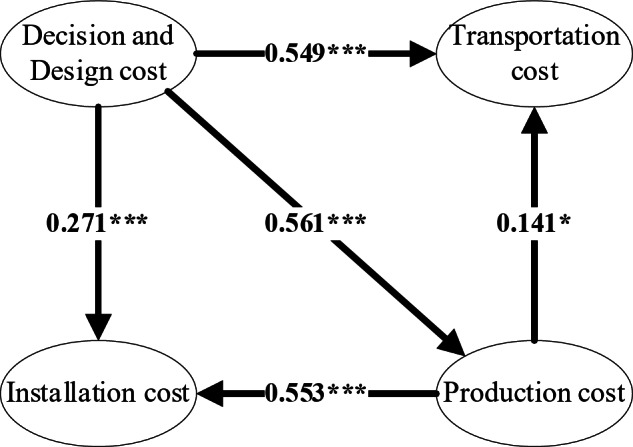
Cost impact factors at different prefabrication stages.
Second-order model creation
The examination of the data presented above indicates that the first-order model aligns closely with the utilized reference data, displaying a significant correlation among the four critical variables. This document utilizes the cost associated with the assembly project as a second-order latent variable, integrating elements such as decision-making in component design, production, installation, and transportation as external variables. These interconnections are further analyzed and incorporated into the model’s operational framework. The correlation model, illustrated in Fig. 5, where the standardized parameter estimates of the latent variables remained between 0.67 and 0.81, with a significance level of P < 0.05, complies with the requisite data reference standards. This effectively confirms the superior overall adequacy of the second-order validation analysis model.
Fig. 5.

Modified second-order model of prefabricated component cost.
The modified overall model fitness is shown: x2/df = 2.824, RMSEA = 0.074, GFI = 0.925, AGFI = 0.903, TLI = 0.948, IFI = 0.961, CFI = 0.961, each model fitness meets requirements. The prefabricated building cost influencing factors model developed in this research exhibits commendable suitability, demonstrating that the model is broadly more scientific and rational.
Discussion
This study reveals that the cost control of prefabricated construction is heavily influenced by the interdependent dynamics across its key phases: decision-making, design, production, transportation, and installation. Among these, the decision-making and design phases demonstrate a disproportionately significant impact, as early-stage decisions establish the parameters for cost management throughout the project lifecycle. Effective design strategies were found to optimize resource utilization, streamline production processes, and mitigate logistical complexities, while efficient production and transportation practices further reinforce these cost benefits. Ultimately, the findings underscore the necessity of a holistic, phased approach to cost control, where early-stage optimization is integrated with downstream efficiency measures to achieve comprehensive cost reduction and enhanced project outcomes.
This study extends existing theories of prefabricated building cost management by emphasizing the compounding cost effects across all phases of a project lifecycle, moving beyond traditional models that often focus on isolated phase-based cost reduction. Unlike prior frameworks that primarily emphasized individual phase efficiency (e.g., production standardization or transportation logistics), the proposed framework introduces a dynamic, interdependent cost management model. This model illustrates how decisions made during the decision and design phase propagate cost implications throughout the subsequent phases, amplifying both cost savings and potential overruns.
Impact of cost inputs at decision and design on cost control at production
Incorporating a greater array of cost considerations during the decision and design phases of prefabricated components augments cost efficiency during the production stage. Initially, Optimizing component design can reduce material usage and lower costs. The design team can leverage sophisticated modeling software to conduct simulations and assessments, pinpointing the most cost-effective dimensions and configurations of components to ensure optimal material utilization47. Unlike prior studies48 that primarily emphasized material savings, our findings reveal that early-stage design optimization not only reduces material volume but also minimizes structural reinforcement costs, ensuring a more balanced approach to cost and performance. While previous research49 focused on production efficiency, this study highlights an additional benefit: standardization significantly reduces the need for adaptive adjustments during production, lowering indirect costs associated with process deviations.
Factoring in the manufacturability of components during the design phase entails that designers consider the limitations and necessities of the manufacturing process in their designs. This foresight reduces production issues, minimizes material waste, and improves efficiency. For instance, accommodating the capabilities of factory machinery in the design can preempt the costs associated with fabricating components that are challenging to produce or necessitate specialized handling50. Allocating more resources to early design ensures accuracy, reducing the need for later modifications. Alterations during the production phase not only escalate direct costs but also induce production delays, impacting the overarching project timeline and financial outlay.
Impact of cost inputs at decision and design on cost control at transportation
Enhancing cost inputs during the decision-making and design phases of prefabricated components significantly benefits cost management in the transportation phase. Initially, transportation expenses can be markedly diminished by optimizing the dimensions and mass of prefabricated components at the design phase. Unlike prior research21 that primarily focused on avoiding oversized or overweight components, our findings indicate that optimized dimensions also enable greater compatibility with multimodal transportation systems, thereby broadening logistical flexibility and reducing total costs, including the use of particular vehicles, police escorts, or specific route authorizations, which could escalate transportation costs. Addressing these considerations during the design phase can mitigate or circumvent these supplementary expenses through strategic optimization51. Furthermore, the emphasis on modularization and standardization during the design phase not only facilitates production efficiency but also optimizes transportation. While earlier studies emphasized improved spatial utilization during transit52, this study reveals that standardized components also reduce the administrative and scheduling complexities associated with transportation planning, offering additional cost savings.
Additionally, crafting prefabricated components with their transportation and onsite assembly requirements in mind can diminish the necessity for adjustments upon arrival, thereby reducing transportation and onsite handling expenses. Designing components for ease of loading and unloading, for example, can shorten the duration transportation vehicles are detained, thus lowering the costs associated with onsite activities17. By considering potential transportation risks during the design phase, components can be engineered to be more durable or adequately protected, decreasing the probability of damage during transit. This approach directly lessens the financial burden associated with repairing or replacing damaged components. Lastly, meticulous planning in the design stage can identify the most effective logistics strategy beforehand, including the sequence of loading, transportation routes, and methods53. Proactive planning helps avoid costs arising from last-minute adjustments and ensures the cost-effectiveness of the transportation process. This research contributes to theoretical advancements by illustrating how transportation cost efficiencies are not isolated but are inherently linked to early-phase design decisions, providing a more integrated perspective on prefabrication cost control frameworks.
Impact of cost inputs at decision and design on cost control at installation
Allocating substantial financial resources to the decision-making and design stages of prefabricated components significantly enhances cost efficiency during the construction and installation phases. Primarily, meticulously engineered prefabricated components guarantee elevated precision and quality levels, substantially reducing the necessity for onsite adjustments and corrections throughout the construction and installation phases. While previous studies have largely emphasized dimensional accuracy54, our findings reveal that enhanced interface design at this stage also minimizes time-consuming alignment processes during installation, further reducing indirect labor costs.
Additionally, the construction timeline can be refined and expedited through anticipatory planning and simulation of the construction process during the design phase. Shortening construction time reduces labor, administrative, and ancillary costs like leasing and maintenance31. Furthermore, the infusion of financial resources into the design phase facilitates the adoption of more advanced construction methodologies and techniques. For instance, by considering the assembly efficiency of components, the design can identify the most suitable connection modalities and construction practices for swift erection, thereby enhancing on-site efficiency and reducing expenditure55. Moreover, meticulous computations and optimizations during the design phase can guarantee material utilization efficiency and minimize waste. Precise material management in prefabrication reduces waste and minimizes onsite modifications9. Lastly, investing in the design phase enables the preemptive identification and mitigation of safety hazards likely to be encountered during construction. Producing prefabricated components in controlled factory settings lowers the risk associated with on-site activities56. Additionally, incorporating safety considerations into the design minimizes the likelihood of accidents, thereby averting related costs and delays.
Impact of cost inputs at production on cost control at transportation
Increasing investment in prefabrication improves cost efficiency in transportation. Initially, heightened investment in the production stage often correlates with the fabrication of superior quality components, employing more refined materials and sophisticated manufacturing techniques. Such high-caliber components exhibit enhanced durability and are less susceptible to damage during transit, thereby diminishing the expenses associated with repairs or replacements and potentially reducing transportation insurance costs. Furthermore, by channeling more resources into material science research and engineering design, prefabricated components that are simultaneously lightweight and robust can be developed57. Lighter components reduce fuel consumption, while increased strength lowers damage risk, both contributing to reduced transportation costs. Moreover, substantial investment in the development of tailored packaging solutions during the production phase can offer superior protection for components in transit, diminishing damage risks. Additionally, innovative packaging designs can optimize loading efficiency and diminish the necessity for multiple shipments. Another significant benefit of increased investment is in the pre-assembly and modularization of components, which markedly enhances transportation efficiency.
Previous research highlighted modularization’s benefits for onsite installation58, however, this study reveals that modularization also streamlines the arrangement of loads within diverse transportation modes, further mitigating re-securing costs during transit. Investment in the production phase extends beyond tangible manufacturing, encompassing logistics and supply chain management advancements. Utilizing cutting-edge logistics software and technologies enables the optimization of transportation routes, loading strategies, and scheduling, reducing unnecessary shipments and vehicle idling, thereby curtailing costs. Strict quality control and manufacturing precision minimize the need for adjustments and modifications upon delivery, reducing onsite workload and eliminating extra transportation for rework. Lastly, increased financial outlays can also support the exploration and implementation of more sustainable manufacturing practices46. The adoption of recycled materials or greener production methodologies not only mitigates environmental impact but can also lower energy consumption during the production and subsequent transportation phases, indirectly easing transportation-related expenditures.
Impact of cost inputs at production on cost control at installation
Elevating financial commitments during the manufacturing phase of prefabricated components significantly enhance cost management in the installation phase. Initially, allocating additional resources to the production stage assures the dimensional precision and consistency in the quality of prefabricated elements. Earlier study emphasized overall dimensional accuracy59, this research highlights that enhanced joint compatibility at production further reduces misalignment issues during installation, leading to significant time and labor savings.
Furthermore, increased financial outlays facilitate a greater extent of pre-assembly and modular manufacturing, which translates to a substantial portion of assembly tasks being executed in the factory setting. Modules or systems that are pre-assembled can be directly installed upon their arrival at the construction site, markedly lessening the onsite labor intensity and the duration required, consequently lowering installation costs.
Thirdly, the utilization of superior production techniques and materials minimizes the likelihood of damage to components during their transit and installation. Damage to components necessitates repairs or replacements, which not only escalates costs but also potentially delays the project. Thus, mitigating the risk of damage can effectively streamline the cost-efficiency of the installation phase47.
Fourthly, further investment can be allocated towards the optimization of design, taking into account factors such as ease of construction and maintenance. Optimized designs can further alleviate costs by simplifying the installation procedure, minimizing the dependence on specialized tools or machinery, and reducing the demand for highly skilled labor.
Fifthly, incorporating design elements that facilitate rapid connection and assembly, achievable through increased investments at the production stage, renders the installation process more swift and efficient. Such rapidity in installation minimizes the labor and equipment leasing durations, thus curtailing costs55.
Lastly, a higher preliminary investment also enables more thorough project planning and coordination, ensuring that the installation of all prefabricated components is meticulously scheduled, which minimizes delays and the costs related to waiting or inaccuracies.
Prefabricated Building construction four phases cost analysis
Upon examining the coefficients of the potential variable structural pathway, it emerges that within the four facets of the prefabricated building costs, they rank from highest to lowest as follows: the decision and design phase (coefficient of 0.81), the component production phase (coefficient of 0.72), the installation phase (coefficient of 0.71), and the component transportation phase (coefficient of 0.67). This delineation signifies that the decision-making and design phase is paramount in cost control, meriting prioritization at the apex of the cost management hierarchy.
The decision and design stages exert paramount influence on the financial outlay of the entire project, as it is during these initial phases that the foundational framework and principal orientation of the project are established. While Nguyen13 highlighted material selection and methodology choices, this study emphasizes that early optimization of modular dimensions significantly reduces downstream reconfiguration costs in production and installation. These decisions are intrinsically linked to the ensuing production, construction, and transportation expenditures. This phase represents an opportune moment to mitigate elevated costs. Through meticulous and precise design, one can forestall future alterations that frequently culminate in significant financial increments.
Following in terms of cost implications is the production phase, where the efficiency of production, choice of materials, and waste management practices directly influence cost dynamics. Standardized and modular designs at this juncture facilitate economies of scale, thus diminishing per unit expenses. Furthermore, the technological sophistication and automation level within the production process markedly affect cost considerations. Highly automated manufacturing lines can diminish labor expenses and enhance productivity.
The financial implications of the construction and installation phase rank third. A cardinal advantage of prefabricated building lies in the abbreviated construction timeline, necessitating proficient site management and thorough preparatory work. Some scholar focused on design simplifications for on-site installation60, however, this study identifies that incorporating adjustable joint mechanisms during the design phase further accelerates assembly while maintaining structural integrity. Moreover, the efficiency of on-site construction is affected by laborer proficiency, meteorological conditions, and the caliber of site management, all contributing factors to the cost.
Although transportation expenses generally represent a minor fraction of total costs, they can become a significant cost factor in certain scenarios, especially over long distances or when specialized transportation equipment is required. Design considerations that account for the dimensions and weight of components can enhance transportation efficacy and mitigate costs. Additionally, transportation expenses can be somewhat reduced through the optimization of logistics and transportation strategies, including the selection of the most cost-effective modes of transport and routes61.
This hierarchical arrangement underscores the significance and impact of each phase on cost dynamics. The design phase lays the foundational cost framework for all subsequent phases; the production and construction phases embody the implementation process, whose efficiency and costs are directly influenced by the precedential design phase decisions; and while transportation costs are relatively modest, they necessitate meticulous management for optimization.
Cost control improvement measures
(1) Decision and Design Improvement: In the decision and design stage, proficiency in information technology (loading factor: 0.89), assembly strategy (loading factor: 0.85), and designer expertise (loading factor: 0.65) are critical cost-influencing factors. To achieve effective cost control, advanced information technology applications must be emphasized. Utilizing project management software and cloud-based platforms can facilitate real-time data sharing, improving coordination and adaptability. Optimizing assembly efficiency to align with cost benchmarks, alongside the strategic selection and refinement of assembly methods, is also vital. These measures significantly enhance early-stage cost management effectiveness.
(2) Production Improvement: In the production stage, large-scale production (loading factor: 0.93), component standardization (loading factor: 0.86), workforce proficiency (loading factor: 0.80), and equipment sophistication (loading factor: 0.73) are the primary influencing factors. Promoting large-scale standardized production, supported by policy-driven industrial ecosystems such as component industrial parks, is essential. Deploying automated and intelligent equipment can further streamline production efficiency. Additionally, detailed segmentation and planning of production workflows can minimize non-essential activities and improve unit productivity. Mechanized construction practices should also be adopted to reduce labor intensity, optimize tool usage, and enhance overall production performance.
(3) Transportation Improvement: In the transportation stage, loading strategies (loading factor: 0.90), transportation planning (loading factor: 0.80), and the proximity between the production site and the construction site (loading factor: 0.66) significantly influence costs. Optimizing loading strategies and transportation plans is crucial to reducing logistics expenses. Utilizing specialized transportation vehicles enhances efficiency and long-term cost-effectiveness. For transporting large prefabricated components, maritime transportation should be prioritized. By leveraging natural waterways, infrastructure costs and energy consumption can be significantly reduced. However, limitations due to natural conditions (e.g., geography, hydrology, and weather) must be thoroughly assessed, and detailed planning is required to ensure feasibility and efficiency.
(4) Installation Improvement: In the installation stage, the sophistication of installation techniques (loading factor: 0.91), site configuration (loading factor: 0.85), and workforce technical proficiency (loading factor: 0.64) are key factors. Improving installation techniques, particularly in the reinforcement and grouting of critical junctions, ensures safety and reliability. Pre-installation preparation, including detailed construction plan briefings, operational training, and workflow optimization, is essential to reduce rework, save time, and maintain quality. These measures effectively contribute to cost savings during the assembly process.
(5) Government Sector Improvement: Due to the distinct cost structures and resource consumption metrics of prefabricated buildings compared to traditional structures, government authorities must lead the development of standardized consumptive norms and pricing models. These frameworks should be based on comprehensive market analyses and actual project data. To address the early-stage issues of prefabricated building markets, such as price manipulation, government oversight must be intensified. Establishing benchmark prices and enforcing their implementation can prevent market disruptions. Additionally, policies to incentivize cost-efficient practices and technology adoption should be introduced to promote industry-wide standardization and efficiency.
The overview of cost improvement measures at each stage is presented in Table 9.
Table 9.
Cost improvement measures across stages.
| Stage | Key Factors | Recommendations |
|---|---|---|
| Decision & Design | IT proficiency, assembly strategy | Apply advanced IT tools, optimize assembly efficiency, and enhance real-time data sharing |
| Production | Large-scale production, component standardization | Promote standardized production, deploy automation, segment workflows, and improve labor productivity |
| Transportation | Loading strategy, transportation planning | Optimize loading and transport plans, use specialized vehicles, and adopt maritime transport |
| Installation | Installation sophistication, workforce skills | Refine installation techniques, improve critical junction connections, and enhance pre-installation workflows |
| Government Sector | Regulatory framework | Develop cost norms and pricing models, monitor markets, and incentivize cost-efficient practices |
Theoretical and practical implications
Theoretical implications
This study contributes to the growing body of knowledge in the field of prefabricated construction by systematically elucidating the dynamic interplay among the key stages of decision-making, design, production, transportation, and installation in cost management. By emphasizing the disproportionate influence of the decision-making and design stages on the overall lifecycle costs, the findings advance theoretical understanding of cost propagation mechanisms and the interdependencies across project phases. The research highlights the necessity of integrating cost control strategies early in the project lifecycle, thereby extending traditional cost management theories to emphasize upstream optimization. Moreover, by identifying specific pathways through which early-stage decisions influence subsequent stages, this study offers a robust framework for developing predictive models that can assess cost impacts across multiple phases. These insights pave the way for future research to incorporate emerging technologies, such as artificial intelligence and digital twins, into cost modeling, thereby deepening theoretical engagement with the systems-level optimization of prefabricated construction processes.
Practical and societal impacts
Practically, the findings of this study offer actionable guidance for industry practitioners seeking to optimize resource allocation and improve cost-efficiency in prefabricated construction projects. By prioritizing investment in decision-making and design stages, stakeholders can significantly reduce material waste, enhance production efficiency, and minimize logistical complexities, thereby improving overall project performance. Additionally, the research underscores the importance of adopting modularization and standardization practices to streamline production and simplify downstream operations, providing a roadmap for improving the scalability and sustainability of prefabricated construction.
For architects, this study highlights the need to integrate cost considerations into early design decisions by leveraging advanced modeling tools and simulation software. These tools enable architects to explore multiple design alternatives, optimize material use, and ensure compatibility with production and transportation constraints. Engineers can benefit from focusing on manufacturability during the design phase, ensuring that components are engineered for efficient production and seamless assembly. By collaborating closely with manufacturers, engineers can specify standard dimensions and connection modalities that simplify production processes and reduce the need for on-site adjustments. Additionally, engineers should prioritize pre-assembly techniques to enhance quality control and reduce installation complexity. For project managers, this study emphasizes the importance of fostering early-stage collaboration among stakeholders, including architects, engineers, manufacturers, and logistics planners. Project managers should implement integrated project delivery (IPD) methods or similar collaborative frameworks to ensure alignment across all phases. They should also invest in digital tools, such as Building Information Modeling (BIM), to coordinate schedules, optimize transportation logistics, and minimize rework. Additionally, project managers must advocate for strategic resource allocation, directing funds to the decision and design phase to mitigate cost overruns in later stages. Decision-makers should prioritize allocating resources to early-stage design activities, such as detailed simulations and material optimization, to preemptively address cost inefficiencies across subsequent phases. Additionally, during the production phase, investing in automation technologies and modular production lines can enhance scalability and reduce per-unit costs, ensuring resource allocation yields maximum efficiency and long-term benefits.
On a societal level, these findings contribute to addressing broader challenges in urbanization and resource management by promoting cost-effective and environmentally sustainable construction methods. The emphasis on early-stage optimization aligns with global efforts to enhance the affordability and accessibility of housing while minimizing environmental footprints. By demonstrating how strategic decisions can ripple through the construction lifecycle to achieve cost and efficiency gains, this research serves as a catalyst for industry-wide shifts toward more sustainable and economically viable building practices.
Conclusions and limitations
Conclusions
This study systematically investigates the cost dynamics across the four key phases of prefabricated building construction—decision and design, production, transportation, and installation—revealing the interconnected nature of cost control throughout the project lifecycle. The findings highlight that the decision and design phase is the most critical, as it exerts the highest influence on overall project costs. Early decisions regarding material selection, component dimensions, and standardization play a pivotal role in shaping downstream efficiencies, reducing material consumption, minimizing structural reinforcement costs, and setting a solid foundation for the subsequent phases. The production phase, with its emphasis on standardization, modularization, and advanced manufacturing technologies, further contributes to significant cost reductions by enhancing economies of scale and production efficiency while simplifying transportation and on-site installation processes. Although the transportation and installation phases exhibit relatively lower cost impact, their efficiency is directly linked to early design and production decisions, with optimized logistics strategies and pre-assembled components reducing transportation expenses and on-site labor requirements. This study underscores the intricate interdependencies among these phases, demonstrating how decisions in one phase can propagate through others, creating compounding cost effects. By adopting a holistic approach to cost management and prioritizing investments in the decision and design phase, practitioners can achieve substantial cost savings and project efficiencies. The findings provide actionable insights for optimizing resource allocation and fostering collaboration among designers, manufacturers, and logistics planners, offering a systematic framework for cost optimization in prefabricated construction. Furthermore, this study bridges the gap between theoretical cost control models and practical implementation, emphasizing the critical role of early-stage decision-making in shaping project outcomes. By highlighting the interdependence of all project phases, the research offers a roadmap for enhancing cost management strategies in prefabrication, while encouraging the exploration of innovative tools and techniques, such as digital twins and AI-driven cost modeling, to further elevate industry practices. These contributions address research gaps and lay the groundwork for future exploration into the application of emerging technologies, ultimately advancing both research and practice in construction management.
Limitations and future research directions
This study provides feasible insights into optimizing the cost-effectiveness of prefabricated buildings. However, the interplay between early design decisions and their long-term impact on cross-project operational costs remains worthy of further investigation, particularly in relation to unforeseen logistics and maintenance challenges. The research primarily focuses on the cost control relationships across four stages of prefabricated construction and identifies the key influencing factors within each stage. Future studies aim to employ quantitative data analysis to further elucidate the cost reduction coefficients triggered in other stages by cost interventions implemented in specific stages. While the current study scope is centered on China, future research plans include incorporating other countries to enhance comparative analysis. This study primarily integrates survey data, and future research plans to incorporate a larger and more diverse sample to ensure that the selected companies and participants more comprehensively represent the prefabrication construction industry.
Acknowledgements
This study confirms that informed consent has been obtained from all participants and has been approved by the Academic Ethics Committee of Weifang University of Science and Technology, where the corresponding author is affiliated. All procedures were conducted in accordance with applicable regulations and strictly adhered to the research principles involving questionnaire participants outlined in the Declaration of Helsinki.
Author contributions
Lin Liu: Methodology, Software, Writing - Original Draft, Visualization; Hsing-Wei Tai:Writing - Review & Editing, Formal analysis. Teng Wang: Visualization; Liang Qiao: Data analysis, Financial support; Kuo-Tai Cheng: Software.
Data availability
The datasets used and/or analysed during the current study available from the corresponding author on reasonable request.
Declarations
Competing interests
The authors declare no competing interests.
Footnotes
The original online version of this Article was revised: The original version of this Article contained an error in Affiliation 2, which was incorrectly given as ‘School of Architectural Engineering, 262700 Weifang, China’. The correct affiliation is: School of Architectural Engineering, Weifang University of Science and Technology, Weifang 262700, China.
Publisher’s note
Springer Nature remains neutral with regard to jurisdictional claims in published maps and institutional affiliations.
Change history
5/14/2025
A Correction to this paper has been published: 10.1038/s41598-025-00858-x
References
- 1.Jin, X., Zhang, C., Xiao, F., Li, A. & Miller, C. A review and reflection on open datasets of city-level Building energy use and their applications. Energy Build.285, 112911 (2023). [Google Scholar]
- 2.Wei, W., Lu, Y., Zhang, X., Wang, B. & Lin, Y. Fine-grained progress tracking of prefabricated construction based on component segmentation. Autom. Constr.160, 105329 (2024). [Google Scholar]
- 3.Ekanayake, E. M. A. C., Shen, G. Q. P. & Kumaraswamy, M. M. A fuzzy synthetic evaluation of capabilities for improving supply chain resilience of industrialised construction: a Hong Kong case study. Prod. Plan. Control. 34, 623–640 (2023). [Google Scholar]
- 4.Han, Y., Fang, X., Zhao, X. & Wang, L. Exploring the impact of incentive policy on the development of prefabricated buildings: a scenario-based system dynamics model. Eng. Constr. Archit. Manage.31, 4697–4725 (2024). [Google Scholar]
- 5.Jayawardana, J., Sandanayake, M., Jayasinghe, J. A. S. C., Kulatunga, A. K. & Zhang, G. A comparative life cycle assessment of prefabricated and traditional construction – A case of a developing country. J. Build. Eng.72, 106550 (2023). [Google Scholar]
- 7.Son, R. H. & Han, K. Automated model-based 3D scan planning for prefabricated Building components. J. Comput. Civ. Eng.37, 04022058 (2023).
- 7.Zaragoza-Benzal, A., Ferrández, D., Atanes-Sánchez, E. & Morón, C. New lightened plaster material with dissolved recycled expanded polystyrene and end-of-life tyres fibres for Building prefabricated industry. Case Stud. Constr. Mater.18, e02178 (2023). [Google Scholar]
- 8.Zhou, F., Ning, Y., Guo, X. & Guo, S. Analyze differences in carbon emissions from traditional and prefabricated buildings combining the life cycle. Buildings13, 874 (2023). [Google Scholar]
- 9.Liu, L., Tai, H. W., Cheng, K. T. & Wei, C. C. Consolidating Building greening: integrating mobile modular vertical greening systems into prefabricated Building. J. Build. Eng.98, 110983 (2024). [Google Scholar]
- 10.Chen, G. et al. Optimal procurement strategy for off-site prefabricated components considering construction schedule and cost. Autom. Constr.147, 104726 (2023). [Google Scholar]
- 11.Yuan, Z., Sun, C. & Wang, Y. Design for manufacture and Assembly-oriented parametric design of prefabricated buildings. Autom. Constr.88, 13–22 (2018). [Google Scholar]
- 13.Bai, S., Li, M., Song, L. & Kong, R. Developing a common library of prefabricated structure components through graphic media mapping to improve design efficiency. J. Constr. Eng. Manag147, 04020156 (2021).
- 13.Nguyen, P. & Shim Smart Struct. Syst.30, 35–47 (2022).
- 14.Wu, C., Lu, D., Ma, C., Hesham El Naggar, M. & Du, X. Structural design and seismic performance analysis of partially prefabricated subway station structure. Tunn. Undergr. Space Technol.140, 105264 (2023). [Google Scholar]
- 15.Lu, L., Ding, Y., Guo, Y., Hao, H. & Ding, S. Flexural performance and design method of the prefabricated RAC composite slab. Structures38, 572–584 (2022). [Google Scholar]
- 16.Shi, Q., Wu, Y., Shi, H. & Yu, S. Deployment method of prefabricated component transport vehicle. Soft Comput.25, 13641–13656 (2021). [Google Scholar]
- 17.Zou, C. et al. Optimal transportation scheduling of prefabricated components based on improved hybrid differential firefly algorithm. Math. Probl. Eng.2022, 1–16 (2022). [Google Scholar]
- 18.Almashaqbeh, M. & El-Rayes, K. Minimizing transportation cost of prefabricated modules in modular construction projects. Eng. Constr. Archit. Manage.29, 3847–3867 (2022). [Google Scholar]
- 19.Zhang, H. & Yu, L. Resilience-cost tradeoff supply chain planning for the prefabricated construction project. J. Civ. Eng. Manag. 27, 45–59 (2021). [Google Scholar]
- 20.Valinejadshoubi, M., Bagchi, A. & Moselhi, O. Damage detection for prefabricated Building modules during transportation. Autom. Constr.142, 104466 (2022). [Google Scholar]
- 21.Qi, R., Li, J. Q. & Liu, X. F. A knowledge-driven multiobjective optimization algorithm for the transportation of assembled prefabricated components with multi-frequency visits. Autom. Constr.152, 104944 (2023). [Google Scholar]
- 22.Wang, H., Liao, L., Yi, W. & Zhen, L. Transportation scheduling for modules used in modular integrated construction. Int. J. Prod. Res.62, 3918–3931 (2024). [Google Scholar]
- 24.Zhang, W., Zhang, H. & Yu, L. Collaborative planning for stacking and installation of prefabricated Building components regarding crane-collision avoidance. J. Constr. Eng. Manag149, 04023029 (2023).
- 24.Yan, X., Zhang, H. & Zhang, W. Intelligent monitoring and evaluation for the prefabricated construction schedule. Comput. -aided Civ. Infrastruct. Eng.38, 391–407 (2023). [Google Scholar]
- 25.Du, J., Li, X., Sugumaran, V., Hu, Y. & Xue, Y. Dynamic model averaging-based procurement optimization of prefabricated components. Neural Comput. Appl.35, 25157–25173 (2023). [Google Scholar]
- 26.Mohammed, A. A. et al. Design considerations for prefabricated composite jackets for structural repair: parametric investigation and case study. Compos. Struct.261, 113288 (2021). [Google Scholar]
- 27.Luo, Z., Guo, J., Han, J. & Wang, Y. Research on the construction safety risk assessment of prefabricated subway stations in China. Eng. Constr. Archit. Manage.31, 1751–1787 (2024). [Google Scholar]
- 29.Xiao, M. et al. Simulation of emergency evacuation from construction site of prefabricated buildings. Sci. Rep.12, 2732 (2022). [DOI] [PMC free article] [PubMed]
- 29.Chen, X. et al. Mixed production line optimization of industrialized building based on ant colony optimization algorithm. Adv. Civ. Eng. (2022). (2022).
- 30.Li, N. & Fan, Z. Impact evaluation of prefabricated buildings cost on game theory-cloud model. J. Math. (2022). (2022).
- 31.Zeng, L. et al. Side-payment contracts for prefabricated construction supply chain coordination under just-in-time purchasing. J. Clean. Prod.379, 134830 (2022). [Google Scholar]
- 32.Wang, J. & Liu, H. Integrated optimization of stochastic resource scheduling and machine maintenance in prefabricated component production processes. Autom. Constr.154, 105030 (2023). [Google Scholar]
- 33.Zhang, W., Kang, K. & Zhong, R. Y. A cost evaluation model for IoT-enabled prefabricated construction supply chain management. Ind. Manag Data Syst.121, 2738–2759 (2021). [Google Scholar]
- 34.Wang, H., Yi, W., Zhen, L., Wang, H. & Chan, P. C. Automated generation of stacking plans for prefabricated panels transported by A-frame trailers. Adv. Eng. Inf.57, 102077 (2023). [Google Scholar]
- 35.Tran, H. et al. A digital twin approach for geometric quality assessment of as-built prefabricated façades. J. Build. Eng.41, 102377 (2021). [Google Scholar]
- 36.Yuan, Z. et al. Improving the construction accuracy of precast components in prefabricated buildings by analyzing relevant factors from the perspective of supply chain: a system dynamics model. Arch. Eng. Des. Manag. 20, 230–248 (2024). [Google Scholar]
- 37.Du, J., Zhang, J., Castro-Lacouture, D. & Hu, Y. Lean manufacturing applications in prefabricated construction projects. Autom. Constr.150, 104790 (2023). [Google Scholar]
- 38.Zhao, L., Cao, Z., Feng, J., Hu, X. & Fan, F. Influence of joint assembly errors on stability of prefabricated single-layer reticulated shells. J. Constr. Steel Res.207, 107979 (2023). [Google Scholar]
- 39.Nestler, S. & Humberg, S. Univariate autoregressive structural equation models as mixed-effects models. Struct. Equ Model.31, 357–366 (2024). [Google Scholar]
- 40.Schuberth, F. et al. Structural parameters under partial least squares and covariance-based structural equation modeling: A comment on Yuan and Deng (2021). Struct. Equ Model.30, 339–345 (2023). [Google Scholar]
- 41.Zyphur, M. J., Bonner, C. V. & Tay, L. Structural equation modeling in organizational research: the state of our science and some proposals for its future. Annu. Rev. Organ. Psychol. Organ. Behav.10, 495–517 (2023). [Google Scholar]
- 42.Asparouhov, T. & Muthén, B. Residual structural equation models. Struct. Equ Model.30, 1–31 (2023). [Google Scholar]
- 43.Hyvärinen, A., Khemakhem, I. & Monti, R. Identifiability of latent-variable and structural-equation models: from linear to nonlinear. Ann. Inst. Stat. Math.76, 1–33 (2024). [Google Scholar]
- 44.Masood, R. Modelling prefabricated construction safety. Appl. Sci. (Basel). 14, 1629 (2024). [Google Scholar]
- 45.Qi, B. & Costin, A. BIM and ontology-based DfMA framework for prefabricated component. Buildings13, 394 (2023). [Google Scholar]
- 47.Pan, M., Yang, Y., Zheng, Z. & Pan, W. Artificial intelligence and robotics for prefabricated and modular construction: A systematic literature review. J. Constr. Eng. Manag148, 03122004 (2022).
- 47.Li, J. Q., Chen, X. L., Duan, P. Y. & Mou, J. H. KMOEA: A knowledge-based multiobjective algorithm for distributed hybrid flow shop in a prefabricated system. IEEE Trans. Industr Inf.18, 5318–5329 (2022). [Google Scholar]
- 48.Rangasamy, V. & Yang, J. B. The convergence of BIM, AI and IoT: reshaping the future of prefabricated construction. J. Build. Eng.84, 108606 (2024). [Google Scholar]
- 49.Lu, L., Wang, W., Zhang, L. & Shao, Y. Longitudinal shear strength of recycled aggregate concrete prefabricated superimposed slabs. Eng. Struct.281, 115745 (2023). [Google Scholar]
- 50.Jang, J. Y., Ahn, S. & Kim, T. W. Cloud-based information system for automated precast concrete transportation planning. Autom. Constr.152, 104942 (2023). [Google Scholar]
- 51.Navaratnam, S. et al. The challenges confronting the growth of sustainable prefabricated Building construction in Australia: construction industry views. J. Build. Eng.48, 103935 (2022). [Google Scholar]
- 52.Bartuska, B., Teischinger, A. & Riegler, M. Effects of Spatial augmented reality assistance on the efficiency of prefabricating timber frame walls. Wood Mater. Sci. Eng.18, 860–869 (2023). [Google Scholar]
- 53.Yanhu, H. & Huimin, X. The capacitated location problem of precast concrete component factory. J. Intell. Fuzzy Syst.44, 10523–10535 (2023). [Google Scholar]
- 54.Qian, H., Wang, X., Li, Z. & Zhang, Y. Experimental study on re-centering behavior and energy dissipation capacity of prefabricated concrete frame joints with shape memory alloy bars and engineered cementitious composites. Eng. Struct.277, 115394 (2023). [Google Scholar]
- 56.Zhang, J., Zhou, Q., Li, F. & Zhang, S. Case study of field application of prefabricated anchoring frame beam structure in slope supporting projects. J. Constr. Eng. Manag148, 05022008 (2022).
- 56.Su, Y. et al. Policies of improving developers’ willingness to implement prefabricated building: A case study from China. J. Civ. Eng. Manag. 29, 289–302 (2023). [Google Scholar]
- 57.Liu, S., Li, Z., Teng, Y. & Dai, L. A dynamic simulation study on the sustainability of prefabricated buildings. Sustain. Cities Soc.77, 103551 (2022). [Google Scholar]
- 58.Wang, L., Cheng, Y. & Zhang, Y. Exploring the risk propagation mechanisms of supply chain for prefabricated Building projects. J. Build. Eng.74, 106771 (2023). [Google Scholar]
- 60.Hasan, M. & Lu, M. Variance analysis on regression models for estimating labor costs of prefabricated components. J. Comput. Civ. Eng.36, 04022019 (2022).
- 60.Deng, X. F., Dong, T. F., Fu, F. & Weng, Y. H. Resilience of prefabricated concrete frames using hybrid steel-concrete composite connections. J. Build. Eng.59, 105119 (2022). [Google Scholar]
- 61.Marsov, A., Lædre, O., Andersen, B. & OlssonN. O. E. Opportunity management enablers in construction projects: a systematic literature review. Prod. Plan. Control. 1-1510.1080/09537287.2024.2362861 (2024).
Associated Data
This section collects any data citations, data availability statements, or supplementary materials included in this article.
Data Availability Statement
The datasets used and/or analysed during the current study available from the corresponding author on reasonable request.