



Abstract
The co-occurrence of insulin resistance (IR)-related metabolic conditions with neuropsychiatric disorders is a major public health challenge. Evidence of the genetic links between these phenotypes is emerging, but little is currently known about the genomic regions and biological functions that are involved. To address this, we performed Local Analysis of [co]Variant Association (LAVA) using large-scale (N = 9,725–933,970) genome-wide association studies (GWASs) results for three IR-related conditions (type 2 diabetes mellitus, obesity, and metabolic syndrome) and nine neuropsychiatric disorders. Subsequently, positional and expression quantitative trait locus (eQTL)-based gene mapping and downstream functional genomic analyses were performed on the significant loci. Patterns of negative and positive local genetic correlations (|rg| = 0.21–1, pFDR < 0.05) were identified at 109 unique genomic regions across all phenotype pairs. Local correlations emerged even in the absence of global genetic correlations between IR-related conditions and Alzheimer’s disease, bipolar disorder, and Tourette’s syndrome. Genes mapped to the correlated regions showed enrichment in biological pathways integral to immune-inflammatory function, vesicle trafficking, insulin signalling, oxygen transport, and lipid metabolism. Colocalisation analyses further prioritised 10 genetically correlated regions for likely harbouring shared causal variants, displaying high deleterious or regulatory potential. These variants were found within or in close proximity to genes, such as SLC39A8 and HLA-DRB1, that can be targeted by supplements and already known drugs, including omega-3/6 fatty acids, immunomodulatory, antihypertensive, and cholesterol-lowering drugs. Overall, our findings highlight the complex genetic architecture of IR-neuropsychiatric multimorbidity, advocating for an integrated disease model and offering novel insights for research and treatment strategies in this domain.
Subject terms: Psychiatric disorders, Genomics
Introduction
Multimorbidity, defined as the co-occurrence of multiple conditions within an individual, poses substantial challenges to healthcare systems [1]. An example is the observed co-occurrence of insulin resistance (IR)-related metabolic conditions, such as type 2 diabetes mellitus (T2DM), obesity, and metabolic syndrome (MetS), with neuropsychiatric disorders [2]. This multimorbidity contributes to more severe physical and mental health outcomes, leading to reduced treatment effectiveness and higher mortality rates [3–5]. Moreover, IR is associated with detrimental effects on cognitive function, potentially worsening the cognitive impairment observed in various neuropsychiatric disorders [6].
IR manifests as reduced tissue responsiveness to insulin stimulation, primarily disrupting blood glucose homeostasis and inducing long-term micro- and macrovascular complications, as well as peripheral nervous system damage [7]. Such a metabolic perturbation is a distinctive feature of T2DM, central obesity, and MetS [7]. Emerging evidence suggests that IR shares aetiological pathways with neuropsychiatric disorders, including Alzheimer’s disease (AD), mood and psychotic disorders [8–10]. The connection between IR-related conditions and neuropsychiatric disorders is supported by compelling epidemiological data [2, 11]. Indeed, bidirectional phenotypic associations have been found between these two nosological groups [2]. This evidence blurs the boundaries between traditional disease categories, advocating for a more integrated approach to research and clinical management [4, 12]. Consequently, a deeper comprehension of the mechanisms underlying this multimorbidity is essential.
Beyond shared environmental risk factors – including poor diet, sedentary lifestyle, and disturbed sleep [13–15], which could also be direct manifestations of psychopathology – shared genetic components have been identified [8]. Both IR-related conditions and neuropsychiatric disorders are highly heritable and polygenic [16, 17], with heritability estimates, derived from twin and family studies, ranging from 40 to 80% [18, 19]. Work by us and others disclosed global genetic correlations between neuropsychiatric disorders and IR-related conditions, indicative of shared genetic bases [8, 10], though the effect directions were not consistent across all phenotype pairs. Intriguingly, two clusters of neuropsychiatric disorders were identified, wherein the genetics of IR-related conditions showed opposite directions of genetic correlation. The first included attention-deficit/hyperactivity disorder (ADHD) and major depressive disorder (MDD), which showed positive genetic correlations with IR-related conditions; the second included obsessive-compulsive disorder (OCD), anorexia nervosa (AN), and schizophrenia, which showed negative genetic correlations with IR-related conditions [8]. Genetic covariance was also highlighted within gene sets pertinent to insulin processing, secretion, and signalling, suggesting that several neuropsychiatric disorders could be reconceptualised as “insulinopathies” of the brain [8]. Strikingly, certain neuropsychiatric disorders, such as AD and bipolar disorder (BD), demonstrated no global genetic correlations with IR-related conditions, despite previous literature suggested a shared pathophysiology [8, 20]. However, global genetic correlation only encapsulates the average direction of genetic sharing across the genome, while the patterns of genetic correlations at the level of individual genomic regions can vary significantly [21]. Local genetic correlation can deviate from the genome-wide average, and regions of strong, local genetic correlation have been reported for multiple traits even in the absence of genome-wide genetic correlation [21, 22]. Therefore, the absence of genome-wide genetic correlations does not necessarily exclude shared genetics in specific regions, suggesting the importance to further study the possible genetic overlap between conditions without global genetic correlation, such as AD and IR-related traits [8]. Importantly, dissecting the local patterns of genetic sharing could shed light on specific genetic factors involved in IR-neuropsychiatric multimorbidity and new potential therapeutic targets for both groups of conditions. Recent advances in bioinformatics have facilitated a more detailed exploration of the genetic overlap across distinct phenotypes. Traditional global genetic correlation methods, like Linkage Disequilibrium Score regression (LDSC), assess shared genetic architecture between phenotypes across the entire genome [23] but may fail in identifying phenotype pairs that share specific genomic regions potentially without showing global genome-wide genetic correlation [23]. Therefore, the utilisation of local genetic correlation analyses may offer more granular insights into shared genetic bases [22].
In this study, we aimed to dissect the genetic overlap between three IR-related metabolic conditions – namely, obesity, T2DM, and MetS - and nine psychiatric disorders by examining their pairwise patterns of local genetic correlation throughout semi-independent regions across the genome. Any shared genomic region was further explored using positional and expression quantitative trait locus (eQTL)-based gene mapping techniques. This was followed by a functional annotation of the mapped genes, enabling a deeper exploration of biological mechanisms underlying IR-neuropsychiatric multimorbidity. Lastly, we investigated the shared (likely) causal variants possibly driving the pathophysiology of this multimorbidity.
Materials and methods
Input datasets
We leveraged publicly available summary statistics from the largest genome-wide association studies (GWASs) on the three most prevalent IR-related conditions, namely obesity, MetS, and T2DM (n = 244,890–933,970), and nine neuropsychiatric disorders, including AD, ADHD, AN, autism spectrum disorder (ASD), BD, MDD, OCD, schizophrenia, and Tourette’s syndrome (TS) (n = 9,725–933,970). These neuropsychiatric disorders were chosen because they are the best genetically characterised by the Psychiatric Genomics Consortium [24]. Further details, including sample size of each GWAS, are reported in Table 1. To maintain consistency in genetic data, analyses were confined to individuals of European ancestry, employing the human genome build GRCh37/hg19 as a reference. All statistical analyses were performed using R v4.2.1 (2022-06-23).
Table 1.
Characteristics of genome-wide association study (GWAS) summary statistics used as input for Local Analysis of [Co]variant Association (LAVA) and follow-up genomic analyses included in this study.
| Phenotype | Authors | Year | PMID | Ancestry | N | Cases | Controls | Neff |
|---|---|---|---|---|---|---|---|---|
| MetS | Lind | 2019 | 31589552 | European | 291,107 | 59,677 | 231,430 | 189,772.81 |
| Obesity | Watanabe et al. | 2019 | 31427789 | European | 244,890 | 9805 | 235,085 | 37,649.69 |
| T2DM | Mahajan et al. | 2022 | 35551307 | European | 933,970 | 80,154 | 853,816 | 293,100.50 |
| AD | Wightman et al. | 2021 | 34493870 | European | 762,917 | 86,531 | 676,386 | 306,866.18 |
| ADHD | Demontis et al. | 2023 | 36702997 | European | 225,534 | 38,691 | 186,843 | 128,213.80 |
| AN | Watson et al. | 2019 | 31308545 | European | 72,517 | 16,992 | 55,525 | 52,041.91 |
| ASD | Grove et al. | 2019 | 30804558 | European | 46,350 | 18,381 | 27,969 | 44,366.62 |
| BD | Mullins et al. | 2021 | 34002096 | European | 413,466 | 41,917 | 371,549 | 150,669.89 |
| OCD | IOCDF-GC/OCGAS | 2018 | 28761083 | European | 9725 | 2688 | 7037 | 7,780.14 |
| MDD | Howard et al. | 2019 | 30718901 | European | 500,199 | 170,756 | 329,443 | 449,855.91 |
| Schizophrenia | Trubetskoy et al. | 2022 | 35396580 | European | 130,644 | 53,386 | 77,258 | 126,281.98 |
| TS | Yu et al. | 2019 | 30818990 | European | 14,307 | 4819 | 9488 | 12,783.30 |
MetS metabolic syndrome, T2DM type 2 diabetes mellitus, AD Alzheimer’s disease, ADHD attention-deficit/ hyperactivity disorder, AN anorexia nervosa, ASD autism spectrum disorder, BD bipolar disorder, MDD major depressive disorder, OCD obsessive-compulsive disorder, IOCDF-GC/OCGAS International OCD Foundation Genetics Collaborative/OCD Collaborative Genetics Association Studies, TS Tourette’s syndrome, PMID PubMed ID, N total sample size, Neff effective sample size [Neff = 4/(1/Cases + 1/Controls)].
Local genetic correlation analyses
We utilised the R package LAVA (Local Analysis of [co]Variant Association) (https://github.com/josefin-werme/LAVA) to perform pairwise local genetic correlation analyses between the three IR-related conditions and the nine neuropsychiatric disorders [22]. Compared to traditional global correlation analysis methods [23], LAVA estimates the genetic correlation at smaller genomic loci, which provides a more fine-grained overview of the genetic overlap between traits. In addition to providing insight into the potentially heterogeneous nature of the shared association patterns across the genome, LAVA allows identification of the regions from which the pleiotropy is originating [22]. Further details regarding the LAVA analytical steps are provided in the Supplementary information. Given the total number of bivariate tests performed across all phenotype pairs, local genetic correlations were deemed as statistically significant at a maximum acceptable false discovery rate (FDR) of q = 0.05, following the approach of Hindley, Frei [25].
Positional and eQTL gene mapping
The biomaRt R package (version 2.54.1) (10.18129/B9.bioc.biomaRt) [26] was used to annotate single-nucleotide polymorphisms (SNPs) within each genetically correlated region and positionally map them to genes. We used the Ensembl database (release 109, GRCh37/hg19, homo sapiens) as a reference for gene annotations. We defined filters to specify the genomic regions of interest based on their location (chromosome number, start and end positions).
For the eQTL-based gene mapping, the loci2path R package (version 1.3.1) (10.18129/B9.bioc.loci2path) [27] was used to identify eQTLs within the genetically correlated regions that may influence gene expression in 13 cortical, subcortical, and cerebellar brain regions (i.e., total brain cortex, frontal cortex BA9, hippocampus, hypothalamus, amygdala, anterior cingulate cortex BA24, caudate, nucleus accumbens, putamen, cervical spinal cord, substantia nigra, cerebellar hemisphere, cerebellum). We obtained the eQTL data from the Genotype-Tissue Expression (GTEx) project (GTEx V8, GRCh38/hg38) (https://gtexportal.org/home/dataset) and restricted our analysis to brain tissues due to their relevance to neuropsychiatric disorders. Prior to the analysis, we lifted the eQTL coordinates to the GRCh37/hg19 genomic build using the UCSC LiftOver tool (https://genome-store.ucsc.edu) to align with the used GWAS summary statistics.
Functional annotation of genetically correlated regions
Functional annotation analyses were conducted separately for each phenotype pair where genetically correlated regions were found. We employed the GENE2FUNC module within the Functional Mapping and Annotation of Genome-Wide Association Studies (FUMA) platform [28], using default parameters and multiple testing correction [28]. This approach served to examine important properties of the mapped genes, such as their tissue-specific and temporal expression profiles, enrichment in predefined gene sets, potential as drug targets, and previous trait/disease associations. Detailed information on the methods applied for these analyses are presented in the Supplementary information.
To contextualise our findings within the broader landscape of known disease associations, we also investigated the overrepresentation of the identified genes within those previously associated with traits or diseases by querying the NHGRI-EBI GWAS Catalog [29].
Colocalisation analyses
To identify the specific shared causal variants within each region showing local genetic correlation, we conducted robust Bayesian colocalisation analyses through the coloc R package [30] and the Sum of Single Effects (SuSiE) regression framework [31] (https://chr1swallace.github.io/coloc/articles/a06_SuSiE.html). Notably, these approaches allow for simultaneous evaluation of multiple causal genetic variants within a genomic region and are therefore not limited by the single causal variant assumption that traditional colocalisation methods use. The input genomic regions were those showing evidence of local genetic correlation between each pair of IR-related conditions and neuropsychiatric disorders. The detailed methodology is reported in the Supplementary information.
Functional annotation of 95% credible sets of shared causal variants
We employed the SNPnexus web server (https://www.snp-nexus.org/) to further characterise the functional significance of the likely causal variants identified by colocalisation [32]. This tool integrates a wealth of genomic and functional annotation resources to elucidate the potential biological consequences of variants on gene structure, regulation, and function. The analysis encompassed several annotation categories, including gene annotations, regulatory elements (e.g., miRBASE, CpG islands), and non-coding scoring (i.e., deleteriousness Combined Annotation Dependent Depletion [CADD] scores), along with pathway enrichment analysis of credible set variants [32]. A detailed description of these steps is provided in the Supplementary information.
Finally, the drugs/compounds that target genes mapped to likely causal variants were sourced from GeneCards, independent from their approved or investigational status. GeneCards is an online platform that gathers information from multiple databases including DrugBank, PharmaGKB, ClinicalTrials, DGIdb, the Human Metabolome Database, and Novoseek [33].
Results
Local patterns of genetic correlation between IR-related conditions and neuropsychiatric disorders
For each pair consisting of an IR-related condition and a neuropsychiatric disorder, bivariate local genetic correlation was evaluated in all genomic regions for which both phenotypes exhibited a univariate signal at p < 1 × 10⁻⁴, resulting in a total of 2251 tests. Of note, only 19.6% of the regions with significant local SNP-based heritability (h2SNP) for both phenotypes showed a bivariate p < 0.05, indicating that significant local h2SNP is often present without any local correlation signal between neuropsychiatric and IR-related conditions. After FDR correction, moderate to high degrees of local genetic correlations (|rg| = 0.21–1, pFDR < 0.05) were identified for 20 of the 27 phenotype pairs examined, across 109 unique semi-independent genomic regions (see Fig. 1 and Table 2). Noteworthy, local genetic correlations also emerged between IR-related conditions and neuropsychiatric disorders that had not shown significant global genetic correlations, namely AD, BD, and TS [8]. In total, 128 FDR-significant local genetic correlations were identified, of which 75 with a positive direction of the effect and 53 with a negative direction (Table 2; detailed results are provided in Table S1; see also Fig. 1b, c). For 59 (46.1%) of the 128 local correlations, the 95% confidence intervals (CIs) for the explained variance included the value 1, consistent with a scenario where the local genetic signal for those phenotype pairs is entirely shared (Table 2). Interestingly, exclusively positive local genetic correlations were found between IR-related conditions and ADHD/MDD, while those detected between IR-related conditions and AN were all negative. No local genetic correlation was found between ASD and IR-related conditions. Conversely, a combination of positive and negative local genetic correlations was detected between all the other IR-related and neuropsychiatric conditions (Fig. 1, Table 2), of which all but MetS-schizophrenia had no previous evidence of global genetic overlap (see Table 2).
Fig. 1. Local genetic correlations between neuropsychiatric and insulin resistance-related conditions.
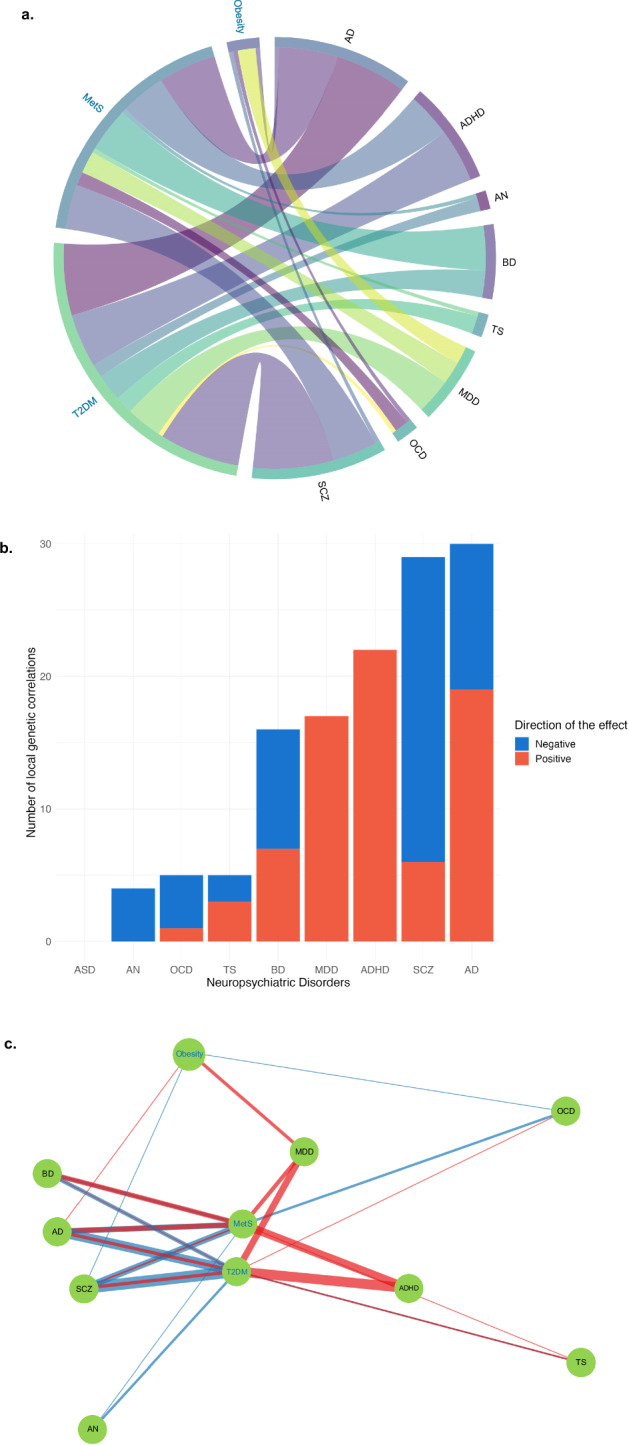
a Chord diagram representing the network of local genetic correlations between insulin resistance-related conditions and neuropsychiatric disorders. A higher width of a ribbon reflects a higher number of shared genetically correlated loci between two phenotypes, highlighting a substantial polygenic overlap and suggesting potential shared pathophysiological mechanisms between them. The colours of the ribbons are used purely for visual distinction and do not imply any additional significance or categorisation. Labels for insulin resistance–related conditions are displayed in dark cyan, while those for neuropsychiatric disorders are shown in black. b Bar plot presenting the number of local genetic correlations identified between neuropsychiatric disorders and insulin resistance-related conditions. Each bar corresponds to a different neuropsychiatric disorder, segmented by the direction of effect of local genetic correlations, with blue indicating negative and red indicating positive local genetic correlations between neuropsychiatric disorders and insulin resistance-related conditions. The height of each bar reflects the quantity of local genetic correlations detected for each disorder. c Network visualisation of local genetic correlations between a spectrum of neuropsychiatric disorders and insulin resistance-related conditions. Nodes represent distinct phenotypes for which local bivariate genetic correlations were evaluated; nodes for insulin resistance–related conditions are labeled in dark cyan, while those for neuropsychiatric disorders are labeled in black. Edges connecting the nodes vary in width proportionally to the number of local genetic correlations identified between phenotype pairs. Edge colour denotes the direction of the genetic correlation estimate, with red indicating a positive correlation and blue indicating a negative correlation. Abbreviations: AD, Alzheimer’s disease; ADHD, attention-deficit/hyperactivity disorder; AN, anorexia nervosa; ASD, autism spectrum disorder; BD, bipolar disorder; MDD, major depressive disorder; MetS, metabolic syndrome, OCD, obsessive-compulsive disorder; T2DM, type 2 diabetes mellitus; SCZ, schizophrenia; TS, Tourette’s syndrome.
Table 2.
Summary of local genetic correlations between neuropsychiatric disorders and insulin resistance-related conditions.
| Neuropsychiatric disorders | Insulin resistance-related conditions | Previous evidence of bivariate global genetic correlation | N loci with significant local h2SNP simultaneously for both phenotypes (% of loci tested) | N genetically correlated locib (% of loci with significanta local h2SNP for both phenotypes) | N positively correlated loci (% of correlated loci for the pair)b | N negatively correlated loci (% of correlated loci for the pair)b | N genetic correlations estimates whose confidence intervals included 1 (% of correlated loci for the pair)b |
|---|---|---|---|---|---|---|---|
| AD | MetS | NO | 306 (12.3%) | 13 (4.2%) | 6 (46.2%) | 7 (53.8%) | 2 (15.4%) |
| AD | Obesity | NO | 34 (1.4%) | 1 (2.9%) | 1 (100.0%) | 0 (0.0%) | 1 (100.0%) |
| AD | T2DM | NO | 214 (8.6%) | 16 (7.5%) | 12 (75.0%) | 4 (25.0%) | 3 (18.8%) |
| ADHD | MetS | YES | 94 (3.8%) | 10 (10.6%) | 10 (100.0%) | 0 (0.0%) | 9 (90.0%) |
| ADHD | Obesity | YES | 30 (1.2%) | 0 (0.0%) | 0 (0.0%) | 0 (0.0%) | 0 (0.0%) |
| ADHD | T2DM | YES | 88 (3.5%) | 12 (13.6%) | 12 (100.0%) | 0 (0.0%) | 7 (58.3%) |
| AN | MetS | YES | 65 (2.6%) | 1 (1.5%) | 0 (0.0%) | 1 (100.0%) | 1 (100.0%) |
| AN | Obesity | YES | 40 (1.6%) | 0 (0.0%) | 0 (0.0%) | 0 (0.0%) | 0 (0.0%) |
| AN | T2DM | YES | 73 (2.9%) | 3 (4.1%) | 0 (0.0%) | 3 (100.0%) | 2 (66.7%) |
| ASD | MetS | YES | 21 (0.8%) | 0 (0.0%) | 0 (0.0%) | 0 (0.0%) | 0 (0.0%) |
| ASD | Obesity | YES | 13 (0.5%) | 0 (0.0%) | 0 (0.0%) | 0 (0.0%) | 0 (0.0%) |
| ASD | T2DM | YES | 12 (0.5%) | 0 (0.0%) | 0 (0.0%) | 0 (0.0%) | 0 (0.0%) |
| BD | MetS | NO | 121 (4.8%) | 10 (8.3%) | 6 (60.0%) | 4 (40.0%) | 0 (0.0%) |
| BD | Obesity | NO | 53 (2.1%) | 0 (0.0%) | 0 (0.0%) | 0 (0.0%) | 0 (0.0%) |
| BD | T2DM | NO | 107 (4.3%) | 6 (5.6%) | 1 (16.7%) | 5 (83.3%) | 1 (16.7%) |
| MDD | MetS | YES | 95 (3.8%) | 5 (5.3%) | 5 (100.0%) | 0 (0.0%) | 3 (60.0%) |
| MDD | Obesity | YES | 45 (1.8%) | 4 (8.9%) | 4 (100.0%) | 0 (0.0%) | 3 (75.0%) |
| MDD | T2DM | YES | 83 (3.3%) | 8 (9.6%) | 8 (100.0%) | 0 (0.0%) | 4 (50.0%) |
| OCD | MetS | YES | 71 (2.8%) | 3 (4.2%) | 0 (0.0%) | 3 (100.0%) | 2 (66.7%) |
| OCD | Obesity | YES | 40 (1.6%) | 1 (2.5%) | 0 (0.0%) | 1 (100.0%) | 0 (0.0%) |
| OCD | T2DM | YES | 54 (2.2%) | 1 (1.9%) | 1 (100.0%) | 0 (0.0%) | 0 (0.0%) |
| Schizophrenia | MetS | YES | 200 (8.0%) | 10 (5.0%) | 2 (20.0%) | 8 (80.0%) | 6 (60.0%) |
| Schizophrenia | Obesity | NO | 89 (3.6%) | 1 (1.1%) | 0 (0.0%) | 1 (100.0%) | 1 (100.0%) |
| Schizophrenia | T2DM | NO | 172 (6.9%) | 18 (10.5%) | 4 (22.2%) | 14 (77.8%) | 10 (55.6%) |
| TS | MetS | NO | 57 (2.3%) | 1 (1.8%) | 1 (100.0%) | 0 (0.0%) | 1 (100.0%) |
| TS | Obesity | NO | 27 (1.1%) | 0 (0.0%) | 0 (0.0%) | 0 (0.0%) | 0 (0.0%) |
| TS | T2DM | NO | 47 (1.9%) | 4 (8.5%) | 2 (50.0%) | 2 (50.0%) | 3 (75.0%) |
| TOTAL | 2251 | 128 (5.7%) | 75 (58.6%) | 53 (41.4%) | 59 (46.1%) |
For each neuropsychiatric disorder, the table presents the presence or absence of global genetic correlation with the specific insulin resistance-related condition, significant loci with h2SNP for both phenotypes tested, and the directionality of local genetic correlations with T2DM, Metabolic Syndrome (MetS), and obesity. The table further provides the number of local genetic correlations with confidence intervals that include 1, indicating potential for completely overlapping genetic influences at specific loci.
AD Alzheimer’s disease, ADHD attention-deficit/ hyperactivity disorder, AN anorexia nervosa, ASD autism spectrum disorder, BD bipolar disorder, h2SNP, single-nucleotide polymorphism (SNP)-based heritability, MetS metabolic syndrome, MDD major depressive disorder, N number of, OCD obsessive-compulsive disorder, T2DM type 2 diabetes mellitus, TS Tourette’s syndrome.
ap < 1 × 10⁻⁴; bFalse discovery rate (FDR) at maximum q = 0.05.
Furthermore, fifteen out of the 109 unique regions were associated with more than one phenotypic pair (Table S1; we refer to these here as hotspots). The major hotspots showing significant bivariate local rgs between multiple phenotypic pairs were the chr2:59251997-60775066 (between T2DM-ADHD, MetS-AN, MetS-MDD), chr6:31320269-31427209 (MetS-AD, T2DM-AD, T2DM-schizophrenia), and chr16:29043178-31384210 genomic regions (MetS-schizophrenia, obesity-schizophrenia, T2DM-schizophrenia) (see Table S1 and Fig. S1). Notably, 11.71% of the genetically correlated regions detected here (15/128) are located in the Major Histocompatibility Complex (MHC) region (chr6:28477797-33448354). All rgs detected in the MHC were between T2DM/MetS and either schizophrenia, AD, or BP, with prevalence of a negative direction of the effect (Table S1).
Genes underlying insulin resistance-neuropsychiatric multimorbidity
In the regions where we detected significant local genetic correlations, we identified a total of 1455 distinct genes through eQTL-based mapping, and 1495 unique protein-coding genes through positional mapping across all phenotype pairs (Table S2–3). Notably, the pseudogene CYP21A1P was recurrently eQTL-mapped across multiple phenotype pairs (AD-T2DM, AD-MetS, BD-T2DM, schizophrenia-T2DM). In total, 140 genes were mapped for at least three phenotype pairs, indicating a potentially broader relevance in the genetic architecture of IR-neuropsychiatric multimorbidity (Table S3). Within this subset, 20 genes, all located within the MHC region, were involved in immune-inflammation and vesicle metabolism/trafficking (e.g., HLA-B, MICA, C4A, C4B, AGER, BTNL2, HLA-DRA, HLA-DRB1, HLA-DQA1, PSMB8, HLA-DRB5, and FLOT1), and four genes were involved in insulin signalling and secretion (i.e., STX1A, FLOT1, MAPK3, and PHKG2) (see Table S3).
Functional annotation of the identified regions
Considering the genes mapped to the regions showing local correlations, 411 gene sets were significantly enriched (Table S4). Immune-related pathways were prominently represented for multiple phenotype pairs (i.e., AD-MetS/T2DM, BD-T2DM, TS-T2DM, schizophrenia-T2DM). Other biological pathways related to oxygen transport, lipid metabolism (including omega-3 and omega-6 polyunsaturated fatty acid levels (PUFAs)), embryonic/placental development, insulin receptor/phosphoinositide 3-kinase (PI3K), and vesicular function/secretion were enriched across different phenotype pairs (Table S4). Pharmacogenomic markers, notably genes genome-wide significantly associated with response to metformin (i.e., STX1B, STX4, ZNF668), were enriched in regions shared between schizophrenia and MetS, obesity, and T2DM (Table S5).
In a more granular examination, we also evaluated enrichment of life-stage-specific expression profiles for genes mapped to the genetically correlated regions (Tables S7–8). Specifically, regions correlated between schizophrenia and obesity featured genes upregulated at 19 weeks post-conception. Conversely, regions associated with the schizophrenia-MetS pair exhibited a distinct pattern, with genes showing downregulation in brain samples from individuals at age 11. Furthermore, regions of overlap between OCD and MetS held genes upregulated in early adulthood brain tissues, while the genes in the overlapping regions marking the OCD-obesity pair exhibited gene downregulation in late childhood.
Detailed results for gene set analysis, spatio-temporal expression specificity of the mapped genes, and druggable gene annotations are reported in Table S4–S10.
Shared causal variants between insulin resistance-related conditions and neuropsychiatric disorders
Of the 128 regions identified with local rg, colocalisation analyses successfully pinpointed the likely causal variants driving this association in 10 regions (see Table S11–12). For comprehensive functional annotations of the 95% credible set variants within these 10 regions see Tables S13–S23.
Notably, one region on chromosome 4 and two on chromosome 6 showed the highest posterior probability for colocalisation, linking schizophrenia with MetS and AD with T2DM, respectively (Table S11–12, Fig. S2–4). The schizophrenia-MetS relationship implicated the rs13107325 variant in the SLC39A8 gene, which modulates the activity of the miRNA hsa-miR-374b-5p (Tables S12–S14). For the AD-T2DM pair, the likely causal variants were rs9271608 and rs9275599, mapped to the HLA-DRB1 and MTCO3P1 genes, respectively. According to GeneCards, HLA-DRB1 is targeted by immunosuppressive and anti-inflammatory drugs (e.g., azathioprine, lapatinib, interferons-β, and acetylsalicylic acid), as well as by statins and psychotropic drugs (e.g., carbamazepine, clozapine, and lamotrigine) (Table S23).
Further seven regions had good support for colocalisation (Supplementary information); these regions showed local genetic correlations for the AD-T2DM, MDD-T2DM, BD-MetS, and schizophrenia-MetS pairs (Table S11–12). Most of the identified variants were observed within or near genes pivotal to immune function, vesicle/small molecules trafficking, lipid metabolism, organ development, retinoic acid signalling, and DNA repair/apoptosis (Tables S17–18). The variants often had high CADD PHRED scores, suggesting highly deleterious effects (Tables S13). Genes mapping to these variants, like the HLA-DQB1 and FADS1/2 genes, are targeted by existing drugs and supplements, such as antihypertensive drugs, omega-3/6 PUFAs, and vitamin A (Table S23).
Discussion
In this study, we examined the genetic relationship between IR-related conditions - specifically, obesity, T2DM, and MetS - and nine neuropsychiatric disorders by investigating the pairwise patterns of local genetic correlation across the genome. At the same time, we explored the specific genetic factors and biological mechanisms underlying their multimorbidity. The results presented here offer novel insights into the shared genetic aetiology between these phenotypes, unveiling a complex pattern of both positive and negative local genetic correlations. For the first time, we demonstrated that even in the absence of global genetic correlations, significant local correlations exist (i.e., between AD, BD, TS and IR-related conditions). These findings expand the results of previous studies [8, 10], with important implications for understanding the pathophysiology of these disorders and for developing targeted therapeutic interventions addressing IR-psychiatric multimorbidity. We identified 128 local genetic correlations across 109 unique genomic regions. Notably, the MHC region emerged as a particularly significant contributor in terms of shared genetic signal, as confirmed by enrichment in biological pathways related to immune function. In addition, genes mapped to the genetically correlated regions showed enrichment in pathways involved in lipid metabolism, insulin signalling, and vesicular function, among others.
Regarding the directions of the detected genetic correlations, we observed exclusively positive local genetic correlations for ADHD and MDD with IR-related conditions, indicating synergistic genetic effects that predispose to both neuropsychiatric symptoms and IR-related conditions. Our enrichment analyses of the genes mapped to these regions suggest that the genetic overlap might be mediated by genes involved in extracellular matrix organisation, vesicle trafficking, and oxygen transport/oxidative processes. These pathways are involved in both brain function and metabolic regulation [34–36]. In particular, extracellular matrix molecules are implicated in synaptic plasticity and homeostasis [34] and may also influence tissue insulin sensitivity [37]. Similarly, vesicle trafficking, integral to synaptic function and neurotransmission, could be a central theme where neuronal communication and insulin signalling intersect, contributing to the multimorbidity of the conditions [36]. Conversely, we identified exclusively negative correlations between AN and IR-related conditions. These results align with the distinct phenotypic characteristics of AN, including increased insulin sensitivity and metabolic alterations related to undernutrition, which differ markedly from other neuropsychiatric disorders [38, 39].
While phenotypic overlap of AD and BD with IR-related conditions has been frequently reported (e.g., Wimberley, Horsdal [2], Santiago and Potashkin [40])), previous genetic analyses did not find global genetic correlations between these phenotypes [8]. This may have occurred due to the averaging effect of global analyses. Our study, which is the first to report significant local genetic correlations between AD, BD, TS and IR-related conditions, suggests that positive and negative local correlations could neutralise each other in global correlation analyses, a phenomenon observed in other recent studies [41, 42]. These heterogeneous patterns of genetic overlap could also point towards aetiologically distinct subgroups that warrant further exploration with deep phenotyping and functional validation. Such analyses could bring us closer towards precision medicine, offering the potential for personalised healthcare and improved treatment success [43].
Multiple genomic regions (15 out of 109) showed significant correlations for more than one phenotype pairs, implying a potentially more prominent and ubiquitous role in the IR-neuropsychiatric multimorbidity. Among the recurring regions, chr2:59251997-60775066, mapping to the BCL11A gene, was implicated in the correlation of T2DM with ADHD, MetS with AN, and MetS with MDD. BCL11A codes for a transcription factor essential for B cell function and haematopoiesis, as well as for neuronal development, regulating processes such as neurogenesis/axonogenesis, and neuronal migration [44, 45]. BCL11A variants have also been associated with neurodevelopmental disorders and impaired cognition, as well as with IR in in vivo and in vitro studies [45–47]. Among other genes that were mapped across at least three phenotypic pairs, some (i.e., STX1A, FLOT1, MAPK3, and PHKG2) are pivotal in insulin signalling and secretion [48–50]. These findings strengthen a molecular basis for linking neuropsychiatric disorders to altered insulin function [8, 50, 51]), which has also been tied to cognitive deficits, anhedonia, and reward processing alterations [3, 4, 6].
Over 11% of the correlated genomic regions were located within the MHC region (chr6:28477797-33448354), where extensive pleiotropy has been demonstrated previously [22, 52]. This region is renowned for its high gene density, polymorphism, and involvement in immune-inflammatory responses [53]. The influence of the MHC region extends beyond autoimmune and infectious diseases susceptibility, being also associated with neuropsychiatric disorders, such as ASD, schizophrenia, and BD [54]. Our findings point to a plausible genetic link between IR-related metabolic dysfunction, immune-inflammatory dysfunction, and neuropsychiatric disorders. This is consistent with previous findings indicating that both central and peripheral inflammation may mediate the link between IR and neuropsychiatric conditions [55, 56]. Inflammation may also impair brain insulin signalling, potentially resulting in neurobehavioural consequences [57]. Notably, most of the local genetic correlations identified within the MHC region showed a negative direction of effect. We cannot provide a clear explanation of this finding, but it may lie in the balance of pro-inflammatory and anti-inflammatory factors in immune response, in which MHC genes play a role [54]. Additionally, MHC class I (MHC-I) molecules, traditionally associated with immune functions, have also been implicated in synapse pruning, a process important for refining neural circuits during development [58]. MHC-I molecules are expressed in neurons and modulate microglia-mediated synapse elimination by marking less active synapses for phagocytosis [59, 60]. This activity-dependent mechanism shapes functional neuronal networks and has been implicated in pathological synapse loss in neurodegenerative conditions [59, 61]. Dysregulated MHC-I signalling can lead to aberrant synaptic pruning, implicated in disorders such as schizophrenia and ASD [58]. Hence, the dual role of MHC-encoded molecules in both immune modulation and synaptic plasticity, as well as the potential differential expression of genes in the MHC region across different tissues and the lifespan may help explain the observed negative genetic correlations [62]. Experimental validation of our findings will be necessary to determine the exact functional implication of the observed genetic associations.
Relatedly, our study identified multiple genes related to the human leukocyte antigen (HLA) system, innate immunity, and immunomodulation (i.e., HLA-B, HLA-DRA, HLA-DRB1, HLA-DQA1, HLA-DRB5, MICA, C4A, C4B, AGER, PSMB8, and BTNL2), supporting their possible influence on IR-neuropsychiatric multimorbidity. Of note, immunomodulatory drugs (e.g., non-steroidal anti-inflammatory drugs and monoclonal antibodies) have shown some efficacy as add-on treatments in psychoses and MDD, and might have higher efficacy in people with IR-neuropsychiatric multimorbidity [63, 64]. Another gene recurrently mapped across various phenotype pairs was the CYP21A1P pseudogene, located within the MHC region. Intergenic recombination of CYP21A1P leads to altered glucocorticoid and androgen production [65]; glucocorticoids have anti-inflammatory/immunosuppressive effects, and regulate glucose metabolism and the body’s stress response [66]. Specifically, glucocorticoids counteract insulin by decreasing peripheral glucose uptake and stimulating hepatic gluconeogenesis, leading to IR under conditions of excessive release, such as in chronic stress [67]. Prolonged exposure to glucocorticoids can induce neurotoxic effects, possibly involved in the development of psychiatric disorders [68, 69]. These hormones also modulate the serotonergic system, which is strongly implicated in psychiatric disorders and insulin signalling [70, 71]. Interestingly, gene set enrichments within correlated regions between schizophrenia and IR-related conditions were related to the response to metformin, a frontline oral medication for T2DM. This implies a potential overlap in therapeutic targets between schizophrenia and T2DM, which could lead to a reassessment of treatment strategies for these patients. Previous randomised-controlled trials (RCTs) confirmed the efficacy of metformin in counteracting antipsychotic-induced metabolic side effects in individuals with psychoses [72, 73], while improving psychiatric and cognitive symptoms in the same population [74].
Another significant finding of this study was the identification of colocalisation signals. Among the 128 regions demonstrating local genetic correlation, 10 regions were prioritised for their high posterior probabilities of harbouring the same causal variants shared between IR-related conditions and neuropsychiatric disorders. This was instrumental for further elucidating shared pathophysiological mechanisms and novel potential drug targets for IR-neuropsychiatric multimorbidity [75, 76]. The two most likely shared causal variants were located in the chr4:102544804-104384534 and chr6:32586785-32629239/chr6:32682214-32897998 regions, suggesting novel cross-links between schizophrenia and MetS, and AD and T2DM, respectively. The identified shared causal variant (rs13107325) between schizophrenia and MetS maps to the SLC39A8 gene, encoding the ZIP8 metal cation transporter. Previous studies demonstrated its association with altered brain manganese levels and protein complexity in schizophrenia, brain morphology and dendritic spine density, as well as a broader impact on various conditions, including developmental, neuropsychiatric and cardio-metabolic diseases/traits [77–80]. Our findings also highlight SLC39A8’s potential as a therapeutic target via zinc chloride/sulphate [81]. Interestingly, RCTs have shown beneficial effects of zinc sulphate in reducing symptoms of ADHD, MDD, and SCZ [82–84], as well as improving glucose handling in prediabetes [85]. In the AD-T2DM context, the rs9271608 variant mapping to the HLA-DRB1 gene presented compelling causal candidacy, pointing to the potential for immunosuppressive drugs such as azathioprine, lapatinib, and interferons-β to influence AD-T2DM manifestations. The administration of intranasal treatment with interferon-β was shown to improve anxious/depressive-like behaviours by modulating microglia polarisation in AD rat models [86]. Of note, the rs9271608 also shows broad biological relevance as it is active as a promoter across numerous cell types and tissues, including various immune and neuronal progenitors [87]. The remaining regions of notable colocalisation underpin associations between AD and T2DM, MDD and T2DM, BD and MetS, and schizophrenia and MetS, hinting at potential targetable mechanisms for current drugs and supplements, including antihypertensive drugs, omega-3/6 PUFAs, vitamin A [81]. Several antihypertensive drugs have been associated with a reduced risk of depression [88], and omega-3 PUFAs showed beneficial effects on depression symptoms in a meta-analysis of RCTs [89]. Genes associated with omega-3/omega-6 PUFAs were enriched when considering the regions showing correlation between BD and MetS, in line with their relevance in the multimorbidity. Finally, vitamin A inhibits amyloid β protein deposition, tau phosphorylation, neuronal degeneration and improves spatial learning and memory in AD mouse models [90]. It is worth noting that a significant local genetic correlation without detectable colocalisation does not necessarily mean that there are no shared causal variants; this may reflect limitations in the power of the colocalisation analysis, particularly in scenarios with complex patterns of associations, which are often observed in highly polygenic traits [22].
Our study should be viewed considering some limitations. Although our study may serve as a starting point by highlighting potential shared causal variants and suggesting biological mechanisms through which shared genetic regions might impact both mental and metabolic health, the functional interpretation of our findings remains largely speculative; future in vitro and animal model studies will be necessary to validate our findings and provide clearer mechanistic insights into the underlying biology. The high linkage disequilibrium in the MHC region may have led to spurious pleiotropy, not necessarily implying the presence of the same shared causal SNPs [91]. Rare genetic variants were not considered, and population-specific effects may not be adequately captured by our analyses, which were limited to European ancestry. While the available GWAS summary statistics were generally obtained in samples of adequate size for this kind of study, the GWAS summary statistics for OCD were based on a relatively small sample size, potentially influencing the number of significant local genetic correlations detected by LAVA.
In conclusion, our study provides novel insights into the shared genetic underpinnings of neuropsychiatric and IR-related conditions, challenging traditional notions of their separate pathophysiology. Our results support a more integrated disease model, and the need to move beyond the conventional view of distinct aetiologies. The implications of our findings extend to clinical practice, emphasising the need for a holistic approach in the screening and management of IR-neuropsychiatric multimorbidity. For example, the importance of lifestyle interventions for both metabolic and psychiatric health, and for developing pharmacological treatments that target both conditions. The discovery of shared causal variants, particularly in genes like SLC39A8 and HLA-DRB1, opens new avenues for targeted therapeutic interventions. The convergence of genetic findings on mechanisms related to immune-inflammation, insulin signalling, lipid metabolism, vesicle trafficking, among others, provides a compelling direction for future research. Overall, our study not only unveils the shared genetic landscape of neuropsychiatric and IR-related conditions, but also establishes a foundation for integrated research and treatment approaches, contributing to a paradigm shift towards comprehensive care strategies that address the issue of multimorbidity.
Supplementary information
Acknowledgements
This project has received funding from the European Union’s Horizon 2020 research and innovation programme under grant agreement No 847879 (PRIME, Prevention and Remediation of Insulin Multimorbidity in Europe). This publication is part of the project ‘No labels needed: understanding psychiatric disorders based on genetic traits’ (with project number 09150161910091) of the research program Veni, which is partly financed by the Dutch Research Council (NWO) Health Research and Development (ZonMW). The project also received relevant funding from the Netherlands Organisation for Scientific Research (NWO) for the GUTS project (grant 024.005.011). Research reported in this publication was supported by the National Institute of Mental Health of the National Institutes of Health under Award Number R01MH124851. GF was partly supported by #NEXTGENERATIONEU (NGEU) and funded by the Italian Ministry of University and Research (MUR), National Recovery and Resilience Plan (NRRP), project MNESYS (PE0000006) – A Multiscale integrated approach to the study of the nervous system in health and disease (DN. 1553 11.10.2022). JSS and FFA are partly supported by ICREA under the ICREA Academia programme. CIBERObn is an initiative of Instituto Salud Carlos III. The content is solely the responsibility of the authors and does not necessarily represent the official views of any of the funders. This work was carried out on the Dutch national e-infrastructure with the support of SURF Cooperative. FFA and SJM thank CERCA Programme/Generalitat de Catalunya for institutional support.
Author contributions
(according to CRediT, Contributor Roles Taxonomy - https://credit.niso.org) Giuseppe Fanelli: Writing – original draft preparation, Conceptualisation, Methodology, Formal analysis, Software, Validation, Investigation, Data Curation, Visualisation; Barbara Franke: Supervision, Conceptualisation, Project administration, Funding acquisition, Resources, Writing – review and editing; Chiara Fabbri: Supervision, Writing – review and editing, Funding acquisition; Josefin Werme: Software, Writing – review and editing; Izel Erdogan: Software, Writing – review and editing; Ward De Witte: Software, Writing – review and editing; Martina Arenella: Conceptualisation, Writing – review and editing; Alessandro Serretti: Supervision, Writing – review and editing, Funding acquisition; Nina Roth Mota: Conceptualisation, Writing – review and editing; Janita Bralten: Supervision, Conceptualisation, Writing – review and editing, Funding acquisition, Resources. All other authors: Writing – review and editing. All authors accepted the final version of the paper.
Data availability
All analyses in this study were conducted using publicly available summary statistics from genome-wide association studies (GWASs), as referenced in Table 1. Our analytical workflow was developed by following the official tutorials and vignettes of the R and Python packages employed, ensuring methodological rigor and reproducibility (see URLs and Materials and methods, sections 2.2–2.5). Any custom scripts and code used for data processing and analysis are available from the corresponding author upon reasonable request to facilitate replication and further research. All data generated during this study are included within this published article and its Supplementary Materials. URLs Local Analysis of [co]Variant Association (LAVA): https://github.com/josefin-werme/LAVA; LD SCore (LDSC) https://github.com/bulik/ldsc; biomaRt: https://bioconductor.org/packages/release/bioc/html/biomaRt.html; LiftOver: https://genome.ucsc.edu/cgi-bin/hgLiftOver; loci2path: https://www.bioconductor.org/packages/release/bioc/html/loci2path.html; coloc & SuSiE: https://github.com/chr1swallace/coloc; SNPnexus: https://www.snp-nexus.org; Functional Mapping and Annotation of Genome-Wide Association Studies (FUMA): http://fuma.ctglab.nl.
Competing interests
AS is or has been a consultant/speaker for Abbott, Abbvie, Angelini, AstraZeneca, Clinical Data, Boehringer, Bristol-Myers Squibb, Eli Lilly, GlaxoSmithKline, Innovapharma, Italfarmaco, Janssen, Lundbeck, Naurex, Pfizer, Polifarma, Sanofi, Servier, and Taliaz. BF discloses having received educational speaking fees and travel support from Medice. CF was a speaker for Janssen. GP is director/chief scientific officer and WDW as well as IHR are employees of Drug Target ID, Ltd., but their activities at this company do not constitute competing interests with regard to this paper. JH has received lecture honoraria as part of continuing medical education programs sponsored by Shire, Takeda, Medice, and Biocodex. JSS reported receiving research support through his institution from the Patrimonio Comunal Olivarero, Almond Board of California and Pistachio Growers of California; he is serving on the board of and receiving grant support through his institution from the International Nut and Dried Foundation, Instituto Danone Spain and Institute Danone International. FFA and SJM have been consultants/speakers for NovoNordisk. All other authors report no biomedical financial interests or potential conflicts of interest.
Ethics
We used publicly available summary statistics of genome-wide association studies (GWASs) conducted by external authors and consortia; thus, no specific authorisation was required from the local Ethics Committee. No individual genotypic data were used or collected.
Footnotes
Publisher’s note Springer Nature remains neutral with regard to jurisdictional claims in published maps and institutional affiliations.
Supplementary information
The online version contains supplementary material available at 10.1038/s41398-025-03349-9.
References
- 1.Skou ST, Mair FS, Fortin M, Guthrie B, Nunes BP, Miranda JJ, et al. Multimorbidity. Nat Rev Dis Primers. 2022;8:48. [DOI] [PMC free article] [PubMed] [Google Scholar]
- 2.Wimberley T, Horsdal HT, Brikell I, Laursen TM, Astrup A, Fanelli G, et al. Temporally ordered associations between type 2 diabetes and brain disorders - a Danish register-based cohort study. BMC Psychiatry. 2022;22:573. [DOI] [PMC free article] [PubMed] [Google Scholar]
- 3.Possidente C, Fanelli G, Serretti A, Fabbri C. Clinical insights into the cross-link between mood disorders and type 2 diabetes: a review of longitudinal studies and Mendelian randomisation analyses. Neurosci Biobehav Rev. 2023;152:105298. [DOI] [PubMed] [Google Scholar]
- 4.Fanelli G, Serretti A. Depression, antidepressants, and insulin resistance: which link? Eur Neuropsychopharmacol. 2022;60:4–6. [DOI] [PubMed] [Google Scholar]
- 5.Kraus C, Kautzky A, Watzal V, Gramser A, Kadriu B, Deng ZD, et al. Body mass index and clinical outcomes in individuals with major depressive disorder: findings from the GSRD European Multicenter Database. J Affect Disord. 2023;335:349–57. [DOI] [PMC free article] [PubMed] [Google Scholar]
- 6.Fanelli G, Mota NR, Salas-Salvadó J, Bulló M, Fernandez-Aranda F, Camacho-Barcia L, et al. The link between cognition and somatic conditions related to insulin resistance in the UK Biobank study cohort: a systematic review. Neurosci Biobehav Rev. 2022;143:104927. [DOI] [PubMed] [Google Scholar]
- 7.DeFronzo RA, Ferrannini E, Groop L, Henry RR, Herman WH, Holst JJ, et al. Type 2 diabetes mellitus. Nat Rev Dis Primers. 2015;1:15019. [DOI] [PubMed] [Google Scholar]
- 8.Fanelli G, Franke B, De Witte W, Ruisch IH, Haavik J, van Gils V, et al. Insulinopathies of the brain? Genetic overlap between somatic insulin-related and neuropsychiatric disorders. Transl Psychiatry. 2022;12:59. [DOI] [PMC free article] [PubMed] [Google Scholar]
- 9.Watson HJ, Yilmaz Z, Thornton LM, Hubel C, Coleman JRI, Gaspar HA, et al. Genome-wide association study identifies eight risk loci and implicates metabo-psychiatric origins for anorexia nervosa. Nat Genet. 2019;51:1207–14. [DOI] [PMC free article] [PubMed] [Google Scholar]
- 10.Hubel C, Gaspar HA, Coleman JRI, Hanscombe KB, Purves K, Prokopenko I, et al. Genetic correlations of psychiatric traits with body composition and glycemic traits are sex- and age-dependent. Nat Commun. 2019;10:5765. [DOI] [PMC free article] [PubMed] [Google Scholar]
- 11.Leutner M, Dervic E, Bellach L, Klimek P, Thurner S, Kautzky A. Obesity as pleiotropic risk state for metabolic and mental health throughout life. Transl Psychiatry. 2023;13:175. [DOI] [PMC free article] [PubMed] [Google Scholar]
- 12.Chwastiak LA, Freudenreich O, Tek C, McKibbin C, Han J, McCarron R, et al. Clinical management of comorbid diabetes and psychotic disorders. Lancet Psychiatry. 2015;2:465–76. [DOI] [PubMed] [Google Scholar]
- 13.Schuch FB, Vancampfort D, Firth J, Rosenbaum S, Ward PB, Silva ES, et al. Physical activity and incident depression: a meta-analysis of prospective cohort studies. Am J Psychiatry. 2018;175:631–48. [DOI] [PubMed] [Google Scholar]
- 14.Marx W, Moseley G, Berk M, Jacka F. Nutritional psychiatry: the present state of the evidence. Proc Nutr Soc. 2017;76:427–36. [DOI] [PubMed] [Google Scholar]
- 15.Ogilvie RP, Patel SR. The Epidemiology of Sleep and Diabetes. Curr Diab Rep. 2018;18:82. [DOI] [PMC free article] [PubMed] [Google Scholar]
- 16.Mahajan A, Spracklen CN, Zhang W, Ng MCY, Petty LE, Kitajima H, et al. Multi-ancestry genetic study of type 2 diabetes highlights the power of diverse populations for discovery and translation. Nat Genet. 2022;54:560–72. [DOI] [PMC free article] [PubMed] [Google Scholar]
- 17.Trubetskoy V, Pardinas AF, Qi T, Panagiotaropoulou G, Awasthi S, Bigdeli TB, et al. Mapping genomic loci implicates genes and synaptic biology in schizophrenia. Nature. 2022;604:502–8. [DOI] [PMC free article] [PubMed] [Google Scholar]
- 18.Wray NR, Lee SH, Mehta D, Vinkhuyzen AA, Dudbridge F, Middeldorp CM. Research review: Polygenic methods and their application to psychiatric traits. J Child Psychol Psychiatry. 2014;55:1068–87. [DOI] [PubMed] [Google Scholar]
- 19.Almgren P, Lehtovirta M, Isomaa B, Sarelin L, Taskinen MR, Lyssenko V, et al. Heritability and familiality of type 2 diabetes and related quantitative traits in the Botnia Study. Diabetologia. 2011;54:2811–9. [DOI] [PubMed] [Google Scholar]
- 20.Shieh JC, Huang PT, Lin YF. Alzheimer’s Disease and Diabetes: Insulin Signaling as the Bridge Linking Two Pathologies. Mol Neurobiol. 2020;57:1966–77. [DOI] [PubMed] [Google Scholar]
- 21.van Rheenen W, Peyrot WJ, Schork AJ, Lee SH, Wray NR. Genetic correlations of polygenic disease traits: from theory to practice. Nat Rev Genet. 2019;20:567–81. [DOI] [PubMed] [Google Scholar]
- 22.Werme J, van der Sluis S, Posthuma D, de Leeuw CA. An integrated framework for local genetic correlation analysis. Nat Genet. 2022;54:274–82. [DOI] [PubMed] [Google Scholar]
- 23.Bulik-Sullivan B, Finucane HK, Anttila V, Gusev A, Day FR, Loh PR, et al. An atlas of genetic correlations across human diseases and traits. Nat Genet. 2015;47:1236–41. [DOI] [PMC free article] [PubMed] [Google Scholar]
- 24.Cross-Disorder Group of the Psychiatric Genomics Consortium. Electronic address, p.m.h.e. and C. Cross-Disorder Group of the Psychiatric Genomics. Genomic relationships, novel loci, and pleiotropic mechanisms across eight psychiatric disorders. Cell. 2019;179:1469–82.e11. [DOI] [PMC free article] [PubMed] [Google Scholar]
- 25.Hindley G, Frei O, Shadrin AA, Cheng W, O’Connell KS, Icick R, et al. Charting the landscape of genetic overlap between mental disorders and related traits beyond genetic correlation. Am J Psychiatry. 2022;179:833–43. [DOI] [PMC free article] [PubMed] [Google Scholar]
- 26.Durinck S, Moreau Y, Kasprzyk A, Davis S, De Moor B, Brazma A, et al. BioMart and Bioconductor: a powerful link between biological databases and microarray data analysis. Bioinformatics. 2005;21:3439–40. [DOI] [PubMed] [Google Scholar]
- 27.Xu T, Jin P, Qin ZS. Regulatory annotation of genomic intervals based on tissue-specific expression QTLs. Bioinformatics. 2020;36:690–7. [DOI] [PMC free article] [PubMed] [Google Scholar]
- 28.Watanabe K, Taskesen E, van Bochoven A, Posthuma D. Functional mapping and annotation of genetic associations with FUMA. Nat Commun. 2017;8:1826. [DOI] [PMC free article] [PubMed] [Google Scholar]
- 29.Buniello A, MacArthur JAL, Cerezo M, Harris LW, Hayhurst J, Malangone C, et al. The NHGRI-EBI GWAS Catalog of published genome-wide association studies, targeted arrays and summary statistics 2019. Nucleic Acids Res. 2019;47:D1005–12. [DOI] [PMC free article] [PubMed] [Google Scholar]
- 30.Giambartolomei C, Vukcevic D, Schadt EE, Franke L, Hingorani AD, Wallace C, et al. Bayesian test for colocalisation between pairs of genetic association studies using summary statistics. PLoS Genet. 2014;10:e1004383. [DOI] [PMC free article] [PubMed] [Google Scholar]
- 31.Wallace C. A more accurate method for colocalisation analysis allowing for multiple causal variants. PLoS Genet. 2021;17:e1009440. [DOI] [PMC free article] [PubMed] [Google Scholar]
- 32.Oscanoa J, Sivapalan L, Gadaleta E, Dayem Ullah AZ, Lemoine NR, Chelala C. SNPnexus: a web server for functional annotation of human genome sequence variation (2020 update). Nucleic Acids Res. 2020;48:W185–92. [DOI] [PMC free article] [PubMed] [Google Scholar]
- 33.Safran M, Dalah I, Alexander J, Rosen N, Iny Stein T, Shmoish M, et al. GeneCards Version 3: the human gene integrator. Database (Oxford). 2010;2010:baq020. [DOI] [PMC free article] [PubMed] [Google Scholar]
- 34.Dityatev A, Schachner M, Sonderegger P. The dual role of the extracellular matrix in synaptic plasticity and homeostasis. Nat Rev Neurosci. 2010;11:735–46. [DOI] [PubMed] [Google Scholar]
- 35.Rossetti AC, Paladini MS, Riva MA, Molteni R. Oxidation-reduction mechanisms in psychiatric disorders: A novel target for pharmacological intervention. Pharmacol Ther. 2020;210:107520. [DOI] [PubMed] [Google Scholar]
- 36.Zou XH, Sun LH, Yang W, Li BJ, Cui RJ. Potential role of insulin on the pathogenesis of depression. Cell Prolif. 2020;53:e12806. [DOI] [PMC free article] [PubMed] [Google Scholar]
- 37.Williams AS, Kang L, Wasserman DH. The extracellular matrix and insulin resistance. Trends Endocrinol Metab. 2015;26:357–66. [DOI] [PMC free article] [PubMed] [Google Scholar]
- 38.Ilyas A, Hubel C, Stahl D, Stadler M, Ismail K, Breen G, et al. The metabolic underpinning of eating disorders: a systematic review and meta-analysis of insulin sensitivity. Mol Cell Endocrinol. 2019;497:110307. [DOI] [PubMed] [Google Scholar]
- 39.Duriez P, Ramoz N, Gorwood P, Viltart O, Tolle V. A metabolic perspective on reward abnormalities in anorexia nervosa. Trends Endocrinol Metab. 2019;30:915–28. [DOI] [PubMed] [Google Scholar]
- 40.Santiago JA, Potashkin JA. The impact of disease comorbidities in Alzheimer’s disease. Front Aging Neurosci. 2021;13:631770. [DOI] [PMC free article] [PubMed] [Google Scholar]
- 41.Fernandes, B, Enduru N, Fernandes B, Bahrami S, Dai Y, Andreassen O, et al. Genetic overlap between Alzheimer’s disease and immune-mediated diseases: An atlas of shared genetic determinants and biological convergence. Res Sq, 2023. 10.21203/rs.3.rs-3346282/v1. [DOI] [PubMed]
- 42.Arenella M, Fanelli G, Kiemeney LA, McAlonan G, Murphy DG, Bralten J. Genetic relationship between the immune system and autism. Brain Behav Immun Health. 2023;34:100698. [DOI] [PMC free article] [PubMed] [Google Scholar]
- 43.Feczko E, Fair DA. Methods and challenges for assessing heterogeneity. Biol Psychiatry. 2020;88:9–17. [DOI] [PMC free article] [PubMed] [Google Scholar]
- 44.Bauer DE, Orkin SH. Hemoglobin switching’s surprise: the versatile transcription factor BCL11A is a master repressor of fetal hemoglobin. Curr Opin Genet Dev. 2015;33:62–70. [DOI] [PMC free article] [PubMed] [Google Scholar]
- 45.Dias C, Estruch SB, Graham SA, McRae J, Sawiak SJ, Hurst JA, et al. BCL11A Haploinsufficiency Causes an Intellectual Disability Syndrome and Dysregulates Transcription. Am J Hum Genet. 2016;99:253–74. [DOI] [PMC free article] [PubMed] [Google Scholar]
- 46.Jonsson A, Ladenvall C, Ahluwalia TS, Kravic J, Krus U, Taneera J, et al. Effects of common genetic variants associated with type 2 diabetes and glycemic traits on alpha- and beta-cell function and insulin action in humans. Diabetes. 2013;62:2978–83. [DOI] [PMC free article] [PubMed] [Google Scholar]
- 47.Wiegreffe C, Wahl T, Joos NS, Bonnefont J, Liu P, Britsch S. Developmental cell death of cortical projection neurons is controlled by a Bcl11a/Bcl6-dependent pathway. EMBO Rep. 2022;23:e54104. [DOI] [PMC free article] [PubMed] [Google Scholar]
- 48.Jager J, Corcelle V, Gremeaux T, Laurent K, Waget A, Pages G, et al. Deficiency in the extracellular signal-regulated kinase 1 (ERK1) protects leptin-deficient mice from insulin resistance without affecting obesity. Diabetologia. 2011;54:180–9. [DOI] [PubMed] [Google Scholar]
- 49.Bagge A, Dahmcke CM, Dalgaard LT. Syntaxin-1a is a direct target of miR-29a in insulin-producing beta-cells. Horm Metab Res. 2013;45:463–6. [DOI] [PubMed] [Google Scholar]
- 50.van de Vondervoort I, Poelmans G, Aschrafi A, Pauls DL, Buitelaar JK, Glennon JC, et al. An integrated molecular landscape implicates the regulation of dendritic spine formation through insulin-related signalling in obsessive-compulsive disorder. J Psychiatry Neurosci. 2016;41:280–5. [DOI] [PMC free article] [PubMed] [Google Scholar]
- 51.Mota, N, Fanelli, G, Erdogan, I, Klein, M, Sprooten, E, Fothi, A, et al. The multivariate genetic architecture of psychiatric and insulin resistance multimorbidity, in medRXiv. [Preprint]. 2024 https://www.medrxiv.org/content/10.1101/2024.10.02.24314704v1. [DOI] [PubMed]
- 52.Watanabe K, Stringer S, Frei O, Umicevic Mirkov M, de Leeuw C, Polderman TJC, et al. A global overview of pleiotropy and genetic architecture in complex traits. Nat Genet. 2019;51:1339–48. [DOI] [PubMed] [Google Scholar]
- 53.Matzaraki V, Kumar V, Wijmenga C, Zhernakova A. The MHC locus and genetic susceptibility to autoimmune and infectious diseases. Genome Biol. 2017;18:76. [DOI] [PMC free article] [PubMed] [Google Scholar]
- 54.Tamouza R, Krishnamoorthy R, Leboyer M. Understanding the genetic contribution of the human leukocyte antigen system to common major psychiatric disorders in a world pandemic context. Brain Behav Immun. 2021;91:731–9. [DOI] [PMC free article] [PubMed] [Google Scholar]
- 55.Chan KL, Cathomas F, Russo SJ. Central and peripheral inflammation link metabolic syndrome and major depressive disorder. Physiology (Bethesda). 2019;34:123–33. [DOI] [PMC free article] [PubMed] [Google Scholar]
- 56.Viardot A, Heilbronn LK, Samocha-Bonet D, Mackay F, Campbell LV, Samaras K. Obesity is associated with activated and insulin resistant immune cells. Diabetes Metab Res Rev. 2012;28:447–54. [DOI] [PubMed] [Google Scholar]
- 57.Gong X, Hu H, Qiao Y, Xu P, Yang M, Dang R, et al. The involvement of renin-angiotensin system in lipopolysaccharide-induced behavioral changes, neuroinflammation, and disturbed insulin signaling. Front Pharmacol. 2019;10:318. [DOI] [PMC free article] [PubMed] [Google Scholar]
- 58.McAllister AK. Major histocompatibility complex I in brain development and schizophrenia. Biol Psychiatry. 2014;75:262–8. [DOI] [PMC free article] [PubMed] [Google Scholar]
- 59.Faust TE, Gunner G, Schafer DP. Mechanisms governing activity-dependent synaptic pruning in the developing mammalian CNS. Nat Rev Neurosci. 2021;22:657–73. [DOI] [PMC free article] [PubMed] [Google Scholar]
- 60.Deivasigamani S, Miteva MT, Natale S, Gutierrez-Barragan D, Basilico B, Di Angelantonio S, et al. Microglia complement signaling promotes neuronal elimination and normal brain functional connectivity. Cereb Cortex. 2023;33:10750–60. [DOI] [PMC free article] [PubMed] [Google Scholar]
- 61.Zalocusky KA, Najm R, Taubes AL, Hao Y, Yoon SY, Koutsodendris N, et al. Neuronal ApoE upregulates MHC-I expression to drive selective neurodegeneration in Alzheimer’s disease. Nat Neurosci. 2021;24:786–98. [DOI] [PMC free article] [PubMed] [Google Scholar]
- 62.Shen Y, Zhang J. Tight regulation of major histocompatibility complex I for the spatial and temporal expression in the hippocampal neurons. Front Cell Neurosci. 2021;15:739136. [DOI] [PMC free article] [PubMed] [Google Scholar]
- 63.Drevets WC, Wittenberg GM, Bullmore ET, Manji HK. Immune targets for therapeutic development in depression: towards precision medicine. Nat Rev Drug Discov. 2022;21:224–44. [DOI] [PMC free article] [PubMed] [Google Scholar]
- 64.Jeppesen R, Christensen RHB, Pedersen EMJ, Nordentoft M, Hjorthoj C, Kohler-Forsberg O, et al. Efficacy and safety of anti-inflammatory agents in treatment of psychotic disorders - A comprehensive systematic review and meta-analysis. Brain Behav Immun. 2020;90:364–80. [DOI] [PubMed] [Google Scholar]
- 65.Carvalho B, Marques CJ, Santos-Silva R, Fontoura M, Carvalho D, Carvalho F. Congenital adrenal hyperplasia due to 21-hydroxylase deficiency: an update on genetic analysis of CYP21A2 gene. Exp Clin Endocrinol Diabetes. 2021;129:477–81. [DOI] [PubMed] [Google Scholar]
- 66.Balsevich G, Abizaid A, Chen A, Karatsoreos IN, Schmidt MV. Stress and glucocorticoid modulation of feeding and metabolism. Neurobiol Stress. 2019;11:100171. [DOI] [PMC free article] [PubMed] [Google Scholar]
- 67.Fichna M, Fichna P. Glucocorticoids and beta-cell function. Endokrynol Pol. 2017;68:568–73. [DOI] [PubMed] [Google Scholar]
- 68.Ding S, Yang L, Huang L, Kong L, Chen M, Su Y, et al. Chronic glucocorticoid exposure accelerates Abeta generation and neurotoxicity by activating calcium-mediated CN-NFAT1 signaling in hippocampal neurons in APP/PS1 mice. Food Chem Toxicol. 2022;168:113407. [DOI] [PubMed] [Google Scholar]
- 69.Chiba S, Numakawa T, Ninomiya M, Richards MC, Wakabayashi C, Kunugi H. Chronic restraint stress causes anxiety- and depression-like behaviors, downregulates glucocorticoid receptor expression, and attenuates glutamate release induced by brain-derived neurotrophic factor in the prefrontal cortex. Prog Neuropsychopharmacol Biol Psychiatry. 2012;39:112–9. [DOI] [PubMed] [Google Scholar]
- 70.Prouty EW, Chandler DJ, Gao WJ, Waterhouse BD. Selective vulnerability of dorsal raphe-medial prefrontal cortex projection neurons to corticosterone-induced hypofunction. Eur J Neurosci. 2019;50:1712–26. [DOI] [PMC free article] [PubMed] [Google Scholar]
- 71.Betari N, Teigen K, Sahlholm K, Haavik J. Synthetic corticosteroids as tryptophan hydroxylase stabilizers. Future Med Chem. 2021;13:1465–74. [DOI] [PubMed] [Google Scholar]
- 72.Agarwal SM, Panda R, Costa-Dookhan KA, MacKenzie NE, Treen QC, Caravaggio F, et al. Metformin for early comorbid glucose dysregulation and schizophrenia spectrum disorders: a pilot double-blind randomized clinical trial. Transl Psychiatry. 2021;11:219. [DOI] [PMC free article] [PubMed] [Google Scholar]
- 73.de Silva VA, Suraweera C, Ratnatunga SS, Dayabandara M, Wanniarachchi N, Hanwella R. Metformin in prevention and treatment of antipsychotic induced weight gain: a systematic review and meta-analysis. BMC Psychiatry. 2016;16:341. [DOI] [PMC free article] [PubMed] [Google Scholar]
- 74.Battini V, Cirnigliaro G, Leuzzi R, Rissotto E, Mosini G, Benatti B, et al. The potential effect of metformin on cognitive and other symptom dimensions in patients with schizophrenia and antipsychotic-induced weight gain: a systematic review, meta-analysis, and meta-regression. Front Psychiatry. 2023;14:1215807. [DOI] [PMC free article] [PubMed] [Google Scholar]
- 75.Karki R, Kodamullil AT, Hofmann-Apitius M. Comorbidity analysis between Alzheimer’s disease and type 2 diabetes mellitus (T2DM) based on shared pathways and the role of T2DM drugs. J Alzheimers Dis. 2017;60:721–31. [DOI] [PMC free article] [PubMed] [Google Scholar]
- 76.Belyaeva A, Cammarata L, Radhakrishnan A, Squires C, Yang KD, Shivashankar GV, et al. Causal network models of SARS-CoV-2 expression and aging to identify candidates for drug repurposing. Nat Commun. 2021;12:1024. [DOI] [PMC free article] [PubMed] [Google Scholar]
- 77.Mealer RG, Jenkins BG, Chen CY, Daly MJ, Ge T, Lehoux S, et al. The schizophrenia risk locus in SLC39A8 alters brain metal transport and plasma glycosylation. Sci Rep. 2020;10:13162. [DOI] [PMC free article] [PubMed] [Google Scholar]
- 78.Nebert DW, Liu Z. SLC39A8 gene encoding a metal ion transporter: discovery and bench to bedside. Hum Genomics. 2019;13:51. [DOI] [PMC free article] [PubMed] [Google Scholar]
- 79.Hermann ER, Chambers E, Davis DN, Montgomery MR, Lin D, Chowanadisai W. Brain Magnetic Resonance Imaging Phenome-Wide Association Study With Metal Transporter Gene SLC39A8. Front Genet. 2021;12:647946. [DOI] [PMC free article] [PubMed] [Google Scholar]
- 80.Li S, Ma C, Li Y, Chen R, Liu Y, Wan LP, et al. The schizophrenia-associated missense variant rs13107325 regulates dendritic spine density. Transl Psychiatry. 2022;12:361. [DOI] [PMC free article] [PubMed] [Google Scholar]
- 81.Wishart DS, Feunang YD, Guo AC, Lo EJ, Marcu A, Grant JR, et al. DrugBank 5.0: a major update to the DrugBank database for 2018. Nucleic Acids Res. 2018;46:D1074–82. [DOI] [PMC free article] [PubMed] [Google Scholar]
- 82.Behrouzian F, Nazarinasab M, Sadegh AM, Abdi L, Sabzevarizadeh M. Effects of zinc sulfate on schizophrenia symptoms in patients undergoing atypical antipsychotic pharmacotherapy. J Family Med Prim Care. 2022;11:7795–9. [DOI] [PMC free article] [PubMed] [Google Scholar]
- 83.Salari S, Khomand P, Arasteh M, Yousefzamani B, Hassanzadeh K. Zinc sulphate: a reasonable choice for depression management in patients with multiple sclerosis: a randomized, double-blind, placebo-controlled clinical trial. Pharmacol Rep. 2015;67:606–9. [DOI] [PubMed] [Google Scholar]
- 84.Bilici M, Yildirim F, Kandil S, Bekaroglu M, Yildirmis S, Deger O, et al. Double-blind, placebo-controlled study of zinc sulfate in the treatment of attention deficit hyperactivity disorder. Prog Neuropsychopharmacol Biol Psychiatry. 2004;28:181–90. [DOI] [PubMed] [Google Scholar]
- 85.Islam MR, Attia J, Ali L, McEvoy M, Selim S, Sibbritt D, et al. Zinc supplementation for improving glucose handling in pre-diabetes: A double blind randomized placebo controlled pilot study. Diabetes Res Clin Pract. 2016;115:39–46. [DOI] [PubMed] [Google Scholar]
- 86.Farhangian M, Azarafrouz F, Chavoshinezhad S, Dargahi L. Intranasal interferon-beta alleviates anxiety and depressive-like behaviors by modulating microglia polarization in an Alzheimer’s disease model. Neurosci Lett. 2023;792:136968. [DOI] [PubMed] [Google Scholar]
- 87.Zerbino DR, Wilder SP, Johnson N, Juettemann T, Flicek PR. The ensembl regulatory build. Genome Biol. 2015;16:56. [DOI] [PMC free article] [PubMed] [Google Scholar]
- 88.Kessing LV, Rytgaard HC, Ekstrom CT, Torp-Pedersen C, Berk M, Gerds TA. Antihypertensive drugs and risk of depression: a nationwide population-based study. Hypertension. 2020;76:1263–79. [DOI] [PubMed] [Google Scholar]
- 89.Liao Y, Xie B, Zhang H, He Q, Guo L, Subramanieapillai M, et al. Efficacy of omega-3 PUFAs in depression: a meta-analysis. Transl Psychiatry. 2019;9:190. [DOI] [PMC free article] [PubMed] [Google Scholar]
- 90.Ono K, Yamada M. Vitamin A and Alzheimer’s disease. Geriatr Gerontol Int. 2012;12:180–8. [DOI] [PubMed] [Google Scholar]
- 91.Lee PH, Feng YA, Smoller JW. Pleiotropy and cross-disorder genetics among psychiatric disorders. Biol Psychiatry. 2021;89:20–31. [DOI] [PMC free article] [PubMed] [Google Scholar]
Associated Data
This section collects any data citations, data availability statements, or supplementary materials included in this article.
Supplementary Materials
Data Availability Statement
All analyses in this study were conducted using publicly available summary statistics from genome-wide association studies (GWASs), as referenced in Table 1. Our analytical workflow was developed by following the official tutorials and vignettes of the R and Python packages employed, ensuring methodological rigor and reproducibility (see URLs and Materials and methods, sections 2.2–2.5). Any custom scripts and code used for data processing and analysis are available from the corresponding author upon reasonable request to facilitate replication and further research. All data generated during this study are included within this published article and its Supplementary Materials. URLs Local Analysis of [co]Variant Association (LAVA): https://github.com/josefin-werme/LAVA; LD SCore (LDSC) https://github.com/bulik/ldsc; biomaRt: https://bioconductor.org/packages/release/bioc/html/biomaRt.html; LiftOver: https://genome.ucsc.edu/cgi-bin/hgLiftOver; loci2path: https://www.bioconductor.org/packages/release/bioc/html/loci2path.html; coloc & SuSiE: https://github.com/chr1swallace/coloc; SNPnexus: https://www.snp-nexus.org; Functional Mapping and Annotation of Genome-Wide Association Studies (FUMA): http://fuma.ctglab.nl.