



Abstract
Background: The mobility of outpatients, frequent treatment sessions, and varying illness severity challenge nursing care and hinder quality improvement efforts. The Donabedian model effectively evaluates nursing quality and is widely used in operating rooms, intensive care units and oncology wards. However, its application in outpatient nursing remains unclear.
Aim: To overview the Donabedian model's application in outpatient care quality.
Methods: A scoping review was conducted using the Arksey and O'Malley framework, adhering to PRISMA-ScR. Searches for eligible papers were performed on PubMed, OVID, Web of Science, Embase, CNKI, CBM, and Wan Fang in June 2024. Data were analyzed narratively using an inductive approach, with visual mapping done through ArcGIS and Origin.
Results: A total of 18 studies were included in the review. Literature review, Delphi and semistructured interview were widely used in the mixed method studies. The primary settings involved dental clinics and health examination centers, followed by traditional Chinese medicine clinics and pediatric clinics. The studies spanned various regions: 2 in Canada, 3 in Germany, and 13 in China. Structural indicators evaluate outpatient care systems and resources, while process indicators emphasize specialty nursing practice, safety, infection control, and humanistic care. Satisfaction, adverse events, and quality care serve as key secondary indicators for outcome assessment.
Conclusions: The research on outpatient care quality based on the Donabedian model is primarily mixed, with a need to expand interventional and qualitative studies. The structure-process-outcome quality indicators have varying focuses that require further verification and coordination. Structural indicators offer more policy and resource support, while process indicators differ across outpatient specialties, leading to heterogeneous specialist nursing practice metrics. Satisfaction and adverse events are crucial components in evaluating outpatient nursing quality outcomes.
Implications for Nursing Management: The application of the Donabedian model offers care managers practical ideas and references for outpatient care quality improvement.
1. Introduction
Nursing quality is a crucial component of medical quality and serves as a key evaluation metric for assessing the service quality of healthcare institutions [1–3]. Managers, nurses, and patients are the three key components in the examination of quality of care. Managers often consider the nursing system, service costs, resource supply, and nursing complaints when making decisions. Nurses, as the central aspect of quality control, primarily define the quality of care in terms of professional skills and outcomes. Patients, in turn, evaluate the quality of care based on the timeliness, effectiveness, and their expectations regarding the delivery of care [4]. Coulon et al. [5] utilized qualitative research methodology to propose that the four key themes of quality care are professional competence, humanistic care, practicality, and humanitarianism. According to Kunaviktikul et al. [6]; the quality of care was contingent upon meeting patients' physical, psychological, and other needs. The Joint Commission International (JCI) expands the concept of quality care to encompass nursing policies, facility and equipment audits, process improvement initiatives, and patient safety measures [7]. Additionally, the World Health Organization (WHO) emphasizes that quality care should address effectiveness, safety, and person-centeredness while meeting standards for timeliness, equity, integration, and efficiency. As the medical paradigm shifts and modern nursing continues to evolve, there is an ongoing refinement of the definition of quality care. In 2022, Chinese scholars Shi and Xi [8] proposed that nursing quality is a broad, abstract concept that should not be limited to the effectiveness of basic nursing services or the level of technology, but should simultaneously cover a variety of topics such as professional nursing, humanized nursing, patient safety, nursing effectiveness, and patient needs. This suggests that the quality of care is not only determined by whether care services meet standard requirements, but also by the extent to which the explicit or implicit needs of care recipients are fulfilled. Therefore, the quality of nursing care includes technical and service attributes that directly respond to the nature and characteristics of nursing care, and is a synthesis of the effectiveness of nursing staff in providing patients with specialized and basic nursing services and in meeting the reasonable needs of patients. The enhancement of nursing quality plays a critical role in improving the safety and effectiveness of nursing services [4, 9, 10], as well as in promoting optimal health outcomes for individuals and populations.
The three-dimensional quality structure model was proposed by American scholar Avedis Donabedian in 1966 as a theory that defines quality attributes in terms of structure, process, and outcome [11, 12]. Through the exploration and active application of scholars from various countries, the theoretical connotation of Donabedian model has been deepened, and it has become a globally recognized, scientific and practical model of nursing quality. Structural quality is the organizational element that guarantees the implementation of nursing activities [13]. Its scope encompasses the evaluation of nursing facilities, human resources and organizational systems [14]. The researcher [15] pointed out that structural indicators were the basis for supporting successful nursing care. Process quality is the evaluation of nursing practice, aimed at ensuring that the nursing staff carries out standardized nursing operations, provides health education, and delivers humanistic care to patients during practice. It focuses on process control to ensure nursing practice. Its scope of evaluation includes the assessment of the feasibility of implementing nursing activities and the fulfillment of nursing practice standards [16, 17]. Outcome quality is the evaluation of the final effect of nursing activities, which includes physical, psychological, and health-related behaviors. Outcome quality is directly influenced by structural and process quality [18]. Structural and process evaluations are designed to ensure that nursing behaviors are practiced in an optimal environment with standard measures. Outcome evaluation is a reflection of the effectiveness of structural and process controls. The Donabedian model has been widely used in nursing practice in clinical departments such as emergency departments, operating rooms, intensive care units, and oncology wards [19–21]. The application mode, type and sensitive indicators have been extensively explored [22, 23]. In addition to this, a series of quality-of-care indicators have been studied for chronic diseases including heart failure, depression, cirrhosis, diabetes, and chronic obstructive pulmonary disease [24–26]. In contrast, utilization in outpatient settings is rarely reported.
Outpatient clinic as the first part of the patient to receive treatment, is the window of the hospital's image [27]. The quality of outpatient nursing services directly reflects the hospital's overall reputation and social impact [28]. Compared to inpatients, outpatients exhibit greater mobility, shorter diagnosis and treatment times, a higher number of diagnosis and treatment procedures, as well as varying degrees of illness severity [29]. Outpatient nurses are often faced with the complexities of interpersonal relationships and the challenges of dealing with the uneven distribution of healthcare resources [30]. At the same time, due to changes in people's lifestyles, work pressure has significantly increased [31], and irregular eating and sleeping patterns have become the norm [32]. This has led to a higher incidence of many diseases, consequently increasing the rate of outpatient visits. All of these unfavorable factors and weaknesses present many challenges to improving the quality of care. Poor quality of care services often affects the patient experience and even leads to medical disputes [4]. Furthermore, the shift in the medical model has led to an increase in people's expectations for the quality of outpatient care [30]. As a result, enhancing the quality of outpatient care has gradually emerged as one of the key medical issues that needs to be addressed [33]. The nursing concept of “people-oriented, patient-centered” guides outpatient nursing staff to provide medical services at physiological, social, and psychological levels in order to ensure the quality of outpatient care. In conclusion, considering the unique nature of the outpatient setting, this study has summarized the application of the Donabedian model in assessing the quality of outpatient nursing. Given the extensive nature of this research topic and our anticipation for a more visual and personalized presentation of findings, we conducted a scoping review to inform researchers about the current developments and status within the field. This provides a valuable reference and foundation for enhancing the delivery of high-quality outpatient nursing care.
2. Aim and Research Questions
This scoping review aimed to provide an overview of the application of the Donabedian model in outpatient care quality.
This scoping review addressed two questions including 4 specific points (see Figure 1):
1. How has the Donabedian model been used in outpatient care quality research including study types, outpatient types and regional distribution?
2. What are the quality indicators of outpatient care according to the Donabedian model (structure-process-outcome)?
Figure 1.

Four specific points of the research questions.
3. Methods
3.1. Design
The scoping review is a research method used to identify the literature on a specific topic or research area, thereby providing key concepts, research gaps, evidence sources, and types of guidance for clinical practice, policy development, and research conduct [34]. Arksey and O'Malley [35] five steps of a scoping review were used to guide this report including (1) defining the research question; (2) locating and identifying relevant studies; (3) selecting relevant studies; (4) graphing the data; and (5) collating, summarizing and reporting the results. The Preferred Reporting Items for Systematic reviews and Meta-Analyses Extension for Scoping Reviews (PRISMA-ScR) was used to optimize reporting and improve fidelity [36]. This review was registered with OSF (https://doi.org/10.17605/OSF.IO/Z65FW).
3.2. Eligibility Criteria
We used the PCC framework to define the study eligibility criteria. Population: the Donabedian model; Concept: nursing care quality; Context: in outpatient diagnosis and treatment. This scoping review encompassed quantitative, qualitative, or mixed studies published in peer-reviewed academic journals between January 2019 and June 2024. Studies utilizing the Donabedian model to facilitate assessment of outpatient care quality or as an intervention strategy to augment outpatient care quality were included. Research protocols, letters to the editor, reviews, and articles lacking full text availability were excluded from consideration.
3.3. Information Sources and Search Strategy
In June 2024, a systematic search was conducted across multiple databases including PubMed, OVID, Web of Science, Embase, CNKI, CBM, and Wan Fang to identify eligible papers. To maximize sensitivity, specific terms were strategically integrated for each individual database. The comprehensive search strategy encompassing all the included search terms utilized for each respective database was shown in the Supporting Information (Table S1). Furthermore, a manual screening of the reference lists of included publications was also undertaken.
3.4. Study Selection
An independent researcher conducted an electronic database search and imported all citation lists and abstracts into the Endnote X7.7 software for analysis. The research screening process is divided into title and abstract screening, as well as full-text screening. Prior to the formal screening process, the project manager (the corresponding author) provided comprehensive training for researchers in order to ensure consistency in screening and minimize selection bias. Two independent reviewers removed all duplicates and then independently screened the remaining titles and abstracts to determine which met all inclusion criteria. At least two out of the eight researchers independently assessed the remaining full-text publications based on the inclusion and exclusion criteria. Any discrepancies in the selection process were resolved through discussion, ultimately reaching a consensus on each study.
3.5. Data Extraction and Charting
The data extraction process was an iterative process involving regular discussions among all authors. Two authors conducted the data extraction according to the predetermined criteria (e.g., authors' names and year of publication, country, objectives, ambulatory institution, research methodology, and key findings). The other three authors then carefully examine the extracted articles to identify any missing information, with the goal of collecting all relevant study characteristics. In the event of disagreements regarding review information, the final author also participated in the discussion until a consensus was reached. To ensure rigor and authenticity, the final data extraction content was reviewed and determined by all authors. The results were analyzed and two additional researchers utilized ArcGIS and Origin software to generate regional distribution maps and 3D pie charts in order to present data information more intuitively and address review questions effectively.
3.6. Date Synthesis and Presentation
After extracting and analyzing the data, a narrative synthesis was used to summarize [27] and the main findings were presented through both descriptive text and tabular format: the initial step involves two researchers systematically identifying all free code/variables mentioned in the article, line by line. Secondly, incorporate the free code into the primary theme. The third step involves deriving the secondary theme following a comparative analysis of the main theme. Finally, the research team has integrated the Donabedian model into their assessment of outpatient care quality. This includes a detailed description of the application used, the regional distribution of the study, specific outpatient institutions involved, and sensitive indicators utilized to measure ambulatory care quality.
4. Results
4.1. Search Results
The database search identified a total of 1532 articles: 181 from Embase, 80 from PubMed, 302 from Web of Science, 94 from OVID, 181 from CNKI, 432 from Wan Fang, and 262 from CBM. In addition to this, two additional records were found through manual reference searching. After removing 468 duplicates, two authors independently screened titles and abstracts (n = 1066) to exclude studies that did not meet the inclusion criteria. Subsequently, the remaining 37 studies were reviewed for full text, with a further 19 irrelevant researches being eliminated. Finally, after thorough review and screening processes, a total of 18 papers met the eligibility criteria and were included in the final synthesis. The PRISMA flowchart is shown in Figure 2.
Figure 2.

PRISMA flow diagram of included studies.
4.2. Study Characteristics Summary
Table 1 provides a summary of the included studies. Of the 18 studies, one were quantitative [47] and 17 were mixed methodology [37–46, 48–53]. Among the 17 mixed studies, 13 utilized literature analysis for data collection [37, 39–41, 43–46, 48–50, 52, 54], seven employed semistructured interviews [38, 40, 41, 46, 48, 50] and 13 utilized Delphi expert consultation [39–46, 48, 50–52]. The 18 studies covered a wide range of outpatient types. Three studies were conducted in the dental clinic, two in the traditional Chinese medicine clinic, two in the pediatric clinic, and three in the health examination center. Additionally, there was one study each conducted in the rheumatology outpatient center, common disorder ambulatory, assisted reproduction clinic, diabetes clinic, advanced kidney diseases ambulatory, febrile clinic, and wound care ambulatory. The 3D pie chart isdepicted in Figure 3. The included studies were conducted in different countries, with two being undertaken in Canada, three in Germany and 13 in China. A world map, which delineates the names of track and trigger charts and study locations, is included in Figure 4.
Table 1.
General characteristics of selected studies.
| Author, year | Country | Objective | Outpatient institution | Research methodology | Quality model | Findings |
|---|---|---|---|---|---|---|
| Mehl et al. [37] | Germany | To develop an indicator set for the evaluation of the quality of routine ambulatory healthcare for common disorders in children and adolescents | Ambulatory health care for asthma, atopic eczema, otitis media, tonsillitis, attention-deficit hyperactivity disorder (ADHD), depression and conduct disorder | Literature analysis method, modified RAND-UCLA appropriateness method (RAM) | Donabedian and OECD quality standard (effectiveness, safety, patient-centered) | 89% of the indicators capture process quality, 9% outcome quality and 2% structural quality; according to the OECD classification, 61% measure effectiveness, 23% patient-centeredness and 16% safety of care |
| Ibishi et al. [38] | Germany | To assess patient satisfaction, needs, expectations and preferences for care and to formulate recommendations to improve the quality of care in a large tertiary rheumatology center | Rheumatology outpatient center | Semistructured interview, content-structuring qualitative content analysis | Donabedian model | 6 recommendations for structural quality optimization; 7 recommendations for process quality optimization and 1 recommendation for outcome quality optimization, specifically to optimize personnel management, internal practice processes, practice equipment and treatment processes in the outpatient clinic |
| Zeng et al. [39] | China | To construct sensitive quality indicators for dental outpatient care | Dental outpatient | Literature analysis method, Delphi expert consultation | Donabedian (structure-process-outcome) model | 3 structural quality indicators, 7 process quality indicators, 19 outcome quality indicators |
| Chen et al. [40] | China | To construct an evaluation index system for the quality of traditional Chinese medicine outpatient nursing care and providing a tool for evaluating the quality of nursing care | Traditional Chinese medicine (TCM) clinic | Literature analysis method, semistructured interview, Delphi expert consultation | Donabedian model | 3 structural quality indicators, 5 process quality indicators, 53 outcome quality indicators |
| Jiang and Yu [41] | China | To construct a sensitive indicator system for quality of care in health examination centers | Health examination center | Literature analysis method, interview, Delphi expert consultation | Donabedian (structure-process-outcome) model | 3 structural quality indicators, 11 process quality indicators, 38 outcome quality indicators |
| Lyu et al. [42] | China | To explore the evaluation index of nursing quality of assisted reproduction center, and provide the basis for the establishment of nursing management evaluation system of assisted reproduction center | Assisted reproduction clinic | Brainstorming, Delphi expert consultation, questionnaire methods | Structure-process-outcome | 16 quality of care indicators, including 2 structural indicators, 9 process indicators and 5 outcome indicators |
| Wang et al. [43] | China | To construct sensitive quality indicators for monitoring and evaluating the quality of dental clinic | Dental clinic | Literature analysis method, interview, Delphi expert consultation | “Structure-process-outcome” three-dimensional model | 3 structural quality indicators, 10 process quality indicators, 26 outcome quality indicators |
| Zhang et al. [44] | China | To construct the evaluation index system of the quality of pediatric outpatient nursing service, and explore the application effect | Pediatric clinic | Literature analysis, Delphi expert correspondence, randomized controlled intervention, questionnaire approach | “Structure-process-outcome” three-dimensional model | 3 structural quality indicators, 9 process quality indicators, 43 outcome quality indicators The indicators can help to improve the quality of nursing services and enhance the satisfaction of nursing care of children's families |
| Sun et al. [45] | China | To construct indicators for evaluating the quality of Chinese medicine outpatient nursing care and provide a basis for systematic, scientific and objective monitoring and evaluation of the quality | Traditional Chinese medicine (TCM) clinic | Literature analysis, Delphi expert correspondence | Donabedian model | 3 structural quality indicators, 10 process quality indicators, 42 outcome quality indicators |
| Shao et al. [46] | China | To construct a sensitive nursing quality index system applicable to geriatric dental outpatient clinics to provide a standardized and quantifiable basis for strengthening nursing quality management and safeguarding the safety of geriatric patients | Geriatric stomatological outpatient | Literature analysis, semistructured interview, Delphi expert correspondence, analytic hierarchy process (AHP) | “Structure-process-outcome” three-dimensional quality model | 3 structure indicators, 12 process indicators and 58 outcome indicators |
| Lu et al. [47] | China | To study the effect of continuous nursing interventions based on structure-process-outcome model in patients with gestational diabetes mellitus (GDM) | Maternity clinic | Randomized controlled intervention, questionnaire method | “Structure-process-outcome” three-dimensional quality model | Glucose metabolism index, self-management ability and quality of life were improved, and pregnancy outcome was good |
| Li et al. [48] | China | To construct the quality evaluation index system of diabetes nurse-led clinic | Diabetes nurse-led clinic | Literature analysis, semistructured interview, Delphi expert correspondence, analytic hierarchy process (AHP) | “Structure-process-outcome” three-dimensional quality model | 3 structure indicators, 11process indicators and 69 outcome indicators |
| Mueller et al. [49] | Germany | To examine the scope, quality dimensions and treatment aspects covered by existing quality indicators (QIs) for the somatic diseases | Pediatric clinic for seven common diseases | Literature analysis method, generalization | Donabedian and OECD quality standard (effectiveness, safety, patient-centered) | 78% focused on process quality, 20% on outcome quality and 2% on structural quality; According to OECD criteria, 72% of the indicators were assigned to effectiveness, 17% to patient-centeredness, 11% to patient safety and 1% to efficiency |
| Jiang [50] | China | To construct a sensitive indicator system for quality of care in medical examination centers | Medical examination centers | Literature analysis, semistructured interview, Delphi expert correspondence | Donabedian model | 3 structure indicators, 11 process indicators and 38 outcome indicators |
| Hingwala et al. [51] | Canada | To identify, categorize, and evaluate quality indicators for ambulatory patients with advanced kidney disease | Ambulatory for advanced kidney disease | Indicator collection, indicator evaluation, modified Delphi method | The institute of medicine and Donabedian frameworks | None of the indicators rated as necessary measured timely or equitable care, nor did they identify any measures that assessed the setting in which care occurs (i.e., structure measures) |
| Guo et al. [52] | China | To establish of a set of scientific, sensitive, actionable and representative quality-sensitive indicators for febrile outpatient care | Febrile outpatient care | Literature analysis, Delphi expert correspondence | Donabedian model | 3 structure indicators and 19 process indicators |
| Dufour et al. [53] | Canada | To measure primary care nursing indicators using a wound care tracer condition and explore the associations between process and outcome indicators | Wound care ambulatory | Descriptive analyses (bivariate analyses, Pearsonχ2testfor homogeneity) | Process-outcome model | Continuity and follow-up of care are associated with improved outcomes, and increasing the level of performance of these indicators can improve both care processes and patient outcomes |
| Chen et al. [40] | China | To construct a quality-of-care evaluation index system for health management centers | Health management centre | Literature analysis, semistructured interview, Delphi expert correspondence, analytic hierarchy process (AHP) | Structure-process-outcome model | 3 structure indicators, 11process indicators and 41 outcome indicators |
Figure 3.
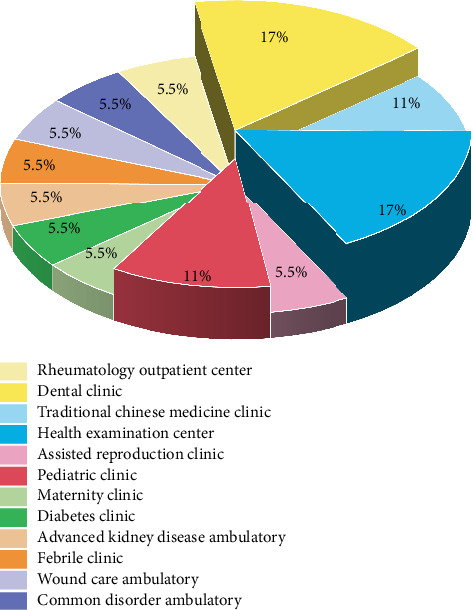
The 3D pie chart of outpatient type distribution.
Figure 4.

The regional distribution map.
4.3. Summary of Outpatient Care Quality Indicators
4.3.1. Structure
Table 2 shows the summary of quality indicators of ambulatory care based on Donabedian model. According to Donabedian's three-dimensional quality model, the quality structure indicators of outpatient care mainly consist of four secondary indicators. These include outpatient management system and norms, organizational environment, nursing human resources, and material resource allocation. The outpatient management system and norms mainly focus on eight tertiary indicators: outpatient nursing management process, system and responsibilities, service evaluation mechanism, emergency response plan, nurse access system, fee project management system, and technology access standards. The organizational environment primarily considers the presence of visible signage, independent consulting rooms, and adherence to outpatient infection management requirements within the clinic. Nursing human resources mainly evaluate the ratio of doctors/nurses, the proportion of nurses with different degrees, the proportion of nurses with different professional titles, the proportion of nurses with different working years, the turnover rate, the composition of nursing staff levels and the flexible deployment of human resources in emergency situations. The material resources mainly consist of four tertiary indicators: the reasonable allocation of materials and equipment, clear labeling, fixed position, and equipment availability.
Table 2.
Summary of quality indicators of ambulatory care based on the Donabedian model.
| Primary indicators | Secondary indicators | Tertiary indicators |
|---|---|---|
| Structure | Outpatient management system and norms | Clear outpatient care management process |
| Clear outpatient nursing management system | ||
| Clear ambulatory nursing position responsibilities | ||
| Complete outpatient nursing service evaluation mechanism | ||
| Emergency response plan for emergencies | ||
| Nurse admittance system | ||
| Charge item management system | ||
| Outpatient nursing technology access system | ||
| Organizational environment | Visible signage | |
| Separate consultation rooms | ||
| Compliance with outpatient infection management requirements | ||
| Complete safety equipment (e.g., handrails, alarms) | ||
| Nursing manpower allocation | Doctor/nurse ratio | |
| The proportion of nurses with different education background | ||
| The proportion of nurses with different professional titles | ||
| The proportion of nurses with different working years | ||
| Quit rate | ||
| Nursing staff level composition | ||
| Emergency flexible deployment of human resources | ||
| Allocation of material resources | Reasonable configuration of materials and equipment | |
| Clearly labelled and placed in a fixed location | ||
| Instruments and equipment intact rate | ||
|
| ||
| Process | Outpatient specialist nursing practice | Nursing training and assessment implementation and pass rate |
| First aid skills pass rate | ||
| Specialist skills pass rate | ||
| Medical treatment management | Waiting time for patients to be seen | |
| Waiting time for medical treatment | ||
| Triage | ||
| Nursing safety | Correct use of warning signs | |
| Recognition and management of common outpatient emergencies (blood and needle sickness, hypoglycemia, syncope, cardiac arrest, etc.) | ||
| Fall protection implementation | ||
| Execution rate of risk assessment for high-risk patients | ||
| Health education | Health education coverage and awareness of outpatient diseases | |
| Patient identification | Accurate matching of identity information | |
| Nursing record | Outpatient care and information records (mental health, quality of life for patients, and families) | |
| Infection control | Standardized prevention | |
| Hand hygiene | ||
| Occupational exposure | ||
| Disinfection of contact surfaces | ||
| Medical waste collection and disposal standardization rate | ||
| Material and equipment management | Qualified rate of standardized management of high value consumables | |
| First-aid equipment and medicine readiness rate | ||
| Humanistic care | Convenience measures (paper towels, paper cups, water dispensers, self-service vending machines, etc.) | |
| Outpatient nurses' communication and co-ordination skills | ||
| Privacy protection implementation rate | ||
| Implementation rate of patient and family needs assessment | ||
| Implementation rate of patient and family emotional calming | ||
|
| ||
| Outcome | Satisfaction | Patient satisfaction |
| Doctor satisfaction | ||
| Patient complaint incidence and effective handling rate | ||
| Nursing adverse events | Incidence of falls | |
| Incidence of swallowing and aspiration | ||
| Incidence of pressure injury | ||
| Incidence of medication administration errors by nursing staff | ||
| Incidence of occupational exposure of nursing staff | ||
| Quality nursing care | Outpatient appointment | |
| Outpatient follow-up | ||
| Outputs | The development of new technologies and project in nursing | |
| Number of patent applications and papers published | ||
| Number of patients | ||
4.3.2. Process
The process indicators of outpatient nursing quality mainly involve nine secondary indicators of outpatient specialty nursing practice, medical management, nursing safety, health education, patient identification, nursing records, infection control, material, and equipment management and humanistic care. Specialized nursing practice mainly assesses the implementation of outpatient nursing training and the pass rate, the pass rate of first aid skills and the pass rate of professional skills. Medical management mainly includes 3 tertiary indicators of patient waiting time, treatment duration and triage. Nursing care safety includes the correct use of warning signs, identification and management of common outpatient emergencies (blood sickness, needle sickness, hypoglycemia, syncope, cardiac arrest, and etc.), implementation of fall protection and implementation rate of risk assessment for high-risk patients. Infection control is an important element of outpatient care quality indicators, including five tertiary indicators of standardized prevention, hand hygiene, occupational exposure, contact surface disinfection and standardized rates of medical waste collection and disposal. Humanistic care is mainly involved in 5 tertiary indicators: convenience measures (paper towels, paper cups, water dispensers, self-service vending machines, and etc.), communication and coordination skills of outpatient nurses, implementation rate of privacy protection, implementation rate of patients' and family members' needs assessment, and implementation rate of patients' and family members' emotional calming. Please refer to Table 2 for more detailed information.
4.3.3. Outcome
The outcome section primarily assessed four secondary indicators: satisfaction, nursing adverse events, high quality nursing, and outputs. Satisfaction includes three tertiary indicators: patient satisfaction with nursing, doctor satisfaction with outpatient nurses, patient complaint incidence and effective handling rate. Adverse nursing events were evaluated using five tertiary indicators: the occurrence of falls, swallowing and aspiration incidents, pressure ulcers, nursing errors, and occupational exposures. In addition to this, the development of new technologies and programs in nursing, the number of patents filed and papers published, and the number of patients seen were used as tertiary indicators to assess the quality of care in the outpatient clinics. Details are provided in Table 2.
5. Discussion
Previous studies have shown that the application of the Donabedian model in the quality of care has shown high-quality development [55, 56], breaking the subjective evaluation of quality evaluation, to a certain extent, promoting the improvement of the evaluation of the quality of care, and using this to push the quality improvement and evaluation to a more scientific and standardized category. The model has been widely used and evaluated in emergency departments, operating rooms, intensive care units, and oncology departments [19–21], but its use in outpatient settings began late and remains limited. The 18 articles included in this study show that the quality of outpatient care has gradually begun to receive attention in recent years, and all are exploring outpatient-specific quality of care indicators to more scientifically assess the quality of outpatient care. However, the shortcoming lies in the underutilization of the Donabedian model in outpatient clinics, as evidenced by its limited application and insufficient research papers on the subject. We anticipate that the Donabedian model will be further developed and expanded to encompass the quality of outpatient care.
This study involved oral, fever, traditional Chinese medicine, advanced kidney disease, and pediatric outpatient care. Each outpatient population has its own unique characteristics. We reviewed 18 papers and found that quality of care indicators constructed based on the structure-process-outcome model have commonalities as well as their own peculiarities. In the structure, institutional norms and environmental settings are emphasized in all specialty clinics. During the process, each specialty clinic incorporated an assessment of specialty-adapted technologies based on its own characteristics. For example, Chinese medicine outpatient clinics assessed the correct rate of implementation of evidence-based care, the standardization rate of Chinese medicine nursing techniques, and the implementation rate of Chinese medicine health promotion in the nursing process [40]. Due to the unique characteristics of pediatric outpatient clinics [57], such as the young age of patients and their lack of behavioral control, quality assessment of nursing processes in these clinics focuses on standardized venous blood collection, use of restraining devices, psychological assessment of children, proper disposal procedures, effective communication among family members, and education for family members [44]. These differences in specialty characteristics lead to the need for further validation and harmonization of outpatient care quality indicators constructed on the basis of the Donabedian model. In addition to this, the process indicators of infection prevention and nursing safety are all key sensitive indicators of nursing quality that have gained wide international recognition [3]. Among the outcomes, satisfaction and adverse events of care were the key indicators to assess the quality of care. Satisfaction assessment is important in improving the patient experience, building healthy nurse-patient relationships, and promoting continuous improvement in nurse-patient services [58]. The importance of assessing nursing adverse events is to promptly identify and address issues in the nursing process, prevent recurrence of similar events, enhance the quality of nursing care, ensure patient safety, support professional development of nursing staff, and create a safer healthcare environment [59].
Reviewing these 18 studies conducted in outpatient clinics, we found that researchers mostly used mixed studies when applying the Donabedian model. Mixed studies often use Delphi, semistructured interviews, hierarchical analysis, or evidence-based methods to construct a quality evaluation system for each outpatient specialty and sensitive indicators of quality of care to assess the quality of outpatient care. Although there are lots of studies that use the model to construct the evaluation system, few scholars have applied the constructed evaluation system. Only one of the included studies [44] applied the constructed evaluation system clinically and evaluated the effect. In addition, there was only one quantitative study among 18 studies [47], which constructed a continuum of care intervention based on the structure-process-outcome model to evaluate the effectiveness of the intervention for patients with gestational diabetes mellitus (GDM). Quantitative studies mainly use the model as a basis for constructing more optimized care plans, aiming to provide better quality care for patients. It is worth noting that despite the uniformity of the research methodology used in the mixed study, there were differences in the results of the study due to the specific attributes of each outpatient specialty. The number of indicators at each level, the importance of each indicator, and the weighting of each indicator are different in the results of each outpatient specialty, which may lead to limitations in the uniformity and application of outpatient nursing care quality evaluation standards, affecting the extrapolation of the research results and their clinical application. In the future we expect more extensions of the Donabedian model in outpatient quality of care studies. For example, conducting more intervention studies with large samples based on structure-process-outcome models to optimize more care protocols. Qualitative research is also the next hot topic that can be explored in this field.
5.1. Limitation
This scoping review provides an overview of published research on the quality of outpatient care based on the Donabedian model over the last 5 years. It uses a systematic search strategy as transparent and easily repeatable as a systematic evaluation [60]. However, it is still important to point out some limitations of this study. The first limitation is that this study did not search all relevant databases.
To expand the search and increase results yield the search could be repeated in other databases such as MEDLINE, CINAHL, the Joanna Briggs Institute, and Google Scholar. It could have also included nonresearch publications. This review focus on the application of the Donabedian model to the quality of outpatient care, rather than the systematic construction of quality indicators for outpatient care. This may be a limitation for scholars who are interested in exploring the construction of metrics for outpatient care. A third potential limitation is that the subject of the study was an outpatient clinic, which may limit generalizability. However, the purpose of this review is to provide an overview of published works related to the topic to inform the reader and help identify the need for further research on the topic, which has been accomplished.
6. Conclusion
This study provides an overview of the application of the Donabedian model in outpatient care quality, including study types, outpatient types, regional distribution, and summarizes outpatient care quality indicators from the structure-process-outcome. Outpatient care quality studies based on the Donabedian model are predominantly mixed, with a relatively homogenous type of study. Mixed studies have used data analysis, Delphi method, and semistructured interviews to innovate and improve the evaluation indexes of outpatient specialty care quality. However, these are only constructing the index system, not applying it in practice, or only focusing on single-center and small-sample applications, lacking the validation of large sample sizes in clinical practice. Interventional and qualitative research would be the next frontier. Multicenter and large sample applications are needed in the future to make it a better value in nursing practice to promote the continuous improvement of outpatient nursing quality. Structural indicators of outpatient care quality provide additional policy and resource support for nursing managers. Process quality involves different outpatient clinic types, and specialty nursing practice indicators have variability and still require further validation and harmonization. Satisfaction and adverse events are core components of outpatient care quality outcome evaluation and important for continuous quality improvement.
7. Implications for Nursing Management
The application of the Donabedian model including study types, outpatient types, regional distribution, and quality indicators, as summarized in this review, offers novel insights and references for nursing managers aiming to enhance the quality of outpatient nursing care. Nursing administrators should actively emphasize and effectively assess important quality indicators such as adverse events, satisfaction, and safety of care, and place outpatient safety, satisfaction, and quality improvement at the forefront of improving the quality of outpatient care. In addition, nursing managers should explore more nursing quality practice methods based on the Donabedian model, listen to patients' voices on nursing quality, and apply qualitative research and intervention methods to quality management.
Acknowledgments
The authors would like to acknowledge Xue Li, Tingting Zhou, and Sulan Jiang for their great support and for providing the research team with adequate research time and resources.
Data Availability Statement
The data that support the findings of this study are available from the corresponding author upon reasonable request.
Ethics Statement
Ethics approval was not required for this scoping review.
Conflicts of Interest
The authors declare no conflicts of interest.
Author Contributions
J.Y.: conceptualization, database search, methodology, data synthesis, writing – original draft, writing – review and editing. F.L.: supervision, resources, writing – review and editing. C.Y.: methodology, data synthesis, writing – review and editing. J.W.: methodology, data synthesis, writing – review and editing. Y.M.: methodology, data extraction and charting, data synthesis, writing – review and editing. L.X.: methodology, data extraction and charting, data synthesis, writing – review and editing. J.X.: methodology, data extraction and charting, data synthesis, writing – review and editing. J.W.: methodology, data extraction and charting, data synthesis, writing – review and editing.
Funding
This study was supported by the project of West China Stomatological Hospital of Sichuan University (RD-01-202401).
Supporting Information
Additional supporting information can be found online in the Supporting Information section.
Additional Supporting Information may be found in the online version of this article.
Table S1: Search terms for various databases. Please note: The publisher is not responsible for the content or functionality of any supporting information supplied by the authors. Any queries (other than missing content) should be directed to the corresponding author for the article.
References
- 1.Chen L., Xi X. The Study of Evaluation for the Quality of Extended Care Based on Donabedian Model of Care. Chinese Nursing Management- . 2015;15(06):713–717. doi: 10.3969/j.issn.1672-1756.2015.06.023. [DOI] [Google Scholar]
- 2.Chen Y., Zheng J., Wu D., Zhang Y., Lin Y. Application of the PDCA Cycle for Standardized Nursing Management in a COVID-19 Intensive Care Unit. Annals of Palliative Medicine . 2020;9(3):1198–1205. doi: 10.21037/apm-20-1084. [DOI] [PubMed] [Google Scholar]
- 3.Eglseer D., Osmancevic S., Hoedl M., Lohrmann C., Bauer S. Improving the Quality of Nursing Care in Austria: 10 Years of Success. Journal of Nursing Management . 2021;29(2):186–193. doi: 10.1111/jonm.13136. [DOI] [PMC free article] [PubMed] [Google Scholar]
- 4.Lee S. E., Scott L. D., Dahinten V. S., Vincent C., Lopez K. D., Park C. G. Safety Culture, Patient Safety, and Quality of Care Outcomes: A Literature Review. Western Journal of Nursing Research . 2019;41(2):279–304. doi: 10.1177/0193945917747416. [DOI] [PubMed] [Google Scholar]
- 5.Coulon L., Mok M., Krause K. L., Anderson M. The Pursuit of Excellence in Nursing Care: What Does it Mean? Journal of Advanced Nursing . 1996;24(4):817–826. doi: 10.1046/j.1365-2648.1996.25921.x. [DOI] [PubMed] [Google Scholar]
- 6.Kunaviktikul W., Anders R. L., Srisuphan W., Chontawan R., Nuntasupawat R., Pumarporn O. Development of Quality of Nursing Care in Thailand. Journal of Advanced Nursing . 2001;36(6):776–784. doi: 10.1046/j.1365-2648.2001.02039.x. [DOI] [PubMed] [Google Scholar]
- 7.Hall L. W., Moore S. M., Barnsteiner J. H. Quality and Nursing: Moving From a Concept to a Core Competency. Urologic Nursing . 2008;28(6):417–425. [PubMed] [Google Scholar]
- 8.Shi M., Xi S. Application Advances of NDNQI Database in Evaluation of Nursing Quality. Nursing Research . 2020;34(04):651–654. [Google Scholar]
- 9.Amiri A., Solankallio-Vahteri T., Tuomi S. Role of Nurses in Improving Patient Safety: Evidence From Surgical Complications in 21 Countries. International Journal of Nursing Science . 2019;6(3):239–246. doi: 10.1016/j.ijnss.2019.05.003. [DOI] [PMC free article] [PubMed] [Google Scholar]
- 10.Mustonen M., Ameel M., Ritmala M., Leino-Kilpi H. Nursing Quality Indicators in Emergency Nursing: A Scoping Review. Journal of Nursing Care Quality . 2024;39(4):376–382. doi: 10.1097/ncq.0000000000000790. [DOI] [PubMed] [Google Scholar]
- 11.Ayanian J. Z., Markel H. Donabedian’s Lasting Framework for Health Care Quality. New England Journal of Medicine . 2016;375(3):205–207. doi: 10.1056/NEJMp1605101. [DOI] [PubMed] [Google Scholar]
- 12.Donabedian A. Evaluating the Quality of Medical Care. Milbank Memorial Fund Quarterly . 1966;44:166–206. [PubMed] [Google Scholar]
- 13.De Rosis S. Performance Measurement and User-Centeredness in the Healthcare Sector: Opening the Black Box Adapting the Framework of Donabedian. The International Journal of Health Planning and Management . 2024;39(4):1172–1182. doi: 10.1002/hpm.3732. [DOI] [PubMed] [Google Scholar]
- 14.Ryan C., Powlesland J., Phillips C., et al. Nurses’ Perceptions of Quality Care. Journal of Nursing Care Quality . 2017;32(2):180–185. doi: 10.1097/ncq.0000000000000211. [DOI] [PubMed] [Google Scholar]
- 15.Donabedian A. Quality Assurance, Structure, Process and Outcome. Nursing Standard . 1992;7(11 Suppl QA):4–5. [PubMed] [Google Scholar]
- 16.Elayan R. M., Ahmad M. M. Assessment of the Quality of Nursing Care From Perspectives of Nurses Who Experienced Hospitalization as Patients. Journal of Nursing Care Quality . 2017;32(4):369–374. doi: 10.1097/ncq.0000000000000259. [DOI] [PubMed] [Google Scholar]
- 17.Hussin E. O. D., Wong L. P., Chong M. C., Subramanian P. Factors Associated With Nurses’ Perceptions About Quality of End-of-Life Care. International Nursing Review . 2018;65(2):200–208. doi: 10.1111/inr.12428. [DOI] [PubMed] [Google Scholar]
- 18.Wang Q., Liu S., Nie Z., et al. The Pan-Canadian Tiered Pricing Framework and Chinese National Volume-Based Procurement: A Comparative Study Using Donabedian’s Structure-Process-Outcome Framework. Journal of Global Health . 2023;13:p. 04137. doi: 10.7189/jogh.13.04137. [DOI] [PMC free article] [PubMed] [Google Scholar]
- 19.Goenka A., Mundkur S., Sujir Nayak S., et al. Improving the Emergency Services Using Quality Improvement Project and Donabedian Model in a Quaternary Teaching Hospital in South India. BMJ Open Quality . 2024;13(1) doi: 10.1136/bmjoq-2022-002246. [DOI] [PMC free article] [PubMed] [Google Scholar]
- 20.Qu J., Fu X. Emergency Departments, Operating Rooms, Intensive Care Units, and Oncology Wards. Nursing Research . 2022;36(22):4007–4012. [Google Scholar]
- 21.Tanaka Y., Masukawa K., Kawashima A., Hirayama H., Miyashita M. Quality Indicators for Palliative Care in Intensive Care Units: A Systematic Review. Annals of Palliative Medicine . 2023;12(3):584–599. doi: 10.21037/apm-22-1005. [DOI] [PubMed] [Google Scholar]
- 22.Nguyen F., Liao G., McIsaac D. I., Lalu M. M., Pysyk C. L., Hamilton G. M. Perioperative Quality Indicators Specific to the Practice of Anesthesia in Noncardiac Surgery: An Umbrella Review. Canadian Journal of Anaesthesia . 2024;71(2):274–291. doi: 10.1007/s12630-023-02671-4. [DOI] [PubMed] [Google Scholar]
- 23.Spanos S., Singh N., Laginha B. I., et al. Measuring the Quality of Skin Cancer Management in Primary Care: A Scoping Review. Australasian Journal of Dermatology . 2023;64(2):177–193. doi: 10.1111/ajd.14023. [DOI] [PMC free article] [PubMed] [Google Scholar]
- 24.Krass I., Costa D., Dhippayom T. Development and Validation of the Attitudes to Pharmacist Services for Diabetes Scale (APSDS) Research in Social and Administrative Pharmacy . 2015;11(1):74–84. doi: 10.1016/j.sapharm.2014.04.005. [DOI] [PubMed] [Google Scholar]
- 25.Petrosyan Y., Sahakyan Y., Barnsley J. M., Kuluski K., Liu B., Wodchis W. P. Quality Indicators for Care of Depression in Primary Care Settings: A Systematic Review. Systematic Reviews . 2017;6(1):p. 126. doi: 10.1186/s13643-017-0530-7. [DOI] [PMC free article] [PubMed] [Google Scholar]
- 26.Yin X., Cheng Y., Gu G. Construction of a Quality Evaluation Index System for Continuity of Care for COPD Patients. Journal of Qilu Nursing . 2024;30(04):31–35. [Google Scholar]
- 27.Aromataris E., Lockwood C., Porritt K., Pilla B., Jordan Z. JBI Manual for Evidence Synthesis. 2024. [DOI]
- 28.Fan Q. Q., Feng X. Q., Jin J. F. Nursing Rounds: A Quality Improvement Project to Improve Outpatient Satisfaction. Journal of Nursing Management . 2021;29(2):177–185. doi: 10.1111/jonm.13131. [DOI] [PubMed] [Google Scholar]
- 29.Santos K. M. D., Tracera G. M. P., Sousa K., Palheta A., Marion da Silva R., Zeitoune R. C. G. Management Styles in Outpatient Nursing Work: Impacts on the Worker’s Health. Revista da Escola de Enfermagem da USP . 2022;56:p. e20220127. doi: 10.1590/1980-220X-REEUSP-2022-0127en. [DOI] [PMC free article] [PubMed] [Google Scholar]
- 30.Pleh D. N., Rosted E., Thomsen T. G. Key Competences of Outpatient Nurses, as Perceived by Patients Attending Nurse-Led Clinics: An Integrative Review. Journal of Clinical Nursing . 2021;30(3-4):311–322. doi: 10.1111/jocn.15557. [DOI] [PubMed] [Google Scholar]
- 31.Hetland J., Bakker A. B., Espevik R., Olsen O. K. Daily Work Pressure and Task Performance: The Moderating Role of Recovery and Sleep. Frontiers in Psychology . 2022;13:p. 857318. doi: 10.3389/fpsyg.2022.857318. [DOI] [PMC free article] [PubMed] [Google Scholar]
- 32.Linnaranta O., Bourguignon C., Crescenzi O., et al. Late and Instable Sleep Phasing Is Associated With Irregular Eating Patterns in Eating Disorders. Annals of Behavioral Medicine . 2020;54(9):680–690. doi: 10.1093/abm/kaaa012. [DOI] [PMC free article] [PubMed] [Google Scholar]
- 33.Fleury M. J., Cao Z., Grenier G., Huýnh C. Profiles of Quality of Outpatient Care Use, Associated Sociodemographic and Clinical Characteristics, and Adverse Outcomes Among Patients With Substance-Related Disorders. Substance Abuse Treatment, Prevention, and Policy . 2023;18(1):p. 5. doi: 10.1186/s13011-022-00511-0. [DOI] [PMC free article] [PubMed] [Google Scholar]
- 34.Daudt H. M., van Mossel C., Scott S. J. Enhancing the Scoping Study Methodology: A Large, Inter-professional Team’s Experience With Arksey and O’Malley’s Framework. BMC Medical Research Methodology . 2013;13:p. 48. doi: 10.1186/1471-2288-13-48. [DOI] [PMC free article] [PubMed] [Google Scholar]
- 35.Arksey H., O’Malley L. Scoping Studies: Towards a Methodological Framework. Nternational Journal of Social Research Methodology: Theory and Practice . 2005;8(1):19–32. doi: 10.1080/1364557032000119616. [DOI] [Google Scholar]
- 36.Tricco A. C., Lillie E., Zarin W., et al. PRISMA Extension for Scoping Reviews (PRISMA-ScR): Checklist and Explanation. Annals of Internal Medicine . 2018;169(7):467–473. doi: 10.7326/m18-0850. [DOI] [PubMed] [Google Scholar]
- 37.Mehl C., Mueller T., Nau T., Bachmann C., Geraedts M. Development of an Indicator Set for the Evaluation of the Quality of Routine Ambulatory Health Care for Common Disorders in Children and Adolescents. Zeitschrift Fur Evidenz Fortbildung Und Qualitaet Im Gesundheitswesen . 2024;186:69–76. doi: 10.1016/j.zefq.2024.03.002. [DOI] [PubMed] [Google Scholar]
- 38.Ibishi V., Kiltz U., Tsiami S., Wessels M., Baraliakos X. Patient-Oriented Optimization of the Quality of Care in a Specialized Outpatient Clinic in a Tertiary Rheumatology Center: A Qualitative Study. Zeitschrift fur Rheumatologie . 2024 doi: 10.1007/s00393-024-01520-z. [DOI] [PMC free article] [PubMed] [Google Scholar]
- 39.Zeng H., Gan L., Li H., et al. Construction of Sensitive Quality Index System of Dental Clinic Nursing. Chinese Journal of Modern Nursing . 2023;29(34):4701–4705. doi: 10.3760/cma.j.cn115682-20230523-02027. [DOI] [Google Scholar]
- 40.Chen J., Fang H., Liu Y., Bai Y., Deng L. Building Nursing Quality Evaluation Index System for Health Management Center. Journal of Kunming Medical University . 2022;43(4):170–174. doi: 10.12259/j.issn.2095-610X.S20220429. [DOI] [Google Scholar]
- 41.Jiang N., Yu W. Constructing a Nursing Quality Sensitive Indicator System for Physical Examination Centers Based on the Donabedian Structure Process Result Three-Dimensional Quality Evaluation Model. International Journal of Nursing . 2023;42(24) doi: 10.3760/cma.j.cn221370-20221216-01078. [DOI] [Google Scholar]
- 42.Lyu H., Chang Q., Gao Y., Li M., Yue S. Study on the Construction of Nursing Quality Index of Assisted Reproduction Center. Chinese Journal of Reproduction and Contraception . 2019;39(11):914–916. doi: 10.3760/cma.j.issn.2096-2916.2019.11.009. [DOI] [Google Scholar]
- 43.Wang Z., Li H., Jiang M. Construction of Sensitive Quality Indicators for Specialized Nursing in Oral Outpatient Department. Chinese Journal of Practical Nursing . 2022;38(14):1091–1096. doi: 10.3760/cma.j.cn211501-20211104-03044. [DOI] [Google Scholar]
- 44.Zhang X., Gao b., Li F., Hu X. Construction and Application of Quality Evaluation Index System for Pediatric Outpatient Nursing Services. International Journal of Nursing . 2024;43(1):6–11. doi: 10.3760/cma.j.cn221370-20220831-00002. [DOI] [Google Scholar]
- 45.Sun M., Wang Y., Xu M., Tan X., Yao B., Yang D. Construction of Nursing Quality Indicators in Chinese Medicine Nursing Outpatient Clinics. Journal of Traditional Chinese Medicine Management . 2023;31(4) [Google Scholar]
- 46.Shao K., Jin J., Fu L. Construction of Sensitivity Index System for Nursing Quality in Geriatric Stomatological Outpatient. Journal of Nursing (China) . 2021;28(22):30–35. doi: 10.16460/j.issn1008-9969.2021.22.030. [DOI] [Google Scholar]
- 47.Lu Y., Xue H., Da Y. Application of Continuous Nursing Based on Structure-Process-Result Three-Dimensional Quality Evaluation in Nursing of Patients With Gestational Diabetes Mellitus. Diabetes New World . 2022;25(5) doi: 10.16658/j.cnki.16724062.2022.05.009. [DOI] [Google Scholar]
- 48.Li W., Zhang C., Hu X., et al. Construction of Quality Evaluation Index System for Diabetes Nurse Gled Clinic. Journal of Nurses Training . 2023;38(15):1350–1355. doi: 10.16821/j.cnki.hsjx.2023.15.002. [DOI] [Google Scholar]
- 49.Mueller T., Mehl C., Nau T., Bachmann C., Geraedts M. Process Over Outcome Quality in Paediatrics? An Analysis of Outpatient Healthcare Quality Indicators for Seven Common Diseases. Bmj Open Quality . 2023;12(1) doi: 10.1136/bmjoq-2022-002125. [DOI] [PMC free article] [PubMed] [Google Scholar]
- 50.Jiang Y. Constructing a Nursing Quality Sensitive Indicator System for Physical Examination Centers Based on the Donabedian Structure Process Result Three-Dimensional Quality Evaluation Model. Modern Nursing . 2024;31(06):163–167. doi: 10.19792/j.cnki.1006-6411.2024.17.039. [DOI] [Google Scholar]
- 51.Hingwala J., Molnar A. O., Mysore P., Silver S. A. An Environmental Scan of Ambulatory Care Quality Indicators for Patients With Advanced Kidney Disease Currently Used in Canada. Canadian Journal of Kidney Health and Disease . 2021;8 doi: 10.1177/2054358121991096. [DOI] [PMC free article] [PubMed] [Google Scholar]
- 52.Guo X., Liu Q., Meng J., Ma j. Construction of Sensitive Indicators in Fever Clinics in Henan Province. Henan Medical Research . 2024;33(4):608–613. doi: 10.3969/j.issn.1004-437X.2024.04.008. [DOI] [Google Scholar]
- 53.Dufour É., Duhoux A., Contandriopoulos D. Measurement and Validation of Primary Care Nursing Indicators Based on a Wound Care Tracer Condition. Journal of Nursing Care Quality . 2020;35(1):63–69. doi: 10.1097/ncq.0000000000000403. [DOI] [PubMed] [Google Scholar]
- 54.Chen X., Ma Q., Yu H. Construction of Nursing Quality Evaluation Index System for Nurse-Led Traditional Chinese Medicineclinic. Chinese Journal of Practical Nursing . 2022;38(17) [Google Scholar]
- 55.Moore L., Lavoie A., Bourgeois G., Lapointe J. Donabedian’s Structure-Process-Outcome Quality of Care Model: Validation in an Integrated Trauma System. Journal of Trauma and Acute Care Surgery . 2015;78(6):1168–1175. doi: 10.1097/ta.0000000000000663. [DOI] [PubMed] [Google Scholar]
- 56.Tossaint-Schoenmakers R., Versluis A., Chavannes N., Talboom-Kamp E., Kasteleyn M. The Challenge of Integrating eHealth Into Health Care: Systematic Literature Review of the Donabedian Model of Structure, Process, and Outcome. Journal of Medical Internet Research . 2021;23(5):p. e27180. doi: 10.2196/27180. [DOI] [PMC free article] [PubMed] [Google Scholar]
- 57.Yun Y. M., Kirby C., Bob N., et al. Promoting Sustainability Practices in the Outpatient Pediatric Setting. Yale Journal of Biology and Medicine . 2023;96(2):261–265. doi: 10.59249/vcah6394. [DOI] [PMC free article] [PubMed] [Google Scholar]
- 58.Kalaja R., Krasniqi M. Patient Satisfaction With Quality of Care in Public Hospitals in Albania. Frontiers in Public Health . 2022;10:p. 925681. doi: 10.3389/fpubh.2022.925681. [DOI] [PMC free article] [PubMed] [Google Scholar]
- 59.Lv Y. S., Xue J., Meng Z., Zhang Q., Liu X. H. Value of Improved Nursing Measures and Enhanced Nursing Management to Reduce the Occurrence of Adverse Events in Pediatric Infusion. World Journal of Clinical Cases . 2024;12(20):4130–4136. doi: 10.12998/wjcc.v12.i20.4130. [DOI] [PMC free article] [PubMed] [Google Scholar]
- 60.Colquhoun H. L., Levac D., O’Brien K. K., et al. Scoping Reviews: Time for Clarity in Definition, Methods, and Reporting. Journal of Clinical Epidemiology . 2014;67(12):1291–1294. doi: 10.1016/j.jclinepi.2014.03.013. [DOI] [PubMed] [Google Scholar]
Associated Data
This section collects any data citations, data availability statements, or supplementary materials included in this article.
Supplementary Materials
Additional supporting information can be found online in the Supporting Information section.
Data Availability Statement
The data that support the findings of this study are available from the corresponding author upon reasonable request.