


Objectives
This is a protocol for a Cochrane Review (prototype). The objectives are as follows:
To assess the effects of weight‐neutral interventions for managing obesity in children and adults (quantitative data).
To explore the views, perspectives and experiences of children and adults receiving the intervention, their close family members or, if appropriate, carers, and healthcare personnel who recommend or deliver weight‐neutral interventions to determine their feasibility and acceptability and any factors that create barriers and facilitators to optimal implementation (qualitative data).
To determine whether the programme theories, components and delivery of interventions take account of the views, perspectives and experiences of intervention recipients and whether patient‐centred interventions have greater effects.
Background
Description of the condition
Definition of the health problem
Obesity has been defined as a chronic disease due to the excessive accumulation of body adiposity [1], but also as a risk factor associated with several diseases, predominantly coronary heart disease, ischaemic stroke, and type 2 diabetes, among others [2]. Recent developments have proposed a more clinical definition of obesity, focusing on the clinical manifestations of obesity itself [3]. Even body mass index (BMI)‐based definitions have been challenged, considering that BMI cut‐off points will misclassify individuals, leading to under‐ and over‐diagnosis [4]. Furthermore, there is variability in the acceptance of alternate terms for obesity, including the denomination 'fat', which in some cases is considered stigmatising but in others sometimes preferred [5]. For the purpose of this review and considering the scope of eligible interventions, we will focus on obesity as a risk factor and use ‘high weight’ or ‘higher body size’ to acknowledge the spectrum of definitions. However, in some circumstances, we might need to refer to obesity and high BMI depending on the sources of the data we use and for clarity.
While genetic factors are significant contributors to increased obesity, environmental factors, including social and commercial determinants of health, are important drivers of the obesity epidemic [6]. Social determinants of health, such as socioeconomic status, education level, and access to safe recreational spaces, significantly influence health outcomes. In parallel, commercial determinants, such as the marketing and availability of ultra‐processed foods and sugary beverages, also play a critical role in shaping dietary behaviours and consumption patterns [7].
According to the Global Burden of Disease study, disability‐adjusted life‐years (DALYs) attributable to high BMI more than doubled between 1990 and 2017 [8]. After cardiovascular disease, elevated BMI was the fifth leading risk factor for attributable DALYs in 2019 [9]. Nonetheless, BMI is known to be an imperfect indicator of health status; adiposity, measured through waist circumference or other methods, may better predict the risk associated with obesity [10, 11]. Moreover, whereas obesity is a risk factor for various conditions, such as cardiovascular disease, cancer and type 2 diabetes, people living with obesity also experience social stigma and discrimination, leading to impaired mental and physical health [12]. Obesity may account for up to 18% of total health expenditure and more than 2% of countries’ gross domestic products [13].
Current management options for obesity in adults
The mainstay of medical management of obesity traditionally includes programs related to lifestyle changes aimed at weight loss, which usually involve a combination of modifications in behaviour, diet and physical activity. Nonetheless, the effectiveness of these programs in achieving their goal of long‐term and sustained weight loss has been disappointing. A recent systematic review and meta‐analysis indicated that the mean change in weight at 24 months or more was only −1.8 kg (95% confidence interval (CI) −2.8 to −0.8 kg) [14]. Despite their limited effects, recommendations to make lifestyle changes to achieve weight loss are incorporated into several guidelines, such as the one from the National Institute for Health and Care Excellence (NICE) in the UK, where programmes are recommended to achieve weight loss of at least 3%, estimating that 30% of participants lose at least 5% of their weight [15].
Alternative interventions for the weight management of obesity include the use of drugs and bariatric surgery [16, 17]. Newer drugs such as semaglutide show early promising results on hard outcomes such as cardiovascular events in adults; however, issues related to long‐term safety and weight maintenance need to be further clarified [18]. Moreover, the costs, accessibility, and sustainability of these high‐cost treatments likely raise equity issues in low‐resource settings. Furthermore, surgery, while promising, is an irreversible procedure and reserved for a selection of participants with very high weight.
In the last few years, some initiatives have focused on ‘staging’ and risk stratification for planning the management of obesity, alongside additional measures to reduce weight bias in healthcare. For instance, the Canadian Guidelines on obesity in adults suggest the ‘5 As’ approach to people with high weight: ASK for permission to discuss weight and explore readiness, ASSESS obesity‐related risks and ‘root causes’ of obesity, ADVISE on health risks and treatment options, AGREE on health outcomes and behavioural goals, ASSIST in accessing appropriate resources and providers [19]. An update on the guidelines for children is planned with the same philosophy. This Framework provides a progressive approach to starting discussions with people with high weight and planning tailored activities focused on patient‐centred outcomes [20]. Mexican, Argentinean and European guidelines have followed a similar approach, but they still mention weight loss as one of the main outcomes of health‐behaviour interventions [21, 22, 23]. Moreover, there is no information on their implementation and a change may require additional (re‐)training of medical professionals [24].
Management of obesity in children and adolescents
The weight and well‐being of children are monitored from birth and through school. If a child is picked up and labelled as living with overweight or obesity and in need of intervention, recommended approaches for children and adolescents usually include family‐based approaches [25, 26]. These interventions focus not only on the individual but also on the environment, including primarily the family and the environment (typically schools). Four large Cochrane reviews found that these interventions may have limited effects on children and adolescents [27, 28, 29, 30]. A narrow focus on the environment close to these families may limit their effectiveness, as broader social determinants, such as economic disparities and commercial determinants, including the marketing of unhealthy products to children, remain under‐addressed [31]. Nonetheless, guidelines recommend these approaches [25, 26], in some cases aiming to achieve at least a 5% weight reduction [26]. The role of drugs and bariatric surgery in this population is restricted to older ages (adolescents) and the presence of comorbidities [26].
The problem of weight bias
One of the factors at play in the management of obesity is weight bias. Weight bias refers to negative attitudes, beliefs, and judgements that individuals or society hold towards individuals based on their body weight [32]. This bias can manifest in various forms, including bullying (especially amongst children and adolescents), exclusion from sports at school, stereotypes, discrimination, and social exclusion, disproportionately affecting individuals with higher body weights. Weight stigma, on the other hand, encompasses the social and cultural devaluation, stereotyping, and discrimination directed at individuals due to their body weight [33]. Both weight bias and weight stigma contribute to an environment where individuals with higher body weights may face unfair treatment, reduced opportunities, and negative perceptions solely based on their appearance, perpetuating a cycle that can adversely impact mental and physical health [34, 35].
Weight bias has been identified at all community levels, including school personnel, healthcare professionals, and all those who deliver dietary and physical activity interventions [36, 37]. Our consumer group highlighted an example of weight‐focused bias in medical consultations. They described situations where, even when weight was not the patient’s primary concern – such as in cases of knee pain – doctors often prioritise weight loss over exploring other pain management strategies. This approach risks reinforcing weight stigma by assuming that weight is the root cause rather than considering it as one of many potential factors or even a consequence of the patient’s condition.
Weight bias may be internalised during the care of people with high weight and, if it is not addressed actively, it can lead to poor treatment outcomes in those affected individuals, including impaired mental health, eating disorders, and poor self‐esteem [38]. Our consumer group highlighted the role of social media, especially in children and adolescents, when establishing unrealistic expectations about weight loss and body image. Weight regain and the accompanying frustration may reinforce weight bias and may even cause further weight gain and poor metabolic outcomes [39].
Alternative approaches for the management of obesity
In recent decades, there has been a growing focus on the patient movement of Body Positivity, which has been instrumental in reshaping the perspectives of those involved in providing care for people with high weight [40]. Patients, healthcare professionals, and advocacy groups advocate moving beyond weight‐centric approaches, urging a more inclusive and compassionate outlook towards individuals of varying body sizes.
Considering the limited effectiveness of current management options and the possible harms associated with weight stigma and weight bias, alternative weight‐neutral interventions (i.e. interventions for which weight loss is not the main goal) have emerged, focusing on promoting health and well‐being without emphasising or prioritising changes in body weight. They include approaches such as Health at Every Size (HAES), mindful/intuitive eating, size acceptance, non‐diet, health, not weight loss [41]. The main features of one of the most popular approaches, HAES, include weight inclusivity, health enhancement, eating for well‐being, respectful care, and life‐enhancing movement [42]. Nonetheless, these interventions have not been widely implemented in healthcare, and their effectiveness remains uncertain [43].
Recently, there has been a notable surge in the adoption of weight‐neutral programs [43, 44, 45, 46, 47, 48], particularly the HAES paradigm and intuitive eating approaches [49]. The growing number of weight‐neutral initiatives reflects an increasing recognition of the limitations and potential for harm associated with conventional weight‐focused interventions [44, 46, 47].
Description of interventions
The target interventions are likely to be complex. HAES promotes a holistic approach to health and well‐being that prioritises overall wellness rather than focusing on weight loss [50, 51]. This approach incorporates mindful and intuitive eating, in which individuals learn to respond naturally to their internal hunger and fullness cues, fostering a more positive and respectful relationship with food [50, 51]. Fundamental to HAES is the idea of size acceptance, which promotes the idea that every body shape and size should be acceptable, going against conventional norms and societal prejudices against weight [42]. The non‐diet concept at the centre of the HAES approach advocates rejecting traditional dieting practices and encouraging sustainable, health‐promoting behaviours without the primary goal of weight loss.
How will the intervention work: a logic model
Weight‐neutral approaches, also called non‐diet, size‐inclusive, or HAES approaches, are based on respect for body diversity and bodily autonomy. Weight‐neutral health interventions promote body respect and acceptance, as well as eating and movement that are attuned to the individual’s bodily needs and signals. The focus is on health and well‐being, not on weight reduction. Weight‐neutral health interventions never include methods that prescribe eating certain food types or ways of eating or use any external rules about eating, such as calorie limits or time slots.
One of the most popular approaches, HAES, offers a paradigm shift in healthcare by focusing on health‐promoting behaviours rather than weight loss. The Association for Size Diversity and Health (ASDAH) has produced a Framework of Care. This Framework has 10 points (summarised below).
Grounding in liberatory frameworks (i.e. committed to the intersectional work of other movements such as feminism)
Respecting bodily autonomy
Observing informed consent
Providing compassionate care
Analysing critically the medical research and recommendations related to weight
Securing skills and equipment to provide adequate care
Defining clearly the roles and responsibilities of providers when providing care
Equipping with tools to support well‐being and healing
Addressing ‘anti‐fat’ bias
Addressing systemic ‘anti‐fat’ bias.
Throughout this Framework, there is a fundamental plea for a shift in how traditional care for people with high weight is researched, planned, delivered and evaluated [42].
We drew from the HAES principles, components and mechanisms of the interventions and expected outcomes/impact to create a preliminary logic model based on an adaptation of theories of change models by De Silva [52]; this is illustrated in Figure 1. This logic model can be described as follows.
1.
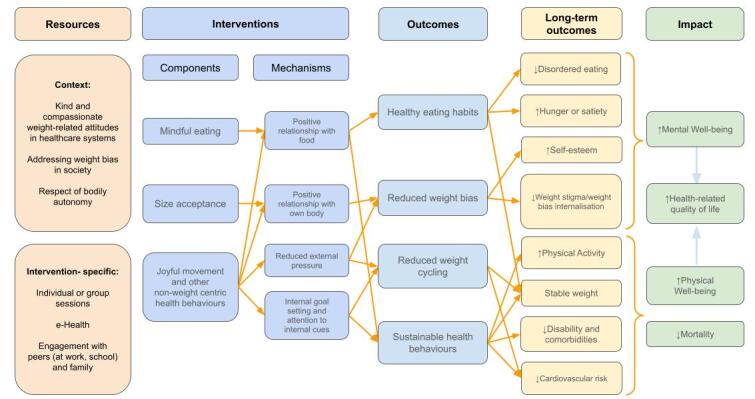
Preliminary logic model developed for the conduct of the review based on the literature and input from the review authors
Resources: these constitute contextual/societal factors that will facilitate/influence the effects of weight‐neutral interventions. They include some of the principles of the HAES approach to compassionate care, addressing weight bias and respect for bodily autonomy as examples to consider in the context in which the interventions are delivered. Moreover, resources specific to the intervention, such as group or individual sessions, e‐Health and the engagement of peers and family, are essential for their delivery.
-
Interventions, mechanisms and outcomes: the components of weight‐neutral approaches may vary and may include the following.
Intuitive eating: interventions to support eating in a way attuned to the body’s signals of hunger and satiety and support a peaceful relationship with food. While mindful eating can be part of intuitive eating, the method itself is not weight‐neutral [53].
Self‐acceptance and the reduction of weight bias/weight bias internalisation: this includes different types of cognitive behavioural therapy (CBT), such as acceptance and commitment therapy. These therapies aim to improve the relationship with their own body and mitigate the negative effects of weight bias and discrimination, reducing weight bias internalisation and improving self‐esteem [53].
Joyful movement and other interventions focusing on health behaviour: they promote a positive relationship with the body and movement for pleasure and appreciation. There is no focus on burning calories or meeting external demands, and they consider individual goals and cues rather than external pressures, such as frequency or duration of physical activity, which can result in less stress due to dieting and weight cycling (i.e. a more stable weight) [53, 54]. Improved health behaviours may have a positive impact on obesity‐related disability, comorbidities and overall cardiovascular risk.
Impact: these complex interventions aim to improve individual outcomes, ultimately improving overall well‐being and quality of life and even reducing mortality.
This generic logic model may need further development as this field of research evolves, and even after the conduct of this review. Moreover, a greater proportion of the evidence for this intervention comes from adults, and few studies were conducted in younger populations, primarily adolescent women [41]. This is because this subgroup is particularly vulnerable to issues related to body image and disordered eating. Weight‐neutral approaches may be instrumental in caring for younger children and adolescents by centring assessment and management on fostering healthy behaviours rather than following societal pressures on weight and body image [55]. Nonetheless, this preliminary logic model may need to be adapted to the characteristics of children and adolescents.
The views of the participants involved in randomised controlled trials of weight‐neutral interventions were explored in ‘sibling’ (embedded) qualitative studies and may provide additional insights into the experience of participating in these interventions [56, 57]. Participants found greater autonomy and pleasure in eating, body image, physical capacity, and decreased automatic eating. Furthermore, qualitative studies with healthcare professionals highlighted conflicting attitudes and views about weight‐neutral approaches, which the authors describe as a change to a weight‐neutral paradigm shift [58]. Further qualitative research with patients provides insights into the views of people with high weight on approaches such as intuitive eating, detailing contrasts to restrictive approaches to dieting [59]. Other qualitative studies have highlighted that patients had positive perceptions of weight‐neutral interventions, including increased confidence surrounding eating, but there appeared to be some barriers to gaining motivation and acquiring the tools to adhere to these approaches [60, 61].
Why is it important to do this review?
A systematic review from 2018 assessed the effects of HEAS approaches and included 14 randomised and non‐randomised studies, indicating beneficial physical and psychological outcomes [62]. An updated review from 2024 found similar changes in anthropometry and other parameters when compared to weight‐loss approaches, with some improvements in eating behaviours [63]. Neither of the reviews used GRADE, and they focused only on quantitative data. Three more recent systematic reviews from 2019, 2020 and 2023 focused on adults and children and identified newer evidence from smaller trials assessing adherence, psychological outcomes, and changes in body weight, with conflicting results [41, 64, 65]. Nonetheless, these reviews also had methodological shortcomings. We identified three records in PROSPERO of registered reviews on this topic restricted to quantitative studies, which have not been published [66, 67, 68]. We found no qualitative evidence synthesis on this topic.
Following the guidance in Chapter 21 of the Cochrane Handbook for Systematic Reviews of Interventions and the upcoming Cochrane‐Campbell Handbook for Qualitative Evidence Synthesis, the use of convergent mixed methods (assessing evidence from quantitative and qualitative studies) provides the opportunity to both assess the effects of these interventions and understand the context in which these interventions are planned and delivered [69]. By synthesising the views, perspectives and experiences of children and adults receiving the interventions, their close family members or, if appropriate, carers, and healthcare personnel who recommend or deliver the interventions, we can identify whether weight‐neutral interventions can better address the needs of individuals living with high weight [69]. Integrating qualitative and quantitative data will foster a more comprehensive understanding of how interventions work and their relevance, serving as a basis for further refinement. This review will also be co‐produced with people who have lived experience and will include public involvement.
Objectives
To assess the effects of weight‐neutral interventions for managing obesity in children and adults (quantitative data).
To explore the views, perspectives and experiences of children and adults receiving the intervention, their close family members or, if appropriate, carers, and healthcare personnel who recommend or deliver weight‐neutral interventions to determine their feasibility and acceptability and any factors that create barriers and facilitators to optimal implementation (qualitative data).
To determine whether the programme theories, components and delivery of interventions take account of the views, perspectives and experiences of intervention recipients and whether patient‐centred interventions have greater effects.
Methods
We will follow standard Cochrane methods according to the guidance of the Cochrane Handbook for Systematic Reviews of Interventions [70], the Methodological Standards for Intervention Reviews (MECIR) [71], and the Cochrane‐Campbell Handbook for Qualitative Evidence Synthesis [72]. Our reporting of the review findings will adhere to PRISMA 2020 [73], and we will follow ENTREQ guidelines (Enhancing transparency in reporting the synthesis of qualitative research) [74]. We will report patient and public involvement following the GRIPP2 (Guidance for Reporting Involvement of Patients and the Public, version 2) statement [75].
Criteria for considering studies for this review
Types of studies
Quantitative data (intervention review)
We will include parallel, cluster, and cross‐over randomised controlled trials (RCTs) and controlled clinical trials. We will also include non‐randomised studies of interventions with the following characteristics: inclusion of a contemporary comparison group, selection of participants by study planners or practitioners, a longitudinal collection of pre‐and post‐intervention data, and adjusted effect measures for observed confounders. These are based on Cochrane guidance on including non‐randomised studies in systematic reviews [76]. These studies will serve as a source of complementary, sequential, or replacement evidence for RCTs if they provide low‐certainty evidence for a given outcome and comparison [77].
Qualitative data (qualitative evidence synthesis)
We will include studies that use qualitative methods for data collection (e.g. interviews, focus group discussions, observations) and data analysis (e.g. thematic analysis, grounded theory, framework analysis), which could come from participants in trials related to management interventions (‘trial siblings’) or those that address the relevant phenomenon of interest. This could include qualitative studies within mixed‐methods studies if it is possible to isolate and extract the qualitative findings [69]; we will not include their quantitative findings. We will exclude studies that used qualitative methods for data collection but did not perform a qualitative analysis (e.g. open‐ended questions in surveys with only a descriptive summary).
We will include studies regardless of date, publication status or language.
Types of participants
Quantitative data (intervention review)
We will include studies on children and adults diagnosed with obesity or high weight/larger body sizes. For adults, obesity will be defined as a BMI of ≥ 30 kg/m2 and further subdivided into the following classes: Class I (BMI 30 to 34.9 kg/m2), Class II (BMI 35 to 39.9 kg/m2), Class III (BMI ≥ 40 kg/m2). For children and adolescents, we will use a BMI‐for‐age greater than two standard deviations above the median or greater than the 95th percentile of the World Health Organization (WHO) Growth Reference Standards [1]. Severe obesity can further be defined as a BMI over three standard deviations above the median or greater than the 120th percentile. Nonetheless, we will include other definitions of obesity or people with high weight, considering the diversity of thresholds based on BMI for the diagnosis of obesity and the different conceptualisations of the included studies of high weight/larger body size.
Qualitative data (qualitative evidence synthesis)
For qualitative studies, we will include studies on adults and children (aged 5 to 18 years), as well as their close family members or, if appropriate, their carers/teachers, etc. and the healthcare professionals providing care for the management of people with high weight.
Types of interventions
Quantitative data (intervention review)
Weight‐neutral approaches include one or more of the following components described in the background section.
Intuitive eating
Self‐acceptance and the reduction of weight bias/weight bias internalisation
Joyful movement and other interventions focusing on health behaviour
Any of the above‐mentioned components or combinations of components aligned with the framework of care in Health at Every Size (HAES) or other non‐diet frameworks
Despite the variability in their components, we will include studies as long as weight loss is not defined as an objective. For instance, we will not include interventions targeting intuitive eating or joyful movement in a framework of weight management/weight‐loss programmes, nor will we include interventions aimed at preventing weight gain. We will place no restriction on the mode of delivery (individual, group, online, in‐person, or hybrid).
Types of comparators
Quantitative data (intervention review)
We will include the following comparators.
Waiting list or other forms of minimal interventions
‘Usual care’, which includes routine forms of management in primary and specialised care
Structured programmes focused on lifestyle changes (nutrition, behaviour and physical activity), including multidisciplinary teams, with a focus on weight loss or management, which may also involve pharmacological or surgical approaches. For children, we will also consider school and family‐based approaches. We will consider all settings (healthcare and community, including at home and in schools for children). Concomitant interventions will be considered if identical in both the intervention and comparator groups.
Qualitative data
We expect that few studies will directly compare two approaches. Therefore, we will include those focusing on weight‐neutral approaches with or without a comparison group.
Comparisons
Quantitative data (intervention review)
We will include the following comparisons.
Weight‐neutral interventions versus waiting list or usual care
Weight‐neutral interventions versus structured weight‐loss programmes
Types of outcome measures
We developed the list of outcomes with the input of our target groups and using existing core‐outcome sets in adults and children, which highlight the need to measure long‐term outcomes (12 to 24 months) and focus on weight change, quality of life, disability and mental health [78, 79, 80].
Quantitative data (intervention review)
Critical outcomes
Health‐related quality of life: measured by validated scales such as the Short Form‐36 (SF‐36) [81], European Quality of Life (EuroQoL) [82], or Pediatric Quality of Life Inventory (PedsQoL)[83].
Self‐esteem and body image: measured by validated scales such as the Rosenberg Self‐Esteem Scale [84], the Body Image Satisfaction Scale [85], and Body Appreciation Scale [86].
Weight bias internalisation (Weight Bias Internalization Scale [87] and the Anti‐Fat Attitudes Test [88]) and experienced weight stigma (Stigmatizing Situations Inventory [89], among others).
Physical activity: measurements of the type, duration, intensity, and frequency (e.g. accelerometer, pedometer or questionnaires).
Physical well‐being: measured by validated scales assessing functioning, mobility, self‐care, life activities and participation.
Mental well‐being: measured by validated scales assessing anxiety, stress, depression, isolation, suicidal ideation.
Disordered eating: measured by validated scales.
Important outcomes
Weight change: measured by BMI/BMI z score/kilograms. In the context of weight‐neutral interventions, this would be considered one of the safety outcomes.
Obesity‐associated disability or overall disability.
-
Obesity comorbidities: including the incidence of non‐communicable diseases (diabetes, cardiovascular disease, osteoarthritis, fatty liver disease, etc.) or surrogate markers, including:
fasting glycaemia: measured or converted to mg/dL or HbA1c,
insulin resistance: insulinemia, euglycemic hyperinsulinemic clamp or other ratios between insulin and glucose (e.g. homeostatic model assessment (HOMA)),
fatty liver indices (enzymes).
Adverse events: those not otherwise covered in the critical outcomes.
-
Cardiovascular risk: as an overall score or indicated by:
blood pressure: measured in mmHg with objective instruments,
lipid metabolism: triglycerides, low‐density lipoprotein, high‐density lipoprotein and total cholesterol.
Hunger or satiety: measured by validated scales.
All‐cause mortality: overall incidence of death in the study period.
We will define time points as short‐term (up to 12 months), medium‐term (from 12 up to 24 months), and long‐term (24 or more months) follow‐up. We will extract and analyse data for the longest follow‐up in each period when multiple time points are reported.
Considering that we have multiple scales for each outcome, we have not predefined a minimally important difference for their interpretation. Nonetheless, we will follow the guidance to select minimally important differences for each scale to guide interpretation [90].
Qualitative data (qualitative evidence synthesis)
We will explore evidence on the following phenomenon of interest: the views, perspectives and experiences (including weight bias, weight stigma and discrimination) of people with high weight, their family members and, if appropriate, their carers and teachers/healthcare professionals in relation to alternative and traditional management programmes. This also includes the acceptability of the intervention, the delivery and implementation fidelity, and the factors that create barriers and facilitators, e.g. regarding the intervention goal, mechanisms of change and implementation [91]. When available, we will also include data on the perception of other key stakeholders (for instance, peers/colleagues, siblings, etc). We will also explore equity, diversity and inclusion [6, 14].
Search methods for identification of studies
Electronic searches
An experienced information scientist (MIM) developed the search strategy for quantitative (RCTs and cohort studies) and qualitative studies in consultation with the author team.
We will search the following sources from the inception of each database to the date of search.
Cochrane Central Register of Controlled Trials (CENTRAL) via the Cochrane Library
MEDLINE (Ovid MEDLINE ALL)
Web of Science Core Collection (Science Citation Index Expanded, Social Sciences Citation Index, Arts & Humanities Citation Index, Emerging Sources Citation Index)
CINAHL EBSCO (Cumulative Index to Nursing and Allied Health Literature)
APA (American Psychological Association) PsycINFO (Ovid)
Bielefeld Academic Search Engine (BASE; www.base‐search.net)
ClinicalTrials.gov (www.clinicaltrials.gov)
World Health Organization International Clinical Trials Registry Platform (ICTRP) (trialsearch.who.int)
For the search strategies for MEDLINE, CENTRAL and Web of Science, see Supplementary material 1. These will be adapted to the other databases before running the search.
Searching other resources
We will search two clinical trial registries (ICTRP and ClinicalTrials.gov) to identify planned, ongoing or completed but unpublished studies. We will use the databases BASE and APA PsycINFO to search the grey literature, and will check the reference lists of included studies.
For qualitative research, we will follow the guidance on searching in chapter 4 of the Cochrane‐Campbell Handbook for Qualitative Evidence Synthesis [72], for example, by conducting forward‐citation searching of included qualitative studies using Web of Science and Scopus, according to the TARCiS statement [92]. We will deduplicate these additional results, incorporate them into the review results, and screen them using the same methods as the main references. We will conduct a new iteration of the forward citation process when additional included studies are identified.
Before submitting the review, we will check all included studies for expressions of concern, errata, corrigenda, and retractions by accessing them again on PubMed, which now incorporates alerts on postpublication amendments in the reference record.
Data collection and analysis
Selection of studies
Two review authors will independently screen the abstract, title, or both of every record retrieved by the literature searches. We will obtain the full text of all potentially relevant records. We will resolve disagreements through consensus or recourse to a third review author.
The selection of studies will create four separate sets of data – two quantitative (adults and children) and two qualitative (adults and children).
For qualitative evidence, we will use the '7S' framework (Sampling and Sources through Structured questions, Search procedures, Strategies and filters and Supplementary strategies, Standards for Reporting) [93]. We will aim to include all qualitative trial sibling studies of included intervention studies as they share the same context and population. From the wider search for qualitative studies, if we identify more studies that meet the inclusion criteria than necessary, we will purposively sample studies to create a maximum variation sample [94].
We will present PRISMA flow diagrams to show the study selection process for each synthesis [73]. We will list all articles excluded after full‐text assessment in a characteristics of excluded studies table and will provide the reasons for exclusion. We will use Covidence software for study selection [95].
Data extraction and management
For studies that fulfil our inclusion criteria, two review authors will independently extract the characteristics of included studies. In the case of disagreement, conflicts will be solved through discussion or consultation with a senior author. We will extract the following data.
Quantitative studies (RCTs and non‐randomised studies of interventions): study design, setting (level of care, country, study period), characteristics of participants (inclusion and exclusion criteria, baseline demographics, anthropometry, sex/gender, age, socioeconomic status, education), details of the interventions and comparisons based on the Template for Intervention Description and Replication (TIDieR) checklist [96], details of the outcomes (definition, measurement, timing and subgroups), funding sources and declarations of interest. We will use Covidence software for this data extraction [95].
Qualitative studies: qualitative approach, aim, epistemology and theoretical models, setting (level of care, country, study period), characteristics of participants (sampling, inclusion and exclusion criteria, baseline demographics, anthropometry, sex/gender, age, socioeconomic status, education and other details of their context), data collection and analysis approach. We will use NVIVO [70] or ATLAS.ti to code data of relevance to the phenomenon of interest that may be found anywhere in the paper and additional files. The exact data coding and extraction method will become clearer when the synthesis method is selected.
We will use a two‐step process to translate the relevant information from papers written in a language other than English: first, by using translation software (DeepL), and secondly, by verification of the translation by a team member who is fluent in the language. If studies are written in a language other than those mastered by the review team (Spanish, English, French, Portuguese, German, Dutch, Danish, Chinese, and Arabic), we will use our network of contacts and Cochrane Engage to get adequate translations of the papers.
Dealing with duplicate and companion publications
In the event of duplicate publications, companion documents, or multiple reports of a primary study, we will maximise the information yield by collating all available data and using the most complete data set aggregated across all known publications. We will list duplicate publications, companion documents, multiple reports of a primary study, and trial documents of included trials (such as trial registry information) as secondary references under the study ID of the included study. Furthermore, we will list duplicate publications, companion documents, multiple reports of a study, and trial documents of excluded trials (such as trial registry information) as secondary references under the study ID of the excluded study.
Data from clinical trial registers
If data from included studies are available as study results in clinical trial registers, such as ClinicalTrials.gov or similar sources, we will make full use of this information and extract the data. We will collate and critically appraise all available data if there is a full study publication. If the published and unpublished data do not match, we will ask the study authors for clarification. If we receive no response, we will present the discrepancies in the full review report. If an included study is labelled as completed in a clinical trial register but no additional information (study results or publication, or both) is available, we will add this study to the characteristics of studies awaiting classification table.
Risk of bias assessment
Quantitative studies
For RCTs, two review authors (JH and YG) will independently assess the risk of bias for the results of the main outcomes (those included in the summary of findings table, see below) in each study using a recently developed revision of the Cochrane risk of bias tool (RoB 2) [97]. We will resolve disagreements by consensus or by consulting a third review author (JVAF). If adequate information is unavailable from the publications, trial protocols, clinical study reports or other sources, we will contact the study authors for more details to request missing data on risk of bias items. We will assess the risk of bias according to the following domains, focusing on the effect of assignment to the intervention at baseline.
The randomisation process
Deviations from intended interventions
Missing outcome data
Measurement of the outcome
Selection of the reported results
Answers to signalling questions and supporting information will collectively lead to a domain‐level judgment of either 'low risk', 'some concerns', or 'high risk' of bias. These domain‐level judgements will inform an overall risk of bias judgement for a single result in the form of (a)'low risk' if all domains are judged as being 'low risk', (b) 'some concerns' if one or more domains are judged as having 'some concerns' and (c) 'high risk' if one or more domains are judged as being 'high risk' or if four domains are judged as having 'some concerns'. We will provide a quote from the study report together with a justification for our judgement in the risk of bias table. We will summarise the risk of bias judgements across different studies for each of the domains listed. We will aim to source trial registries, protocols and analysis plans for the assessment of selective reporting. Where information on the risk of bias relates to unpublished data or correspondence with a trialist, we will note this in the risk of bias table.
When considering treatment effects, we will take into account the risk of bias for the studies that contribute to that outcome. We will construct summary assessments of the risk of bias for each important outcome (across domains), within and across studies.
We will use the RoB 2 Excel tool to manage the data supporting the answers to the signalling questions and risk of bias judgements (available at www.riskofbias.info/). All these data will be publicly available as supplementary material in a public repository.
For cluster‐RCTs, we will use the RoB 2.0 tool, and add another domain, specific to cluster‐RCTs, from the archived version of the tool (Domain 1b. ‘Bias arising from the timing of identification and recruitment of participants’, available at www.riskofbias.info/), with its corresponding signalling questions, following the guidance in section 23.1.2 and table 23.1.a in the Cochrane Handbook [70].
For non‐randomised studies of interventions, we will assess the risk of bias with the risk of bias in non‐randomised studies of interventions tool (ROBINS‐I) [98]. We will assess the following domains on an outcome‐specific basis for each study and outcome.
Bias due to confounding
Bias in selection of participants into the study
Bias in classification of interventions
Bias due to deviations from intended interventions
Bias due to missing data
Bias in measurement of outcomes
Bias in selection of the reported result
We will judge the risk of bias domains as 'low risk', 'moderate risk', 'serious risk', 'critical risk', or 'no information', and evaluate individual bias items as described in the tool. Based on a particular level of risk of bias for an individual domain, we will make an overall judgement about risk of bias.
Low risk of bias (the study is comparable to a well‐performed RCT).
Moderate risk of bias (the study provides sound evidence for an NRS but cannot be considered comparable to a well‐performed RCT).
Serious risk of bias (the study has some important problems).
Critical risk of bias (the study is too problematic to provide any useful evidence and should not be included in any synthesis).
No information on which to base a judgement about risk of bias.
The effect of interest in the non‐randomised studies will be that of assigning intervention at baseline (start of follow‐up), regardless of the extent to which the intervention was received during follow‐up.
We will consider the following baseline confounding factors and co‐interventions.
Participants' characteristics: age, sex/gender, severity of obesity, presence of clinical comorbidities and medical history, socioeconomic status, smoking status, mental health conditions, physical activity and dietary intake patterns.
Co‐interventions: concomitant programs or activities to manage high weight or comorbidities (e.g. hypertension and diabetes), medication use and bariatric surgery.
Qualitative studies
We will assess the methodological strengths and limitations of each study using the CochrAne Qualitative MEthodological LimitatiOns Tool (CAMELOT) [99], which has been highlighted as the tool of choice by the Cochrane Qualitative and Implementation Methods Group [100]. Two review authors with experience in qualitative research (RM and JVAF) will independently assess each study. Disagreements will be resolved through discussion and consultation with a third review author (JN). For missing details, we will contact study authors and document communications.
Measures of treatment effect
For quantitative study data, we will try to express dichotomous data as a risk ratio (RR) with 95% confidence interval (CI). For continuous outcomes measured on the same scale (e.g. weight loss in kg), we will estimate the intervention effect using the mean difference (MD) with 95% CI. When data are pooled from studies that used different instruments to measure the same outcome, we plan to calculate standardised mean difference (SMD) with 95% CI, to enter data presented as a scale with a consistent direction of effect, and to multiply the SMD by a standard deviation (SD) that is representative of the pooled studies. For example, we could use the most common SD from studies which used a well‐known scale. We will express time‐to‐event data as a hazard ratio (HR) with 95% CI.
Unit of analysis issues
For quantitative study data, we will consider the level at which randomisation occurred, such as cross‐over studies, cluster‐randomised trials, and multiple observations for the same outcome. If more than one comparison from the same study is eligible for inclusion in the same meta‐analysis, we will either combine groups to create a single pair‐wise comparison or we will appropriately reduce the sample size so that the same participants do not contribute data to the meta‐analysis more than once (splitting the 'shared' group into two or more groups). Although the latter approach offers some solutions for adjusting the precision of the comparison, it does not account for correlation arising from the inclusion of the same set of participants in multiple comparisons [70].
We will attempt to reanalyse cluster‐RCTs that have not appropriately adjusted for the potential clustering of participants within clusters in their analyses. The variance of intervention effects will be inflated by a design effect. Calculating a design effect involves the estimation of an intracluster correlation coefficient (ICC) as specified in Chapter 23 of the Cochrane Handbook [70]. We will obtain estimates of ICCs by contacting study authors, by imputing ICC values using estimates from other included studies that report ICCs, or by using external estimates from empirical research. We plan to examine the impact of clustering by performing sensitivity analyses.
For cross‐over studies, we will include data from the first period, following the guidance in Section 23.2.6 of the Cochrane Handbook [70].
Dealing with missing data
For quantitative study data, if possible, we will obtain missing data from the authors of the included studies. We will carefully evaluate important numerical data such as screened, randomly assigned participants, as well as intention‐to‐treat and as‐treated and per‐protocol populations in our risk of bias assessments. For this, we will investigate attrition rates (e.g. dropouts, losses to follow‐up and withdrawals) and critically appraise issues concerning missing data and imputation methods (e.g. last observation carried forward). For our primary analyses, we will conduct available case analyses, considering these issues when assessing the risk of bias and the certainty of the evidence.
For studies in which the SD of the outcome is not available at follow‐up, or we cannot recreate it, we will standardise by the mean of the pooled baseline SD from studies that reported this information.
Reporting bias assessment
For quantitative study data, if we include 10 studies or more per comparison and outcome, we will use funnel plots to assess small‐study effects. Several explanations may account for funnel plot asymmetry, including true heterogeneity of effect with respect to study size, poor methodological design (and hence bias of small studies), and selective non‐reporting, and we will interpret the results carefully [101].
Synthesis methods
Development of logic models and theories of change
As the interventions are likely to be complex, we will follow the guidance in chapter 17 of the Cochrane Handbook for Systematic Reviews of Interventions [70] and chapters 3 and 4 in the Cochrane‐Campbell Handbook for Qualitative Evidence Synthesis [102, 103]. We will start by developing logic models and theories of change for interventions aimed at adults and children.
Quantitative data
When studies are comparable, we will primarily summarise data using a random‐effects model, interpreting the whole distribution of effects, and present a 95% confidence interval. We will perform statistical analyses according to the statistical guidelines presented in the Cochrane Handbook [70], using the software RevMan [104]. When meta‐analysis is not possible, we will conduct alternative forms of synthesis as described in Chapter 12 of the Cochrane Handbook [70].
Qualitative data
We aim to conduct two thematic syntheses using the Thomas and Harden Method (one for adults and one for children), but the final choice of synthesis method will depend on the type and amount of available qualitative data [105]. We will also consider using additional visual methods to support synthesis as outlined in Chapter 12 of the Cochrane‐Campbell Handbook for Qualitative Evidence Synthesis [106], including flipcharts, labels, diagrams, whiteboards and logic models, which will be uploaded as supplementary materials on the Open Science Framework (www.osf.io).
We will consider equity‐related issues (see below) when synthesising evidence from qualitative studies.
Investigation of heterogeneity and subgroup analysis
In the event of substantial clinical or methodological heterogeneity, we will not report study results as a pooled effect estimate from a meta‐analysis.
We will consider a visual examination of the variability in point estimates and the overlap in confidence intervals. We will use the I² statistic to estimate the degree of heterogeneity present among the trials in each analysis. If we identify substantial unexplained heterogeneity, we will report it and explore possible causes through prespecified subgroup analysis. We will use the rough guide to interpretation as outlined in Chapter 10 of the Cochrane Handbook [70], as follows:
0% to 40%: might not be important;
30% to 60%: may represent moderate heterogeneity;
50% to 90%: may represent substantial heterogeneity;
75% to 100%: considerable heterogeneity.
We will avoid the use of absolute cut‐off values but interpret I² in relation to (a) the size and direction of effects and (b) the strength of evidence for heterogeneity (e.g. the P value from the Chi2 test or CI for I²).
We expect the following characteristics to introduce clinical heterogeneity, and we plan to conduct subgroup analyses for these, including an investigation of interactions in meta‐analyses with 10 or more studies and substantial heterogeneity [107].
Equity‐related characteristics: age, sex and severity of obesity, among other PROGRESS‐Plus‐related characteristics (see below)
Characteristics of the intervention: setting, duration and intensity (frequency) and components of the interventions
We will use the formal test for subgroup interactions in Review Manager [108], acknowledging its limitations due to its observational nature and low power to detect differences with fewer than 10 studies per category [70].
Equity‐related assessment
Equity, Diversity, and Inclusion (EDI) aims to ensure equitable opportunities, representation, and participation across diverse populations while addressing biases and systemic barriers within study design, methodologies, and dissemination of findings. Considering that aim, we will consider the following PROGRESS‐Plus characteristics related to equity [109].
Place of residence: low‐ versus high‐resource settings/context, low‐ and middle‐income country versus high‐income country
Ethnicity, culture and language
Occupation
Age, gender and sex
Education
Socioeconomic status
Disability
Access to healthcare
We aim to use these characteristics to undertake the following.
Explore sources of heterogeneity (quantitative data).
Map diversity and coverage of the current body of evidence.
Analyse and integrate the results, considering these factors and their intersectionality.
Furthermore, investigating the intersection of newer interventions for adults and children with high weight with a focus on weight stigma also provides the opportunity to look at these populations as potentially disadvantaged groups and the corresponding weight‐neutral interventions as those aiming to reduce social stigma.
Sensitivity Analysis
We plan to perform sensitivity analyses to explore the influence of the following factors (when applicable) on effect sizes.
Restricting the analysis to studies at an overall low risk of bias.
We may also decide to conduct sensitivity analyses for the qualitative evidence synthesis, such as to determine whether removing studies with lower methodological quality affects the findings.
Reflexivity
The author team and consumers involved in this review comprise engaged citizens, people with lived experience (high weight/obesity), epidemiologists, information specialists, medical doctors, medical students, psychologists, nurses and methodologists. Our team members have previously conducted evidence syntheses on interventions focused on weight loss. Clinicians in our team have also provided care for people (children and adults) with high weight, some with a focus on weight loss and some implementing weight‐neutral approaches. Some members of our team are more engaged in aspects related to body positivity (identifying themselves as 'fat'), size acceptance and other key elements of weight‐neutral interventions, while others remain sceptical. Some people in our team and our group of consumers with lived experience are interested in losing weight, and others are not. We believe that the diversity of backgrounds, experiences, and views on this topic will help us critically analyse the literature throughout the different stages of the review process. Moreover, we are open to engagement with other professionals (e.g. dietists) and specialist societies interested in this topic. Given the positionality of the respective members of the review team, we will make these positions transparent when discussing the data and interpreting results and findings and will keep a record in a reflexive memo. The full team will discuss all analyses and interpretations to achieve a consensus.
Certainty of evidence
Quantitative evidence
We will present the overall certainty of the evidence for each outcome specified below according to the GRADE approach, which considers issues related to internal validity (overall risk of bias, inconsistency, imprecision, publication bias) and external validity (such as directness of results) [110]. Two review authors (JH and YG) will independently rate the certainty of the evidence for each outcome. We will resolve any differences in assessment by discussion or by consultation with a third review author (JVAF).
We will present an overview of the evidence in summary of findings tables. These will provide key information about the best estimate of the magnitude of effect, in relative terms and as absolute differences, for each relevant comparison of alternative management strategies; the numbers of participants and studies addressing each important outcome; and a rating of overall confidence in effect estimates for each outcome. We will create the summary of findings tables using the methods described in the Cochrane Handbook [70], with the assistance of Review Manager and GRADEpro software [108, 111].
If meta‐analysis is not possible, we will present the results in a narrative format in the summary of findings tables. We will justify all decisions to downgrade the certainty of the evidence by using informative footnotes, following GRADE guidelines [112, 113].
We will create summary of findings tables for the following comparisons and outcomes.
-
Comparisons
Weight‐neutral interventions versus no intervention (waiting list or usual care)
Weight‐neutral interventions versus structured weight‐loss programmes
-
Outcomes (medium to long‐term follow‐up)
Health‐related quality of life
Self‐esteem and body image
Weight bias
Physical activity
Physical well‐being
Mental well‐being
Disordered eating
Qualitative evidence
To assess the confidence in qualitative evidence synthesis findings, we will use the GRADE‐CERQual approach [114]. Two independent review authors (JH and YG) will evaluate the evidence using four components: methodological limitations, coherence, adequacy of data, and relevance of data, followed by an overarching assessment of confidence in the evidence. We will resolve any differences in assessment by discussion or consultation with a third review author (JVAF). The confidence levels in GRADE‐CERQual will be categorised as high, moderate, low, or very low based on the likeliness of a review finding being a reasonable representation of the phenomenon and on the likeliness of further research to change the confidence in the finding. The final assessment will be based on consensus among the two review authors. All findings will start with high confidence and will be graded down if important concerns exist regarding any of the GRADE‐CERQual components [114].
The key findings, confidence in the evidence for each finding, and an explanation of the assessment of the certainty of the qualitative evidence will be presented in a summary of findings table. This table will serve as a structured summary, facilitating the understanding and use of the review findings. The summary of findings table will include a summary of each review finding, the overall CERQual assessment, and references to the studies contributing data, along with an explanation of the contexts in which those studies were conducted [114].
Integration of qualitative and quantitative data
We will select the most appropriate data integration methods when the quantitative results, qualitative results and findings from the respective syntheses are available, and draw on the recommended methods in Chapter 14 of the Cochrane‐Campbell Handbook for Qualitative Evidence Synthesis [115]. At a minimum, we would like to determine if the programme theories, logic, and active components of included interventions match the views, perceptions and experiences of those receiving the intervention (adults and children) and whether the more person‐centred interventions are more effective. This can be undertaken by developing a matrix and juxtaposing the evidence from the respective syntheses within the matrix to establish the fit of the interventions to the target populations of adults and children.
Consumer involvement
The steps taken to involve consumers in this protocol are described in Table 1.
1. Details on consumer involvement.
| Review development | Consumer involvement |
| Identification of research needs | In 2023, we conducted two meetings with our Citizens Council (based at the Centre of Health and Society of the University of Düsseldorf). We presented different paradigms of the management of high weight (weight‐centred and weight‐neutral interventions) and received feedback based on the Council's lived experience with the German healthcare system. The citizens highlighted the need to define health beyond weight loss for high weight, the role of stigma and discrimination, especially in the construct of stereotypes of body image, and the importance of acknowledging the social determinants of high weight and discrimination against people with high weight, including the rising role of social media. We also held a meeting with the German Association Against Weight Discrimination (Gesellschaft gegen Gewichtsdiskriminierung, GgG). Their members explained the current problems they face receiving care that is focused on their weight, regardless of whether weight is the initial motive for consultation, and highlighted their interest in alternative managing approaches focusing on healthy nutrition and promotion of physical activity without the emphasis on weight reduction. The Association’s interest lies in promoting body diversity and reducing discrimination across different settings, including healthcare. They also highlighted the need to capture the view of patients and the evaluation of alternative approaches focusing on long‐term well‐being. |
| Planning of the systematic review | For this research plan, we again consulted the university's Citizens’ Council and the GgG to validate the framing of the research question, including eligibility criteria, outcomes, and core methods. This took place in two online meetings in which our research team presented the draft research idea and methodological approach, and further specifications were defined together with the stakeholder group. |
| Conduct of the systematic review | During the conduct of the review, the support of our Citizens’ Council and the GgG will be materialised in bimonthly meetings where we will debrief the progress and ask for input primarily, but not restricted to, the following aspects.
|
| Use and dissemination of results of the systematic review. | The GgG is interested in disseminating the findings of this research and has offered to collaborate in the efforts alongside our experts at the Institute of General Practice and the Citizens Council. By combining a multipronged approach, we aim to use traditional scientific channels to communicate our findings, as well as exploit multimedia (infographics and podcasts in different languages) and social media to reach a wider, and international, audience. |
| Children and adolescents | Our consumer engagement has not been able to directly reach a population of children and adolescents. However, we have planned to engage this population at later stages of the review process. |
Supporting Information
Supplementary materials are available with the online version of this article: 10.1002/14651858.CD016107.
Supplementary materials are published alongside the article and contain additional data and information that support or enhance the article. Supplementary materials may not be subject to the same editorial scrutiny as the content of the article and Cochrane has not copyedited, typeset or proofread these materials. The material in these sections has been supplied by the author(s) for publication under a Licence for Publication and the author(s) are solely responsible for the material. Cochrane accordingly gives no representations or warranties of any kind in relation to, and accepts no liability for any reliance on or use of, such material.
Supplementary material 1 Search strategies
New
Additional information
Acknowledgements
We want to thank the members of the Citizens Council (based at the Centre of Health and Society of the University of Düsseldorf) and the Association Against Weight Discrimination (Gesellschaft gegen Gewichtsdiskriminierung) for their involvement in the development of the protocol.
Editorial and peer‐reviewer contributions
The following people conducted the editorial process for this article.
Sign‐off Editor (final editorial decision): Toby Lasserson, Cochrane Deputy Editor‐in Chief
Managing Editor (selected peer reviewers, provided editorial guidance to authors, edited the article): Sue Marcus, Central Editorial Service
Editorial Assistant (conducted editorial policy checks, collated peer‐reviewer comments and supported editorial team): Jessenia Hernandez, Central Editorial Service
Copy Editor (copy editing and production): Andrea Takeda, Cochrane Central Production Service
Peer‐reviewers (provided comments and recommended an editorial decision): Cintia Chaves Curioni ‐ Nutrition Institute/Rio de Janeiro State University (clinical/content review); Jennifer Brown, MSc, RD, CBE, The Ottawa Hospital Bariatric Centre of Excellence (clinical/content review); Nuala Livingstone, Cochrane Evidence Production and Methods Directorate (methods review); Jo Platt, Central Editorial Information Specialist (search review). One additional peer‐reviewer provided clinical/content peer‐review but chose not to be publicly acknowledged.
Contributions of authors
JVAF, JH, YG, BB and MIM wrote the first draft of the protocol (conceptualisation and methodology).
RKR and LBM provided substantial content‐expert feedback (conceptualisation).
JN and RM provided substantial content‐expert feedback (methodology).
All authors provided substantial contributions to this draft and approved this version of the protocol.
JVAF is the guarantor of the protocol and review.
Declarations of interest
JVAF: none known.
JH: none known.
YG: none known.
BB: none known.
MIM: none known.
RKR: Associate professor at the Department of Public Health at Copenhagen University, who has received funding for research from The Novo Nordisk Foundation. RKR is employed 50% at Copenhagen University and receives a standard associate professor salary.
LBM: Postdoc at the Department of Public Health at Copenhagen University. She gets a standard postdoc salary for working part‐time on developing a weight‐neutral health intervention. The project is part of the large LightCOM project that was funded by a grant from the Novo Nordic Foundation to Hvidovre Hospital and Copenhagen University. LM has her own eating disorder practice where she receives clients for therapy. She teaches courses about eating disorders, weight stigma and weight‐neutral health to private and publicly employed healthcare professionals. LM is paid a fee for these courses.
JN: none known.
RM: none known.
RP: none known.
JN, BB, MM and JVAF are Cochrane Editors, but they were not involved in the editorial process of this review.
Sources of support
Internal sources
-
Heinrich Heine University Düsseldorf, Germany
In‐kind support for JVAF, JH, YG, BB, MIM and RM.
External sources
No sources of support provided
Registration and protocol
This protocol has not been registered as it will be submitted for publication to the Cochrane Database of Systematic Reviews before the conduct of the review.
Data, code and other materials
As part of the published Cochrane protocol, the following will be made available for download for users of the Cochrane Library: full search strategies for each database.
For the final review, the following will be made available: full citations of each unique report for all studies included, ongoing or awaiting classification, or excluded at the full‐text screen, study data, including study information, study arms, and study results or test data; consensus risk of bias assessments; and analysis data, including overall estimates and settings, subgroup estimates, and individual data rows. Appropriate permissions will have been obtained for such use. Analyses and data management will be conducted within Cochrane’s authoring tool, Review Manager, using the inbuilt computation methods. Template data extraction forms from Covidence are available from the authors on reasonable request.
References
- 1.World Health Organization. ICD-11 for mortality and morbidity statistics; January 2024. https://icd.who.int/browse/2024-01/mms/en. [WEBPAGE: https://icd.who.int/browse/2024-01/mms/en]
- 2.Ashwell M, Gunn P, Gibson S. Waist-to-height ratio is a better screening tool than waist circumference and BMI for adult cardiometabolic risk factors: systematic review and meta-analysis. Obesity Reviews 2012;13(3):275-86. [DOI: 10.1111/j.1467-789X.2011.00952.x] [DOI] [PubMed] [Google Scholar]
- 3.Rubino F, Batterham RL, Koch M, Mingrone G, Le Roux CW, Farooqi IS, et al. Lancet Diabetes & Endocrinology commission on the definition and diagnosis of clinical obesity. Lancet. Diabetes & Endocrinology 2023;11(4):226-8. [DOI: 10.1016/S2213-8587(23)00058-X] [DOI] [PubMed] [Google Scholar]
- 4.Sommer I, Teufer B, Szelag M, Nussbaumer-Streit B, Titscher V, Klerings I, et al. The performance of anthropometric tools to determine obesity: a systematic review and meta-analysis. Scientific Reports 2020;10(1):12699. [DOI: 10.1038/s41598-020-69498-7] [DOI] [PMC free article] [PubMed] [Google Scholar]
- 5.Puhl RM. What words should we use to talk about weight? A systematic review of quantitative and qualitative studies examining preferences for weight-related terminology. Obesity Reviews 2020;21(6):e13008. [DOI: 10.1111/obr.13008] [DOI] [PubMed] [Google Scholar]
- 6.Lean ME, Astrup A, Roberts SB. Making progress on the global crisis of obesity and weight management. BMJ 2018;361:k2538. [DOI: 10.1136/bmj.k2538] [DOI] [PMC free article] [PubMed] [Google Scholar]
- 7.Kollapally Navya M, Keloth Vipina K, Xu J, Geller J. Integrating commercial and social determinants of health: a unified ontology for non-clinical determinants of health. AMIA Annual Symposium Proceedings 2023;2023:446-55. [PMC free article] [PubMed] [Google Scholar]
- 8.Dai H, Alsalhe TA, Chalghaf N, Ricco M, Bragazzi NL, Wu J. The global burden of disease attributable to high body mass index in 195 countries and territories, 1990-2017: An analysis of the Global Burden of Disease Study. PLoS Medicine 2020;17(7):e1003198. [DOI: 10.1371/journal.pmed.1003198] [DOI] [PMC free article] [PubMed] [Google Scholar]
- 9.GBD Risk Factors Collaborators. Global burden of 87 risk factors in 204 countries and territories, 1990-2019: a systematic analysis for the Global Burden of Disease Study 2019. Lancet 2020;396(10258):1223-49. [DOI: 10.1016/S0140-6736(20)30752-2] [DOI] [PMC free article] [PubMed] [Google Scholar]
- 10.Jayedi A, Soltani S, Zargar MS, Khan TA, Shab-Bidar S. Central fatness and risk of all cause mortality: systematic review and dose-response meta-analysis of 72 prospective cohort studies. BMJ 2020;370:m3324. [DOI: 10.1136/bmj.m3324] [DOI] [PMC free article] [PubMed] [Google Scholar]
- 11.Jayedi A, Khan Tauseef A, Aune D, Emadi A, Shab-Bidar S. Body fat and risk of all-cause mortality: a systematic review and dose-response meta-analysis of prospective cohort studies. International Journal of Obesity 2022;46(9):1573-81. [DOI: 10.1038/s41366-022-01165-5] [DOI] [PubMed] [Google Scholar]
- 12.Wu YK, Berry DC. Impact of weight stigma on physiological and psychological health outcomes for overweight and obese adults: A systematic review. Journal of Advanced Nursing 2018;74(5):1030-42. [DOI: 10.1111/jan.13511] [DOI] [PubMed] [Google Scholar]
- 13.Nagi MA, Ahmed H, Rezq MA, Sangroongruangsri S, Chaikledkaew U, Almalki Z, et al. Economic costs of obesity: a systematic review. International Journal of Obesity 2024;48(1):33-43. [DOI: 10.1038/s41366-023-01398-y] [DOI] [PubMed] [Google Scholar]
- 14.Madigan CD, Graham HE, Sturgiss E, Kettle VE, Gokal K, Biddle G, et al. Effectiveness of weight management interventions for adults delivered in primary care: systematic review and meta-analysis of randomised controlled trials. BMJ 2022;377:e069719. [DOI: 10.1136/bmj-2021-069719] [DOI] [PMC free article] [PubMed] [Google Scholar]
- 15.NICE. Weight management: lifestyle services for overweight or obese adults; 28 May 2014. https://www.nice.org.uk/guidance/ph53/chapter/Recommendations.
- 16.Colquitt JL, Pickett K, Loveman E, Frampton GK. Surgery for weight loss in adults. Cochrane Database of Systematic Reviews 2014;2014(8):CD003641. [DOI: 10.1002/14651858.CD003641.pub4] [DOI] [PMC free article] [PubMed] [Google Scholar]
- 17.Deutsche Gesellschaft für Allgemein- und Viszeralchirurgie(DGAV). S3 Guideline for surgery of obesity and metabolic diseases; 2018 [S3-Leitlinie Chirurgie der Adipositas und metabolischer Erkrankungen]. Available at: https://register.awmf.org/de/leitlinien/detail/088-001.
- 18.Lincoff AM, Brown-Frandsen K, Colhoun HM, Deanfield J, Emerson SS, Esbjerg S, et al; Investigators Select Trial. Semaglutide and cardiovascular outcomes in obesity without diabetes. New England Journal of Medicine 2023;389(24):2221-32. [DOI: 10.1056/NEJMoa2307563] [DOI] [PubMed] [Google Scholar]
- 19.Osunlana AM, Asselin J, Anderson R, Ogunleye AA, Cave A, Sharma AM, et al. 5As Team obesity intervention in primary care: development and evaluation of shared decision-making weight management tools. Clinical Obesity 2015;5(4):219-25. [DOI: 10.1111/cob.12105] [DOI] [PMC free article] [PubMed] [Google Scholar]
- 20.Wharton S, Lau DC, Vallis M, Sharma AM, Biertho L, Campbell-Scherer D, et al. Obesity in adults: a clinical practice guideline. CMAJ: Canadian Medical Association Journal 2020;192(31):E875-E891. [DOI: 10.1503/cmaj.191707] [DOI] [PMC free article] [PubMed] [Google Scholar]
- 21.Chávez-Manzanera EA, Vera-Zertuche JM, Kaufer-Horwitz M, Vázquez-Velázquez V, Flores-Lázaro JR, Mireles-Zavala L, et al. Mexican clinical practice guidelines for adult overweight and obesity management. Current Obesity Reports 2024;13(4):643-66. [DOI: 10.1007/s13679-024-00585-w] [DOI] [PMC free article] [PubMed] [Google Scholar]
- 22.Health Ministry of Argentina. National Clinical Practice Guideline on Comprehensive Approach to Obesity in Adults; 2023 [Guía de Práctica Clínica Nacional sobre Abordaje Integral de la Obesidad en personas adultas]. https://www.argentina.gob.ar/sites/default/files/bancos/2023-11/guia_practica_clinica_nacional_sobre_abordaje_integral_obesidad_personas_adultas_14112023.pdf.
- 23.Busetto L, Dicker D, Frühbeck G, Halford JC, Sbraccia P, Yumuk V, et al. A new framework for the diagnosis, staging and management of obesity in adults. Nature Medicine 2024;30(9):2395-9. [DOI: 10.1038/s41591-024-03095-3] [DOI] [PubMed] [Google Scholar]
- 24.Nagpal TS, Pearce N, Dhaliwal K, Abraham JR. Implementing evidence-based obesity management guidelines requires development of medical competencies: A commentary outlining future directions in obesity education in Canada. Obesity Pillars 2023;18(8):100086. [DOI: 10.1016/j.obpill.2023.100086] [DOI] [PMC free article] [PubMed] [Google Scholar]
- 25.Association of the Scientific Medical Societies in Germany (Arbeitsgemeinschaft der Wissenschaftlichen Medizinischen F, AWMF). S3 Guideline Therapy and Prevention of Obesity in Childhood and Adolescence; 2019 [S3-Leitlinie Therapie und Prävention der Adipositas Im Kindes und Jugendalter]. Available at: https://register.awmf.org/de/leitlinien/detail/050-002.
- 26.Hampl SE, Hassink SG, Skinner AC, Armstrong SC, Barlow SE, Bolling CF, et al. Clinical practice guideline for the evaluation and treatment of children and adolescents with obesity. Pediatrics 2023;151(2):e2022060640. [DOI: 10.1542/peds.2022-060640] [DOI] [PubMed] [Google Scholar]
- 27.Al-Khudairy L, Loveman E, Colquitt JL, Mead E, Johnson RE, Fraser H, et al. Diet, physical activity and behavioural interventions for the treatment of overweight or obese adolescents aged 12 to 17 years. Cochrane Database of Systematic Reviews 2017, Issue 6. Art. No: CD012691. [DOI: 10.1002/14651858.CD012691] [DOI] [PMC free article] [PubMed] [Google Scholar]
- 28.Mead E, Brown T, Rees K, Azevedo LB, Whittaker V, Jones D, et al. Diet, physical activity and behavioural interventions for the treatment of overweight or obese children from the age of 6 to 11 years. Cochrane Database of Systematic Reviews 2017, Issue 6. Art. No: CD012651. [DOI: 10.1002/14651858.CD012651] [DOI] [PMC free article] [PubMed] [Google Scholar]
- 29.Loveman E, Al-Khudairy L, Johnson RE, Robertson W, Colquitt JL, Mead EL. Parent-only interventions for childhood overweight or obesity in children aged 5 to 11 years. Cochrane Database of Systematic Reviews 2015, Issue 12. Art. No: CD012008. [DOI: 10.1002/14651858.CD012008] [DOI] [PMC free article] [PubMed] [Google Scholar]
- 30.Colquitt JL, Loveman E, O'Malley C, Azevedo LB, Mead E, et al. Diet, physical activity, and behavioural interventions for the treatment of overweight or obesity in preschool children up to the age of 6 years. Cochrane Database of Systematic Reviews 2016, Issue 10. Art. No: CD012105. [DOI: 10.1002/14651858.CD012105] [DOI] [PMC free article] [PubMed] [Google Scholar]
- 31.Mc Carthy CM, Vries R, Mackenbach JD. The influence of unhealthy food and beverage marketing through social media and advergaming on diet-related outcomes in children - a systematic review. Obesity Reviews 2022;23(6):e13441. [DOI: 10.1111/obr.13441] [DOI] [PMC free article] [PubMed] [Google Scholar]
- 32.Charlesworth TE, Banaji MR. Patterns of implicit and explicit attitudes: I. Long-term change and stability from 2007 to 2016. Psychological Science 2019;30(2):174-92. [DOI: 10.1177/0956797618813087] [DOI] [PubMed] [Google Scholar]
- 33.Andersen MM, Varga S, Folker AP. On the definition of stigma. Journal of Evaluation in Clinical Practice 2022;28(5):847-53. [DOI: 10.1111/jep.13684] [DOI] [PMC free article] [PubMed] [Google Scholar]
- 34.Prunty A, Hahn A, O'Shea A, Edmonds S, Clark MK. Associations among enacted weight stigma, weight self-stigma, and multiple physical health outcomes, healthcare utilization, and selected health behaviors. International Journal of Obesity 2023;47(1):33-8. [DOI: 10.1038/s41366-022-01233-w] [DOI] [PubMed] [Google Scholar]
- 35.Hilbert A, Braehler E, Haeuser W, Zenger M. Weight bias internalization, core self-evaluation, and health in overweight and obese persons. Obesity 2014;22(1):79-85. [DOI: 10.1002/oby.20561] [DOI] [PubMed] [Google Scholar]
- 36.Lawrence BJ, Kerr D, Pollard CM, Theophilus M, Alexander E, Haywood D, et al. Weight bias among health care professionals: a systematic review and meta-analysis. Obesity 2021;29(11):1802-12. [DOI: 10.1002/oby.23266] [DOI] [PubMed] [Google Scholar]
- 37.Panza GA, Armstrong LE, Taylor BA, Puhl RM, Livingston J, Pescatello LS. Weight bias among exercise and nutrition professionals: a systematic review. Obesity Reviews 2018;19(11):1492-503. [DOI: 10.1111/obr.12743] [DOI] [PubMed] [Google Scholar]
- 38.Gmeiner MS, Warschburger P. Simply too much: the extent to which weight bias internalization results in a higher risk of eating disorders and psychosocial problems. Eating and Weight Disorders 2022;27(1):317-24. [DOI: 10.1007/s40519-021-01170-z] [DOI] [PMC free article] [PubMed] [Google Scholar]
- 39.Puhl RM, Phelan SM, Nadglowski J, Kyle TK. Overcoming weight bias in the management of patients with diabetes and obesity. Clinical Diabetes 2016;34(1):44-50. [DOI: 10.2337/diaclin.34.1.44] [DOI] [PMC free article] [PubMed] [Google Scholar]
- 40.Cooper C. Fat and Proud: The Politics of Size. London: Women's Press Ltd, 1998. [ISBN-10: 0704344734] [ISBN-13: 978-0704344730] [Google Scholar]
- 41.Hoare JK, Lister NB, Garnett SP, Baur LA, Jebeile H. Weight-neutral interventions in young people with high body mass index: A systematic review. Nutrition & Dietetics 2023;80(1):8-20. [DOI: 10.1111/1747-0080.1272] [DOI] [PMC free article] [PubMed] [Google Scholar]
- 42.Association for Size Diversity and Health. Health at Every Size® Principles. https://asdah.org/haes/ (accessed 26 July 2024).
- 43.Bombak A. Obesity, health at every size, and public health policy. American Journal of Public Health 2014;104(2):e60-7. [DOI: 10.2105/AJPH.2013.301486] [DOI] [PMC free article] [PubMed] [Google Scholar]
- 44.Tingle E, Saunders JF, Nutter S, Russell-Mayhew S. Taking weight out of the equation: unintended harms of weight-focused health discourse in schools. Journal of Physical Education Recreation and Dance 2023;94(2):49-58. [DOI: 10.1080/07303084.2022.2146818] [DOI] [Google Scholar]
- 45.McGregor S, Roberts S, Grant SL, O’Loghlen E. Weight-normative versus weight-inclusive narratives in weight-related public health campaigns: effects on anti-fat attitudes, stigma, motivation, and self-efficacy. Obesities 2022;2(1):76-93. [DOI: 10.3390/obesities2010008] [DOI] [Google Scholar]
- 46.Hunger JM, Smith JP, Tomiyama AJ. An evidence-based rationale for adopting weight-inclusive health policy. Social Issues and Policy Review 2020;14(1):73-107. [DOI: 10.1111/sipr.12062] [DOI] [Google Scholar]
- 47.Mann T, Tomiyama AJ, Ward A. Promoting public health in the context of the "obesity epidemic": false starts and promising new directions. Perspectives on Psychological Science 2015;10(6):706-10. [DOI: 10.1177/1745691615586401] [DOI] [PMC free article] [PubMed] [Google Scholar]
- 48.Begin C, Carbonneau E, Gagnon-Girouard MP, Mongeau L, Paquette MC, Turcotte M, et al. Eating-related and psychological outcomes of health at every size intervention in health and social services centers across the province of Quebec. American Journal of Health Promotion 2019;33(2):248-58. [DOI: 10.1177/0890117118786326] [DOI] [PubMed] [Google Scholar]
- 49.Liebenstein S. Confronting weight discrimination in germany-the foundation of a fat acceptance organization. Fat Studies 2012;1(2):166-79. [DOI: 10.1080/21604851.2012.643681] [DOI] [Google Scholar]
- 50.Burgard D. What is “health at every size”? In: Fat Studies Reader. New York University Press, 2009:pp. 41-53. [GOOGLE BOOKS: https://www.degruyter.com/document/doi/10.18574/nyu/9780814777435.003.0010/pdf] [Google Scholar]
- 51.Robison J. Health at every size: toward a new paradigm of weight and health. Medscape General Medicine 2005;7(3):13. [PMID: ] [PMC free article] [PubMed] [Google Scholar]
- 52.De Silva MJ, Breuer E, Lee L, Asher L, Chowdhary N, Lund C, et al. Theory of Change: a theory-driven approach to enhance the Medical Research Council's framework for complex interventions. Trials 2014;15:267. [DOI: 10.1186/1745-6215-15-267] [DOI] [PMC free article] [PubMed] [Google Scholar]
- 53.Bacon L. Size acceptance and intuitive eating improve health for obese, female chronic dieters. Journal of the American Dietetic Association 2005;105(6):929-36. [EMBASE: https://doi.org/10.1016/j.jada.2005.03.011] [DOI] [PubMed] [Google Scholar]
- 54.Clifford D. Impact of non-diet approaches on attitudes, behaviors, and health outcomes: a systematic review. Journal of Nutrition Education and Behavior 2009;47:143-55. [DOI: 10.1016/j.jneb.2014.12.002] [DOI] [PubMed] [Google Scholar]
- 55.Raffoul A, Williams L. Integrating Health at Every Size principles into adolescent care. Current Opinion in Pediatrics 2021;33(4):361-7. [DOI: 10.1097/MOP.0000000000001023] [DOI] [PubMed] [Google Scholar]
- 56.Sabatini F, Ulian MD, Perez I, Pinto AJ, Vessoni A, Aburad L, et al. Eating pleasure in a sample of obese brazilian women: a qualitative report of an interdisciplinary intervention based on the health at every size approach. Journal of the Academy of Nutrition and Dietetics 2019;119(9):1470-82. [DOI: 10.1016/j.jand.2019.01.006] [DOI] [PubMed] [Google Scholar]
- 57.Dimitrov Ulian M, Pinto AJ, Morais Sato P, B Benatti F, Lopes de Campos-Ferraz P, Coelho D, et al. Effects of a new intervention based on the Health at Every Size approach for the management of obesity: The "Health and Wellness in Obesity" study. PloS One 2018;13(7):e0198401. [DOI: 10.1371/journal.pone.0198401] [DOI] [PMC free article] [PubMed] [Google Scholar]
- 58.Jovanovski N, Jaeger T, McDougall R, Keogh L. Gut feelings and lived experiences: a qualitative study of 'anti-diet' dietitians' and psychologists' motivations and experiences regarding the weight-neutral approach. Health Sociology Review 2023;1:1-16. [DOI: 10.1080/14461242.2023.2248080] [DOI] [PubMed] [Google Scholar]
- 59.Jackson AM, Iniguez A, Min HJ, Strickland M, Lanigan J. "I enjoy the good foods, all of which are not good for me." The categorization and moralization of food. Appetite 2023;191:107071. [DOI: 10.1016/j.appet.2023.107071] [DOI] [PubMed] [Google Scholar]
- 60.Ulian MD, Gualano B, Benatti FB, Campos-Ferraz PL, Roble OJ, Modesto BT, et al. "Now I can do better": a study of obese women's experiences following a nonprescriptive nutritional intervention. Clinical Medicine Insights. Women's Health 2015;8:13-24. [DOI: 10.4137/CMWH.S23163] [DOI] [PMC free article] [PubMed] [Google Scholar]
- 61.Ulian MD, Benatti FB, Campos-Ferraz PL, Roble OJ, Unsain RF, Morais Sato P, et al. The effects of a "Health at Every Size(®)"-based approach in obese women: a pilot-trial of the "Health and Wellness in Obesity" study. Frontiers in Nutrition 2015;2:34. [DOI: 10.3389/fnut.2015.00034] [DOI] [PMC free article] [PubMed] [Google Scholar]
- 62.Ulian MD, Aburad L, Da Silva Oliveira MS, Poppe AC, Sabatini F, Perez I, et al. Effects of health at every size(R) interventions on health-related outcomes of people with overweight and obesity: a systematic review. Obesity Reviews 2018;19(12):1659-66. [DOI: 10.1111/obr.12749] [DOI] [PubMed] [Google Scholar]
- 63.Clarke ED, Stanford J, Gomez-Martin M, Collins CE. Revisiting the impact of Health at Every Size® interventions on health and cardiometabolic related outcomes: an updated systematic review with meta-analysis. Nutrition & Dietetics 2024;81(3):261-82. [DOI: 10.1111/1747-0080.12869] [DOI] [PubMed] [Google Scholar]
- 64.Khasteganan N, Lycett D, Furze G, Turner AP. Health, not weight loss, focused programmes versus conventional weight loss programmes for cardiovascular risk factors: a systematic review and meta-analysis. Systematic Reviews 2019;8(1):200. [DOI: 10.1186/s13643-019-1083-8] [DOI] [PMC free article] [PubMed] [Google Scholar]
- 65.Dugmore JA, Winten CG, Niven HE, Bauer J. Effects of weight-neutral approaches compared with traditional weight-loss approaches on behavioral, physical, and psychological health outcomes: a systematic review and meta-analysis. Nutrition Reviews 2020;78(1):39-55. [DOI: 10.1093/nutrit/nuz020] [DOI] [PubMed] [Google Scholar]
- 66.Drucker S, Brewer J. The effects of interventions based on the weight-neutral model of health in non-clinical adult populations: a systematic review. https://www.crd.york.ac.uk/PROSPERO/view/CRD42017082601 2024.
- 67.Eaton M, Probst Y, Robinson L. The effects of weight-neutral nutrition approaches on physical, mental and behavioural health outcomes: a systematic review and meta-analysis. https://www.crd.york.ac.uk/PROSPERO/view/CRD42021252052 2024.
- 68.Papa S, la Piedad Garcia X, Stolar S. The Extent of Non-Dieting Interventions Reducing Internalised Weight Stigma: A Systematic Literature Review and Meta-Analysis. https://www.crd.york.ac.uk/PROSPERO/view/CRD42021254883 2024.
- 69.Noyes J, Booth A, Cargo M, Flemming K, Harden A, Harris J, et al. Chapter 21: qualitative evidence. In: Higgins JP, Thomas J, Chandler J, Cumpston M, Li T, Page MJ, Welch VA, editor(s). Cochrane Handbook for Systematic Reviews of Interventions Version 6.4 (updated August 2023). Cochrane, 2023. Available from https://training.cochrane.org/handbook.
- 70.Higgins JP, Thomas J, Chandler J, Cumpston M, Li T, Page MJ, Welch VA, editor(s). Cochrane Handbook for Systematic Reviews of Interventions Version 6.4 (updated August 2023). Cochrane, 2023. Available from https://training.cochrane.org/handbook. [DOI] [PMC free article] [PubMed]
- 71.Higgins JP, Lasserson T, Thomas J, Flemyng E, Churchill R. Methodological Expectations of Cochrane Intervention Reviews. London: Cochrane, Version August 2023. [Google Scholar]
- 72.Noyes J, Harden A, editor(s). Cochrane-Campbell Handbook for Qualitative Evidence Synthesis, Version 1. London: Cochrane, 2024. [WEBPAGE: https://training.cochrane.org/cochrane-campbell-handbook-qualitative-evidence-synthesis] [Google Scholar]
- 73.Page MJ, McKenzie JE, Bossuyt PM, Boutron I, Hoffmann TC, Mulrow CD, et al. The PRISMA 2020 statement: an updated guideline for reporting systematic reviews. BMJ 2021;372:n71. [DOI: 10.1136/bmj.n71] [DOI] [PMC free article] [PubMed] [Google Scholar]
- 74.Tong A, Flemming K, McInnes E, Oliver S, Craig J. Enhancing transparency in reporting the synthesis of qualitative research: ENTREQ. BMC Medical Research Methodology 2012;12:181. [DOI: 10.1186/1471-2288-12-181] [DOI] [PMC free article] [PubMed] [Google Scholar]
- 75.Staniszewska S, Brett J, Simera I, Seers K, Mockford C, Goodlad S, et al. GRIPP2 reporting checklists: tools to improve reporting of patient and public involvement in research. BMJ 2017;358:j3453. [DOI: 10.1136/bmj.j3453] [DOI] [PMC free article] [PubMed] [Google Scholar]
- 76.Lindson N, Hartmann-Boyce J, Bero L, Dumville J, Flemyng E, Livingstone N, et al. Defining and determining which quantitative study designs to include in your systematic review of effects of a healthcare intervention. Cochrane; April 2024. Available at https://methods.cochrane.org/defining-and-determining-which-quantitative-study-designs-include-your-systematic-review-effects.
- 77.Schünemann HJ, Tugwell P, Reeves BC, Akl EA, Santesso N, Spencer FA, et al. Non-randomized studies as a source of complementary, sequential or replacement evidence for randomized controlled trials in systematic reviews on the effects of interventions. Research Synthesis Methods 2013;4(1):49-62. [DOI: 10.1002/jrsm.1078] [DOI] [PubMed] [Google Scholar]
- 78.Mackenzie RM, Ells LJ, Simpson SA, Logue J. Core outcome set for behavioural weight management interventions for adults with overweight and obesity: Standardised reporting of lifestyle weight management interventions to aid evaluation (STAR-LITE). Obesity Reviews 2020;21(2):e12961. [DOI: 10.1111/obr.12961] [DOI] [PMC free article] [PubMed] [Google Scholar]
- 79.Brown SJ, Carter GJ, Halliwell G, Brown K, Caswell R, Howarth E, et al. Survivor, family and professional experiences of psychosocial interventions for sexual abuse and violence: a qualitative evidence synthesis. Cochrane Database of Systematic Reviews 2022;10(10):CD013648. [DOI: 10.1002/14651858.CD013648.pub2] [DOI] [PMC free article] [PubMed] [Google Scholar]
- 80.Brown V, Moodie M, Sultana M, Hunter KE, Byrne R, Seidler AL, et al. Core outcome set for early intervention trials to prevent obesity in childhood (COS-EPOCH): Agreement on "what" to measure. International Journal of Obesity 2022;46(10):1867-74. [DOI: 10.1038/s41366-022-01198-w] [DOI] [PMC free article] [PubMed] [Google Scholar]
- 81.Ware JE Jr, Sherbourne CD. The MOS 36-item short-form health survey (SF-36). I. Conceptual framework and item selection. Medical Care 1992;30(6):473-83. [PMID: ] [PubMed] [Google Scholar]
- 82.EuroQol Group. EuroQol--a new facility for the measurement of health-related quality of life. Health Policy 1990;16(3):199-208. [DOI: 10.1016/0168-8510(90)90421-9.] [DOI] [PubMed] [Google Scholar]
- 83.Varni JW, Seid M, Kurtin PS. PedsQL 4.0: reliability and validity of the Pediatric Quality of Life Inventory version 4.0 generic core scales in healthy and patient populations. Medical Care 2001;39(8):800-12. [DOI: 10.1097/00005650-200108000-00006] [DOI] [PubMed] [Google Scholar]
- 84.Rosenberg M. Conceiving the Self. New York: Basic Books, 1979. [Google Scholar]
- 85.Holsen I, Jones DC, Birkelan MS. Body Image Satisfaction Scale. APA PsycTests 2012. [DOI: 10.1037/t20849-000] [DOI]
- 86.Avalos L, Tylka TL, Wood-Barcalow N. The Body Appreciation Scale: development and psychometric evaluation. Body Image 2005;2(3):285-97. [DOI] [PubMed] [Google Scholar]
- 87.Durso LE, Latner JD. Understanding self-directed stigma: development of the weight bias internalization scale. Obesity 2008;16(Suppl 2):S80-6. [DOI: 10.1038/oby.2008.448] [DOI] [PubMed] [Google Scholar]
- 88.Crandall CS. Antifat Attitudes Questionnaire (AFA). APA PsycTests 1994. [DOI: 10.1037/t02008-000] [DOI]
- 89.Myers A, Rosen JC. Obesity stigmatization and coping: relation to mental health symptoms, body image, and self‐esteem. International Journal of Obesity and Related Metabolic Disorders 1999;23:221-30. [DOI] [PubMed] [Google Scholar]
- 90.Wang Y, Devji T, Carrasco-Labra A, King MT, Terluin B, Terwee CB, et al. A step-by-step approach for selecting an optimal minimal important difference. BMJ 2023;381:e073822. [DOI: 10.1136/bmj-2022-073822] [DOI] [PubMed] [Google Scholar]
- 91.Moore GF, Audrey S, Barker M, Bond L, Bonell C, Hardeman W, et al. Process evaluation of complex interventions: Medical Research Council guidance. BMJ 2015;350:h1258. [DOI: 10.1136/bmj.h1258] [DOI] [PMC free article] [PubMed] [Google Scholar]
- 92.Hirt J, Nordhausen T, Fuerst T, Ewald H, Appenzeller-Herzog C. Guidance on terminology, application, and reporting of citation searching: the TARCiS statement. BMJ 2024;385:e078384. [DOI: 10.1136/bmj-2023-078384] [DOI] [PubMed] [Google Scholar]
- 93.Booth A, Noyes J, Flemming K, Gerhardus A, Wahlster P, Wilt G, et al. Guidance on Choosing Qualitative Evidence Synthesis Methods for Use in Health Technology Assessments of Complex Interventions. European Union: INTEGRATE-HTA, 2016. [URL: http://www.integrate-hta.eu/downloads/] [Google Scholar]
- 94.Ames, H, Booth A, Noyes J. Chapter 6: Selecting studies and sampling. Draft version (May 2024). In: Noyes J, Harden A, editor(s). Cochrane-Campbell Handbook for Qualitative Evidence Synthesis, Version 1. London: Cochrane, 2024. [Google Scholar]
- 95.Covidence. Version accessed after 18 March 2025. Melbourne, Australia: Veritas Health Innovation, 2025. Available at https://www.covidence.org.
- 96.Hoffmann TC, Glasziou PP, Boutron I, Milne R, Perera R, Moher D, et al. Better reporting of interventions: template for intervention description and replication (TIDieR) checklist and guide. BMJ 2014;348:g1687. [DOI: 10.1136/bmj.g1687] [DOI] [PubMed] [Google Scholar]
- 97.Sterne JA, Savovic J, Page MJ, Elbers RG, Blencowe NS, Boutron I, et al. RoB 2: a revised tool for assessing risk of bias in randomised trials. BMJ 2019;366:l4898. [DOI: 10.1136/bmj.l4898] [DOI] [PubMed] [Google Scholar]
- 98.Sterne JA, Hernan MA, Reeves BC, Savovic J, Berkman ND, Viswanathan M, et al. ROBINS-I: a tool for assessing risk of bias in non-randomised studies of interventions. BMJ 2016;355:i4919. [DOI: 10.1136/bmj.i4919] [DOI] [PMC free article] [PubMed] [Google Scholar]
- 99.Munthe-Kaas HM, Booth A, Sommer I, Cooper S, Garside R, Hannes K, et al. Developing CAMELOT for assessing methodological limitations of qualitative research for inclusion in qualitative evidence syntheses. Cochrane Evidence Synthesis and Methods 2024;2(6):e12058. [DOI: 10.1002/cesm.12058] [DOI] [PMC free article] [PubMed] [Google Scholar]
- 100.Noyes J, Booth A, Flemming K, Garside R, Harden A, Lewin S, et al. Cochrane Qualitative and Implementation Methods Group guidance series-paper 3: methods for assessing methodological limitations, data extraction and synthesis, and confidence in synthesized qualitative findings. Journal of Clinical Epidemiology 2018;97:49-58. [DOI: 10.1016/j.jclinepi.2017.06.020] [DOI] [PubMed] [Google Scholar]
- 101.Kirkham JJ, Dwan KM, Altman DG, Gamble C, Dodd S, Smyth R, et al. The impact of outcome reporting bias in randomised controlled trials on a cohort of systematic reviews. BMJ 2010;340:c365. [DOI] [PubMed] [Google Scholar]
- 102.Thomas J, Kneale D, Booth A, Garside R, Noyes J. Chapter 3. Selecting and using theory. Draft version (December 2023). In: Noyes J, Harden A, editor(s). Cochrane-Campbell Handbook for Qualitative Evidence Synthesis, Version 1. London: Cochrane, 2023. [Google Scholar]
- 103.Kneale D, Thomas J, Booth A, Garside R, Noyes J. Chapter 4. Developing and using logic models. Draft version (October 2023). In: Noyes J, Harden A, editor(s). Cochrane-Campbell Handbook for Qualitative Evidence Synthesis, Version 1. London: Cochrane, 2023. [Google Scholar]
- 104.Deeks JJ, Higgins JP, Altman DG. Chapter 10: Analysing data and undertaking meta-analyses. In: Higgins JP, Thomas J, Chandler J, Cumpston M, Li T, Page MJ, Welch VA, editor(s). Cochrane Handbook for Systematic Reviews of Interventions Version 6.4 (updated August 2023). Cochrane, 2023. Available from https://training.cochrane.org/handbook.
- 105.Thomas J, Harden A. Methods for the thematic synthesis of qualitative research in systematic reviews. BMC Medical Research Methodology 2008;8:45. [DOI: 10.1186/1471-2288-8-45] [DOI] [PMC free article] [PubMed] [Google Scholar]
- 106.Bianchim MS, France E, Noyes J. Chapter 12. Visual Methods to support synthesis (Draft version December 2023). In: Noyes, J Harden, editor(s). Cochrane-Campbell Handbook for Qualitative Evidence Synthesis, Version 1. London: Cochrane, 2023. [Google Scholar]
- 107.Altman DG, Bland JM. Interaction revisited: the difference between two estimates. BMJ 2003;326(7382):2019. [DOI] [PMC free article] [PubMed] [Google Scholar]
- 108.Review Manager (RevMan). Version 8.1.1. The Cochrane Collaboration, 2024. Available at https://revman.cochrane.org.
- 109.Welch VA, Petkovic J, Jull J, Hartling L, Klassen T, Kristjansson E, et al. Chapter 16: Equity and specific populations. In: Higgins JP, Thomas J, Chandler J, Cumpston M, Li T, Page MJ, Welch VA, editor(s). Cochrane Handbook for Systematic Reviews of Interventions Version 6.4 (updated August 2023). Cochrane, 2023. Available from https://training.cochrane.org/handbook.
- 110.Schünemann HJ, Higgins JP, Vist GE, Glasziou P, Akl EA, Skoetz N, et al. Chapter 14: Completing 'Summary of findings' tables and grading the certainty of the evidence. In: Higgins JP, Thomas J, Chandler J, Cumpston M, Li T, Page MJ, Welch VA, editor(s). Cochrane Handbook for Systematic Reviews of Interventions. Version 6.4 (updated August 2023). Available from https://training.cochrane.org/handbook.
- 111.GRADEpro GDT. Version accessed after 18 March 2025. Hamilton (ON): McMaster University (developed by Evidence Prime), 2025. Available at https://www.gradepro.org.
- 112.Santesso N, Carrasco-Labra A, Langendam M, Brignardello-Petersen R, Mustafa RA, Heus P, et al. Improving GRADE evidence tables part 3: detailed guidance for explanatory footnotes supports creating and understanding GRADE certainty in the evidence judgments. Journal of Clinical Epidemiology 2016;74:28-39. [DOI] [PubMed] [Google Scholar]
- 113.Santesso N, Glenton C, Dahm P, Garner P, Akl EA, Alper B, et al. GRADE guidelines 26: informative statements to communicate the findings of systematic reviews of interventions. Journal of Clinical Epidemiology 2020;119:126-35. [DOI] [PubMed] [Google Scholar]
- 114.Lewin S, Booth A, Glenton C, Munthe-Kaas H, Rashidian A, Wainwright M, et al. Applying GRADE-CERQual to qualitative evidence synthesis findings: introduction to the series. Implementation Science 2018;13(Suppl 1):2. [DOI: 10.1186/s13012-017-0688-3] [DOI] [PMC free article] [PubMed] [Google Scholar]
- 115.Sutcliffe K, Harden A, Noyes J, Thomas J, Garside R. Chapter 14. Integrating qualitative and quantitative review evidence. Draft version (February 2024). In: Noyes J, Harden A, editor(s). Cochrane-Campbell Handbook for Qualitative Evidence Synthesis, Version 1. London: Cochrane, 2024. [Google Scholar]
Associated Data
This section collects any data citations, data availability statements, or supplementary materials included in this article.
Supplementary Materials
Supplementary material 1 Search strategies
Data Availability Statement
As part of the published Cochrane protocol, the following will be made available for download for users of the Cochrane Library: full search strategies for each database.
For the final review, the following will be made available: full citations of each unique report for all studies included, ongoing or awaiting classification, or excluded at the full‐text screen, study data, including study information, study arms, and study results or test data; consensus risk of bias assessments; and analysis data, including overall estimates and settings, subgroup estimates, and individual data rows. Appropriate permissions will have been obtained for such use. Analyses and data management will be conducted within Cochrane’s authoring tool, Review Manager, using the inbuilt computation methods. Template data extraction forms from Covidence are available from the authors on reasonable request.