



Abstract
Alfalfa (Medicago sativa L.), a perennial legume forage, has been broadly cultivated owing to a variety of favorable characteristics, including comprehensive ecological adaptability, superior nutritive value and palatability, and nitrogen fixation capacity. The productivity traits of alfalfa, specifically its biomass yield and forage quality, are significantly influenced by a series of determinants, including internal developmental factors and external environmental cues. However, the regulatory mechanisms underlying the fundamental biological problems of alfalfa remain elusive. Here, we conducted a comprehensive review focusing on the genomics of alfalfa, advancements in gene-editing technologies, and the identification of genes that control pivotal agronomic characteristics, including biomass formation, nutritional quality, flowering time, and resistance to various stresses. Moreover, a molecular design roadmap for the ‘ideal alfalfa’ has been proposed and the potential of pangenomes, self-incompatibility mechanisms, de novo domestication, and intelligent breeding strategies to enhance alfalfa's yield, quality, and resilience were further discussed. This review will provide comprehensive information on the basic biology of alfalfa and offer new insights for the cultivation of ideal alfalfa.
Introduction
Alfalfa (Medicago sativa L.) is perennial legume forage, known as the ‘Queen of forages’, which has been extensively cultivated owing to numerous favorable characteristics, including wide ecological adaptability, superior nutritive value, good palatability, and nitrogen fixation capacity [1–4]. Alfalfa is originated from Persia and was introduced to Greece during the period of Alexander the Great, and then spread across Europe. Drought and winter survival are two issues in the domestication center of alfalfa, which is located in the steppe regions of present-day Iran and Iraq. The term ‘alfalfa’ is originated from the Arabic language, which stands for ‘the best forage’. The alfalfa cultivation was subsequently introduced to North Africa, southern Europe, and Spain. Then, it was shipped to the West Coast of South America, and subsequently to California ~1850. Alfalfa is a prevalent source of forage protein for animals, cultivated in ~80 countries worldwide, predominantly in the USA, Argentina, and China, with a total area spanning >30 million hectares [1, 5, 6], which plays a pivotal role in the fields of animal husbandry.
The yield and quality of alfalfa are determined by a variety of factors, including internal developmental factors and external environmental conditions. The growth and development of alfalfa can be categorized into distinct stages: seed germination, sprouting, seedling (or resprouting) stage, branching stage, budding stage, mowing, and postmowing regrowth (Fig. 1). In alfalfa production, farmers usually face a trade-off: early harvesting can boost forage nutrition but hinders regrowth and stand longevity. On the contrary, late harvesting, at full bloom stage, extends stand life and increases biomass yield, but it compromises the nutritive value of the forage [4]. Therefore, flowering time is critical for farmers to determine the optimal time for alfalfa harvesting, thereby maximizing economic benefits.
Figure 1.

Alfalfa development stages. The growth and development stages of alfalfa include: seed germination, sprouting, seedling (or resprouting) stage, branching stage, budding stage, mowing, and postmowing regrowth stage.
The biomass formation of alfalfa is regulated by various phenotypic factors, including plant architecture, plant height, leaf area, branch number, and other physiological and morphological characteristics. In addition, the yield and quality of alfalfa are also influenced by biotic and abiotic stresses, including salinity, drought, cold, heat, diseases, and insect pests (Fig. 2). Therefore, the improvement of alfalfa yield and quality can be achieved through the regulation of alfalfa flowering time and the cultivation of resilient varieties against a range of biotic and abiotic stresses. Here, we provide a comprehensive overview of the latest advances in the basic biology of alfalfa, which include genome assembly, genome editing, biomass and quality improvement, and the development of stress-resistant varieties. These advances have the potential to significantly enhance the productivity and adaptability of alfalfa. Additionally, we also proposed a molecular design roadmap for an ‘ideal alfalfa’, encompassing more branching numbers, increased plant height and biomass, enhanced nutritive value, and increased resilience to multiple biotic and abiotic stresses, which will provide a framework for the improvement of alfalfa yield and quality. Taken together, this review will provide comprehensive information on the basic biology of alfalfa and offer new insights for the cultivation of ideal alfalfa.
Figure 2.
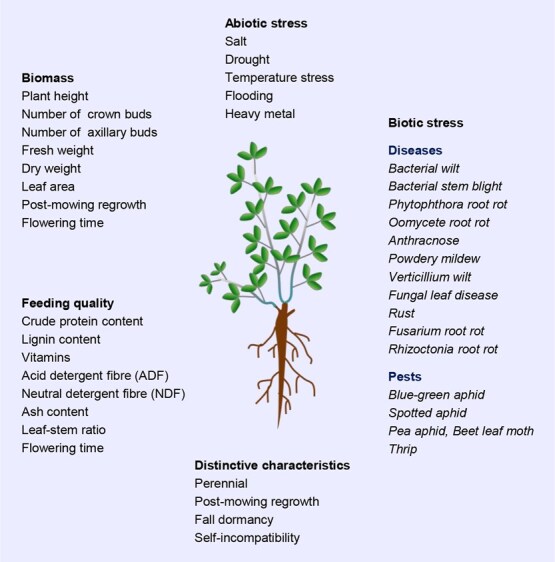
Agronomic traits and distinctive characteristics affecting the yield and quality of alfalfa.
Genomics of M. sativa
Alfalfa is an allotetraploid (2n = 4x = 32) with a large genome (4c = 3.2 Gb), and it is challenging to assemble its genome in the era of high-cost sequencing technology. Lacking high-quality reference genome restrained the molecular biology, genetics, and breeding in alfalfa. However, with the development of third-generation sequencing technology, the genomes of tetraploid and diploid alfalfa were successively deciphered since 2020. An allele-aware chromosome-level genome assembly for the cultivated tetraploid alfalfa ‘XinJiangDaYe’ has been constructed by combining precise single-molecule sequencing with Hi-C data, which consists of 32 allelic chromosomes [1]. Subsequently, a CRISPR/Cas9-based gene editing tool was further developed based on this high-quality reference genome. This system is capable of generating tetra-allelic mutations, leading to significant phenotypic alterations, thus indicating that gene editing system is highly efficient and easy to implement in the cultivated alfalfa, which may facilitate the acceleration of research and molecular breeding in alfalfa [1]. Subsequently, an 816-Mb high-resolution, chromosome-level haploid genome for the autotetraploid alfalfa variety ‘Zhongmu No.1’ has been assembled, with the contig N50 as 3.92 Mb, and in total 49 165 genes were annotated [7]. Further, 137 alfalfa core germplasms and 25 potential ancestral species were resequenced, and genomic population and migration analysis have revealed high genetic diversity and significant gene transfer from wild populations to cultivated alfalfa [7]. Moreover, genome-wide association studies (GWAS) analysis was performed with >30 agronomic traits of 137 alfalfa samples, and discovered >100 potential genomic regions linked to key agricultural characteristics. In addition, it has revealed that the expression of MsFTa2, a homolog of Flowering Locus T, is upregulated in salt-resistant germplasms, which may affect the dormancy and salt tolerance of alfalfa [7]. Furthermore, an allele-aware chromosome-level genome of autotetraploid cultivated alfalfa ‘Zhongmu-4’ was deciphered [8]. Additionally, a total of 101 single nucleotide polymorphisms (SNPs) associated with 27 distinct agronomic traits were identified via GWAS [8]. Subsequently, two chromosome-scale genomes of diploid alfalfa (M. sativa ssp. caerulea), an ancestor of autotetraploid alfalfa, were assembled successively [9, 10]. Comparative and evolutionary analysis was performed between M. sativa ssp. caerulea and Medicago truncatula [9]. Numerous structural variations (SVs) were detected between M. sativa ssp. Caerulea and an autotetraploid alfalfa ‘XinJiangDaYe’ [10]. In summary, three tetraploid cultivated alfalfa genomes and two diploid alfalfa genomes have been assembled (Table 1), which facilitates the molecular genetics and breeding research in alfalfa.
Table 1.
Information on the three assembled tetraploid cultivated lucerne genomes and two diploid lucerne genomes.
| Variety | Ploidy | Species information | Taxon | References |
|---|---|---|---|---|
| XinJiangDaYe | Allotetraploid | Cultivar | M. sativa L. | 1 |
| Zhongmu No.1 | Allotetraploid | Cultivar | M. sativa L. | 7 |
| Zhongmu-4 | Allotetraploid | Cultivar | M. sativa L. | 8 |
| PI464715 | Diploid | Direct diploid progenitor of autotetraploid alfalfa | M. sativa ssp. caerulea | 9 |
| ZW0012 | Diploid | Direct diploid progenitor of autotetraploid alfalfa | M. sativa ssp. caerulea | 10 |
The potential of gene editing techniques in facilitating precise crop breeding is remarkable. A CRISPR/Cas9-based gene editing technology system has been developed [1]. Further, a CRISPR/Cas9-engineered genic male sterility system was established by targeting the male fertility gene MsNP1 (No Pollen 1) [11]. Moreover, an efficient CRISPR_2.0 toolkit, featuring multiple gRNAs, was created for gene editing in ‘Gongnong 1’, a widely grown variety in Northeast China, utilizing an ultrasonic-assisted leaf disc transformation method [12]. An additional CRISPR/Cas9 system has been developed to induce a single nonhomologous end-joining-derived insertion–deletion (indel) at a precise genomic locus in alfalfa [13]. The continuous advancement in CRISPR/Cas9 technology for gene editing in alfalfa promises to revolutionize alfalfa breeding by enabling targeted and efficient genetic modifications, thereby facilitating the development of improved varieties with enhanced traits.
The MODMS (Multi-Omics Database of M. sativa) is a comprehensive database that has been established to incorporate data from multiple reference genomes, comparative genomics, high-quality genomic variants, annotations, transcriptomes, proteomics, and metabolomics [14]. The MODMS database is a robust and accessible resource that has a significant impact on alfalfa genomics research.
Mining of genes regulating critical agronomic traits in alfalfa
The identification of genomic loci or genes regulating various agronomic traits, including forage yield, nutritive value, flowering time, salt tolerance, drought tolerance, temperature tolerance, and biotic stress, is critical for alfalfa breeding. This can be achieved by GWAS in combination with genotypic sequencing (GBS), genome editing, and transgenic technologies.
Biomass
Alfalfa biomass is a complicated agronomic trait, which is influenced by many phenotypic factors that collectively contribute to its overall development and yield. These factors encompass plant height, plant architecture, branches numbers, leaf area, and several other physiological and morphological characteristics. Plant height is a principal component of plant architecture, exerting a considerable influence on biomass production. Genomic regions related with plant height were identified through a GWAS analysis using 220 accessions of alfalfa worldwide. In total, eight novel SNPs were identified as being substantially associated with plant height. Among them, Msa0882400, which is close to one of the SNPs, was annotated as phosphate transporter 3.1, and may serve as a potential candidate [15]. Furthermore, a series of genes that regulate alfalfa biomass have been identified using transgenic techniques. The mutation of FLOWERING LOCUS Ta1 (MsFTa1) through CRISPR/Cas9 editing tools has led to a significant enhancement in forage biomass yield [16]. Overexpression of stress-induced mitogen-activated protein kinases (SIMK) resulted in a notable enhancement of the aboveground biomass in alfalfa [17]. Melatonin, known as N-acetyl-5-methoxytryptamine, is a multifunctional signaling molecule that is crucial for controlling plant growth, development, and stress responses [18]. N-acetylserotonin methyltransferase (ASMT) is accountable for the final step in melatonin biosynthesis in plants, which is imperative for the synthesis of melatonin [19]. MsASMT1-overexpression alfalfa exhibited significantly enhanced biomass, with substantial increases in vegetative growth, plant height, leaf area, stem diameter, cell size, cell number, vascular bundle density, and the number of branches [20]. Overexpression of MicroRNA156 in transgenic alfalfa plants resulted in a number of significant changes in the plant's characteristics. These included a reduction in internode length and stem thickness, an increase in trichome density and shoot branching, and a delay in flowering time. In addition, there was an elevated level of biomass production, indicating a potential for enhanced agricultural productivity [21]. The SQUAMOSA PROMOTER-BINDING PROTEIN-LIKE 8 (SPL8)-RNAi transgenic alfalfa plants exhibited a significant increase in biomass, reaching up to 43% in the initial harvest and up to 86% in the subsequent harvest [22]. Branching is a pivotal factor in the architecture of plants, with considerable ramifications for the biomass of alfalfa. The plant hormones strigolactones (SLs) have been designated as suppressors of plant branching [23]. The silencing of MsD14, which encodes the strigolactone receptor, led to enhanced branching of alfalfa shoots and a significantly increased forage biomass [24]. In summary, alfalfa biomass improvement is a complex process involving the manipulation of multiple genetic and physiological factors. Recent studies have demonstrated the potential efficacy of gene editing, hormone regulation, and signaling molecules in substantially improving plant architecture and yield. However, further investigation is needed to identify additional genes and molecular mechanisms that regulate biomass formation in alfalfa.
Quality
Nutritive value is another crucial agronomic trait of alfalfa, which directly affects its economic value. Alfalfa leaves are considered to be more nutritious than the stems due to the lignification of the stems, which prevents the digestion of the cell walls. In addition, lignin is regarded as a pivotal factor influencing the nutritive value of forage [3, 25]. Coumarate 3-hydroxylase (C3H) is a member of the cytochrome P450 family of enzymes and plays a pivotal role in the biosynthesis of lignin [26, 27]. The tetra-allelic homozygous Msc3h mutant lines created using the multiplex CRISPR/Cas9 system exhibited a marked decrease in lignin content, along with reduced levels of acid detergent fiber (ADF) and neutral detergent fiber (NDF) [28]. Although these alterations did not notably influence biomass yield, they resulted in enhanced digestibility and nutritional characteristics [28]. Comparative transcriptome analyses demonstrate that the NAC transcription factor gene, NAC SECONDARY WALL THICKENING PROMOTING FACTOR 1 (MsNST1), plays a significant role in regulating lignin synthesis in alfalfa [29]. Overexpression of the HEADLESS (HDL) gene, a homolog of Arabidopsis WUSCHEL, induced significant phenotypic improvements in alfalfa. HDL-overexpressing plants showed increased branching, greater plant height, and a higher leaf-to-stem ratio, along with enhanced accumulation of fresh and dry biomass. Forage quality assays further revealed elevated levels of crude protein, crude fat, water-soluble sugars, microelements, and both NDFs and ADFs in HDL-overexpression plants, collectively enhancing their nutritive value [30]. Vitamin E is a crucial nutrient that animals require from their diets for optimal growth and development. The enzyme γ-tocopherol methyltransferase (γ-TMT), facilitates the conversion of δ- and γ-tocopherols (or tocotrienols) into β- and α-tocopherols (or tocotrienols), playing a pivotal role as the terminal enzyme in the biosynthesis of vitamin E [31]. The content of α-tocopherol was slightly increased in the leaves of MsTMT-overexpression transgenic alfalfa plants [32]. Overexpression of MsTMT also resulted in delayed leaf senescence [32]. The forage quality was enhanced in the MsDREB1C-overexpression alfalfa, exhibiting elevated crude protein and diminished lignin content [33]. The downregulation of MsFTa1 has been demonstrated to enhance the quality of forage, as evidenced by a notable decline in both NDF and ADF, accompanied by a reduction in lignin content [4]. Taken together, a limited number of genes associated with nutritive value have been identified and additional research is required to uncover more genes that could enhance the quality of alfalfa.
Flowering time
Flowering time represents a pivotal stage in the growth cycle, marking the transition from the vegetative to the reproductive phase. In contrast to seed-bearing crops, alfalfa is harvested throughout the year for its aboveground biomass. As alfalfa matures, there is a notable decline in the quantity and quality of its nutritional components, particularly in the concentration of nutrients in the leaves, proteins, vitamins, and minerals. Conversely, the proportion of stems, cellulose, and lignification levels increase. To achieve the optimal balance between biomass and feeding quality, the standard practice in alfalfa production is to harvest at the early budding stage. Therefore, it is imperative to elucidate the underlying molecular mechanisms that regulate alfalfa's flowering time. Several genes that regulate flowering time in alfalfa have been identified. Overexpression of MsSPL20 in alfalfa led to delayed flowering time [34]. CRISPR/Cas9-mediated knockout of the polyester synthase-like genes MSAD_264347 delayed flowering time in alfalfa (M. sativa) [35]. The overexpression of MsFLAVIN-BINDING, KELCH REPEAT, F BOX 1 (MsFKF1), which encodes a putative blue light photoreceptor, has been demonstrated to delay the flowering time of alfalfa plants [36]. The expression of MsFTa1 is associated with photoperiodic flowering and its downregulation results in a significant delay in flowering time [4, 16]. Overexpression of MsTERMINAL FLOWERING 1 A (MsTFL1A) delays flowering time in alfalfa [37]. Overexpression of MsmiR156 in transgenic alfalfa led to a delayed flowering time [21]. Silencing of MsSPL13 in alfalfa resulted in delayed flowering time [38]. Furthermore, numerous genetic loci and candidate genes linked to flowering time regulation in alfalfa were identified through GWAS, transcriptomic analysis, and quantitative trait loci mapping [39, 40]. Collectively, only a limited number of genes have been identified as being involved in the regulation of flowering time in alfalfa. Further investigation is required to elucidate the molecular regulatory networks that regulate the flowering time of alfalfa.
Salt
Salinity represents a significant abiotic stress factor influencing alfalfa yield. The development of salt-tolerant alfalfa varieties is critical to improving and exploiting underutilized land, including saline and alkaline land. The identification of genes that regulate this complex agronomic trait will facilitate the development of more effective alfalfa breeding strategies. A number of genes have been identified that are involved in the regulation of salt tolerance in alfalfa. Downregulation of SPL8 led to significantly enhanced salt tolerance. Conversely, SPL8-overexpressing transgenic alfalfa plants were more sensitive to salt stress [22]. Alfalfa transgenic plants overexpressing MsSPL12 showed improved salt tolerance [41]. By integrating GWAS with transcriptome profiling, eight candidate genes were identified. Among these, five were correlated with resistance to salt stress, while the other three were associated with seed germination under saline conditions [ 42]. Two specific SNPs were identified within the promoter region of the auxin-responsive gene MsAUX28 that were significantly correlated with salt tolerance [42]. Enhancing the expression of MsPMTR1, a putative melatonin receptor, may improve alfalfa growth in saline conditions [43]. The Defender Against Apoptotic Death (DAD) gene, which was first identified for its role in inhibiting cell death in mammals, plays a pivotal role in the N-glycosylation pathway and acts as an enhancer in the processes of protein folding and the export from the endoplasmic reticulum (ER) [44, 45]. Overexpression of MsDAD2 enhanced salinity tolerance in alfalfa [46]. The Aquaporin family encompasses a group of membrane proteins that enable the transport of water and certain small molecules through cellular membranes. Nodulin 26-like intrinsic proteins (NIPs) represent a subgroup of the aquaporin family that is unique to plants. Overexpression of MsNodulin 26-like intrinsic protein 2 (MsNIP2) improved salinity tolerance of alfalfa [47]. The rare cold-inducible 2 (RCI2) gene family encodes a highly conserved small molecule hydrophobic peptide. Overexpression of MsRCI2A, MsRCI2B, MsRCI2C, MsRCI2D, and MsRCI2E could enhance salt tolerance in alfalfa [48, 49]. Overexpression of the MsWRKY33 gene resulted in improved salt stress tolerance and increased antioxidant capacity, while other agricultural traits remained largely unchanged [50]. Myo-inositol oxygenase (MIOX) serves as a rate-limiting enzyme that irreversibly converts myo-inositol (MI) to D-glucuronic acid (D-GlcA) [51]. The expression of the MsbZIP53 is significantly induced under saline–alkali stress, which subsequently binds to the promoter region of MsMIOX2, thereby activating its expression. The activated MsMIOX2 protein enhanced alfalfa tolerance to saline–alkali stress by converting MI to D-GlcA, thereby increasing polysaccharide content and participating in the biosynthesis of cell wall pectin and hemicellulose. This strengthens the cell wall and enhances the antioxidant system and photosynthesis [52]. The EMISSION OF BENZENOIDS I/II (EOBI/II), an MYB-type transcription factor, plays a significant role in the floral volatile benzenoid/phenylpropanoid (FVBP) pathway, which is essential for the emission of floral scents [53]. The MsEOBI, an R2R3-MYB transcription factor, has been shown to directly interact with the promoter of MsPAL1, a key enzyme in the phenylpropanoid pathway. Overexpression of both MsEOBI and MsPAL1 could enhance the salt stress tolerance of alfalfa, suggesting that the MsEOBI-MsPAL1 module has a great potential in improving salt tolerance of alfalfa [54]. The MsMYB206–MsMYB450–MsHY5 complex modulates alfalfa's salt stress tolerance by regulating flavonoid biosynthesis across diurnal cycles [55]. To conclude, the identification and manipulation of these key genetic factors has demonstrated the potential to significantly enhance alfalfa's tolerance to saline conditions, offering promising genetic targets for the improvement of alfalfa varieties that are better adapted to saline environments.
Drought
Drought represents a significant threat to alfalfa production. The identification of alfalfa genes that regulate drought response will facilitate the breeding of drought-resistant alfalfa cultivars. MicroRNA156 (miR156) is increasingly being recognized as a potential strategy to improve various plant characteristics. Enhancing the expression of miR156 in alfalfa leads to improved drought tolerance, which is achieved by the repression of the SPL13 gene [56]. Alfalfa plants with reduced SPL9 expression through RNA interference showed improved resistance to drought stress, partly due to the modulation of anthocyanin production pathways [57]. Silencing the MsSPHK1 gene, which encodes a sphingosine kinase, has been demonstrated to markedly enhance drought tolerance in alfalfa [58]. An MYB-like transcription factor gene (MsMYBH) was identified by GWAS of drought resistance in alfalfa. Overexpression of MsMYBH substantially improved drought stress tolerance, whereas MsMYBH-RNAi plants were more susceptible to drought stress [59]. The plant metalloproteinase Filamentation temperature-sensitive H (FtsH) encodes an ATP- and Zn2+-dependent enzyme that plays crucial roles in responding to environmental stressors. The overexpression of MsFtsH8 has the potential to enhance the tolerance of PEG-simulated drought stress by stimulating antioxidant capacity [60]. The thiamine thiazole synthase (THI1) plays a pivotal role in regulating thiamine biosynthesis in plants exhibiting a physiological response to diverse abiotic stresses. Transgenic alfalfa plants overexpressing MsTHI1, when exposed to drought stress, exhibited higher levels of vitamin B1, soluble proteins, chlorophyll a and b, and increased SPAD values along with heightened peroxidase activity, all of which contributed to improved drought resistance [61]. α-Tocopherol, a key constituent of vitamin E in plants, serves as a powerful antioxidant that neutralizes reactive oxygen species (ROS) generated under photosynthesis and shields lipids from oxidative damage during drought stress. The enzyme γ-Tocopherol methyltransferase (γ-TMT) is pivotal in the biosynthesis of α-tocopherol, catalyzing its formation from γ-tocopherol within the tocopherol biosynthetic pathway. Overexpression of γ-TMT increased the accumulation of α-tocopherol in alfalfa [32] and also enhanced PEG-simulated drought tolerance in alfalfa [62]. Dehydrins and aquaporins are essential in the regulation of plant development and stress resilience. Dehydrins offer protective effects, and aquaporins manage the movement of water through cell membranes. The dehydrin MsDHN1 and the aquaporin MsPIP2;1 have been demonstrated to interact with a membrane-bound MYB transcription factor, MsmMYB, in the plasma membrane under nonstressed conditions. Both MsDHN1 and MsPIP2;1 positively regulate drought tolerance of alfalfa [63]. In addition, the expression of MsNUCLEAR TRANSPORT FACTOR 2-LIKE (MsNTF2L) was markedly activated by ABA and drought stress. Elevated MsNTF2L levels in alfalfa led to improved resistance to drought, whereas MsNTF2L-RNAi transgenic plants demonstrated decreased tolerance to drought, as evidenced by the modulation of leaf water loss in alfalfa [64]. Further, the genomic loci or genes associated with drought resistance traits were determined through GWAS or transcriptomic analysis in alfalfa [65–67]. Taken together, the identification and characterization of these crucial genes involved in the response to drought conditions will facilitate the development of targeted breeding strategies aimed at enhancing alfalfa resilience to drought.
Heat stress
Heat stress is a key environmental challenge that significantly limits the productivity of alfalfa. Elevated temperatures can disrupt vital physiological functions such as photosynthesis, respiration, and nutrient uptake. These disruptions typically lead to reduced biomass, lower forage quality, and decreased overall yield. Alfalfa plants that have increased miR156 expression and decreased SPL13 levels due to RNAi show improved heat stress resistance at 40°C. This is achieved through higher water potential, increased nonenzymatic antioxidant levels, higher anthocyanin content, and greater chlorophyll levels when exposed to elevated temperatures [68]. Additionally, a comparative transcriptome analysis was conducted on plants overexpressing miR156 under heat stress conditions and identified critical differentially expressed genes (DEGs) and potential targets related to metabolism, stress response, and hormone signaling. These findings highlight the role of the miR156/SPL network in regulating heat stress tolerance [69]. Moreover, an integrated transcriptomics and metabolomics analysis was conducted on alfalfa leaves exposed to varying high-temperature stresses and revealed significant changes in gene expression and metabolite profiles, particularly within key pathways such as plant signal transduction and glyoxylate metabolism [70]. Collectively, these findings provide valuable insights into the mechanisms underlying high-temperature regulation in alfalfa and highlight the need for further investigation using multilayered approaches.
Cold stress
As a perennial legume forage, alfalfa's ability to survive winter is crucial for its sustainable development. Thus, understanding the genes and molecular mechanisms underlying its cold stress response is essential for enhancing its tolerance, expanding cultivation areas, and increasing yields. Overexpression of the flavonol synthase gene MsFLS13 improves the tolerance of alfalfa to combined cold and saline–alkali stress [71, 72]. Additionally, quantitative trait locus mapping and transcriptomic analysis are employed to identify genes or SNPs that are associated with temperature [73–75]. Low temperature also induces fall dormancy in alfalfa, initiating a suite of physiological and biochemical responses that enable the plant to acclimate to winter conditions. These adaptations, including the accumulation of protective compounds and cessation of active growth, are essential for overwintering survival. Thus, elucidating the mechanisms by which cold stress regulates dormancy is critical for optimizing alfalfa management practices and enhancing its winter hardiness. Further investigation is required to identify and characterize the genes that regulate the response of alfalfa to cold stress, which is essential for expanding the range of cultivation conditions for alfalfa and for enhancing yields.
Biotic stress
Alfalfa faces significant challenges from diseases and pests, which can impact its productivity and quality, leading to substantial economic losses. ‘Bacterial wilt’, ‘Bacterial stem blight’, ‘Phytophthora root rot’, ‘Oomycete root rot’, ‘Anthracnose’, ‘Powdery mildew’, ‘Verticillium wilt’, ‘Fungal leaf disease’, ‘Rust’, ‘Fusarium root rot’, and ‘Rhizoctonia root rot’ are the main diseases of alfalfa [76]. Blue-green aphid, Spotted aphid, Pea aphid, Beet leaf moth, and Thrip are the major pests that threaten the production of alfalfa [76]. An economical and eco-friendly approach to manage pests and diseases is to develop pest- and disease-resistant varieties [76, 77]. Discovering genes that confer resistance to pests and diseases is essential for the breeding of disease-/pest-resistant alfalfa lines. MsVR38 and MsVR39, two linked alfalfa Verticillium wilt resistance genes, both are belonging to the TIR-NBS-LRR family [78]. MsVR39 regulates resistance to Verticillium wilt in a positive way, while MsVR38 regulates it in a negative way [78]. Defoliator insects Spodoptera litura larvae are the main threats to alfalfa, which severely affects its yield and quality [79–81]. To determine the function of miR396 in alfalfa responding to S. litura larvae, the MIM396 was overexpressed into alfalfa. The results showed that sequestering microRNA396 increased alfalfa resistance, possibly through increased lignin content and biosynthesis of small flavonoids and glucosinolates [82]. To date, only a limited number of genes that confer resistance to diseases and pests have been characterized in alfalfa. It is imperative that future research uncovers additional novel genes to breed varieties with improved resistance to these threats.
Distinctive characteristics of alfalfa
Perennial, postmowing regrowth and fall dormancy (FD) are distinct characteristics of alfalfa. The perennial and postmowing regrowth nature of alfalfa allows it to regrow multiple times after cutting, thus facilitating repeated harvests throughout the growing season, which are pivotal to its economic significance. Nevertheless, there is a paucity of research investigating the molecular basis of these distinctive characteristics in alfalfa.
FD is an adaptive trait of alfalfa, manifested during the regrowth phase following harvest in late summer or early autumn. FD plays an important role in both biomass production and winter survival at higher latitudes [83]. Nevertheless, the precise physiological, biochemical, and molecular mechanisms that initiate and regulate FD, as well as the genes that are involved, remain largely unclear. Short day (SD) is the primary environmental factor that induces FD in alfalfa. The concentrations of phytochrome B (PhyB) and abscisic acid (ABA) are associated with the photoperiodic reaction and FD in alfalfa [84]. The concentration of leaf PhyB was highest in strongly dormant varieties, moderate in semidormant ones, and lowest in nondormant alfalfa varieties. In accordance with this, the concentration of ABA was also greater in highly dormant varieties [84]. These findings suggest that photoperiod is critical for fall dormancy. However, how photoperiod regulates fall dormancy in alfalfa remains unclear and requires further investigation.
To summarize, here we reviewed the genes that have been identified in regulating important agronomic traits in alfalfa, including forage yield, nutritive value, flowering time, salt tolerance, drought tolerance, temperature tolerance, biotic stresses, and distinctive characteristics of alfalfa, which will be essential for alfalfa breeding (Table 2; Fig. 3).
Table 2.
The genes have been used to improve the biomass, quality, and tolerance to biotic and abiotic stresses in lucerne using biotechnology.
| Phenotypes | Gene | Positive or negative regulation | References |
|---|---|---|---|
| Msa0882400, phosphate transporter 3.1 | / | 15 | |
| FLOWERING LOCUS Ta1 (MsFTa1) | Negative | 16 | |
| Stress-induced mitogen-activated protein kinases (SIMK) | Positive | 17 | |
| MsASMT1 | Positive | 20 | |
| MsmiR156 | Positive | 21 | |
| SQUAMOSA PROMOTER BINDING PROTEIN-LIKE 8 (SPL8) | Negative | 22 | |
| Biomass | MsD14 | Negative | 24 |
| MsCoumarate 3-hydroxylase (MsC3H) | Negative | 28 | |
| MsTMT | Positive | 30 | |
| MsDREB1C | Positive | 31 | |
| MsFTa1 | Negative | 4 | |
| MsNST1 | Negative | 29 | |
| Quality | MsHDL | Positive | 30 |
| MsSPL20 | Negative | 34 | |
| MSAD_264347 | Positive | 35 | |
| MsFKF1 | Negative | 36 | |
| MsFTa1 | Positive | 4,16 | |
| MsmiR156 | Negative | 21 | |
| Flowering time | MsSPL13 | Positive | 38 |
| MsSPL8 | Negative | 22 | |
| MsSPL12 | Positive | 41 | |
| MsAUX28 | / | 42 | |
| MsPMTR1 | Positive | 43 | |
| MsDAD2 | Positive | 46 | |
| MsNodulin 26-like intrinsic protein 2 (MsNIP2) | Positive | 47 | |
| MsRCI2A, MsRCI2B, MsRCI2C, MsRCI2D, and MsRCI2E | Positive | 48,49 | |
| MsWRKY33 | Positive | 50 | |
| MsMIOX2 | Positive | 52 | |
| MsEOBI | Positive | 54 | |
| MsPAL1 | Positive | 54 | |
| Salt | MsMYB206 | Positive | 55 |
| MsmiR156 | Positive | 56 | |
| MsSPL9 | Negative | 57 | |
| MsSPHK1 | Negative | 58 | |
| MsMYBH | Positive | 59 | |
| MsFtsH8 | Positive | 60 | |
| MsTHI1 | Positive | 61 | |
| Msγ-TMT | Positive | 62 | |
| MsDHN1 | Positive | 63 | |
| MsPIP2;1 | Positive | 63 | |
| Drought | MsNUCLEAR TRANSPORT FACTOR 2-LIKE (MsNTF2L) | Positive | 64 |
| MsmiR156 | Positive | 68 | |
| Heat stress | MsSPL13 | Negative | 68 |
| Cold stress | MsFLS13 | Positive | 71.72 |
| MsVR39 | Positive | 78 | |
| MsVR38 | Negative | 78 | |
| Biotic stress | MsmiR396 | Negative | 82 |
| Fall dormancy | MsPhyB | / | 84 |
Figure 3.
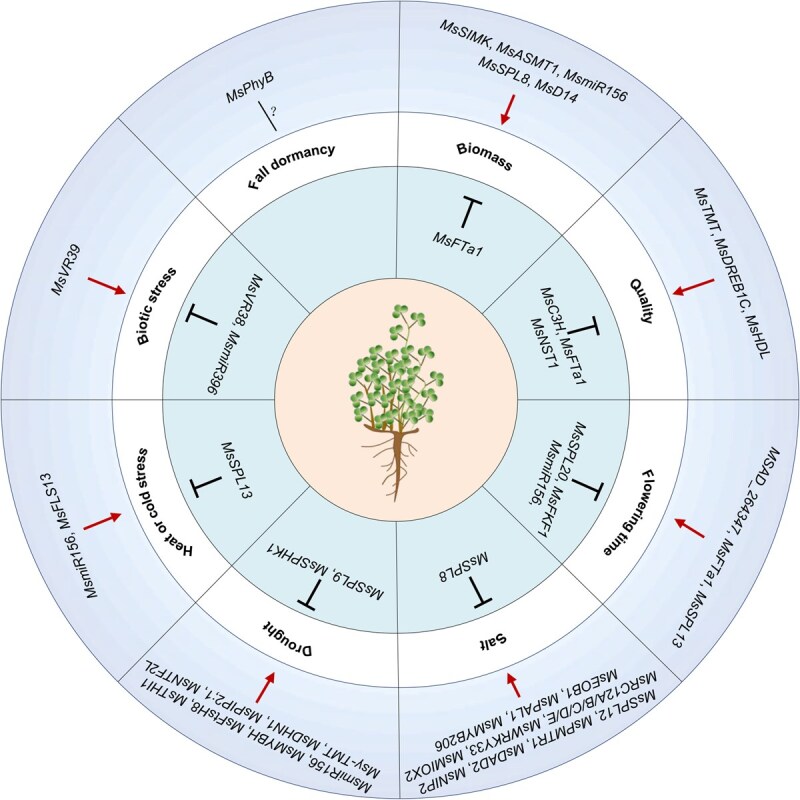
The gene regulatory network for critical agronomic traits in alfalfa.
Future prospects
Research conducted in other crop species can offer valuable research paradigms that can be applied to the study of alfalfa. The application of pangenomics, the elucidation of self-incompatibility (SI) mechanisms, the pioneering method of de novo domestication, and cutting-edge intelligent breeding techniques represent essential components in the development of a molecular design paradigm for the ‘ideal alfalfa’ (Fig. 4). The ideal alfalfa encompasses more branching numbers, increased plant height and biomass, enhanced nutritive value, and increased resilience to multiple biotic and abiotic stresses, which will provide a framework for the improvement of alfalfa yield and quality.
Figure 4.

Molecular design roadmap for ‘ideal alfalfa’.
Pangenome
An increasing number of studies indicate that it is not possible to capture the full genetic diversity of any species with one or few reference genomes [85–88]. SVs are a main source of genetic variation [89, 90]. However, traditional linear references have challenges with the presentation of genotypes for different alleles at each locus and the identification of larger SVs [88]. The concept of pangenomics and the significance of structural variants are becoming increasingly acknowledged within the plant genomics community [91–94]. Pangenomes have been constructed for a series of major diploid crops, including rice, soybean, maize, pearl millet, sorghum, peas, sunflower, and grapes [88, 90, 95–102]. Polyploid pangenomes have only been constructed in wheat, potato, Brassica napus, and cotton [103–106]. Alfalfa is a highly heterozygous, cross-pollinated, and autotetraploid forage crop; the concerns and challenges were discussed and a step-by-step guide to pangenome development for alfalfa has been proposed [91]. Consequently, the development of a pangenome for alfalfa offers great promise for advancing the understanding and enhancement of forage crop. The alfalfa pangenome will facilitate the identification of SVs, which are critical for understanding domestication, environmental adaptation, and phenotypic diversity, also providing insights into core and dispensable genes, enabling the discovery of novel genes and genome-wide patterns of variation associated with important agronomic traits. Taken together, the development of a pangenome for alfalfa is not only a significant step forward in heterozygous and autotetraploid genomics but also a practical tool for enhancing the genetic improvement of this important forage crop.
Self-incompatibility
SI is a prevalent mechanism in flowering plants that enables plants to recognize and reject self-pollen or pollen from genetically identical individuals, thus promoting outcrossing and preventing inbreeding [107]. Two distinct types of SI have been revealed, namely sporophytic self-incompatibility (SSI) and gametophytic self-incompatibility (GSI). The molecular mechanisms of SI in various plant species were systematically reviewed by a series of preeminent reviews [108–115]. In various plant species, the recognition of self-/nonself SI is governed by a single genetic locus known as the S-locus. Detailed molecular analysis of the S-locus has demonstrated that SI is not a single mechanism but rather a series of divergent mechanisms. In the Brassicaceae, these genes encode a pollen ligand and its corresponding stigma receptor kinase, and their interaction triggers incompatible signaling within the stigma's papilla cells. For the Solanaceae-type SI, the key genes are a ribonuclease and an F-box protein, indicating a role for RNA and protein degradation in the process. In the Papaveraceae, the identified female determinant initiates a Ca2+-dependent signaling pathway that leads to the rejection of incompatible pollen through cell death [108–115]. Alfalfa is a member of the Fabaceae family and is self-incompatible. Previous studies have identified the S-lineage T2 RNase genes in the genomes of M. truncatula, Trifolium pratense, Glycine max, Cicer arietinum, and Lupinus angustifolius, but there is no evidence that GSI in Fabaceae is determined by S-RNase lineage genes in Rosaceae, Solanaceae, and Plantaginaceae [116]. A transcriptomic analysis of SI in alfalfa was performed using dissected pistils 24 h after self-pollination and some candidate genes associated with SI were identified [117]. However, the SI in Fabaceae, including alfalfa, is still poorly understood. In summary, while significant progress has been made in understanding the molecular mechanisms of SI across various plant families, the specific mechanisms of SI in Fabaceae, including alfalfa, remain largely elusive and warrant further investigation. SI is a significant barrier to the use of hybrid vigor in alfalfa. Overcoming the mechanisms of SI in alfalfa may lead to more effective use of hybrid vigor to improve both yield and quality.
Advancing alfalfa breeding with multiomics and cutting-edge tools
Future research on alfalfa should focus on integrating genetic advancements with industrial applications to enhance its resilience and economic value. Developing new alfalfa varieties with increased biomass, enhanced stress tolerance, and improved forage quality is crucial for supporting sustainable livestock production. GWAS offer a promising approach for rapidly identifying genes linked to important traits, thereby accelerating breeding efforts. However, the effectiveness of GWAS can be constrained by population structure and linkage disequilibrium (LD). To overcome these challenges, alternative approaches such as multiomics integration have garnered increasing attention. Integrating GWAS with metabolomics, transcriptomics, and proteomics offers a comprehensive perspective on genetic and biochemical processes, thereby enhancing the identification of candidate genes and their pathways. Moreover, advancements in genomic selection (GS) and machine learning (ML) provide promising alternatives to GWAS. GS utilizes genome-wide marker information to predict breeding values, thereby shortening breeding cycles and enhancing selection efficiency. In addition, ML models, when combined with GWAS, have shown significant improvements in prediction accuracy for complex traits. Taken together, while GWAS is a fundamental tool for rapid gene mining, its integration with other omics approaches and advanced computational methods is essential for maximizing its potential. This integrated strategy will not only enhance alfalfa improvement through precision breeding but also support sustainable agricultural practices.
De novo domestication
Wild species generally have unique advantages such as perennial habits, polyploidy, stress resistance, and natural nutrition. However, there are significant challenges to using wild species in conventional breeding. De novo domestication, a novel breeding strategy, has emerged and been demonstrated by pioneer work. Rapid domestication was accomplished in a number of species, such as Solanum galapagense, Solanum pimpinellifolium, Physalis pruinosa, and allotetraploid rice [118–125]. A stepwise strategy for de novo domestication has been established in allotetraploid rice: (i) selection of a suitable wild starting material for de novo domestication; (ii) assembly and annotation of a high-quality reference genome; (iii) development of an efficient genome-editing and transformation system; (iv) editing multiple genes of domestication and agronomic importance to improve various traits, then certification and popularization of the new crop [123, 126]. This pipeline holds great potential for guiding the domestication of alfalfa, which will provide a new avenue for enhancing yield, quality, and resilience.
Intelligent breeding
The integration of big data and artificial intelligence (AI) in crop breeding paves the way for a new era of smart breeding [127], significantly improving the efficiency of crop breeding and focusing on forage crops such as alfalfa. This paradigm shift is being driven by rapid advances in gene discovery, biological big data, and AI-based technologies that will revolutionize the approach to crop breeding. AI technologies can analyze large genomic and phenotypic datasets, helping breeders to identify genes correlated with specific traits. AI models, with a particular emphasis on ML and Deep Learning (DL), are increasingly being deployed in the field of crop breeding [128]. In addition, AI enables real-time monitoring of plant growth and health, combined with high-throughput phenotyping, allowing breeders to quickly identify elite varieties in large-scale trials, significantly increasing breeding efficiency [129]. The paradigm of Intelligent Precision-Design Breeding (IPDB), underpinned by AI and big data, targets the optimization of breeding decisions through the synthesis of disparate data sources [127]. The CropGPT initiative can be regarded as an exemplar of IPDB, promoting the dissemination and exchange of breeding expertise via interdisciplinary collaboration and enhancing breeding efficacy [127, 130]. Intelligent breeding promises to revolutionize alfalfa breeding through the application of AI-driven image analysis, which can significantly speed up the selection process and improve the accuracy of phenotypic evaluation, ultimately leading to improved crop productivity and yield.
Acknowledgements
The work was supported by the National Natural Sciences Foundation of China (32441004 to Y.Z.), National Key Research and Development Program of China (2022YFF1003201), STI 2030-Major Projects (2023ZD0407102), and Youth Innovation Promotion Association of the Chinese Academy of Sciences (Y2021032).
Contributor Information
Yuanyuan Zhang, State Key Laboratory of Forage Breeding-by-Design and Utilization, Institute of Botany, Chinese Academy of Science, No.20 Nanxincun, Xiangshan, Beijing 100093, China; Key Laboratory of Plant Molecular Physiology, Institute of Botany, Chinese Academy of Sciences, No.20 Nanxincun, Xiangshan, Beijing 100093, China; China National Botanical Garden, No.20 Nanxincun, Xiangshan, Beijing 100093, China.
Lei Wang, State Key Laboratory of Forage Breeding-by-Design and Utilization, Institute of Botany, Chinese Academy of Science, No.20 Nanxincun, Xiangshan, Beijing 100093, China; Key Laboratory of Plant Molecular Physiology, Institute of Botany, Chinese Academy of Sciences, No.20 Nanxincun, Xiangshan, Beijing 100093, China; China National Botanical Garden, No.20 Nanxincun, Xiangshan, Beijing 100093, China; University of Chinese Academy of Sciences, No.1 Yanqihu East Road, Huairou District, Beijing 101408, China; Academician Workstation of Agricultural High-Tech Industrial Area of the Yellow River Delta, National Center of Technology Innovation for Comprehensive Utilization of Saline-Alkali Land, No. 8 Zhihui Road, Dongying 257300, China.
Author contributions
Y.Z. conceived and wrote the review. L.W. revised and edited the review.
Data availability
All data have been included in the article.
Conflict of interest statement
All authors declare no conflict of interest.
References
- 1. Chen H, Zeng Y, Yang Y. et al. Allele-aware chromosome-level genome assembly and efficient transgene-free genome editing for the autotetraploid cultivated alfalfa. Nat Commun. 2020;11:2494. [DOI] [PMC free article] [PubMed] [Google Scholar]
- 2. Zhou C, Han L, Pislariu C. et al. From model to crop: functional analysis of a STAY-GREEN gene in the model legume Medicago truncatula and effective use of the gene for alfalfa improvement. Plant Physiol. 2011;157:1483–96 [DOI] [PMC free article] [PubMed] [Google Scholar]
- 3. Singer SD, Hannoufa A, Acharya S. Molecular improvement of alfalfa for enhanced productivity and adaptability in a changing environment. Plant Cell Environ. 2018;41:1955–71 [DOI] [PubMed] [Google Scholar]
- 4. Lorenzo CD, García-Gagliardi P, Antonietti MS. et al. Improvement of alfalfa forage quality and management through the down-regulation of MsFTa1. Plant Biotechnol J. 2020;18:944–54 [DOI] [PMC free article] [PubMed] [Google Scholar]
- 5. Latif A, Sun Y, Noman A. Herbaceous alfalfa plant as a multipurpose crop and predominant forage specie in Pakistan. Front Sustain Food Syst. 2023;7:1126151 [Google Scholar]
- 6. Mielmann A. The utilisation of lucerne (Medicago sativa): a review. British Food J. 2013;115:590–600 [Google Scholar]
- 7. Shen C, du H, Chen Z. et al. The chromosome-level genome sequence of the autotetraploid alfalfa and resequencing of core germplasms provide genomic resources for alfalfa research. Mol Plant. 2020;13:1250–61 [DOI] [PubMed] [Google Scholar]
- 8. Long R, Zhang F, Zhang Z. et al. Genome assembly of alfalfa cultivar Zhongmu-4 and identification of SNPs associated with agronomic traits. Genomics Proteomics Bioinformatics. 2022;20:14–28 [DOI] [PMC free article] [PubMed] [Google Scholar]
- 9. Li A, Liu A, du X. et al. A chromosome-scale genome assembly of a diploid alfalfa, the progenitor of autotetraploid alfalfa. Hortic Res. 2020;7:194. [DOI] [PMC free article] [PubMed] [Google Scholar]
- 10. Shi K, Dong H, du H. et al. The chromosome-level assembly of the wild diploid alfalfa genome provides insights into the full landscape of genomic variations between cultivated and wild alfalfa. Plant Biotechnol J. 2024;22:1757–72 [DOI] [PMC free article] [PubMed] [Google Scholar]
- 11. Ye Q, Meng X, Chen H. et al. Construction of genic male sterility system by CRISPR/Cas9 editing from model legume to alfalfa. Plant Biotechnol J. 2022;20:613–5 [DOI] [PMC free article] [PubMed] [Google Scholar]
- 12. Zhao HX, Zhao S, Cao Y. et al. Development of a single transcript CRISPR/Cas9 toolkit for efficient genome editing in autotetraploid alfalfa. Crop J. 2024;12:788–95 [Google Scholar]
- 13. Subedi U, Burton Hughes K, Chen G. et al. Eliciting targeted mutations in Medicago sativa using CRISPR/Cas9-mediated genome editing: a potential tool for the improvement of disease resistance. Methods Mol Biol. 2023;2659:219–39 [DOI] [PubMed] [Google Scholar]
- 14. Fang LF, Liu T, Li M. et al. MODMS: a multi-omics database for facilitating biological studies on alfalfa (Medicago sativa L.). Hortic Res. 2024;11:uhad245 [DOI] [PMC free article] [PubMed] [Google Scholar]
- 15. Jiang X, Yang T, He F. et al. A genome-wide association study reveals novel loci and candidate genes associated with plant height variation in Medicago sativa. BMC Plant Biol. 2024;24:544. [DOI] [PMC free article] [PubMed] [Google Scholar]
- 16. Wolabu TW, Mahmood K, Jerez IT. et al. Multiplex CRISPR/Cas9-mediated mutagenesis of alfalfa FLOWERING LOCUS Ta1 (MsFTa1) leads to delayed flowering time with improved forage biomass yield and quality. Plant Biotechnol J. 2023;21:1383–92 [DOI] [PMC free article] [PubMed] [Google Scholar]
- 17. Hrbackova M, Luptovčiak I, Hlaváčková K. et al. Overexpression of alfalfa SIMK promotes root hair growth, nodule clustering and shoot biomass production. Plant Biotechnol J. 2021;19:767–84 [DOI] [PMC free article] [PubMed] [Google Scholar]
- 18. Reiter RJ, Tan DX, Zhou Z. et al. Phytomelatonin: assisting plants to survive and thrive. Molecules. 2015;20:7396–437 [DOI] [PMC free article] [PubMed] [Google Scholar]
- 19. Tan DX, Hardeland R, Back K. et al. On the significance of an alternate pathway of melatonin synthesis via 5-methoxytryptamine: comparisons across species. J Pineal Res. 2016;61:27–40 [DOI] [PubMed] [Google Scholar]
- 20. Cen HF, Wang T, Liu H. et al. Overexpression of MsASMT1 promotes plant growth and decreases flavonoids biosynthesis in transgenic alfalfa (Medicago sativa L.). Front Plant Sci. 2020;11:489. [DOI] [PMC free article] [PubMed] [Google Scholar]
- 21. Aung B, Gruber MY, Amyot L. et al. MicroRNA156 as a promising tool for alfalfa improvement. Plant Biotechnol J. 2015;13:779–90 [DOI] [PubMed] [Google Scholar]
- 22. Gou J, Debnath S, Sun L. et al. From model to crop: functional characterization of SPL8 in M. truncatula led to genetic improvement of biomass yield and abiotic stress tolerance in alfalfa. Plant Biotechnol J. 2018;16:951–62 [DOI] [PMC free article] [PubMed] [Google Scholar]
- 23. Gomez-Roldan V, Fermas S, Brewer PB. et al. Strigolactone inhibition of shoot branching. Nature. 2008;455:189–94 [DOI] [PubMed] [Google Scholar]
- 24. Ma L, Zhang Y, Wen H. et al. Silencing of MsD14 resulted in enhanced forage biomass through increasing shoot branching in alfalfa (Medicago sativa L.). Plants (Basel). 2022;11:939. [DOI] [PMC free article] [PubMed] [Google Scholar]
- 25. Getachew G, Laca EA, Putnam DH. et al. The impact of lignin downregulation on alfalfa yield, chemical composition, and in vitro gas production. J Sci Food Agric. 2018;98:4205–15 [DOI] [PubMed] [Google Scholar]
- 26. Tong ZY, Li H, Zhang R. et al. Co-downregulation of the hydroxycinnamoyl-CoA:shikimate hydroxycinnamoyl transferase and coumarate 3-hydroxylase significantly increases cellulose content in transgenic alfalfa (Medicago sativa L.). Plant Sci. 2015;239:230–7 [DOI] [PubMed] [Google Scholar]
- 27. Reddy MSS, Chen F, Shadle G. et al. Targeted down-regulation of cytochrome P450 enzymes for forage quality improvement in alfalfa (Medicago sativa L.). Proc Natl Acad Sci USA. 2005;102:16573–8 [DOI] [PMC free article] [PubMed] [Google Scholar]
- 28. Wolabu TW, Mahmood K, Chen F. et al. Mutating alfalfa COUMARATE 3-HYDROXYLASE using multiplex CRISPR/Cas9 leads to reduced lignin deposition and improved forage quality. Front Plant Sci. 2024;15:1363182. [DOI] [PMC free article] [PubMed] [Google Scholar]
- 29. Zhou Q, Mao P, Luo D. et al. Comparative transcriptome analyses reveal that the MsNST1 gene affects lignin synthesis in alfalfa (Medicago sativa L.). Crop J. 2022;10:1059–72 [Google Scholar]
- 30. Wang HF, Xu Y, Wang Y. et al. Manipulation of WUSCHEL orthologue expression improves the forage yield and quality in Medicago. Plant Biotechnol J. 2025 [DOI] [PMC free article] [PubMed] [Google Scholar]
- 31. Arun M, Subramanyam K, Theboral J. et al. Transfer and targeted overexpression of γ-tocopherol methyltransferase (γ-TMT) gene using seed-specific promoter improves tocopherol composition in Indian soybean cultivars. Appl Biochem Biotechnol. 2014;172:1763–76 [DOI] [PubMed] [Google Scholar]
- 32. Jiang J, Jia H, Feng G. et al. Overexpression of Medicago sativa TMT elevates the α-tocopherol content in Arabidopsis seeds, alfalfa leaves, and delays dark-induced leaf senescence. Plant Sci. 2016;249:93–104 [DOI] [PubMed] [Google Scholar]
- 33. Zhang YY, Wang Z, Zhang F. et al. Overexpression of MsDREB1C modulates growth and improves forage quality in tetraploid alfalfa (Medicago sativa L.). Plants (Basel). 2024;13:1237. [DOI] [PMC free article] [PubMed] [Google Scholar]
- 34. Ma L, Liu X, Liu W. et al. Characterization of squamosa-promoter binding protein-Box family genes reveals the critical role of MsSPL20 in alfalfa flowering time regulation. Front Plant Sci. 2022;12:775690 [DOI] [PMC free article] [PubMed] [Google Scholar]
- 35. Galindo-Sotomonte L, Jozefkowicz C, Gómez C. et al. CRISPR/Cas9-mediated knockout of a polyester synthase-like gene delays flowering time in alfalfa. Plant Cell Rep. 2023;42:953–6 [DOI] [PubMed] [Google Scholar]
- 36. Jiang X, Zhang L, Li Y. et al. Functional characterization of the MsFKF1 gene reveals its dual role in regulating the flowering time and plant height in Medicago sativa L. Plants (Basel). 2024;13:655. [DOI] [PMC free article] [PubMed] [Google Scholar]
- 37. Lorenzo CD, García-Gagliardi P, Gobbini ML. et al. MsTFL1A delays flowering and regulates shoot architecture and root development in Medicago sativa. Plant Reprod. 2024;37:229–42 [DOI] [PubMed] [Google Scholar]
- 38. Gao R, Gruber MY, Amyot L. et al. SPL13 regulates shoot branching and flowering time in Medicago sativa. Plant Mol Biol. 2018;96:119–33 [DOI] [PubMed] [Google Scholar]
- 39. He F, Zhang F, Jiang X. et al. A genome-wide association study coupled with a transcriptomic analysis reveals the genetic loci and candidate genes governing the flowering time in alfalfa (Medicago sativa L.). Front Plant Sci. 2022;13:913947 [DOI] [PMC free article] [PubMed] [Google Scholar]
- 40. Jiang X, Yang T, Zhang F. et al. RAD-seq-based high-density linkage maps construction and quantitative trait loci mapping of flowering time trait in alfalfa (Medicago sativa L.). Front Plant Sci. 2022;13:899681 [DOI] [PMC free article] [PubMed] [Google Scholar]
- 41. Lin S, Yang J, Liu Y. et al. MsSPL12 is a positive regulator in alfalfa (Medicago sativa L.) salt tolerance. Plant Cell Rep. 2024;43:101. [DOI] [PubMed] [Google Scholar]
- 42. He F, Wei C, Zhang Y. et al. Genome-wide association analysis coupled with transcriptome analysis reveals candidate genes related to salt stress in alfalfa (Medicago sativa L.). Front Plant Sci. 2021;12:826584 [DOI] [PMC free article] [PubMed] [Google Scholar]
- 43. Yu R, Zuo T, Diao P. et al. Melatonin enhances seed germination and seedling growth of Medicago sativa under salinity via a putative melatonin receptor MsPMTR1. Front Plant Sci. 2021;12:702875 [DOI] [PMC free article] [PubMed] [Google Scholar]
- 44. Roboti P, High S. The oligosaccharyltransferase subunits OST48, DAD1 and KCP2 function as ubiquitous and selective modulators of mammalian N-glycosylation. J Cell Sci. 2012;125:3474–84 [DOI] [PubMed] [Google Scholar]
- 45. Zhang Y, Cui C, Lai ZC. The defender against apoptotic cell death 1 gene is required for tissue growth and efficient N-glycosylation in Drosophila melanogaster. Dev Biol. 2016;420:186–95 [DOI] [PubMed] [Google Scholar]
- 46. Wang X, Tang H, Lu T. et al. Novel underlying regulatory mechanism of the MsDAD2-mediated salt stress response in alfalfa. Biochem Biophys Res Commun. 2024;690:149252 [DOI] [PubMed] [Google Scholar]
- 47. Kong W, Huang H, Du W. et al. Overexpression of MsNIP2 improves salinity tolerance in Medicago sativa. J Plant Physiol. 2024;295:154207 [DOI] [PubMed] [Google Scholar]
- 48. Li C, Song T, Zhan L. et al. Overexpression of MsRCI2A, MsRCI2B, and MsRCI2C in alfalfa (Medicago sativa L.) provides different extents of enhanced alkali and salt tolerance due to functional specialization of MsRCI2s. Front Plant Sci. 2021;12:702195 [DOI] [PMC free article] [PubMed] [Google Scholar]
- 49. Zhang D, Zhang Z, Li C. et al. Overexpression of MsRCI2D and MsRCI2E enhances salt tolerance in alfalfa (Medicago sativa L.) by stabilizing antioxidant activity and regulating ion homeostasis. Int J Mol Sci. 2022;23:9810. [DOI] [PMC free article] [PubMed] [Google Scholar]
- 50. Ma L, Li X, Zhang J. et al. MsWRKY33 increases alfalfa (Medicago sativa L.) salt stress tolerance through altering the ROS scavenger via activating MsERF5 transcription. Plant Cell Environ. 2023;46:3887–901 [DOI] [PubMed] [Google Scholar]
- 51. Arner, Prabhu KS, Thompson JT. et al. Myo-inositol oxygenase: molecular cloning and expression of a unique enzyme that oxidizes myo-inositol and D-chiro-inositol. Biochem J. 2001;360:313–20 [DOI] [PMC free article] [PubMed] [Google Scholar]
- 52. Guo WL, Chen J, Liu L. et al. MsMIOX2, encoding a MsbZIP53-activated myo-inositol oxygenase, enhances saline-alkali stress tolerance by regulating cell wall pectin and hemicellulose biosynthesis in alfalfa. Plant J. 2024;120:998–1013 [DOI] [PubMed] [Google Scholar]
- 53. Spitzer-Rimon B, Farhi M, Albo B. et al. The R2R3-MYB-like regulatory factor EOBI, acting downstream of EOBII, regulates scent production by activating ODO1 and structural scent-related genes in petunia. Plant Cell. 2012;24:5089–105 [DOI] [PMC free article] [PubMed] [Google Scholar]
- 54. Song YG, Tang H, Zhang Z. et al. A novel MsEOBI-MsPAL1 module enhances salinity stress tolerance, floral scent emission and seed yield in alfalfa. Plant Cell Environ. 2024;48:907–22 [DOI] [PubMed] [Google Scholar]
- 55. Su LT, Lv A, Wen W. et al. MsMYB206-MsMYB450-MsHY5 complex regulates alfalfa tolerance to salt stress via regulating flavonoid biosynthesis during the day and night cycles. Plant J. 2025;121:e17216 [DOI] [PubMed] [Google Scholar]
- 56. Lei KJ, Lin YM, Ren J. et al. Modulation of the phosphate-deficient responses by MicroRNA156 and its targeted SQUAMOSA PROMOTER BINDING PROTEIN-LIKE 3 in Arabidopsis. Plant Cell Physiol. 2016;57:192–203 [DOI] [PubMed] [Google Scholar]
- 57. Hanly A, Karagiannis J, Lu QSMM. et al. Characterization of the role of SPL9 in drought stress tolerance in Medicago sativa. Int J Mol Sci. 2020;21:6003. [DOI] [PMC free article] [PubMed] [Google Scholar]
- 58. Luo S, Liu J, Shi K. et al. Integrated transcriptomic and metabolomic analyses reveal that MsSPHK1-A sphingosine kinase gene negatively regulates drought tolerance in alfalfa (Medicago sativa L.). Plant Physiol Biochem. 2024;218:109302 [DOI] [PubMed] [Google Scholar]
- 59. Shi K, Liu J, Liang H. et al. An alfalfa MYB-like transcriptional factor MsMYBH positively regulates alfalfa seedling drought resistance and undergoes MsWAV3-mediated degradation. J Integr Plant Biol. 2024;66:683–99 [DOI] [PubMed] [Google Scholar]
- 60. Li R, Zeng X, Jiang X. et al. MsFtsH8 enhances the tolerance of PEG-simulated drought stress by boosting antioxidant capacity in Medicago sativa L. Plants (Basel). 2024;13:3025. [DOI] [PMC free article] [PubMed] [Google Scholar]
- 61. Yin H, Wang Z, Li H. et al. MsTHI1 overexpression improves drought tolerance in transgenic alfalfa (Medicago sativa L.). Front Plant Sci. 2022;13:992024 [DOI] [PMC free article] [PubMed] [Google Scholar]
- 62. Ma J, Qiu D, Gao H. et al. Over-expression of a γ-tocopherol methyltransferase gene in vitamin E pathway confers PEG-simulated drought tolerance in alfalfa. BMC Plant Biol. 2020;20:226. [DOI] [PMC free article] [PubMed] [Google Scholar]
- 63. Lv A, Su L, Fan N. et al. The MsDHN1-MsPIP2;1-MsmMYB module orchestrates the trade-off between growth and survival of alfalfa in response to drought stress. Plant Biotechnol J. 2024;22:1132–45 [DOI] [PMC free article] [PubMed] [Google Scholar]
- 64. Luo D, Liu J, Wu Y. et al. NUCLEAR TRANSPORT FACTOR 2-LIKE improves drought tolerance by modulating leaf water loss in alfalfa (Medicago sativa L.). Plant J. 2022;112:429–50 [DOI] [PubMed] [Google Scholar]
- 65. Zhang T, Yu LX, Zheng P. et al. Identification of loci associated with drought resistance traits in heterozygous autotetraploid alfalfa (Medicago sativa L.) using genome-wide association studies with genotyping by sequencing. PLoS One. 2015;10:e0138931 [DOI] [PMC free article] [PubMed] [Google Scholar]
- 66. Chen F, Ha X, Ma T. et al. Comparative analysis of the physiological and transcriptomic profiles reveals alfalfa drought resistance mechanisms. BMC Plant Biol. 2024;24:954. [DOI] [PMC free article] [PubMed] [Google Scholar]
- 67. Zhou Z, Li J, Gao Y. et al. Research on drought stress in Medicago sativa L. from 1998 to 2023: a bibliometric analysis. Front Plant Sci. 2024;15:1406256. [DOI] [PMC free article] [PubMed] [Google Scholar]
- 68. Matthews C, Arshad M, Hannoufa A. Alfalfa response to heat stress is modulated by microRNA156. Physiol Plant. 2019;165:830–42 [DOI] [PubMed] [Google Scholar]
- 69. Arshad M, Hannoufa A. Alfalfa transcriptome profiling provides insight into miR156-mediated molecular mechanisms of heat stress tolerance. Genome. 2022;65:315–30 [DOI] [PubMed] [Google Scholar]
- 70. Zhou J, Tang X, Li J. et al. Comparative transcriptomic and metabolomic analyses provide insights into the responses to high temperature stress in alfalfa (Medicago sativa L.). BMC Plant Biol. 2024;24:776. [DOI] [PMC free article] [PubMed] [Google Scholar]
- 71. Liu L, Si L, Zhang L. et al. Metabolomics and transcriptomics analysis revealed the response mechanism of alfalfa to combined cold and saline-alkali stress. Plant J. 2024;119:1900–19 [DOI] [PubMed] [Google Scholar]
- 72. Zhang LS, Sun Y, Ji J. et al. Flavonol synthase gene MsFLS13 regulates saline-alkali stress tolerance in alfalfa. Crop J. 2023;11:1218–29 [Google Scholar]
- 73. Davik J, Wilson RC, Njah RG. et al. Genetic mapping and identification of a QTL determining tolerance to freezing stress in Fragaria vesca L. PLoS One. 2021;16:e0248089 [DOI] [PMC free article] [PubMed] [Google Scholar]
- 74. Adhikari L, Makaju SO, Lindstrom OM. et al. Mapping freezing tolerance QTL in alfalfa: based on indoor phenotyping. BMC Plant Biol. 2021;21:403. [DOI] [PMC free article] [PubMed] [Google Scholar]
- 75. Pu XJ, Fu Y, Xu C. et al. Transcriptomic analyses provide molecular insight into the cold stress response of cold-tolerant alfalfa. BMC Plant Biol. 2024;24:741. [DOI] [PMC free article] [PubMed] [Google Scholar]
- 76. Yang B, Zhao Y, Guo ZF. Research progress and prospect of alfalfa resistance to pathogens and pests. Plants (Basel). 2022;11:2008. [DOI] [PMC free article] [PubMed] [Google Scholar]
- 77. Wang Y, Tyler BM, Wang YC. Defense and counterdefense during plant-pathogenic oomycete infection. Ann Rev Microbiol. 2019;73:667–96 [DOI] [PubMed] [Google Scholar]
- 78. Lin S, Niu Y, Medina CA. et al. Two linked resistance genes function divergently in defence against Verticillium wilt in alfalfa. Plant Biotechnol J. 2022;20:619–21 [DOI] [PMC free article] [PubMed] [Google Scholar]
- 79. Agrell J, Oleszek W, Stochmal A. et al. Herbivore-induced responses in alfalfa (Medicago sativa). J Chem Ecol. 2003;29:303–20 [DOI] [PubMed] [Google Scholar]
- 80. Lei YT, Liu Q, Hettenhausen C. et al. Salt-tolerant and -sensitive alfalfa (Medicago sativa) cultivars have large variations in defense responses to the lepidopteran insect Spodoptera litura under normal and salt stress condition. PLoS One. 2017;12:e0181589 [DOI] [PMC free article] [PubMed] [Google Scholar]
- 81. Abdullah A, Ullah MI, Raza AM. et al. Host plant selection affects biological parameters in armyworm, Spodoptera litura (Lepidoptera: Noctuidae). Pakistan J Zool. 2019;51:2117–23 [Google Scholar]
- 82. Yan JP, Qiu RM, Wang KX. et al. Enhancing alfalfa resistance to Spodoptera herbivory by sequestering microRNA396 expression. Plant Cell Rep. 2023;42:805–19 [DOI] [PubMed] [Google Scholar]
- 83. Zhang S, Wang C. Transcriptome profiling of gene expression in fall dormant and nondormant alfalfa. Genom Data. 2014;2:282–4 [DOI] [PMC free article] [PubMed] [Google Scholar]
- 84. Wang CZ, Ma BL, Han J. et al. Photoperiod effect on phytochrome and abscisic acid in alfalfa varieties differing in fall dormancy. J Plant Nutrition. 2008;31:1257–69 [Google Scholar]
- 85. Zhou P, Silverstein KAT, Ramaraj T. et al. Exploring structural variation and gene family architecture with de novo assemblies of 15 Medicago genomes. BMC Genomics. 2017;18:261. [DOI] [PMC free article] [PubMed] [Google Scholar]
- 86. Wang WS, Mauleon R, Hu Z. et al. Genomic variation in 3,010 diverse accessions of Asian cultivated rice. Nature. 2018;557:43–9 [DOI] [PMC free article] [PubMed] [Google Scholar]
- 87. Hurgobin B, Golicz AA, Bayer PE. et al. Homoeologous exchange is a major cause of gene presence/absence variation in the amphidiploid Brassica napus. Plant Biotechnol J. 2018;16:1265–74 [DOI] [PMC free article] [PubMed] [Google Scholar]
- 88. Liu YC, du H, Li P. et al. Pan-genome of wild and cultivated soybeans. Cell. 2020;182:162–176.e13 [DOI] [PubMed] [Google Scholar]
- 89. Lye ZN, Purugganan MD. Copy number variation in domestication. Trends Plant Sci. 2019;24:352–65 [DOI] [PubMed] [Google Scholar]
- 90. Qin P, Lu H, du H. et al. Pan-genome analysis of 33 genetically diverse rice accessions reveals hidden genomic variations. Cell. 2021;184:3542–3558.e16 [DOI] [PubMed] [Google Scholar]
- 91. Kaur H, Shannon LM, Samac DA. A stepwise guide for pangenome development in crop plants: an alfalfa (Medicago sativa) case study. BMC Genomics. 2024;25:1022. [DOI] [PMC free article] [PubMed] [Google Scholar]
- 92. Tettelin H, Masignani V, Cieslewicz MJ. et al. Genome analysis of multiple pathogenic isolates of Streptococcus agalactiae: implications for the microbial "pan-genome". Proc Natl Acad Sci USA. 2005;102:13950–5 [DOI] [PMC free article] [PubMed] [Google Scholar]
- 93. Golicz AA, Bayer PE, Barker GC. et al. The pangenome of an agronomically important crop plant Brassica oleracea. Nat Commun. 2016;7:13390. [DOI] [PMC free article] [PubMed] [Google Scholar]
- 94. Tao YF, Zhao XR, Mace E. et al. Exploring and exploiting pan-genomics for crop improvement. Mol Plant. 2019;12:156–69 [DOI] [PubMed] [Google Scholar]
- 95. Wang BB, Hou M, Shi J. et al. De novo genome assembly and analyses of 12 founder inbred lines provide insights into maize heterosis. Nat Genet. 2023;55:312–23 [DOI] [PubMed] [Google Scholar]
- 96. Gui ST, Wei W, Jiang C. et al. A pan-Zea genome map for enhancing maize improvement. Genome Biol. 2022;23:178. [DOI] [PMC free article] [PubMed] [Google Scholar]
- 97. Yan HD, Sun M, Zhang Z. et al. Pangenomic analysis identifies structural variation associated with heat tolerance in pearl millet. Nat Genet. 2023;55:507–18 [DOI] [PMC free article] [PubMed] [Google Scholar]
- 98. Tao YF, Luo H, Xu J. et al. Extensive variation within the pan-genome of cultivated and wild sorghum. Nat Plants. 2021;7:766–73 [DOI] [PubMed] [Google Scholar]
- 99. Yang T, Liu R, Luo Y. et al. Improved pea reference genome and pan-genome highlight genomic features and evolutionary characteristics. Nat Genet. 2022;54:1553–63 [DOI] [PMC free article] [PubMed] [Google Scholar]
- 100. Hübner S, Bercovich N, Todesco M. et al. Sunflower pan-genome analysis shows that hybridization altered gene content and disease resistance. Nat Plants. 2019;5:54–62 [DOI] [PubMed] [Google Scholar]
- 101. Liu ZJ, Wang N, Su Y. et al. Grapevine pangenome facilitates trait genetics and genomic breeding. Nat Genet. 2024;56:2804–14 [DOI] [PMC free article] [PubMed] [Google Scholar]
- 102. Cochetel N, Minio A, Guarracino A. et al. A super-pangenome of the North American wild grape species. Genome Biol. 2023;24:290. [DOI] [PMC free article] [PubMed] [Google Scholar]
- 103. Jiao, Xie X, Hao C. et al. Pan-genome bridges wheat structural variations with habitat and breeding. Nature. 2025;637:384–93 [DOI] [PubMed] [Google Scholar]
- 104. Tang D, Jia Y, Zhang J. et al. Genome evolution and diversity of wild and cultivated potatoes. Nature. 2022;606:535–41 [DOI] [PMC free article] [PubMed] [Google Scholar]
- 105. Song JM, Guan Z, Hu J. et al. Eight high-quality genomes reveal pan-genome architecture and ecotype differentiation of Brassica napus. Nat Plants. 2020;6:34–45 [DOI] [PMC free article] [PubMed] [Google Scholar]
- 106. Li JY, Yuan D, Wang P. et al. Cotton pan-genome retrieves the lost sequences and genes during domestication and selection. Genome Biol. 2021;22:119. [DOI] [PMC free article] [PubMed] [Google Scholar]
- 107. Silva NF, Goring DR. Mechanisms of self-incompatibility in flowering plants. Cell Mol Life Sci. 2001;58:1988–2007 [DOI] [PMC free article] [PubMed] [Google Scholar]
- 108. Takayama S, Isogai A. Self-incompatibility in plants. Annu Rev Plant Biol. 2005;56:467–89 [DOI] [PubMed] [Google Scholar]
- 109. Fobis-Loisy I, Miege C, Gaude T. Molecular evolution of the s locus controlling mating in the brassicaceae. Plant Biol (Stuttg). 2004;6:109–18 [DOI] [PubMed] [Google Scholar]
- 110. Franklin-Tong N, Franklin FCH. Gametophytic self-incompatibility inhibits pollen tube growth using different mechanisms. Trends Plant Sci. 2003;8:598–605 [DOI] [PubMed] [Google Scholar]
- 111. Hiscock SJ, McInnis SM. Pollen recognition and rejection during the sporophytic self-incompatibility response: Brassica and beyond. Trends Plant Sci. 2004;8:606–13 [DOI] [PubMed] [Google Scholar]
- 112. Kachroo A, Nasrallah ME, Nasrallah JB. Self-incompatibility in the Brassicaceae: receptor-ligand signaling and cell-to-cell communication. Plant Cell. 2002;14:S227–38 [DOI] [PMC free article] [PubMed] [Google Scholar]
- 113. Kao TH, Tsukamoto T. The molecular and genetic bases of S-RNase-based self-incompatibility. Plant Cell. 2004;16:S72–83 [DOI] [PMC free article] [PubMed] [Google Scholar]
- 114. McCubbin AG, Kao T. Molecular recognition and response in pollen and pistil interactions. Annu Rev Cell Dev Biol. 2000;16:333–64 [DOI] [PubMed] [Google Scholar]
- 115. Takayama S, Isogai A. Molecular mechanism of self-recognition in Brassica self-incompatibility. J Exp Bot. 2003;54:149–56 [DOI] [PubMed] [Google Scholar]
- 116. Aguiar B, Vieira J, Cunha AE. et al. No evidence for Fabaceae gametophytic self-incompatibility being determined by Rosaceae, Solanaceae, and Plantaginaceae S-RNase lineage genes. BMC Plant Biol. 2015;15:129. [DOI] [PMC free article] [PubMed] [Google Scholar]
- 117. Li, Liu S, Wang Y. et al. Transcriptomic analysis of self-incompatibility in alfalfa. Plants (Basel). 2024;13:875. [DOI] [PMC free article] [PubMed] [Google Scholar]
- 118. Zsögön A, Cermak T, Voytas D. et al. Genome editing as a tool to achieve the crop ideotype and de novo domestication of wild relatives: case study in tomato. Plant Sci. 2017;256:120–30 [DOI] [PubMed] [Google Scholar]
- 119. Osterberg, Xiang W, Olsen LI. et al. Accelerating the domestication of new crops: feasibility and approaches. Trends Plant Sci. 2017;22:373–84 [DOI] [PubMed] [Google Scholar]
- 120. Li TD, Yang X, Yu Y. et al. Domestication of wild tomato is accelerated by genome editing. Nat Biotechnol. 2018;36:1160–3 [DOI] [PubMed] [Google Scholar]
- 121. Zsögön A, Čermák T, Naves ER. et al. De novo domestication of wild tomato using genome editing. Nat Biotechnol. 2018;36:1211–6 [DOI] [PubMed] [Google Scholar]
- 122. Lemmon ZH, Reem NT, Dalrymple J. et al. Rapid improvement of domestication traits in an orphan crop by genome editing. Nat Plants. 2018;4:766–70 [DOI] [PubMed] [Google Scholar]
- 123. Yu H, Lin T, Meng X. et al. A route to de novo domestication of wild allotetraploid rice. Cell. 2021;184:1156–1170.e14 [DOI] [PubMed] [Google Scholar]
- 124. Xie Y, Zhang TH, Huang XZ. et al. A two-in-one breeding strategy boosts rapid utilization of wild species and elite cultivars. Plant Biotechnol J. 2022;20:800–2 [DOI] [PMC free article] [PubMed] [Google Scholar]
- 125. Zhang JK, Yu H, De LJY. De novo domestication: retrace the history of agriculture to design future crops. Curr Opin Biotechnol. 2023;81:102946 [DOI] [PubMed] [Google Scholar]
- 126. Xie X, Liu YG. De novo domestication towards new crops. Natl Sci Rev. 2021;8:nwab033 [DOI] [PMC free article] [PubMed] [Google Scholar]
- 127. Zhu W, Li W, Zhang H. et al. Big data and artificial intelligence-aided crop breeding: progress and prospects. J Integr Plant Biol. 2024;00:1–18 [DOI] [PMC free article] [PubMed] [Google Scholar]
- 128. Farooq MA, Gao S, Hassan MA. et al. Artificial intelligence in plant breeding. Trends Genet. 2024;40:891–908 [DOI] [PubMed] [Google Scholar]
- 129. Mushtaq MA, Ahmed HGMD, Zeng YW. Applications of artificial intelligence in wheat breeding for sustainable food security. Sustain For. 2024;16:5688 [Google Scholar]
- 130. Zhu WC, Han R, Shang X. et al. The CropGPT project: call for a global, coordinated effort in precision design breeding driven by AI using biological big data. Mol Plant. 2024;17:215–8 [DOI] [PubMed] [Google Scholar]
Associated Data
This section collects any data citations, data availability statements, or supplementary materials included in this article.
Data Availability Statement
All data have been included in the article.