



Abstract
Lysine specific demethylase-1 (LSD1) serves as a regulator of transcription and represents a promising epigenetic target for anticancer treatment. LSD1 inhibitors are in clinical trials for the treatment of Ewing sarcoma (EWS), acute myeloid leukemia, and small cell lung cancer, and the development of robust inhibitors requires accurate methods for probing demethylation, potency, and selectivity. Here, the inhibition kinetics on the H3K4me2 peptide and nucleosome substrates was examined, comparing the rates of demethylation in the presence of reversible [CC-90011 (PD) and SP-2577 (SD)] and irreversible [ORY-1001 (ID) and tranylcypromine (TCP)] inhibitors. Inhibitors were also subject to viability studies in three human cell lines and Western blot assays to monitor H3K4me2 nucleosome levels in EWS (TC-32) cells, enabling a correlation of drug potency, inhibition in vitro, and cell-based studies. For example, SP-2577, a drug in clinical trials for EWS, inhibits activity on small peptide substrates (Ki = 60 ± 20 nM) using an indirect coupled assay but does not inhibit demethylation on H3K4me2 peptides or nucleosomes using direct Western blot approaches. In addition, the drug has no effect on H3K4me2 levels in TC-32 cells. These data show that SP-2577 is not an LSD1enzyme inhibitor, although the drug may function independent of demethylation due to its cytotoxic selectivity in TC-32 cells. Taken together, this work highlights the pitfalls of using coupled assays to ascribe a drug’s mode of action, emphasizes the use of physiologically relevant substrates in epigenetic drug targeting strategies, and provides insight into the development of substrate-selective inhibitors of LSD1.
Graphical Abstract

Introduction:
Multidomain enzyme complexes that add or remove methyl functional groups at specific locations within the N-terminal tails of histone proteins can lead to dramatic changes in eukaryotic gene regulation. Methylation patterns on histones alter the molecular recognition properties of nucleosomes, impacting chromatin accessibility, and are embedded within all aspects of differential gene expression, from transcription regulation to cell proliferation.1-3 Thus, an understanding of the diverse functions and “druggability” of methyl-regulatory complexes that impact chromatin serves as an important step in defining the role of epigenetic regulation in cancer pathology and in the development of cancer treatments.
The human histone lysine specific demethylase (LSD1) is a validated drug target, and aberrant LSD1 biology serves as a prognostic indicator of cancer initiation and metastasis. LSD1 functions as a regulator of gene expression through its action as an FAD-dependent monoamine oxidative demethylase on nucleosomes and primarily catalyzes the removal of mono- and dimethyl functional groups from lysine 4 of histone H3(H3K4me1/2), resulting in co-repressor transcriptional marks.4-8 LSD1’s mode of engagement on H3K4me1/2 nucleosomes has been determined (Figure 1A),9-11 yet LSD1 can act on H3K9 in limited situations12,13 and can also demethylate non-histone targets to alter physiological processes,3 thereby contributing to cell homeostasis and disease progression.
Figure 1. Structure of the LSD1–CoREST–nuclesosome complex and the substrates and anticancer drugs used in this study.
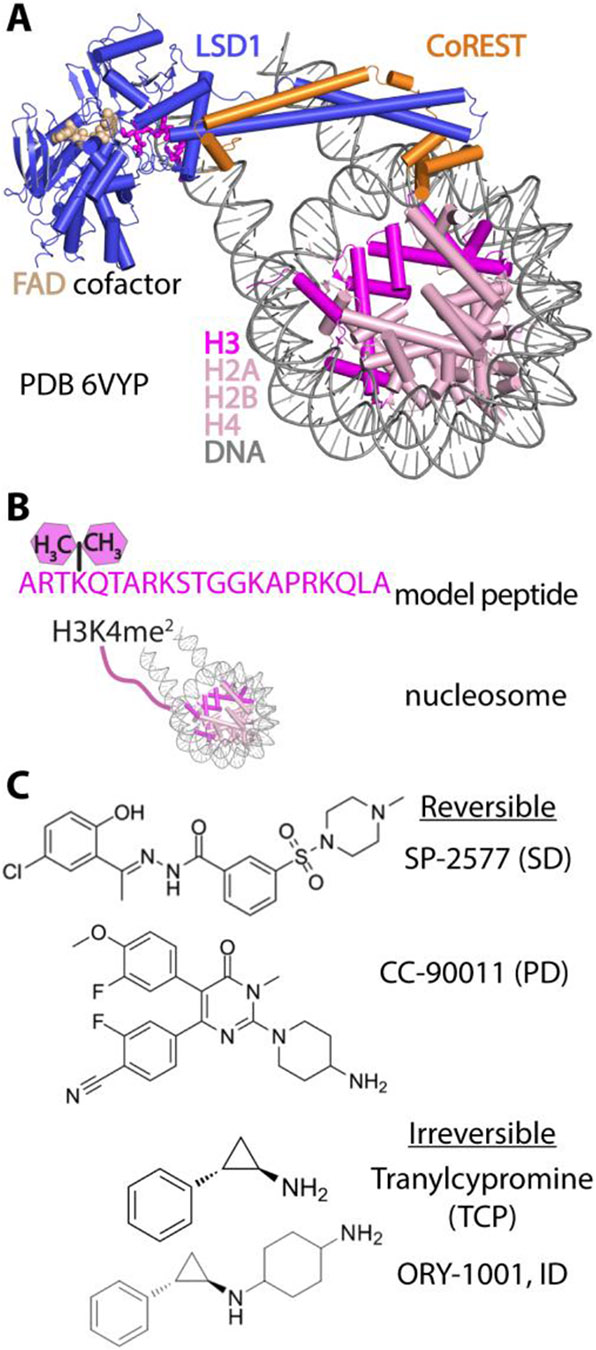
(A) Structure of the complex with nucleosomes (Protein Data Bank entry6VYP). LSD1 (blue), CoREST (orange), and cofactor FAD (beige) interact and demethylate H3K4me1/2 nucleosomes, comprised of DNA (gray) and the histone octamer [H3 (magenta), H2A, H2B, and H4 (light pink)]. (B) Schematic of substrates used in this study: H3K4me2 peptide (top) and H3K4me2 nucleosome (bottom). (C) Anticancer drugs that interact with LSD1. SP-2577 [seclidemstat (SD)] and CC-90011 [pulrodemstat (PD)] are reversible binding ligands, whereas tranylcypromine (TCP) and ORY-1001 [iadademstat (ID)] are irreversible inhibitors that react with FAD.
An exploration of new druggable spaces that target LSD1’s structural and context specific interaction network is highly relevant in the design of effective inhibitors and anticancer therapies.14-18 A series of impressive studies that interrogate small molecule compounds as inhibitors of LSD1 catalytic activity are available in the literature,15,16 yet it is unclear whether some of these small molecule compounds serve as potent LSD1 inhibitors on nucleosome substrates. Inhibitor activity studies on nucleosome substrates offer insight into the development of more selective LSD1-based drug and help to distinguish whether the drug functions as an LSD1 inhibitor on nucleosomes, a protein–protein disruptor, and/or an inducer of cell differentiation. This is especially relevant for established inhibitors of LSD1 that appear to exhibit poor selectivity, potency, efficacy, and off-target toxicity, all of which may complicate and limit the interrogation of LSD1 as a viable therapeutic strategy.15,17 Nonetheless, several inhibitors have entered clinical trials, and intensive pharmacological efforts have focused on the treatment of acute myeloid leukemia (AML), myelodysplastic syndrome, small cell lung cancer(SCLC), and prostate cancer.14-16,19,20
For example, clinical trials evaluating the drug SP-2577 have been pursued as a treatment for Ewing sarcoma (EWS) and ovarian cancer. 21-23 In EWS, the EWS-FLI1 fusion oncoprotein reportedly associates with LSD1 and other proteins at nucleosomes to aberrantly regulate key transcriptional programs.24,25 SP-2577 was shown to act as a reversible and selective inhibitor of LSD1 (IC50 ~ 31 nM), and mouse models reveal that the drug led to an 80% reduction in tumor morphology.21-23,25 These data suggest a potent and effective drug that inhibits demethylation on nucleosomes and helps to reverse aberrant gene expression. However, studies have questioned the efficacy of drugs that contain the core 2-hydroxybenzylidene hydrazide motif found in SP-257726 and propose that SP-2577 may have minimal anticancer efficacy.27 In addition, the mechanism of action for how the drug functions as an LSD1 inhibitor has not been established. To clarify this discrepancy and better understand LSD1–drug interactions that impact LSD1’s action on nucleosomes, we initiated a small molecule comparative kinetics approach with a focus on LSD1’s primary molecular target, H3K4me2 containing nucleosome substrates. We sought to examine how drugs alter LSD1-catalyzed H3K4me2 nucleosome demethylation in vitro and in cancer cells. Specifically, we focused on drugs in clinical trials that include both reversible [SP-2577 and CC-90011 (pulrodemstat)] and irreversible [ORY-1001 (iadademstat) and tranylcypromine (TCP)] inhibitors (Figure 1B, C). A focus on these drugs allows for a direct comparison of the drug’s efficacy to inhibit LSD1 on small peptide and nucleosomal substrates in vitro, an interrogation of enzyme assay readout as well as the cytotoxicity profiles across three human cell lines, and whether these drugs impact H3K4me2 demethylation in EWS (TC-32) cancer cells.
First, we purified the LSD1–CoREST enzyme as described previously28 and determined the LSD1–SP-2577 binding interaction. We initially focused on SP-2577 because its mechanism of action and LSD1–drug structure are unknown, and it is being administered in clinical trials with EWS patients. The intrinsic fluorescence of FAD represents a strategy for measuring the binding of the drug to LSD129,30 because the purification of the enzyme reveals a 1:1 stoichiometric ratio between LSD1 and FAD, where the flavin moiety is deeply embedded non-covalently within the amine oxidase do-main.4,7,31 The optimal FAD emission was monitored (520nm), and SP-2577 was titrated into a solution containing the enzymatically active LSD1–CoREST-FAD complex. An increase in fluorescence intensity was attributed to ligand binding near the FAD moiety within LSD1, as previously established29 (section SM1.2 of the Supporting Information). This fluorescence-based binding approach allowed for the determination of an ΔN LSD1–CoREST-SP-2577 dissociation constant (Kd = 1.3 ± 0.3 μM), suggesting that the drug binds weakly near FAD and the substrate binding pocket of the amine oxidase domain (AOD) (Figure 2A). Here, it is possible that the observed FAD fluorescence changes may be due to protein conformational changes indirectly induced by SP-2577, where the drug may alter the dynamics of the substrate binding pocket. Local conformational changes of the active site would influence the accessibility of FAD, and structural changes have been surmised through molecular dynamics simulations of other inhibitor drug–LSD1 complexes.32 If this is the case for the SP-2577–LSD1 binding interaction, the fluorescence-based Kd value would substantially underestimate a direct binding affinity measurement of the LSD1–drug interaction. Unfortunately, the exact binding location of the LSD1–SP-2577 interface could not be unambiguously resolved, despite exhaustive crystallographic trials and blind docking prediction strategies.
Figure 2. SP-2577 binds LSD1 yet displays variable inhibition onH3K4me2 peptide substrates.
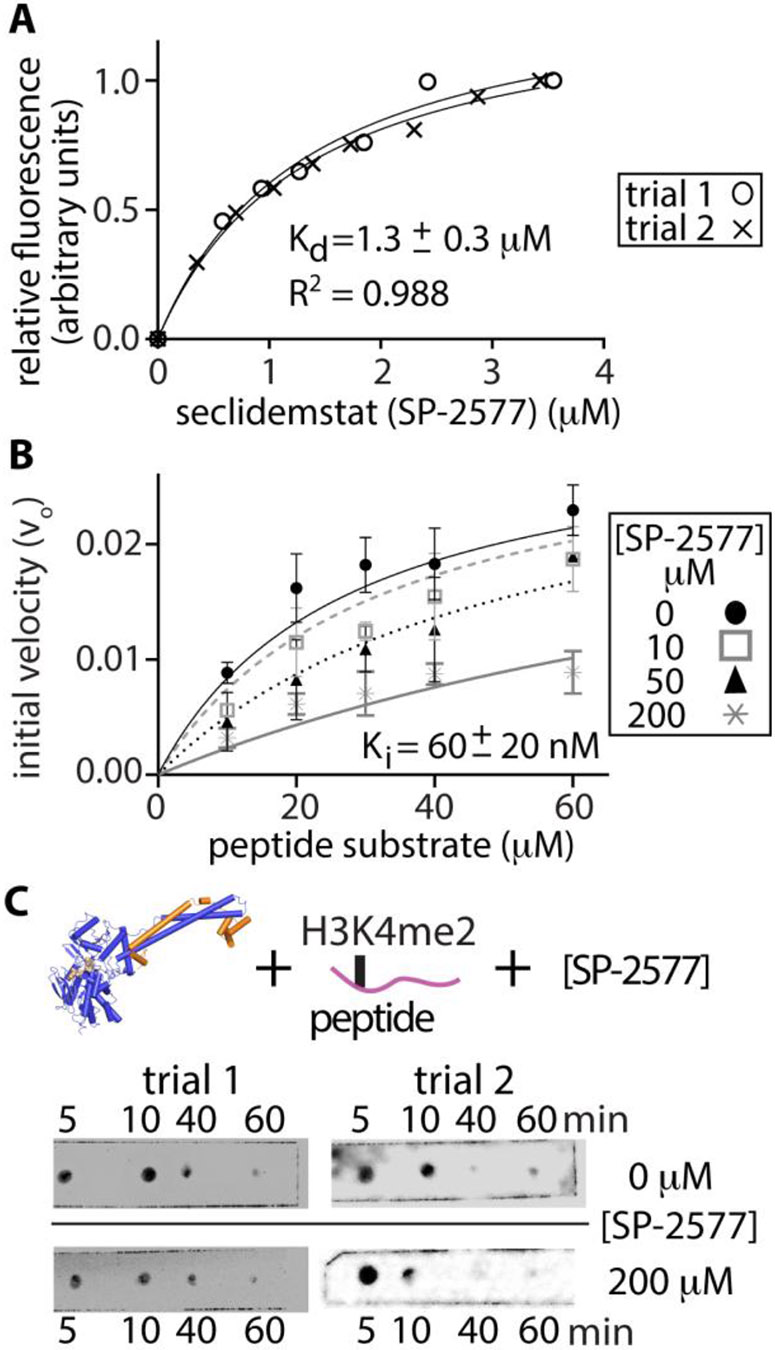
(A) Relative fluorescence changes with increasing SP-2577 concentrations enable determination of the apparent dissociation constant (Kd ~ 1.3 ± 0.3 μM). Two independent experiments (× and ○) were both fit to a 1:1 binding isotherm. (B) Demethylation HRP-coupled assays with H3K4me2 peptide substrates and SP-2577. Reactions with increasing concentrations of SP-2577 are shown, allowing for the determination of an apparent inhibition constant (Ki). (C) Dot blot data of LSD1 demethylation on 25 μM H3K4me2 peptide substrate in the absence (0 μM) and presence of 200 μM SP-2577. A schematic of LSD1(blue)–CoREST (orange) with the H3K4me2 peptide substrate(pink) and SP-2577 shows commonalities between contradictory inhibitory data (panels B and C).
Next, we performed inhibition kinetics of LSD1-catalyzed demethylation in the presence of a small H3K4me2 peptide substrate with increasing amounts of SP-2577 using the established horseradish peroxidase (HRP)-coupledassay.4,7,31,33 The initial velocity and substrate concentration were obtained in triplicate, allowing for the determination of an apparent inhibition constant (Ki = 60 ± 20 nM) (Figure2B) that is entirely consistent with the originally determined Ki value of 31 ± 12 nM.23 Additional Lineweaver–Burk analysis of these data suggest competitive and/or mixed model inhibition (Figure S1), and apparent false positives in the coupled assay experiments were ruled out (Figure S2). These data suggest the drug is a bona fide inhibitor of LSD1–CoREST when using H3K4me2 peptide substrates, as previously determined.23
As an alternative to coupled assays and to further confirmSP-2577 directly impacts demethylation, a dot blot time-course assay on the small H3K4me2 peptide substrate was performed in duplicate, subject to H3K4me2 antibodies, and visualized using chemiluminescence (Figure 2C and section SM1.4). Surprisingly, dot blot results show that SP-2577 has no noticeable inhibitory effect, in direct contrast to the HRP-coupled assay result (Figure 2B). These data obfuscate SP-2577’s role as a targeted LSD1 inhibitor and further suggest that inhibitor studies using enzyme-coupled analyses may suffer from indirect assay readout artifacts.
Thus, an in vitro quantitative Western blot assay in the presence of H3K4me2 nucleosome substrates was established, with a focus on SP-2577 (SD), the reversible inhibitor [CC-90011 (PD)], and the irreversible inhibitor [tranylcypromine (TCP)]. This comparative drug inhibition kinetics approach provides enhanced reliability of the antibody reagents as well as a robust measure of LSD1’s ability to act upon nucleosomes.34 A series of time-course assays measuring the fraction of demethylated H3K4me2 nucleosomes containing a 147 bp DNA were performed using an anti-H3K4me2 specific antibody (Figure 3A and Figure S3A-D). As a control and under identical conditions, Western blot experiments were performed in the absence of LSD1 and at high drug concentrations, confirming that the anti-H3K4me2 signal does not significantly diminish over the time course of the experiment (Figure S4). To accurately measure the fraction of all demethylated H3K4me2 nucleosomes, each of the reactions was performed and monitored with the anti-H3 antibody (section SM1.5). The fraction of demethylated nucleosomes was then quantitated over time, allowing for the determination of the relative kinetics (kobserved) of LSD1-based demethylation (Figure 3B and Figure S5).
Figure 3. Anticancer drugs of LSD1 display variable inhibition on H3K4me2 nucleosomes.
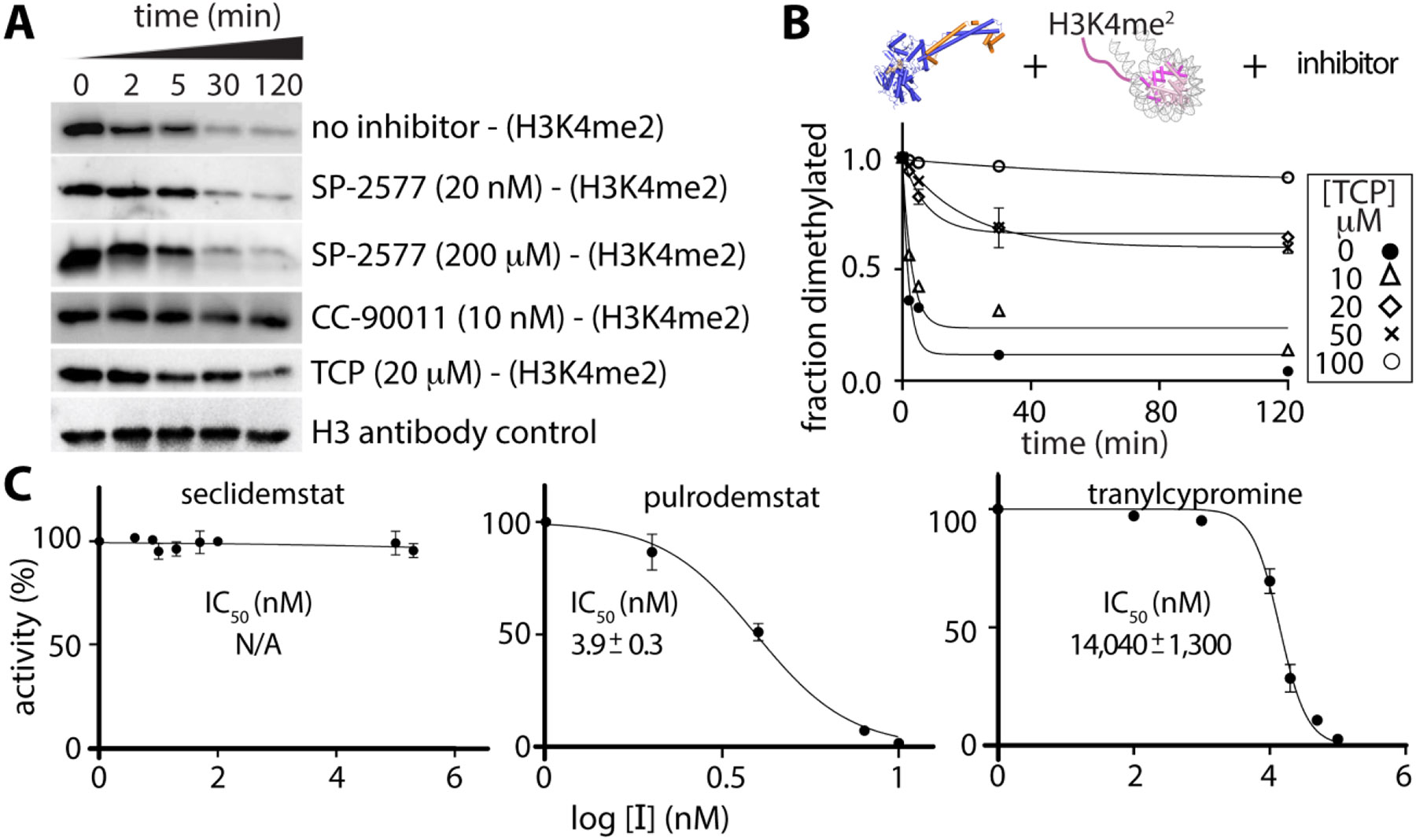
(A) Demethylase activity on nucleosomes analyzed using a time-course Western blot assay, with defined inhibitor concentrations (N = 2). The fraction of dimethylated nucleosomes with and without different anticancer drug concentrations was monitored using H3K4me2 antibodies and evaluated using anti-H3 antibodies as a control. A weaker signal intensity corresponds to stronger demethylase activity. (B) Plot of the fraction dimethylated over time with increasing concentrations for tranylcypromine (TCP). Dimethylation profiles reveal individual kobserved values, providing a measure of the potency of a drug to inhibit LSD1’s activity. (C) Half-maximal inhibitory concentrations (IC50) determined on the basis of the analysis of the percent activity (y-axis) and drug concentration (log10, x-axis). See Figures S3-S5 for Western blot images and analysis for SP-2577, CC-90011, and TCP, respectively.
Dimethylation profiles with increasing drug concentrations reveal that SP-2577 does not impact demethylation on nucleosomes, whereas the addition of CC-90011 exhibits potent inhibition (IC50 = 3.9 ± 0.3 nM) (Figure 3C). Further, the addition of TCP, considered a lead scaffold compound and weak irreversible inhibitor,35-37 displayed appreciable levels of inhibition on H3K4me2 nucleosomes (IC50 = 14.0 ± 1.3 μM). These results are in contrast to SP-2577’s inhibitory properties on a short H3K4me2-containing peptide under coupled assay conditions. However, it is worth noting that H3K4me2 nucleosomes containing a 147 bp DNA used in these assays are also not optimal substrates, as it has been previously shown that LSD1 activity is optimal when using an extended, extranucleosomal DNA linker.38 Taken together, the Western blot strategies for monitoring direct demethylation on either small peptide and nucleosome substrates provide insight into how different LSD1-targeted drugs affect H3K4 demethylation, calling into question (1) the potency of SP-2577 as an inhibitor and (2) the perils of using the indirect HRP-coupled assays for drug discovery purposes.
To further clarify the effect of these LSD1 drugs in a cellular context, the cytotoxic potency and selectivity of the anticancer drugs were evaluated in three cell types [human embryonic kidney (HEK293), EWS (TC-32), and osteosarcoma (U2OS)] using a cell titer blue assay.37 After a timeline for monitoring cell viability was established, as previously described,39 SP-2577 (SD) showed the highest selectivity toward TC-32 cells (IC50 3.3 ± 0.7 μM) yet did not demonstrate appreciable cytotoxicity in U2OS or HEK293 cells. In contrast, CC-90011(PD) showed consistent cytotoxic potency [IC50 values of 36± 23 μM (TC-32), 47 ± 11 μM (U2OS), and 12 μM (HEK293)], and a clinically relevant TCP derivative irreversible drug, iadademstat [ORY-1001 (ID)], displayed cytotoxic effects at slightly higher concentrations [IC50 values of 178 ± 38 μM (TC-32), 346 ± 3 μM (U2OS), and 120 μM (HEK293)] (Figure 4A and Figure S6A). Lastly, the tranylcypromine (TCP) had no appreciable effect on viability in all cell lines at concentrations of ≤ 500 μM (Figure S6B). These results suggest a degree of selectivity by SP-2577 unique to EWS TC-32 cells and demonstrate cytotoxic IC50 profiles for CC-90011 and ORY-1001 across all tested cell types, similar to viability results observed in other human cell lines.15,16
Figure 4. Cell viability and ability of anticancer drugs to demethylate H3K4me2 nucleosomes in EWS (TC-32) cancer cells.
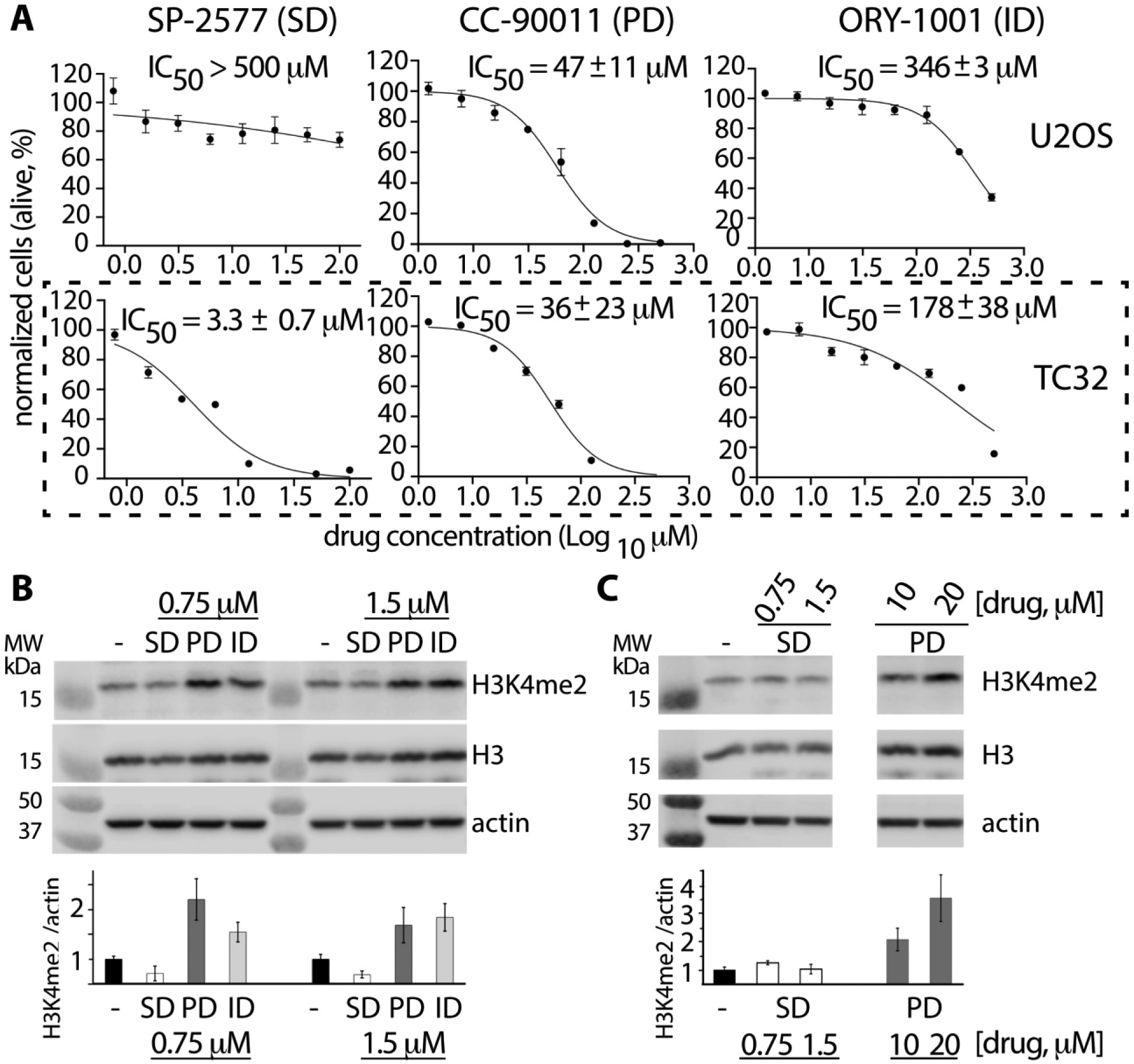
(A) Cell viability IC50 determination of the anticancer drugs, SP-2577 (SD), CC-90011 (PD), and ORY-1001 (ID), in U2OS and TC32 cells. Experiments were performed in duplicate (N = 2) with the reported standard error of the mean (SEM). The log-10 scale range of drug concentrations (x-axis) compared to cancer cells (y-axis, normalized alive cells %) was examined for each inhibitor drug. Data from IC50 profiles (black dashed box) were used in the optimization of cell-based H3K4me2 Western blot (WB) assays. Cell viability IC50 profiles in HEK293 cells and for TCP were also determined (panels A and B, respectively, of Figure S6). (B) Western blot (WB) of H3K4me2, H3, and actin levels in TC-32 EWS cancer cells. Drugs were incubated at single-dose concentrations (0.75 and 1.5 μM), and cells were examined after 48 h. Endogenous levels of H3K4me2 at each drug concentration and no drug (−) were determined in the same blot and detected using a H3K4me2 specific antibody. Below the Western blot images, the measured signal of the WB control relative to actin was determined, yielding a H3K4me2/actin signal. Inhibition of LSD1 demethylation on nucleosomes is surmised by an increase in H3K4me2 levels, as previously observed.40 WB data also allowed for the determination of the H3K4me2/H3 signal (Figure S7). (C) In addition, reversible inhibitor drugs (SP-2577 and CC-90011) were chosen at concentrations according to their comparable cell viability IC50 levels. Here, cells were treated in a manner identical to that described for panel B, except without (−) and with concentrations of the reversible inhibitor drugs SP-2577 (0.75 and 1.5 μM) and CC-90011 (10 and 20 μM). Densitometry data from the images allowed for a qualitative determination of the H3K4me2/actin signal across all conditions.
Because SP-2577 (SD), CC-90011 (PD), and ORY-1001(ID) are putative drugs in clinical trials that target LSD1, the degree of enzyme inhibition was further examined by monitoring demethylation levels of H3K4me2 nucleosomes in EWS cells (TC-32). After drug treatment at single-dose concentrations (0.75 and 1.5 μM), the abundance ofH3K4me2 in the cell lysates was assessed by Western blot analysis (Figure 4B). An increase in the H3K4me2 signal in TC-32 cells, as noted for PD and ID, indicates inhibition. No measurable effect on H3K4me2 nucleosome levels was noted for SD. Here, the residual H3K4me2 levels for treated and untreated cells were measured relative to loading controls in each corresponding lane, revealing that SP-2577 has no effect on H3K4me2 levels whereas both CC-90011 and ORY-1001show potency in blocking H3K4me2 demethylation (Figure 4Band Figure S7). Similarly, the reversible binding LSD1 drug concentrations at comparable cell viability IC50 levels were also tested, corroborating the varying degrees of inhibition by SP-2577 and CC-90011 in TC-32 cells (Figure 4C). For all cell-based WB assays, it is surmised that the inhibition of LSD1demethylation on nucleosomes in cells is demarcated by an increase in H3K4me2 levels, as previously observed.40 Taken together, the data reveal that CC-90011 and ORY-1001 are promising inhibitors of LSD1 in EWS TC-32 cells whereas the reversible binding LSD1 drug SP-2577 is not effective in altering LSD1-catalyzed demethylation activity on nucleosomes in vitro or in TC-32 cells. The juxtaposed results for SP-2577 (SD) on model substrates and lack of inhibition on nucleosome substrates warrant additional caution in the performance of inhibition assays that monitor only short peptide substrates, such as HRP-coupled assays and HTRF assays.31,41
Although we find no evidence that SP-2577 is effective to inhibit LSD1–CoREST-catalyzed demethylation on nucleosomes, the drug’s weak profile for binding to LSD1 (Figure2A) and its selective cytotoxic effects toward TC-32 EWS cells(Figure 4A) merit further mechanism-of-action studies. Thus, SP-2577 impacts TC-32 cells selectively, but its potency as an LSD1 inhibitor does not include nucleosome substrates. One possibility is that SP-2577 attenuates the transcriptional profileof LSD1 in EWS specific cells through an indirect means, such as mitochondrial dysfunction, as shown in studies of the drug analogue SP-2509.42 Alternatively, the drug may bind and affect LSD1 independent of the demethylation reaction on nucleosomes, perhaps disrupting a higher-order LSD1 complex or impacting a non-histone LSD1 target. For example, SP-2577 has been proposed to function as a potential disruptor of a Zn binding protein–LSD1 interface,43,44 although target engagement studies in AML and SCLC cells fail to support SP-2577as a molecular disruptor of LSD1 or a higher-order complex.15 In light of our TC-32 cell-based results and these previousstudies,15 it is likely that SP-2577 has been mischaracterized as an LSD1 inhibitor on nucleosomes and that continued studies are needed to clarify the drug’s role in EWS cells.
Taken together, a Western blot analysis in vitro and in cancer cells provides insight into LSD1’s mode of engagement onnucleosomes9,11,34,38 and suggests new strategies for monitoring whether an anticancer drug can impact LSD1-based demethylation on nucleosome substrates. The contrast in LSD1 inhibition efficacy on nucleosomes highlights the need to include in vitro and cell-based substrate selectivity studies when targeting epigenetic mechanisms associated with cancer pathology. Thus, both substrate-selective approaches and covalent and non-covalent chemotype strategies may serve as synergistic applications to characterize the various classes of mechanistically based LSD1 inhibitors.14,19,33,45 This work also suggests that pharmacology studies on putative anticancer drugs should not rely on enzyme-coupled inhibition assays that use histone peptide substrates and should instead examine LSD1 inhibition through direct assay readout strategies, preferably in the context of the nucleosome complex. Small molecule inhibitor studies that include both in vitro and cell-based nucleosome-based assays will provide mechanistic insights into the therapeutic targeting of epigenetic-based chromatin-modifying enzymes.
Supplementary Material
ACKNOWLEDGMENTS:
N.J.R. acknowledges the National Institutes of Health(GM120572), the Little Warrior Foundation (https://littlewarrior.org), and Marquette University’s Department of Chemistry for support. J. H. is a McNair Scholar with support from the Dept of Chemistry Marquette summer undergraduate research fellowship (SURF) program. O.S. acknowledges support as an NIH biomedical trainee (GM120572-06S1) and was supported through Marquette’s SURF program. S.A. acknowledges support from Marquette’s Dept. of Chemistry and the Denis J. O’Brien fellowship award. The authors thank Piero Spada for critical reading of the manuscript.
ABBREVIATIONS:
- LSD1
lysine specific demethylase 1
- FAD
flavin adenine dinucleotide
- EWS
Ewing sarcoma
- SP-2577 or SD
seclidemstat
- CC-90011 or PD
pulrodemstat
- TCP
tranylcypromine
- ORY-1001 or ID
iadademstat
- H3
histone 3
- K4me2
dimethylated lysine 4
- HDAC
histone deacetylase
- AML
acute myeloid leukemia
- U2OS
human bone osteosarcoma epithelial
- HEK-293
human embryonic kidney
- TC32
Ewing’s sarcoma cell line
- LOX
lysyl oxidase
- HRP
horseradish peroxidase
Footnotes
Supporting Information: The Supporting Information is available free of charge athttps://pubs.acs.org/doi/10.1021/acs.biochem.4c00090.
Methods, supplemental figures, and additional material (PDF)
Accession Codes: LSD1, O60341; CoREST, Q9UKL0; H3, Q71DI3; H2A,Q6FI13; H2B, O60814; H4, P62805.
Notes: The authors declare no competing financial interest.
Contributor Information
Dulmi Senanayaka, Department of Chemistry, MarquetteUniversity, Milwaukee, Wisconsin 53233, United States.
Danyun Zeng, Department of Chemistry, MarquetteUniversity, Milwaukee, Wisconsin 53233, United States; Present Address: Wuhan Institute of Physics and Mathematics, Innovation Academy for Precision Measurement Science and Technology, Chinese Academyof Sciences, Wuhan 430071, China.
Emre Deniz, Department of Oncology, Georgetown University Medical Center, Georgetown University, Washington, D.C. 20007, United States.
Indunil K. Priyankara, Department of Chemistry, Marquette University, Milwaukee, Wisconsin 53233, United States
Joceline Helmbreck, Department of Chemistry, Marquette University, Milwaukee, Wisconsin 53233, United States.
Owen Schneider, Department of Chemistry, Marquett eUniversity, Milwaukee, Wisconsin 53233, United States.
Aashay Mardikar, Department of Chemistry, Marquette University, Milwaukee, Wisconsin 53233, United States.
Aykut Uren, Department of Oncology, Georgetown University Medical Center, Georgetown University, Washington, D.C. 20007, United States.
Nicholas J Reiter, Department of Chemistry, Marquette University, Milwaukee, Wisconsin 53233, United States.
REFERENCES:
- (1).Greer EL; Shi Y Histone methylation: a dynamic mark inhealth, disease and inheritance. Nat. Rev. Genet 2012, 13, 343–357. [DOI] [PMC free article] [PubMed] [Google Scholar]
- (2).Marabelli C; Marrocco B; Mattevi A The growing structural and functional complexity of the LSD1/KDM1A histone demethylase. Curr. Opin Struct Biol 2016, 41, 135–144. [DOI] [PubMed] [Google Scholar]
- (3).Burg JM; Link JE; Morgan BS; Heller FJ; Hargrove AE; McCafferty DG KDM1 class flavin-dependent protein lysine demethylases. Biopolymers 2015, 104, 213–246. [DOI] [PMC free article] [PubMed] [Google Scholar]
- (4).Shi Y; Lan F; Matson C; Mulligan P; Whetstine JR; Cole PA; Casero RA; Shi Y Histone demethylation mediated by the nuclear amine oxidase homolog LSD1. Cell 2004, 119, 941–953. [DOI] [PubMed] [Google Scholar]
- (5).Yang M; Gocke CB; Luo X; Borek D; Tomchick DR; Machius M; Otwinowski Z; Yu H Structural basis for CoREST-dependent demethylation of nucleosomes by the human LSD1histone demethylase. Mol. Cell 2006, 23, 377–387. [DOI] [PubMed] [Google Scholar]
- (6).Laurent B; Ruitu L; Murn J; Hempel K; Ferrao R; Xiang Y; Liu S; Garcia BA; Wu H; Wu F; Steen H; Shi Y A SpecificLSD1/KDM1A Isoform Regulates Neuronal Differentiation through H3K9 Demethylation. Mol. Cell 2015, 57, 957–970. [DOI] [PMC free article] [PubMed] [Google Scholar]
- (7).Forneris F; Binda C; Vanoni MA; Battaglioli E; Mattevi A Human histone demethylase LSD1 reads the histone code. J. Biol. Chem 2005, 280, 41360–41365. [DOI] [PubMed] [Google Scholar]
- (8).Gaweska H; Henderson Pozzi M; Schmidt DM; McCafferty DG; Fitzpatrick PF Use of pH and kinetic isotope effects to establish chemistry as rate-limiting in oxidation of a peptide substrateby LSD1. Biochemistry 2009, 48, 5440–5445. [DOI] [PMC free article] [PubMed] [Google Scholar]
- (9).Kim SA; Zhu J; Yennawar N; Eek P; Tan S Crystal Structure of the LSD1/CoREST Histone Demethylase Bound to Its Nucleosome Substrate. Mol. Cell 2020, 78, 903–914.e4. [DOI] [PMC free article] [PubMed] [Google Scholar]
- (10).Song Y; Dagil L; Fairall L; Robertson N; Wu M; Ragan TJ; Savva CG; Saleh A; Morone N; Kunze MBA; Jamieson AG; Cole PA; Hansen DF; Schwabe JWR Mechanism of Crosstalk between the LSD1 Demethylase and HDAC1 Deacetylase in the CoREST Complex. Cell Rep 2020, 30, 2699–2711.e8. [DOI] [PMC free article] [PubMed] [Google Scholar]
- (11).Pilotto S; Speranzini V; Tortorici M; Durand D; Fish A;Valente S; Forneris F; Mai A; Sixma TK; Vachette P; Mattevi A Interplay among nucleosomal DNA, histone tails, and corepressor CoREST underlies LSD1-mediated H3 demethylation. Proc. Natl.Acad . Sci. U. S. A 2015, 112, 2752–2757. [DOI] [PMC free article] [PubMed] [Google Scholar]
- (12).Laurent B; Ruitu L; Murn J; Hempel K; Ferrao R; Xiang Y; Liu S; Garcia BA; Wu H; Wu F; Steen H; Shi Y A specificLSD1/KDM1A isoform regulates neuronal differentiation throughH3K9 demethylation. Mol. Cell 2015, 57, 957–970. [DOI] [PMC free article] [PubMed] [Google Scholar]
- (13).Metzger E; Willmann D; McMillan J; Forne I; Metzger P; Gerhardt S; Petroll K; von Maessenhausen A; Urban S; Schott AK; Espejo A; Eberlin A; Wohlwend D; Schule KM; Schleicher M; Perner S; Bedford MT; Jung M; Dengjel J; Flaig R; Imhof A; Einsle O; Schule R Assembly of methylated KDM1A and CHD1drives androgen receptor-dependent transcription and translocation. Nat. Struct Mol. Biol 2016, 23, 132–139. [DOI] [PubMed] [Google Scholar]
- (14).Dai XJ; Liu Y; Xue LP; Xiong XP; Zhou Y; Zheng YC; Liu HM Reversible Lysine Specific Demethylase 1 (LSD1) Inhibitors: A Promising Wrench to Impair LSD1. J. Med. Chem 2021,64, 2466–2488. [DOI] [PubMed] [Google Scholar]
- (15).Sacilotto N; Dessanti P; Lufino MMP; Ortega A;Rodríguez-Gimeno A; Salas J; Maes T; Buesa C; Mascaró C; Soliva R Comprehensive in vitro characterization of the LSD1 small molecule inhibitor class in Oncology. ACS Pharmacol Transl Sci.2021, 4, 1818–1834. [DOI] [PMC free article] [PubMed] [Google Scholar]
- (16).Kanouni T; Severin C; Cho RW; Yuen NY; Xu J; Shi L; Lai C; Del Rosario JR; Stansfield RK; Lawton LN; Hosfield D; O’Connell S; Kreilein MM; Tavares-Greco P; Nie Z; Kaldor SW; Veal JM; Stafford JA; Chen YK Discovery ofCC-90011: A Potent and Selective Reversible Inhibitor of Lysine Specific Demethylase 1 (LSD1). J. Med. Chem 2020, 63, 14522–14529. [DOI] [PubMed] [Google Scholar]
- (17).Baby S; Shinde SD; Kulkarni N; Sahu B Lysine-Specific Demethylase 1 (LSD1) Inhibitors: Peptides as an Emerging Class of Therapeutics. ACS Chem. Biol 2023, 18, 2144–2155. [DOI] [PubMed] [Google Scholar]
- (18).Noce B; Di Bello E; Fioravanti R; Mai A LSD1 inhibitors for cancer treatment: Focus on multi-target agents and compounds in clinical trials. Front. Pharmacol 2023, 14, 1120911. [DOI] [PMC free article] [PubMed] [Google Scholar]
- (19).Dong J; Pervaiz W; Tayyab B; Li D; Kang L; Zhang H;Gong H; Ma X; Li J; Agboyibor C; Bi Y; Liu H A comprehensive comparative study on LSD1 in different cancers and tumor specific LSD1 inhibitors. Eur. J. Med. Chem 2022, 240, 114564. [DOI] [PubMed] [Google Scholar]
- (20).Kalin JH; Wu M; Gomez AV; Song Y; Das J; Hayward D; Adejola N; Wu M; Panova I; Chung HJ; Kim E; Roberts HJ; Roberts JM; Prusevich P; Jeliazkov JR; Roy Burman SS;Fairall L; Milano C; Eroglu A; Proby CM; Dinkova-Kostova AT; Hancock WW; Gray JJ; Bradner JE; Valente S; Mai A; Anders NM; Rudek MA; Hu Y; Ryu B; Schwabe JWR;Mattevi A; Alani RM; Cole PA Targeting the CoREST complex with dual histone deacetylase and demethylase inhibitors. Nat. Commun 2018, 9, 53. [DOI] [PMC free article] [PubMed] [Google Scholar]
- (21).Sankar S; Theisen ER; Bearss J; Mulvihill T; Hoffman LM; Sorna V; Beckerle MC; Sharma S; Lessnick SL ReversibleLSD1 inhibition interferes with global EWS/ETS transcriptional activity and impedes Ewing sarcoma tumor growth. Clin. Cancer Res 2014, 20, 4584–4597. [DOI] [PMC free article] [PubMed] [Google Scholar]
- (22).Soldi R; Ghosh Halder T; Weston A; Thode T; Drenner K; Lewis R; Kaadige MR; Srivastava S; Daniel Ampanattu S;Rodriguez Del Villar R; Lang J; Vankayalapati H; Weissman B; Trent JM; Hendricks WPD; Sharma S The novel reversibleLSD1 inhibitor SP-2577 promotes anti-tumor immunity in SWItch/Sucrose-Non Fermentable (SWI/SNF) complex mutated ovarian cancer. PLoS One 2020, 15, No. e0235705. [DOI] [PMC free article] [PubMed] [Google Scholar]
- (23).Sorna V; Theisen ER; Stephens B; Warner SL; Bearss DJ; Vankayalapati H; Sharma S High-throughput virtual screening identifies novel N’-(1-phenylethylidene)-benzohydrazides as potent, specific, and reversible LSD1 inhibitors. J. Med. Chem 2013, 56,9496–9508. [DOI] [PubMed] [Google Scholar]
- (24).Theisen ER; Pishas KI; Saund RS; Lessnick SL Therapeutic opportunities in Ewing sarcoma: EWS-FLI inhibition viaLSD1 targeting. Oncotarget 2016, 7, 17616–17630. [DOI] [PMC free article] [PubMed] [Google Scholar]
- (25).Sankar S; Bell R; Stephens B; Zhuo R; Sharma S; Bearss DJ; Lessnick SL Mechanism and relevance of EWS/FLI-mediated transcriptional repression in Ewing sarcoma. Oncogene 2013, 32,5089–5100. [DOI] [PMC free article] [PubMed] [Google Scholar]
- (26).Mould DP; McGonagle AE; Wiseman DH; Williams EL; Jordan AM Reversible inhibitors of LSD1 as therapeutic agents in acute myeloid leukemia: clinical significance and progress to date.Med. Res. Rev 2015, 35, 586–618. [DOI] [PubMed] [Google Scholar]
- (27).Kurmasheva RT; Erickson SW; Han R; Teicher BA;Smith MA; Roth M; Gorlick R; Houghton PJ In vivo evaluation of the lysine-specific demethylase (KDM1A/LSD1) inhibitor SP-2577 (Seclidemstat) against pediatric sarcoma preclinical models: A report from the Pediatric Preclinical Testing Consortium(PPTC). Pediatr. Blood Cancer 2021, 68, No. e29304. [DOI] [PMC free article] [PubMed] [Google Scholar]
- (28).Hirschi A; Martin WJ; Luka Z; Loukachevitch LV; Reiter NJ G-quadruplex RNA binding and recognition by the lysine-specific histone demethylase-1 enzyme. RNA 2016, 22, 1250–1260. [DOI] [PMC free article] [PubMed] [Google Scholar]
- (29).Casalin P; Pollegioni L; Curti B; Pilone Simonetta M A study on apoenzyme from Rhodotorula gracilis D-amino acid oxidase. Eur. J. Biochem 1991, 197, 513–517. [DOI] [PubMed] [Google Scholar]
- (30).Forneris F; Orru R; Bonivento D; Chiarelli LR; Mattevi A ThermoFAD, a Thermofluor-adapted flavin ad hoc detection system for protein folding and ligand binding. FEBS J. 2009, 276,2833–2840. [DOI] [PubMed] [Google Scholar]
- (31).Forneris F; Binda C; Vanoni MA; Mattevi A; Battaglioli E Histone demethylation catalyzed by LSD1 is a flavin-dependent oxidative process. FEBS Lett. 2005, 579, 2203–2207. [DOI] [PubMed] [Google Scholar]
- (32).Yang K; Liu H Uncovering New Conformational States ofthe Substrate Binding Pocket of LSD1 Potential for Inhibitor Design via Funnel Metadynamics. Journal of Physical Chemistry. B 2024, 128,137–149. [DOI] [PubMed] [Google Scholar]
- (33).Hayward D; Cole PA LSD1 Histone Demethylase Assays and Inhibition. Methods Enzymol 2016, 573, 261–278. [DOI] [PMC free article] [PubMed] [Google Scholar]
- (34).Dhall A; Shelton PMM; Delachat AM; Leonen CJA;Fierz B; Chatterjee C Nucleosome Binding by the Lysine SpecificDemethylase 1 (LSD1) Enzyme Enables Histone H3 Demethylation. Biochemistry 2020, 59, 2479–2483. [DOI] [PMC free article] [PubMed] [Google Scholar]
- (35).Fioravanti R; Romanelli A; Mautone N; Di Bello E;Rovere A; Corinti D; Zwergel C; Valente S; Rotili D; Botrugno OA; Dessanti P; Vultaggio S; Vianello P; Cappa A; Binda C; Mattevi A; Minucci S; Mercurio C; Varasi M; Mai A Tranylcypromine-Based LSD1 Inhibitors: Structure-Activity Relation-ships, Antiproliferative Effects in Leukemia, and Gene Target Modulation. ChemMedChem. 2020, 15, 643–658. [DOI] [PMC free article] [PubMed] [Google Scholar]
- (36).Schenk T; Chen WC; Gollner S; Howell L; Jin L;Hebestreit K; Klein HU; Popescu AC; Burnett A; Mills K;Casero RA Jr; Marton L; Woster P; Minden MD; Dugas M;Wang JC; Dick JE; Muller-Tidow C; Petrie K; Zelent A Inhibition of the LSD1 (KDM1A) demethylase reactivates the all-trans-retinoic acid differentiation pathway in acute myeloid leukemia. Nature medicine 2012, 18, 605–611. [DOI] [PMC free article] [PubMed] [Google Scholar]
- (37).Vianello P; Botrugno OA; Cappa A; Dal Zuffo R; Dessanti P; Mai A; Marrocco B; Mattevi A; Meroni G; Minucci S; Stazi G; Thaler F; Trifiró P; Valente S; Villa M; Varasi M; Mercurio C Discovery of a Novel Inhibitor of Histone Lysine-Specific Demethylase 1A (KDM1A/LSD1) as Orally Active Antitumor Agent. J. Med. Chem 2016, 59, 1501–1517. [DOI] [PubMed] [Google Scholar]
- (38).Kim SA; Chatterjee N; Jennings MJ; Bartholomew B; Tan S Extranucleosomal DNA enhances the activity of the LSD1/CoREST histone demethylase complex. Nucleic Acids Res. 2015, 43,4868–4880 [DOI] [PMC free article] [PubMed] [Google Scholar]
- (39).Balaraman K; Deniz E; Nelson E; Pilicer SL; Atasoy S;Molotkova A; Sevim H; Tiwari PB; Üren A; Wolf C Design, synthesis and biological evaluation of Nucleosidic CD99 inhibitors that selectively reduce Ewing sarcoma viability. Eur. J. Med. Chem 2023, 251, 115244. [DOI] [PMC free article] [PubMed] [Google Scholar]
- (40).Al Abdi L; Saha D; He M; Dar MS; Utturkar SM;Sudyanti PA; McCune S; Spears BH; Breedlove JA; Lanman NA; Gowher H Oct4-Mediated Inhibition of Lsd1 Activity Promotes the Active and Primed State of Pluripotency Enhancers. CellRep 2020, 30, 1478–1490.e6. [DOI] [PMC free article] [PubMed] [Google Scholar]
- (41).Yu V; Fisch T; Long AM; Tang J; Lee JH; Hierl M;Chen H; Yakowec P; Schwandner R; Emkey R High-throughput TR-FRET assays for identifying inhibitors of LSD1 and JMJD2Chistone lysine demethylases. J. Biomol Screen 2012, 17, 27–38. [DOI] [PubMed] [Google Scholar]
- (42).Tokarsky EJ; Crow JC; Guenther LM; Sherman J;Taslim C; Alexe G; Pishas KI; Rask G; Justis BS; Kasumova A; Stegmaier K; Lessnick SL; Theisen ER Mitochondrial Dysfunction Is a Driver of SP-2509 Drug Resistance in Ewing Sarcoma. Mol. Cancer Res 2022, 20, 1035–1046. [DOI] [PMC free article] [PubMed] [Google Scholar]
- (43).Sehrawat A; Gao L; Wang Y; Bankhead A; McWeeney SK; King CJ; Schwartzman J; Urrutia J; Bisson WH; Coleman DJ; Joshi SK; Kim DH; Sampson DA; Weinmann S;Kallakury BVS; Berry DL; Haque R; Van Den Eeden SK;Sharma S; Bearss J; Beer TM; Thomas GV; Heiser LM;Alumkal JJ LSD1 activates a lethal prostate cancer gene network independently of its demethylase function. Proc. Natl. Acad. Sci. U. S.A 2018, 115, No. E4179–E4188. [DOI] [PMC free article] [PubMed] [Google Scholar]
- (44).Qin XK; Du Y; Liu XH; Wang L LSD1 Promotes Prostate Cancer Cell Survival by Destabilizing FBXW7 at Post-Translational Level. Front. Oncol 2021, 10, 616185. [DOI] [PMC free article] [PubMed] [Google Scholar]
- (45).Stazi G; Fioravanti R; Mai A; Mattevi A; Valente S Histone deacetylases as an epigenetic pillar for the development of hybrid inhibitors in cancer. Curr. Opin Chem. Biol 2019, 50, 89–100. [DOI] [PubMed] [Google Scholar]
Associated Data
This section collects any data citations, data availability statements, or supplementary materials included in this article.