


Extended Data Fig. 4 |. Effect of discount factor on model estimates.
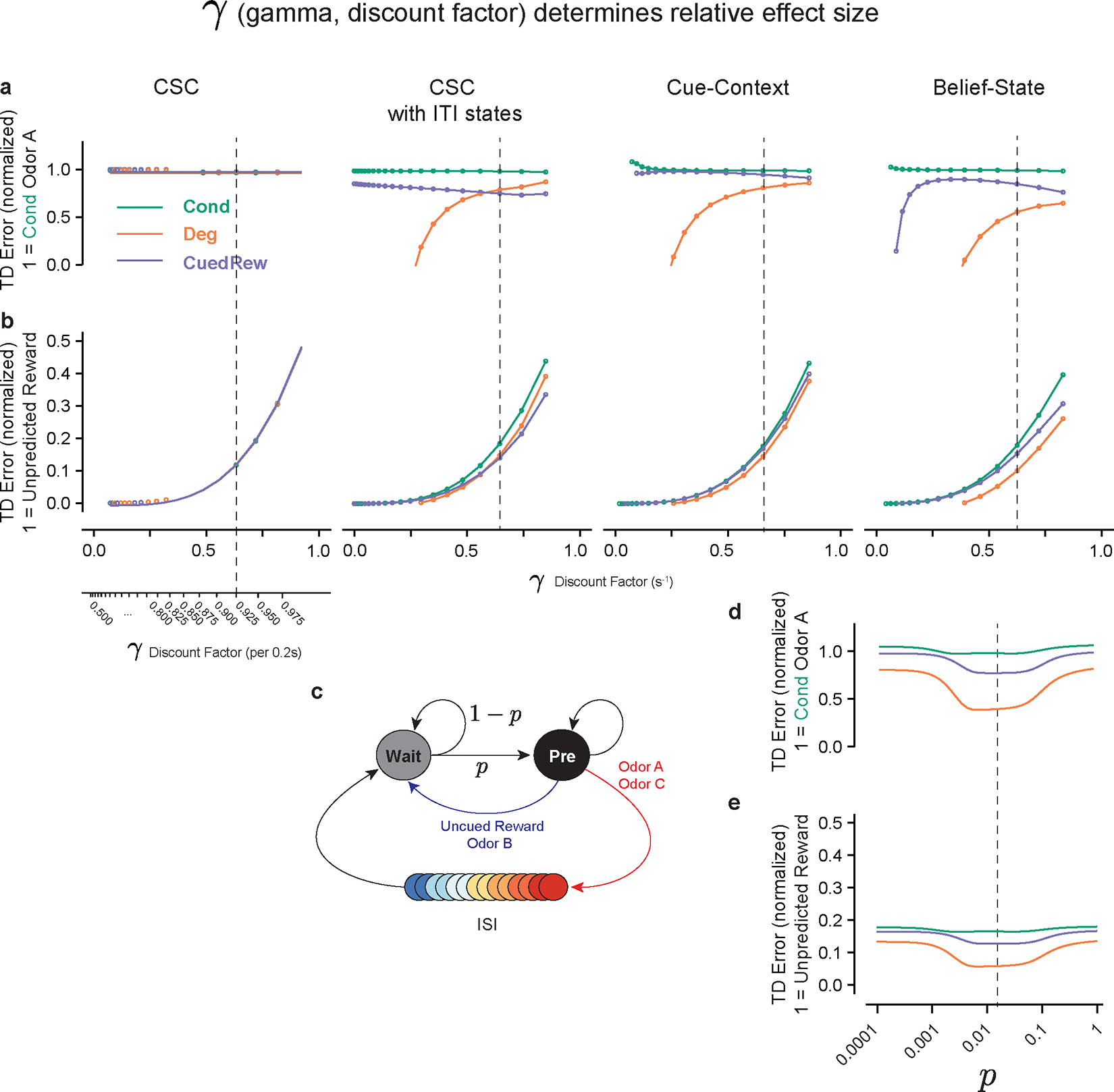
Top: Influence of discount factor (γ) on relative predicted Odor A response relative to Conditioning (a) or relative to unpredicted reward (b), where reward size = 1 for four models presented in Figure 3. Bottom left scale showing discount factor converted to step size (0.2s), other axes use per second discount. Tested range: 0.5–0.975 discount per 0.2s in 0.025 steps. Dotted line indicates discount factor used in main text.
Bottom: Effect size of transition probability in Belief-State model. The Belief-State model used assumes a fixed rate of transition (p) from the Wait state to the Pre-state with each timestep. Varying p around the value fitted to the experimental parameters has minimal effect on prediction (note logarithimic scale). If p is assumed extremely high or low than the transition from the Wait state to the Pre-state either happens almost instaneously or not at all, resulting in a single state dominating the ITI and the model behaving like the Cue-Context model.