



Abstract
Background
The global rise in UV radiation is widely recognized as one of the most relevant health impacts of climate change. Consequently, the prevalence of skin cancer is experiencing a significant increase, with outdoor athletes being identified as a particularly vulnerable population group.
Objectives
This study aims to investigate the extent of UV‐specific skin cancer knowledge among coaches in outdoor sports and to examine potential variations in this knowledge between different sports, coach‐ and club‐specific factors.
Methods
This nationwide representative study was conducted among outdoor sports coaches from the 10 largest outdoor sports associations in Germany. Their knowledge of the risks associated with UV radiation and prevention measures were evaluated using the Skin Cancer and Sun Knowledge Scale (SCSK Scale).
Results
Out of 1200 participating trainers, the UV‐specific skin cancer knowledge score averaged 17.76 (±2.98) on a scale ranging from 0 to 25. The true‐false statements ‘A tan is a sign that the skin is damaged’ (true) and ‘When using sunscreen, you can tan without any negative effects’ (false) were most frequently answered incorrectly. Only 16% of participants correctly identified basal cell carcinoma as the most prevalent form of skin cancer. Differences in UV‐specific skin cancer knowledge were evident across different sports, with football and tennis coaches showing the major knowledge deficits. Conversely, trainers in skiing, swimming and mountain sports demonstrated the highest levels of knowledge. Significant deficiencies in knowledge were particularly notable among male trainers, as well as those from the youngest and the oldest age group, with limited training experience and who primarily worked with children and adolescents in small clubs on a regular basis.
Conclusions
Serious knowledge deficiencies are evident among German outdoor sports coaches. The study results emphasize the necessity for enhanced coach education and the implementation of evaluated concepts for climate adaptation in sports.
The nationwide representative C3O study shows clear deficits in UV‐specific skin cancer knowledge among 1200 German coaches interviewed. Significant differences were evident across different sports as well as between micro and meso‐level characteristics.

Why was the study undertaken?
Due to the global rise in UV radiation, the prevalence of skin cancer is increasing significantly, with outdoor athletes being identified as a particularly vulnerable population group.
What does this study add?
Our nationwide representative study shows clear deficits in UV‐specific skin cancer knowledge among German coaches. Significant differences were evident across different sports as well as across sex, age group, training experience and target group of trainers and frequency of training.
What are the implications of this study for disease understanding and/or clinical care?
This study enables the identification of topics and sport‐, coach‐ and club‐specific target groups for new low‐threshold and lay‐understandable training measures and information campaigns for coaches as key persons for the protection of millions of athletes.
INTRODUCTION
Worldwide the incidence of skin cancer has increased dramatically, establishing the three main types – malignant melanoma, squamous cell carcinoma and basal cell carcinoma – as growing public health concerns. 1 , 2 , 3 , 4 , 5 It is to be feared that this global trend will not only continue, but even intensify: After all, the increase in UV exposure is considered one of the most significant health consequences of climate change. 6
According to the World Health Organization (WHO) and current medical guidelines, outdoor sports enthusiasts are among the main risk groups for the development of skin cancer. 7 , 8 , 9 And there are several reasons for this: First, unlike for other risk groups, it is hardly possible or not possible at all to seek shade or move the sport indoors. Second, outdoor sports usually take place in daylight, while competitions (e.g. league matches, endurance runs, tennis, horse riding and golf tournaments, regattas, skiing competitions) largely take place in the strongest sunlight at midday. 10 Third, depending on the type of sport, athletes seek out environments with particularly high UV exposure for training and competitions (water sports, skiing and mountain hiking 11 ). Fourth, sweat production increases photosensitivity and the risk of sunburn. 2 , 11 Fifth, sweating makes it difficult to use sunscreen and some competition rules make it difficult to wear protective clothing. 11 And finally, many athletes who participate in outdoor sports are underage and therefore particularly susceptible to skin cancer. 8
The increased UV risks in outdoor sports are also reflected in the incidence of sunburn and melanocytic nevi: Very recent representative data from Germany show a 1‐year incidence of sunburn of 17%, with significantly higher values for team sports (21%). 12 And a longitudinal study reported that young outdoor athletes had a significantly higher increase of melanocytic nevi over 2 years than children of the same age who did not exercise outdoors. 13
Sports organizations are responsible for the health of a significant proportion of the population: In Germany, 27% of all children play sports in their free time in the 10 largest outdoor sports associations. Among adults, this figure is 14% (as of January 2023). 14 , 15 The basic prerequisite for prevention is that the trainers have relevant UV‐specific knowledge. 16 , 17
Specifically, this study is therefore dedicated to the question of what UV‐specific skin cancer knowledge coaches in outdoor sports have and whether this knowledge varies between sports and other coach‐, club‐ and location‐specific factors.
MATERIALS AND METHODS
Study design and setting
As part of the ‘C3O study’ (Climate Change, Coaches and Outdoor Sports—Study) presented here, outdoor sports coaches were asked about their knowledge of the risks of UV radiation and corresponding prevention options in a cross‐sectional study. In order to obtain external validity, the survey was conducted nationwide and included the 10 largest outdoor sports associations in Germany. In doing so, we followed the definition of Dee et al., 18 according to which outdoor sports are considered outdoor sports if the competitions usually take place outdoors. According to the official membership statistics of the umbrella organization German Olympic Sports Confederation (DOSB), these were the German Football Association (DFB), the German Tennis Association (DTB), the German Alpine Association (DAV), the German Athletics Association (DLV), the German Equestrian Federation (FN), the German Golf Association (DGV), the German Life Saving Association (DLRG), the German Ski Association (DSV), the German Sailing Association (DSV) and the German Cycling Federation (BDR). With a total of 14 million members, 16% of the German population is organized in these associations (as of January 2023). 15 All participants were informed in advance about the content and procedure of the study via an online link and their consent to participate in the study was obtained (informed consent). The survey was conducted online as an asynchronous written survey using CAWI (computer‐aided web interview) with the help of a standardized questionnaire using the Lime‐Survey software package from May 2022 to June 2023. Before the start of the survey phase, the online questionnaire was subjected to an expert review (n = 4) and a classic pretest (n = 8). The Declaration of Helsinki and the STROBE statement 19 were met. An unqualified positive vote from the responsible ethics committee of the Mannheim Medical Faculty of Heidelberg University was available in advance (AZ 2021‐653, November 16, 2021). The study was preregistered in the German Clinical Trials Registry on January 18, 2022 (registration number DRKS00027815; https://drks.de/search/de/trial/DRKS00027815).
Participants
In addition to being of legal age (≥18 years) and a German resident, the central inclusion criterion was a coaching activity in a competitive or popular sport in one of the 10 most popular German outdoor sports. The study participants were recruited by means of quota sampling, a systematic, non‐probabilistic sampling procedure, according to sport and federal state. The minimum sample size of n = 600 originally envisaged in the study protocol was far exceeded (n = 1200) due to the great interest shown by the target group. Using a standard weighting procedure (so‐called standard redressment on number of cases), each of the outdoor sports under consideration was represented with 120 cases (disproportionate quotas by sport) and the sample was representative nationwide in terms of distribution across the federal states (proportionate quotas by state). 20
Variables and measurement
Dependent variables
Expected effects of climate change: As an introduction to the topic, all trainers were first asked in general terms how likely they thought it was (in %) that climate change would have an impact on the health of outdoor athletes within the next 10 years.
UV‐specific skin cancer knowledge: Our main outcome was operationalized using the Skin Cancer and Sun Knowledge Scale (SCSK Scale). 16 This scale covers several dimensions of this heterogeneous construct such as risk factors for skin cancer, prevalence of skin cancer, symptoms of skin cancer, sun protection and tanning. The SCSK Scale comprises 25 items. The first 15 items are true‐false statements. The subsequent 10 items are phrased as multiple‐choice questions of which only one answer is correct. Due to the one‐factor structure of the SCSK, up to 25 points could be achieved as a sum score. A higher score indicates better knowledge. The psychometric characteristics of the SCSK were tested in Australia, Turkey and Germany and revealed acceptable psychometric properties (internal reliability: KR‐20 between 0.51 and 0.69; test–retest reliability: r = 0.52 to 0.83, p < 0.001). 3 , 16 , 21 , 22 Face, content and incremental validity are also occupied. 16 The SCSK Scale was labelled ‘to be the most appropriate instrument to capture the level of knowledge (…)’ in terms of skin cancer and sun protection in a recent systematic review. 3 In the C3O study, we used the current German version, which was validated according to the TRAPD method as standard for the German‐speaking world. 3 Our study thus fulfils the call to use this scale on survey collectives in non‐English‐speaking countries. 3 , 16 The 25 questions of the SCSK Scale were given the title ‘health quiz’ in our questionnaire in order to increase motivation to answer them. To generate a direct benefit for the participants as part of the survey, the respondents received program‐supported detailed feedback on the answers they gave.
Finally, the coaches were asked which institutions had informed them about UV‐related risks in the past and which sports institution they would expect to do so.
Independent variables (determinants)
Possible determinants were recorded at the micro level as trainer‐specific (sex, age, experience and qualification), the meso level as club‐specific (performance level, training frequency, size and age of the group, size of the club) and the macro level as location‐specific characteristics (zip code and federal state of the club).
Bias and quality control
The online survey method enabled plausibility checks to be carried out during input, for example by blocking unauthorized values and incompletely completed questionnaires. Multiple participations from the same IP address were also not possible. In addition, plausibility checks were carried out in the data set after the database lock (June 30, 2023). This did not reveal any systematic anomalies. The average processing time was 24 min and over 95% of respondents took between 10 and 60 min to complete the questionnaire.
Statistical analysis
The C3O study was evaluated with classic descriptive and inferential methods using the IBM SPSS Statistics 29.0.0.0 program (IBM Corp., Armonk, NY, USA). The interval‐scaled score was approximately normally distributed. The difference the between arithmetic mean and median was less than 0.1 standard deviations. All tests were exploratory and two‐sided with a significance threshold of p ≤ 0.05. Group differences were analysed in the first step using t‐tests and ANOVA. Bivariate significant determinants were further analysed in a second step using multiple regression analyses.
RESULTS
The coaches surveyed were 68% male and had an average age of 44 (±14, range [18–81]) years. On average, they had 15 years of experience working as a coach and 84% held an accredited coaching licence. Most teams pursued recreational (i.e. non‐competitive) sports (63%) and trained at least once per week (79%). The training groups consisted of an average of 11 (±8) people and were made up of children in 26% of the cases, adolescents in 40% and adults in 34%. Sports club membership varied from ≤300 members (39%) to 302–1000 (36%) or ≥1000 members (25%). The specification of sex was missing in two cases and age in three cases. All other variables had no missing values.
Overall, the trainers estimated the probability that climate change would affect the health of outdoor athletes within the next decade at an average of 62% (±29). The values for the SCSK Scale, which measures UV‐specific skin cancer knowledge, averaged 17.76 (±2.98, range [0–25]). A maximum of 10 points was achieved by 2.3% of all trainers, more than 10 to 15 points by 16.2%, more than 15 to 20 points by 65.2% and more than 20 points by 16.3%. The supplement shows which questions were answered incorrectly particularly often.
UV‐specific skin cancer knowledge differed significantly between sports: Football (i.e. soccer) and tennis coaches showed the greatest knowledge deficits (Figure 1). The highest scores were achieved by trainers in skiing (e.g. alpine skiing, cross‐country skiing or ski jumping trainers), swimming (e.g. swimming or lifeguard trainers) and mountain sports (e.g. trainers for mountain hiking, mountaineering, sport or alpine climbing). Figure 1 shows the key data.
FIGURE 1.
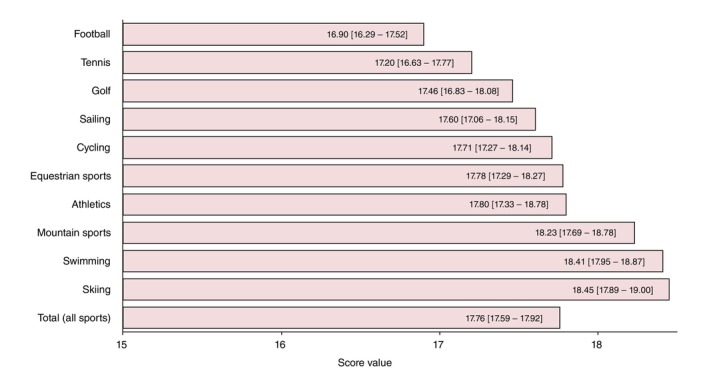
Skin Cancer and Sun Knowledge (SCSK) Scale by type of sport. Arithmetic mean of the Skin Cancer and Sun Knowledge (SCSK) Scale by type of sport (n = 1200; ANOVA: F‐value: 3.48, df = 9, p < 0.001).
In addition, it was investigated whether coach‐, club‐ and location‐specific factors determine the coaches' health knowledge alongside the type of sport. The bivariate analyses showed no significant differences with regard to the qualification of the trainer (licence level), the size and performance level (competitive sport vs. popular sport) of the group or the geographical location of the club (northern vs. southern Germany). However, there were significant differences in other characteristics: To put it simply, the knowledge deficits accumulated particularly among male coaches from the youngest or oldest age groups with little training experience who tend to train children and young people in a small club on an a regular basis (Figure 2).
FIGURE 2.
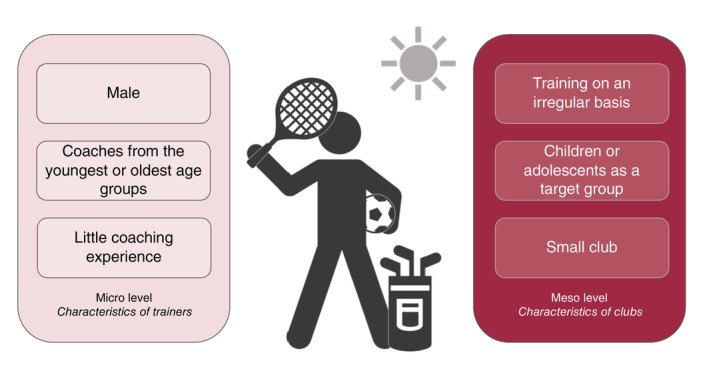
Graphical abstract of negative bivariate significant (p < 0.05) associations between the Skin Cancer and Sun Knowledge (SCSK) Scale and coach and club characteristics of the 10 largest outdoor sports organizations.
The subsequent regression analysis considered that coach characteristics and club structures can differ from sport to sport (Table 1). Essentially, the same picture emerged even after adjustment in the various models: coaches in football had the worst score values. At the micro level, the age of the coach and at the meso level the size of the club were the most important determinants (Table 1).
TABLE 1.
Multivariable linear regression analyses on UV‐specific knowledge among German coaches of the 10 largest outdoor sports associations based on the Skin Cancer and Sun Knowledge (SCSK) Scale.
| Variables | Regression 1: Type of sport | Regression 2: Characteristics of trainers (micro level) | Regression 3: Characteristics of clubs (Meso level) | Regression 4: Overall model |
|---|---|---|---|---|
| Type of sport a | ||||
| Football | −1.54 [+2.29 to −0.79] (p < 0.001) | −1.70 [−245 to −0.95] (p < 0.001) | ||
| Tennis | −1.24 [−1.99 to −0.50] (p = 0.001) | −1.14 [−1.88 to −0.39] (p = 0.003) | ||
| Sailing | −0.84 [−1.59 to −0.09] (p = 0.027) | −0.90 [−1.64 to −0.16] (p = 0.018) | ||
| Golf | −0.99 [−1.74 to −0.24] (p = 0.010) | −0.89 [−1.66 to −0.11] (p = 0.025) | ||
| Equestrian sports | −0.67 [−1.41 to +0.08] (p = 0.082) | −0.80 [−1.60 to −0.00] (p = 0.049) | ||
| Athletics | −0.64 [−1.39 to +0.10] (p = 0.091) | −0.72 [−1.47 − +0.02] (p = 0.058) | ||
| Mountain sports | −0.21 [−0.96 − +0.54] (p = 0.577) | −0.68 [−1.44 to +0.09] (p = 0.082) | ||
| Cycling | −0.74 [−1.49 to +0.01] (p = 0.052) | −0.67 [−1.42 to +0.08] (p = 0.078) | ||
| Swimming | −0.04 [−0.79 to +0.71] (p = 0.924) | −0.32 [−1.07 to +0.42] (p = 0.394) | ||
| Male gender b | −0.42 [−0.78 to −0.06] (p = 0.023) | −0.42 [−0.82 to −0.01] (p = 0.044) | ||
| Middle age c | +0.67 [+0.33 to +1.01] (p < 0.001) | +0.77 [+0.43 to +1.11] (p < 0.001) | ||
| Little coaching experience d | −0.54 [−1.00 to −0.08] (p = 0.021) | −0.48 [−0.93 to −0.02] (p = 0.041) | ||
| Training on a daily basis e | −0.82 [−1.27 to −0.37] (p < 0.001) | −0.83 [−1.33 to −0.33] (p = 0.001) | ||
| Adult target group f | +0.42 [+0.06 to +0.77] (p = 0.021) | +0.30 [−0.08 to +0.0.68] (p = 0.124) | ||
| Small club g | −0.90 [−1.43 to −0.37] (p = 0.001) | −1.05 [−1.61 to −0.50] (p < 0.001) | ||
| Constant/p | 18.447/<0.001 | 17.727/<0.001 | 17.853/<0.001 | 18.595/<0.001 |
| R‐squared | 0.026 | 0.022 | 0.024 | 0.070 |
| n | 1199 | 1194 | 1199 | 1194 |
Note: b‐coefficiants, dependent variable: Skin Cancer and Sun Knowledge (SCSK) Scale (range [0–25]).
Ref.: Skiing.
Ref.: Female gender.
Ref.: Age <25 or ≥55 years.
Ref.: Coaching experience ≥5 years.
Ref.: Non‐daily training.
Ref.: Target group: children or adolescents.
Ref.: Large club (>100 members).
If one asks the coaches who informed them about UV‐specific risks in sports in the past, it was most likely their own club (Figure 3). The coaches occasionally received support in this regard from the sport‐specific state and federal associations, and least often from the cross‐sport state and federal associations. The existing lack of information was clearly evident when it came to the question of desired support. Figure 3 shows that coaches would like to receive significantly more information on UV risks and UV protection from all institutions—for example in the form of training, further education and other qualification measures. From the coaches' point of view, the sport‐specific associations in particular are called upon to do more than their own clubs (Figure 3).
FIGURE 3.
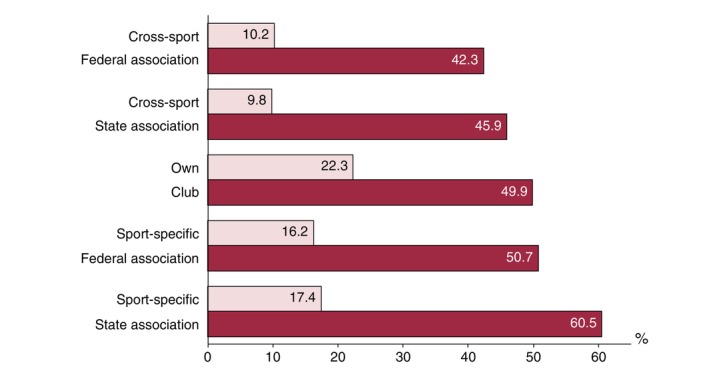
Actual and desired information practice on UV‐related health risks by responsible sports institutions from the perspective of German coaches from the 10 largest outdoor sports associations. N = 1200. Light pink = Proportion of trainers who were actually informed about UV‐related health risks by a sports institution (%). Dark red = Proportion of coaches who would like information from a sports institution about UV‐related health risks (%).
DISCUSSION
Almost all adverse effects of solar UV exposure are preventable through adequate sun protection behaviour. 3 , 10 In organized sports, trainers are key players in the prevention of acute skin damage, such as painful sunburns, and of chronic skin damage, such as malignant melanoma, which is often fatal. 2 , 3 , 10 This applies both to competitive sport with its typically high training volumes and long exposure times as well as to recreational sport with its large proportion of children and adolescents, who are considered to be at particular dermatological risk.
With a mean value of 18 points (compared to a maximum of 25 points), the C3O study presented here shows clear knowledge deficits among German coaches. Our large, representative, confounder‐adjusted sample enables the identification of sport‐, coach‐ and club‐specific differences. In terms of health‐related knowledge, the sports of football and tennis as well as male coaches from the youngest and oldest age groups with little coaching experience and minors as a target group performed particularly poorly. There were also deficits in small clubs and in clubs where training takes place on a daily basis.
This means that the two largest outdoor sports associations in Germany, namely football and tennis, have the most significant gaps in knowledge. With 7.4 million members, the German Football Association (DFB) is by far the largest sports association in Germany. 14 Almost one in 10 Germans plays this sport. The German Tennis Association (DTB) is in second place with 1.5 million members. 14 In both sports, games often take place in the summer in very high temperatures under blazing sunlight and without any shading on the pitch. This is an example of new sports‐specific research questions and potentials for prevention.
Limitations and strengths of the study
The weaknesses of this study include possible selection effects and restrictions on transferability to other regions: First, it cannot be ruled out that in particular those trainers who considered the topic to be more relevant and therefore had more health knowledge were willing to participate. This typical limitation is also problematized by comparable studies. 2 In this case, the deficits would possibly be even more pronounced de facto than described above. However, the selection bias should be mitigated by the representative sample approach. A second limitation concerns the transferability of our results to other regions of the world. The strengths of our study include the large sample size, its representativeness and the ability to differentiate between the sports relevant in this context. A special feature is the framing of the SCSK questions as a ‘health quiz’ as part of the online survey. This may not only have increased the respondents' ambition and motivation. It also enabled us to obtain immediate feedback on the correct answers. Through this short information (in the sense of a ‘brief intervention’), we were able to realize a direct benefit for the respondents (and perhaps an indirect benefit for the athletes they supervise).
Classification in the research context
With our study, we are taking up the call to use the SCSK Scale in future in collectives other than those observed so far in order to test its practicability and establish it as a validated measurement instrument. 16 This provides an opportunity for a comparison with previously studied collectives: The SCSK mean values among Australian students (male and female) ranged between 18.06 ± 3.14 and 18.35 ± 3.12, 16 among Turkish students between 14.19 ± 3.05 and 15.28 ± 2.74 and among German students between 14.33 ± 2.69 and 15.85 ± 3.20. 3 An Australian patient collective (mean age 62 ± 14) achieved values of 19.3 ± 3.3 23 and a Turkish collective of oncology nurses achieved values between 15.23 ± 2.73 and 20.55 ± 4.44. 24 We also found similar, merely small sex differences in our data (17.60 ± 3.08 and 18.07 ± 2.74; p ≤ 0.011). In the literature, these are primarily attributed to the lower risk awareness of men. 10 Overall, our mean values were therefore between the previous findings: slightly better than previously studied collectives of students and about worse than previously studied collectives of other adults.
A recent systematic scoping review criticizes the fact that, despite the explosive nature of this topic, there is hardly any data on ‘sun protection in sport’. 10 The situation is different with regard to the second major field of prevention in outdoor sports, namely the topic of ‘external heat illnesses’. For example, elaborate position statements, guidelines and recommendations for the prevention and treatment of external heat illnesses have long been available for the USA and Australia and have been extensively monitored and evaluated. 25 , 26
The large overlap between UV protection and heat protection in sports has considerable synergistic potential. Many measures reduce UV and heat stress in equal measure. Only a few recommendations require a consensus discussion. To protect against UV radiation, dark clothing with the longest possible cut is recommended, whereas the guidelines for heat protection tend to call for light‐coloured clothing with the airiest possible cut. 11 , 27
Our findings call for improved coach education. In concrete terms, it is therefore a matter of developing sport‐specific ‘climate and health literacy’. 17 One possibility is to provide information and practical training for trainers as part of education measures. In Germany, trainers are required to renew their licence every 4 years by attending courses lasting several days. Climate change‐specific content could be easily integrated into these comprehensive training measures at relatively short notice.
There are already very elaborate and successfully evaluated concepts for climate adaptation in sports. 9 , 10 , 28 , 29 They recommend that knowledge transfer (e.g. in coach training) be flanked by structural measures (e.g. installation of sun sails, setting up sunshades by coaches during breaks in training and matches), 28 , 29 , 30 organizational measures (e.g. moving training times to the morning or afternoon, exclusion of athletes without adequate sun protection, rule changes, clothing policy, additional shade breaks, redesigning endurance competitions as night runs, etc.) 9 , 10 , 28 , 29 , 30 , 31 as well as personalized measures (e.g. purchase of certified jersey sets and sportswear with UPF50+ ratings, affixing stickers in the cabins reminding people to use sunscreen, provision of sunscreen dispensers). 9 , 10 , 29 The recently published SC 3 pyramid model also includes information campaigns. 29 In this context, prominent top athletes could act as role models. Such frameworks should now be promptly adapted to UV protection in outdoor sports and established accordingly. Specific training courses and targeted further training for trainers appear to be the first step.
AUTHOR CONTRIBUTIONS
Conceptualization: S.S. and S.L.; methodology: S.S. and S.L.; resources: S.S. and S.L.; writing – original draft preparation: S.S. and S.L.; writing – review and editing: S.S., S.L. and Z.A.P.; visualization: S.S. and S.L.; translation: S.L. and Z.A.P.; supervision: S.S.; project administration: S.S. and S.L. All authors have read and agreed to the published version of the manuscript.
FUNDING INFORMATION
Open Access funding enabled and organized by Projekt DEAL.
CONFLICT OF INTEREST STATEMENT
The authors have no conflict of interest to declare.
ETHICAL APPROVAL
An unqualified positive vote from the responsible ethics committee of the Mannheim Medical Faculty of Heidelberg University was available in advance (AZ 2021‐653, November 16, 2021).
Supporting information
Table S1:
ACKNOWLEDGEMENTS
We would like to thank Dr. med. Simone Berkel (physician, specialist in general medicine, Mannheim, Germany), Xenia Rolof (University of Mannheim, Germany) and Clara Ehls (Heidelberg University, Germany) for their helpful comments on earlier versions of this manuscript.
Schneider S, Parsons ZA, Leer S. Beyond the scoreboard: Coaches' UV‐related skin cancer knowledge in outdoor sports. J Eur Acad Dermatol Venereol. 2025;39:1297–1305. 10.1111/jdv.20461
Linked article: P. N. Lim. et al. J Eur Acad Dermatol Venereol 2025;39:e625–e627. https://doi.org/10.1111/jdv.20755
DATA AVAILABILITY STATEMENT
The original data that support the findings of this study are available in German on request from the corresponding author [SS].
REFERENCES
- 1. Glanz K, Yaroch AL, Dancel M, Saraiya M, Crane LA, Buller DB, et al. Measures of sun exposure and sun protection practices for behavioral and epidemiologic research. Arch Dermatol. 2008;144(2):217–222. [DOI] [PubMed] [Google Scholar]
- 2. Wysong A, Gladstone H, Kim D, Lingala B, Copeland J, Tang JY. Sunscreen use in NCAA collegiate athletes: identifying targets for intervention and barriers to use. Prev Med. 2012;55(5):493–496. [DOI] [PubMed] [Google Scholar]
- 3. Rocholl M, Hannappel J, Ludewig M, John SM. UV‐induced skin cancer knowledge, sun exposure, and tanning behavior among university students: investigation of an opportunity sample of German university students. J Skin Cancer. 2021;2021:5558694. [DOI] [PMC free article] [PubMed] [Google Scholar]
- 4. Leiter U, Keim U, Garbe C. Epidemiology of skin cancer: update 2019. In: Reichrath J, editor. Sunlight, Vitamin D and skin cancer. Cham: Springer International Publishing; 2020. p. 123–139. [DOI] [PubMed] [Google Scholar]
- 5. International Agency for Research on Cancer (IARC) . Skin cancer. 2022. Available from: https://www.iarc.who.int/cancer‐type/skin‐cancer/. Accessed 23 May 2024.
- 6. Intergovernmental Panel on Climate Change (IPCC) . Climate Change 2021 – The physical science basis: working group I contribution to the sixth assessment report of the intergovernmental panel on climate change. Cambridge: Cambridge University Press; 2023. [Google Scholar]
- 7. Weltgesundheitsorganisation . Gesundheitshinweise zur Prävention hitzebedingter Gesundheitsschäden: Neue und aktualisierte Hinweise für unterschiedliche Zielgruppen. Kopenhagen: WHO‐Regionalbüro für Europa; 2019. [Google Scholar]
- 8. Deutsche Krebsgesellschaft, Deutsche Krebshilfe, AWMF . S3‐Leitlinie Prävention von Hautkrebs. 2021.
- 9. Stölzel F, Wolff M, Fieber V, Glausch M, Wachs C, Breitbart E, et al. UV protection for young athletes: using participatory program planning to develop a sports schools program. Environ Health Prev Med. 2020;25(1):39. [DOI] [PMC free article] [PubMed] [Google Scholar]
- 10. Morton SK, Harrison SL. Slip, slop, slap, slide, seek and sport: a systematic scoping review of sun protection in sport in Australasia. Curr Oncol. 2022;30(1):401–415. [DOI] [PMC free article] [PubMed] [Google Scholar]
- 11. Jinna S, Adams BB. Ultraviolet radiation and the athlete: risk, sun safety, and barriers to implementation of protective strategies. Sports Med. 2013;43(7):531–537. [DOI] [PubMed] [Google Scholar]
- 12. Görig T, Apfelbacher C, Drewitz KP, Reimers AK, Breitbart EW, Diehl K. Sunburn and sun protection during recreational outdoor sport in summer: findings from the German general population aged 16–65 years. Photodermatol Photoimmunol Photomed. 2023;39(6):589–597. [DOI] [PubMed] [Google Scholar]
- 13. Mahé E, Beauchet A, de Paula CM, Godin‐Beekmann S, Haeffelin M, Bruant S, et al. Outdoor sports and risk of ultraviolet radiation‐related skin lesions in children: evaluation of risks and prevention. Br J Dermatol. 2011;165(2):360–367. [DOI] [PubMed] [Google Scholar]
- 14. Deutscher Olympischer Sportbund e. V . Bestandserhebung 2023. 2023. Available from: https://cdn.dosb.de/user_upload/www.dosb.de/uber_uns/Bestandserhebung/Bestandserhebung_2023.pdf. Accessed 23 May 2024.
- 15. Statistisches Bundesamt . Bevölkerung nach Nationalität und Bundesländern. 2023. Available from: https://www.destatis.de/DE/Themen/Gesellschaft‐Umwelt/Bevoelkerung/Bevoelkerungsstand/Tabellen/bevoelkerung‐nichtdeutsch‐laender.html. Accessed 22 January 2024.
- 16. Day AK, Wilson C, Roberts RM, Hutchinson AD. The skin cancer and sun knowledge (SCSK) scale: validity, reliability, and relationship to sun‐related behaviors among young Western adults. Health Educ Behav. 2014;41(4):440–448. [DOI] [PubMed] [Google Scholar]
- 17. Limaye VS, Grabow ML, Stull VJ, Patz JA. Developing a definition of climate and health literacy. Health Aff (Millwood). 2020;39(12):2182–2188. [DOI] [PMC free article] [PubMed] [Google Scholar]
- 18. Dee SG, Nabizadeh E, Nittrouer CL, Baldwin JW, Li C, Gaviria L, et al. Increasing health risks during outdoor sports due to climate change in Texas: projections versus attitudes. Geohealth. 2022;6(8):e2022GH000595. [DOI] [PMC free article] [PubMed] [Google Scholar]
- 19. Vandenbroucke JP, von Elm E, Altman DG, Gotzsche PC, Mulrow CD, Pocock SJ, et al. Strengthening the reporting of observational studies in epidemiology (STROBE): explanation and elaboration. PLoS Med. 2007;4(10):1628–1654. [DOI] [PMC free article] [PubMed] [Google Scholar]
- 20. Monette DR, Sullivan TJ, DeJong CR. Applied social research: a tool for the human services. 8th ed. Pacific Grove, CA: Brooks/Cole; 2011. p. 152. [Google Scholar]
- 21. Rönsch H, Rocholl M, Ludewig M, Staudt A, Langner M, Steeb T, et al. Sonnenschutz bei Beschäftigten im Freien. Entwicklung und Validierung von standardisierten Fragebögen für Verhalten und Wissen: sun protection in outdoor workers – development and validation of standardized questionnaires for behavior and knowledge. J Dtsch Dermatol Ges. 2024;22(5):665–674. [DOI] [PubMed] [Google Scholar]
- 22. Haney MO, Bahar Z, Beser A, Arkan G, Cengiz B. Psychometric testing of the Turkish version of the skin cancer and sun knowledge scale in nursing students. J Cancer Educ. 2018;33(1):21–28. [DOI] [PubMed] [Google Scholar]
- 23. Thet Z, Lam AK, Ng SK, Aung SY, Han T, Ranganathan D, et al. An integrated skin cancer education program in renal transplant recipients and patients with glomerular disease. BMC Nephrol. 2022;23(1):361. [DOI] [PMC free article] [PubMed] [Google Scholar]
- 24. Akdeniz Kudubes A, Aydın A, Ugur O, Bektas M. Factors affecting knowledge levels of oncology nurses about skin cancer and sun protection. Eur J Cancer Care (Engl). 2020;29(6):e13310. [DOI] [PubMed] [Google Scholar]
- 25. Kerr ZY, Marshall SW, Comstock RD, Casa DJ. Exertional heat stroke management strategies in United States high school football. Am J Sports Med. 2014;42(1):70–77. [DOI] [PubMed] [Google Scholar]
- 26. Valdes AS, Hoffman JR, Clark MH, Stout JR. National Collegiate Athletic Association strength and conditioning coaches' knowledge and practices regarding prevention and recognition of exertional heat stroke. J Strength Cond Res. 2014;28(11):3013–3023. [DOI] [PubMed] [Google Scholar]
- 27. Marshall SW. Heat injury in youth sport. Br J Sports Med. 2010;44(1):8–12. [DOI] [PubMed] [Google Scholar]
- 28. Racinais S, Alonso JM, Coutts AJ, Flouris AD, Girard O, Gonzalez‐Alonso J, et al. Consensus recommendations on training and competing in the heat. Br J Sports Med. 2015;49(18):1164–1173. [DOI] [PMC free article] [PubMed] [Google Scholar]
- 29. Schneider S, Niederberger M, Kurowski L, Bade L. How can outdoor sports protect themselves against climate change‐related health risks? – a prevention model based on an expert Delphi study. J Sci Med Sport. 2023;27:37–44. [DOI] [PubMed] [Google Scholar]
- 30. Chalmers S, Jay O. Australian community sport extreme heat policies: limitations and opportunities for improvement. J Sci Med Sport. 2018;21(6):544–548. [DOI] [PubMed] [Google Scholar]
- 31. Yankelson L, Sadeh B, Gershovitz L, Werthein J, Heller K, Halpern P, et al. Life‐threatening events during endurance sports: is heat stroke more prevalent than arrhythmic death? J Am Coll Cardiol. 2014;64(5):463–469. [DOI] [PubMed] [Google Scholar]
Associated Data
This section collects any data citations, data availability statements, or supplementary materials included in this article.
Supplementary Materials
Table S1:
Data Availability Statement
The original data that support the findings of this study are available in German on request from the corresponding author [SS].