



ABSTRACT
Objectives
The understanding of usefulness of immunoglobulin replacement therapy (IgRT) for hypogammaglobulinemia (HGG) in patients with hematologic malignancies (HM) has changed over time. This is mainly caused by the introduction of new treatment, such as B‐cell targeted agents. We investigated the real world effectiveness of IgRT on the severe bacterial infection (SBI) incidence in patients with HGG secondary to HMs using a Japanese claims database provided by MDV Inc.
Methods
Patients who were diagnosed with both HM and HGG from May 2010 to March 2021 in this database and prescribed IgRT with the dosage of > 5 g/month were eligible. We compared the SBI incidence, which was defined as a prescription of intravenous antibacterial agents during hospitalization, between during 12‐month before IgRT initiation (baseline period) and 12‐month after IgRT initiation (follow‐up period).
Results
In total 1621 eligible patients, 37.9% and 17.7% of patients were for non‐Hodgkin's lymphoma (NHL) and multiple myeloma (MM), respectively. A total of 24.4% of patients were hematopoietic stem cell transplantation (HSCT) recipients. In the follow‐up period, SBI incidence significantly decreased than that in the baseline period (2.3 events per person‐year vs. 0.9; p < 0.001). Similar results were observed in various subgroups such as patients who were diagnosed with NHL or MM, treated with anti‐CD20 monoclonal antibody or anti‐CD38 monoclonal antibody, or HSCT recipients. In the small number of patients whose baseline serum IgG levels were available (n = 28), decrease of the SBI incidence in the follow‐up period was observed regardless of IgG levels. A reduction of the SBI incidence was seen in patients with < 400 mg/dL (2.6 vs. 0.6).
Conclusion
IgRT may decrease the SBI incidence in patients with HGG secondary to HM.
Trial Registration:
Registered at UMIN Clinical Trials Registry, UMIN000047418
Keywords: claims database, hematologic malignancies, hypogammaglobulinemia, immunoglobulin replacement therapy, severe bacterial infection
1. Introduction
Prognosis of hematologic malignancies (HMs) has remarkably improved in the last decade. This was mainly provided by the progress of treatment strategy including the standardization of B‐cell targeted agents (BCTAs). On the other hands, infectious event is known as a major cause of non‐cancer related deaths [1, 2, 3]. Secondary hypogammaglobulinemia (HGG) is a critical factor of infectious risk, which is prone to occur in HMs and is induced by their treatments, particularly BCTAs (i.e., anti‐CD20 monoclonal antibody [mAb], anti‐CD38mAb, CD19 chimeric antigen receptor T cell, and B‐cell maturation antigen targeted therapies), or a hematopoietic stem cell transplantation (HSCT) [4, 5]. HGG is observed in over 40% of the patients with B‐cell malignancies during or after receiving BCTAs [6, 7, 8, 9]. One‐fourth of allogeneic HSCT recipients experienced HGG until 1 year after HSCT [10].
Randomized clinical trials (RCTs) previously demonstrated that immunoglobulin replacement therapy (IgRT; intravenous immunoglobulin [IVIG]; or subcutaneous immunoglobulin [SCIG]) reduced the risk of infectious events, including severe infection, in HGG patients with chronic lymphocytic leukemia (CLL) or multiple myeloma (MM) [11, 12, 13, 14]. However, no RCT has been demonstrated in terms of efficacy with IgRT in the patients treated with BCTAs because the most of these studies were conducted before 2000s. As for allogeneic HSCT recipients, RCT never showed the distinct efficacy of IgRT on infections because it was presumed that many patients with sufficient serum IgG levels were included and were not stratified in these studies [15, 16]. The guidelines state that the use of IgRT (IVIG, SCIG) is recommended and considered for cases with HGG (< 400–500 mg/dL) and/or a history of repeated or severe infections [17, 18, 19, 20]. Recently, several retrospective studies of HGG with BCTAs or HGG after allogeneic HSCT have reported a reduction in infectious events with IgRT, but the effectiveness of IgRT has not been still fully investigated in these populations [6, 7, 21, 22, 23].
Thus, we conducted a retrospective claims database study to examine the impact of IgRT on the incidence of severe bacterial infections (SBIs) in patients with HGG secondary to HM in the real world Japanese clinical practice in BCTA era.
2. Materials and Methods
This study is a cohort study using the hospital‐based claims data based on the Diagnosis Procedure Combination / Per Diem Payment System (DPC/PDPS). This study was approved by the non‐profit organization MINS Research Ethics Committee (MINS‐REC‐220211).
2.1. Data Source
We used the hospital claims database accumulated by Medical Data Vision, Co. (MDV; Tokyo, Japan). The MDV database (MDV‐DB) consists of treatment management data from 400 hospitals and approximately 35 million patients, representing about 30% of Japanese hospitals using DPC/PDPS [24]. This uses anonymized patient identifiers and stores the following information on patients: gender, year of birth, date of care, diagnosis code (International Statistical Classification of Diseases and Related Health Problems, 10th Edition [ICD‐10]), date of admission, medical procedures, laboratory orders, surgeries, and prescriptions. We used MDV‐DB because this contains the large amount of data on patients diagnosed with secondary HGG by HM in Japan over the past several years.
2.2. Study Population
Patients who were diagnosed with both HM (ICD‐10 C81.x‐96.x) and HGG (Japan‐specific disease code 2790006) and treated with an IgRT from May 1st, 2010 to March 31, 2021 in the MDV‐DB were extracted. IgRT was defined as the prescription of immunoglobulins (Anatomical Therapeutic Chemical code J06C0 and J06E0) with the dosage > 5 g/month.
Eligible patients had to meet all of the following criteria: (1) diagnosed with HMs (ICD‐10 C81.x‐96.x, Table S1); (2) diagnosed with HGG (Japan‐specific disease code 2790006, Table S1); (3) treated with IgRT after initial diagnosis of HMs and HGG (the date of first immunoglobulin prescription was defined as the index date); (4) had two or more medical records during both the baseline (12 months before the index date) and the follow‐up (12 months after the index date) periods; (5) received two or more courses of immunoglobulins during the follow‐up period (one course was defined as one‐consecutive treatments with an interval of less than 7 days); and (6) 16 years or older at the index date.
Patients with the following criteria were excluded: (1) diagnosed with primary immunodeficiency (disease code 2793012, Table S1) or human immunodeficiency virus (ICD‐10 B20.x‐B24.x, Table S1) during the study period; and (2) treated with immunoglobulins for any reason before the first diagnosis of HGG.
2.3. Endpoints
The primary endpoint was the incidence of SBIs, which was defined as a prescription of any intravenous antibacterial agents (ATC code J01, Table S2) during hospitalization. We compared the incidence of SBIs per person‐year during the baseline period with that of SBIs during the follow‐up period. The secondary endpoint was the number of treatment days of intravenous antibacterial agents and was compared between the baseline and follow‐up periods.
For the incidence of SBI, the following different observation periods were employed for analysis (1) comparison between 3 months before and after the index date and (2) in patients without a history of HSCT (Medical code K922x, Table S3), comparison between the start date of any antitumor therapy (ATC code L01, Table S2) and the index date and between the index date and the end date of antitumor therapy (28 days after the last prescription of antitumor therapy) or the last date of IgRT, whichever comes first.
Subgroup analyses comparing SBI incidence at baseline and at follow‐up were performed according to the following criteria: type of B‐cell malignancy (CLL; ICD‐10 C911, non‐Hodgkin's lymphoma [NHL]; ICD‐10 C82x‐C85x and MM; ICD‐10, and C900, Table S2), type of BCTA (anti‐CD20mAb; ATC code L01G1 and anti‐CD38mAb; Receipt codes 622594701, 622594801, 629908401, and 629908501, Table S2), history of HSCT at baseline, IgRT route of administration (IVIG or SCIG).
We performed sensitivity analyses for other subgroups such as the use of bendamustine (defined by the generic name), use of granulocyte colony‐stimulating factor (G‐CSF) or oral antibiotics at baseline, and the number of SBIs during the baseline period.
In patients for whom index date serum IgG levels were available, subgroup analyses were performed by baseline serum IgG levels (< 400 mg/dL, ≥ 400 and < 600 mg/dL, or ≥ 600 mg/dL). In addition, changes in serum IgG levels were described.
We described the proportion of patients with the type of intravenous antimicrobial agents and the infectious events by organ for both baseline and follow‐up periods as sensitivity analyses (Tables S1 and S2). We also confirmed the number of all‐cause deaths in the follow‐up period.
2.4. Statistical Analysis
For SBI, descriptive statistics were summarized as incidence per person‐year. The difference in the incidence of SBI between before and after the index date is calculated as a rate.
Poisson regression analysis was used to compare the number of events per person‐year between before and after the index date by adjusting for differences in observation periods between patients as an offset variable.
A two‐sided p value of < 0.05 was considered statistically significant.
The statistical analysis software R (version 4.1.2) (The R Foundation for Statistical Computing, Vienna, Austria) was used for analysis.
3. Results
3.1. Patient Characteristics
Of the 37,345 patients with at least one HGG diagnosis during the data extraction period in MDV‐DB, 1621 eligible patients were identified (Figure 1).
FIGURE 1.
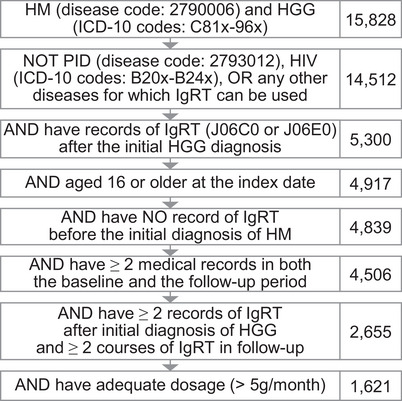
Patient identification flow.
Patient characteristics was described in Table 1. The median (IQR) age was 60.0 (48.0–68.0) and 42.0% was female. CLL, NHL, and MM occupied 1.7%, 37.9%, and 17.7%, respectively. Other type of HM included acute lymphoblastic leukemia in 12.5% and acute myeloid leukemia in 25.1%. Around a quarter of the patients were treated with BCTAs (anti‐CD20mAb and anti‐CD38mAb were 22.8% and 3.8%, respectively) and 24.4% of patients were HSCT recipients. A total of 59.8% and 87.0% of patients were prescribed G‐CSF and oral antibiotics (trimethoprim‐sulfamethoxazole, levofloxacin, ciprofloxacin, or azithromycin), respectively. In the 743 non‐HSCT recipients during receiving antitumor agents, 85.7% and 87.0% of them were prescribed G‐CSF and oral antibiotics during the baseline period, respectively.
TABLE 1.
Patient background.
| (a) Baseline characteristics | ||
|---|---|---|
| Parameters | Categories | n (%), median (IQR) |
| N | 1621 | |
| Age (median, IQR) | 60 (48–68) | |
| Sex (n, %) | Male | 940 (58.0) |
| Female | 681 (42.0) | |
| Type of hematologic malignancy at the first diagnosis (n, %) | CLL | 28 (1.7) |
| NHL | 615 (37.9) | |
| MM | 287 (17.7) | |
| Others | 818 (50.5) | |
| Type of BCTA by category (n, %) | Anti‐CD20 antibody | 369 (22.8) |
| Anti‐CD38 antibody | 61 (3.8) | |
| History of HSCT (n, %) | Yes | 396 (24.4) |
| No | 1225 (75.6) | |
| Administration route of IgRT at the index date (n, %) | IVIG | 1478 (91.2) |
| SCIG | 143 (8.8) | |
| Prescribed G‐CSF (n, %) | 970 (59.8) | |
| Non‐HSCT recipients during anti‐cancer agents (n = 743) | 414 (55.7) | |
| Prescribed oral antibiotics (n, %) | 1410 (87.0) | |
| Non‐HSCT recipients during anti‐cancer agents (n = 743) | 637 (85.7) | |
| (b) Distribution of serum IgG levels at the index date | ||
|---|---|---|
| Parameters | Categories | n (%) |
| N | 28 | |
| Serum IgG levels (n, %) | ≥ 600 mg/dL | 8 (28.6) |
| ≥ 400 mg/dL, < 600 mg/dL | 8 (28.6) | |
| < 400 mg/dL | 12 (42.9) | |
Abbreviations: BCTA, B‐cell targeted agent; CLL, chronic lymphocytic leukemia; HSCT, hematopoietic stem cell transplantation; IVIG, intravenous Immunoglobulin; MM, multiple myeloma; NHL, non‐Hodgkin lymphoma; SCIG subcutaneous immunoglobulin.
Regarding the administration route of IgRT, 91.2% of patients received IVIG and 8.8% received SCIG.
Due to the nature of the database, we evaluated serum IgG levels for only 28 patients, of which 12 patients (37.5%) were < 400 mg/dL at the index date.
3.2. SBI Incidence
The median (IQR) of the baseline and follow‐up periods (months) were 5 (2–12) and 12 (4–12), respectively.
The incidence of SBI per person‐year during 12 months after initiation of IgRT (follow‐up period, 0.9) was significantly lower than that of 12 months before initiation (baseline period, 2.3; p < 0.0001, Figure 2a). The proportion of patients prescribed antibacterials were larger than antivirals and antifungals in both the baseline and the follow‐up periods (Table S4). Regarding the infectious event by organ, gastrointestinal, respiratory, urinary, and systemic infections were observed in higher proportion of patients. Frequency of these events were less in the follow‐up period than baseline period regardless of organ (Table 2).
FIGURE 2.

Incidence of SBI in the baseline and follow‐up period. (a) Within 12 months of baseline and follow‐up period. (b) Within 3 months of baseline and follow‐up period. (c) During antitumor therapy. (d) Incidence days within 12 months of baseline and follow‐up period.
TABLE 2.
Frequency of the infectious event by organ.
| Baseline | Follow‐up | |||
|---|---|---|---|---|
| Category | n | % | n | % |
| Respiratory | 928 | 57.2 | 460 | 28.4 |
| Urinary | 692 | 42.7 | 343 | 21.2 |
| Skin and subcutaneous tissues | 182 | 11.2 | 82 | 5.1 |
| Central nervous | 37 | 2.3 | 20 | 1.2 |
| Systemic infection | 790 | 48.7 | 333 | 20.5 |
| Gastrointestinal | 976 | 60.2 | 502 | 31.0 |
| Reproductive | 23 | 1.4 | 7 | 0.4 |
| Bones and joints | 324 | 20.0 | 239 | 14.7 |
| Sensory (eyes, ears, nose, and pharynx) | 443 | 27.3 | 203 | 12.5 |
| Cardiovascular | 29 | 1.8 | 12 | 0.7 |
| Liver, gallbladder, and pancreas | 416 | 25.7 | 209 | 12.9 |
| Medical devices and surgery | 628 | 38.7 | 293 | 18.1 |
When using the short observation period of 3 months before and after the index date, the result was similar (3.2 vs. 0.9, respectively; p < 0.001, Figure 2b).
In the 743 non‐HSCT recipients during receiving antitumor agents, no significant difference in SBI incidence was observed between the baseline and follow‐up period (1.1 vs. 1.2, respectively; p = 0.691, Figure 2c). In this cohort followed during receiving antitumor agents, the SBI incidence in the baseline period was lower than the overall population (1.1 vs. 2.3, respectively, Figure 2) and twice as many patients did not experience SBIs during the baseline period. (60.8% vs. 28.2%, respectively). The results were similar when analyzing only at people who received BCTAs. (1.0 vs. 0.9, p = 0.393).
The number of days of intravenous antibiotics prescription was significantly shorter during the follow‐up period (36.0 days vs. 17.2 days, respectively; p < 0.001, Figure 2d). In the follow‐up period, no aseptic meningitis and 192 of all cause death were recorded.
3.3. SBI Incidence by Subgroup
We conducted subgroup analysis according to type of B‐cell malignancy, type of BCTA, history of HSCT, and administration route of IgRT.
The SBI incidence in the follow‐up period significantly decreased in patients with NHL (2.1 vs. 1.0, p < 0.001) and MM (1.1 vs. 0.8, p < 0.001) compared to the baseline period. In the 28 CLL patients, SBI incidence decreased, but not statistically significant (1.6 vs. 1.1, p = 0.581, Table 3a).
TABLE 3.
Subgroup analyses of the incidence of SBI.
| Category | N |
Baseline PY |
Number of incidences | Incidence rate |
Follow‐up PY |
Number of incidences | Incidence rate | Statistic | p value |
|---|---|---|---|---|---|---|---|---|---|
| (a) By the type of B‐cell malignancy | |||||||||
| CLL | 28 | 16.1 | 25 | 1.6 | 21.8 | 23 | 1.1 | −1.5 | 0.581 |
| NHL | 615 | 379.4 | 787 | 2.1 | 443.7 | 462 | 1.0 | −12.0 | < 0.001 |
| MM | 287 | 179.6 | 206 | 1.1 | 219.6 | 170 | 0.8 | −3.9 | < 0.001 |
| (b) By the type of BCTA | |||||||||
| Anti‐CD20mab | 369 | 262.2 | 576 | 2.2 | 270.6 | 284 | 1.0 | −10.1 | < 0.001 |
| Anti‐CD38mab | 61 | 47.8 | 60 | 1.3 | 36.2 | 25 | 0.7 | −2.4 | 0.035 |
| (c) By HSCT history | |||||||||
| Yes | 396 | 200.1 | 661 | 3.3 | 276.0 | 197 | 0.7 | −18.9 | < 0.001 |
| No | 1225 | 662.8 | 1289 | 1.9 | 874.7 | 820 | 0.9 | −17.1 | < 0.001 |
| (d) By administration route of IgRT | |||||||||
| IVIG | 1478 | 794.2 | 1791 | 2.3 | 1043.3 | 939 | 0.9 | −23.4 | < 0.001 |
| SCIG | 143 | 68.7 | 159 | 2.3 | 107.3 | 78 | 0.7 | −8.5 | < 0.001 |
Abbreviations: BCTA, B‐cell targeted agent; CLL, chronic lymphocytic leukemia; HSCT, hematopoietic stem cell transplantation; IVIG, intravenous immunoglobulin; NHL, non‐Hodgkin's lymphoma; MM, multiple myeloma; PY, person‐year; SBI, serious bacterial infection; SCIG, subcutaneous immunoglobulin.
In patients treated with both anti‐CD20mAb and CD38mAb (n = 369 and 61, respectively), the SBI incidence in the follow‐up period significantly decreased than the baseline period. (2.2 vs. 1.0, p < 0.001; 1.3 vs. 0.7, p = 0.035, respectively, Table 3b). In patients treated with bendamustine (n = 106), the SBI incidence in the follow‐up period did not change from the baseline period (1.3 vs. 1.3, p = 0.802).
The SBI incidences in the follow‐up period significantly decreased irrespective to the history of HSCT (HSCT recipients 3.3 vs. 0.7, p < 0.001; non‐HSCT recipients 1.9 vs. 0.9, p < 0.001, Table 3c).
The SBI incidences in the follow‐up period significantly decreased regardless of administration route of IgRT (IVIG 2.3 vs. 0.6, p < 0.001; SCIG 2.3 vs. 0.7, p < 0.001, Table 3d).
In patients treated with G‐CSF and oral antibiotics during the baseline period (n = 970 and 1410, respectively), the SBI incidences in the follow‐up period significantly decreased (G‐CSF 2.7 vs. 0.9, p < 0.001; oral antibiotics 2.4 vs. 0.9, p < 0.001). In patients who experienced SBIs before the initiation of IgRT (n = 1164), the SBI incidences in the follow‐up period significantly decreased (3.1 vs. 1.0, p < 0.001).
3.4. Serum IgG Level
The SBI incidence was analyzed according to baseline serum IgG levels in the small number of patients for whom serum IgG levels were evaluable (Table 4). The reduction of SBI incidence during the follow‐up period was observed in all subgroups, < 400 mg/dL, ≥ 400 and < 600 mg/dL, and < 600 mg/dL. A decrease of the SBI incidence was observed in patients with < 400 mg/dL (n = 12, 2.6 in the baseline period vs. 0.6 in the follow‐up period), and in those with ≥ 400 mg/dL (≥ 400 and < 600 mg/dL [n = 8] 1.8 vs. 0.9; ≥ 600 mg/dL [n = 8] 3.7 vs. 1.2).
TABLE 4.
SBI incidence by the serum IgG level at the index date.
| Category | N |
Baseline PY |
Number of incidences | Incidence rate |
Follow‐up PY |
Number of incidences | Incidence rate |
|---|---|---|---|---|---|---|---|
| ≥ 600 mg/dL | 8 | 3.5 | 13 | 3.7 | 5.7 | 7 | 1.2 |
| ≥ 400 mg/dL, < 600 mg/dL | 8 | 6.8 | 12 | 1.8 | 6.9 | 6 | 0.9 |
| < 400 mg/dL | 12 | 8.5 | 22 | 2.6 | 9.4 | 6 | 0.6 |
Abbreviation: SBI, serious bacterial infection.
Nine (37.5%) of 24 patients who had been able to observe IgG levels both baseline period and follow‐up period had their serum IgG levels < 400 mg/dL at the index date. After IgRT initiation, three patients (12.5%) remained < 400 mg/dL (Figure 3).
FIGURE 3.
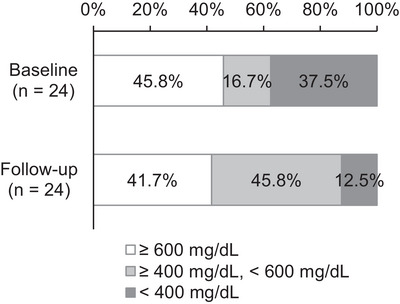
Change in IgG by the dose of IgRT.
4. Discussion
In the last decade, treatment for HMs has remarkably advanced with the standardization of BCTAs, which potentially induce HGG. Previous retrospective studies indicated that IgRT decreased the risk of serious infectious events for HGG patients treated with BCTAs or after HSCT, however number of patients who were included in these studies were limited [6, 7, 21, 23].
Therefore, we conducted the present claims database study which aimed to investigate the real world impact of IgRT reflecting the HM care during the past decade. To our knowledge, this is one of the largest studies to investigate the effectiveness of IgRT. Our study demonstrated that the SBI incidence significantly decreased after IgRT initiation for patients with HGG secondary to HM, regardless of their background, such as the type of B‐cell malignancy, use of BCTA, or history of HSCT. Gastrointestinal, respiratory, urinary, and systemic infections were observed in more patients. Frequency of these events were less in the follow‐up period than the baseline period regardless of the type of organ. In the follow‐up period, no aseptic meningitis was observed.
The incidence of SBI was used as the primary outcome in our study. The proportion of patients prescribed intravenous antibacterials were greater than antivirals and antifungals regardless of the baseline or follow‐up period. In a previous claims database study from the United States, SBIs were defined as the prescription of intravenous antibiotics in the outpatient setting or those hospitalized. In our study, the definition of SBI was determined by combining diagnostic codes and prescription information (hospitalization and prescription of intravenous antibiotics, respectively) because intravenous antibiotics were mostly prescribed in hospital setting (96.0% during the baseline period and 93.7% during the follow‐up period, data not shown). We believe that our definition well reflects the actual clinical practice in Japan.
A 12‐month period was used as the study period because seasonal effect of infectious events was reported [25]. In addition to this, we also conducted a comparison using a shorter observation period of 3 months. The SBI incidence consistently decreased after IgRT initiation in both periods, which strongly supports the validity of our study results.
Unexpectedly, the SBI incidence did not significantly change in non‐HSCT recipients who received antitumor agents. The baseline SBI incidence in this cohort was approximately half than that of the overall population (1.1 vs. 2.3, respectively). In addition, a higher proportion of patients did not experience the SBIs in the baseline period compared to the overall population (60.8% vs. 28.2%, respectively).
A retrospective study indicated that repeated infections before diagnosis of secondary immunodeficiency could be a predictive factor for future severe infections and IgRT is likely to be effective in such patients [26]. Guidelines recommend the use of IgRT for higher risk population, such as HGG with a history of repeated or severe infection [17, 18, 19]. The lower SBI incidence in the baseline period might be one of the reasons for lower clinical impact of IgRT in this cohort because IgRT can be prescribed for HGG patients irrespective to their infection history in Japan.
Next, we considered the impact of G‐CSF and oral antibiotics use on the study result [27, 28]. The proportion of patients who were treated with G‐CSF and oral antibiotics in this cohort was similar to that of the overall population. The SBI incidence in patients treated with G‐CSF or oral antibiotics in the overall population was significantly lower in the follow‐up period than in the baseline period (C‐CSF: 2.7 vs. 0.9, p < 0.0001; oral antibiotics: 2.4 vs. 0.9, p < 0.0001).
A study in MM patients suggested that there might be a patient subgroup for whom IgRT is significantly beneficial. Reduction of serious infections was not observed in patients only diagnosed with HGG, but in patients with HGG and non‐progressive disease [29]. In patients who experienced SBIs in the baseline period, SBI incidence was significantly lower than that in the follow‐up period. G‐CSF and oral antibiotics are generally used for infection management before IgRT initiation. IgRT might have an additional effect on G‐CSF or antibiotics. Further consideration is needed to reach a consensus on which patients would benefit best from IgRT while receiving antitumor agents.
Significant reduction of SBI incidence after IgRT was observed in patients regardless of their backgrounds (i.e., type of B‐cell malignancy, type of BCTAs [anti‐CD20mAb and anti‐CD38mAb], and history of HSCT). Interestingly, SBI incidence decreased to the same levels after IgRT initiation irrespective to subgroups, although that in the baseline periods varied among subgroups. As in a retrospective study, we would expect a greater reduction in SBI incidence in the group with a higher incidence of SBI during the baseline period [29]. On the other hands, these results also indicate that there may be areas of improvement to further reducing SBIs with IgRT, as there were still incidence of SBI in the follow‐up period although lower. In addition, IVIG and SCIG are plasma‐derived products. A recent RCT for B‐cell malignancies suggested that the incidence of the major infection between IgRT and prophylactic antibiotics was comparable [30]. Oral antibiotics are available at low cost but there is a potential concern of antimicrobial resistant bacteria. Thus, it is desirable to establish the appropriate strategy of infection management by considering the features of both drugs.
In Japan, both IVIG and SCIG are available for management of HGG. The reduction in SBI during the follow‐up period decreased to similar levels between the administration route of IgRT, and similar results were observed in a previous study in B‐cell lymphoproliferative disease [21]. It is reasonable to choose the IgRT route of administration according to the medical and social background or patient preferences.
With respect to the baseline serum IgG level, IgRT was associated with decrease of the SBI incidence in patients regardless of the baseline serum IgG levels. A noticeable decrease of the SBI incidence was seen in patients with < 400 mg/dL alone (from 2.6 to 0.6). This difference may have been achieved because the proportion of patients with the serum IgG level < 400 mg/dL decrease to one‐third (37.5% at the index date and 12.5% in the follow‐up period), potentially lowering the SBI incidence. These results might reflect only a part of our subject cohort. Most of guidelines support IgRT initiation for HGG patients secondary to HM with serum IgG levels < 400 mg/dL and/or the history infectious events [17, 18, 19, 20], To our knowledge, no previous studies have investigated the validity of threshold on serum IgG levels to consider IgRT initiation. It would be important for future studies to further investigate the threshold of the serum IgG level for IgRT initiation.
Our study has potential limitations. First, a case‐control study, which analyzes the SBI incidence between patients treated with IgRT and those without IgRT, was preferable to confirm the efficacy of IgRT. Unfortunately, we could not set an appropriate index date in patients who were not treated with IgRT, so we compared the SBI incidence between the baseline period and the follow‐up period only in patients treated with IgRT. Second, although the detail analyses are required for the types of SBIs and the cause of death, we could not identify them due to the limitation of the claims database. Third, because the limited serum IgG levels data were available, HGGs in this study were defined based on practice codes rather than serum IgG levels. Fourth, we could not consider the impact of potential risk factors other than HGG for SBI incidence, such as performance status, clinical status of malignancy, or other immune status, because this is a claims database study.
5. Conclusion
In summary, we conducted a retrospective claims database study to investigate real world clinical impact of IgRT for patients receiving newer HM treatment regimens contributing to HGG in the past decade in Japan. The SBI incidence during 12 months after IgRT initiation was lower than that before IgRT initiation. This result was also observed in various subgroups such as patients who were diagnosed with NHL or MM, treated with BCTAs, or HSCT recipients. This real world data supports IgRT benefit in decreasing the SBI incidence in patients with HGG secondary to HM.
Author Contributions
Keichiro Mihara and Masayuki Matsumaru designed the study, interpreted data, and wrote the manuscript. Takakazu Kawase and Takahiko Miyama interpreted data and contributed to the preparation and critical review of the manuscript. Katsuhiko Iwasaki and Ayako Shoji analyzed and interpreted data, performed statistical analysis, and wrote the manuscript. All authors gave final approval for the manuscript.
Ethics Statement
This study was approved by the non‐profit organization MINS Research Ethics Committee (MINS‐REC‐220211).
Conflicts of Interest
Keichiro Mihara has received honoraria for speaker's bureaus from Sanofi, CSL Behring, and Janssen Pharma. Katsuhiko Iwasaki and Ayako Shoji were employees of Medilead Inc., which was commissioned to perform this work by CSL Behring. Masayuki Matsumaru is an employee of CSL Behring. The other authors declare no conflicts of interest.
Novelty Statement
This publication is the first database study in Japan to investigate the real world impact of immunoglobulin replacement therapy (IgRT) on the severe bacterial infection (SBI) incidence in patients with hypogammaglobulinemia (HGG) secondary to hematologic malignancies focusing on patients who had recent treatments where B‐cell targeted agents (BCTAs) were one of the standard therapies used. The central finding of our work is that SBI incidence decreased after IgRT initiation in patients with HGG with various treatment including BCTAs and those with < 400 mg/dL of baseline serum IgG levels. The specific clinical relevance of our work is to provide improved understanding and awareness in reducing SBI risks to the specified cohort of patients with currently available treatments.
Supporting information
Supplementary Table S1 Disease definitions.
Supplementary Table S2 Drug definitions.
Supplementary Table S3 Treatment definitions.
Supplementary Table S4 The proportion of patients by the type of intravenous antimicrobial agents in the overall population (n = 1621).
Acknowledgments
The authors also thank Yamada Translation Bureau Inc., (www.ytrans.com/home.html) for editorial assistance funded by CSL Behring.
Two authors changed their affiliation during the study, as follows: Katsuhiko Iwasaki and Ayako Shoji moved from Medilead Inc., Tokyo, to Healthcare Consulting Inc., Tokyo.
Funding: This study was funded by CSL Behring; this funding also covered the journal's rapid service and open access fees.
Data Availability Statement
The datasets generated and/or analyzed during the current study are available from the corresponding author on reasonable request; subject to approval by the study sponsor.
References
- 1. Chen L., Zheng Y., Yu K., et al., “Changing Causes of Death in Persons With Haematological Cancers 1975–2016,” Leukemia 36, no. 7 (2022): 1850–1860, 10.1038/s41375-022-01596-z. [DOI] [PMC free article] [PubMed] [Google Scholar]
- 2. Mohty M., Cavo M., Fink L., et al., “Understanding Mortality in Multiple Myeloma: Findings of a European Retrospective Chart Review,” European Journal of Haematology 103, no. 2 (2019): 107–115, 10.1111/ejh.13264. [DOI] [PMC free article] [PubMed] [Google Scholar]
- 3. Valcarcel B., Schonfeld S. J., Meyer C. L., et al., “Comparison of Vital Status, Cause of Death, and Follow‐Up After Hematopoietic Cell Transplantation in Linked Center for International Blood and Marrow Transplant Research and California Cancer Registry Data, 1991 to 2018,” Transplantation and Cellular Therapy 30, no. 2 (2024): 239.e1–239.e11, 10.1016/j.jtct.2023.11.011. [DOI] [PMC free article] [PubMed] [Google Scholar]
- 4. Patel S. Y., Carbone J., and Jolles S., “The Expanding Field of Secondary Antibody Deficiency: Causes, Diagnosis, and Management,” Frontiers in Immunology 10 (2019): 33, 10.3389/fimmu.2019.00033. [DOI] [PMC free article] [PubMed] [Google Scholar]
- 5. Visentin A., Compagno N., Cinetto F., et al., “Clinical Profile Associated With Infections in Patients With Chronic Lymphocytic Leukemia. Protective Role of Immunoglobulin Replacement Therapy,” Haematologica 100, no. 12 (2015): e515–e518, 10.3324/haematol.2015.126763. [DOI] [PMC free article] [PubMed] [Google Scholar]
- 6. Casulo C., Maragulia J., and Zelenetz A. D., “Incidence of Hypogammaglobulinemia in Patients Receiving Rituximab and the Use of Intravenous Immunoglobulin for Recurrent Infections,” Clinical Lymphoma, Myeloma & Leukemia 13, no. 2 (2013): 106–111, 10.1016/j.clml.2012.11.011. [DOI] [PMC free article] [PubMed] [Google Scholar]
- 7. Vitkon R., Netanely D., Levi S., et al., “Daratumumab in Combination With Proteasome Inhibitors, Rapidly Decreases Polyclonal Immunoglobulins and Increases Infection Risk Among Relapsed Multiple Myeloma Patients: A Single Center Retrospective Study,” Therapeutic Advances in Hematology 12 (2021): 20406207211035272, 10.1177/20406207211035272. [DOI] [PMC free article] [PubMed] [Google Scholar]
- 8. Hill J. A., Krantz E. M., Hay K. A., et al., “Durable Preservation of Antiviral Antibodies After CD19‐Directed Chimeric Antigen Receptor T‐Cell Immunotherapy,” Blood Advances 3, no. 22 (2019): 3590–3601, 10.1182/bloodadvances.2019000717. [DOI] [PMC free article] [PubMed] [Google Scholar]
- 9. Kambhampati S., Sheng Y., Huang C. Y., et al., “Infectious Complications in Patients With Relapsed Refractory Multiple Myeloma After BCMA CAR T‐Cell Therapy,” Blood Advances 6, no. 7 (2022): 2045–2054, 10.1182/bloodadvances.2020004079. [DOI] [PMC free article] [PubMed] [Google Scholar]
- 10. Arai Y., Yamashita K., Mizugishi K., et al., “Risk Factors for Hypogammaglobulinemia After Allo‐SCT,” Bone Marrow Transplantation 49, no. 6 (2014): 859–861, 10.1038/bmt.2014.28. [DOI] [PubMed] [Google Scholar]
- 11. Gale R. P., Chapel H. M., Bunch C., et al., “Intravenous Immunoglobulin for the Prevention of Infection in Chronic Lymphocytic Leukemia. A Randomized, Controlled Clinical Trial,” New England Journal of Medicine 319, no. 14 (1988): 902–907, 10.1056/NEJM198810063191403. [DOI] [PubMed] [Google Scholar]
- 12. Boughton B. J., Jackson N., Lim S., and Smith N., “Randomized Trial of Intravenous Immunoglobulin Prophylaxis for Patients With Chronic Lymphocytic Leukaemia and Secondary Hypogammaglobulinaemia,” Clinical and Laboratory Haematology 17, no. 1 (1995): 75–80, 10.1111/j.1365-2257.1995.tb00322.x. [DOI] [PubMed] [Google Scholar]
- 13. Chapel H. M., Lee M., Hargreaves R., Pamphilon D. H., and Prentice A. G., “Randomised Trial of Intravenous Immunoglobulin as Prophylaxis Against Infection in Plateau‐Phase Multiple Myeloma,” Lancet 343, no. 8905 (1994): 1059–1063, 10.1016/s0140-6736(94)90180-5. [DOI] [PubMed] [Google Scholar]
- 14. Vacca A., Melaccio A., Sportelli A., Solimando A. G., Dammacco F., and Ria R., “Subcutaneous Immunoglobulins in Patients With Multiple Myeloma and Secondary Hypogammaglobulinemia: A Randomized Trial,” Clinical Immunology 191 (2018): 110–115, 10.1016/j.clim.2017.11.014. [DOI] [PubMed] [Google Scholar]
- 15. Sullivan K. M., Kopecky K. J., Jocom J., et al., “Immunomodulatory and Antimicrobial Efficacy of Intravenous Immunoglobulin in Bone Marrow Transplantation,” New England Journal of Medicine 323, no. 11 (1990): 705–712, 10.1056/NEJM199009133231103. [DOI] [PubMed] [Google Scholar]
- 16. Cordonnier C., Chevret S., Legrand M., et al., “Should Immunoglobulin Therapy be Used in Allogeneic Stem‐Cell Transplantation? A Randomized, Double‐Blind, Dose Effect, Placebo‐Controlled, Multicenter Trial,” Annals of Internal Medicine 139, no. 1 (2003): 8–18, 10.7326/0003-4819-139-1-200307010-00007. [DOI] [PubMed] [Google Scholar]
- 17. Wierda W. G., Brown J., Abramson J. S., et al., “NCCN Guidelines® Insights: Chronic Lymphocytic Leukemia/Small Lymphocytic Lymphoma, Version 3.2022,” Journal of the National Comprehensive Cancer Network: JNCCN 20, no. 6 (2022): 622–634, 10.6004/jnccn.2022.0031. [DOI] [PubMed] [Google Scholar]
- 18. Callander N. S., Baljevic M., Adekola K., et al., “NCCN Guidelines® Insights: Multiple Myeloma, Version 3.2022,” Journal of the National Comprehensive Cancer Network: JNCCN 20, no. 1 (2022. Jan): 8–19, 10.6004/jnccn.2022.0002. [DOI] [PubMed] [Google Scholar]
- 19. Thompson J. A., Schneider B. J., Brahmer J., et al., Management of Immunotherapy‐Related Toxicities, Version 1, 2024 (NCCN Guidelines, 2023). [DOI] [PubMed] [Google Scholar]
- 20. Tomblyn M., Chiller T., Einsele H., et al., “Guidelines for Preventing Infectious Complications Among Hematopoietic Cell Transplantation Recipients: A Global Perspective [Erratum in: Biol Blood Marrow Transplant. 2010 Feb;16(2):294. Boeckh, Michael A [Corrected to Boeckh, Michael J]],” Biology of Blood and Marrow Transplantation 15, no. 10 (2009): 1143–1238, 10.1016/j.bbmt.2009.06.019. [DOI] [PMC free article] [PubMed] [Google Scholar]
- 21. Compagno N., Cinetto F., Semenzato G., and Agostini C., “Subcutaneous Immunoglobulin in Lymphoproliferative Disorders and Rituximab‐Related Secondary Hypogammaglobulinemia: A Single‐Center Experience in 61 Patients,” Haematologica 99, no. 6 (2014): 1101–1106, 10.3324/haematol.2013.101261. [DOI] [PMC free article] [PubMed] [Google Scholar]
- 22. Lancman G., Parsa K., Kotlarz K., et al., “IVIg Use Associated With Ten‐Fold Reduction of Serious Infections in Multiple Myeloma Patients Treated With Anti‐BCMA Bispecific Antibodies,” Blood Cancer Discovery 4, no. 6 (2023): 440–451, 10.1158/2643-3230.BCD-23-0049. [DOI] [PMC free article] [PubMed] [Google Scholar]
- 23. Suga M., Fuji S., Tada Y., et al., “A Single‐Institution Pre‐Post Comparison of Subcutaneous Immunoglobulin Replacement Therapy in Allogeneic Haematopoietic Cell Transplantation Recipients,” British Journal of Haematology 204, no. 1 (2024): 260–267, 10.1111/bjh.19203. [DOI] [PubMed] [Google Scholar]
- 24. Laurent T., Simeone J., Kuwatsuru R., et al., “Context and Considerations for Use of Two Japanese Real‐World Databases in Japan: Medical Data Vision and Japanese Medical Data Center,” Drugs Real World Outcomes 9, no. 2 (2022): 175–187, 10.1007/s40801-022-00296-5. [DOI] [PMC free article] [PubMed] [Google Scholar]
- 25. Eber M. R., Shardell M., Schweizer M. L., Laxminarayan R., and Perencevich E. N., “Seasonal and Temperature‐Associated Increases in Gram‐Negative Bacterial Bloodstream Infections Among Hospitalized Patients,” PLoS ONE 6, no. 9 (2011): e25298, 10.1371/journal.pone.0025298. [DOI] [PMC free article] [PubMed] [Google Scholar]
- 26. Jolles S., Smith B. D., Vinh D. C., et al., “Risk Factors for Severe Infections in Secondary Immunodeficiency: A Retrospective US Administrative Claims Study in Patients With Hematological Malignancies,” Leukemia & Lymphoma 63, no. 1 (2022): 64–73, 10.1080/10428194.2021.1992761. [DOI] [PubMed] [Google Scholar]
- 27. Bohlius J., Herbst C., Reiser M., Schwarzer G., and Engert A., “Granulopoiesis‐Stimulating Factors to Prevent Adverse Effects in the Treatment of Malignant Lymphoma,” Cochrane Database of Systematic Reviews 2008, no. 4 (2008): CD003189, 10.1002/14651858.CD003189.pub4. [DOI] [PMC free article] [PubMed] [Google Scholar]
- 28. Drayson M. T., Bowcock S., Planche T., et al., “Levofloxacin Prophylaxis in Patients With Newly Diagnosed Myeloma (TEAMM): A Multicentre, Double‐Blind, Placebo‐Controlled, Randomised, Phase 3 Trial,” Lancet Oncology 20, no. 12 (2019): 1760–1772, 10.1016/S1470-2045(19)30506-6. [DOI] [PMC free article] [PubMed] [Google Scholar]
- 29. Lancman G., Lozada K., Athar N., et al., “Efficacy of Intravenous Immunoglobulin for Preventing Infections in Patients With Multiple Myeloma,” Clinical Lymphoma, Myeloma & Leukemia 21, no. 5 (2021): e470–e476, 10.1016/j.clml.2020.12.026. [DOI] [PubMed] [Google Scholar]
- 30. McQuilten Z. K., Weinkove R., Thao L. T. P., et al., “Immunoglobulin Replacement vs Prophylactic Antibiotics for Hypogammaglobulinemia Secondary to Hematological Malignancy,” Blood Advances 8, no. 7 (2024): 1787–1795, 10.1182/bloodadvances.2023011231. [DOI] [PMC free article] [PubMed] [Google Scholar]
Associated Data
This section collects any data citations, data availability statements, or supplementary materials included in this article.
Supplementary Materials
Supplementary Table S1 Disease definitions.
Supplementary Table S2 Drug definitions.
Supplementary Table S3 Treatment definitions.
Supplementary Table S4 The proportion of patients by the type of intravenous antimicrobial agents in the overall population (n = 1621).
Data Availability Statement
The datasets generated and/or analyzed during the current study are available from the corresponding author on reasonable request; subject to approval by the study sponsor.