



Abstract
Restless legs syndrome (RLS) and Parkinson's disease (PD) are both classified as neurological movement disorders, and they may be interconnected due to abnormalities in the dopaminergic system. The incidence of RLS in PD patients is higher than that in the general population. And PD patients with RLS exhibit a higher age of onset, more severe depression, worse nutritional status, lower quality of life, and a relatively lower frequency and severity of RLS symptom. The current research has unveiled several potential mechanisms underlying RLS in PD patients, such as iron deficiency, reduced function of the dopamine system in the A11 region, and decreased connectivity of related pathways and so on. By systematically summarizing the pathogenesis, clinical manifestations, diagnosis and treatment of PD with RLS, this paper not only provides ideas for the precise diagnosis and treatment of PD with RLS, but also lays a theoretical foundation for clarifying the intricate relationship between PD and RLS.
Keywords: Restless legs syndrome (RLS), Parkinson's disease (PD), Dopamine, Comorbidity
Introduction
Parkinson's disease (PD) is a progressive neurodegenerative disorder marked by both motor and nonmotor symptoms. A key feature is the abnormal accumulation of α-synuclein, which can be found in the gut, brainstem, and higher brain regions [1]. Clinically, PD presents with progressive, asymmetric bradykinesia, as well as tremor, rigidity, and gait disturbance. In addition to these motor symptoms, PD also involves nonmotor features, such as psychiatric disorders, olfactory dysfunction, autonomic dysfunction, cognitive impairment, and sleep disorders [2]. The main sleep disorders in PD include insomnia, excessive daytime sleepiness, circadian rhythm dysfunction, obstructive sleep apnea, rapid eye movement (REM) sleep behavior disorder (RBD), and restless legs syndrome [3]. Notably, restless legs syndrome can cause patients to experience pain in their legs at night, which can significantly impair their sleep quality.
Restless legs syndrome (RLS), also known as Willis–Ekbom disease (WED), is a common sensory-motor disorder of the nervous system characterized by an intense and almost irresistible desire to move the legs, usually accompanied by various sensory symptoms and unpleasant sensations in the ankle, knee, or entire lower limb [4]. Most of them occur at night or in the evening, aggravate when quiet or at rest, and improve after activity [5]. RLS can be idiopathic or secondary to many other diseases, such as polyneuropathy and multiple sclerosis, iron deficiency anemia [6], migraine [7], peripheral neuropathy [8], hypertension or cardiovascular disease [9], diabetes [10], renal disease [11], chronic liver disease [12], and pregnancy [13]. Owing to the increased discomfort in the legs—such as restlessness, discomfort, stiffness, pain, tingling, burning, cold, heat, and spasms—RLS can lead to frequent nocturnal awakenings [2], which can severely impact patients' quality of life.
As a common sleep disorder, RLS also affects a significant proportion of PD patients [14]. Besides the significantly higher prevalence of RLS in PD patients as compared to the general population (15.74% vs 5–10%) [15, 16], there is an overlap in clinical manifestations, including sensory symptoms, pain, motor restlessness, and akathisia, between PD and RLS [17]. In addition, both conditions respond well to dopaminergic replacement therapy, are exacerbated by dopaminergic antagonists, and both are associated with periodic limb movements in sleep (PLMS) [18]. These similarities suggest a potential pathogenetic link between PD and RLS [19]. However, it remains unclear whether RLS is a manifestation of an early pathological process in PD or if it occurs as PD progresses. Thus, the hypothesis of central dopaminergic system dysfunction in RLS remains controversial, and RLS in PD may have a different mechanism than idiopathic RLS [20].
Incidence of RLS in PD
To explore whether RLS and PD are epidemiologically related, numerous studies have investigated the incidence of RLS in PD, with results on comorbidity ranging from 0 to 52.3% [21]. On average, RLS occurs in 15.74% PD patients [15], and its prevalence increases from 4.6% to 16.3% over 4 years as PD progresses [22].
Early research on the link between PD and RLS showed inconsistent results, partly due to the lack of standardized diagnostic criteria before their establishment. For instance, a 1987 study reported no RLS cases in 100 PD patients [23], before formal RLS diagnostic criteria were set. While later regional studies using varying methodologies reported prevalences such as 7.9% in Indian PD patients [24], 20.8% in a U.S. cohort [25], and 16.3% in Korean patients (compared to 7.5% in non-PD controls) [26, 27]. The introduction of IRLSSG criteria improved standardization, yet rates remained variable, including 15.2% (with incomplete features) in Singapore [28], 24% meeting full criteria [29], 21.9% in Caucasians [30], and notably 52.3% in a levodopa-treated cohort [31], indicating medication-related effects.
The recent studies with stricter diagnostic differentiation have clarified some inconsistencies. A 2010 Dutch longitudinal cohort found similar RLS prevalence (11%) in PD patients vs the general population [32]. However, a Caucasian study reported a higher prevalence (12.5%) in PD patients as compared to controls (6.9%) after excluding confounding factors [33]. The following data also showed increased RLS prevalence in PD patients: 5.5% in Japan [34] and 21.3% in Canada [35], as compared to 2.2% and 4.7% in non-PD controls, respectively. By 2014, Iranian research (14.8%) [36] aligned with a 2018 meta-analysis (14%) [37]. More recent data (2022–2023) have suggested the PD-associated RLS prevalence around 9.3–12.2% [38, 39]. However, a 2023 Romanian cross-sectional study reported a higher prevalence (26.71%) [40]. A 2024 meta-analysis of 46 studies (6990 PD patients) consolidated a pooled prevalence of 20% [41], highlighting methodological variations as a key source of heterogeneity.
Different studies varied in research methods and confounders, causing discrepancies in RLS incidence rates in PD patients (Fig. 1). Accurate diagnosis of RLS in PD is challenging and can be swayed by interviewers' approaches and patients' disease understanding. Clinical data from patient interviews and medical history bear the risk for recall bias and referral bias. Also, RLS diagnosis in PD is often prone to false positives due to potential overlap with dystonia, akathisia, 'leg motor restlessness', pain neuropathy, and bipolar movement disorder [18]. Other issues include small samples and hindering multivariate analysis. Most critically, there is a lack of consistent RLS diagnostic criteria. Although most studies over the past decade used the same diagnostic criteria, the wording wasn’t standardized, with insufficient translations and cultural adaptation [42]. These factors may account for the significant variation in RLS prevalence reported across and even within regions, thereby suspecting and reducing the accuracy of RLS diagnosis in PD patients.
Fig. 1.

Studies evaluating the frequency of RLS in PD. From 1987 to 2024, studies on the incidence of RLS in PD have yielded incidence rates ranging from 0 to 52.3%
Clinical manifestations of PD with RLS
Studies on incidence have demonstrated that RLS occurs more frequently in PD than in the general population. Therefore, it is necessary to summarize the differences in the symptoms of patients when it comorbid with PD.
General manifestations
When RLS occurs in PD patients, parkinsonism usually precedes the onset of RLS by several years [2]. This temporal relationship has led some researchers to propose that RLS may be considered part of the parkinsonism spectrum in PD patients [43]. Supporting this notion, PD patients with RLS are older and more likely to have iron deficiency, as indicated by lower serum ferritin levels, than PD patients without RLS [36]. Thus, low ferritin levels have been suggested as a possible predisposing factor for the development of RLS in PD [44]. Besides, according to some studies [45, 46], RLS is more common in women and may be related to hormonal factors or iron deficiency.
Furthermore, PD + RLS patients often have a shorter duration of RLS symptoms compared to individuals with idiopathic RLS [47]. Seasonal variations in symptom severity also differ between the two groups. In RLS patients, symptoms tend to worsen in the summer and improve when the legs are exposed to cold or icy objects. Conversely, PD + RLS patients experience more severe symptoms during the winter months. In addition, while RLS symptoms are often asymmetric, 82.4% of PD + RLS patients report RLS symptoms on the same side as their more affected PD symptoms [43].
In addition, the prevalence of RLS in PD patients gradually increased with the prolongation of treatment time (< 2 years: 10.6%; 2–5 years: 15.7%; > 5 years: 23.1%) [22, 27]. Further research on Levodopa has found that it is highly effective for RLS, but it can also aggravate RLS, especially in cases of prolonged exposure, due to the phenomenon of augmentation [48]. The increased RLS incidence in PD patients with long-term dopaminergic therapy likely shares a mechanism with levodopa-induced augmentation. Specifically, early dopaminergic treatment for PD motor symptoms may mask subclinical RLS. However, as treatment duration extends, the potential development of augmentation from prolonged dopaminergic exposure can unmask and intensify these previously concealed RLS symptoms, leading to their clinical manifestation and subsequent diagnosis during the course of PD treatment.
Motor symptoms
In PD patients with RLS, there is a lower incidence of movement disorders [49], and the severity of RLS symptoms tends to be less pronounced compared to RLS patients [43]. However, RLS symptoms in PD patients can be inconsistent, transient, and challenging to distinguish subjectively from other motor symptoms of PD. As a result, patients often do not report these symptoms, perceiving them as part of their PD symptom complex [44]. The Movement Disorders Society Unified Parkinson's Disease Rating Scale (MDS-UPDRS) was used to assess the motor symptoms of PD patients with RLS and those without RLS. Significant differences were observed in the total scores of MDS-UPDRS-iii between the two groups: the PD + RLS group had a score of 36.45 ± 11.02, while the PD-RLS group had a score of 31.17 ± 14.22 (p = 0.009) [40]. This indicates that PD patients with RLS exhibit more pronounced motor deficits compared to those without RLS.
Nonmotor symptoms
Similar to motor symptoms, studies indicate that PD patients with RLS experience more severe anxiety, worse depression, more sleep issues, worse nutritional status, worse cardiovascular autonomic function and lower quality of life than those without RLS [36, 38, 47]. In terms of sleep issues, PD patients with RLS had significantly higher scores in snoring/wheezing/dyspnea, insomnia rate and excessive daytime sleepiness as compared to PD-RLS patients [40, 42]. In terms of discomfort, Diaconu et al. found that PD + RLS patients had significantly higher scores in restlessness, periodic limb movements, physical discomfort dimensions, other types of pain (nighttime, oral/facial) and physical fatigue [40]. In addition, RLS itself may be a risk factor for impulse control disorders (ICD), including pathological gambling, hypersexuality, compulsive shopping, compulsive eating, and ICD-related behaviors like punding, hobbyism, or compulsive medication use in PD patients [50, 51].
Regarding cognitive impairment in PD patients with RLS, different studies have reached varying conclusions. A meta-analysis assessing sleep and cognitive impairment in PD patients found that patients with RLS and PD had more severe cognitive impairment [52]. The suggested causes included dysfunction of dopaminergic circuits involved in RLS pathophysiology [6], inflammatory processes linked to RLS development [53], and cognitive impairment in PD patients [54]. However, another study reported the opposite finding, namely that RLS patients with PD showed better cognitive status; but this was mainly attributed to the young age of this subgroup in that study [55]. While Gomez-Esteban et al. did not find any significant differences in cognitive status (UPDRS-part I) between PD patients with and without RLS [30]. Further studies are needed to confirm whether RLS is associated with cognitive impairment in PD.
Possible mechanisms of PD with RLS
With the duration of PD, the prevalence of RLS gradually increases, and RLS in PD has its special clinical manifestations, indicating that RLS may be associated with progressive neurodegeneration and dopamine depletion of PD [6, 22]. A large number of studies have not been conducted specifically on the pathogenesis of RLS in PD, but the relevant hypotheses generally include iron deficiency, decreased function of the dopamine system, and decreased connectivity of related pathways (Fig. 2).
Fig. 2.

Possible mechanisms of PD with RLS. Environmental factors and gene mutations lead to iron deficiency in the basal ganglia region, thereby causing the disease by affecting the function of the A11 region, dopamine synthesis, and DAT function. In addition, environmental toxins and PINK1 mutations increase the production of mitochondrial reactive oxygen species, thereby causing the degeneration and death of dopaminergic neurons
Iron deficiency
In PD patients with RLS, plasma ferritin levels are lower than PD [2, 25], based on studies indicating that reduced serum ferritin may constitute a risk factor for RLS in these patients [25]. Pathological examinations have shown that in RLS patients, iron depletion in dopaminergic regions (reduced ferritin staining) leads to reduced striatal dopaminergic function [56]. Iron serves as a crucial cofactor for tyrosine hydroxylase (TH), so that iron deficiency can directly impair dopamine synthesis [57, 58]. Additionally, dietary iron deficiency has been linked to reduced striatal dopamine transporter (DAT) function in both PD and RLS [59–61]. The reduction in DAT function compromises dopamine reuptake in the synaptic cleft [62], leading to further decreases in intracellular dopamine levels.
However, iron content is elevated in the substantia nigra and basal ganglia of PD patients [63]. As a potent oxidant, iron's redox activity may be a key factor in PD-related neuronal cell death [64]. The specific mechanism may involve mitochondrial dysfunction in PD patients (e.g., due to environmental toxins or PINK1 gene mutations), which results in inadequate production of ATP and iron–sulfur clusters (ISCs). This triggers the activation of iron-regulating protein (IRP1), increases labile iron production, and generates excessive reactive oxygen species (ROS) via the Fenton reaction. Ultimately, this leads to dopaminergic neuron death and exacerbates mitochondrial dysfunction [65]. Thus, iron deposition in PD creates a dopamine-deficient environment in the brain, establishing a pathological basis for the subsequent progression of RLS.
Combined with findings that PD + RLS patients have increased transferrin and decreased cerebrospinal fluid iron, ferritin, dopamine (DA), and 5-HT levels, RLS in PD patients may result from dysfunction of iron transport, binding, and storage in the central and peripheral nervous systems. This dysfunction mediates iron deficiency in relevant brain regions, leading to decreased DA and 5-HT levels and ultimately causing RLS in PD patients [66].
Degeneration of the dopaminergic system
Braga-Neto et al. highlighted that RLS is more prevalent in PD patients with longer disease durations, suggesting a link between the progressive degeneration of the dopamine system and the onset of RLS in PD [31]. This is supported by decreased binding rate of striatal D2 receptors in RLS [67, 68] and reduced D2 receptor availability in advanced PD [69, 70]. Crucially, unlike PD, RLS shows no dopaminergic cell depletion in the substantia nigra pars compacta [71], redirecting focus to extranigral pathways.
The hypothalamic A11 nucleus provides the exclusive source of spinal dopamine via projections through the dorsolateral funiculus. Clemens et al. demonstrated that A11-lesioned rats exhibited hyperactivity, increased wakefulness, and reduced sensory thresholds during the rest/activity cycle, resembling human RLS symptoms [72]. Neurons in A11 connect locally within the hypothalamus, project to the neocortex and serotonergic dorsal raphe, and descend as the spinal dopamine's sole source via the dorsolateral funiculus and collaterals [72]. During pain transmission, the A11 dopaminergic system can inhibit pain signals in the spinal dorsal horn via the D2 receptors of the descending inhibitory pathway, producing analgesic effects [73]. Thus, dysfunction of the hypothalamic dopaminergic diencephalon–spinal pathway (A11) is crucial in RLS pathophysiology. During the terminal stage of PD progression, characterized by extensive cerebral cortex damage, these neurons may degenerate alongside nigrostriatal neurons, leading to RLS [74, 75].
In addition, the higher incidence of RLS in PD patients treated with DA drugs compared to the general population may also be related to area A11 of the hypothalamus, a hypersensitivity state that leads to denervation of postsynaptic DA receptors in the spinal cord. Chronic DA treatment in PD patients with RLS might exacerbate this hypersensitivity, increasing RLS incidence [76].
Change of brain structure and connectivity
Neuroimaging studies have shown that the occurrence of RLS in PD patients is associated with larger gray matter volume in the posterior cingulate cortex (PCC) [21] and significantly lower resting-state functional connectivity between the left central opercular cortex and the bilateral precentral gyri and postcentral gyri [77]. In addition, PD patients with RLS have lower connectivity between the PCC and the left caudate nucleus, between the right precentral gyrus and the left precentral gyrus and posterior gyrus, and between the right superior frontal gyrus and multiple brain regions (middle frontal gyrus, cerebellum, and frontal pole) than those without RLS [78], which may affect the lateral pain system and lead to more severe pain [79].
Other possible factors
In addition to the above three hypotheses, there are some related studies with additional findings. RLS symptoms have been reported in a PD patient with a PINK1 mutation, and 10 Parkin mutations were identified in 20 patients from 2 families with idiopathic RLS [5]. Moreover, the PD pathogenic gene SNCA has also been reported to increase the susceptibility to iron deficiency and the risk of disease in patients with RLS [1, 80]. These findings suggest a potential genetic link in the development of RLS in some PD patients. Besides, persistent/recurrent RLS is currently thought to be associated with prodromal signs of PD in men, such as rapid eye movement sleep behavior disorder (RBD) and constipation [81]. In this case, the density of small fibers in the epidermis is reduced and the thermal sensory function of the lower limbs is impaired in patients with idiopathic RBD may serve as a pathological mechanism of RLS during premotor period of PD [76].
Furthermore, neuroinflammation may also play an indispensable role in the pathogenesis. Researchers find that excessive neuroinflammation can directly damage neurons and lead to the progressive aggravation of PD [82]. Similarly, patients with RLS have higher levels of serum/plasma C-reactive protein (CRP) and a higher ratio of neutrophils to lymphocytes (NLR) [83]. These findings highlight the complex interplay between PD and RLS, thus further research is needed to explore the underlying mechanisms and develop more effective therapeutic strategies for these patients.
Diagnosis of PD with RLS
When diagnosed with PD based on the PD diagnostic criteria set forth by the International MDS Working Group in 2015 [84], a diagnosis of PD with RLS can be established if the IRLSSG criteria for RLS are also satisfied (Table 1). The diagnostic criteria for RLS have been revised many times throughout history. These include Ekbom (1960), DCSAD (1979), ICSD (1990), IRLSSG (1995), and NIH/IRLSSG (2003) criteria for restless legs. Based on previous diagnostic criteria, the Four Basic diagnostic criteria for RLS published by NIH/IRLSSG in 2003 emphasized the importance of the urge to move the legs in the diagnosis of RLS, but the criteria still did not distinguish RLS from other similar symptoms. Compared with the 2003 NIH/IRLSSG diagnostic criteria, the 2012 revised criteria for RLS added an important basic criterion stating that RLS should be distinguished from other similar disorders [85], thereby improving diagnostic specificity and reducing false positives [86]. In addition, in the 2012 edition of the International Restless Legs Syndrome Study Group RLS diagnostic criteria, the diagnosis of RLS relies on the subjective description of the patient's symptoms. All five IRLSSG diagnostic criteria must be met to formally diagnose RLS, 1. The urge to move the leg, usually accompanying or causing an uncomfortable or unpleasant feeling in the leg. Sometimes the urge to move appears without discomfort, and sometimes the arm or other part of the body is involved; 2. The urge to move or an unpleasant feeling that appears or worsens during rest or inactivity, such as lying or sitting; 3. The urge to move or unpleasant feelings can be partially or completely relieved by exercise, such as walking or stretching, at least as long as the activity is sustained; 4. Impulsive or unpleasant feelings are worse in the evening or at night, or occur only in the evening or at night. When symptoms are severe, the nocturnal deterioration may not be apparent but must have been present before; 5. symptoms are not entirely explained by other medical or behavioral conditions such as leg cramp or habitual foot stomp [86, 87].
Table 1.
Diagnostic criteria of PD with RLS
| Diagnostic criteria |
|---|
|
1. The urge to move the leg, usually accompanying or causing an uncomfortable or unpleasant feeling in the leg 2. The urge to move or an unpleasant feeling that appears or worsens during rest or inactivity, such as lying or sitting 3. The urge to move or unpleasant feelings can be partially or completely relieved by exercise 4. Impulsive or unpleasant feelings are worse in the evening or at night, or occur only in the evening or at night 5. symptoms are not entirely explained by other medical or behavioral conditions such as leg cramp or habitual foot stomp |
|
Supporting criteria: 1. a positive response to levodopa 2. PLM was observed in PSG |
|
Exclusion criteria: 1. secondary RLS due to iron deficiency, diabetic peripheral neuropathy, renal insufficiency 2. secondary RLS caused by some medications include antidepressants, antipsychotics, antiepileptic drugs, beta—blockers, some anticonvulsants, and lithium |
After a diagnosis of PD has been established, if the diagnostic criteria for RLS are also met, the conditions can be considered to be comorbid. However, other factors that may cause RLS need to be excluded, such as iron deficiency anemia, uremia or secondary RLS caused by drugs [6]. Additionally, a pharmacological test using levodopa can support the diagnosis of both RLS and PD, particularly if the patient exhibits a positive response to the drug [88]. Furthermore, polysomnography (PSG) can also characterize these two disorders, as periodic limb movements (PLM) during sleep can be identified in approximately 80–90% of all patients with RLS and are likely increased in PD patients as well [89]. These factors may serve as supporting criteria for the comorbidity of RLS and PD.
In addition to meeting the above criteria, it is essential to differentiate RLS mimics in PD from true RLS in PD patients. This distinction is crucial as it prevents overestimation of RLS prevalence in studies and avoids clinical misdiagnosis, thereby optimizing therapeutic strategies and treatment outcomes. Several conditions can mimic RLS by satisfying the four diagnostic criteria, and among these, akathisia and dystonia are particularly important to distinguish from RLS.
Akathisia is a common mimic of PD-related RLS, with a prevalence from 25 to 45% in PD patients [23, 90]. It is characterized by an inner restlessness with an urge to move, often described as a generalized whole-body sensation. To distinguish akathisia from RLS, clinicians should note that akathisia typically lacks the sensory discomfort characteristic of RLS. Additionally, akathisia does not exhibit a strong circadian pattern, unlike RLS, which worsens at night. Furthermore, akathisia symptoms are not relieved by movement, whereas RLS symptoms improve with activity [91].
Besides, early morning dystonia, painful neuropathy, nocturnal hypokinesia, biphasic dyskinesia, and nocturnal legs cramps can also mimic RLS in PD patients due to potential symptom overlap [92]. These conditions can be distinguished from RLS by their lack of typical nocturnal worsening and persistent discomfort, unlike the transient and movement-relieved discomfort of RLS [29, 91]. It remains unclear whether leg motor restlessness symptoms that do not meet all RLS criteria might later evolve into full-blown RLS in PD patients. This highlights the need for further research to better understand the natural history of these symptoms and their potential progression.
Clinical evaluation of PD with RLS
Clinicians can use a variety of tools to determine the clinical features of RLS. Including IRLSSG Rating Scale (IRLS), Johns Hopkins Restless Legs Severity Scale (JHRLSSS), RLS-6 and Pediatric RLS Severity Scale to assess its severity [93]; MDS-UPDRSIII (Movement Disorder Society Unified Parkinson's Disease Rating Scale Part III) was used to evaluate the motor characteristics of patients, and QoL-RLS and RLS-QLI scales were used to evaluate the quality of life of patients [94]. The association between RLS and excessive daytime sleepiness was observed according to Ess (Epworth Sleepiness Scale) score [40], and the association between RLS and depression and anxiety was evaluated by HADS [66]. The SCOPA-AUT scale was used to confirm the presence of autonomic dysfunction in PD with RLS. The RLS olfaction and constipation were evaluated based on clinical interviews [95].
However, to date, none of these scales is adequate to comprehensively assess the sensory symptoms of RLS. The most commonly used instrument to assess the severity of RLS and its impact on quality of life is the IRLS [96], which consists of 10 items. Of these, only one assesses the sensory aspect of RLS and refers to it only as "discomfort" without any further specification. Another approved RLS scale is the JHRLSSS, which contains only one question and mainly explores the differences of RLS symptoms in different time periods [97]. The RLS-6 is an effective complement to the IRLS. In addition to questions about sleep satisfaction and sleepiness, the scale mainly rates the severity of RLS in four different situations during the past week [98]. The Pediatric RLS Severity Scale was developed to address a specific patient population, but it does not specifically assess characteristics and severity in terms of the perception of illness in this age group [99]. Only one study explored the possibility of using a pain questionnaire (validated) to assess the sensory symptoms and severity of RLS [100]. The authors evaluated RLS patients using IRLS, MPQ, and visual analog scales and concluded that it appears that MPQ can be used to measure the severity of RLS sensation and that RLS severity is correlated with the degree of pain calculated by the MPQ index.
In summary, although many scales have been validated and used in routine clinical practice to assess the severity of RLS, most of them focus on its effects on daily activities, sleep, mood, etc., and no scale can accurately assess its sensory symptoms. Further research is needed to develop a scale that provides a comprehensive assessment of the nature and severity of the sensory symptoms of RLS.
Treatment of PD with RLS
Firstly, certain medications that may induce or exacerbate RLS should be carefully reconsidered. These include antidepressants (e.g., mirtazapine, citalopram), antipsychotics (e.g., olanzapine, quetiapine), antiepileptic drugs (such as topiramate, zonisamide), beta—blockers, some anticonvulsants, and lithium [42, 101]. Additionally, routine blood tests are necessary to exclude potential causes of RLS, such as iron—deficiency—related markers, anemia, renal insufficiency, diabetes, and peripheral neuropathy [101]. Regarding treatment options, they vary depending on the severity of the condition and may encompass lifestyle modifications, pharmacological treatments, and surgical interventions (Fig. 3).
Fig. 3.
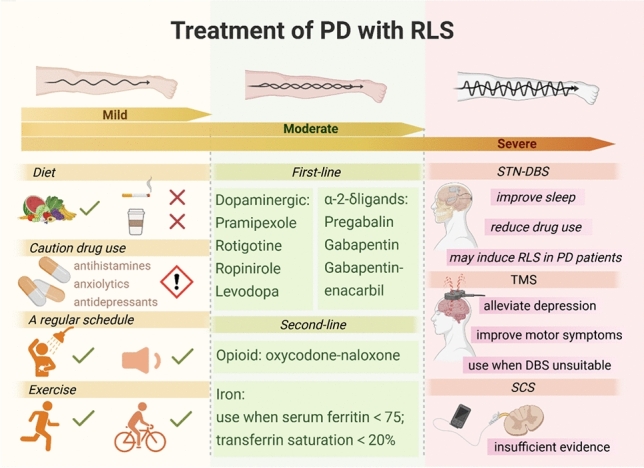
Treatment of PD with RLS. Mild symptoms can be intervened first through diet, exercise, etc. Medications can be added when they are ineffective or the symptoms worsen. First-line medications include dopaminergic drugs and α-2-δ ligands, while second-line medications include opioids and iron supplements. When both lifestyle and drug interventions are ineffective, consider surgery on this basis
Lifestyle interventions
It is mainly suitable for patients with mild disease. It mainly includes: (1) regular work and rest, adhere to good sleep hygiene, take a hot bath or carry out simple activities before going to bed, try to avoid sleep deprivation and create a quiet sleep environment [42]; (2) avoid or reduce the intake of caffeine, tea, energy drinks, nicotine, alcohol, etc., and increase the diet rich in vitamins and iron; (3) aerobic exercise and resistance training; Rubbing or massaging the affected limb; [102] (4) Medications that may induce or aggravate RLS symptoms, such as dopamine receptor antagonists, antihistamines, anxiolytics, antidepressants, calcium channel blockers, etc. [94, 101, 103, 104], should be used with caution.
Pharmacotherapy
At present, there is a lack of prospective interventional studies on Parkinson's disease combined with RLS. The main treatment is based on the treatment plan of primary RLS, which is reasonably adjusted according to the specific condition of PD [94, 105]. Well-recognized medical treatment options for primary RLS include dopaminergic agents (e.g., pramipexole, ropinirole, and rotigotine patches), α-2-δ ligands (gabapentin–enacarbil, pregabalin, and gabapentin), extended-release oxycodone/naloxone (if available), carboxymaltose-ferrous and ferrous sulfate, and vitamin C [106]. Dopaminergic medications can be effective in alleviating the symptoms of both PD and RLS, but even at low doses, these medications may exacerbate RLS symptoms [107]. The possible reason is the up-regulation and sensitization of dopaminergic receptors in the putamen [108, 109]. Additionally, patients treated with α-2-δ ligands often experience more side effects, such as fatigue, drowsiness, and dizziness [110]. Therefore, in clinical practice, the choice of drugs should be judged based on their efficacy and potential side effects.
Dopaminergic drugs
Dopamine agonists and levodopa improve both RLS and PD, so adjusting these drugs in PD may improve RLS. Dopamine agonists provide the most sustained dopaminergic stimulation, but they are not always well tolerated [105, 111]. Levodopa and other short-acting dopaminergic drugs may increase the risk of developing augmentation syndrome [9, 48]. For this reason, the lowest possible effective dose and the most continuous delivery are recommended, and levodopa should be avoided as the primary treatment for RLS in Parkinson's disease [48]. In patients with Parkinson's disease who are older, have cognitive impairment, or cannot tolerate dopamine agonists, adding nocturnal levodopa at an optimal dose may improve RLS symptoms and reduce the rebound of RLS symptoms during the day [111].
Rotigotine Recover study described the efficacy of the dopamine agonist rotigotine for the treatment of Parkinson's disease with RLS [112]. Transdermal rotigotine patch can improve motor and nocturnal leg motor symptoms in patients with Parkinson's disease compared to placebo, which is helpful in the treatment of patients with Parkinson's disease and RLS [113–116], but may cause local skin reactions when using the patch [94]. The recommended starting dose of rotigotine is 2 mg/ day, which is gradually adjusted to an optimal dose (the recommended dose is 2-16 mg) [117]. Based on two randomized, double-blind, controlled trials, rotigotine is considered effective for the treatment of RLS/WED for six months [42].
Pramipexole Pramipexole is a D1, D2, and D3 receptor agonist with a higher affinity for the D3 receptor. It can reduce PLMI and improve subjective sleep quality, quality of life and mood disorders [118]. Pramipexole can be the first choice for the treatment of moderate to severe RLS, starting with 0.125 mg [94] and the recommended dose is 0.375–4.5 mg [119]. The most commonly reported adverse events associated with pramipexole use include somnolence, nausea, and insomnia [120].
Ropinirole A number of studies have shown that ropinirole, with effective doses ranging from 0.25 to 4.00 mg [121], can effectively improve the quality of life and objective sleep quality of RLS patients [122, 123]. The most commonly reported adverse events included nausea, headache, fatigue, dizziness, and vomiting [120]. Ropinirole and pramipexole in immediate release form can be used in the early evening in PD and, based on their short-acting nature, can reduce some of the daytime side effects, Such as sleepiness, hallucinations, and sometimes impulse control disorders [111].
However, a study in the United States showed that the use of dopamine agonists in the treatment of RLS or PD may cause serious impulse control disorders, including pathological gambling, hyperactivity and compulsive shopping [124]. Therefore, adverse reactions such as hallucinations, withdrawal syndrome, and impulse control disorders should be considered when adjusting the dose of dopamine receptor agonists.
α-2-δ calcium channel ligands
In idiopathic RLS, a-2-δ calcium channel ligands have shown better effects than dopamine agonists [110]. The latest international guidelines propose it as an initial treatment for RLS [125]. To reduce the risk of RLS symptoms worsening, a-2-δ calcium channel ligands such as gabapentin–enacarbil, gabapentin, and pregabalin can be used in patients with Parkinson's disease [42, 110]. Recommended doses are 1200 mg, 800 mg, and 150–450 mg, with adverse side effects including EDS, dizziness, and weight gain [111]. Among them, pregabalin is recommended to be administered 1 to 3 h before bedtime. In the application of pregabalin in PD patients, there are case reports related to Parkinsonism and movement disorders [126–128]. Therefore, introduction and upregulation should be performed with caution.
Opioids
Further treatment options are low-potency opioids, such as oxycodone–naloxone combinations, which have been systematically evaluated only in idiopathic RLS but not yet in PD [129]. Randomized trials have shown that oxycodone/naloxone results in greater reductions in IRLS symptoms than placebo, but also more treaty-related GI disorders, neurological disorders, fatigue, and pruritic [130]. In patients with Parkinson's disease who have severe sensory symptoms of RLS or neuropathic pain [131], these agents may improve symptoms. When symptoms worsen, opioids can be used as a second-line treatment.
Iron
Iron supplementation is recommended when the patient's serum ferritin level is less than 75 μg per milliliter and/or the transferrin saturation is less than 20%. Oral iron combined with vitamin C is recommended for 3 months, and ferritin levels are evaluated [132]. If oral iron is ineffective, intravenous iron may be considered as an alternative (hospitalization) [125]. However, more and more studies have shown that PD is related to oxidative damage caused by iron deposition in the substantia nigra, and iron chelators can improve PD [133]. Therefore, prescribing iron supplementation in such patients is controversial.
Physical therapy
SCS
The existing evidence indicates that spinal cord stimulation (SCS) can ameliorate certain PD symptoms, like freezing of gait and postural instability, and has demonstrated favorable effects on enhancing the quality of life [134]. However, the therapeutic effect of SCS on RLS remains to be fully established. Despite this, SCS has shown potential as a treatment option by potentially modulating central neuronal hyperexcitation [135]. So, more research is needed to explore its potential applications investigate the effectiveness and safety of SCS in RLS patients.
TMS
A meta-analysis has shown that Repetitive Transcranial magnetic stimulation (TMS) noninvasive modulates cortical excitability and may improve motor symptoms and depression in PD [136]. In RLS, small sample studies showed a significant decrease in the scores of RLS-related scales after 14 sessions of TMS treatment [137]. Therefore, in some patients who cannot tolerate DBS, TMS can be considered as an alternative treatment.
Potential treatment
Deep brain stimulation (DBS), a well-established treatment for PD, may incidentally improve RLS symptoms in PD patients. The subthalamic nucleus (STN) is the most commonly targeted site for DBS. One clinical trial demonstrated significant changes in scores on RLS-related scales after DBS, with sustained symptom reduction for 2 years and decreased dopaminergic medication requirements [138]. These findings were corroborated by longitudinal and retrospective studies [139, 140]. Moreover, PD patients who received unilateral or bilateral STN-DBS reported significant improvements in sleep quality and daytime sleepiness [140]. Collectively, these studies suggest that DBS may alleviate symptoms and reduce medication burden in PD patients with RLS.
However, results are not universally consistent. Tordjman et al. reported a patient with idiopathic PD who developed disabling RLS after STN–DBS treatment, despite improvement in PD-related motor symptoms [141]. Another study found that RLS in PD after DBS-STN may be related to higher postoperative dopamine agonist doses [142]. Given these conflicting findings, DBS should be considered for PD patients with moderate to severe RLS only after a thorough assessment of its risks and benefits, particularly when nonsurgical treatments are deemed inappropriate.
Conclusion
In this article, an attempt is made to summarize the current research progress of the incidence, clinical manifestations, mechanisms, diagnosis and treatment on Parkinson's disease (PD) with Restless Legs Syndrome (RLS). However, given the complexity of factors and predictors that contribute to the progression of RLS in PD, each of these areas requires further investigation.
The existing research in this field is still in its infancy and ongoing. This review notes that RLS in PD may be associated with iron deficiency, dysfunction of the dopamine system, and reduced connectivity of related neural pathways. Despite this, more in—depth research is required to explore whether the progression of RLS in PD is also linked to immune inflammation, gut microbiota, and other factors. Additionally, there is significant variation in prevalence studies. To accurately assess the prevalence of RLS in PD, there is a need for standardized research methods in the future. Furthermore, current treatments can only alleviate symptoms and fall short in preventing or reversing the disease's progression. Therefore, future research should focus on the pathogenesis of RLS in PD to provide a theoretical foundation for the development of more effective treatments. Until now, research on RLS in PD spans multiple disciplines, including neurology, neuroimaging, and genetics. In the future, interdisciplinary cooperation should be strengthened. By integrating resources and technical advantages, we can promote the in—depth development of RLS research in PD.
Acknowledgements
The figures in this review article were created via Biorender.
Author contributions
The first draft of the manuscript was written by [Zhixin Wang]. Supervision was performed by [Nian Xiong] and [Shurui Zhang] and all authors commented on previous versions of the manuscript. All authors read and approved the final manuscript.
Funding
This work was supported by grants 2024ZD0529200 from the National Science and Technology Major Project, grants 82271278 from the National Natural Science Foundation of China, grants 2023020601012303 from the Outstanding Youth Project of Natural Science Foundation of Hubei province and 2023 Science and Technology Development Project Approved by Chinese Association of Rehabilitation Medicine (all to N.X).
Data availability
Data sharing is not applicable to this article as no new data were created or analyzed in this study.
Declarations
Conflicts of interest
On behalf of all authors, the corresponding author states that there is no conflict of interest.
Footnotes
Zhixin Wang and Shurui Zhang have contributed equally to this work and share first authorship.
References
- 1.Morris HR, Spillantini MG, Sue CM, Williams-Gray CH (2024) The pathogenesis of Parkinson’s disease. Lancet 403:293–304. 10.1016/S0140-6736(23)01478-2 [DOI] [PubMed] [Google Scholar]
- 2.Iranzo A, Comella CL, Santamaria J, Oertel W (2007) Restless legs syndrome in Parkinson’s disease and other neurodegenerative diseases of the central nervous system. Mov Disord 22(Suppl 18):S424-430. 10.1002/mds.21600 [DOI] [PubMed] [Google Scholar]
- 3.Iranzo A, Cochen De Cock V, Fantini ML, Pérez-Carbonell L, Trotti LM (2024) Sleep and sleep disorders in people with Parkinson’s disease. Lancet Neurol 23:925–937. 10.1016/S1474-4422(24)00170-4 [DOI] [PubMed] [Google Scholar]
- 4.Trenkwalder C, Paulus W, Walters AS (2005) The restless legs syndrome. Lancet Neurol 4:465–475. 10.1016/S1474-4422(05)70139-3 [DOI] [PubMed] [Google Scholar]
- 5.Allen RP, Earley CJ (2001) Restless legs syndrome: a review of clinical and pathophysiologic features. J Clin Neurophysiol 18:128–147. 10.1097/00004691-200103000-00004 [DOI] [PubMed] [Google Scholar]
- 6.Ferini-Strambi L, Carli G, Casoni F, Galbiati A (2018) Restless legs syndrome and Parkinson disease: a causal relationship between the two disorders? Front Neurol 9:551. 10.3389/fneur.2018.00551 [DOI] [PMC free article] [PubMed] [Google Scholar]
- 7.Ghasemi H, Khaledi-Paveh B, Abdi A, Jalali R, Salari N, Vaisi-Raygani A, Mohammadi M (2020) The prevalence of restless legs syndrome in patients with migraine: a systematic review and meta-analysis. Pain Res Manag 2020:2763808. 10.1155/2020/2763808 [DOI] [PMC free article] [PubMed] [Google Scholar]
- 8.Jiménez-Jiménez FJ, Alonso-Navarro H, García-Martín E, Agúndez JAG (2021) Association between restless legs syndrome and peripheral neuropathy: a systematic review and meta-analysis. Eur J Neurol 28:2423–2442. 10.1111/ene.14840 [DOI] [PubMed] [Google Scholar]
- 9.Earley CJ, Silber MH (2010) Restless legs syndrome: understanding its consequences and the need for better treatment. Sleep Med 11:807–815. 10.1016/j.sleep.2010.07.007 [DOI] [PubMed] [Google Scholar]
- 10.Ning P, Mu X, Yang X, Li T, Xu Y (2022) Prevalence of restless legs syndrome in people with diabetes mellitus: a pooling analysis of observational studies. EClinMed 46:101357. 10.1016/j.eclinm.2022.101357 [DOI] [PMC free article] [PubMed] [Google Scholar]
- 11.Huang C-W, Lee M-J, Wang L-J, Lee P-T, Tu Y-K, Hsu C-W, Lin P-Y (2020) Comparative efficacy and acceptability of treatments for restless legs syndrome in end-stage renal disease: a systematic review and network meta-analysis. Nephrol Dial Transplant 35:1609–1618. 10.1093/ndt/gfz097 [DOI] [PubMed] [Google Scholar]
- 12.Gupta R, Gupta R, Kumar N, Rawat VS, Ulfberg J, Allen RP (2021) Restless legs syndrome among subjects having chronic liver disease: a systematic review and meta-analysis. Sleep Med Rev 58:101463. 10.1016/j.smrv.2021.101463 [DOI] [PubMed] [Google Scholar]
- 13.Zhang X, Lang Y, Sun L, Zhang W, Lin W, Cui L (2020) Clinical characteristics and prognostic analysis of anti-gamma-aminobutyric acid-B (GABA-B) receptor encephalitis in northeast China. BMC Neurol 20:1. 10.1186/s12883-019-1585-y [DOI] [PMC free article] [PubMed] [Google Scholar]
- 14.Szatmari S, Bereczki D, Fornadi K, Kalantar-Zadeh K, Kovesdy CP, Molnar MZ (2017) Association of restless legs syndrome with incident Parkinson’s disease. Sleep 40:zsw065. 10.1093/sleep/zsw065 [DOI] [PMC free article] [PubMed] [Google Scholar]
- 15.Tan E-K (2006) Restless legs syndrome and Parkinson’s disease: is there an etiologic link? J Neurol 253 Suppl 7:VII33–VII37. 10.1007/s00415-006-7008-1 [DOI] [PubMed] [Google Scholar]
- 16.Allen RP, Bharmal M, Calloway M (2011) Prevalence and disease burden of primary restless legs syndrome: results of a general population survey in the United States. Mov Disord 26:114–120. 10.1002/mds.23430 [DOI] [PubMed] [Google Scholar]
- 17.Rinaldi F, Galbiati A, Marelli S, Ferini Strambi L, Zucconi M (2016) Treatment options in intractable restless legs syndrome/willis-ekbom disease (RLS/WED). Curr Treat Options Neurol 18:7. 10.1007/s11940-015-0390-1 [DOI] [PubMed] [Google Scholar]
- 18.Suzuki K, Miyamoto M, Miyamoto T, Hirata K (2015) Restless legs syndrome and leg motor restlessness in Parkinson’s disease. Parkinsons Dis 2015:490938. 10.1155/2015/490938 [DOI] [PMC free article] [PubMed] [Google Scholar]
- 19.Broström A, Alimoradi Z, Lind J, Ulander M, Lundin F, Pakpour A (2023) Worldwide estimation of restless legs syndrome: a systematic review and meta-analysis of prevalence in the general adult population. J Sleep Res 32:e13783. 10.1111/jsr.13783 [DOI] [PubMed] [Google Scholar]
- 20.Rijsman RM, Schoolderman LF, Rundervoort RS, Louter M (2014) Restless legs syndrome in Parkinson’s disease. Parkinsonism Relat Disord 20(Suppl 1):S5-9. 10.1016/S1353-8020(13)70004-X [DOI] [PubMed] [Google Scholar]
- 21.Alonso-Navarro H, García-Martín E, Agúndez JAG, Jiménez-Jiménez FJ (2019) Association between restless legs syndrome and other movement disorders. Neurology 92:948–964. 10.1212/WNL.0000000000007500 [DOI] [PubMed] [Google Scholar]
- 22.Moccia M, Erro R, Picillo M, Santangelo G, Spina E, Allocca R, Longo K, Amboni M, Palladino R, Assante R, Pappatà S, Pellecchia MT, Barone P, Vitale C (2016) A four-year longitudinal study on restless legs syndrome in Parkinson disease. Sleep 39:405–412. 10.5665/sleep.5452 [DOI] [PMC free article] [PubMed] [Google Scholar]
- 23.Lang AE, Johnson K (1987) Akathisia in idiopathic Parkinson’s disease. Neurology 37:477–481. 10.1212/wnl.37.3.477 [DOI] [PubMed] [Google Scholar]
- 24.Krishnan PR, Bhatia M, Behari M (2003) Restless legs syndrome in Parkinson’s disease: a case-controlled study. Mov Disord 18:181–185. 10.1002/mds.10307 [DOI] [PubMed] [Google Scholar]
- 25.Ondo WG, Vuong KD, Jankovic J (2002) Exploring the relationship between Parkinson disease and restless legs syndrome. Arch Neurol 59:421–424. 10.1001/archneur.59.3.421 [DOI] [PubMed] [Google Scholar]
- 26.Cho YW, Shin WC, Yun CH, Hong SB, Kim JH, Allen RP, Earley CJ (2008) Epidemiology of restless legs syndrome in Korean adults. Sleep 31:219–223. 10.1093/sleep/31.2.219 [DOI] [PMC free article] [PubMed] [Google Scholar]
- 27.Lee JE, Shin H-W, Kim KS, Sohn YH (2009) Factors contributing to the development of restless legs syndrome in patients with Parkinson disease. Mov Disord 24:579–582. 10.1002/mds.22410 [DOI] [PubMed] [Google Scholar]
- 28.Tan EK, Lum SY, Wong MC (2002) Restless legs syndrome in Parkinson’s disease. J Neurol Sci 196:33–36. 10.1016/s0022-510x(02)00020-5 [DOI] [PubMed] [Google Scholar]
- 29.Peralta CM, Frauscher B, Seppi K, Wolf E, Wenning GK, Högl B, Poewe W (2009) Restless legs syndrome in Parkinson’s disease. Mov Disord 24:2076–2080. 10.1002/mds.22694 [DOI] [PubMed] [Google Scholar]
- 30.Gómez-Esteban JC, Zarranz JJ, Tijero B, Velasco F, Barcena J, Rouco I, Lezcano E, Lachen MC, Jauregui A, Ugarte A (2007) Restless legs syndrome in Parkinson’s disease. Mov Disord 22:1912–1916. 10.1002/mds.21624 [DOI] [PubMed] [Google Scholar]
- 31.Braga-Neto P, da Silva-Júnior FP, Sueli Monte F, de Bruin PFC, de Bruin VMS (2004) Snoring and excessive daytime sleepiness in Parkinson’s disease. J Neurol Sci 217:41–45. 10.1016/j.jns.2003.08.010 [DOI] [PubMed] [Google Scholar]
- 32.Verbaan D, van Rooden SM, van Hilten JJ, Rijsman RM (2010) Prevalence and clinical profile of restless legs syndrome in Parkinson’s disease. Mov Disord 25:2142–2147. 10.1002/mds.23241 [DOI] [PubMed] [Google Scholar]
- 33.Gjerstad MD, Tysnes OB, Larsen JP (2011) Increased risk of leg motor restlessness but not RLS in early Parkinson disease. Neurology 77:1941–1946. 10.1212/WNL.0b013e31823a0cc8 [DOI] [PubMed] [Google Scholar]
- 34.Suzuki K, Miyamoto M, Miyamoto T, Tatsumoto M, Watanabe Y, Suzuki S, Iwanami M, Sada T, Kadowaki T, Numao A, Trenkwalder C (2012) Nocturnal disturbances and restlessness in Parkinson’s disease: using the Japanese version of the Parkinson’s disease sleep scale-2. J Neurol Sci. 10.1016/j.jns.2012.03.022 [DOI] [PubMed] [Google Scholar]
- 35.Rana AQ, Siddiqui I, Mosabbir A, Athar A, Syed O, Jesudasan M, Hafez K (2013) Association of pain, Parkinson’s disease, and restless legs syndrome. J Neurol Sci 327:32–34. 10.1016/j.jns.2013.01.039 [DOI] [PubMed] [Google Scholar]
- 36.Fereshtehnejad S-M, Shafieesabet M, Shahidi GA, Delbari A, Lökk J (2015) Restless legs syndrome in patients with Parkinson’s disease: a comparative study on prevalence, clinical characteristics, quality of life and nutritional status. Acta Neurol Scand 131:211–218. 10.1111/ane.12307 [DOI] [PubMed] [Google Scholar]
- 37.Yang X, Liu B, Shen H, Li S, Zhao Q, An R, Hu F, Ren H, Xu Y, Xu Z (2018) Prevalence of restless legs syndrome in Parkinson’s disease: a systematic review and meta-analysis of observational studies. Sleep Med 43:40–46. 10.1016/j.sleep.2017.11.1146 [DOI] [PubMed] [Google Scholar]
- 38.Kim J-M, Choi S-M, Cho SH, Kim BC (2023) Restless legs syndrome affects sleep in de novo Parkinson’s disease patients. Medicine (Baltimore) 102:e35551. 10.1097/MD.0000000000035551 [DOI] [PMC free article] [PubMed] [Google Scholar]
- 39.Bliwise DL, Karroum EG, Greer SA, Factor SA, Trotti LM (2022) Restless legs symptoms and periodic leg movements in sleep among patients with Parkinson’s disease. J Parkinsons Dis 12:1339–1344. 10.3233/JPD-213100 [DOI] [PMC free article] [PubMed] [Google Scholar]
- 40.Diaconu Ş, Irincu L, Ungureanu L, Ciopleiaș B, Țînț D, Falup-Pecurariu C (2023) Restless legs syndrome in Parkinson’s disease. J Pers Med 13:915. 10.3390/jpm13060915 [DOI] [PMC free article] [PubMed] [Google Scholar]
- 41.Maggi G, Barone A, Mastromarino C, Santangelo G, Vitale C (2024) Prevalence and clinical profile of patients with restless legs syndrome in Parkinson’s disease: a meta-analysis. Sleep Med 121:275–286. 10.1016/j.sleep.2024.07.015 [DOI] [PubMed] [Google Scholar]
- 42.Garcia-Borreguero D, Cano-Pumarega I (2017) New concepts in the management of restless legs syndrome. BMJ 356:j104. 10.1136/bmj.j104 [DOI] [PubMed] [Google Scholar]
- 43.Zhu X-Y, Liu Y, Zhang X-J, Yang W-H, Feng Y, Ondo WG, Tan E-K, Wu Y-C (2015) Clinical characteristics of leg restlessness in Parkinson’s disease compared with idiopathic restless legs syndrome. J Neurol Sci 357:109–114. 10.1016/j.jns.2015.07.008 [DOI] [PubMed] [Google Scholar]
- 44.Garcia-Borreguero D, Odin P, Serrano C (2003) Restless legs syndrome and PD: a review of the evidence for a possible association. Neurology 61(Suppl 3):S49-55. 10.1212/wnl.61.6_suppl_3.s49 [DOI] [PubMed] [Google Scholar]
- 45.Garcia-Borreguero D, Egatz R, Winkelmann J, Berger K (2006) Epidemiology of restless legs syndrome: the current status. Sleep Med Rev 10:153–167. 10.1016/j.smrv.2006.01.001 [DOI] [PubMed] [Google Scholar]
- 46.Loo H-V, Tan E-K (2008) Case-control study of restless legs syndrome and quality of sleep in Parkinson’s disease. J Neurol Sci 266:145–149. 10.1016/j.jns.2007.09.033 [DOI] [PubMed] [Google Scholar]
- 47.You S, Jeon SM, Do SY, Cho YW (2019) Restless legs syndrome in Parkinson’s disease patients: clinical features including motor and nonmotor symptoms. J Clin Neurol 15:321–327. 10.3988/jcn.2019.15.3.321 [DOI] [PMC free article] [PubMed] [Google Scholar]
- 48.García-Borreguero D, Allen RP, Benes H, Earley C, Happe S, Högl B, Kohnen R, Paulus W, Rye D, Winkelmann J (2007) Augmentation as a treatment complication of restless legs syndrome: Concept and management. Mov Disord 22(Suppl 18):S476-484. 10.1002/mds.21610 [DOI] [PubMed] [Google Scholar]
- 49.Dragan EM, Chen Z, Ondo WG (2015) Does idiopathic restless legs syndrome delay onset and reduce severity of Parkinson’s disease: a pilot study. Int J Neurosci 125:526–530. 10.3109/00207454.2014.987771 [DOI] [PubMed] [Google Scholar]
- 50.Scullin MK, Sollinger AB, Land J, Wood-Siverio C, Zanders L, Lee R, Freeman A, Goldstein FC, Bliwise DL, Factor SA (2013) Sleep and impulsivity in Parkinson’s disease. Parkinsonism Relat Disord 19:991–994. 10.1016/j.parkreldis.2013.06.018 [DOI] [PMC free article] [PubMed] [Google Scholar]
- 51.Marques A, Figorilli M, Pereira B, Derost P, Debilly B, Beudin P, Vidal T, Durif F, Fantini ML (2018) Impulse control disorders in Parkinson’s disease patients with RLS: a cross sectional-study. Sleep Med 48:148–154. 10.1016/j.sleep.2018.02.004 [DOI] [PubMed] [Google Scholar]
- 52.Maggi G, Trojano L, Barone P, Santangelo G (2021) Sleep disorders and cognitive dysfunctions in Parkinson’s disease: a meta-analytic study. Neuropsychol Rev 31:643–682. 10.1007/s11065-020-09473-1 [DOI] [PubMed] [Google Scholar]
- 53.Weinstock LB, Walters AS, Paueksakon P (2012) Restless legs syndrome–theoretical roles of inflammatory and immune mechanisms. Sleep Med Rev 16:341–354. 10.1016/j.smrv.2011.09.003 [DOI] [PubMed] [Google Scholar]
- 54.Menza M, Dobkin RD, Marin H, Mark MH, Gara M, Bienfait K, Dicke A, Kusnekov A (2010) The role of inflammatory cytokines in cognition and other non-motor symptoms of Parkinson’s disease. Psychosomatics 51:474–479. 10.1176/appi.psy.51.6.474 [DOI] [PMC free article] [PubMed] [Google Scholar]
- 55.Azmin S, Khairul Anuar AM, Nafisah WY, Tan HJ, Raymond AA, Hanita O, Shah SA, Norlinah MI (2013) Restless legs syndrome and its associated risk factors in Parkinson’s disease. Parkinsons Dis 2013:535613. 10.1155/2013/535613 [DOI] [PMC free article] [PubMed] [Google Scholar]
- 56.Connor JR, Boyer PJ, Menzies SL, Dellinger B, Allen RP, Ondo WG, Earley CJ (2003) Neuropathological examination suggests impaired brain iron acquisition in restless legs syndrome. Neurology 61:304–309. 10.1212/01.wnl.0000078887.16593.12 [DOI] [PubMed] [Google Scholar]
- 57.Connor JR, Wang X-S, Allen RP, Beard JL, Wiesinger JA, Felt BT, Earley CJ (2009) Altered dopaminergic profile in the putamen and substantia nigra in restless leg syndrome. Brain 132:2403–2412. 10.1093/brain/awp125 [DOI] [PMC free article] [PubMed] [Google Scholar]
- 58.Earley CJ, Connor J, Garcia-Borreguero D, Jenner P, Winkelman J, Zee PC, Allen R (2014) Altered brain iron homeostasis and dopaminergic function in restless legs syndrome (willis-ekbom disease). Sleep Med 15:1288–1301. 10.1016/j.sleep.2014.05.009 [DOI] [PubMed] [Google Scholar]
- 59.Earley CJ, Kuwabara H, Wong DF, Gamaldo C, Salas R, Brasic J, Ravert HT, Dannals RF, Allen RP (2011) The dopamine transporter is decreased in the striatum of subjects with restless legs syndrome. Sleep 34:341–347. 10.1093/sleep/34.3.341 [DOI] [PMC free article] [PubMed] [Google Scholar]
- 60.Felicio AC, Shih MC, Godeiro-Junior C, Andrade LAF, Bressan RA, Ferraz HB (2009) Molecular imaging studies in Parkinson disease: reducing diagnostic uncertainty. Neurologist 15:6–16. 10.1097/NRL.0b013e318183fdd8 [DOI] [PubMed] [Google Scholar]
- 61.Bianco LE, Wiesinger J, Earley CJ, Jones BC, Beard JL (2008) Iron deficiency alters dopamine uptake and response to L-DOPA injection in sprague-dawley rats. J Neurochem 106:205–215. 10.1111/j.1471-4159.2008.05358.x [DOI] [PubMed] [Google Scholar]
- 62.Erikson KM, Jones BC, Beard JL (2000) Iron deficiency alters dopamine transporter functioning in rat striatum. J Nutr 130:2831–2837. 10.1093/jn/130.11.2831 [DOI] [PubMed] [Google Scholar]
- 63.Graham JM, Paley MN, Grünewald RA, Hoggard N, Griffiths PD (2000) Brain iron deposition in Parkinson’s disease imaged using the PRIME magnetic resonance sequence. Brain 123(Pt 12):2423–2431. 10.1093/brain/123.12.2423 [DOI] [PubMed] [Google Scholar]
- 64.Liu Z, Shen H-C, Lian T-H, Mao L, Tang S-X, Sun L, Huang X-Y, Guo P, Cao C-J, Yu S-Y, Zuo L-J, Wang X-M, Chen S-D, Chan P, Zhang W (2017) Iron deposition in substantia nigra: abnormal iron metabolism, neuroinflammatory mechanism and clinical relevance. Sci Rep 7:14973. 10.1038/s41598-017-14721-1 [DOI] [PMC free article] [PubMed] [Google Scholar]
- 65.Muñoz Y, Carrasco CM, Campos JD, Aguirre P, Núñez MT (2016) Parkinson’s disease: the mitochondria-iron link. Parkinson’s Dis 2016:7049108. 10.1155/2016/7049108 [DOI] [PMC free article] [PubMed] [Google Scholar]
- 66.Piao Y-S, Lian T-H, Hu Y, Zuo L-J, Guo P, Yu S-Y, Liu L, Jin Z, Zhao H, Li L-X, Yu Q-J, Wang R-D, Chen S-D, Chan P, Wang X-M, Zhang W (2017) Restless legs syndrome in Parkinson disease: Clinical characteristics, abnormal iron metabolism and altered neurotransmitters. Sci Rep 7:10547. 10.1038/s41598-017-10593-7 [DOI] [PMC free article] [PubMed] [Google Scholar]
- 67.Turjanski N, Lees AJ, Brooks DJ (1999) Striatal dopaminergic function in restless legs syndrome: 18F-dopa and 11C-raclopride PET studies. Neurology 52:932–937. 10.1212/wnl.52.5.932 [DOI] [PubMed] [Google Scholar]
- 68.Michaud M, Soucy J-P, Chabli A, Lavigne G, Montplaisir J (2002) SPECT imaging of striatal pre- and postsynaptic dopaminergic status in restless legs syndrome with periodic leg movements in sleep. J Neurol 249:164–170. 10.1007/pl00007859 [DOI] [PubMed] [Google Scholar]
- 69.Dentresangle C, Veyre L, Le Bars D, Pierre C, Lavenne F, Pollak P, Guerin J, Froment JC, Brousolle E (1999) Striatal D2 dopamine receptor status in Parkinson’s disease: an [18F]dopa and [11C]raclopride PET study. Mov Disord 14:1025–1030. 10.1002/1531-8257(199911)14:6%3c1025::aid-mds1020%3e3.0.co;2-p [DOI] [PubMed] [Google Scholar]
- 70.Antonini A, Schwarz J, Oertel WH, Pogarell O, Leenders KL (1997) Long-term changes of striatal dopamine D2 receptors in patients with Parkinson’s disease: a study with positron emission tomography and [11C]raclopride. Mov Disord 12:33–38. 10.1002/mds.870120107 [DOI] [PubMed] [Google Scholar]
- 71.Peeraully T, Tan E-K (2012) Linking restless legs syndrome with Parkinson’s disease: clinical, imaging and genetic evidence. Transl Neurodegener 1:6. 10.1186/2047-9158-1-6 [DOI] [PMC free article] [PubMed] [Google Scholar]
- 72.Clemens S, Rye D, Hochman S (2006) Restless legs syndrome: revisiting the dopamine hypothesis from the spinal cord perspective. Neurology 67:125–130. 10.1212/01.wnl.0000223316.53428.c9 [DOI] [PubMed] [Google Scholar]
- 73.Puopolo M (2019) The hypothalamic-spinal dopaminergic system: a target for pain modulation. Neural Regen Res 14:925–930. 10.4103/1673-5374.250567 [DOI] [PMC free article] [PubMed] [Google Scholar]
- 74.Braak H, Del Tredici K, Rüb U, de Vos RAI, Jansen Steur ENH, Braak E (2003) Staging of brain pathology related to sporadic Parkinson’s disease. Neurobiol Aging 24:197–211. 10.1016/s0197-4580(02)00065-9 [DOI] [PubMed] [Google Scholar]
- 75.Kaasinen V, Någren K, Hietala J, Oikonen V, Vilkman H, Farde L, Halldin C, Rinne JO (2000) Extrastriatal dopamine D2 and D3 receptors in early and advanced Parkinson’s disease. Neurology 54:1482–1487. 10.1212/wnl.54.7.1482 [DOI] [PubMed] [Google Scholar]
- 76.Calzetti S, Negrotti A, Pietrini V (2021) Does restless legs syndrome have a different pathomechanism in premotor and motor Parkinson’s disease? J Mov Disord 14:204–207. 10.14802/jmd.20160 [DOI] [PMC free article] [PubMed] [Google Scholar]
- 77.Li Z, Chen J, Lin Y, Zhou M, Cai Q, Li X, Wu Z, Chen X, Yang X, Zhu X, Lu J, Zhang L, Liu B, Luo X, Xu P (2019) Reduced regional activity and functional connectivity within sensorimotor network in Parkinson’s patients with restless legs syndrome. Mol Pain 15:1744806919882272. 10.1177/1744806919882272 [DOI] [PMC free article] [PubMed] [Google Scholar]
- 78.Zang QL, Zheng JH, Ma JJ, Zhang Q, Huang PP, Shen NN, Miao W (2022) Neuroanatomy and functional connectivity in patients with Parkinson’s disease with or without restless legs syndrome. Neurol Ther 11:1625–1636. 10.1007/s40120-022-00397-x [DOI] [PMC free article] [PubMed] [Google Scholar]
- 79.Rana AQ, Mosabbir AA, Qureshi ARM, Abbas M, Rana MA (2016) Restless leg syndrome: a risk factor of higher prevalence of anxiety and depression in Parkinson’s disease patients. Neurol Res 38:309–312. 10.1080/01616412.2016.1147682 [DOI] [PubMed] [Google Scholar]
- 80.Zhu X-Y, Wang H-M, Wu T-T, Liu T, Chen Y-J, Li X, Chen T-J, Liu Y, Zhang X-J, Wang X-X, Zhang Y, Ondo WG, Wu Y-C (2020) SNCA-rep1 polymorphism correlates with susceptibility and iron deficiency in restless legs syndrome. Parkinsonism Relat Disord 81:12–17. 10.1016/j.parkreldis.2020.09.015 [DOI] [PubMed] [Google Scholar]
- 81.Iwaki H, Hughes KC, Gao X, Schwarzschild MA, Ascherio A (2018) The association between restless legs syndrome and premotor symptoms of Parkinson’s disease. J Neurol Sci 394:41–44. 10.1016/j.jns.2018.08.028 [DOI] [PubMed] [Google Scholar]
- 82.Wang T, Shi C, Luo H, Zheng H, Fan L, Tang M, Su Y, Yang J, Mao C, Xu Y (2022) Neuroinflammation in Parkinson’s disease: triggers, mechanisms, and immunotherapies. Neuroscientist 28:364–381. 10.1177/1073858421991066 [DOI] [PubMed] [Google Scholar]
- 83.Jiménez-Jiménez FJ, Alonso-Navarro H, García-Martín E, Agúndez JAG (2023) Inflammatory factors and restless legs syndrome: a systematic review and meta-analysis. Sleep Med Rev 68:101744. 10.1016/j.smrv.2022.101744 [DOI] [PubMed] [Google Scholar]
- 84.Postuma RB, Berg D, Stern M, Poewe W, Olanow CW, Oertel W, Obeso J, Marek K, Litvan I, Lang AE, Halliday G, Goetz CG, Gasser T, Dubois B, Chan P, Bloem BR, Adler CH, Deuschl G (2015) MDS clinical diagnostic criteria for Parkinson’s disease. Mov Disord 30:1591–1601. 10.1002/mds.26424 [DOI] [PubMed] [Google Scholar]
- 85.Guo S, Huang J, Jiang H, Han C, Li J, Xu X, Zhang G, Lin Z, Xiong N, Wang T (2017) Restless legs syndrome: From pathophysiology to clinical diagnosis and management. Front Aging Neurosci. 10.3389/fnagi.2017.00171 [DOI] [PMC free article] [PubMed] [Google Scholar]
- 86.Allen RP, Picchietti DL, Garcia-Borreguero D, Ondo WG, Walters AS, Winkelman JW, Zucconi M, Ferri R, Trenkwalder C, Lee HB, International Restless Legs Syndrome Study Group (2014) Restless legs syndrome/willis-ekbom disease diagnostic criteria: Updated international restless legs syndrome study group (IRLSSG) consensus criteria-history, rationale, description, and significance. Sleep Med 15:860–873. 10.1016/j.sleep.2014.03.025 [DOI] [PubMed] [Google Scholar]
- 87.Kwatra V, Khan MA, Quadri SA, Cook TS (2018) Differential diagnosis and treatment of restless legs syndrome: a literature review. Cureus 10:e3297. 10.7759/cureus.3297 [DOI] [PMC free article] [PubMed] [Google Scholar]
- 88.Stiasny-Kolster K, Kohnen R, Möller JC, Trenkwalder C, Oertel WH (2006) Validation of the “L-DOPA test” for diagnosis of restless legs syndrome. Mov Disord 21:1333–1339. 10.1002/mds.20969 [DOI] [PubMed] [Google Scholar]
- 89.Möller JC, Unger M, Stiasny-Kolster K, Oertel WH (2010) Restless legs syndrome (RLS) and parkinson’s disease (PD)-related disorders or different entities? J Neurol Sci 289:135–137. 10.1016/j.jns.2009.08.035 [DOI] [PubMed] [Google Scholar]
- 90.Comella CL, Goetz CG (1994) Akathisia in Parkinson’s disease. Mov Disord 9:545–549. 10.1002/mds.870090507 [DOI] [PubMed] [Google Scholar]
- 91.Poewe W, Högl B (2004) Akathisia, restless legs and periodic limb movements in sleep in Parkinson’s disease. Neurology 63:S12-16. 10.1212/wnl.63.8_suppl_3.s12 [DOI] [PubMed] [Google Scholar]
- 92.Stefani A, Högl B (2020) Sleep in Parkinson’s disease. Neuropsychopharmacology 45:121–128. 10.1038/s41386-019-0448-y [DOI] [PMC free article] [PubMed] [Google Scholar]
- 93.Walters AS, Frauscher B, Allen R, Benes H, Chaudhuri KR, Garcia-Borreguero D, Lee HB, Picchietti DL, Trenkwalder C, Martinez-Martin P, Schrag A, Stebbins G (2014) Review of severity rating scales for restless legs syndrome: critique and recommendations. Mov Disord Clin Pract 1:317–324. 10.1002/mdc3.12088 [DOI] [PMC free article] [PubMed] [Google Scholar]
- 94.Chinese Society of Neurology, Chinese Medical Doctor Association, Chinese Society of Sleep Disorders, Chinese Society of Sleep Disorders Professional Committee (2021) Chinese guidelines for the diagnosis and treatment of restless legs syndrome (2021 edition). Chin J Med 101:908–925. 10.3760/cma.j.cn112137-20200820-02431(in Chinese)
- 95.Sobreira-Neto MA, Pena-Pereira MA, Sobreira EST, Chagas MHN, de Almeida CMO, Fernandes RMF, Tumas V, Eckeli AL (2021) Is restless legs syndrome in Parkinson disease patients associated with any specific factor? Arq Neuropsiquiatr 79:38–43. 10.1590/0004-282X-anp-2020-0122 [DOI] [PubMed] [Google Scholar]
- 96.Walters AS, LeBrocq C, Dhar A, Hening W, Rosen R, Allen RP, Trenkwalder C, International Restless Legs Syndrome Study Group (2003) Validation of the international restless legs syndrome study group rating scale for restless legs syndrome. Sleep Med 4:121–132. 10.1016/s1389-9457(02)00258-7 [DOI] [PubMed] [Google Scholar]
- 97.Allen RP, Earley CJ (2001) Validation of the Johns Hopkins restless legs severity scale. Sleep Med 2:239–242. 10.1016/s1389-9457(00)00080-0 [DOI] [PubMed] [Google Scholar]
- 98.Kohnen R, Martinez-Martin P, Benes H, Trenkwalder C, Högl B, Dunkl E, Walters AS (2016) Rating of daytime and nighttime symptoms in RLS: validation of the RLS-6 scale of restless legs syndrome/willis-ekbom disease. Sleep Med 20:116–122. 10.1016/j.sleep.2015.10.014 [DOI] [PubMed] [Google Scholar]
- 99.Arbuckle R, Abetz L, Durmer JS, Ivanenko A, Owens JA, Croenlein J, Bolton K, Moore A, Allen RP, Walters AS, Picchietti DL (2010) Development of the pediatric restless legs syndrome severity scale (P-RLS-SS): a patient-reported outcome measure of pediatric RLS symptoms and impact. Sleep Med 11:897–906. 10.1016/j.sleep.2010.03.016 [DOI] [PubMed] [Google Scholar]
- 100.Bentley AJ, Rosman KD, Mitchell D (2007) Can the sensory symptoms of restless legs syndrome be assessed using a qualitative pain questionnaire? Clin J Pain 23:62–66. 10.1097/01.ajp.0000210948.11805.69 [DOI] [PubMed] [Google Scholar]
- 101.Li WT, Gan J, Liu ZG (2021) Expert consensus on integrated traditional Chinese and western medicine management of sleep disorders in Parkinson’s disease. J Shanghai Univ Tradit Chin Med 35:1–6. 10.16306/j.1008-861x.2021.03.001. (in Chinese) [Google Scholar]
- 102.Klingelhoefer L, Cova I, Gupta S, Chaudhuri KR (2014) A review of current treatment strategies for restless legs syndrome (Willis-Ekbom disease). Clin Med (Lond) 14:520–524. 10.7861/clinmedicine.14-5-520 [DOI] [PMC free article] [PubMed] [Google Scholar]
- 103.Allen RP, Ondo WG, Ball E, Calloway MO, Manjunath R, Higbie RL, Lee MR, Nisbet PA (2011) Restless legs syndrome (RLS) augmentation associated with dopamine agonist and levodopa usage in a community sample. Sleep Med 12:431–439. 10.1016/j.sleep.2011.03.003 [DOI] [PubMed] [Google Scholar]
- 104.Hoque R (2010) Pharmacologically induced/exacerbated restless legs syndrome, periodic limb movements of sleep, and REM behavior disorder/REM sleep without atonia: literature review, qualitative scoring, and comparative analysis. J Clin Sleep Medicine JCSM 6:13–14 [PMC free article] [PubMed] [Google Scholar]
- 105.Winkelmann J, Allen RP, Högl B, Inoue Y, Oertel W, Salminen AV, Winkelman JW, Trenkwalder C, Sampaio C (2018) Treatment of restless legs syndrome: evidence-based review and implications for clinical practice (revised 2017)§. Mov Disord 33:1077–1091. 10.1002/mds.27260 [DOI] [PubMed] [Google Scholar]
- 106.Winkelman JW, Armstrong MJ, Allen RP, Chaudhuri KR, Ondo W, Trenkwalder C, Zee PC, Gronseth GS, Gloss D, Zesiewicz T (2016) Practice guideline summary: Treatment of restless legs syndrome in adults: report of the guideline development, dissemination, and implementation subcommittee of the American academy of neurology. Neurology 87:2585–2593. 10.1212/WNL.0000000000003388 [DOI] [PMC free article] [PubMed] [Google Scholar]
- 107.Garcia-Borreguero D, Patrick J, DuBrava S, Becker PM, Lankford A, Chen C, Miceli J, Knapp L, Allen RP (2014) Pregabalin versus pramipexole: effects on sleep disturbance in restless legs syndrome. Sleep 37:635–643. 10.5665/sleep.3558 [DOI] [PMC free article] [PubMed] [Google Scholar]
- 108.Allen RP, Picchietti D, Hening WA, Trenkwalder C, Walters AS, Montplaisi J, Restless Legs Syndrome Diagnosis and Epidemiology workshop at the National Institutes of Health, International Restless Legs Syndrome Study Group (2003) Restless legs syndrome: diagnostic criteria, special considerations, and epidemiology. A report from the restless legs syndrome diagnosis and epidemiology workshop at the national institutes of health. Sleep Med 4:101–119. 10.1016/s1389-9457(03)00010-8 [DOI] [PubMed] [Google Scholar]
- 109.Trenkwalder C, Allen R, Högl B, Clemens S, Patton S, Schormair B, Winkelmann J (2018) Comorbidities, treatment, and pathophysiology in restless legs syndrome. Lancet Neurol 17:994–1005. 10.1016/S1474-4422(18)30311-9 [DOI] [PubMed] [Google Scholar]
- 110.Iftikhar IH, Alghothani L, Trotti LM (2017) Gabapentin enacarbil, pregabalin and rotigotine are equally effective in restless legs syndrome: a comparative meta-analysis. Eur J Neurol 24:1446–1456. 10.1111/ene.13449 [DOI] [PubMed] [Google Scholar]
- 111.Cochen De Cock V (2019) Therapies for restless legs in Parkinson’s disease. Curr Treat Options Neurol 21:56. 10.1007/s11940-019-0596-8 [DOI] [PubMed] [Google Scholar]
- 112.Trenkwalder C, Kies B, Rudzinska M, Fine J, Nikl J, Honczarenko K, Dioszeghy P, Hill D, Anderson T, Myllyla V, Kassubek J, Steiger M, Zucconi M, Tolosa E, Poewe W, Surmann E, Whitesides J, Boroojerdi B, Chaudhuri KR (2011) Rotigotine effects on early morning motor function and sleep in Parkinson’s disease: a double-blind, randomized, placebo-controlled study (RECOVER). Mov Disord 26:90–99. 10.1002/mds.23441 [DOI] [PMC free article] [PubMed] [Google Scholar]
- 113.Wang Y, Yang Y-C, Lan D-M, Wu H-J, Zhao Z-X (2017) An observational clinical and video-polysomnographic study of the effects of rotigotine in sleep disorder in Parkinson’s disease. Sleep Breath 21:319–325. 10.1007/s11325-016-1414-0 [DOI] [PubMed] [Google Scholar]
- 114.Vallderiola F, Compta Y, Aparicio J, Tarradellas J, Salazar G, Oliver JM, Callén A, Delgado T, Nobbe F (2015) Effects of night-time use of rotigotine on nocturnal symptoms in Parkinson’s disease. Parkinsons Dis 2015:475630. 10.1155/2015/475630 [DOI] [PMC free article] [PubMed] [Google Scholar]
- 115.Kim J-M, Chung SJ, Kim JW, Jeon BS, Singh P, Thierfelder S, Ikeda J, Bauer L, Asia Pacific Rotigotine Add-on Study Group (2015) Rotigotine transdermal system as add-on to oral dopamine agonist in advanced Parkinson’s disease: an open-label study. BMC Neurol 15:17. 10.1186/s12883-015-0267-7 [DOI] [PMC free article] [PubMed] [Google Scholar]
- 116.Pagonabarraga J, Piñol G, Cardozo A, Sanz P, Puente V, Otermín P, Legarda I, Delgado T, Serrano C, Balaguer E, Aguirregomozcorta M, Álvarez R, Kulisevsky JJ (2015) Transdermal rotigotine improves sleep fragmentation in Parkinson’s disease: results of the multicenter, prospective SLEEP-FRAM study. Parkinsons Dis 2015:131508. 10.1155/2015/131508 [DOI] [PMC free article] [PubMed] [Google Scholar]
- 117.Kesayan T, Shaw JD, Jones TM, Staffetti JS, Zesiewicz TA (2015) Critical appraisal of rotigotine transdermal system in management of Parkinson’s disease and restless legs syndrome—patient considerations. Degener Neurol Neuromuscul Dis 5:63–72. 10.2147/DNND.S37268 [DOI] [PMC free article] [PubMed] [Google Scholar]
- 118.Högl B, Garcia-Borreguero D, Trenkwalder C, Ferini-Strambi L, Hening W, Poewe W, Brenner SS, Fraessdorf M, Busse M, Albrecht S, Allen RP (2011) Efficacy and augmentation during 6 months of double-blind pramipexole for restless legs syndrome. Sleep Med 12:351–360. 10.1016/j.sleep.2010.12.007 [DOI] [PubMed] [Google Scholar]
- 119.Wilson SM, Wurst MG, Whatley MF, Daniels RN (2020) Classics in chemical neuroscience: pramipexole. ACS Chem Neurosci 11:2506–2512. 10.1021/acschemneuro.0c00332 [DOI] [PubMed] [Google Scholar]
- 120.Garcia-Borreguero D, Kohnen R, Silber MH, Winkelman JW, Earley CJ, Högl B, Manconi M, Montplaisir J, Inoue Y, Allen RP (2013) The long-term treatment of restless legs syndrome/Willis-Ekbom disease: evidence-based guidelines and clinical consensus best practice guidance: a report from the international restless legs syndrome study group. Sleep Med 14:675–684. 10.1016/j.sleep.2013.05.016 [DOI] [PubMed] [Google Scholar]
- 121.Kakar RS, Kushida CA (2005) Ropinirole in the treatment of restless legs syndrome. Expert Rev Neurother 5:35–42. 10.1586/14737175.5.1.35 [DOI] [PubMed] [Google Scholar]
- 122.Kim J, Hartzema AG (2018) Adherence and persistence to ropinirole, pramipexole, and gabapentin in patients with newly diagnosed restless legs syndrome. Sleep Med 44:45–52. 10.1016/j.sleep.2017.11.1139 [DOI] [PubMed] [Google Scholar]
- 123.Montplaisir J, Karrasch J, Haan J, Volc D (2006) Ropinirole is effective in the long-term management of restless legs syndrome: a randomized controlled trial. Mov Disord 21:1627–1635. 10.1002/mds.21050 [DOI] [PubMed] [Google Scholar]
- 124.Moore TJ, Glenmullen J, Mattison DR (2014) Reports of pathological gambling, hypersexuality, and compulsive shopping associated with dopamine receptor agonist drugs. JAMA Intern Med 174:1930–1933. 10.1001/jamainternmed.2014.5262 [DOI] [PubMed] [Google Scholar]
- 125.Garcia-Borreguero D, Silber MH, Winkelman JW, Högl B, Bainbridge J, Buchfuhrer M, Hadjigeorgiou G, Inoue Y, Manconi M, Oertel W, Ondo W, Winkelmann J, Allen RP (2016) Guidelines for the first-line treatment of restless legs syndrome/willis-ekbom disease, prevention and treatment of dopaminergic augmentation: a combined task force of the IRLSSG, EURLSSG, and the RLS-foundation. Sleep Med 21:1–11. 10.1016/j.sleep.2016.01.017 [DOI] [PubMed] [Google Scholar]
- 126.Perez Lloret S, Amaya M, Merello M (2009) Pregabalin-induced parkinsonism: a case report. Clin Neuropharmacol 32:353–354. 10.1097/WNF.0b013e3181a9eb1b [DOI] [PubMed] [Google Scholar]
- 127.Erol C, Ozben S, Ozer F, Cetin S, Tiras R (2009) Bilateral ballism induced by gabapentin in idiopatic Parkinson’s disease. Clin Neurol Neurosurg 111:397. 10.1016/j.clineuro.2008.11.015 [DOI] [PubMed] [Google Scholar]
- 128.Raju PM, Walker RW, Lee MA (2007) Dyskinesia induced by gabapentin in idiopathic Parkinson’s disease. Mov Disord 22:288–289. 10.1002/mds.21209 [DOI] [PubMed] [Google Scholar]
- 129.Schütz L, Sixel-Döring F, Hermann W (2022) Management of sleep disturbances in Parkinson’s disease. J Parkinsons Dis 12:2029–2058. 10.3233/JPD-212749 [DOI] [PMC free article] [PubMed] [Google Scholar]
- 130.Trenkwalder C, Beneš H, Grote L, García-Borreguero D, Högl B, Hopp M, Bosse B, Oksche A, Reimer K, Winkelmann J, Allen RP, Kohnen R, RELOXYN Study Group (2013) Prolonged release oxycodone-naloxone for treatment of severe restless legs syndrome after failure of previous treatment: a double-blind, randomised, placebo-controlled trial with an open-label extension. Lancet Neurol 12:1141–1150. 10.1016/S1474-4422(13)70239-4 [DOI] [PubMed] [Google Scholar]
- 131.Trenkwalder C, Chaudhuri KR, Martinez-Martin P, Rascol O, Ehret R, Vališ M, Sátori M, Krygowska-Wajs A, Marti MJ, Reimer K, Oksche A, Lomax M, DeCesare J, Hopp M, PANDA study group (2015) Prolonged-release oxycodone-naloxone for treatment of severe pain in patients with Parkinson’s disease (PANDA): a double-blind, randomised, placebo-controlled trial. Lancet Neurol 14:1161–1170. 10.1016/S1474-4422(15)00243-4 [DOI] [PubMed] [Google Scholar]
- 132.Loddo G, Calandra-Buonaura G, Sambati L, Giannini G, Cecere A, Cortelli P, Provini F (2017) The treatment of sleep disorders in Parkinson’s disease: from research to clinical practice. Front Neurol 8:42. 10.3389/fneur.2017.00042 [DOI] [PMC free article] [PubMed] [Google Scholar]
- 133.Grolez G, Moreau C, Sablonnière B, Garçon G, Devedjian J-C, Meguig S, Gelé P, Delmaire C, Bordet R, Defebvre L, Cabantchik IZ, Devos D (2015) Ceruloplasmin activity and iron chelation treatment of patients with Parkinson’s disease. BMC Neurol 15:74. 10.1186/s12883-015-0331-3 [DOI] [PMC free article] [PubMed] [Google Scholar]
- 134.Opova K, Limousin P, Akram H (2023) Spinal cord stimulation for gait disorders in Parkinson’s disease. J Parkinsons Dis 13:57–70. 10.3233/JPD-223284 [DOI] [PMC free article] [PubMed] [Google Scholar]
- 135.Pagani-Estévez GL, Holland MT, Tippmann-Peikert M, Benarroch EE, Silber MH, Carvalho DZ (2023) Potential therapeutic benefit of spinal cord stimulation in restless legs syndrome: scoping review and mechanistic considerations. Pain Med 24:S18–S23. 10.1093/pm/pnad089 [DOI] [PubMed] [Google Scholar]
- 136.Zhang W, Deng B, Xie F, Zhou H, Guo J-F, Jiang H, Sim A, Tang B, Wang Q (2022) Efficacy of repetitive transcranial magnetic stimulation in Parkinson’s disease: a systematic review and meta-analysis of randomised controlled trials. EClinicalMedicine 52:101589. 10.1016/j.eclinm.2022.101589 [DOI] [PMC free article] [PubMed] [Google Scholar]
- 137.Lin Y-C, Feng Y, Zhan S-Q, Li N, Ding Y, Hou Y, Wang L, Lin H, Sun Y, Huang Z-Y, Xue Q, Wang Y-P (2015) Repetitive transcranial magnetic stimulation for the treatment of restless legs syndrome. Chin Med J (Engl) 128:1728–1731. 10.4103/0366-6999.159344 [DOI] [PMC free article] [PubMed] [Google Scholar]
- 138.Klepitskaya O, Liu Y, Sharma S, Sillau SH, Tsai J, Walters AS (2018) Deep brain stimulation improves restless legs syndrome in patients with Parkinson disease. Neurology 91:e1013–e1021. 10.1212/WNL.0000000000006162 [DOI] [PubMed] [Google Scholar]
- 139.Driver-Dunckley E, Evidente VGH, Adler CH, Hillman R, Hernandez J, Fletcher G, Lyons MK (2006) Restless legs syndrome in Parkinson’s disease patients may improve with subthalamic stimulation. Mov Disord 21:1287–1289. 10.1002/mds.20911 [DOI] [PubMed] [Google Scholar]
- 140.Chahine LM, Ahmed A, Sun Z (2011) Effects of STN DBS for Parkinson’s disease on restless legs syndrome and other sleep-related measures. Parkinsonism Relat Disord 17:208–211. 10.1016/j.parkreldis.2010.11.017 [DOI] [PubMed] [Google Scholar]
- 141.Tordjman L, Lagha-Boukbiza O, Anheim M, Tranchant C, Bourgin P, Ruppert E (2024) Restless legs syndrome in the dominant Parkinson’s side related to subthalamic deep-brain stimulation. Sleep Med 115:174–176. 10.1016/j.sleep.2024.02.025 [DOI] [PubMed] [Google Scholar]
- 142.Marques A, Fantini ML, Morand D, Pereira B, Derost P, Ulla M, Debilly B, Lemaire J-J, Durif F (2015) Emergence of restless legs syndrome after subthalamic stimulation in Parkinson’s disease: a dopaminergic overstimulation? Sleep Med 16:583–588. 10.1016/j.sleep.2014.11.020 [DOI] [PubMed] [Google Scholar]
Associated Data
This section collects any data citations, data availability statements, or supplementary materials included in this article.
Data Availability Statement
Data sharing is not applicable to this article as no new data were created or analyzed in this study.