



Abstract
Background
Striga hermonthica (Del.) Benth is an obligate root parasitic flowering plant capable of causing 30–90% yield loss in cereal fields thereby constituting a huge threat to food security. Despite its economic importance, effective and eco-friendly management measures for this weed have not yet been found. Hence, this study explores the application of bioinoculants in combating S. hermonthica infestation in maize. A total of 63 bacteria isolates originally obtained from maize rhizosphere were screened for ammonia production, siderophore production, phosphate solubilization, 1-aminocyclopropane-1-carboxylate (ACC) deaminase activity, and ethylene gas quantification using standard protocols. The screened bacteria isolates were subjected to both in-vitro and in-vivo experiments arranged in a completely randomized design (CRD) with three replications, to investigate the potential of the screened bioinoculant to combat against infestation in maize. Data gathered on the growth, biomass, and stalk lodging caused by Striga infestation were subjected to ANOVA analysis at p ≤ 0.05.
Results
A total of 11 prospective bioinoculants were derived from the Plant-Growth Promoting Rhizobacteria (PGPR) and ethylene productions, while the in-vitro and in-vivo evaluation showed that isolates; B2 (Enterobacter asburiae OR044418), B3 (Enterobacter chengduensis, OR044419), B4 (Priestia aryabhattai OR044420), B7 (Priestia megaterium OR044423), NWUAB 12 (Pseudomonas koreensis MH399240), enhanced both growth and biomass production and exhibited strong biocontrol potential against Striga. Their performances in managing the Striga-induced damage to maize shows B3 (Enterobacter chengduensis) > B7 (Priestia megaterium) > B2 (Enterobacter asburiae) > NWUAB 12 (Pseudomonas koreensis) > B4 (Priestia aryabhattai) as the order of performance.
Conclusion
This research demonstrated that bioinoculants hold great promise in controlling Striga infestation.
Supplementary Information
The online version contains supplementary material available at 10.1186/s12866-025-04264-1.
Keywords: ACC deaminase, Eco-friendly management, Ethylene production, Food security, PGPR
Introduction
Striga, commonly known as witchweed, is an obligate root parasitic flowering plant from the genus Scrophulariaceae. The genus consists of about 30 to 35 species, with approximately 80% of them occurring in Africa [1–3]. This parasitic weed constitutes a severe limitation and substantial threat to subsistence cereal productions, which includes; maize, sorghum, millet, and upland rice [4]. The severity of Striga infestation is further exacerbated by recurrent drought, low fertility, and overall natural resource degradation. Striga-infected plants exhibit stunted development and an overall drought-like phenotype even before Striga plants appear [5]. Across the globe, 40 species of Striga have been identified, among which 33 are prevalent in Africa, from which 11 species affect major grain crops [6]. Striga hermonthica (Del.) Benth. and S. asiatica (L.) Kuntze have been reported as the greatest biotic constraints on agricultural development, particularly in the non-fertile, and semi-arid area of Africa [2, 7]. Striga produces several minute seeds that can remain latent in the soil for decades, resulting in yield losses ranging from 20 to 80% in Africa, while total crop failure occurs in the worst cases, especially with vulnerable cultivars and drought conditions. Such situations have forced farmers to abandon their heavily infected farms [8, 9].
Striga hermonthica infestation causes 30–90% yield loss in cereal fields, making it a serious limitation to grain production in Sub-Saharan Africa. This significant loss has been related to the generation of a large number of viable S. hermonthica seeds [10]. More so, the life cycle of Striga weed is synchronized with that of its host, as the parasite seeds only germinate in the presence of a host, causing severe crop damage and accumulation of the parasite seeds [11]. As a result of the current cereal monoculture practices with low organic and mineral fertilizer input rates, the infested area and level of infestation are likely to grow in the future [9], given the high seed production rate of 10,000–2,100,000 seed/plant that may survive in the soil for up to 20 years [12].
Several efforts have been made in Striga management that include the use of herbicides as tolerant traits, such as the combination of seed treatment and acetolactate synthase herbicide tolerance characteristics that functions as a witchweed (Striga spp.) management strategy for sorghum [13, 14]. The use of imazapyr as seed coating has also been exploited in some maize hybrids [15]. However, the use of chemical herbicides has recently attracted public scrutiny because of their adverse impacts on human health and the environment, especially for the possible emergence of herbicide-resistant or tolerant weed species [9]. Although the conventional approach of weed management through diverse agricultural practices has existed for a long time and found effective in decreasing chemical usage, this has not sustainably solved the menace of Striga whose seeds still remain dormant on agricultural land until favourable host crops are planted [16]. Striga, therefore, constitutes a huge threat to continuous cereal cultivation in the future, and its control has become an urgent global concern. Hence, there is a need to explore the efficacy of bioinoculants in Striga management. Bacterial bioinoculants are a sustainable and eco-friendly solutions that consists of naturally occurring or engineered bacteria species that are specifically selected for their ability to suppress Striga growths [17–19]. This research, therefore, aims to screen and evaluate the effectiveness of some bacteria species in the control of S. hermonthica in maize.
Materials and methods
Sources of bacteria isolates
A total of 63 bacteria isolates already characterized, and originally obtained from maize rhizosphere were sourced from the culture collections of the Microbial Biotechnology Laboratory, Department of Microbiology, North-West University, South Africa.
Screening of the bacteria isolates
The bacteria isolates were subjected to Plant-Growth Promoting Rhizobacteria (PGPR) tests consisting of ammonia production, siderophore production, phosphate solubilization and ACC deaminase activity.
Ammonia production
Following the protocol described by Islam, Madhaiyan [20], the evaluation of ammonia production from the bacteria isolates was conducted using a freshly prepared bacterial cultures (10 µL at 0.2 OD), which were inoculated into test tubes containing 10 mL of peptone water and afterward incubated for seven days at 30 °C. After incubation, this process was followed by the addition of 1 mL Nessler’s reagent to each test tube, and observation of the color changes was recorded; the change in the color of the media from yellow to brown indicates the ammonia production. This experiment was conducted in triplicate to ensure reliability.
Phosphate solubilization activity
To assess the phosphorus-solubilizing capability of the bacteria isolates, the method outlined by Islam, Madhaiyan [20] was employed. A 10 µL aliquot of freshly prepared bacterial culture was spot-inoculated onto Pikovskaya’s agar plates supplemented with 2% tricalcium phosphate. These inoculated plates were then incubated at 37 °C for a duration of 7 days, during which observations were made for the development of a clear zone surrounding the bacteria colonies.
Siderophore production
A modified version of the Schwyn and Neilands [21] method was employed to evaluate siderophore production in the bacteria isolates using the chrome azurol S (CAS) assay. Initially, 60.5 mg of CAS (Merck, SA) was dissolved in 50 mL distilled water and then mixed with 10 mL of iron (III) solution (1 mM FeCl3·6 H₂O in 10 mM HCl). The solution composed of 72.9 mg of hexadecyltrimethylammonium bromide (HDTMA, Merck, SA) was gradually added to 40 mL distilled water while the mixture was stirred continuously. The mixture was then autoclaved at 121 °C for 15 min. The 100 CAS-HDTMA solution was stirred continuously while mixing into 900 mL of sterilized LB Broth adjusted to pH 6.8, and the medium was then poured into Petri dishes. The freshly prepared bacterial cultures were spot inoculated into the plates containing solidified medium before incubating the plates at 25 °C for seven days. The production of siderophores by bacteria could be recognized through the development of a yellowish-orange halo around growing colonies.
ACC deaminase activity
The test procedure for ACC deaminase activity detection among bacteria was conducted following the protocol described by Ali, Sandhya [22]. The bacterial isolates received 5 mL Tryptone Soy Broth (TSB from Merck, South Africa) medium followed by a 48-hour incubation at room temperature. The cultures were then centrifuged at 5000 X g centrifugation process. The bacterial pellets were subjected to two washes with sterile 0.1 M Tris-HCl buffer (pH 7.5) before resuspending in 1 mL of the same buffer solution. The washed bacterial cells were then spot inoculated into Petri dishes containing modified Dworkin and Foster (DF) minimal salts medium [23], supplemented with 3 mM ACC as the sole nitrogen source. The experimental procedure included two control groups: one contained DF minimal salt medium alone as the negative control compared to a positive control that combined DF minimal salt medium with 0.2% w/v (NH₄)₂SO₄. The plates were inoculated at 30 °C for 7 days. The bacterial growth on ACC-containing DF minimal medium was compared against both positive and negative controls, which are the two control media sets containing either additional (NH₄)₂SO₄ or none. The bacterial isolates that grow on ACC-supplemented plates demonstrated their potential to utilize ACC as the sole nitrogen source, thereby confirming ACC deaminase activity. The experiment was conducted in triplicate for reproducibility [24].
Quantification of ethylene production
Approximately 1 ml of each bacterial isolate was inoculated into 50 ml TSA Broth, and grown in the gas collection vials, placed in an incubator at 30 °C for 24 h. The gas produced was collected using gas syringes. The ethylene content was then measured using a portable ethylene gas detector (Shenzhen Yuate Technology co, Ltd model no: SKY2000-C2H4, serial no: 230918A9, version no: V4.5) calibrated at 50ppm.
Sterilization and preconditioning of Striga seeds
The Striga seeds were initially preconditioned before germination following the protocol described by Mbuvi, Masiga [25]. A total of 25 mg (about 5000 seeds) were surface-sterilized in 25 mL of 10% (v/v) sodium hypochlorite for 10 min with gentle agitation. After sterilization, the seeds were transferred into a Whatman GFA filter paper-lined funnel and rinsed thoroughly with 250 mL of sterile distilled water. Still on the filter paper, the rinsed seeds were placed in 9 cm diameter petri dishes, to which 5 mL of sterile distilled water was added. Afterward, the petri dishes were sealed with parafilm, wrapped in aluminium foil, and incubated at 29 °C for 11 days to complete the preconditioning.
Evaluation of striga infestation
Two maize varieties, Wema31281 and PANSR-5R2CP8, were used in this study. The seeds were pregerminated in the incubator and then transferred into 50 mL glass test tubes containing a long Ashton nutrient solution, a nutrient mixture designed to cultivate plants under laboratory conditions (Supplementary Table 1). The tubes were anchored upright using cotton wool.
Striga-maize-bacteria interaction in-vitro
Germinated maize seedlings were maintained in the glass tubes for 7 days in Long Ashton nutrient solution (25 ml of 40% solution daily) to stabilize. The maize seedlings with well-developed roots were then infected with 25 mg of pre-germinated S. hermonthica seeds. The Striga seeds were suspended in sterile distilled water, homogenized, and then transferred to the maize root region using a Pasteur pipette. This was conducted to assess the effect of the S. hermonthica on the growth of maize.
The in-vitro experiment consisted of maize grown in long Ashton nutrient, carried out in three replicates, and arranged in a completely randomized design. The 11 most promising of all the screened isolates were evaluated for their potential to cause abortive germination of Striga species. The treatments comprised of T1 = Maize + S. hermonthica, T2 = Maize + S. hermonthica + Bacteria isolate, T3 = Maize + Bacteria isolate, and T4 = Maize only (Control). Approximately 1 ml of each bacterial isolate was pipette into the respective treatments. Maize roots were also observed for Striga attachment. The experiment was observed for two weeks after the transplant and repeated the second time to ascertain the result validity.
Screenhouse experiment
The 5 most promising of the 11 bacterial isolates evaluated in the in-vitro experiment were further investigated under screenhouse conditions. Surface soil sample (10 to 15 cm) was collected and sterilized at 121 °C in an autoclave, and after cooling, 4 kg of the sterile soil was packed into each clean perforated polyethylene planting pot and arranged in a completely randomized design (CRD) with three replications. Treatments were allocated as applied in the in-vitro experiment. The already preconditioned Striga seeds (25 mg) were gently incorporated into the respective pots 2 weeks before the planting maize to enable the seeds acclimatize to the soil. Bacterial inoculants were prepared and applied using the soil-drenching method as described by Chai, Futrell [26]. Application of 50 mL (10⁷ CFU/mL) bacterial inoculants per pot was carried out on the respective treatments at planting and at two weeks after planting. Three maize seeds (PANSR-5R2CP8) were sown per pot but thinned to one seedling after emergence on the seventh day. The experiment was observed for 6 weeks.
Scoring of stalk lodging caused by the Striga infestation
A visual rating scale ranging from 1 to 9 was employed to assess stalk lodging weekly, with ratings reflecting the degree of broken stalks (1 = no stalk lodging; 9 = all plants lodged) [27, 28].
Data collection and analysis
Data were collected weekly on the growth parameters consisting of plant height (cm), number of leaves, leaf length (cm), leaf area (cm2), shoot and root weight (g) and stalk lodging both in-vitro and in-vivo using standard protocols. All the data gathered were subjected to the Analysis of variance (ANOVA) using the General Linear Model, and means were separated at 95% CI using the Duncan Multiple Range Test (DMRT) using SAS 9.1 version. The Principal Component Analysis (PCA) was performed using Canoco version 5.0 to identify and quantify the contribution of key parameters to the variability among treatments.
Result
Among the screened bacterial isolates, A9, A16, B1, B2, B3, B4, B6, B7, NWUAB 01, NWUAB 06, and NWUAB 12 exhibited strong biological potential against Striga based on their biochemical and physiological traits. The isolates reacted positively to ammonia production and showed higher phosphate solubilization, siderophore production, and ACC deaminase activities, as well as high ethylene levels (100 µmol/mol) (Table 1).
Table 1.
Screening of bacterial isolates and their potential against Striga
| Isolates | Ammonia production | Phosphate production (mg/L) | Siderophore production (µg/mL) |
ACC deaminase test | Ethylene gas quantification (µmol/mol) | ||
|---|---|---|---|---|---|---|---|
| ACC (µmol/min/mg protein) | (NH4) 2SO4 (mg/L) |
Control | |||||
| A1 | + | + | ++ | + | + | + | 2.00 + 1.55 |
| A2 | - | + | + | + | + | + | 20.70 + 1.24 |
| A3 | + | - | - | - | - | - | 23.20 + 0.98 |
| A4 | + | - | - | - | - | - | 67.10 + 2.10 |
| A5 | - | + | - | - | - | - | 14.40 + 5.18 |
| A6 | + | - | - | + | + | + | 38.50 + 3.26 |
| A7 | + | - | - | + | + | + | 34.30 + 1.38 |
| A8 | + | ++ | + | - | + | + | 100.00 + 0.00 |
| A9 | + | ++ | + | + | + | + | 82.20 + 3.18 |
| A10 | + | ++ | ++ | - | + | + | 100.00 + 0.00 |
| A11 | + | +++ | + | - | + | - | 100.00 + 0.00 |
| A12 | + | +++ | + | - | + | + | 95.70 + 0.18 |
| A13 | + | ++ | - | - | - | + | 25.70 + 4.12 |
| A14 | + | +++ | - | - | - | + | 70.40 + 2.14 |
| A15 | + | ++ | - | - | - | + | 49.40 + 1.76 |
| A16 | - | ++ | + | + | + | + | 100.00 + 0.00 |
| A17 | + | ++ | + | - | - | + | 72.10 + 1.48 |
| A18 | + | ++ | + | + | + | + | 20.80 + 2.82 |
| A19 | + | - | + | - | + | + | 32.90 + 4.12 |
| A20 | - | ++ | - | + | + | + | 32.10 + 3.16 |
| A21 | + | ++ | + | - | - | - | 61.70 + 3.18 |
| A22 | + | ++ | ++ | + | + | + | 42.60 + 2.48 |
| A23 | + | ++ | + | - | - | - | 100.00 + 0.00 |
| A24 | - | ++ | +++ | + | - | - | 3.20 + 6.24 |
| A25 | + | ++ | + | + | - | + | 36.60 + 3.12 |
| A26 | + | ++ | + | - | - | + | 100.00 + 0.00 |
| A27 | + | ++ | + | + | - | - | 61.30 + 2.18 |
| A28 | + | ++ | + | - | - | - | 15.00 + 7.20 |
| A29 | - | ++ | - | - | - | - | 56.50 + 4.20 |
| A30 | + | +++ | + | - | - | - | 56.50 + 2.18 |
| A31 | + | ++ | - | - | - | - | 96.90 + 1.86 |
| B1 | + | ++ | + | + | - | + | 100.00 + 0.00 |
| B2 | + | ++ | + | + | + | + | 100.00 + 0.00 |
| B3 | + | ++ | + | + | + | + | 100.00 + 0.00 |
| B4 | + | ++ | + | + | + | + | 100.00 + 0.00 |
| B5 | + | +++ | + | + | + | + | 100.00 + 0.00 |
| B6 | + | ++ | + | + | + | + | 100.00 + 0.00 |
| B7 | + | ++ | + | + | + | + | 100.00 + 0.00 |
| D1 | + | ++ | + | - | - | - | 98.80 + 0.84 |
| D2 | + | +++ | + | + | + | + | 0.00 + 0.00 |
| D3 | + | +++ | + | + | + | + | 99.60 + 1.86 |
| D4 | + | ++ | + | - | + | + | 10.40 + 6.14 |
| D5 | + | +++ | + | - | + | + | 84.40 + 4.12 |
| D6 | + | ++ | + | - | + | + | 77.80 + 3.44 |
| D7 | + | ++ | + | + | + | + | 59.70 + 1.24 |
| D8 | + | - | - | - | + | + | 51.70 + 4.28 |
| D9 | + | ++ | - | + | + | + | 25.30 + 5.12 |
| D10 | + | +++ | - | + | + | + | 27.40 + 2.12 |
| D11 | - | - | - | - | - | - | 100.00 + 0.00 |
| D14 | - | - | - | + | + | + | 100.00 + 0.00 |
| D15 | - | +++ | + | - | - | + | 100.00 + 0.00 |
| D16 | - | ++ | - | - | + | + | 100.00 + 0.00 |
| D17 | - | + | - | + | + | + | 100.00 + 0.00 |
| D18 | - | - | + | - | + | + | 100.00 + 0.00 |
| D19 | - | - | - | + | + | + | 20.90 + 3.84 |
| D20 | - | +++ | + | - | + | + | 100.00 + 0.00 |
| D21 | - | +++ | + | - | + | + | 100.00 + 0.00 |
| D22 | - | +++ | + | - | + | + | 100.00 + 0.00 |
| D23 | - | +++ | + | - | + | + | 100.00 + 0.00 |
| D24 | - | +++ | + | - | + | + | 100.00 + 0.00 |
| NWUAB 01 | + | +++ | + | + | - | + | 100.00 + 0.00 |
| NWUAB 06 | + | +++ | + | + | + | + | 100.00 + 0.00 |
| NWUAB 12 | + | ++ | + | + | + | + | 100.00 + 0.00 |
Means (+ standard error) with different letters are significantly p ≤ 0.05 different across the column. For phosphate and siderophore production, the clear zone measure of between: + = 0.1–0.5 cm, ++ = 0.6–1.0 cm, +++ = 1.10–1.50 cm.ACC = DF minimal salts medium without ACC, Control= DF minimal salts medium without ACC, Positive control = DF minimal salts medium with 0.2% (w/v) (NH4)2SO4
The in-vitro evaluation of the severity of stalk lodging caused by S. hermontica between two maize varieties showed that both PANSR-5R2CP8 and Wema 31,281 recorded a stalk lodging percentage of 20% in the absence of Striga (control). Whereas, Wema 31,281 recorded 80% stalk lodging, and PANSR-5R2CP8 showed 100% stalk lodging and indicated higher susceptibility (Fig. 1).
Fig. 1.
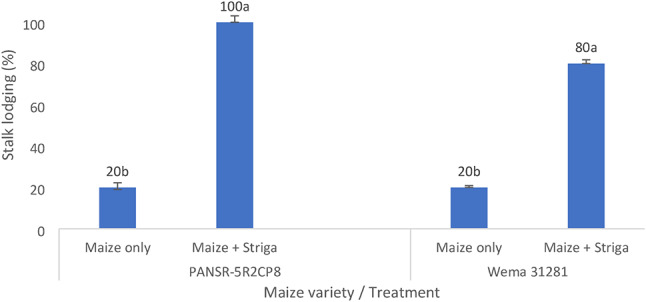
Severity of Striga infestation in the maize varieties evaluated in vitro
The in-vitro evaluation of the shoot and root growth of maize (PANSR-5R2CP8) treated with the screened bioinoculants with and without Striga treatments showed that without Striga, isolates A9, B7, and B3 had the longest shoots compared to the control (Table 2. Whereas, under Striga stress, isolates B4 (30.55 cm), B3 (26.75 cm), and NWUAB 12 (26.60 cm) showed significant shoot growth. Root length was highest in B3 (12.90 cm) treated without Striga and B1 (14.05 cm) with Striga. Isolate B3 without Striga treatment recorded the highest shoot biomass (0.47 g) while NWUAB 12 (0.57 g) and B2 (0.50 g) showed a more significant result under Striga stress conditions. The root biomass was highest in A16 (0.78 g) and B4 (0.71 g) while the untreated plants (control) had the least stalk lodging severity (10–20%). The highest severity (100%) was recorded in only Striga-infested maize treatment and the A9, B1, and A16 inoculated plants. However, NWUAB 12 (30%) exhibited reduced Striga infestation, followed by B2, B3, B4 and B7 (Table 2).
Table 2.
In-vitro evaluation of the bioinoculants potentials towards controlling Striga infestation in maize
| Treatments | Organisms | Shoot length (cm) | Root length (cm) | Shoot weight (g) | Root weight (g) | Stalk lodging (%) |
|---|---|---|---|---|---|---|
| Bacteria without Striga | A9 | 24.15a + 1.76 | 10.00ab + 1.54 | 0.21a + 0.05 | 0.64a + 0.07 | 60a + 9.95 |
| A16 | 19.90ab + 2.10 | 10.35ab + 1.00 | 0.22a + 0.02 | 0.68a + 0.09 | 40ab + 6.26 | |
| B1 | 15.10b + 1.60 | 7.45ab + 1.28 | 0.27a + 0.03 | 0.46ab + 0.08 | 60a + 11.29 | |
| B2 | 21.80ab + 1.59 | 6.80ab + 0.76 | 0.31a + 0.03 | 0.46ab + 0.06 | 30ab + 5.90 | |
| B3 | 22.75ab + 1.72 | 12.90a + 0.79 | 0.47a + 0.04 | 0.55ab + 0.09 | 30ab + 7.07 | |
| B4 | 21.85ab + 1.60 | 6.25ab + 0.81 | 0.44a + 0.04 | 0.31ab + 0.08 | 20ab + 3.27 | |
| B6 | 19.60ab + 1.38 | 5.75b + 0.88 | 0.22a + 0.05 | 0.48ab + 0.04 | 20ab + 3.65 | |
| B7 | 24.75a + 0.74 | 6.05ab + 0.54 | 0.25a + 0.08 | 0.64a + 0.06 | 40ab + 7.59 | |
| NWUAB 01 | 19.75ab + 4.10 | 7.60ab + 0.80 | 0.26a + 0.07 | 0.52ab + 0.09 | 40ab + 5.26 | |
| NWUAB 06 | 20.40ab + 1.16 | 11.45ab + 0.84 | 0.18a + 0.05 | 0.56ab + 0.07 | 20ab + 3.21 | |
| NWUAB 12 | 16.70ab + 0.88 | 6.65ab + 0.74 | 0.29a + 0.09 | 0.42ab + 0.05 | 20ab + 3.48 | |
| Control | 22.67ab + 0.68 | 8.07ab + 0.81 | 0.28a + 0.05 | 0.56ab + 0.08 | 10b + 2.92 | |
| Striga only | 21.76ab + 0.91 | 9.15ab + 0.76 | 0.26a + 0.06 | 0.51ab + 0.04 | 80a + 8.39 | |
| LSD | 7.70 | 6.10 | 0.46 | 0.26 | 40.99 | |
| Bacteria with Striga | A9 | 25.80ab + 0.82 | 7.80a + 1.00 | 0.16c + 0.07 | 0.55ab + 0.08 | 100a + 8.39 |
| A16 | 23.05abc + 1.02 | 7.35a + 1.52 | 0.45abc + 0.09 | 0.78a + 0.06 | 60abc + 6.24 | |
| B1 | 22.10abc + 1.46 | 14.05a + 1.66 | 0.26abc + 0.04 | 0.59ab + 0.04 | 100a + 7.56 | |
| B2 | 26.65ab + 1.28 | 10.40 a + 0.88 | 0.50ab + 0.06 | 0.72ab + 0.06 | 50bc + 3.48 | |
| B3 | 26.75ab + 0.84 | 10.05 a + 1.28 | 0.31abc + 0.05 | 0.54ab + 0.03 | 50bc + 6.26 | |
| B4 | 30.55a + 1.05 | 6.65a + 1.52 | 0.15c + 0.03 | 0.71ab + 0.06 | 50bc + 5.26 | |
| B6 | 19.00bc + 1.48 | 10.25a + 1.66 | 0.32abc + 0.04 | 0.63ab + 0.05 | 60abc + 7.56 | |
| B7 | 22.45abc + 1.28 | 8.95 a + 0.87 | 0.21bc + 0.06 | 0.53ab + 0.03 | 50bc + 6.27 | |
| NWUAB 01 | 16.95c + 1.10 | 5.75a + 1.04 | 0.81bc + 0.04 | 0.59ab + 0.04 | 60abc + 7.56 | |
| NWUAB 06 | 19.35bc + 1.38 | 7.20a + 1.15 | 0.18bc + 0.05 | 0.42b + 0.03 | 70ab + 4.53 | |
| NWUAB 12 | 26.60ab + 2.05 | 8.40a + 1.33 | 0.57a + 0.03 | 0.47ab + 0.05 | 30bc + 5.00 | |
| Control | 22.67abc + 1.76 | 8.07a + 1.15 | 0.28abc + 0.03 | 0.56ab + 0.04 | 20c + 4.50 | |
| Striga only | 21.80abc + 1.60 | 9.16a + 1.52 | 0.26abc + 0.04 | 0.51ab + 0.02 | 100a + 6.26 | |
| LSD | 7.78 | 8.36 | 0.30 | 0.28 | 41.72 |
Means (+ standard error) with different letters are significantly p ≤ 0.05 different across the column of each treatment class
The evaluation of the performance of the bioinoculants on the growth of maize plants revealed significantly taller plants with NWUAB 12 (49.37 cm) and B7 (46.24 cm) while Isolate B7 produced significantly highest shoot (3.87 g) and root (3.75 g) biomass. Although no significant difference in the mean number of leaves per plant was recorded across the treatments, isolate NWUAB 12 produced the highest leaf length (34.78 cm) while B2 had significant leaf leaf area (38.97 cm²).
On the bioinoculants and Striga-treated maize plants, the treatments comprising the control experiments (untreated maize) (45.61 cm) and maize infected with Striga only (43.50 cm) produced significantly taller plants. The isolate B3 produced the highest shoot biomass (4.15 g) while isolate B2 produced the highest root biomass (3.14 g). The shortest maize plants (34.32 cm) and least root biomass (1.41 g) were recorded in pots treated with NWUAB 12 isolate (Table 3).
Table 3.
Screen house evaluation of the bioinoculants potentials in Striga infested in maize
| Treatments | Organisms | Plant height (cm) | Leaf number | Leaf length (cm) | Leaf width (cm) | Leaf Area (cm2) | Shoot weight (g) | Root weight (g) |
|---|---|---|---|---|---|---|---|---|
| Bacteria without Striga | B2 | 35.13b + 1.71 | 4.67a + 0.17 | 25.46b + 1.47 | 2.02bc + 0.11 | 38.97bc + 3.55 | 1.51b + 0.76 | 1.62b + 0.81 |
| B3 | 34.13b + 2.83 | 4.67a + 0.17 | 25.52b + 2.23 | 1.78c + 0.14 | 35.75bc + 5.71 | 1.63b + 0.83 | 2.05b + 1.03 | |
| B4 | 43.73a + 3.40 | 5.33a + 0.37 | 30.51ab + 2.57 | 2.30ab + 025 | 56.15ab + 10.05 | 3.81a + 1.91 | 2.63a + 1.32 | |
| B7 | 46.24a + 3.60 | 5.22a + 0.14 | 30.80ab + 2.38 | 2.42a + 0.19 | 57.50a + 7.32 | 3.87a + 1.94 | 3.75a + 1.88 | |
| NWUAB 12 | 49.37a + 4.57 | 5.22a + 0.28 | 34.78a + 3.65 | 1.97bc + 0.91 | 53.96ab + 4.11 | 3.54a + 1.77 | 2.45b + 1.23 | |
| Striga only | 43.50a + 3.47 | 5.00a + 0.41 | 32.31a + 4.26 | 2.39a + 0.22 | 57.92a + 13.55 | 3.37a + 1.82 | 1.41b + 0.75 | |
| Control | 45.61a + 4.67 | 5.22a + 0.28 | 31.78a + 3.65 | 2.26ab + 0.19 | 57.71a + 10.98 | 3.87a + 1.95 | 1.82b + 0.91 | |
| LSD | 5.81 | 6.03 | 5.45 | 0.31 | 15.52 | 1.67 | 1.14 | |
| Bacteria with Striga | B2 | 36.03bc + 2.93 | 5.56a + 0.41 | 26.46ab + 2.50 | 2.14ab + 0.20 | 45.02ab + 7.13 | 2.76ab + 1.38 | 3.14a + 1.58 |
| B3 | 39.49abc + 4.35 | 5.22a + 0.28 | 29.48ab + 3.47 | 2.39a + 0.26 | 57.48ab + 11.87 | 4.15a + 2.19 | 2.97ab + 1.52 | |
| B4 | 36.14bc + 4.66 | 5.33a + 0.44 | 27.44ab+ | 2.21ab | 51.77ab | 2.19ab | 2.03abc | |
| B7 | 40.10abc + 4.87 | 4.89a + 0.20 | 27.53ab + 3.48 | 1.86ab + 0.22 | 42.74ab + 9.17 | 2.20ab + 1.11 | 2.02abc + 1.04 | |
| NWUAB 12 | 34.32c + 3.29 | 5.00a + 0.24 | 24.86b + 2.77 | 2.01ab + 0.18 | 39.87b + 6.70 | 2.01b + 1.01 | 1.41c + 0.72 | |
| Striga only | 43.50ab + 5.22 | 5.00a + 0.41 | 32.31a + 4.26 | 2.39a + 0.22 | 57.92a + 13.55 | 3.37ab + 1.82 | 1.41c + 0.75 | |
| Control | 45.61a + 4.67 | 5.22a + 0.28 | 31.78a + 3.65 | 2.26ab + 0.19 | 57.71ab + 10.98 | 3.87ab + 1.95 | 1.82c + 0.91 | |
| LSD | 7.25 | 6.00 | 5.72 | 0.40 | 18.15 | 1.74 | 1.11 |
Means (+ Standard error) with different alphabet are significantly p ≤ 0.05 different across the column of each treatment class
Isolate B2 (8.80%) and B3 (2.22%) recorded lower stalk lodging severity compared to the control (11.11%), which recorded a similar level of severity to NWUAB 12 (11.11%). However, the evaluation of stalk lodging in the bioinoculants and Striga treatments showed that all the bioinoculants significantly suppressed the stalk lodging severity with isolate B3 (8.89%) producing the lowest stalk lodging severity than the control. In contrast, Striga-infected maize treatments (42.86%) recorded the highest severity (Fig. 2).
Fig. 2.

Percentage severity of Striga infestation in bioinoculants treated and untreated maize plants, evaluated in vivo
B2 = Enterobacter asburiae OR044418, B3 = Enterobacter chengduensis OR044419, B4 = Priestia aryabhattai OR044420, B7 = Priestia megaterium OR044423, NWUAB 12 = Pseudomonas koreensis MH399240.
PCA 1 accounted for 61.27% of the total variation and distinguishes the treatments based on plant growth performance and disease severity, while PCA 2 explained 22.73% of the total variance and differentiates treatments based on specific traits such as the root and the shoot length. The growth traits of maize, such as both shoot and root, length, and weight, demonstrated a positive relationship to plant health but a negative correlation with disease severity. The treatments B3, NWUAB12, and B7 supported the shoot-related traits, while the combination of B1 + Striga and NWUAB06 showed increased root length and weight parameters. B4 + Striga and NWUAB01 + Striga showed moderate performance and were located between the control and the disease severity, while the control demonstrated optimal plant growth (Fig. 3).
Fig. 3.
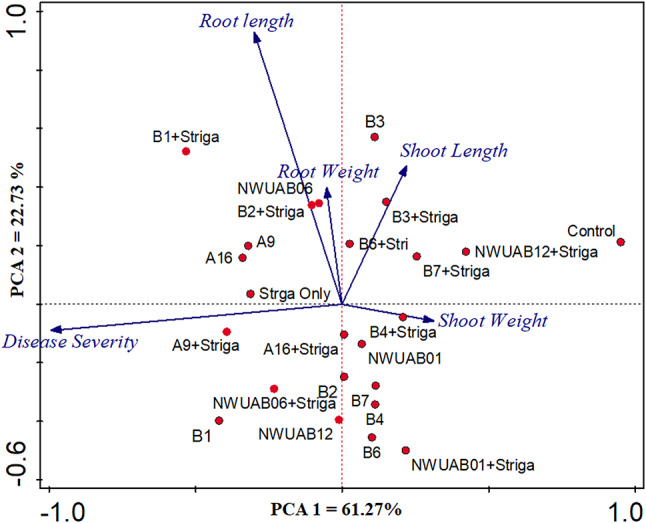
Principal Component Analysis (PCA) of the effects of bioinoculants on Striga in vitro
The PCA biplot shows the relationship between different treatments of inoculants and Striga applications on the growth, biomass, and disease severity caused by Striga. PCA 1 explains 74.62% of the total variation, making it the dominant factor that differentiates treatments, while PCA2 accounted for 20.72%. The treatments without Striga B7, B2, and B3 showed the highest root and shoot weight, while NWUAB12 and B4 treatments (with or without Striga) clustered closer to the control, and had a moderate effect. Furthermore, Striga and inoculant treatments show intermediate positioning, indicating the mitigation of the negative effects of Striga (Fig. 4).
Fig. 4.
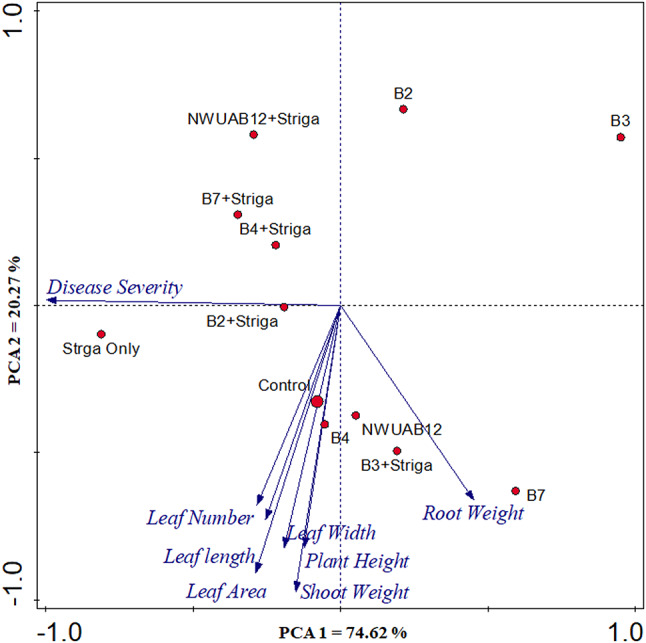
Principal Component Analysis (PCA) of the effects of bioinoculants on Striga under screenhouse
Discussion
Striga hermonthica constitutes a huge threat to food security, especially in Africa, where it infects millions of hectares of arable land, and threatens the production of cereal crops [17, 29]. Most of the earlier methods of managing the menace of these parasitic plants have majorly focused on the cultural, mechanical, and chemical methods, while few studies also explored the biological roles of microbes [30–32]. However, these methods have not sufficiently yielded satisfactory results in curtailing the devastating effect of S. hermontica. Hence, the potency of the bacterial species was investigated in this study. A total of 11 bacterial isolates served as the prospective bioinoculant, among the 63 screened for PGPR and ethylene production, which reveals their prospects of exhibiting plant growth promotion under stress conditions. This was demonstrated in the multi traits potentials of the isolates, such as strong phosphate solubilization, a trait that enhances plant root development, and nutrient acquisition that qualifies the isolates as valuable biofertilizers [33]. The isolates are also excellent producers of siderophore demonstrating their ability to chelate iron, thereby making it more available to plants and as well suppressing the pathogen within the plant rhizosphere. Furthermore, nearly all the screened isolates tested positive for ammonia production, indicating their capacity for improving nitrogen metabolism, its availability for plants’ use, and increasing plant tolerance against abiotic stresses [34]. In addition, the ACC deaminase test is relevant in ethylene regulation and stress reduction through the breaking down of ACC (1-aminocyclopropane-1-carboxylate), which is a precursor of ethylene, indicating the reduction of plant stresses. Also, by the reduction of ethylene stress, ACC deaminase promotes root elongation and biomass accumulation, a property that enhances the potential of maize plants to access nutrients and water, thereby making the plant more resilient against Striga-induced damage [10]. More so, since Striga’s germination is dependent on sensing the strigolactones produced by the exudates in plant roots, ACC deaminase disrupts this signaling pathway, thereby limiting the germination of Striga seeds and their attachment to maize roots. All the 11 screened bacterial isolates possess high levels of ethylene (C2H4) production, which is especially important in suppressing the strigolactones production in host plants, and exposing the resident Striga seeds to ethylene to induce premature Striga seed germination under non-favorable conditions, thereby leading to suicidal germination [35–37].
The high severity of stalk lodging recorded in the maize varieties PANSR-5R2CP8 and Wema 31,281 treated with seeds of S. hermonthica under in vitro conditions validates the report of Kim, Adetimirin [38] on the susceptibility of some maize varieties to the stalk lodging disease caused by Striga, the condition that causes deprivation of water and nutrient to the host. Also, the occurrence of symptoms in the Striga treated maize compared to the non-treated affirms Striga’s infectivity [11]. This was demonstrated in the study of Irafasha, Mutinda [39] that germination in Striga–host interactions is highly variable as the perception of strigolactones initiates the germination process, resulting in varying germination rates, as sorghum genotypes carrying a mutation in the lgs1 locus, such as SRN39, produce the weaker germination stimulant orobanchol, whereas those with the functional LGS1 allele synthesize the more potent inducer, 5-deoxystrigol. Furthermore, in-vitro evaluation of the bioinoculants’ potentials towards controlling Striga infestation in maize revealed isolates B3 (E. chengduensis), B4 (P. aryabhattai), NWUAB 12 (P. koreensis), and B7 (P. megaterium) demonstrated strong potential in mitigating Striga stress through their promotion of plant growths and reduction in the stalk lodging severity, while NWUAB 12 (P. koreensis) appear the most promising considering its balance between growth promotion and disease suppression. This observation is consistent with some earlier reports of Mounde, Boh [40], who enumerated the prospects of bacterial as bioinoculants in suppressing the influence of Striga in sorghum.
The in-vivo evaluation of the five isolates under the screenhouse condition revealed varying traits of the bioinoculants, as B2 (E. asburiae) and B3 (E. chengduensis) were found to enhance the plants’ shoot and root biomass under Striga stress, while the five bioinoculants; B2 = E. asburiae (OR044418), B3 = E. chengduensis (OR044419), P. aryabhattai (OR044420), B7 = P. megaterium (OR044423), NWUAB 12 = P. koreensis (MH399240) effectively suppressed the stalk better than that of the Striga treatment alone (42.86%), however, isolate B3 (8.89%) showed the most effectiveness in suppressing the influence of Striga. These results could be ascribed to the high ethylene contents that is present in the screened isolates since hormonal interference suppressed the growth and successful attachment of Striga to the host plants. Hormones such as abscisic acid and auxin have been reported to repress Striga germination, while brassinosteroid, jasmonic acid and ethylene were reported to promote germination [39]. Whereas, ethylene has been reported as an alternative germination stimulant that mimics strigolactone signalling [41], and some rhizobacteria with PGPR properties have shown to either synthesize ethylene or modulate ethylene biosynthesis in plants [42]. Hence, Striga seeds may undergo premature germination when exposed to ethylene but would die off in the absence of the host root to establish attachment [43]. However, in the presence of the ethylene-producing bacteria when Striga haustoria attaches successfully to the host root, studies have reported that the ethylene producing bacteria could interfere with the vascular connectivity, and the possibility of abortive germination or programmed cell death (PCD) is dependent on some factors which include the ethylene levels, host plant responses and the physiological state of the parasite [44–46]. The findings from PCA of both in vitro and in vivo experiments in this research also validate the results that the inoculants such as B3 (E. chengduensis), NWUAB12 (P. koreensis), and B7 (P. megaterium) effectively enhance both root and shoot growth in maize, while B1 + Striga, NWUAB06 improved root resilience under Striga stress. However, the best-performing inoculants for mitigating Striga effects appear to be B7 (P. megaterium) and B2 (E. asburiae), as they are positioned closer to growth traits and farther from disease severity. The results further substantiate the efficacy of some bacteria species in mitigating Striga seed development towards its efficient management [17].
In conclusion, this research demonstrated that bacterial bioinoculants hold great potential for the control of Striga infestation. Among the inoculants tested, B3 (E. chengduensis), NWUAB12 (P. koreensis), and B7 (P. megaterium) displayed the ability to improve maize growth while minimizing Striga-induced damage, isolate B3 has the most effective Striga suppression potential. This finding, therefore, provides the bedrock for further investigations towards a sustainable improvement in food security in Striga-prone regions.
Supplementary Information
Below is the link to the electronic supplementary material.
Acknowledgements
OOB recognizes the National Research Foundation (NRF South Africa) for grants (UID123634 and UID132595) that support this research.
Author contributions
OOB conceived the study concept. AOA and ASA conducted the experiments and prepared the initial manuscript draft. OOB, FRK, and JJOO supervised the research, reviewed the manuscript, and provided the necessary resources. All authors have carefully reviewed the final manuscript and approved it for publication.
Funding
OOB recognizes the National Research Foundation (NRF South Africa) for grants (UID123634 and UID132595) that support this research.
Data availability
The sequences used are available in the NCBI Genebank repository with the following accession details; B2 = Enterobacter asburiae OR044418, https://www.ncbi.nlm.nih.gov/nuccore/OR044418 B3 = Enterobacter chengduensis OR044419, https://www.ncbi.nlm.nih.gov/nuccore/OR044419 B4= Priestia aryabhattai OR044420, https://www.ncbi.nlm.nih.gov/nuccore/OR044420 B7 = Priestia megaterium OR044423, https://www.ncbi.nlm.nih.gov/nuccore/OR044423 NWUAB 12 = Pseudomonas koreensis MH399240; https://www.ncbi.nlm.nih.gov/nuccore/MH399240.
Declarations
Ethics consent to participate
Not applicable.
Consent to Publish
Not applicable.
Competing interests
The authors declare no competing interests.
Footnotes
Publisher’s note
Springer Nature remains neutral with regard to jurisdictional claims in published maps and institutional affiliations.
Change history
9/15/2025
The affiliation 2 of the published version was updated to Department of Life Sciences, Imperial College London, Silwood Park Campus, Buckhurst Road, Ascot, Berkshire, SL5 7PY, UK.
References
- 1.Mohamed KI, Musselman LJ, Riches CR. The genus striga (scrophulariaceae) in Africa. Ann Mo Bot Gard. 2001:60–103.
- 2.Osman NY, Hamdani MS, Oslan SN, Zulperi DM, Saidi NB. Biological control strategies of purple witchweed, striga hermonthica: A review. Pertanika J Trop Agric Sci. 2023;46(1):177–95. [Google Scholar]
- 3.Babalola OO, Olowe OM, Ayangbenro AS. Shotgun metagenomics dataset of striga hermonthica-infested maize (Zea Mays L.) rhizospheric soil Microbiome. Data Brief. 2023;48:109132. [DOI] [PMC free article] [PubMed] [Google Scholar]
- 4.Chidawanyika F, Muriithi B, Niassy S, Ouya FO, Pittchar JO, Kassie M, et al. Sustainable intensification of vegetable production using the cereal ‘push-pull technology’: benefits and one health implications. Environ Sustain. 2023;6(1):25–34. [Google Scholar]
- 5.Makaza W, En-nahli Y, Amri M. Harnessing plant resistance against striga spp. Parasitism in major cereal crops for enhanced crop production and food security in Sub-Saharan africa: a review. Food Secur. 2023:1–23.
- 6.Ejeta G. Breeding for striga resistance in sorghum: exploitation of an intricate host–parasite biology. Crop Sci. 2007;47:S–216. [Google Scholar]
- 7.Olowe OM, Ayangbenro AS, Akanmu AO, Kutu FR, Odhiambo JJ, Babalola OO. Comparative insights into the microbial diversity and community structure of striga hermonthica-Infested maize rhizosphere. Appl Sci. 2023;13(5):3260. [Google Scholar]
- 8.Degebasa L, Tessema T, Bekeko Z, Belete K. Prevalence and socioeconomic impact of striga (Striga hermonthica) in sorghum producing areas of East and West Hararghe zones, oromia, Ethiopia. Int J Agron. 2022;2022:8402280. [Google Scholar]
- 9.Teka HB. Advance research on striga control: A review. Afr J Plant Sci. 2014;8(11):492–506. [Google Scholar]
- 10.David OG, Ayangbenro AS, Odhiambo JJ, Babalola OO. Striga hermonthica: A highly destructive pathogen in maize production. Environ Challenges. 2022:100590.
- 11.Mwangangi IM, Büchi L, Haefele SM, Bastiaans L, Runo S, Rodenburg J. Combining host plant defence with targeted nutrition: key to durable control of hemiparasitic striga in cereals in sub-Saharan africa?? New Phytol. 2021;230(6):2164–78. [DOI] [PubMed] [Google Scholar]
- 12.Huizinga S, Bouwmeester HJ. Role of Strigolactones in the Host-Specificity of broomrapes and witchweeds. Plant Cell Physiol. 2023:pcad058.
- 13.Dembélé B, Dembélé D, Westwood JH. Herbicide seed treatments for control of purple Witchweed (Striga hermonthica) in sorghum and millet. Weed Technol. 2005;19(3):629–35. [Google Scholar]
- 14.Tuinstra MR, Soumana S, Al-Khatib K, Kapran I, Toure A, van Ast A, et al. Efficacy of herbicide seed treatments for controlling striga infestation of sorghum. Crop Sci. 2009;49(3):923–9. [Google Scholar]
- 15.Chikoye D, Lum AF, Menkir A. Witchweed [Striga hermonthica (Del.) Benth] control using imazapyr seed coating in maize hybrids in the Nigerian savannah. Can J Plant Sci. 2020;100(4):392–400. [Google Scholar]
- 16.de Souza Pereira F, Teixeira IR, Pelá A, dos Reis EF, da Silva GC, Timossi PC, et al. Agronomic performance of kidney bean and castor bean cultivars in intercropping and monocropping systems under weed competition. Aust J Crop Sci. 2015;9(7):614–20. [Google Scholar]
- 17.Babalola O, Berner D, Amusa N. Evaluation of some bacterial isolates as germination stimulants of striga Hermonthica. Afr J Agric Res. 2007;2(1):27–30. [Google Scholar]
- 18.Babalola OO. Beneficial bacteria of agricultural importance. Biotechnol Lett. 2010;32:1559–70. [DOI] [PubMed] [Google Scholar]
- 19.Babalola OO, Odhiambo GD. Effect of inoculation with Klebsiella Oxytoca ‘10 Mkr 7’on striga suicidal germination in Zea Mays. World Appl Sci J. 2008;3(1):57–62. [Google Scholar]
- 20.Islam MR, Madhaiyan M, Deka Boruah HP, Yim W, Lee G, Saravanan V, et al. Characterization of plant growth-promoting traits of free-living diazotrophic bacteria and their inoculation effects on growth and nitrogen uptake of crop plants. J Microbiol Biotechnol. 2009;19(10):1213–22. [DOI] [PubMed] [Google Scholar]
- 21.Schwyn B, Neilands J. Universal chemical assay for the detection and determination of siderophores. Anal Biochem. 1987;160(1):47–56. [DOI] [PubMed] [Google Scholar]
- 22.Ali SZ, Sandhya V, Venkateswar Rao L. Isolation and characterization of drought-tolerant ACC deaminase and exopolysaccharide-producing fluorescent Pseudomonas Sp. Ann Microbiol. 2014;64(2):493–502. [Google Scholar]
- 23.Dworkin M, Foster J. Experiments with some microorganisms which utilize Ethane and hydrogen. J Bacteriol. 1958;75(5):592–603. [DOI] [PMC free article] [PubMed] [Google Scholar]
- 24.Penrose DM, Glick BR. Methods for isolating and characterizing ACC deaminase-containing plant growth‐promoting rhizobacteria. Physiol Plant. 2003;118(1):10–5. [DOI] [PubMed] [Google Scholar]
- 25.Mbuvi DA, Masiga CW, Kuria E, Masanga J, Wamalwa M, Mohamed A, et al. Novel sources of Witchweed (Striga) resistance from wild sorghum accessions. Front Plant Sci. 2017;8:116. [DOI] [PMC free article] [PubMed] [Google Scholar]
- 26.Chai YN, Futrell S, Schachtman DP. Assessment of bacterial inoculant delivery methods for cereal crops. Front Microbiol. 2022;13:791110. [DOI] [PMC free article] [PubMed] [Google Scholar]
- 27.Kim SK, Adetimirin VO. Responses of tolerant and susceptible maize varieties to timing and rate of nitrogen under striga Hermonthica infestation. Agron J. 1997;89(1):38–44. [Google Scholar]
- 28.Kim S, Akintunde A, Walker P. Responses of maize, sorghum and millet host plants to infestation by striga Hermonthica. Crop Prot. 1994;13(8):582–90. [Google Scholar]
- 29.Kim SK. Genetics of maize tolerance of striga Hermonthica. Crop Sci. 1994;34(4):900–7. [Google Scholar]
- 30.Sibhatu B. Review on striga weed management. Int J Life-Sciences Sci Res. 2016;2(2):110–20. [Google Scholar]
- 31.Gressel J, Meir S, Herschkovitz Y, Al-Ahmad H, Babalola O, Amsellem Z. Transgenic biocontrol agents to overcome evolutionary barriers. Integrating new technologies for striga control: towards ending the Witch-Hunt. World Scientific; 2007. pp. 313–23.
- 32.Babalola OO. Exogenous cellulase contributes to mycoherbicidal activity of fusarium arthrosporioides on Orobanche aegyptiaca. Int J Agron. 2010;2010(1):963259. [Google Scholar]
- 33.Akanmu AO, Babalola OO. Characterization and biocontrol potential of some rhizobacteria against fungal pathogens causing foliar diseases in maize. Stud Univ Babes-Bolyai Biol. 2024;69(1):183–203. [Google Scholar]
- 34.Babalola OO, Emmanuel OC, Adeleke BS, Odelade KA, Nwachukwu BC, Ayiti OE, et al. Rhizosphere microbiome cooperations: strategies for sustainable crop production. Curr Microbiol. 2021;78(4):1069–85. [DOI] [PubMed] [Google Scholar]
- 35.Olowe OM, Akanmu AO, Ayangbenro AS, Fadiji AE, Bitire TD, Odhiambo JJ, et al. Trenchant microbiological-based approach for the control of striga: current practices and future prospects. Front Sustainable Food Syst. 2023;7:1073339. [Google Scholar]
- 36.Babalola OO, Osir EO, Sanni AI. Characterization of potential ethylene-producing rhizosphere bacteria of Striga-infested maize and sorghum. Afr J Biotechnol. 2002;1(2):67–9.
- 37.Babalola OO, Sanni AI, Odhiambo GD, Torto B. Plant growth-promoting rhizobacteria do not pose any deleterious effect on cowpea and detectable amounts of ethylene are produced. World J Microbiol Biotechnol. 2007;23:747–52. [Google Scholar]
- 38.Kim S, Adetimirin V, The C, Dossou R. Yield losses in maize due to striga Hermonthica in West and central Africa. Int J Pest Manage. 2002;48(3):211–7. [Google Scholar]
- 39.Irafasha G, Mutinda S, Mobegi F, Hale B, Omwenga G, Wijeratne AJ, et al. Transcriptome atlas of striga germination: implications for managing an intractable parasitic plant. Plants People Planet. 2023;7:396–410. [Google Scholar]
- 40.Mounde LG, Boh MY, Cotter M, Rasche F. Potential of rhizobacteria for promoting sorghum growth and suppressing Striga hermonthica development. J Plant Dis Prot. 2015;122:100–6.
- 41.Villedieu-Percheron E, Lachia M, Jung PM, Screpanti C, Fonné-Pfister R, Wendeborn S, et al. Chemicals inducing seed germination and early seedling development. Chimia. 2014;68(9):654. [DOI] [PubMed] [Google Scholar]
- 42.Gamalero E, Glick BR. Bacterial modulation of plant ethylene levels. Plant Physiol. 2015;169(1):13–22. [DOI] [PMC free article] [PubMed] [Google Scholar]
- 43.Berner D, Winslow M, Awad A, Cardwell K, Raj DM, Kim S. Striga research methods. Manual, the Pan-African striga control network (PASCON) and the international Institute. Trop Agric. 1997;64(22):13–20. [Google Scholar]
- 44.Masteling R, Tsega U, Tessema T, Dini-Andreote F. Controlling striga Hermonthica by precursor-directed activation of microbial volatile production: from in vitro to greenhouse bioassays. Leiden Uni Ersit. 2023:113.
- 45.Fernández-Aparicio M, Reboud X, Gibot-Leclerc S. Broomrape weeds. Underground mechanisms of parasitism and associated strategies for their control: a review. Front Plant Sci. 2016;7:135. [DOI] [PMC free article] [PubMed] [Google Scholar]
- 46.Hoeberichts FA, Woltering EJ. Multiple mediators of plant programmed cell death: interplay of conserved cell death mechanisms and plant-specific regulators. BioEssays. 2003;25(1):47–57. [DOI] [PubMed] [Google Scholar]
Associated Data
This section collects any data citations, data availability statements, or supplementary materials included in this article.
Supplementary Materials
Data Availability Statement
The sequences used are available in the NCBI Genebank repository with the following accession details; B2 = Enterobacter asburiae OR044418, https://www.ncbi.nlm.nih.gov/nuccore/OR044418 B3 = Enterobacter chengduensis OR044419, https://www.ncbi.nlm.nih.gov/nuccore/OR044419 B4= Priestia aryabhattai OR044420, https://www.ncbi.nlm.nih.gov/nuccore/OR044420 B7 = Priestia megaterium OR044423, https://www.ncbi.nlm.nih.gov/nuccore/OR044423 NWUAB 12 = Pseudomonas koreensis MH399240; https://www.ncbi.nlm.nih.gov/nuccore/MH399240.