


Abstract
Background
Alcohol abuse and dependence represents a serious health problem worldwide with social, interpersonal and legal interpolations. Benzodiazepines have been widely used for the treatment of alcohol withdrawal symptoms. Moreover it is unknown whether different benzodiazepines and different regimens of administration may have the same merits.
Objectives
To evaluate the effectiveness and safety of benzodiazepines in the treatment of alcohol withdrawal.
Search methods
Cochrane Drugs and Alcohol Group' Register of Trials (December 2009), PubMed, EMBASE, CINAHL (January 1966 to December 2009), EconLIT (1969 to December 2009). Parallel searches on web sites of health technology assessment and related agencies, and their databases.
Selection criteria
Randomized controlled trials examining effectiveness, safety and risk‐benefit of benzodiazepines in comparison with placebo or other pharmacological treatment and between themselves. All patients were included regardless of age, gender, nationality, and outpatient or inpatient therapy.
Data collection and analysis
Two authors independently screened and extracted data from studies.
Main results
Sixty four studies, 4309 participants, met the inclusion criteria.
‐ Comparing benzodiazepines versus placebo, benzodiazepines performed better for seizures, 3 studies, 324 participants, RR 0.16 (0.04 to 0.69), no statistically significant difference for the other outcomes considered.
‐ Comparing benzodiazepines versus other drugs, there is a trend in favour of benzodiazepines for seizure and delirium control, severe life threatening side effect, dropouts, dropouts due to side effects and patient's global assessment score. A trend in favour of control group was observed for CIWA‐Ar scores at 48 hours and at the end of treatment. The results reach statistical significance only in one study, with 61 participants, results on Hamilton anxiety rating scale favour control MD ‐1.60 (‐2.59 to ‐0.61)
‐ Comparing different benzodiazepines among themselves,results never reached statistical significance but chlordiazepoxide performed better
‐ Comparing benzodiazepine plus other drug versus other drug, results never reached statistical significance.
‐ In the comparison of fixed‐schedule versus symptom‐triggered regimens, results from a single study, with 159 participants, favour symptom‐triggered regimens MD ‐1.10 [‐3.27, 1.07] for CIWA‐Ar scores at the end of treatment. Differences in isolated trials should be interpreted very cautiously.
Authors' conclusions
Benzodiazepines showed a protective benefit against alcohol withdrawal symptoms, in particular seizures, when compared to placebo and a potentially protective benefit for many outcomes when compared with other drugs. Nevertheless, no definite conclusions about the effectiveness and safety of benzodiazepines was possible, because of the heterogeneity of the trials both in interventions and the assessment of outcomes.
Keywords: Humans, Alcohol Withdrawal Delirium, Alcohol Withdrawal Delirium/drug therapy, Alcohol Withdrawal Seizures, Alcohol Withdrawal Seizures/drug therapy, Benzodiazepines, Benzodiazepines/therapeutic use, Randomized Controlled Trials as Topic
Plain language summary
Benzodiazepines for alcohol withdrawal
Benzodiazepines are more effective than placebo against alcohol withdrawal seizures while they have variable profile against other commonly used treatments
This Cochrane review summarizes evidence from sixty‐four randomised controlled trials evaluating the effectiveness and safety of benzodiazepines in the treatment of alcohol withdrawal symptoms. The available data show that benzodiazepines are effective against alcohol withdrawal seizures when compared to placebo and a potentially protective benefit for many outcomes when compared with other drugs. Data on safety outcomes are sparse and fragmented.
Summary of findings
Summary of findings for the main comparison. Benzodiazepine versus Placebo for alcohol withdrawal.
| Benzodiazepine versus Placebo for alcohol withdrawal | ||||||
| Patient or population: patients with alcohol withdrawal Settings: Intervention: Benzodiazepine versus Placebo | ||||||
| Outcomes | Illustrative comparative risks* (95% CI) | Relative effect (95% CI) | No of Participants (studies) | Quality of the evidence (GRADE) | Comments | |
| Assumed risk | Corresponding risk | |||||
| Control | Benzodiazepine versus Placebo | |||||
| Alcohol withdrawal seizures objective | Study population | RR 0.16 (0.04 to 0.69) | 324 (3 studies) | ⊕⊕⊕⊝ moderate1 | ||
| 80 per 1000 | 13 per 1000 (3 to 55) | |||||
| Medium risk population | ||||||
| 69 per 1000 | 11 per 1000 (3 to 48) | |||||
| Adverse events | Study population | RR 3.28 (0.31 to 34.52) | 71 (2 studies) | ⊕⊕⊝⊝ low2,3 | ||
| 28 per 1000 | 92 per 1000 (9 to 967) | |||||
| Medium risk population | ||||||
| 46 per 1000 | 151 per 1000 (14 to 1000) | |||||
| Dropouts | Study population | RR 0.68 (0.38 to 1.24) | 312 (3 studies) | ⊕⊕⊕⊝ moderate1 | ||
| 162 per 1000 | 110 per 1000 (62 to 201) | |||||
| Medium risk population | ||||||
| 167 per 1000 | 114 per 1000 (63 to 207) | |||||
| *The basis for the assumed risk (e.g. the median control group risk across studies) is provided in footnotes. The corresponding risk (and its 95% confidence interval) is based on the assumed risk in the comparison group and the relative effect of the intervention (and its 95% CI). CI: Confidence interval; RR: Risk ratio; | ||||||
| GRADE Working Group grades of evidence High quality: Further research is very unlikely to change our confidence in the estimate of effect. Moderate quality: Further research is likely to have an important impact on our confidence in the estimate of effect and may change the estimate. Low quality: Further research is very likely to have an important impact on our confidence in the estimate of effect and is likely to change the estimate. Very low quality: We are very uncertain about the estimate. | ||||||
1 Allocation concealment unclear for 2/3 studies 2 only two studies, limited number of participants 3 Large confidence interval
Summary of findings 2. Benzodiazepine versus Other Drug for.
| Benzodiazepine versus Other Drug for | ||||||
| Patient or population: patients with Settings: Intervention: Benzodiazepine versus Other Drug | ||||||
| Outcomes | Illustrative comparative risks* (95% CI) | Relative effect (95% CI) | No of Participants (studies) | Quality of the evidence (GRADE) | Comments | |
| Assumed risk | Corresponding risk | |||||
| Control | Benzodiazepine versus Other Drug | |||||
| Alcohol withdrawal seizures ‐ Benzodiazepine vs. Other Drug | Study population | RR 0.52 (0.21 to 1.31) | 1228 (12 studies) | ⊕⊕⊕⊝ moderate1 | ||
| 47 per 1000 | 24 per 1000 (10 to 62) | |||||
| Medium risk population | ||||||
| 18 per 1000 | 9 per 1000 (4 to 24) | |||||
| Alcohol withdrawal seizures ‐ Benzodiazepine vs. Anticonvulsant | Study population | RR 1.7 (0.39 to 7.37) | 523 (7 studies) | ⊕⊕⊕⊝ moderate2 | ||
| 7 per 1000 | 12 per 1000 (3 to 52) | |||||
| Medium risk population | ||||||
| 0 per 1000 | 0 per 1000 (0 to 0) | |||||
| Adverse events ‐ Benzodiazepine vs. Other Drug | Study population | RR 1.31 (0.99 to 1.72) | 919 (18 studies) | ⊕⊕⊝⊝ low3 | ||
| 140 per 1000 | 183 per 1000 (139 to 241) | |||||
| Medium risk population | ||||||
| 54 per 1000 | 71 per 1000 (53 to 93) | |||||
| Adverse events ‐ Benzodiazepine vs. Anticonvulsant | Study population | RR 1.5 (0.83 to 2.7) | 471 (9 studies) | ⊕⊕⊕⊕ high | ||
| 138 per 1000 | 207 per 1000 (115 to 373) | |||||
| Medium risk population | ||||||
| 111 per 1000 | 167 per 1000 (92 to 300) | |||||
| Dropouts ‐ Benzodiazepine vs. Other Drug | Study population | RR 0.93 (0.7 to 1.24) | 1848 (22 studies) | ⊕⊕⊕⊝ moderate4 | ||
| 117 per 1000 | 109 per 1000 (82 to 145) | |||||
| Medium risk population | ||||||
| 77 per 1000 | 72 per 1000 (54 to 95) | |||||
| Dropouts ‐ Benzodiazepine vs. Anticonvulsant | Study population | RR 1.11 (0.75 to 1.63) | 839 (11 studies) | ⊕⊕⊕⊕ high | ||
| 98 per 1000 | 109 per 1000 (74 to 160) | |||||
| Medium risk population | ||||||
| 102 per 1000 | 113 per 1000 (76 to 166) | |||||
| *The basis for the assumed risk (e.g. the median control group risk across studies) is provided in footnotes. The corresponding risk (and its 95% confidence interval) is based on the assumed risk in the comparison group and the relative effect of the intervention (and its 95% CI). CI: Confidence interval; RR: Risk ratio; | ||||||
| GRADE Working Group grades of evidence High quality: Further research is very unlikely to change our confidence in the estimate of effect. Moderate quality: Further research is likely to have an important impact on our confidence in the estimate of effect and may change the estimate. Low quality: Further research is very likely to have an important impact on our confidence in the estimate of effect and is likely to change the estimate. Very low quality: We are very uncertain about the estimate. | ||||||
1 Allocation concealment adequate only for 3/12 studies 2 large confidence interval 3 Allcation concealment adequate in 6/18 studies 4 Allocation concealment adequate in 7/22 studies
Background
Description of the condition
Alcohol abuse and dependence represents a most serious health problem worldwide with major social, interpersonal and legal interpolations. Dependence on alcohol is associated with both physiological symptoms such as tolerance and withdrawal, and behavioural symptoms such as impaired control over drinking (Hasin 1990). Alcohol withdrawal syndrome is a cluster of symptoms that occurs in alcohol‐dependent people after cessation or reduction in alcohol use that has been heavy or prolonged. The clinical presentation varies from mild to serious and the onset of symptoms typically occurs a few hours after the last alcohol intake. The most common manifestations are tremor, restlessness, insomnia, nightmares, paroxysmal sweats, tachycardia, fever, nausea, vomiting, seizures, hallucinations (auditory, visual, tactile), increased agitation, tremulousness and delirium. These symptoms involve a wide range of neurotransmitter circuits that are implicated in alcohol tolerance and reflect a homeostatic readjustment of the central nervous system (De Witte 2003; Koob 1997; Nutt 1999; Slawecki 1999). Long‐term alcohol consumption affects brain receptors that undergo adaptive changes in an attempt to maintain normal function. Some of the key changes involve reduced brain gamma‐aminobutyric acid (GABA) levels and GABA‐ receptor sensitivity (Dodd 2000; Gilman 1996; Kohl 1998; Petty 1993) and activation of glutamate systems (Tsai 1995), which lead to nervous system hyperactivity in the absence of alcohol. The advances in knowledge of neurobiology and neurochemistry have prompted the use of drugs in the treatment of alcohol dependence and withdrawal that act through these GABA pathways.
Description of the intervention
Benzodiazepines in particular have been widely used for the treatment of alcohol withdrawal symptoms. A meta‐analysis of studies concerning pharmacological therapies of alcohol withdrawal (Mayo‐Smith 1997) has suggested that benzodiazepines are effective in reducing withdrawal severity, incidence of delirium and seizures with a greater margin of safety and lower abuse potential when compared to other therapies. A more recent systematic review (Holbrook 1999) of randomised controlled trials (RCTs) comparing benzodiazepines to placebo or other therapy reached similar conclusions. However a large amount of evidence of benzodiazepine use has been published during the last years and it is important that an up‐to‐date systematic review is performed. Moreover not all patients may need pharmacological treatment and it is unknown whether different benzodiazepines and different regimens of administration (e.g. fixed versus symptom‐triggered schedule) may have the same merits.
How the intervention might work
Benzodiazepines have been shown to be one of the most effective class of drugs in the management of alcohol withdrawal syndrome. The rationale of the use of benzodiazepine is to modulate CNS hyperactivity, interacting with GABA receptors, due to the alcohol withdrawal.
Why it is important to do this review
The purpose of this systematic review was to examine the evidence on the effectiveness and safety of benzodiazepines in the management of alcohol withdrawal. Results of a previous version of a Cochrane Systematic review (Ntais 2005) on benzodiazepines efficacy and safety are not conclusive. New trials have been published and the review needs update.
Area of uncertainty: no conclusive evidence of comparative effectiveness between benzodiazepine and other medications.
This review has a parallel one on anticonvulsants for alcohol withdrawal (Minozzi 2010) and together they are part of a series of reviews and protocols on the efficacy of pharmacological treatment (Acamprosate GHB, nitrous oxide, magnesium) for alcohol withdrawal (Gillman 2007; Leone 2010; Fox 2003; Tejani 2010)
Objectives
The objectives of this systematic review are:
To evaluate the effectiveness of benzodiazepines in the treatment of alcohol withdrawal.
To evaluate the safety (potential arms) of benzodiazepines in the treatment of the alcohol withdrawal symptoms (AWS).
Methods
Criteria for considering studies for this review
Types of studies
Randomized Controlled Trials (RCT) and Controlled Clinical Trials (CCT) evaluating the efficacy, safety and overall risk‐benefit of benzodiazepines for the treatment of alcohol withdrawal.
Types of participants
Alcohol dependent patients diagnosed in accordance with appropriate standardized criteria (e.g., criteria of Diagnostic and Statistical Manual of Mental Disorders (DSM‐IV‐R) or ICD) who experienced alcohol withdrawal symptoms regardless of the severity of the withdrawal manifestations. All patients were included regardless of age, gender, nationality, and outpatient or inpatient therapy. The history of previous treatments was considered, but it was not an eligibility criterion.
Types of interventions
‐Experimental intervention
Benzodiazepines alone or in combination with other drugs
‐ Control Intervention
Placebo; Other pharmacological interventions
‐ Types of comparisons
benzodiazepines versus placebo;
benzodiazepines versus other drug
different benzodiazepines between themselves;
benzodiazepines combined with other drug versus other drug.
Types of outcome measures
Primary outcomes
Efficacy outcomes
Alcohol withdrawal seizures as number of subjects experiencing seizures
Alcohol withdrawal delirium as number of subjects experiencing delirium
Alcohol withdrawal symptoms as measured by prespecified scales(as the CIWA‐Ar score)
Global improvement of overall alcohol withdrawal syndrome as measured in pre‐specified scales ( as number of patients with global improvement, global doctors assessment of efficacy, Patients assessment of efficacy)
Craving as measured by prespecified scales
Safety outcomes
Adverse events as number of subjects experiencing at least one adverse event
Severe, life‐threatening adverse events as measured by number of subjects experiencing severe, life threatening adverse events
Acceptability outcomes
Dropout
Dropout due to adverse events
Secondary outcomes
Additional medication needed
Length of stay in intensive therapy
Mortality
Quality of life
Search methods for identification of studies
Electronic searches
Relevant trials were obtained from the following sources:
Cochrane Drugs and Alcohol Group' Register of Trials (December 2009)
PubMed (January 1966– December 2009)
EMBASE (January 1988– December 2009)
CINAHL (January 1982– December 2009)
EconLIT (1969 to December 2009)
We compiled detailed search strategies for each database searched, for detail see Appendix 1; Appendix 2; Appendix 3; Appendix 4
Searching other resources
We also searched:
the reference lists of all relevant papers to identify further studies.
conference proceedings likely to contain trials relevant to the review.
We contacted investigators seeking information about unpublished or incomplete trials.All searches included non‐English language literature and studies with English abstracts were assessed for inclusion. When considered likely to meet inclusion criteria, studies were translated.
Data collection and analysis
Selection of studies
Two authors independently screened the titles and abstracts of all publications, obtained through the search strategy. All potentially eligible studies were obtained as full articles and two authors independently assessed these for inclusion. In doubtful or controversial cases, all identified discrepancies were discussed and reached consensus on all items.
Data extraction and management
Two authors independently extracted data from published sources, where differences in data extracted occurred this was resolved through discussion. Where required additional information was obtained through collaboration with the original authors.
Assessment of risk of bias in included studies
The risk of bias assessment for RCTs and CCTs in this review was performed using four out of the six criteria recommended by the Cochrane Handbbok (Higgins 2008). The recommended approach for assessing risk of bias in studies included in Cochrane Review is a two‐part tool, addressing four specific domains (namely sequence generation, allocation concealment, blinding, incomplete outcome data). The first part of the tool involves describing what was reported to have happened in the study. The second part of the tool involves assigning a judgement relating to the risk of bias for that entry. This is achieved by answering a pre‐specified question about the adequacy of the study in relation to the entry, such that a judgement of "Yes" indicates low risk of bias, "No" indicates high risk of bias, and "Unclear" indicates unclear or unknown risk of bias. To make these judgments we will use the criteria indicated by the handbook adapted to the addiction field. See Appendix 5 for details.
The domains of sequence generation and allocation concealment (avoidance of selection bias) will be addressed in the tool by a single entry for each study.
Blinding of participants, personnel and outcome assessor (avoidance of performance bias and detection bias) was considered separately for objective outcomes (e.g. drop out, drop out due to adverse events, seizures, delirium, adverse events) and subjective outcomes (e.g. duration and severity of signs and symptoms of withdrawal, craving, psychiatric symptoms; improvements assessed by doctors and patients).
Incomplete outcome data (avoidance of attrition bias) was considered for all outcomes except for the drop out from the treatment, which is very often the primary outcome measure in trials on addiction.
Measures of treatment effect
Dichotomous outcomes were analysed calculating the Relative risk (RR) for each trial with the uncertainty in each result being expressed by their confidence intervals. Continuous outcomes were analysed calculating the MD or the SMD with 95%CI. In case of missing standard deviation of the differences from baseline to the end of treatment, the standard deviation were imputed using the standard deviation of the mean at the end of treatment for each group.
Assessment of heterogeneity
Statistically significant heterogeneity among primary outcome studies will be assessed with Chi‐squared (Q) test and I‐squared (Higgins 2008). A significant Q ( P<.05) and I‐squared of at least 50% will be considered as statistical heterogeneity
Assessment of reporting biases
Funnel plot (plot of the effect estimate from each study against the sample size or effect standard error) was not used to assess the potential for bias related to the size of the trials, because all the included studies had small sample size and not statistically significant results.
Data synthesis
The outcomes from the individual trials have been combined through meta‐analysis where possible (comparability of intervention and outcomes between trials) using a fixed effect model unless there was significant heterogeneity, in which case a random effect model have been used.
If all arms in a multi‐arm trial are to be included in the meta‐analysis and one treatment arm is to be included in more than one of the treatment comparisons, then we divided the number of events and the number of participants in that arm by the number of treatment comparisons made. This method avoid the multiple use of participants in the pooled estimate of treatment effect while retaining information from each arm of the trial. It compromise the precision of the pooled estimate slightly.
Sensitivity analysis
To assess the effect of methodological quality on the results, we first performed a graphical inspection of any effect sorting the results on the forest plots according to risk of bias for sequence generation, allocation concealment, blinding (subjective outcomes) ; if we found a difference in the results between studies at low, unclear, high risk of bias, we performed a sensitivity analysis excluding studies at high risk of bias.
Results
Description of studies
Results of the search
We identified 695 reports from all electronic databases searched excluding duplicate, 603 were excluded on basis of title and abstract; 1 article is awaiting classification because we cannot find the full text, 91 articles were retrieved in full text for more detailed evaluation, 27 of which were excluded, 64 satisfied all the criteria to be included in the review. See Figure 1 to see a flow chart showing identification of studies.
1.

Flow chart of identified studies
Included studies
64 studies met the inclusion criteria, with a total of 4309 participants. For a description of the characteristics of the included studies, See Characteristics of included studies Table
Country of origin of the included studies
26 studies were conducted in Europe, 32 in North America, 3 in Asia, 2 in South Africa and 1 in Australia
Number of studies per type of comparison
Benzodiazepines versus placebo (No. = 11 studies) (Adinoff 1994; Burroughs 1985a; Kaim 1969; Kaim 1972; Krupitsky 2007; Martin 1975; McLendon 1980; Mielke 1976; Naranjo 1983; Sellers 1977; Sellers 1983)
Benzodiazepines versus other drug (No. = 42 studies) (Addolorato 1999; Addolorato 2006; Adinoff 1994; Bailly 1992; Baumgartner 1987; Baumgartner 1991; Borg 1986; Burroughs 1985a; Burroughs 1985b; Choi 2005; Dion 1968; Favre 2005; Funderburk 1978; Gillman 2004; Gillmer 1973; Golbert 1967; Kaim 1969; Kaim 1972; Kalyoncu 1996; Kramp 1978; Krupitsky 2007; Lapierre 1983; Lenzenhuber 1999; Lepola 1984; Longo 2002; Lucht 2003; Malcolm 1989; Malcolm 2002; Malcolm 2007; McGrath 1975; Nava 2007; Overall 1973; Palestine 1976; Pena‐Ramos 1977; Pena‐Ramos 1979; Radouco‐Thomas 1989; Runion 1978; Sellers 1977; Stuppaeck 1992; Tubridy 1988; Worner 1994 ).
Different benzodiazepines between themselves (No.= 18 studies) (Adinoff 1994; Anton 1997; Brown 1972; Day 2004; Jauhar 2000; Kolin 1981;Kumar 2009; Martin 1975; McLendon 1980; Mendels 1985; Mielke 1976; Miller 1984; Mukherjee 1983; O'Brien 1983; Ritson 1986; Saletu 1983; Solomon 1983; Wilson 1985)
Benzodiazepines alone versus benzodiazepines combined with other drug (No. = 3 studies) (Dion 1968; Sellers 1977; Spies 1996)
For a more detailed information about the comparisons considered in the studies, see Addictional Table 3; Table 4; Table 5; Table 6; Table 7; Table 8
1. Comparisons Benzodiazepines versus Placebo.
| Author | Treatment (benzodiazepine) | Control |
| Adinoff 1994 | Diazepam | Placebo |
| Burroughs 1985a | Chlordiazepoxide | Placebo |
| Kaim 1969 | Chlordiazepoxide | Placebo |
| Kaim 1972 | Chlordiazepoxide | Placebo |
| Krupitsky 2007 | Diazepam | Placebo |
| Martin 1975 | Diazepam | Placebo |
| McLendon 1980 | Chlordiazepoxide | Placebo |
| Mielke 1976 | Diazepam | Placebo |
| Naranjo 1983 | Lorazepam | Placebo |
| Sellers 1977 | Chlordiazepoxide | Placebo |
| Sellers 1983 | Diazepam | Placebo |
2. Comparisons Benzodiazepines versus Anticonvulsants.
| Author | Treatment (benzodiazepines) | Control (anticonvulsants) |
| Burroughs 1985a | Chlordiazepoxide | Chlormethiazole |
| Burroughs 1985b | Chlordiazepoxide | Chlormethiazole |
| Dion 1968 | Chlordiazepoxide | Magnesium sulphate |
| Golbert 1967 | Chlordiazepoxide |
Promazine |
| Paraldehyde + Chloral hydrate (sedative) | ||
| Kaim 1972 | Chlordiazepoxide |
Paraldehyde |
| Pentobarbital | ||
| Lapierre 1983 | Chlordiazepoxide | Chlormethiazole |
| Longo 2002 | Chlordiazepoxide | Sodium valproate |
| MC Grath 1975 | Chlordiazepoxide | Chlormethiazole |
| Radouco‐Thomas 1989 | Chlordiazepoxide | Phenobarbital |
| Kalyoncu 1996 | Diazepam | Carbamazepine |
| Kramp 1978 | Diazepam | Barbital |
| Krupitsky 2007 | Diazepam | Topiramate |
| Memantine | ||
| Lamotrigine | ||
| Lucht 2003 | Diazepam | Chlormethiazole |
| Carbamazepine | ||
| Thompson 1975 | Diazepam | Paraldehyde |
| Malcom 2002 | Lorazepam | Carbamazepine |
| Malcom 2007 | Lorazepam | Gabapentin |
| Choi 2005 | Lorazepam | Topiramate |
| Borg 1986 | Oxazepam | Amobarbital |
| Malcom 1989 | Oxazepam | Carbamazepine |
| Stuppaeck 1992 | Oxazepam | Carbamazepine |
| Tubridy 1988 | Alprazolam | Chlormethiazole |
3. Comparison Benzodiazepines versus Antipsychotics.
| Author | Treatment (benzodiazepine) | Control (antipsychotic) |
| Kaim 1969 | Chlordiazepoxide | Chlorpromazine |
| Kaim 1972 | Chlordiazepoxide | Perhenazine |
| Lepola 1984 | Chlordiazepoxide | Tiapride |
| Overall 1973 | Chlordiazepoxide | Mesoridazine |
| Palestine 1976 | Chlordiazepoxide | Haloperidol |
| Pena‐Ramos 1977 | Chlordiazepoxide | Thioridazine |
| Pena‐Ramos 1979 | Chlordiazepoxide | Thioridazine |
| Borg 1986 | Oxazepam | Melperone |
| Favre 2005 | Diazepam | Cyametazine |
4. Comparisons Benzodiazepines versus Miscellanea.
| Author | Treatment (benzodiazepine) | Control |
| Baumgartner 1987 | Chlordiazepoxide | Clonidine (alpha adrenergic) |
| Baumgartner 1991 | Chlordiazepoxide | Clonidine (alpha adrenergic) |
| Burroughs 1985a | Chlordiazepoxide | Bromocriptine (dopamine agonist) |
| Burroughs 1985b | Chlordiazepoxide | Bromocriptine (dopamine agonist) |
| Funderburk 1978 | Chlordiazepoxide |
Ethanol |
| Golbert 1967 | Chlordiazepoxide | Alcohol |
| Kaim 1969 | Chlordiazepoxide |
Hydroxyzine (anxiolytic) |
| Thiamine (vitamin B1) | ||
| Runion 1978 | Chlordiazepoxide | Hydroxyzine (anxiolytic) |
| Sellers 1977 | Chlordiazepoxide | Propranol (beta‐blocking)) |
| Addolorato 1999 | Diazepam | GHB |
| Addolorato 2005 | Diazepam | Baclofen (muscle relaxant) |
| Bailly 1992 | Diazepam | Propranol (beta‐blocking)) |
| Gillman 2004 | Diazepam | Nitrous Oxide |
| Nava 2007 | Diazepam | GHB |
| Worner 1994 | Diazepam | Propranol (beta‐blocking)) |
| Adinoff 1994 | Diazepam | Clonidine (alpha adrenergic) |
| Lenzenhuber 1999 | Flunitrazepam | GHB |
| Ansoms 1991 | Lometazepam | Zopiclone (anxiolytic) |
| Gillmer 1973 | Oxazepam | Benzoctamine (anxiolytic) |
5. Comparisons of different Benzodiazepines.
| Author | Treatment (benzodiazepine 1) | Control (benzodiazepine 2 |
| Brown 1972 | Chlordiazepoxide | Diazepam |
| Day 2004 | Chlordiazepoxide | Diazepam |
| Jauhar 2000 | Chlordiazepoxide | Diazepam |
| Kumar 2009 | Chlordiazepoxide | Lorazepam |
| McLendon 1980 | Chlordiazepoxide | Alprazolam |
| Mendels 1985 | Chlordiazepoxide | Halazepam |
| Mukherjee 1983 | Chlordiazepoxide | Clobazam |
| Solomon 1983 | Chlordiazepoxide | Lorazepam |
| Wilson 1985 | Chlordiazepoxide | Alprazolam |
| Anton 1997 | Diazepam | Abecamil |
| Kolin 1981 | Diazepam | Alprazolam |
| Martin 1975 | Diazepam | Clobazam |
| Mielke 1976 | Diazepam | Clorazepate |
| Miller 1984 | Diazepam | Lorazepam |
| O'Brien 1983 | Diazepam | Lorazepam |
| Ritson 1986 | Diazepam | Lorazepam |
| Adinoff 1994 | Diazepam | Alprazolam |
| Saletu 1983 | Lopirazepam | Prazepam |
6. Comparisons Benzodiazepines alone versus Benzodiazepine plus other drugs.
| Author | Treatment | Control |
| Dion 1968 | Chlordiazepoxide |
Chlordiazepoxide + Magnesium sulphate (anticonvulsant) |
| Sellers 1977 | Chlordiazepoxide | Chlordiazepoxide + Propanol |
| Spies 1996 | Flunitrazepam + haloperidol (antipsychotic) | Flunitrazepam + Clonidine (alpha adrenergic) |
The benzodiazepines considered in the 64 studies included were:Abecamil, Alprazolam, Chlordiazepoxide, Clobazam, Clorazepate, Diazepam, Flunitrazepam, Halazepam, Lometazepam, Lopirazepam, Lorazepam, Oxazepam, Prazepam
Excluded studies
27 studies did not meet the criteria for inclusion in this review. The grounds for exclusion were: type of intervention not in the inclusion criteria: 6 studies; study design not in the inclusion criteria: 12 studies; type of outcomes measures not in the inclusion criteria: 1 study; Type of comparison not in the inclusion criteria : 4 studies; duplicate publication: 3 studies, outcome measures presented in a way not suitable for meta‐analysis: 1 study. See Excluded studies Table
Risk of bias in included studies
All the studies were randomised controlled trials.
Allocation
The sequence generation was adequate in 16 studies, unclear in 43 and inadequate in 5 studies ; the allocation concealment was adequate in 13 studies, unclear in 47 and inadequate in 4 studies;
Blinding
Blinding for subjective outcomes was adequate in 43 studies, it was unclear in 14 and inadequate in 7;
Blinding for objective outcomes was adequate in 52 studies and unclear in 12 studies
Incomplete outcome data
Incomplete outcome data were addressed in 48 studies, it was unclear in 13 studies and were not addressed in 3 studies
See Included studies Table and Figure 2; Figure 3 for a more detailed description of risk of bias across the studies.
2.

Methodological quality graph: review authors' judgements about each methodological quality item presented as percentages across all included studies.
3.

Methodological quality summary: review authors' judgements about each methodological quality item for each included study.
With a graphical inspection of the forest plots sorting studies according to the risk of bias, we didn't find any systematic difference in the results between studies at high risk of bias and studies at low or unclear risk of bias. For that sensitivity analysis excluding studies at high risk of bias was not performed.
Effects of interventions
We only performed meta‐analysis for the studies that had directly comparable interventions and used exactly the same rating scales for continuous outcome measures or had the same binary outcomes. The rest of the data retrieved from the studies (single comparison data) were not synthesized quantitatively. The following results refer to the cases where quantitative synthesis was performed.
The Results are split into four sections referring to the four main comparisons:
Benzodiazepine versus Placebo,
Benzodiazepine versus Other Drug,
Benzodiazepine 1 versus Benzodiazepine 2
Benzodiazepine alone versus Benzodiazepine + Other drug
Benzodiazepines (fixed schedules) versus Benzodiazepines (symptom‐triggered)
The outcomes are categorized as primary efficacy outcomes and secondary efficacy outcomes, according to the protocol. We dived them according to efficacy, safety and acceptability. For a summary of results of some important outcomes see Table 1 and Table 2
Comparison 1 Benzodiazepines versus placebo:
Efficacy
1.1 Alcohol withdrawal seizures
3 studies (Kaim 1969; Naranjo 1983; Sellers 1983), 324 participants, RR 0.16 (0.04 to 0.69), the result is in favour of benzodiazepines; see Analysis 1.1 or Figure 4
1.1. Analysis.

Comparison 1 Benzodiazepine versus Placebo, Outcome 1 Alcohol withdrawal seizures.
4.

Forest plot of comparison: 1 Benzodiazepine versus Placebo, outcome: 1.1 Alcohol withdrawal seizures.
Safety
1.2 Adverse events as number of participants with at least one adverse event
2 studies (Burroughs 1985a; Krupitsky 2007), 71 participants, RR 3.28 (0.31 to 34.52), the result is not statistically significant; see Analysis 1.2 or Figure 5
1.2. Analysis.

Comparison 1 Benzodiazepine versus Placebo, Outcome 2 Adverse events.
5.

Forest plot of comparison: 1 Benzodiazepine versus Placebo, outcome: 1.2 Adverse events.
Acceptability
1.3 Dropout
3 studies (Adinoff 1994; Burroughs 1985a; Kaim 1969), 312 participants, RR 0.68 (0.38 to 1.24), the result is not statistically significant; see Analysis 1.3 or Figure 6
1.3. Analysis.
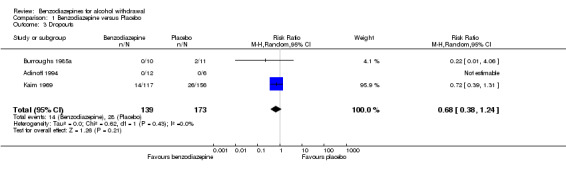
Comparison 1 Benzodiazepine versus Placebo, Outcome 3 Dropouts.
6.

Forest plot of comparison: 1 Benzodiazepine versus Placebo, outcome: 1.3 Dropouts.
1.4 Dropout due to adverse events
2 studies (Burroughs 1985a; McLendon 1980), 86 participants, RR 0.36 (0.02 to 8.03), the result is not statistically significant; see Analysis 1.4
1.4. Analysis.

Comparison 1 Benzodiazepine versus Placebo, Outcome 4 Dropout due to adverse events.
Comparison 2 Benzodiazepines versus Other Drugs:
Efficacy
2.1 Alcohol withdrawal seizures
2.1.1Any Benzodiazepine versus any Other , 12 studies (Bailly 1992; Baumgartner 1991; Borg 1986; Favre 2005; Kaim 1969; Kaim 1972; Kramp 1978; Lucht 2003; Radouco‐Thomas 1989; Stuppaeck 1992; Tubridy 1988; Worner 1994), 1228 participants, RR 0.52 (0.21 to 1.31), the result is not statistically significant, see Analysis 2.1 or Figure 7
2.1. Analysis.

Comparison 2 Benzodiazepine versus Other Drug, Outcome 1 Alcohol withdrawal seizures.
7.

Forest plot of comparison: 2 Benzodiazepine versus Other Drug, outcome: 2.1 Alcohol withdrawal seizures.
2.1.2Any Benzodiazepine versus Anticonvulsants , 7 studies (Borg 1986; Kaim 1972; Kramp 1978; Lucht 2003; Radouco‐Thomas 1989; Stuppaeck 1992; Tubridy 1988), 523 participants, RR 1.70 (0.39 to 7.37), the result is not statistically significant, see Analysis 2.1 or Figure 7
2.2 Alcohol withdrawal delirium
2.2.1Any Benzodiazepine versus any Other, 8 studies (Dion 1968; Favre 2005; Golbert 1967; Kaim 1969; Kalyoncu 1996; Lucht 2003; McGrath 1975; Stuppaeck 1992), 893 participants, RR 0.65 [0.21, 1.98], the result is not statistically significant, see Analysis 2.2 or Figure 8
2.2. Analysis.

Comparison 2 Benzodiazepine versus Other Drug, Outcome 2 Alcohol withdrawal delirium.
8.
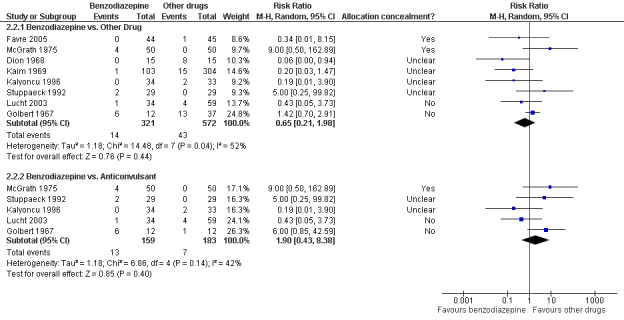
Forest plot of comparison: 2 Benzodiazepine versus Other Drug, outcome: 2.2 Alcohol withdrawal delirium.
2.2.2Any Benzodiazepine versus Anticonvulsants, 5 studies (Golbert 1967; Kalyoncu 1996; Lucht 2003; McGrath 1975; Stuppaeck 1992), 342 participants, RR 1.90 [0.43, 8.38), the result is not statistically significant, see Analysis 2.2 or Figure 8
2.3 CIWA‐Ar score at 48 hours
2.3.1Any Benzodiazepine versus any Other, 5 studies (Addolorato 1999; Baumgartner 1987; Malcolm 1989; Malcolm 2002; Stuppaeck 1992), 355 participants, MD ‐1.03 (‐2.21 to 0.15), the result is not statistically significant, see Analysis 2.3
2.3. Analysis.

Comparison 2 Benzodiazepine versus Other Drug, Outcome 3 CIWA‐Ar score (48 hrs).
2.3.2Any Benzodiazepine versus Anticonvulsants, 3 studies ( Malcolm 1989; Malcolm 2002; Stuppaeck 1992), 260 participants, MD ‐0.73 (‐2.88 to 1.42), the result is not statistically significant, see Analysis 2.3
2.4 CIWA‐Ar score at the end of treatment
2.4.1 Any Benzodiazepine versus any Other, 6 studies (Addolorato 1999; Baumgartner 1987; Favre 2005; Malcolm 1989; Malcolm 2002; Stuppaeck 1992), 435 participants, MD ‐0.17 (‐1.29 to 0.95), the result is not statistically significant, see Analysis 2.4
2.4. Analysis.

Comparison 2 Benzodiazepine versus Other Drug, Outcome 4 CIWA‐Ar score (end of treatment).
2.4.2Any Benzodiazepine versus Anticonvulsants, 3 studies ( Malcolm 1989; Malcolm 2002; Stuppaeck 1992), 260 participants, MD ‐1.04 (‐3.45 to 1.38), the result is not statistically significant, see Analysis 2.4
2.5 HARS score at 48 hours
1 study (Baumgartner 1991), 43 participants, MD ‐1.60 (‐2.59 to ‐0.61), the result is in favour of other drugs, see Analysis 2.5
2.5. Analysis.

Comparison 2 Benzodiazepine versus Other Drug, Outcome 5 HARS score (48 hrs).
2.6 HARS score at the end of treatment
2 studies (Baumgartner 1987; Baumgartner 1991), 90 participants, MD ‐2.05 (‐4.37 to 0.27), the result is not statistically significant, see Analysis 2.6
2.6. Analysis.

Comparison 2 Benzodiazepine versus Other Drug, Outcome 6 HARS score (end of treatment).
2.7 Zung Anxiety scale
1 study (Malcolm 2002), 136 participants, MD 0.80 (‐24.18 to 22.58), the result is not statistically significant, see Analysis 2.7
2.7. Analysis.

Comparison 2 Benzodiazepine versus Other Drug, Outcome 7 Zung Anxiety Scale (end of treatment).
2.8 Global Improvement as number of participants with global improvement
2.8.1Any Benzodiazepine versus any Other, 11 studies (Ansoms 1991; Burroughs 1985a; Burroughs 1985b; Gillman 2004; Gillmer 1973; Golbert 1967; Kramp 1978; Lepola 1984; Lucht 2003; Palestine 1976; Tubridy 1988), 619 participants, RR 1.01 (0.90 to 1.12), the result is not statistically significant, see Analysis 2.8
2.8. Analysis.
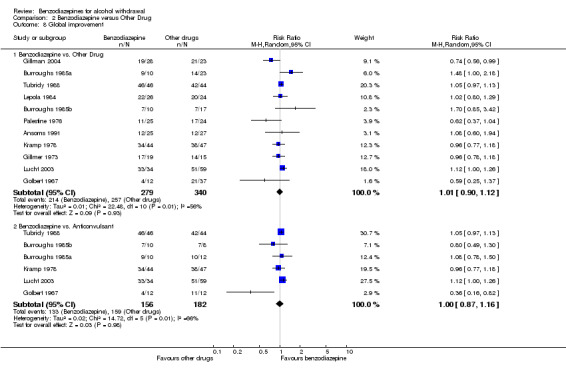
Comparison 2 Benzodiazepine versus Other Drug, Outcome 8 Global improvement.
2.8.2Any Benzodiazepine versus Anticonvulsants, 6 studies (Burroughs 1985a; Burroughs 1985b; Golbert 1967; Kramp 1978; Lucht 2003; Tubridy 1988), 338 participants, RR 1.00 (0.87 to 1.16), the result is not statistically significant, see Analysis 2.8
2.9 Global doctor’s assessment of efficacy
2.9.1Any Benzodiazepine versus any Other, 3 studies (Ansoms 1991; Kramp 1978; Tubridy 1988), 233 participants RR 1.04 (0.97 to 1.11), the result is not statistically significant, see Analysis 2.9
2.9. Analysis.

Comparison 2 Benzodiazepine versus Other Drug, Outcome 9 Global doctor's assessment of efficacy.
2.9.2Any Benzodiazepine versus Anticonvulsants, 2 studies (Kramp 1978; Tubridy 1988), 181 participants, RR 1.03 (0.93 to 1.14), the result is not statistically significant, see Analysis 2.9
2.10 Global patient’s assessment of efficacy
2 studies (Lepola 1984; Tubridy 1988), 140 participants, RR 1.04 (0.97 to 1.12), the result is not statistically significant, see Analysis 2.10
2.10. Analysis.

Comparison 2 Benzodiazepine versus Other Drug, Outcome 10 Global patient's assessment of efficacy.
Safety
2.11 Adverse events as number of participants with at least one adverse event
2.11.1Any Benzodiazepine versus any Other, 18 studies (Addolorato 1999; Addolorato 2006; Ansoms 1991; Bailly 1992; Burroughs 1985a; Burroughs 1985b; Favre 2005; Gillmer 1973; Krupitsky 2007; Lapierre 1983; Lepola 1984; Longo 2002; Lucht 2003; Nava 2007; Palestine 1976; Radouco‐Thomas 1989; Stuppaeck 1992; Tubridy 1988), 919 participants, RR 1.31 (0.99 to 1.72), the result is not statistically significant, see Analysis 2.11 or Figure 9
2.11. Analysis.

Comparison 2 Benzodiazepine versus Other Drug, Outcome 11 Adverse events.
9.
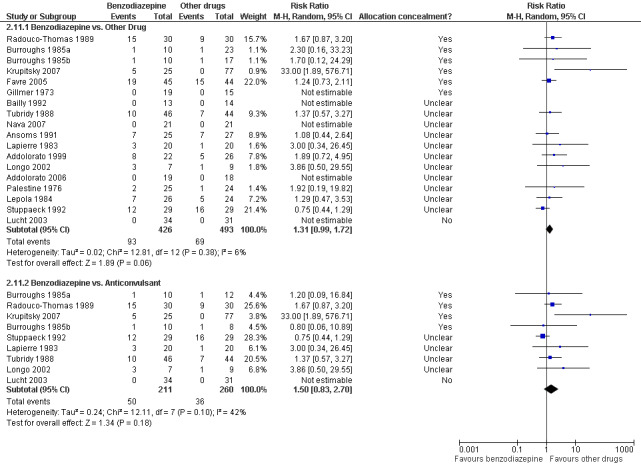
Forest plot of comparison: 2 Benzodiazepine versus Other Drug, outcome: 2.11 Adverse events.
2.11.2Any Benzodiazepine versus Anticonvulsants, 9 studies (Burroughs 1985a; Burroughs 1985b; Krupitsky 2007; Lapierre 1983; Longo 2002; Lucht 2003; Radouco‐Thomas 1989; Stuppaeck 1992; Tubridy 1988), 471 participants, RR 1.50 (0.83 to 2.70), the result is not statistically significant, see Analysis 2.11 or Figure 9
2.12 Severe, life‐treating adverse events
2.12.1Any Benzodiazepine versus any Other, 7 studies (Addolorato 1999; Burroughs 1985a; Burroughs 1985b; Lapierre 1983; Nava 2007; Radouco‐Thomas 1989; Tubridy 1988), 340 participants, RR 1.95 (0.25 to 15.28), the result is not statistically significant, see Analysis 2.12 or Figure 10
2.12. Analysis.

Comparison 2 Benzodiazepine versus Other Drug, Outcome 12 Severe, life‐treating adverse events.
10.

Forest plot of comparison: 2 Benzodiazepine versus Other Drug, outcome: 2.12 Severe, life‐treating adverse events.
2.12.2 Any Benzodiazepine versus Anticonvulsants, 5 studies (Burroughs 1985a; Burroughs 1985b; Lapierre 1983; Radouco‐Thomas 1989; Tubridy 1988, 230 participants, RR 1.45 (0.19 to 11.24), the result is not statistically significant, see Analysis 2.12 or Figure 10
2.13 Mortality
32 studies (Addolorato 1999; Adinoff 1994; Ansoms 1991; Bailly 1992; Baumgartner 1987; Baumgartner 1991; Borg 1986; Burroughs 1985a; Burroughs 1985b; Dion 1968; Gillman 2004; Gillmer 1973; Golbert 1967; Kaim 1969; Kaim 1972; Kalyoncu 1996; Kramp 1978; Lapierre 1983; Lenzenhuber 1999; Lepola 1984; Longo 2002; Lucht 2003; Malcolm 2002; Malcolm 2002; Palestine 1976; Pena‐Ramos 1977; Radouco‐Thomas 1989; Runion 1978; Sellers 1977; Stuppaeck 1992; Tubridy 1988; Worner 1994), 2088 participants, only 4/21 studies reported deaths, see Analysis 2.13
2.13. Analysis.

Comparison 2 Benzodiazepine versus Other Drug, Outcome 13 Mortality.
Acceptability
2.14 Dropout
2.14.1Any Benzodiazepine versus any Other, 22 studies (Addolorato 1999; Addolorato 2006; Adinoff 1994; Bailly 1992; Baumgartner 1987; Baumgartner 1991; Borg 1986; Burroughs 1985a; Burroughs 1985b; Favre 2005; Gillmer 1973; Kaim 1969; Kaim 1972; Kalyoncu 1996; Kramp 1978; Lucht 2003; McGrath 1975; Nava 2007; Radouco‐Thomas 1989; Stuppaeck 1992; Tubridy 1988; Worner 1994), 1848 participants, RR 0.93 (0.70, 1.24), the result is not statistically significant, see Analysis 2.14 or Figure 11
2.14. Analysis.

Comparison 2 Benzodiazepine versus Other Drug, Outcome 14 Dropouts.
11.

Forest plot of comparison: 2 Benzodiazepine versus Other Drug, outcome: 2.14 Dropouts.
2.14.2Any Benzodiazepine versus Anticonvulsants, 11 studies (Borg 1986; Burroughs 1985a; Burroughs 1985b; Kaim 1972; Kalyoncu 1996; Kramp 1978; Lucht 2003;McGrath 1975; Radouco‐Thomas 1989; Stuppaeck 1992; Tubridy 1988), 839 participants,RR 1.11 (0.75, 1.63), the result is not statistically significant, see Analysis 2.14 or Figure 11
2.15 Dropout due to adverse events
2.15.1Any Benzodiazepine versus any Other, 8 studies (Addolorato 1999; Burroughs 1985a; Burroughs 1985b; Kaim 1972; Lapierre 1983; Palestine 1976; Stuppaeck 1992; Tubridy 1988), 533 participants, RR 0.82 (0.23 to 2.88), the result is not statistically significant, see Analysis 2.15
2.15. Analysis.

Comparison 2 Benzodiazepine versus Other Drug, Outcome 15 Dropouts due to adverse events.
2.15.2Any Benzodiazepine versus Anticonvulsants, 6 studies (Burroughs 1985a; Burroughs 1985b; Kaim 1972; Lapierre 1983; Stuppaeck 1992; Tubridy 1988, 370 participants, RR 0.54 (0.14 to 2.16), the result is not statistically significant, see Analysis 2.15
Comparison 3 Different Benzodiazepines among themselves
Efficacy
3.1 Alcohol withdrawal seizures
3.1.1 Chlordiazepoxide versus Alprazolam , 1 study (Wilson 1985), 100 participants, RR 0.44 (0.15 to 1.35)
3.1.2 Chlordiazepoxide versus Diazepam, 1 study, 24 participants, RR 0.33 (0.01 to 7.45)
3.1.3 Chlordiazepoxide versus Lorazepam, 1 study (Solomon 1983), 50 participants, RR 0.20 (0.01 to 3.97)
3.1.2 Lorazepam versus Diazepam, 1 study (Ritson 1986), 40 participants, RR 3.00 (0.13 to 69.52)
None found statistically significant differences, but chlordiazepoxide performed better, see Analysis 3.1 or Figure 12
3.1. Analysis.

Comparison 3 Benzodiazepine 1 versus Benzodiazepine 2, Outcome 1 Alcohol withdrawal seizures.
12.

Forest plot of comparison: 3 Benzodiazepine 1 versus Benzodiazepine 2, outcome: 3.1 Alcohol withdrawal seizures.
3.2 Alcohol withdrawal delirium
3.2.1 Alprazolam versus Chlordiazepoxide, 1 study (Wilson 1985), 100 participants, RR 1.00 (0.21 to 4.72)
3.2.2 Diazepam versus Abecamil, 1 study (Anton 1997), 48 participants, RR 0.33 (0.01 to 7.80)
3.2.3 Diazepam versus Lorazepam , 1 study (Miller 1984), 55 participants, RR 0.19 (0.01 to 3.85)
3.2.4 Lorazepam versus Chlordiazepoxide , 1 study (Kumar 2009)100 participants, RR 0.33 (0.01, 7.99)
None found statistically significant differences, but diazepam performed better, see Analysis 3.2 or Figure 13
3.2. Analysis.

Comparison 3 Benzodiazepine 1 versus Benzodiazepine 2, Outcome 2 Alcohol withdrawal delirium.
13.

Forest plot of comparison: 3 Benzodiazepine 1 versus Benzodiazepine 2, outcome: 3.2 Alcohol withdrawal delirium.
3.3 CIWA‐Ar score at 48 hours
3.3.1 Diazepam versus Abecamil, 1 study (Anton 1997), 48 participants, MD 1.80 (‐1.85 to 5.45)
3.2.2 Diazepam versus Chlordiazepoxide, 1 study (Jauhar 2000), 20 participants, MD ‐4.50 (‐11.44 to 2.44)
3.3.3 Lorazepam versus Chlordiazepoxide , 1 study (Kumar 2009) 100 participants MD 0.00 (‐0.60, 0.60)
None found statistically significant differences, see Analysis 3.3
3.3. Analysis.

Comparison 3 Benzodiazepine 1 versus Benzodiazepine 2, Outcome 3 CIWA‐Ar score (48 hrs).
3.4 CIWA‐Ar score at the end of treatment
3.4.1 Diazepam versus Abecamil, 1 study (Anton 1997), 48 participants, MD 2.50 (‐1.14 to 6.14)
3.4.2 Diazepam versus Chlordiazepoxide, 1 study (Jauhar 2000), 20 participants, MD ‐3.30 (‐10.79 to 4.19)
3.4.3 Lorazepam versus Chlordiazepoxide , 1 study (Kumar 2009) 100 participants MD 0.00 (‐0.51, 0.51)
None found statistically significant differences, see Analysis 3.4
3.4. Analysis.

Comparison 3 Benzodiazepine 1 versus Benzodiazepine 2, Outcome 4 CIWA‐Ar score (end of treatment).
3.5 HARS score at 48 hours
3.5.1 Clobazam versus Diazepam, 1 study (Martin 1975), 30 participants, MD ‐0.40 (‐1.92 to 1.12)
3.5.2 Clobazam versus Chlordiazepoxide, (Mukherjee 1983),1 study, 40 participants, MD ‐0.70 (‐5.95 to 4.55)
3.5.3 Lopirazepam versus Prazepam, 1 study (Saletu 1983), 42 participants, MD 0.00 (‐1.21 to 1.21)
None found statistically significant differences, see Analysis 3.5
3.5. Analysis.

Comparison 3 Benzodiazepine 1 versus Benzodiazepine 2, Outcome 5 HARS score (48 hrs).
3.6 HARS score at the end of treatment
3.6.1 Alprazolam versus Diazepam, 1 study (Kolin 1981), 44 participants, MD 0.80 (‐0.38 to 1.98), the result is not statistically significant
3.6.3 Alprazolam versus Chlordiazepoxide, 1 study (McLendon 1980), 43 participants, MD ‐2.90 (‐4.10 to ‐1.70), the result is in favour of Chlordiazepoxide
3.6.2 Clobazam versus Diazepam, 1 study, (Martin 1975), 30 participants, MD ‐0.30 (‐1.82 to 1.22), the result is not statistically significant
3.6.4 Clobazam versus Chlordiazepoxide, 1 study (Mukherjee 1983), 40 participants, MD ‐3.50 (‐8.65 to 1.65), the result is not statistically significant
3.6.5 Lopirazepam versus Prazepam, 1 study (Saletu 1983), 42 participants, MD 1.60 (0.39 to 2.81), the result is in favour of Lopirazepam
see Analysis 3.6
3.6. Analysis.

Comparison 3 Benzodiazepine 1 versus Benzodiazepine 2, Outcome 6 HARS score (end of treatment).
3.7 Global doctor’s assessment of efficacy
3.7.1 Alprazolam versus Diazepam, 1 study (Kolin 1981), 44 participants, RR 1.00 (0.87 to 1.13)
3.7.2 Alprazolam versus Chlordiazepoxide, 1 study (Wilson 1985), 100 participants, RR 0.93 (0.81 to 1.07)
3.7.3 Diazepam versus Abecamil, 1 study (Anton 1997), 48 participants, RR 1.00 (0.84 to 1.19)
None found statistically significant differences, but chlordiazepoxide performed better, see Analysis 3.7
3.7. Analysis.

Comparison 3 Benzodiazepine 1 versus Benzodiazepine 2, Outcome 7 Global doctor's assessment of efficacy.
3.8 Global patient’s assessment of efficacy
3.8.1 Alprazolam versus Diazepam, 1 study, (Kolin 1981), 44 participants, RR 1.04 (0.92 to 1.18), the result is not statistically significant, see Analysis 3.8
3.8. Analysis.

Comparison 3 Benzodiazepine 1 versus Benzodiazepine 2, Outcome 8 Global patient's assessment of efficacy.
Safety
3.9 Adverse events as number of participants with at least one adverse event
3.9.1 Chlordiazepoxide versus Clobazam, 1 study (Mukherjee 1983), 40 participants, RR 0.80 (0.25 to 2.55),
3.9.2 Chlordiazepoxide versus Diazepam, 2 studies (Brown 1972; Jauhar 2000), 34 participants, RR 3.00 (0.14 to 63.15),
3.9.3 Chlordiazepoxide versus Halazepam, 1 study (Mendels 1985), 80 participants, RR 0.53 (0.05 to 5.57),
3.9.4 Lorazepam versus Diazepam, 2 studies (Miller 1984; O'Brien 1983), 96 participants, RR 2.56 (0.35 to 18.62),
3.9.5 Lorazepam versus Chlordiazepoxide , 1 study (Kumar 2009) 100 participants RR2.00 0.19, 21.36)
None found statistically significant differences, see Analysis 3.9 or Figure 14
3.9. Analysis.

Comparison 3 Benzodiazepine 1 versus Benzodiazepine 2, Outcome 9 Adverse events.
14.

Forest plot of comparison: 3 Benzodiazepine 1 versus Benzodiazepine 2, outcome: 3.9 Adverse events.
3.10 Severe, life‐treating adverse events
3.10.1 Chlordiazepoxide versus Alprazolam, 1 study (Wilson 1985), 100 participants, only one severe, RR 3.00 (0.131 to 71.92), the result is not statistically significant
3.10.2 Chlordiazepoxide versus Clobazam, 1 study (Mukherjee 1983), 40 participants, no events in both groups
3.10.3 Chlordiazepoxide versus Diazepam, 1 study (Jauhar 2000), 20 participants, no events in both groups
3.10.4 Chlordiazepoxide versus Halazepam, 1 study (Mendels 1985), 80 participants, no events in both groups
3.10.5 Diazepam versus Abecamil, 1 study (Anton 1997), 48 participants, RR 0.33 (0.04 to 2.98), the result is not statistically significant
3.10.6 Diazepam versus Alprazolam, 1 study (Kolin 1981), 44 participants, no events in both groups
see Analysis 3.10
3.10. Analysis.

Comparison 3 Benzodiazepine 1 versus Benzodiazepine 2, Outcome 10 Severe, life‐treating adverse events.
Acceptability
3.11 Dropout
3.11.1 Alprazolam versus Diazepam , 2 studies (Adinoff 1994; Kolin 1981), 60 participants, RR 0.25 (0.01 to 5.03)
3.11.2 Chlordiazepoxide versus Diazepam, 2 studies (Brown 1972; Day 2004), 41 participants, RR 6.00 (0.37 to 98.65)
3.11.3 Chlordiazepoxide versus Halazepam, 1 study (Mendels 1985), 92 participants, RR 2.75 (0.80 to 9.51)
3.11.4 Chlordiazepoxide versus Clobazam, 1 study (Mukherjee 1983), 54 participants, RR 0.81 (0.32 to 2.01)
3.11.5 Chlordiazepoxide versus Lorazepam, 2 study (Kumar 2009; Solomon 1983), 158 participants, RR 0.75 (0.24, 2.37)
3.11.6 Lorazepam versus Diazepam, 3 studies (Miller 1984; O'Brien 1983; Ritson 1986), 156 participants, RR 1.20 (0.54 to 2.65)
None found statistically significant differences, see Analysis 3.11 or Figure 15
3.11. Analysis.

Comparison 3 Benzodiazepine 1 versus Benzodiazepine 2, Outcome 11 Dropouts.
15.

Forest plot of comparison: 3 Benzodiazepine 1 versus Benzodiazepine 2, outcome: 3.11 Dropouts.
3.12 Dropout due to adverse events
3.12.1 Chlordiazepoxide versus Alprazolam, 2 studies (McLendon 1980; Wilson 1985), 143 participants, RR 1.00 (0.21 to 4.72)
3.12.2 Chlordiazepoxide versus Clobazam, 1 study (Mukherjee 1983), 40 participants,no events in both groups
3.12.3 Chlordiazepoxide versus Diazepam, 2 studies (Brown 1972; Jauhar 2000), 34 participants, RR 3.00 (0.14 to 63.15)
3.12.4 Chlordiazepoxide versus Halazepam, 1 study (Mendels 1985), 80 participants, no events in both groups
3.12.5 Chlordiazepoxide versus Lorazepam, 1 study, 50 participants, no events in both groups
3.12.6 Diazepam versus Abecamil, 1 study (Anton 1997), 48 participants, RR 0.14 (0.01 to 2.62)
3.12.7 Diazepam versus Alprazolam, 1 study (Kolin 1981), 44 participants, RR 2.75 (0.12 to 64. 04)
3.12.8 Diazepam versus Lorazepam , 2 studies (Miller 1984; O'Brien 1983), 96 participants, RR 0.60 (0.08 to 4.69)
None found statistically significant differences, see Analysis 3.12
3.12. Analysis.
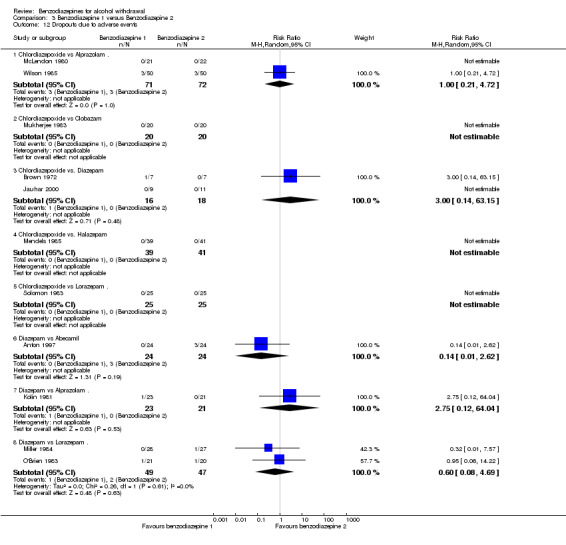
Comparison 3 Benzodiazepine 1 versus Benzodiazepine 2, Outcome 12 Dropouts due to adverse events.
Benzodiazepine+Other Drug versus Other Drug Three trials including a total of 207 participants, compared benzodiazepine with the combination of a benzodiazepine with another drug : Dion 1968 (Chlordiazepoxide + Magnesium sulphate); Sellers 1977; (Chlordiazepoxide + Propanol) and Spies 1996 (Flunitrazepam + Clonidine). Very limited data were available, thus making quantitative synthesis not very informative, for more details see Analysis 4.1; Analysis 4.2; Analysis 4.3.
4.1. Analysis.

Comparison 4 Benzodiazepine alone vs benzodiazepine + other drugs, Outcome 1 Mortality.
4.2. Analysis.

Comparison 4 Benzodiazepine alone vs benzodiazepine + other drugs, Outcome 2 Dropouts.
4.3. Analysis.

Comparison 4 Benzodiazepine alone vs benzodiazepine + other drugs, Outcome 3 Dropouts due to adverse events.
Benzodiazepine (fixed schedule) versus Benzodiazepine (symptom‐triggered) Three trials (Daeppen 2002; Saitz 1994; Spies 2003), including a total of 262 randomised participants, compared fixed versus symptom‐triggered schedules of a benzodiazepine (chlordiazepoxide, oxazepam, flunitrazepam) for various outcomes. There was a small significant benefit of symptom‐triggered regimens regarding CIWA‐Ar score (change from baseline) at 48 hrs /MD ‐5.70, CI ‐11.02 to ‐0.38). Data on all other outcomes were very all not statistically significant. For more details see Analysis 5.1; Analysis 5.2; Analysis 5.3; Analysis 5.4; Analysis 5.5; Analysis 5.6
5.1. Analysis.
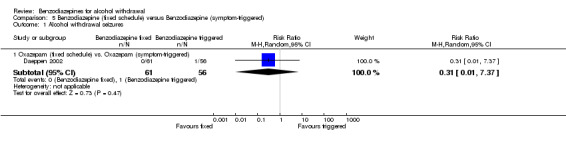
Comparison 5 Benzodiazepine (fixed schedule) versus Benzodiazepine (symptom‐triggered), Outcome 1 Alcohol withdrawal seizures.
5.2. Analysis.

Comparison 5 Benzodiazepine (fixed schedule) versus Benzodiazepine (symptom‐triggered), Outcome 2 Alcohol withdrawal delirium.
5.3. Analysis.

Comparison 5 Benzodiazepine (fixed schedule) versus Benzodiazepine (symptom‐triggered), Outcome 3 CIWA‐Ar score (48 hrs).
5.4. Analysis.

Comparison 5 Benzodiazepine (fixed schedule) versus Benzodiazepine (symptom‐triggered), Outcome 4 CIWA‐Ar score (end of treatment).
5.5. Analysis.

Comparison 5 Benzodiazepine (fixed schedule) versus Benzodiazepine (symptom‐triggered), Outcome 5 Mortality.
5.6. Analysis.

Comparison 5 Benzodiazepine (fixed schedule) versus Benzodiazepine (symptom‐triggered), Outcome 6 Dropouts.
Discussion
Overall, the small sample size of published RCTs and lack of detailed information on various outcomes illustrate a need for larger, well‐designed studies in this field. These studies should be limited to more important efficacy variables and consistency on rating continuous outcomes with the same scales should also be achieved among researchers.
Summary of main results
This systematic review includes data from 57 RCTs with over 4,000 patients with alcohol withdrawal syndrome. Despite the considerable number of RCTs, the large variety of outcomes and rating scales limited considerably the ability to perform a quantitative synthesis of all available data.
Benzodiazepines clearly offered a significant benefit against alcohol withdrawal seizures compared to placebo. This might suggest that their current status as first‐line treatment for alcohol withdrawal syndrome is justified. Nevertheless, the available evidence did not suggest that benzodiazepines are clearly superior to other drugs with the exception of a possible superiority in seizure control when compared against non‐anticonvulsants. Broadly defined success rates were very similar with benzodiazepines versus other drugs and the 95% confidence intervals even exclude any clinically meaningful differences in this regard. This was true for both short‐acting and long‐acting benzodiazepines.
Differences between regimens in isolated small trials using more particular outcome measures should be interpreted very cautiously given the large number of outcomes in this field and the small sample size of the studies conducted therein. Nevertheless, even the limited data on such outcomes are not suggestive of any clear superiority of benzodiazepines. Benzodiazepines were less effective, if anything, compared to other drugs in reducing the severity of alcohol withdrawal symptoms, as indicated by change from baseline in doctor's global assessment score at the end of treatment and Hamilton Anxiety Rating Scale score at both 48 hours and the end of treatment in a few small trials. When compared to anticonvulsants, benzodiazepines tended to offer a non‐significant benefit for change from baseline in the patient's global assessment score at the end of treatment, but also a non‐significant increased risk for alcohol withdrawal seizures.
Data on the comparisons of different benzodiazepines among themselves, benzodiazepine combined with other drug versus other drug, and fixed‐schedule versus symptom‐triggered regimens of benzodiazepines were very limited, thus making quantitative synthesis for various outcomes either not applicable or not very informative. Based on indirect comparisons, there is no strong evidence at the moment that particular benzodiazepines are more effective than others.
Overall completeness and applicability of evidence
Information on side‐effects was not consistently reported in the trial reports. More detailed data on adverse effects would be important to record in these trials, since discontinuation due to side‐effects may affect the success of treatment. Moreover, data on side effects should be compared cautiously, as they were derived from patients with potentially different co‐morbidity. Patients with severe medical conditions, such as hepatic, heart or lung disease, were often excluded from these trials. However, these patients may be more susceptible to various adverse effects of benzodiazepines. The extremely small mortality rate in all these studies is reassuring, but data on other harms‐related outcomes are sparse and fragmented. This important deficiency of the benzodiazepine literature needs to be highlighted for improving future clinical research efforts in this field.
Quality of the evidence
The overall results need to be interpreted with caution, as bias cannot be excluded. Most trials were of very small sample size. Although randomisation was an inclusion criterion indicating some methodological quality for these studies, the method of randomisation was not usually described in sufficient detail in the published reports. Moreover, allocation concealment was usually unclear and information on follow‐up was often missing. Furthermore, it was difficult to interpret comparisons of specific settings of treatment (inpatient or outpatient), because a large number of the analysed studies did not present sufficient background information so as to allow a clear understanding of the treatment setting. We could not also examine dose‐response effects since patients were not treated with even similar doses of various benzodiazepines across RCTs. Small trials are difficult to interpret in isolation, especially in the face of potential selective reporting of outcomes.
Authors' conclusions
Implications for practice.
Benzodiazepines are effective against alcohol withdrawal symptoms, in particular seizures, when compared to placebo. It is not possible to draw very precise conclusions about the relative effectiveness and safety of benzodiazepines against other drugs in alcohol withdrawal, because of the large heterogeneity of the trials both in interventions and assessment of outcomes. Nevertheless, the available data do not show differences between benzodiazepines and other drugs in broadly defined success rates. Data on potential harms are sparse and fragmented.
Implications for research.
Although a significant number of trends has emerged, most of these were small and the data for most outcomes did not reach statistical significance, indicating the need for larger, well‐designed studies in this field. These studies should be limited to few, important efficacy variables such as severity of the alcohol withdrawal syndrome, incidence of seizures and delirium tremens, side effects and mortality. Consistency on rating continuous outcomes in the same scales should also be achieved in order to obtain comparable information from all relevant studies.
What's new
| Date | Event | Description |
|---|---|---|
| 7 January 2010 | New search has been performed | substantially update; authors changed |
| 7 January 2010 | New citation required and conclusions have changed | new studies |
History
Protocol first published: Issue 1, 2005 Review first published: Issue 3, 2005
| Date | Event | Description |
|---|---|---|
| 25 March 2008 | Amended | Converted to new review format. |
| 19 May 2005 | New citation required and conclusions have changed | Substantive amendment |
Acknowledgements
We thank the author of the first version of the review that did an excellent work that was very helpful for this update and Zuzana Mitrova for providing helpful assistance during all the process
Appendices
Appendix 1. CENTRAL ‐ The Cochrane Library 4, 2004) search strategy
Free text: (((alcohol*) AND (withdraw* or detox* or abstinen* or abstain*)) AND (benzodiazepine)))
Appendix 2. PubMed search strategy
Alcohol‐related disorders [mesh]
Alcohol‐Induced Disorders, Nervous System [mesh]
((alcohol*) and (disorder* or withdr* or abstinen* or abstain* or detox* or neuropathy)) [tiab]
1 or 2 or 3
BENZODIAZEPINES [mesh]
benzodiazepine or alprazolam or bromazepan or Brotizolam or Chlordiazepoxide or Clobazam or Clotiazepam or Adinazolam or Bentazepam or camazepam or Diazepam or Cloxazolam or Etizolam or Flutoprazepam or flunitrazepam or flurazepam or halazepam or Ketazolam or Loflazepate or lorazepam or Lormetazepam or loprazolam or Metaclazepam or midazolam or nitrazepam or oxzepam or prazepam or temazepan or triazolam or Propazepam or Ripazepam or Serazepine or Tofisopam).tw
exp ANTI‐ANXIETY AGENTS [mesh]
5 or 6 or 7
randomized controlled trial[pt]
controlled clinical trial[pt]
random*[tiab]
placebo[tiab]
drug therapy[mesh]
trial[tiab]
groups[tiab]
9 or 10 or 11 or 12 or 13 or 14 or 15
animals [mesh]
humans [mesh]
animals NOT (17 and 18)
16 NOT 19
4 and 8 and 20
Benzodiazepine/adverse effects [mesh] or Benzodiazepine /poisoning [mesh] or Benzodiazepine /toxicity [mesh]
Benzodiazepine/contraindications [mesh]
adverse effects [subheadings]
Drug toxicity [mesh]
“adverse effect*”[tiab]
“side effect* [tiab]
serious or safety or surveillance or adverse or toxicity or complication or tolerability [tiab]
22 or 23 or 24 or 25 or 26 or 27 or 28
4 AND 8 AND 29
30 NOT 19
Appendix 3. EMBASE search strategy
Exp Alcohol Withdrawal/
Exp Withdrawal Syndrome/
((alcohol*) and (disorder* or withdr* or abstinen* or abstain* or detox* or neuropathy)) [tiab]
1 or 2 or 3
Exp benzodiazepine derivative/
(benzodiazepine or alprazolam or bromazepan or Brotizolam or Chlordiazepoxide or Clobazam or Clotiazepam or Adinazolam or Bentazepam or camazepam or Diazepam or Cloxazolam or Etizolam or Flutoprazepam or flunitrazepam or flurazepam or halazepam or Ketazolam or Loflazepate or lorazepam or Lormetazepam or loprazolam or Metaclazepam or midazolam or nitrazepam or oxzepam or prazepam or temazepan or triazolam or Propazepam or Ripazepam or Serazepine or Tofisopam).ti,ab
5 or 6
random*.ti,ab
placebo.ti,ab
(singl* or doubl* or trebl* or tripl*) and (blind* or mask*)).ti,ab
crossover*.ti,ab
exp randomized controlled trial/
exp double blind procedure/
exp single blind procedure/
exp triple blind procedure/
exp latin square design
exp crossover procedure/
exp Latin square design/
exp placebos/
exp multicenter study/
8/20 OR
4 and 7 and 21
limit 22 to human
Appendix 4. CINAHL search strategy
MESH alcohol related disorders
MESH alcohol withdrawal delirium
TX ((alcohol*) and (disorder* or withdr* or abstinen* or abstain* or detox* or neuropathy))
1 or 2 or 3
MH Antianxiety agents, Benzodiazepine
TW benzodiazepine or alprazolam or bromazepan or Brotizolam or Chlordiazepoxide or Clobazam or Clotiazepam or Adinazolam or Bentazepam or camazepam or Diazepam or Cloxazolam or Etizolam or Flutoprazepam or flunitrazepam or flurazepam or halazepam or Ketazolam or Loflazepate or lorazepam or Lormetazepam or loprazolam or Metaclazepam or midazolam or nitrazepam or oxzepam or prazepam or temazepan or triazolam or Propazepam or Ripazepam or Serazepine or Tofisopam
5 or 6
MH Random Assignment/
MH Clinical Trials/
TW random*
TW placebo*
TW group*
TW (singl* or doubl* or tripl* or trebl*) and (mask* or blind*)
MH crossover design
TW crossover*
TW allocate*
TW assign*
9/17 OR
4 and 8 and 18
Appendix 5. Criteria for Risk of bias in RCTs and CCTs
| Item | Judgment | Description | |
| 1 | Was the method of randomisation adequate? | Yes | The investigators describe a random component in the sequence generation process such as: random number table; computer random number generator; coin tossing; shuffling cards or envelopes; throwing dice; drawing of lots; minimization |
| No | The investigators describe a non‐random component in the sequence generation process such as: odd or even date of birth; date (or day) of admission; hospital or clinic record number; alternation; judgement of the clinician; results of a laboratory test or a series of tests; availability of the intervention | ||
| Unclear | Insufficient information about the sequence generation process to permit judgement of ‘Yes’ or ‘No’. | ||
| 2 | Was the treatment allocation concealed? | Yes | Investigators enrolling participants could not foresee assignment because one of the following, or an equivalent method, was used to conceal allocation: central allocation (including telephone, web‐based, and pharmacy‐controlled, randomization); sequentially numbered drug containers of identical appearance; sequentially numbered, opaque, sealed envelopes. |
| No | Investigators enrolling participants could possibly foresee assignments because one of the following method was used: open random allocation schedule (e.g. a list of random numbers); assignment envelopes without appropriate safeguards (e.g. if envelopes were unsealed or non opaque or not sequentially numbered); alternation or rotation; date of birth; case record number; any other explicitly unconcealed procedure. | ||
| Unclear | Insufficient information to permit judgement of ‘Yes’ or ‘No’. This is usually the case if the method of concealment is not described or not described in sufficient detail to allow a definite judgement | ||
| 3/4 |
Was knowledge of the allocated interventions adequately prevented during the study? (blinding of patients, provider, outcome assessor) Objective outcomes Subjective outcomes |
Yes | Blinding of participants, providers and outcome assessor and unlikely that the blinding could have been broken; Either participants or providers were not blinded, but outcome assessment was blinded and the non‐blinding of others unlikely to introduce bias. No blinding, but the objective outcome measurement are not likely to be influenced by lack of blinding |
| No | No blinding or incomplete blinding, and the outcome or outcome measurement is likely to be influenced by lack of blinding; Blinding of key study participants and personnel attempted, but likely that the blinding could have been broken; Either participants or outcome assessor were not blinded, and the non‐blinding of others likely to introduce bias |
||
| Unclear | Insufficient information to permit judgement of ‘Yes’ or ‘No’; | ||
| 5 |
Were incomplete outcome data adequately addressed? For all outcomes except retention in treatment or drop out |
Yes | No missing outcome data; Reasons for missing outcome data unlikely to be related to true outcome (for survival data, censoring unlikely to be introducing bias); Missing outcome data balanced in numbers across intervention groups, with similar reasons for missing data across groups; For dichotomous outcome data, the proportion of missing outcomes compared with observed event risk not enough to have a clinically relevant impact on the intervention effect estimate; For continuous outcome data, plausible effect size (difference in means or standardized difference in means) among missing outcomes not enough to have a clinically relevant impact on observed effect size; Missing data have been imputed using appropriate methods All randomised patients are reported/analysed in the group they were allocated to by randomisation irrespective of non‐compliance and co‐interventions (intention to treat) |
| No | Reason for missing outcome data likely to be related to true outcome, with either imbalance in numbers or reasons for missing data across intervention groups; For dichotomous outcome data, the proportion of missing outcomes compared with observed event risk enough to induce clinically relevant bias in intervention effect estimate; For continuous outcome data, plausible effect size (difference in means or standardized difference in means) among missing outcomes enough to induce clinically relevant bias in observed effect size; ‘As‐treated’ analysis done with substantial departure of the intervention received from that assigned at randomisation; |
||
| Unclear | Insufficient reporting of attrition/exclusions to permit judgement of ‘Yes’ or ‘No’ (e.g. number randomised not stated, no reasons for missing data provided; number of drop out not reported for each group); |
Data and analyses
Comparison 1. Benzodiazepine versus Placebo.
| Outcome or subgroup title | No. of studies | No. of participants | Statistical method | Effect size |
|---|---|---|---|---|
| 1 Alcohol withdrawal seizures | 3 | 324 | Risk Ratio (M‐H, Random, 95% CI) | 0.16 [0.04, 0.69] |
| 2 Adverse events | 2 | 71 | Risk Ratio (M‐H, Random, 95% CI) | 3.28 [0.31, 34.52] |
| 3 Dropouts | 3 | 312 | Risk Ratio (M‐H, Random, 95% CI) | 0.68 [0.38, 1.24] |
| 4 Dropout due to adverse events | 2 | 86 | Risk Ratio (M‐H, Random, 95% CI) | 0.36 [0.02, 8.03] |
Comparison 2. Benzodiazepine versus Other Drug.
| Outcome or subgroup title | No. of studies | No. of participants | Statistical method | Effect size |
|---|---|---|---|---|
| 1 Alcohol withdrawal seizures | 12 | Risk Ratio (M‐H, Random, 95% CI) | Subtotals only | |
| 1.1 Benzodiazepine vs. Other Drug | 12 | 1228 | Risk Ratio (M‐H, Random, 95% CI) | 0.52 [0.21, 1.31] |
| 1.2 Benzodiazepine vs. Anticonvulsant | 7 | 523 | Risk Ratio (M‐H, Random, 95% CI) | 1.70 [0.39, 7.37] |
| 2 Alcohol withdrawal delirium | 8 | Risk Ratio (M‐H, Random, 95% CI) | Subtotals only | |
| 2.1 Benzodiazepine vs. Other Drug | 8 | 893 | Risk Ratio (M‐H, Random, 95% CI) | 0.65 [0.21, 1.98] |
| 2.2 Benzodiazepine vs. Anticonvulsant | 5 | 342 | Risk Ratio (M‐H, Random, 95% CI) | 1.90 [0.43, 8.38] |
| 3 CIWA‐Ar score (48 hrs) | 5 | Mean Difference (IV, Random, 95% CI) | Subtotals only | |
| 3.1 Benzodiazepine vs. Other Drug | 5 | 355 | Mean Difference (IV, Random, 95% CI) | ‐1.03 [‐2.21, 0.15] |
| 3.2 Benzodiazepine vs. Anticonvulsant | 3 | 260 | Mean Difference (IV, Random, 95% CI) | ‐0.73 [‐2.88, 1.42] |
| 4 CIWA‐Ar score (end of treatment) | 6 | Mean Difference (IV, Random, 95% CI) | Subtotals only | |
| 4.1 Benzodiazepine vs. Other Drug | 6 | 435 | Mean Difference (IV, Random, 95% CI) | ‐0.17 [‐1.29, 0.95] |
| 4.2 Benzodiazepine vs. Anticonvulsant | 3 | 260 | Mean Difference (IV, Random, 95% CI) | ‐1.04 [‐3.45, 1.38] |
| 5 HARS score (48 hrs) | 1 | Mean Difference (IV, Random, 95% CI) | Subtotals only | |
| 6 HARS score (end of treatment) | 2 | 90 | Mean Difference (IV, Random, 95% CI) | ‐2.05 [‐4.37, 0.27] |
| 7 Zung Anxiety Scale (end of treatment) | 1 | Mean Difference (IV, Random, 95% CI) | Subtotals only | |
| 8 Global improvement | 11 | Risk Ratio (M‐H, Random, 95% CI) | Subtotals only | |
| 8.1 Benzodiazepine vs. Other Drug | 11 | 619 | Risk Ratio (M‐H, Random, 95% CI) | 1.01 [0.90, 1.12] |
| 8.2 Benzodiazepine vs. Anticonvulsant | 6 | 338 | Risk Ratio (M‐H, Random, 95% CI) | 1.00 [0.87, 1.16] |
| 9 Global doctor's assessment of efficacy | 3 | Risk Ratio (M‐H, Random, 95% CI) | Subtotals only | |
| 9.1 Benzodiazepine vs. Other Drug | 3 | 233 | Risk Ratio (M‐H, Random, 95% CI) | 1.04 [0.97, 1.11] |
| 9.2 Benzodiazepine vs. Anticonvulsant | 2 | 181 | Risk Ratio (M‐H, Random, 95% CI) | 1.03 [0.93, 1.14] |
| 10 Global patient's assessment of efficacy | 2 | Risk Ratio (M‐H, Random, 95% CI) | Subtotals only | |
| 10.1 Benzodiazepine vs. Other Drug | 2 | 140 | Risk Ratio (M‐H, Random, 95% CI) | 1.04 [0.97, 1.12] |
| 11 Adverse events | 18 | Risk Ratio (M‐H, Random, 95% CI) | Subtotals only | |
| 11.1 Benzodiazepine vs. Other Drug | 18 | 919 | Risk Ratio (M‐H, Random, 95% CI) | 1.31 [0.99, 1.72] |
| 11.2 Benzodiazepine vs. Anticonvulsant | 9 | 471 | Risk Ratio (M‐H, Random, 95% CI) | 1.50 [0.83, 2.70] |
| 12 Severe, life‐treating adverse events | 7 | Risk Ratio (M‐H, Random, 95% CI) | Subtotals only | |
| 12.1 Benzodiazepine vs. Other Drug | 7 | 340 | Risk Ratio (M‐H, Random, 95% CI) | 1.95 [0.25, 15.28] |
| 12.2 Benzodiazepine vs. Anticonvulsant | 5 | 230 | Risk Ratio (M‐H, Random, 95% CI) | 1.45 [0.19, 11.24] |
| 13 Mortality | 32 | Risk Ratio (M‐H, Random, 95% CI) | Subtotals only | |
| 14 Dropouts | 22 | Risk Ratio (M‐H, Random, 95% CI) | Subtotals only | |
| 14.1 Benzodiazepine vs. Other Drug | 22 | 1848 | Risk Ratio (M‐H, Random, 95% CI) | 0.93 [0.70, 1.24] |
| 14.2 Benzodiazepine vs. Anticonvulsant | 11 | 839 | Risk Ratio (M‐H, Random, 95% CI) | 1.11 [0.75, 1.63] |
| 15 Dropouts due to adverse events | 8 | Risk Ratio (M‐H, Random, 95% CI) | Subtotals only | |
| 15.1 Benzodiazepine vs. Other Drug | 8 | 533 | Risk Ratio (M‐H, Random, 95% CI) | 0.82 [0.23, 2.88] |
| 15.2 Benzodiazepine vs. Anticonvulsant | 6 | 370 | Risk Ratio (M‐H, Random, 95% CI) | 0.54 [0.14, 2.16] |
Comparison 3. Benzodiazepine 1 versus Benzodiazepine 2.
| Outcome or subgroup title | No. of studies | No. of participants | Statistical method | Effect size |
|---|---|---|---|---|
| 1 Alcohol withdrawal seizures | 4 | Risk Ratio (M‐H, Random, 95% CI) | Subtotals only | |
| 1.1 Chlordiazepoxide vs Alprazolam . | 1 | 100 | Risk Ratio (M‐H, Random, 95% CI) | 0.44 [0.15, 1.35] |
| 1.2 Chlordiazepoxide vs Diazepam | 1 | 24 | Risk Ratio (M‐H, Random, 95% CI) | 0.33 [0.01, 7.45] |
| 1.3 Chlordiazepoxide vs Lorazepam. | 1 | 50 | Risk Ratio (M‐H, Random, 95% CI) | 0.2 [0.01, 3.97] |
| 1.4 Lorazepam vs. Diazepam | 1 | 40 | Risk Ratio (M‐H, Random, 95% CI) | 3.00 [0.13, 69.52] |
| 2 Alcohol withdrawal delirium | 4 | Risk Ratio (M‐H, Random, 95% CI) | Subtotals only | |
| 2.1 Alprazolam vs. Chlordiazepoxide | 1 | 100 | Risk Ratio (M‐H, Random, 95% CI) | 1.0 [0.21, 4.72] |
| 2.2 Diazepam vs Abecamil | 1 | 48 | Risk Ratio (M‐H, Random, 95% CI) | 0.33 [0.01, 7.80] |
| 2.3 Diazepam vs Lorazepam . | 1 | 55 | Risk Ratio (M‐H, Random, 95% CI) | 0.19 [0.01, 3.85] |
| 2.4 Lorazepam vs Chlordiazepoxide | 1 | 100 | Risk Ratio (M‐H, Random, 95% CI) | 0.33 [0.01, 7.99] |
| 3 CIWA‐Ar score (48 hrs) | 3 | Mean Difference (IV, Random, 95% CI) | Subtotals only | |
| 3.1 Diazepam vs Abecamil | 1 | 48 | Mean Difference (IV, Random, 95% CI) | 1.80 [‐1.85, 5.45] |
| 3.2 Diazepam vs Chlordiazepoxide . | 1 | 20 | Mean Difference (IV, Random, 95% CI) | ‐4.5 [‐11.44, 2.44] |
| 3.3 Lorazepam vs Chlorziazepoxide | 1 | 100 | Mean Difference (IV, Random, 95% CI) | 0.0 [‐0.60, 0.60] |
| 4 CIWA‐Ar score (end of treatment) | 3 | Mean Difference (IV, Random, 95% CI) | Subtotals only | |
| 4.1 Diazepam vs Abecamil | 1 | 48 | Mean Difference (IV, Random, 95% CI) | 2.5 [‐1.14, 6.14] |
| 4.2 Diazepam vs Chlordiazepoxide . | 1 | 20 | Mean Difference (IV, Random, 95% CI) | ‐3.30 [‐10.79, 4.19] |
| 4.3 Lorazepam vs Chlordiazepoxide | 1 | 100 | Mean Difference (IV, Random, 95% CI) | 0.0 [‐0.51, 0.51] |
| 5 HARS score (48 hrs) | 3 | Mean Difference (IV, Random, 95% CI) | Subtotals only | |
| 5.1 Clobazam vs. Diazepam | 1 | 30 | Mean Difference (IV, Random, 95% CI) | ‐0.40 [‐1.92, 1.12] |
| 5.2 Clobazam vs Chlordiazepoxide | 1 | 40 | Mean Difference (IV, Random, 95% CI) | ‐0.70 [‐5.95, 4.55] |
| 5.3 Lopirazepam vs. Prazepam | 1 | 42 | Mean Difference (IV, Random, 95% CI) | 0.0 [‐1.21, 1.21] |
| 6 HARS score (end of treatment) | 5 | Mean Difference (IV, Random, 95% CI) | Subtotals only | |
| 6.1 Alprazolam vs. Diazepam | 1 | 44 | Mean Difference (IV, Random, 95% CI) | 0.80 [‐0.38, 1.98] |
| 6.2 Alprazolam vs. Chlordiazepoxide | 1 | 43 | Mean Difference (IV, Random, 95% CI) | ‐2.90 [‐4.10, ‐1.70] |
| 6.3 Clobazam vs. Diazepam | 1 | 30 | Mean Difference (IV, Random, 95% CI) | ‐0.30 [‐1.82, 1.22] |
| 6.4 Clobazam vs Chlordiazepoxide | 1 | 40 | Mean Difference (IV, Random, 95% CI) | ‐3.5 [‐8.65, 1.65] |
| 6.5 Lopirazepam vs. Prazepam | 1 | 42 | Mean Difference (IV, Random, 95% CI) | 1.60 [0.39, 2.81] |
| 7 Global doctor's assessment of efficacy | 3 | Risk Ratio (M‐H, Random, 95% CI) | Subtotals only | |
| 7.1 Alprazolam vs. Diazepam | 1 | 44 | Risk Ratio (M‐H, Random, 95% CI) | 1.00 [0.87, 1.13] |
| 7.2 Alprazolam vs. Chlordiazepoxide | 1 | 100 | Risk Ratio (M‐H, Random, 95% CI) | 0.93 [0.81, 1.07] |
| 7.3 Diazepam vs Abecamil | 1 | 48 | Risk Ratio (M‐H, Random, 95% CI) | 1.0 [0.84, 1.19] |
| 8 Global patient's assessment of efficacy | 1 | Risk Ratio (M‐H, Random, 95% CI) | Subtotals only | |
| 8.1 Alprazolam vs. Diazepam | 1 | 44 | Risk Ratio (M‐H, Random, 95% CI) | 1.04 [0.92, 1.18] |
| 9 Adverse events | 7 | Risk Ratio (M‐H, Random, 95% CI) | Subtotals only | |
| 9.1 Chlordiazepoxide vs Clobazam | 1 | 40 | Risk Ratio (M‐H, Random, 95% CI) | 0.8 [0.25, 2.55] |
| 9.2 Chlordiazepoxide vs. Diazepam | 2 | 34 | Risk Ratio (M‐H, Random, 95% CI) | 3.00 [0.14, 63.15] |
| 9.3 Chlordiazepoxide vs. Halazepam | 1 | 80 | Risk Ratio (M‐H, Random, 95% CI) | 0.53 [0.05, 5.57] |
| 9.4 Lorazepam vs. Diazepam | 2 | 96 | Risk Ratio (M‐H, Random, 95% CI) | 2.56 [0.35, 18.62] |
| 9.5 Lorazepam vs chlordiazepoxide | 1 | 100 | Risk Ratio (M‐H, Random, 95% CI) | 2.0 [0.19, 21.36] |
| 10 Severe, life‐treating adverse events | 6 | Risk Ratio (M‐H, Random, 95% CI) | Subtotals only | |
| 10.1 Chlordiazepoxide vs Alprazolam . | 1 | 100 | Risk Ratio (M‐H, Random, 95% CI) | 3.00 [0.13, 71.92] |
| 10.2 Chlordiazepoxide vs Clobazam | 1 | 40 | Risk Ratio (M‐H, Random, 95% CI) | 0.0 [0.0, 0.0] |
| 10.3 Chlordiazepoxide vs. Diazepam | 1 | 20 | Risk Ratio (M‐H, Random, 95% CI) | 0.0 [0.0, 0.0] |
| 10.4 Chlordiazepoxide vs. Halazepam | 1 | 80 | Risk Ratio (M‐H, Random, 95% CI) | 0.0 [0.0, 0.0] |
| 10.5 Diazepam vs Abecamil | 1 | 48 | Risk Ratio (M‐H, Random, 95% CI) | 0.33 [0.04, 2.98] |
| 10.6 Diazepam vs Alprazolam | 1 | 44 | Risk Ratio (M‐H, Random, 95% CI) | 0.0 [0.0, 0.0] |
| 11 Dropouts | 11 | Risk Ratio (M‐H, Random, 95% CI) | Subtotals only | |
| 11.1 Alprazolam vs. Diazepam | 2 | 60 | Risk Ratio (M‐H, Random, 95% CI) | 0.25 [0.01, 5.03] |
| 11.2 Chlordiazepoxide vs. Diazepam | 2 | 41 | Risk Ratio (M‐H, Random, 95% CI) | 6.0 [0.37, 96.85] |
| 11.3 Chlordiazepoxide vs. Halazepam | 1 | 92 | Risk Ratio (M‐H, Random, 95% CI) | 2.75 [0.80, 9.51] |
| 11.4 Chlordiazepoxide vs Clobazam | 1 | 54 | Risk Ratio (M‐H, Random, 95% CI) | 0.81 [0.32, 2.01] |
| 11.5 Chlordiazepoxide vs Lorazepam . | 2 | 158 | Risk Ratio (M‐H, Random, 95% CI) | 0.75 [0.24, 2.37] |
| 11.6 Lorazepam vs. Diazepam | 3 | 156 | Risk Ratio (M‐H, Random, 95% CI) | 1.20 [0.54, 2.65] |
| 12 Dropouts due to adverse events | 11 | Risk Ratio (M‐H, Random, 95% CI) | Subtotals only | |
| 12.1 Chlordiazepoxide vs Alprazolam . | 2 | 143 | Risk Ratio (M‐H, Random, 95% CI) | 1.0 [0.21, 4.72] |
| 12.2 Chlordiazepoxide vs Clobazam | 1 | 40 | Risk Ratio (M‐H, Random, 95% CI) | 0.0 [0.0, 0.0] |
| 12.3 Chlordiazepoxide vs. Diazepam | 2 | 34 | Risk Ratio (M‐H, Random, 95% CI) | 3.00 [0.14, 63.15] |
| 12.4 Chlordiazepoxide vs. Halazepam | 1 | 80 | Risk Ratio (M‐H, Random, 95% CI) | 0.0 [0.0, 0.0] |
| 12.5 Chlordiazepoxide vs Lorazepam . | 1 | 50 | Risk Ratio (M‐H, Random, 95% CI) | 0.0 [0.0, 0.0] |
| 12.6 Diazepam vs Abecamil | 1 | 48 | Risk Ratio (M‐H, Random, 95% CI) | 0.14 [0.01, 2.62] |
| 12.7 Diazepam vs Alprazolam . | 1 | 44 | Risk Ratio (M‐H, Random, 95% CI) | 2.75 [0.12, 64.04] |
| 12.8 Diazepam vs Lorazepam . | 2 | 96 | Risk Ratio (M‐H, Random, 95% CI) | 0.60 [0.08, 4.69] |
Comparison 4. Benzodiazepine alone vs benzodiazepine + other drugs.
| Outcome or subgroup title | No. of studies | No. of participants | Statistical method | Effect size |
|---|---|---|---|---|
| 1 Mortality | 3 | Risk Ratio (M‐H, Random, 95% CI) | Subtotals only | |
| 1.1 Benzodiazepine+Other Drug vs. Other Drug | 3 | 207 | Risk Ratio (M‐H, Random, 95% CI) | 0.86 [0.39, 1.90] |
| 2 Dropouts | 1 | Risk Ratio (M‐H, Random, 95% CI) | Subtotals only | |
| 2.1 Benzodiazepine+Other Drug vs. Other Drug | 1 | 169 | Risk Ratio (M‐H, Random, 95% CI) | 3.89 [0.51, 29.91] |
| 3 Dropouts due to adverse events | 1 | Risk Ratio (M‐H, Random, 95% CI) | Subtotals only | |
| 3.1 Benzodiazepine+Other Drug vs. Other Drug | 1 | 159 | Risk Ratio (M‐H, Random, 95% CI) | 2.29 [0.28, 19.12] |
Comparison 5. Benzodiazepine (fixed schedule) versus Benzodiazepine (symptom‐triggered).
| Outcome or subgroup title | No. of studies | No. of participants | Statistical method | Effect size |
|---|---|---|---|---|
| 1 Alcohol withdrawal seizures | 1 | Risk Ratio (M‐H, Random, 95% CI) | Subtotals only | |
| 1.1 Oxazepam (fixed schedule) vs. Oxazepam (symptom‐triggered) | 1 | 117 | Risk Ratio (M‐H, Random, 95% CI) | 0.31 [0.01, 7.37] |
| 2 Alcohol withdrawal delirium | 2 | Risk Ratio (M‐H, Random, 95% CI) | Subtotals only | |
| 2.1 Oxazepam (fixed schedule) vs. Oxazepam (symptom‐triggered) | 1 | 117 | Risk Ratio (M‐H, Random, 95% CI) | 0.0 [0.0, 0.0] |
| 2.2 Chlordiazepoxide (fixed schedule) vs. Chlordiazepoxide (symptom‐triggered) | 1 | 101 | Risk Ratio (M‐H, Random, 95% CI) | 3.06 [0.33, 28.44] |
| 3 CIWA‐Ar score (48 hrs) | 1 | Mean Difference (IV, Random, 95% CI) | Subtotals only | |
| 3.1 Flunitrazepam (fixed schedule) vs. Flunitrazepam (symptom‐triggered) | 1 | 44 | Mean Difference (IV, Random, 95% CI) | ‐5.7 [‐11.02, ‐0.38] |
| 4 CIWA‐Ar score (end of treatment) | 2 | Mean Difference (IV, Random, 95% CI) | Subtotals only | |
| 4.1 Oxazepam (fixed schedule) vs. Oxazepam (symptom‐triggered) | 1 | 117 | Mean Difference (IV, Random, 95% CI) | ‐1.1 [‐3.27, 1.07] |
| 4.2 Flunitrazepam (fixed schedule) vs. Flunitrazepam (symptom‐triggered) | 1 | 44 | Mean Difference (IV, Random, 95% CI) | 1.0 [‐2.47, 4.47] |
| 5 Mortality | 3 | Risk Ratio (M‐H, Random, 95% CI) | Subtotals only | |
| 5.1 Oxazepam (fixed schedule) vs. Oxazepam (symptom‐triggered) | 1 | 117 | Risk Ratio (M‐H, Random, 95% CI) | 0.0 [0.0, 0.0] |
| 5.2 Chlordiazepoxide (fixed schedule) vs. Chlordiazepoxide (symptom‐triggered) | 1 | 101 | Risk Ratio (M‐H, Random, 95% CI) | 0.0 [0.0, 0.0] |
| 5.3 Flunitrazepam (fixed schedule) vs. Flunitrazepam (symptom‐triggered) | 1 | 44 | Risk Ratio (M‐H, Random, 95% CI) | 2.19 [0.21, 22.43] |
| 6 Dropouts | 2 | Risk Ratio (M‐H, Random, 95% CI) | Subtotals only | |
| 6.1 Chlordiazepoxide (fixed schedule) vs. Chlordiazepoxide (symptom‐triggered) | 1 | 106 | Risk Ratio (M‐H, Random, 95% CI) | 1.5 [0.26, 8.62] |
| 6.2 Flunitrazepam (fixed schedule) vs. Flunitrazepam (symptom‐triggered) | 1 | 48 | Risk Ratio (M‐H, Random, 95% CI) | 3.00 [0.34, 26.84] |
Characteristics of studies
Characteristics of included studies [ordered by study ID]
Addolorato 1999.
| Methods | Randomised controlled trial | |
| Participants | No. = 60; Gender: 85% male; age range: 19‐63 years Inclusion criteria: Alcoholics (DSM‐IV criteria for alcohol abuse and/or dependence), daily alcohol consumption over 80g of ethanol during the last 24h; CIWA‐Ar score > 10 (moderate or severe alcohol withdrawal syndrome). Exclusion criteria: delirium tremens; alcoholic hallucinosis; severe psychiatric disease; epilepsy; severe cardiac failure; diabetes mellitus; severe liver impairment; hepatic encephalopathy; kidney failure; neoplastic disease; polydrug abusers. | |
| Interventions | Group A (22) oral diazepam, Group B (26) oral GHB | |
| Outcomes | Efficacy: changes in CIWA‐Ar scores; STAI; Zung self‐rating depression scale; Safety: adverse events, severe life‐treating adverse events, mortality; Acceptability: dropouts, dropouts due to adverse events | |
| Notes | ||
| Risk of bias | ||
| Bias | Authors' judgement | Support for judgement |
| Adequate sequence generation? | Unclear risk | "All the patiens were randomly divided into two group of treatment" |
| Allocation concealment? | Unclear risk | "All the patiens were randomly divided into two group of treatment" |
| Blinding? subjective outcomes | Low risk | "The whole study was performed on a single blind design; in particular investigators who performed CIWA‐Ar and Zung test at the different time of treatment did not know which drug was being administered to the patients"COMMENT: we judged the study at low risk of bias because the outcome assessors were blind |
| Blinding? objective outcomes | Low risk | "The whole study was performed on a singke blind design; in particular investigators who performed CIWA‐Ar and Zung test at the different time of treatment did not know which drug was being administered to the patients" COMMENT: outcomes unlikely to be biased by lack of blinding of patients and personnel who administered the treatments |
| Incomplete outcome data addressed? All outcomes | High risk | "26% of the patients in the diazepam group and 13.3% of patients in the GHB group dropped out from the study". Reason for drop out not given except the information that none dropped out for side effect COMMENT: percentage dropped out different between group. Information about reason not reported |
Addolorato 2006.
| Methods | Randomised controlled trial | |
| Participants | No: 37. Gender: 86% male; mean age: 42 Inclusion criteria: met DSM‐IV criteria for alcohol dependence; daily alcohol consumption of more than 80g alcohol/day during the previous 24 hours. Exclusion criteria: current presence of delirium tremens or hallucinosis; severe psychiatric disease; epilepsy; severe cardiac failure; diabetes mellitus; severe liver impairment; liver encephalopathy; kidney failure; neoplastic disease; lack of cooperating relatives; abuse or dependence on other drugs except nicotine |
|
| Interventions | Group A ( 19) diazepam, total dose of 0.5‐0.75mg/kg divided in 6 daily administration; Group B (18) baclofen; 30 mg/day fractionated in 3 daily administration | |
| Outcomes | Efficacy: Withdrawal symptoms (CIWA‐Ar scale); Safety: adverse events; Acceptability: dropouts | |
| Notes | ||
| Risk of bias | ||
| Bias | Authors' judgement | Support for judgement |
| Adequate sequence generation? | Unclear risk | "all subjects were randomly divided into 2 groups by a 1:1 randomisation procedure" |
| Allocation concealment? | Unclear risk | "all subjects were randomly divided into 2 groups by a 1:1 randomisation procedure" |
| Blinding? subjective outcomes | Low risk | "the whole study was performed on a single blind design: in particular investigators who performed the CIVWA‐Ar at the different times of treatment were always the same and were unaware as to which drug was being administered to patients" |
| Blinding? objective outcomes | Unclear risk | "the whole study was performed on a single blind design: in particular investigators who performed the CIVWA‐Ar at the different times of treatment were always the same and were unaware as to which drug was being administered to patients" |
| Incomplete outcome data addressed? All outcomes | Low risk | "all patients completed the study, with no drop out in either groups and no different in patients' compliance |
Adinoff 1994.
| Methods | Randomised controlled trial | |
| Participants | No. = 25; Gender: 100% male. Inclusion criteria: alcoholics (DSM‐III‐R criteria), who have been drinking at least six standard drinks daily for at least 2 weeks before admission and have ingested alcohol within 24h prior admission. Exclusion criteria: concurrent use of other psychoactive substances (except marijuana) within the previous 14 days or history or within the previous 30 days; past or present diagnosis of schizophrenia or bipolar affective disorder; history of seizures or medical conditions (such as liver disease); present use of medication (psychotropics, calcium channel blockers, b‐blockers, hypoglycemics, anticonvulsants, sympathetico mimetics) |
|
| Interventions | Group A (6) diazepam, Group B (6) placebo,Group C (7) clonidine, Group D (6) alprazolam, | |
| Outcomes | Efficacy: Treatment requirements in order to obtain CIWA‐Ar score less than 5; change in CIWA‐Ar score 1h after the first medication dose; mean change in CIWA‐Ar score/dose of medication administrated; changes in blood pressure and heart rate 1h after the first dose of medication; Safety: mortality; Acceptability: dropouts | |
| Notes | ||
| Risk of bias | ||
| Bias | Authors' judgement | Support for judgement |
| Adequate sequence generation? | Unclear risk | "Subjects were randomly assigned to 1 of the 4 treatment group" |
| Allocation concealment? | Unclear risk | "Subjects were randomly assigned to 1 of the 4 treatment group" |
| Blinding? subjective outcomes | Unclear risk | "Medications were in identical capsules and were administered in a double blind paradigm". Blinding of outcomes assessor: it was not stated if the outcome assessor was blind, but because the outcomes were recorded during the treatment we judged that they were assessed by the blind personnel who gave the treatment |
| Blinding? objective outcomes | Low risk | "Medications were in identical capsules and were administered in a double blind paradigm" Blinding of outcomes assessor: it was not stated if the outcome assessor was blind, but because the outcomes were recorded during the treatment we judged that they were assessed by the blind personnel who gave the treatment |
| Incomplete outcome data addressed? All outcomes | Low risk | no drop out from the study |
Ansoms 1991.
| Methods | Randomised controlled trial | |
| Participants | No. = 54; Gender: 67% male; age: 20‐55 Inclusion criteria: insomniac participants in post alcoholism withdrawal period of at least ten days and patients that it was expected to need a hypnotic every day because of their alcohol withdrawal. Exclusion criteria: treatment with psychotropic drugs for the first time during the study period; change of the existing psychotropic drug medication; use of tranquillizers of benzodiazepine type; use of high doses of hypnotics or other drug abuse prior the study period; myasthenia gravis; any disease accompanied with pain; living in an unstable fluctuating condition with mental or physical stress; severe liver or kidney disturbance; shift workers. |
|
| Interventions | Group A (25) lometazepam 1mg/day for 5 days, Group B (27) zopiclone, 7.5mg/day for 5 days. | |
| Outcomes | Efficacy: global improvement, Hypnotic efficacy (Spiegel sleep questionnaire); behavior and mood at awakening (Norris Mood Rating Scale); doctor's assessment of efficacy; Safety: adverse events, mortality; | |
| Notes | ||
| Risk of bias | ||
| Bias | Authors' judgement | Support for judgement |
| Adequate sequence generation? | Unclear risk | Unclear |
| Allocation concealment? | Unclear risk | Unclear |
| Blinding? subjective outcomes | Unclear risk | Unclear |
| Blinding? objective outcomes | Unclear risk | unclear |
| Incomplete outcome data addressed? All outcomes | Unclear risk | Unclear |
Anton 1997.
| Methods | Randomised controlled trial | |
| Participants | No. = 49; Gender: 100% male Inclusion criteria: met DSM‐III‐R criteria for uncomplicated alcohol withdrawal; no history of seizures; blood alcohol levels less than or equal to 100 mg% at study entry; alcohol withdrawal of mild‐to‐moderate severity, as indicated by a CIWA‐Ar score; good cognitive function. Exclusion criteria: incidental use of prescribed benzodiazepines or other sedative‐hypnotic drugs in the 5 days prior to the study; a past psychotic or bipolar affective disorder; current anxiety disorder or organic mental disorder; recent use of therapeutic psychotropic medications; other substance abuse disorder in the month prior to the study; liver enzyme elevations more than 2.5 times normal; increased medical risk during alcohol withdrawal due to serious medical conditions (e.g. IDDM, uncontrolled hypertension, renal disease) |
|
| Interventions | Group A (24) diazepam, total daily dosage over 5 days: 25 mg, 20 mg, 15 mg, 10 mg, and 5 mg. Group B (25) Abecamil; total daily dosage over 5 days: 20 mg, 17.5 mg, 12.5 mg, 7.5mg, and 2.5 mg. | |
| Outcomes | Efficacy: delirium, change in CIWA‐Ar score; global improvement, doctor's assessment of efficacy; Safety: adverse events, severe life‐treating adverse events, mortality; Acceptability: dropouts, dropouts due to adverse events | |
| Notes | ||
| Risk of bias | ||
| Bias | Authors' judgement | Support for judgement |
| Adequate sequence generation? | Unclear risk | "Patients were randomly assigned to receive either Abecamil or diazepam in double blind fashion" |
| Allocation concealment? | Unclear risk | "Patients were randomly assigned to receive either Abecamil or diazepam in double blind fashion" |
| Blinding? subjective outcomes | Low risk | study described as double blind. Blinding of outcomes assessor: it was not stated if the outcome assessor was blind, but because the outcomes were recorded during the treatment we judged that they were assessed by the blind personnel who gave the treatment |
| Blinding? objective outcomes | Low risk | study described as double blind. Blinding of outcomes assessor: it was not stated if the outcome assessor was blind, but because the outcomes were recorded during the treatment we judged that they were assessed by the blind personnel who gave the treatment |
| Incomplete outcome data addressed? All outcomes | Low risk | 28% of the patients in the Abecamil group and 21% of the patients in the diazepam group dropped out. Reason for drop out reported |
Bailly 1992.
| Methods | Randomised controlled trial | |
| Participants | No. = 28 Gender: 100% male Inclusion criteria: met DSM‐III‐R criteria for alcohol dependence; exhibited moderate uncomplicated alcohol withdrawal the day following admission. Exclusion criteria: score < 8 in the Gross Rating Scale for Alcohol Withdrawal; alcohol withdrawal delirium and other mental disorders specific medical problems, especially intolerance to propranolol or diazepam treatment |
|
| Interventions | Group A (14) diazepam; 30 mg for 15 days, Group B (14) propranolol; 75 mg for 15 days. All patients received vitamins and hydrated as appropriate. Additional diazepam treatment was administered when necessary | |
| Outcomes | Efficacy: seizures, Changes in GRSAW; evaluation of anxiety with HARS and CAS; sedation assessment; changes in pulse rate, blood pressure, breathing frequency; Safety: adverse events, mortality; Acceptability: dropouts; Other: duration and total dose of extra administered diazepam. | |
| Notes | ||
| Risk of bias | ||
| Bias | Authors' judgement | Support for judgement |
| Adequate sequence generation? | Unclear risk | "patients were randomly allocated to one of the two group" |
| Allocation concealment? | Unclear risk | "patients were randomly allocated to one of the two group" |
| Blinding? subjective outcomes | Low risk | "patients were studies for 15 days in a double blind treatment design". Blinding of outcomes assessor: it was not stated if the outcome assessor was blind, but because the outcomes were recorded during the treatment we judged that they were assessed by the blind personnel who gave the treatment |
| Blinding? objective outcomes | Low risk | "patients were studies for 15 days in a double blind treatment design". Blinding of outcomes assessor: it was not stated if the outcome assessor was blind, but because the outcomes were recorded during the treatment we judged that they were assessed by the blind personnel who gave the treatment |
| Incomplete outcome data addressed? All outcomes | Low risk | "1 drop out in the diazepam group due to non compliance" |
Baumgartner 1987.
| Methods | Randomised controlled trial | |
| Participants | No. = 61Gender: 100% male; age range: 18‐65 years Inclusion criteria: met DSM‐III criteria for alcohol dependence; histories consistent with daily drinking of large volumes of alcoholic beverages for the month prior to admission Exclusion criteria: history, physical examination, or laboratory evidence suggestive of severe medical or psychiatric illness; history of use of prescription or illicit drugs; and history of seizures |
|
| Interventions | Group A (21) chlordiazepoxide oral, Group B (26) clonidine oral. All participants could receive up to 650 mg of acetaminophen for headache if needed | |
| Outcomes | Efficacy: changes in CIWA‐Ar scores, HARS, CCSE; SRS; vital signs; Safety: mortality; Acceptability: dropouts; | |
| Notes | ||
| Risk of bias | ||
| Bias | Authors' judgement | Support for judgement |
| Adequate sequence generation? | Unclear risk | Unclear |
| Allocation concealment? | Unclear risk | Unclear |
| Blinding? subjective outcomes | Unclear risk | Unclear |
| Blinding? objective outcomes | Unclear risk | unclear |
| Incomplete outcome data addressed? All outcomes | Unclear risk | Unclear |
Baumgartner 1991.
| Methods | Randomised controlled trial | |
| Participants | No. = 50 Inclusion criteria: meet DSM‐III‐R criteria for alcohol dependence; drinking more than 160g of ethanol per day for more than 10 days before the study and an average of more than 80g of ethanol per day for more than 2 years; an AWAS score 15 or higher; a CCSE score of at least 15; and be able to sign informed consent. Exclusion criteria: participation in any drug protocol within the preceding 16 months; use of any concurrent prescription, non prescription or illicit drug; use of illicit drugs for 3 or more days during the 60 days before admission; severe medical or psychiatric illness; history of a hypersensitivity response to either clonidine or chlordiazepoxide |
|
| Interventions | Group A (20) chlordiazepoxide, Group B (23) transdermal clonidine. All participants could receive up to 650mg of acetaminophen for headache if needed | |
| Outcomes | Efficacy: seizures, Withdrawal severity with AWAS; HARS, CCSE; evaluation of sleep quality and vital signs; Safety: mortality; Acceptability: dropouts; | |
| Notes | ||
| Risk of bias | ||
| Bias | Authors' judgement | Support for judgement |
| Adequate sequence generation? | Unclear risk | Unclear |
| Allocation concealment? | High risk | Inadequate |
| Blinding? subjective outcomes | Unclear risk | Unclear |
| Blinding? objective outcomes | Unclear risk | Unclear |
| Incomplete outcome data addressed? All outcomes | Unclear risk | Unclear |
Borg 1986.
| Methods | Randomised controlled trial | |
| Participants | No. = 45; Gender: 100% male; age range: 29‐73 years Inclusion criteria: WHO criteria for alcohol dependence. Exclusion criteria: history of liver cirrhosis or psychotic disorders |
|
| Interventions | Group A (15) oxazepam; initial dose=120 mg/day reduced in steps of 10 mg/day during the week, Group B (15) amobarbital; initial dose=800 mg/day reduced in steps of 100 mg/day during the week. Group C (15) Melperone; 200 mg/day throughout the week | |
| Outcomes | Efficacy: seizures, CPRS scores ; homovanillic acid levels in cerebrospinal fluid; Safety: mortality; Acceptability: dropouts | |
| Notes | ||
| Risk of bias | ||
| Bias | Authors' judgement | Support for judgement |
| Adequate sequence generation? | Unclear risk | "the patients were randomly assigned to treatment with either amobarbital, oxazepam or Melperone" |
| Allocation concealment? | Unclear risk | "the patients were randomly assigned to treatment with either amobarbital, oxazepam or Melperone" |
| Blinding? subjective outcomes | Low risk | "patients were treated with amobarbital, oxazepam and Melperone in a double blind design". Blinding of outcomes assessor: it was not stated if the outcome assessor was blind, but because the outcomes were recorded during the treatment we judged that they were assessed by the blind personnel who gave the treatment |
| Blinding? objective outcomes | Low risk | "patients were treated with amobarbital, oxazepam and Melperone in a double blind design". Blinding of outcomes assessor: it was not stated if the outcome assessor was blind, but because the outcomes were recorded during the treatment we judged that they were assessed by the blind personnel who gave the treatment |
| Incomplete outcome data addressed? All outcomes | Low risk | "four patients were excluded before the study was finished from the Melperone group because of epileptic fits" |
Brown 1972.
| Methods | Randomised controlled trial | |
| Participants | No. = 18 Inclusion criteria : history of alcoholism; recent heavy drinking ending not more than 72h previously; disorientation for time and impaired retention of information on simple testing; visual and/or auditory hallucinations; restlessness and/or aggressiveness; and coarse irregular tremor. Exclusion criteria: pre‐existing functional or organic psychosis; addiction to other drugs; other significant physical illness; previous treatment for the presence attack; administration of phenothiazines within the past 48h; pregnancy; age > 55 years |
|
| Interventions | Group A (7) chlordiazepoxide injection, Group B (7) diazepam injection, . | |
| Outcomes | Efficacy: Changes in blood pressure, heart rate; blood alcohol levels; symptoms check list; Safety: adverse events; Acceptability: dropouts, dropouts due to adverse events | |
| Notes | ||
| Risk of bias | ||
| Bias | Authors' judgement | Support for judgement |
| Adequate sequence generation? | Unclear risk | Unclear |
| Allocation concealment? | Low risk | Adequate |
| Blinding? subjective outcomes | Unclear risk | Unclear |
| Blinding? objective outcomes | Unclear risk | unclear |
| Incomplete outcome data addressed? All outcomes | Unclear risk | Unclear |
Burroughs 1985a.
| Methods | Randomised controlled trial | |
| Participants | No. = 44 Inclusion criteria: history of alcohol drinking in excess of 80 g/day for five or more years; history of previous alcohol withdrawal.Patient with minimal withdrawal syndrome Exclusion criteria: participants who had taken psychotropic drugs within 48h of hospital administration |
|
| Interventions | Group A (10) chlordiazepoxide, Group B (11) placebo, Group C (12) Chlormethiazole, Group D (11) bromocriptine | |
| Outcomes | Efficacy: global improvement, Changes in Gross scale and Borg scale; Safety: adverse events, severe life‐treating adverse events, mortality; Acceptability: dropouts dropouts due to adverse events | |
| Notes | ||
| Risk of bias | ||
| Bias | Authors' judgement | Support for judgement |
| Adequate sequence generation? | Low risk | "the patients in each group were randomised to treatment using a pre‐fixed code devised by the hospital pharmacy from a random number table, with a blocked design to ensure roughly equal numbers in the different treatment groups" |
| Allocation concealment? | Low risk | "the patients in each group were randomised to treatment using a pre‐fixed code devised by the hospital pharmacy from a random number table, with a blocked design to ensure roughly equal numbers in the different treatment groups" |
| Blinding? subjective outcomes | Low risk | "the patients in each group were randomised to treatment in double blind fashion using a pre‐fixed code devised by the hospital pharmacy" "The drugs were masked in the same size capsule and were pre‐packaged into daily dosage containers". Blinding of outcomes assessor: it was not stated if the outcome assessor was blind, but because the outcomes were recorded during the treatment we judged that they were assessed by the blind personnel who gave the treatment |
| Blinding? objective outcomes | Low risk | "the patients in each group were randomised to treatment in double blind fashion using a pre‐fixed code devised by the hospital pharmacy" "The drugs were masked in the same size capsule and were pre‐packaged into daily dosage containers". Blinding of outcomes assessor: it was not stated if the outcome assessor was blind, but because the outcomes were recorded during the treatment we judged that they were assessed by the blind personnel who gave the treatment |
| Incomplete outcome data addressed? All outcomes | Low risk | "three patients withdrawn from the study: Two in the minor withdrawal group from the placebo group. One in the major withdrawal group taking chlordiazepoxide". " Analysis of difference between groups was based on intent to treat regardless of subsequent withdrawal from the study" |
Burroughs 1985b.
| Methods | Randomised controlled trial | |
| Participants | No. = 27 Inclusion criteria: history of alcohol drinking in excess of 80 g/day for five or more years; history of previous alcohol withdrawal.Patients with intense withdrawal syndrome Exclusion criteria: participants who had taken psychotropic drugs within 48h of hospital administration |
|
| Interventions | Group A (10) chlordiazepoxide, Group B (8) Chlormethiazole, Group C (9) bromocriptine | |
| Outcomes | Efficacy: global improvement, Changes in Gross scale and Borg scale; Safety: adverse events, severe life‐treating adverse events, mortality; Acceptability: dropouts, dropouts due to adverse events | |
| Notes | ||
| Risk of bias | ||
| Bias | Authors' judgement | Support for judgement |
| Adequate sequence generation? | Low risk | "the patients in each group were randomised to treatment using a pre‐fixed code devised by the hospital pharmacy from a random number table, with a blocked design to ensure roughly equal numbers in the different treatment groups" |
| Allocation concealment? | Low risk | "the patients in each group were randomised to treatment using a pre‐fixed code devised by the hospital pharmacy from a random number table, with a blocked design to ensure roughly equal numbers in the different treatment groups" |
| Blinding? subjective outcomes | Low risk | "the patients in each group were randomised to treatment in double blind fashion using a pre‐fixed code devised by the hospital pharmacy" "The drugs were masked in the same size capsule and were pre‐packaged into daily dosage containers". Blinding of outcomes assessor: it was not stated if the outcome assessor was blind, but because the outcomes were recorded during the treatment we judged that they were assessed by the blind personnel who gave the treatment |
| Blinding? objective outcomes | Low risk | "the patients in each group were randomised to treatment in double blind fashion using a pre‐fixed code devised by the hospital pharmacy" "The drugs were masked in the same size capsule and were pre‐packaged into daily dosage containers". Blinding of outcomes assessor: it was not stated if the outcome assessor was blind, but because the outcomes were recorded during the treatment we judged that they were assessed by the blind personnel who gave the treatment |
| Incomplete outcome data addressed? All outcomes | Low risk | "three patients withdrawn from the study: Two in the minor withdrawal group from the placebo group. One in the major withdrawal group taking chlordiazepoxide". " Analysis of difference between groups was based on intent to treat regardless of subsequent withdreawal from the study" |
Choi 2005.
| Methods | Randomised controlled trial | |
| Participants | No: 52. . Gender: male:93%; mean age: 46 Inclusion criteria: meet DSM‐IV criteria for alcohol dependence |
|
| Interventions | Group A (27) lorazepam 4mg divided by 4 doses on day 1, tapering to 2mg divided by 2 doses. Group B (25) Topiramate fixed, single dose, 50mg | |
| Outcomes | Efficacy: Withdrawal symptoms (CIWA‐Ar scale) | |
| Notes | ||
| Risk of bias | ||
| Bias | Authors' judgement | Support for judgement |
| Adequate sequence generation? | Unclear risk | "Fifty‐two patients after providing written informed consent are randomised to either lorazepam (N=27) or Topiramate (N=25) groups" |
| Allocation concealment? | Unclear risk | "Fifty‐two patients after providing written informed consent are randomised to either lorazepam (N=27) or Topiramate (N=25) groups" |
| Blinding? subjective outcomes | Unclear risk | no information about blindness |
| Blinding? objective outcomes | Unclear risk | no information about blindness |
| Incomplete outcome data addressed? All outcomes | Low risk | no withdrawn from the study |
Daeppen 2002.
| Methods | Randomised controlled trial | |
| Participants | No. = 117, Gender: 77% male Inclusion criteria: meet DSM‐IV criteria for alcohol dependence. Exclusion criteria: last alcoholic beverage intake more than 72 hours prior to admission; daily use of medication for treatment of alcohol withdrawal for the 30 days prior to admission; major cognitive, psychiatric, or medical comorbidity; opiate or stimulant dependence; no fluency in French |
|
| Interventions | Group A (56) oxazepam in response to signs of alcohol withdrawal (symptom‐triggered) plus placebo every 6 hours (4 doses of 30 mg/6 hours, then 8 doses of 15 mg/6 hours). Group B (61) oxazepam every 6 hours (fixed‐schedule); 4 doses of 30 mg/6 hours, then 8 doses of 15 mg/6 hours | |
| Outcomes | Efficacy: seizures, delirium, changes in CIWA‐Ar scores; Safety: mortality; Other: comfort level (well‐being schedule and health‐related quality of life) | |
| Notes | ||
| Risk of bias | ||
| Bias | Authors' judgement | Support for judgement |
| Adequate sequence generation? | Low risk | "A pharmacist not involved in other aspects of the trial randomly assigned eligible patients in cluster of 10 subjects to one of the two group. The allocation was generated using a program running on Excel. During the trial each patient was allocated an identification number. A safety sealed envelope labelled with the patient's identification number contained the code of randomisation of each individual.". |
| Allocation concealment? | Low risk | "A pharmacist not involved in other aspects of the trial randomly assigned eligible patients in cluster of 10 subjects to one of the two group. The allocation was generated using a program running on ExcelDuring the trial each patient was allocated an identification number. A safety sealed envelope labelled with the patient's identification number contained the code of randomisation of each individual.. ". |
| Blinding? subjective outcomes | Low risk | "Oxazepan and placebo were manufactured in capsules of identical appearance". "Physicians , nurses, research assistant and patients were blinded to treatment assignment" |
| Blinding? objective outcomes | Low risk | "Oxazepan and placebo were manufactured in capsules of identical appearance". "Physicians , nurses, research assistant and patients were blinded to treatment assignment" |
| Incomplete outcome data addressed? All outcomes | Low risk | 7 patients exit from the trial after randomisation. reason for drop out reported |
Day 2004.
| Methods | Randomised controlled trial | |
| Participants | No. = 23 Gender: 61% male; mean age: 45 Inclusion criteria: patients meeting ICD‐10 criteria for alcohol dependence; requiring inpatient detoxification; one of the following criteria: history of seizures related to alcohol withdrawal, history of delirium tremens, more than three previous unsuccessful attempts at home detoxification in the past, physical or psychiatric comorbidity, making community detoxification unsafe, lack of social support for a community detoxification Exclusion criteria: dependents on substances other than alcohol; severe liver impairment; other major physical illness; unable or unwilling to give informed consent. |
|
| Interventions | Group A (11) diazepam 20 or 10 mg according to CIWA‐Ar score. Group B (12) chlordiazepoxide 30mg of every 6 hours on the first day then tapered to 0. | |
| Outcomes | Efficacy: seizures;Acceptability: dropouts; Other: Amount of medication used; duration of the detoxification period; patient satisfaction;view of the nursing staff | |
| Notes | ||
| Risk of bias | ||
| Bias | Authors' judgement | Support for judgement |
| Adequate sequence generation? | Unclear risk | method of sequence generation not reported |
| Allocation concealment? | Low risk | "The admitting doctor then telephoned a remote randomisation service and the patient was allocated to either symptom‐triggered front‐loading detoxification or usual treatment." |
| Blinding? subjective outcomes | High risk | patients, providers and outcome assessor not blind to treatment |
| Blinding? objective outcomes | Low risk | patients, providers and outcome assessor not blind to treatment COMMENT: objective outcomes unlikely to be biased by lack of blinding |
| Incomplete outcome data addressed? All outcomes | Low risk | "All 23 participants completed the full detoxification process, and no one left the unit prematurely." |
Dion 1968.
| Methods | Randomised controlled trial | |
| Participants | No. = 45, Gender: 100% male Inclusion criteria: gamma alcoholics |
|
| Interventions | Group A (15) chlordiazepoxide; 50 mg, Group B (15) MgSO4; 2000 mg, Group C (15) chlordiazepoxide 25 mg + MgSO4 1000 mg | |
| Outcomes | Efficacy: delirium, Patients' improvement; Safety: mortality | |
| Notes | Article in French | |
| Risk of bias | ||
| Bias | Authors' judgement | Support for judgement |
| Adequate sequence generation? | Unclear risk | Unclear |
| Allocation concealment? | Unclear risk | Unclear |
| Blinding? subjective outcomes | Unclear risk | Unclear |
| Blinding? objective outcomes | Unclear risk | Unclear |
| Incomplete outcome data addressed? All outcomes | Unclear risk | Unclear |
Favre 2005.
| Methods | Randomised controlled trial | |
| Participants | No.= 89 Gender: 86 % male; mean age: 43. Inclusion criteria: patients hospitalised to achieve alcohol withdrawal; alcohol‐dependence syndrome (DSM IV criteria); alcohol withdrawal symptoms score between 10 and 30 at the CIWA_Ar scale. Exclusion criteria: psychiatric or neurological disorders; dependence on illicit substances; respiratory insufficiency; cancer; HIV infection; immuno‐depression syndrome; serious hepatic, renal, cardiac or metabolic pathologies; pregnancy; women taking contraceptives; any established contra‐indication for cyamemazine and diazepam; regular treatment during the preceding 2 weeks with meprobamate, antidepressants, neuroleptics, opioid agonists, anticonvulsant agents, levodopa; treatment during the week preceding the inclusion with hypnotic or sedative agents, antipsychotics, central antihypertensive agents, guanethidine and guanethidine‐like drugs, sulpiride, or drugs used to treat alcohol withdrawal; participation in any clinical trial during the preceding month or any previous inclusion in an alcohol withdrawal trial. |
|
| Interventions | Group A (44) diazepam 10 mg, Group B (45) cyamemazine 50mg. | |
| Outcomes | Efficacy: seizures,delirium, changes in CIWA‐Ar scores, change in the anxiety intensity; global clinical impression; global improvement (CGI scale); Safety: adverse events, extrapyramidal symptom;blood pressure; oxygen saturation; Acceptability: dropouts; | |
| Notes | ||
| Risk of bias | ||
| Bias | Authors' judgement | Support for judgement |
| Adequate sequence generation? | Low risk | "The attribution of a randomised treatment number was decided prior to the first dose administration. The randomisation was balanced between the two treatment arms (1:1), each containing four patients (block size)." |
| Allocation concealment? | Low risk | "The number of capsules necessary to treat a single patient was placed in an appropriately numbered package matched with a sealed envelope containing the treatment code (such a code could only be opened by the physician when justified by a worsening of the patient’s clinical status)." |
| Blinding? subjective outcomes | Low risk | "double blind study". "Cyamemazine (Tercian1) and diazepam (Valium1) were used in 50 mg and 10 mg capsules, respectively, of the same type and appearance to preserve the double‐blind requirement for the trial" |
| Blinding? objective outcomes | Low risk | "double blind study". "Cyamemazine (Tercian1) and diazepam (Valium1) were used in 50 mg and 10 mg capsules, respectively, of the same type and appearance to preserve the double‐blind requirement for the trial" |
| Incomplete outcome data addressed? All outcomes | Low risk | "Eighty nine patients were randomised (45 in the cyamemazine group and 44 in the diazepam group). Two patients of the cyamemazine group were excluded from the intention to treat (ITT) population. One patient withdrew his protocol consent before initiating treatment and the other had a major protocol deviation (hepatic failure). Thus, the intention to treat (ITT) population was reduced to 87 patients (43 and 44 in the cyamemazine and diazepam groups" |
Funderburk 1978.
| Methods | Randomised controlled trial | |
| Participants | No. = 18, Gender: 100% male; age range: 22‐45 years (mean = 45) Inclusion criteria: Alcoholics admitted to the sleep research ward at Baltimore City Hospitals. All subjects were volunteers who were screened for medical and neurological problems and who had been drinking at the time of admission. |
|
| Interventions | Group A chlordiazepoxide; 50‐200 mg daily during a 2‐ to 4‐day treatment period, Group B ethanol; 8 doses daily of 60 ml every 2 hours for 2 to 5 days, reduced to 30 ml on the final treatment day. | |
| Outcomes | Efficacy: Sleep characteristics; BCL; MAC | |
| Notes | ||
| Risk of bias | ||
| Bias | Authors' judgement | Support for judgement |
| Adequate sequence generation? | Unclear risk | "Patient were randomly assigned to one of two treatment" |
| Allocation concealment? | Unclear risk | "Patient were randomly assigned to one of two treatment" |
| Blinding? subjective outcomes | High risk | blinding not mentioned. COMMENT: we judged the study not blind because the way and the frequency of treatment administration were different among group |
| Blinding? objective outcomes | Low risk | blinding not mentioned. COMMENT: outcomes unlikely to be biased by lack of blinding |
| Incomplete outcome data addressed? All outcomes | Unclear risk | no information reported about the number of patients who terminated the study |
Gillman 2004.
| Methods | Randomised controlled trial | |
| Participants | No. = 51 Inclusion criteria: meet DSM‐IV criteria for alcohol withdrawal. Exclusion criteria: other medical or psychiatric condition; other substances of abuse; alcoholic delirium and pre delirium; |
|
| Interventions | Group A (28) diazepam 5 mg, Group B (23) psychotropic analgesic nitrous oxide | |
| Outcomes | Efficacy: alcohol withdrawal seizures, global improvement, modified Gross scale (similar to CIWA‐Ar); Safety: mortality | |
| Notes | ||
| Risk of bias | ||
| Bias | Authors' judgement | Support for judgement |
| Adequate sequence generation? | Low risk | "Patients were randomised into two groups using a random number table" |
| Allocation concealment? | Unclear risk | "Patients were randomised into two groups using a random number table" |
| Blinding? subjective outcomes | Low risk | Study defined as Double blind. "Gases were titrated through two identical Quantiflex relative dental analgesia machines disguised to avoid identification of the gas line. Placebo tablets looked identical to active tablets" . "The identity of the gas and medication given was only revealed to the investigators after completion of the trial. All assessments were made by a trained nurse who was blinded to the code". |
| Blinding? objective outcomes | Low risk | Study defined as Double blind. "Gases were titrated through two identical Quantiflex relative dental analgesia machines disguised to avoid identification of the gaslinePlacebo tablets looked identical to active tablets " . "The identity of the gas and medication given was only revealed to the investigators after completion of the trial. All assessments were made by a trained nurse who was blinded to the code". |
| Incomplete outcome data addressed? All outcomes | Low risk | no drop out from the study |
Gillmer 1973.
| Methods | Randomised controlled trial | |
| Participants | No. = 35 Gender: 74% male Exclusion criteria: endogenous depression, severe hepatitis or renal disease |
|
| Interventions | Group A (19) oxazepam, Group B (15) benzoctamine. | |
| Outcomes | Efficacy: global improvement, Changes in doctor's global assessment in a 5‐point scale; changes in patient's assessment in a thermometer scale; Safety: adverse events, mortality; Acceptability: dropouts | |
| Notes | ||
| Risk of bias | ||
| Bias | Authors' judgement | Support for judgement |
| Adequate sequence generation? | Unclear risk | "Patients were allocated blindly to one or the other treatment in accordance with a predetermined random list" |
| Allocation concealment? | Low risk | "Patients were allocated blindly to one or the other treatment in accordance with a predetermined random list" |
| Blinding? subjective outcomes | Low risk | Study described as double blind. "The two comparatives medications were made up in identical capsules". Blinding of outcomes assessor: it was not stated if the outcome assessor was blind, but because the outcomes were recorded during the treatment we judged that they were assessed by the blind personnel who gave the treatment |
| Blinding? objective outcomes | Low risk | Study described as double blind. "The two comparatives medications were made up in identical capsules". Blinding of outcomes assessor: it was not stated if the outcome assessor was blind, but because the outcomes were recorded during the treatment we judged that they were assessed by the blind personnel who gave the treatment |
| Incomplete outcome data addressed? All outcomes | Low risk | one patient in the benzoctamine group dropped out. reason for drop out given |
Golbert 1967.
| Methods | Randomised controlled trial | |
| Participants | N=49, Gender: 100% male; age range: 31‐71 years Inclusion criteria: patients admitted to the Veterans Administration Hospital, and in whom alcohol withdrawal syndromes subsequently developed. 47 were classified as in the "tremulous state" and 2 patients were classified as in "acute hallucinosis" |
|
| Interventions | Group A (12) chlordiazepoxide, Group B (13) promazine. Group C (12) paraldehyde and chloral hydrate. Group D (12) alcohol. | |
| Outcomes | Efficacy: delirium, global improvement; Safety: mortality | |
| Notes | ||
| Risk of bias | ||
| Bias | Authors' judgement | Support for judgement |
| Adequate sequence generation? | High risk | "Random selection was achieved by assigning each patients medication by rotation" |
| Allocation concealment? | High risk | "Random selection was achieved by assigning each patients medication by rotation" |
| Blinding? subjective outcomes | High risk | Blinding: Not mentioned. COMMENT:We judged that the study was not blind because the route of administration of treatment was different (alcohol administered orally vs drug administered intramuscularly) |
| Blinding? objective outcomes | Low risk | Blinding: Not mentioned. COMMENT: the outcomes are unlikely to be influenced by lack of blinding |
| Incomplete outcome data addressed? All outcomes | Low risk | no drop out from the study |
Jauhar 2000.
| Methods | Randomised controlled trial | |
| Participants | N = 20 Inclusion criteria: in‐patients with severe alcohol‐dependence syndrome. Exclusion criteria: severe physical illness or psychiatric co‐morbidity |
|
| Interventions | Group A (9) chlordiazepoxide 4 times a day over 8 days; starting daily dose of 80 mg. Group B (11) diazepam once and placebo 3 times a day over 8 days; starting daily dose of 40 mg | |
| Outcomes | Efficacy: changes in CIWA‐Ar scores, pulse; temperature; blood pressure; Safety: adverse events, severe life‐treating adverse events; Acceptability: dropouts, dropouts due to adverse events | |
| Notes | ||
| Risk of bias | ||
| Bias | Authors' judgement | Support for judgement |
| Adequate sequence generation? | Unclear risk | "Patients were randomly allocated, by pharmacy, to one of two regimens" |
| Allocation concealment? | Low risk | "Patients were randomly allocated, by pharmacy, to one of two regimens" |
| Blinding? subjective outcomes | Low risk | study described as double blind. Blinding of outcomes assessor: it was not stated if the outcome assessor was blind, but because the outcomes were recorded during the treatment we judged that they were assessed by the blind personnel who gave the treatment |
| Blinding? objective outcomes | Low risk | study described as double blind. Blinding of outcomes assessor: it was not stated if the outcome assessor was blind, but because the outcomes were recorded during the treatment we judged that they were assessed by the blind personnel who gave the treatment |
| Incomplete outcome data addressed? All outcomes | Low risk | no withdrawn from the study |
Kaim 1969.
| Methods | Randomised controlled trial | |
| Participants | No. = 537 Inclusion criteria: newly admitted male who had been drinking for a period of at least two weeks preceding hospitalisation, and patients admitted for relatively minor medical or surgical conditions and developed AWS during the early part of hospitalisation; all with at least four of the following symptoms: gastrointestinal distress sweatiness or flushing or both; insomnia; tremulousness; irritability; apprehension; clouded sensorium; confusion Exclusion criteria: age over 55; frank schizophrenia or obvious chronic brain syndrome; complications requiring primarily medical or surgical attention; delirium tremens at the time of hospitalisation; known epilepsy or diabetes |
|
| Interventions | Group A (103) chlordiazepoxide. Group B (130) placebo, Group C (103) chlorpromazine. Group D (98) hydroxyzine. Group D (103) thiamine | |
| Outcomes | Efficacy: seizures; delirium, Nurse Rating Scale; Lorr's Mood; symptoms checklist; global rating; Safety: mortality; Acceptability: dropouts | |
| Notes | ||
| Risk of bias | ||
| Bias | Authors' judgement | Support for judgement |
| Adequate sequence generation? | Unclear risk | "Patients were assigned by random code to one of five treatment group" |
| Allocation concealment? | Unclear risk | "Patients were assigned by random code to one of five treatment group" |
| Blinding? subjective outcomes | Low risk | study described as double blind. Blinding of outcomes assessor: it was not stated if the outcome assessor was blind, but because the outcomes were recorded during the treatment we judged that they were assessed by the blind personnel who gave the treatment |
| Blinding? objective outcomes | Low risk | study described as double blind. Blinding of outcomes assessor: it was not stated if the outcome assessor was blind, but because the outcomes were recorded during the treatment we judged that they were assessed by the blind personnel who gave the treatment |
| Incomplete outcome data addressed? All outcomes | Low risk | 106 out of 537 patients terminated early the study. Reason for early termination given. "The early terminators were fairly even distributed among the five group with the exception of the hydroxyzine group who lost only two patients . It is difficult to account for this difference because the patients left the study for a variety of reasons". |
Kaim 1972.
| Methods | Randomised controlled trial | |
| Participants | No. = 202, Gender: 100% male Inclusion criteria: patients with a clearly established history of alcoholism and manifested all three of the cardinal symptoms of delirium tremens ‐ disorientation, tremor, and hallucinations ‐ during the episode that led to their hospitalisation. Exclusion criteria: frank schizophrenic reaction; obvious chronic brain syndrome; serious medical or surgical conditions; diabetes mellitus; or a diagnosis of epilepsy |
|
| Interventions | Group A (46) chlordiazepoxide, Group B (14) placebo, Group C (55) paraldehyde, Group D (41) pentobarbital, Group E (46) perphenazine, | |
| Outcomes | Efficacy: seizures; Nurse Rating Scale; Physicians Symptom Recor d;symptoms checklist; global rating; Safety: mortality; Acceptability: dropouts, dropouts due to adverse events; Other: Treatment Booklet | |
| Notes | ||
| Risk of bias | ||
| Bias | Authors' judgement | Support for judgement |
| Adequate sequence generation? | Unclear risk | "The random assignment of patients to treatments was controlled by a study code number;; patients were assigned consecutive numbers. Prepackaged box of study medication corresponding to the patient's code number." COMMENT: it is not clear how the code numbers were generated |
| Allocation concealment? | Low risk | "The random assignment of patients to treatments was controlled by a study code number;; patients were assigned consecutive numbers. Prepackaged box of study medication corresponding to the patient's code number." |
| Blinding? subjective outcomes | Unclear risk | "The parenteral form of chlordiazepoxide is straw‐coloured and required to be mixed with an intramuscular diluent; The IM form of prephenazine is a clear fluid supplied in 2cc. ampoules: IM sodium pentobarbital is colourless fluid, supplied in 5cc ampules.To maintain a partial double blind all IM medication was prepared with matching placebo and each patients was supplied with two injections of equivalent amount, one of which was placebo" "Oral medication other than paraldehyde were in capsule of identical appearance" .Blinding of outcomes assessor: it was not stated if the outcome assessor was blind, COMMENT: the authors described the study as partial double blind; we judged that physicians could easily understand the type of treatment given |
| Blinding? objective outcomes | Low risk | The parenteral form of chlordiazepoxide is straw‐coloured and required to be mixed with an intramuscular diluent; The IM form of perphenazine is a clear fluid supplied in 2cc. ampoules: IM sodium pentobarbital is colourless fluid, supplied in 5cc ampules.To maintain a partial double blind all IM medication was prepared with matching placebo and each patients was supplied with two injections of equivalent amount, one of which was placebo" "Oral medication other than paraldehyde were in capsule of identical appearance". Blinding of outcomes assessor: it was not stated if the outcome assessor was blind, COMMENT: the outcomes are unlikely to be influenced by lack of blinding |
| Incomplete outcome data addressed? All outcomes | Low risk | "The random assignment of patients to treatments was controlled by a study code number;; patients were assigned consecutive numbers. Prepackaged box of study medication corresponding to the patient's code number." COMMENT: it is not clear how the code numbers were generated |
Kalyoncu 1996.
| Methods | Randomised controlled trial | |
| Participants | No. = 83, Gender: 100% male; age range: 18‐65 years | |
| Interventions | Group A (34) diazepam; max. 80 mg/day for 7 days, Group B (33) carbamazepine; max. 800mg/day for 7 days. | |
| Outcomes | Efficacy: delirium, MMSE; CIWA score; SCL‐90‐R; Beck depression inventory; global pathology assessment; Safety: mortality; Acceptability: dropouts | |
| Notes | Meeting Abstract | |
| Risk of bias | ||
| Bias | Authors' judgement | Support for judgement |
| Adequate sequence generation? | Unclear risk | "patients were randomly assigned to either carbamazepine or diazepam" |
| Allocation concealment? | Unclear risk | "patients were randomly assigned to either carbamazepine or diazepam" |
| Blinding? subjective outcomes | Unclear risk | blinding not mentioned COMMENT: there are no sufficient information about treatments to judge if the study could be blinded |
| Blinding? objective outcomes | Low risk | linding not mentioned COMMENT: outcomes unlikely to be biased by lack of blinding |
| Incomplete outcome data addressed? All outcomes | Low risk | 16 patients dropped out from studies. reason given |
Kolin 1981.
| Methods | Randomised controlled trial | |
| Participants | No. = 49, Gender: 57% male; age range: 18‐70 years Inclusion criteria: chronic alcoholics on the 5th day after their last drink with moderate to severe anxiety. Exclusion criteria: acute withdrawal reaction; history of delirium tremens; additional psychiatric disease; uncontrolled organic disease; pregnancy; use of contraceptive pills; sensitivity to benzodiazepines; drug addiction; treatment with another psychotropic medication, strong analgesics, or another investigational drug |
|
| Interventions | Group A (23) oral diazepam, Group B (21) oral alprazolam. | |
| Outcomes | Efficacy: changes in HARS scores; doctor's assessment of efficacy; patient's assessment of efficacy; HSCL; target symptoms record; Safety: adverse events, severe life‐treating adverse events; Acceptability: dropouts, dropouts due to adverse events | |
| Notes | ||
| Risk of bias | ||
| Bias | Authors' judgement | Support for judgement |
| Adequate sequence generation? | Unclear risk | "The design of the study was double blind with random allocation." |
| Allocation concealment? | Unclear risk | "The design of the study was double blind with random allocation." |
| Blinding? subjective outcomes | Low risk | study described as double blind. Blinding of outcomes assessor: it was not stated if the outcome assessor was blind, but because the outcomes were recorded during the treatment we judged that they were assessed by the blind personnel who gave the treatment |
| Blinding? objective outcomes | Low risk | study described as double blind. Blinding of outcomes assessor: it was not stated if the outcome assessor was blind, but because the outcomes were recorded during the treatment we judged that they were assessed by the blind personnel who gave the treatment |
| Incomplete outcome data addressed? All outcomes | Low risk | 3 patients from the alprazolam group and two from the diazepam group withdrawn from the study. Reason for withdrawn given. |
Kramp 1978.
| Methods | Randomised controlled trial | |
| Participants | No. = 91, Gender: 89% male; age range: 21‐62 years Inclusion criteria: delirium tremens; history of alcohol abuse; actual condition was related to alcohol abuse; severity of the symptoms permitted admission and treatment according to the general routine of the department; intense gross tremor of the extremities and intense perspiration; duration of the symptoms should be at least some hours. Exclusion criteria: intake of psychoactive drugs during the last 24 hours before treatment; alcohol in the blood at the time of treatment; acute event in chronic alcoholic hallucinosis |
|
| Interventions | Group A (44) diazepam 20 mg i.m. plus placebo p.os. Group B (47) barbital 500 mg p.os plus placebo i.m. | |
| Outcomes | Efficacy: seizures, global improvement, doctor's assessment of efficacy; Safety: mortality; Acceptability: dropouts; Other: Physical status; mental condition | |
| Notes | ||
| Risk of bias | ||
| Bias | Authors' judgement | Support for judgement |
| Adequate sequence generation? | Unclear risk | "The patients were allocated double blind to treatment" COMMENT: it was not state if the study was randomised |
| Allocation concealment? | Unclear risk | "The patients were allocated double blind to treatment" COMMENT: it was not state if the study was randomised |
| Blinding? subjective outcomes | Low risk | "The patients were allocated double blind to treatment with either barbital (by oral route ) or diazepam (by intramuscular route). Patients received tablets as well as injections when medication was given(active tables plus placebo injection or active injection plus placebo tablet) ". Blinding of outcomes assessor: it was not stated if the outcome assessor was blind, but because the outcomes were recorded during the treatment we judged that they were assessed by the blind personnel who gave the treatment |
| Blinding? objective outcomes | Low risk | "The patients were allocated double blind to treatment with either barbital (by oral route ) or diazepam (by intramuscular route). Patients received tablets as well as injections when medication was given(active tables plus placebo injection or active injection plus placebo tablet) ". Blinding of outcomes assessor: it was not stated if the outcome assessor was blind, but because the outcomes were recorded during the treatment we judged that they were assessed by the blind personnel who gave the treatment |
| Incomplete outcome data addressed? All outcomes | Low risk | "The patients were allocated double blind to treatment" COMMENT: it was not state if the study was randomised |
Krupitsky 2007.
| Methods | Randomised controlled trial | |
| Participants | No.= 127 Gender: 100 % male; mean age: 43. Inclusion criteria: meet DSM‐IV criteria for alcohol dependence; history of most recent alcohol consumption between 8 and 48 hours before study entry; clinically significant alcohol withdrawal symptoms on the basis of the CIWA‐Ar. Exclusion criteria : use of psychoactive or anticonvulsant medications other than those prescribed in the study; opiate dependence; need of urgent treatment for other symptoms; to be at high risk for untoward side effects from study medications |
|
| Interventions | Group A (25) diazepam 10 mg every 8 hours for a total daily dose of 30 mg/d. Group B (25) placebo, Group C (26) Topiramate 25mg every 6 hours for a total of 100 mg/d, Group D (26) memantine 10 mg every 8 hours for a total of 30 mg/d, Group E (25) lamotrigine 25 mg every 6 hours for a total daily dose of 100 mg/d. | |
| Outcomes | Efficacy: Withdrawal symptom (CIVA‐Ar observer and self rated); Dysphoric mood (MADRS scale); Safety: adverse events; Acceptability: dropouts | |
| Notes | ||
| Risk of bias | ||
| Bias | Authors' judgement | Support for judgement |
| Adequate sequence generation? | Low risk | Block randomisation was used with block sizes of 15, 20, and 25 randomly varied |
| Allocation concealment? | Low risk | patients randomly chose from blocks of 15, 20, or 25 envelopes, each envelope containing 1 treatment assignment. Assessors were unaware of block sizes and were not involved with any aspect of the randomization. Patient treatment assignment was kept under lock and key throughout the study |
| Blinding? subjective outcomes | Low risk | placebo‐controlled randomised single‐blinded Blinding of outcome assessor: "raters blind to the treatment assignment administered an alcohol withdrawal severity scale ". Patients blinded to treatment completed a self reported withdrawal symptoms checklist "Because study medications were not encapsulated, there was a potential for subjects to learn their group assignment by studying their medications if they were aware of distinctive markings associated with each study medication. We suspect that the blind was largely intact in this patient group based on informal clinical interactions with patients, although the integrity of the blind was not formally assessed. To promote the integrity of the blind, no medication could be identified by its administration schedule |
| Blinding? objective outcomes | Low risk | placebo‐controlled randomised single‐blinded Blinding of outcome assessor: "raters blind to the treatment assignment" |
| Incomplete outcome data addressed? All outcomes | Low risk | Block randomisation was used with block sizes of 15, 20, and 25 randomly varied |
Kumar 2009.
| Methods | Randomized controlled trial | |
| Participants | No: 100, Gender: 100% male; age ranges: 18‐55 years | |
| Interventions |
Group A: lorazepam (n = 50) ; Group B: chlordiazepoxide (n = 50) Inclusion criteria: Patients admitted to hospital for detoxification form alcohol, free of medical conditions that required immediate attention or that could decompensate during the course of the study. Exclusion criteria: patients dependent on any substance other than nicotine; had used a drug known to lower the seizure threshold during the past 14 days; had already received medication that could influence the clinical picture of alcohol withdrawal or the outcome assessments; had clinically signifi cant psychiatric comorbidity (e.g., major depression or psychosis); had contraindications for the use of either of the study medications; or had already experienced a complication related to alcohol withdrawal at the time of screening. |
|
| Outcomes | Efficacy: CIWA‐Ar score , delirium, seizures, Safety:adverse events; Acceptability: drop out | |
| Notes | ||
| Risk of bias | ||
| Bias | Authors' judgement | Support for judgement |
| Adequate sequence generation? | Low risk | "A computer‐generated randomisation chart was used to assign patients into groups" |
| Allocation concealment? | Unclear risk | COMMENT: allocation concealment not mentioned |
| Blinding? subjective outcomes | Low risk | "Double‐blind assessments were obtained at baseline and throughout the course of the study". |
| Blinding? objective outcomes | Low risk | "Double‐blind assessments were obtained at baseline and throughout the course of the study". |
| Incomplete outcome data addressed? All outcomes | Low risk | "An intent‐to‐treat analysis was conducted on randomised patients using the last‐observation‐carried‐forward method for patients who dropped out. Four lorazepam and five chlordiazepoxide patients did not complete the study because withdrew consent" |
Lapierre 1983.
| Methods | Randomised controlled trial | |
| Participants | No. = 40, Gender: 83% male; age range: 24‐60 years Inclusion criteria: patients admitted to hospital for moderate to acute symptoms of alcohol withdrawal; history of alcohol abuse of at least 5 years; current episode of heavy drinking of at least 10 days duration. Exclusion criteria: history or positive urine drug screen for other substances' addiction; acute infections; head or major bony injures; medical conditions involving the cardiovascular; endocrine; pulmonary; and nervous system; gross and severe physical deterioration secondary to excessive alcohol intake resulting in severe renal, hepatic, nutritional, hematological and electrolytic disturbances; and schizophrenic illness |
|
| Interventions | Group A (20) chlordiazepoxide, Group B (20) Chlormethiazole. | |
| Outcomes | Efficacy: Changes in AWS; TSA; SSA; Safety: adverse events, severe life‐treating adverse events, mortality; Acceptability: dropouts, dropouts due to adverse events; Other: psychophysiological assessment | |
| Notes | ||
| Risk of bias | ||
| Bias | Authors' judgement | Support for judgement |
| Adequate sequence generation? | High risk | "Treatment were randomly administered sequentially as the patients were included in the study" |
| Allocation concealment? | Unclear risk | "Treatment were randomly administered sequentially as the patients were included in the study" |
| Blinding? subjective outcomes | Low risk | "Double blind was assured by the double dummy technique in which the patient received equal number of either of the two active drugs and the placebo of the other". Blinding of outcomes assessor: it was not stated if the outcome assessor was blind, but because the outcomes were recorded during the treatment we judged that they were assessed by the blind personnel who gave the treatment |
| Blinding? objective outcomes | Low risk | "Double blind was assured by the double dummy technique in which the patient received equal number of either of the two active drugs and the placebo of the other". Blinding of outcomes assessor: it was not stated if the outcome assessor was blind, but because the outcomes were recorded during the treatment we judged that they were assessed by the blind personnel who gave the treatment |
| Incomplete outcome data addressed? All outcomes | Low risk | no withdrawn from the study |
Lenzenhuber 1999.
| Methods | Randomised controlled trial | |
| Participants | No. = 42 | |
| Interventions | Group A (21) flunitrazepam, Group B (21) gamma‐hydroxybutyrate (GHB). | |
| Outcomes | Efficacy: CIWA‐Ar score; Safety: mortality | |
| Notes | Article in German | |
| Risk of bias | ||
| Bias | Authors' judgement | Support for judgement |
| Adequate sequence generation? | Unclear risk | Unclear |
| Allocation concealment? | Unclear risk | Unclear |
| Blinding? subjective outcomes | Unclear risk | Unclear |
| Blinding? objective outcomes | Unclear risk | unclear |
| Incomplete outcome data addressed? All outcomes | Unclear risk | Unclear |
Lepola 1984.
| Methods | Randomised controlled trial | |
| Participants | No. = 60, Gender: 88% male; age range: 20‐60 years Inclusion criteria: patients admitted to Harjamaki Mental Hospitalbecause of abuse of alcohol and acute alcohol withdrawal symptoms, who signed informed consent. Exclusion criteria: treatment with the study medication for at least 3 days |
|
| Interventions | Group A (26) chlordiazepoxide, Group B (24) Tiapride. | |
| Outcomes | Efficacy: global improvement, patient's assessment of efficacy, changes in heart rate, blood pressure, symptomatology; patients' assessment of efficacy; changes in laboratory values; Safety: adverse events, mortality; | |
| Notes | ||
| Risk of bias | ||
| Bias | Authors' judgement | Support for judgement |
| Adequate sequence generation? | Low risk | "The patients were randomised to one of the two groups by mean of randomisation tables" |
| Allocation concealment? | Unclear risk | "The patients were randomised to one of the two groups by mean of randomisation tables" |
| Blinding? subjective outcomes | Low risk | "The study followed a double blind design". Blinding of outcomes assessor: it was not stated if the outcome assessor was blind, but because the outcomes were recorded during the treatment we judged that they were assessed by the blind personnel who gave the treatment |
| Blinding? objective outcomes | Low risk | "The study followed a double blind design". Blinding of outcomes assessor: it was not stated if the outcome assessor was blind, but because the outcomes were recorded during the treatment we judged that they were assessed by the blind personnel who gave the treatment |
| Incomplete outcome data addressed? All outcomes | Low risk | no withdrawn from the study |
Longo 2002.
| Methods | Randomised controlled trial | |
| Participants | No. = 16, Gender: 50% male; age: 18‐65 Inclusion criteria: DSM‐IV criteria for alcohol dependence; desire to quit drinking; acceptable health; reliable and compliant; CIWA‐Ar score > 8 and < 20 on entry. Exclusion criteria: history of seizures or delirium tremens; significant medical co‐morbidity; abuse or dependence on drugs other than alcohol, cannabis, nicotine or caffeine; DSM‐IV diagnosis of an Axis I psychiatric disorder for which pharmacotherapy was required; pregnancy or lack of birth control; treatment within the month prior to screening and during the six week period with medications which might influence drinking outcomes; no fixed domicile or collateral informant |
|
| Interventions | Group A (7) chlordiazepoxide Group B (5) Depakote 5‐day detoxification. Group C (5) Depakote plus 6‐week maintenance | |
| Outcomes | Efficacy: changes in CIWA‐Ar scores, ADS; TLFB, drinking diary; treatment utilization; CGI; ASI; VCS; OCDS; VSS; SIP; Laboratory values; Safety: adverse events, mortality; | |
| Notes | ||
| Risk of bias | ||
| Bias | Authors' judgement | Support for judgement |
| Adequate sequence generation? | High risk | "Patients were sequentially randomised into one of three group" |
| Allocation concealment? | Unclear risk | "Patients were randomised to receive a standard benzodiazepine detoxification or Depakote detox plus maintenance" |
| Blinding? subjective outcomes | High risk | "CIWA‐Ar raters were unaware of subjects cohort group assignment" COMMENT: we judged that the study was not blinded because the treatment differed in duration and way and frequency of drug administration. |
| Blinding? objective outcomes | Low risk | COMMENT: the outcomes are unlikely to be influenced by lack of blinding |
| Incomplete outcome data addressed? All outcomes | Low risk | no withdrawn from the study |
Lucht 2003.
| Methods | Randomised controlled trial | |
| Participants | No. = 127, Gender: 93% male; mean age = 43.1 years Inclusion criteria: patients with alcohol dependence (ICD‐10) admitted for alcohol detoxification therapy; alcohol withdrawal syndrome; age > or = 18 years; direct admission. Exclusion criteria: delirium on admission; contraindications or severe side effects against the study medications; other drug/substance dependence; pregnancy and lactation; psychosis; severe physical diseases; more than 5 single doses of study medications 2 weeks prior to study |
|
| Interventions | Group A (34) diazepam (max. 80 mg/day) for 9 days, Group B (31) Chlormethiazole (max. 3840 mg/day) for 9 days, Group C (28) carbamazepine (max. 1200 mg/day) for 9 days. | |
| Outcomes | Efficacy: seizure; delirium; CIWA‐Ar score; global improvement, VAS; SCL‐90‐R; Safety: adverse events, mortality; Acceptability: dropouts | |
| Notes | ||
| Risk of bias | ||
| Bias | Authors' judgement | Support for judgement |
| Adequate sequence generation? | High risk | "Assignment took place in blocks of 10 in order of admission ( first 10 patients into group A, next 10 patients into group B, etc) |
| Allocation concealment? | High risk | "Assignment took place in blocks of 10 in order of admission ( first 10 patients into group A, next 10 patients into group B, etc) |
| Blinding? subjective outcomes | High risk | "patients, physicians and nurses were not blind to the study medication" |
| Blinding? objective outcomes | Low risk | "patients, physicians and nurses were not blind to the study medication" COMMENT: lack of blinding unlikely or influence outcomes |
| Incomplete outcome data addressed? All outcomes | Low risk | no withdrawn from the study |
Malcolm 1989.
| Methods | Randomised controlled trial | |
| Participants | No. = 66, Gender: 100% male; age range: 18‐65 years Inclusion criteria: met DSM‐III criteria for alcohol dependency, MMSE >25; CIWA = or > 20. Exclusion criteria: history of daily use of CNS active drugs, including prescription, nonprescription, and illicit agents; 5 or more days of illicit drug abuse (other than alcohol) in the 30 days before admission; allergic or adverse reactions to oxazepam or carbamazepine; manic‐depressive illness, schizophrenia, or dementia; history of hepatic encephalopathy, jaundice, ascites, diabetes, renal disease, neurologic disease (excluding peripheral neuropathy), or leukopenia; liver function transaminase levels (SGOT, LDH, SGPT) 2.5 times higher than normal; total WBC <4000/mm3; platelet count <100,000/mm3; participating in any drug |
|
| Interventions | Group A (34) oxazepam 120 mg/day for 7 days, Group B (32) carbamazepine 800 mg/day for 7 days. | |
| Outcomes | Efficacy: changes in CIWA‐Ar scores, physiological measures; neurological measures; self‐report measures; standard psychological testing ( SCL‐90‐R, [Beck depression inventory, State‐Trait anxiety inventory, Wechsler Memory scale) | |
| Notes | ||
| Risk of bias | ||
| Bias | Authors' judgement | Support for judgement |
| Adequate sequence generation? | Unclear risk | "Subjetcs were blindly assigned to a group who received carbamazepine or to a group who received oxazepam" |
| Allocation concealment? | Unclear risk | "Subjetcs were blindly assigned to a group who received carbamazepine or to a group who received oxazepam" |
| Blinding? subjective outcomes | Low risk | study described ad "double blind". Blinding of outcomes assessor: it was not stated if the outcome assessor was blind, but because the outcomes were recorded during the treatment we judged that they were assessed by the blind personnel who gave the treatment. |
| Blinding? objective outcomes | Low risk | study described ad "double blind". Blinding of outcomes assessor: it was not stated if the outcome assessor was blind, but because the outcomes were recorded during the treatment we judged that they were assessed by the blind personnel who gave the treatment. |
| Incomplete outcome data addressed? All outcomes | Low risk | 20 subjects dropped out from the study. Reason for drop out give, No difference in number of subjects dropped out between groups |
Malcolm 2002.
| Methods | Randomised controlled trial | |
| Participants | No. = 136, Gender: 75% male Inclusion criteria: met DSM‐IV criteria for alcohol dependence and alcohol withdrawal; blood alcohol level = or <0.1 g/dl; residence within 50 miles of the study site; MMSE = or >26; admission score on CIWA‐Ar = or >10. Exclusion criteria: all substance abuse syndromes other than alcohol, nicotine or cannabis; major Axis I psychiatric disorder; use of medication in the preceding 30 days that could alter the withdrawal process; history of head injury or other neurologic illness including idiopathic epilepsy; medical instability; electroencephalogram abnormalities; grossly abnormal laboratory values |
|
| Interventions | Group A (75) lorazepam 6‐8 mg on day 1 tapering to 2 mg on day 5. Group B (61) carbamazepine 600‐800 mg on day 1 tapering to 200 mg on day 5 | |
| Outcomes | Efficacy: changes in CIWA‐Ar scores; ADS; daily drinking log; Zung Anxiety scale; Beck depression inventory; ability to return to work; sleep quality measures; Safety: mortality | |
| Notes | ||
| Risk of bias | ||
| Bias | Authors' judgement | Support for judgement |
| Adequate sequence generation? | Low risk | "Subjects randomisation was based on on a computer generated schedule administered by a research pharmacist not involved in data collection" |
| Allocation concealment? | Low risk | "Subjects randomisation was based on on a computer generated schedule administered by a research pharmacist not involved in data collection" |
| Blinding? subjective outcomes | Low risk | Study describes as double blind". Blinding of outcomes assessor: it was not stated if the outcome assessor was blind, but because the outcomes were recorded during the treatment we judged that they were assessed by the blind personnel who gave the treatment. |
| Blinding? objective outcomes | Low risk | Study describes as double blind". Blinding of outcomes assessor: it was not stated if the outcome assessor was blind, but because the outcomes were recorded during the treatment we judged that they were assessed by the blind personnel who gave the treatment. |
| Incomplete outcome data addressed? All outcomes | Low risk | "Retention rate did not differ between the groups". Reported flow chart of treatment retention |
Malcolm 2007.
| Methods | Randomised controlled trial | |
| Participants | No.= 101 Gender: 75 % male; mean age: 41. Inclusion criteria: meet DSM‐IV1 criteria for alcohol dependence and for current alcohol withdrawal syndrome; medically stable and not likely to require hospitalisation for medical complications within 10 days of entry into the study; score of 10 or higher (CIWA‐Ar); negative urine drug screens for benzodiazepines, other sedative‐hypnotics, opiates, and amphetamine. Exclusion criteria: history of taking medications known to ameliorate or intensify the AWS ; diagnosis of any other substance‐dependence syndrome other than alcohol , except cannabis and cocaine; history of idiopathic epilepsy, schizophrenia, bipolar disorder, or dementia; liver function tests 4 times higher than the upper range of normal; history of hepatic encephalopathy, jaundice, ascites, insulin‐dependent diabetes mellitus, or renal insufficiency . |
|
| Interventions | Group A (21) lorazepam 2 mg 3 times a day for the first 3 days and 2 mg twice daily on the last day of treatment, Group B (20) Gabapentin, mid‐range dose 300 mg 3 times a day for 3 days and 300 mg twice daily for the last day | |
| Outcomes | Efficacy: Insomnia measured by CIWA‐AR scale; Quality of sleep measured by Beck Depression Inventory (BDI); Sleepiness measured by the Eporth Sleepiness Scale; | |
| Notes | ||
| Risk of bias | ||
| Bias | Authors' judgement | Support for judgement |
| Adequate sequence generation? | Low risk | Subjects were randomised using a stratified permuted block method in which individuals with particular characteristics were assigned to medication groups with constraint that the assignment was balanced within successive blocks of subjects. We used a relatively small block size of q=4in order to promote a high degree of balance. Stratifications were based on the intersection of previous alcohol treatment history (0‐1 or more than 1 past treated withdrawals) and sex (male or female). |
| Allocation concealment? | Unclear risk | not specified if providers including subjects were aware of the criteria used to allocate patients to groups |
| Blinding? subjective outcomes | Low risk | "double blind study" "Medications prepared for the project were identical capsules prepared and distributed by the Alcohol Research Center Shared Scientific Core pharmacists under supervision by the University Research Pharmacy Office" |
| Blinding? objective outcomes | Low risk | "double blind study" "Medications prepared for the project were identical capsules prepared and distributed by the Alcohol Research Center Shared Scientific Core pharmacists under supervision by the University Research Pharmacy Office" |
| Incomplete outcome data addressed? All outcomes | Unclear risk | reported the number of subjects excluded or who dropped out for treatment but not divided for group assignment |
Martin 1975.
| Methods | Randomised controlled trial | |
| Participants | No. = 40; Gender: 70% male; age range: 26‐63 years | |
| Interventions | Group A (10) diazepam, Group B (10) placebo, Group C (10) clobazam (15 mg). Group D (10) clobazam (30mg). | |
| Outcomes | Efficacy: changes in HARS scores | |
| Notes | Article in French | |
| Risk of bias | ||
| Bias | Authors' judgement | Support for judgement |
| Adequate sequence generation? | Unclear risk | Unclear |
| Allocation concealment? | Unclear risk | Unclear |
| Blinding? subjective outcomes | Unclear risk | Unclear |
| Blinding? objective outcomes | Unclear risk | unclear |
| Incomplete outcome data addressed? All outcomes | Unclear risk | Unclear |
McGrath 1975.
| Methods | Randomised controlled trial | |
| Participants | No: 100, Gender: not reported, age range: not reported Inclusion criteria: patients with acute withdrawals phase of alcoholism. No further detailes given Exclusion criteria: not reported |
|
| Interventions | group A: chlordiazepoxide (50);Groupd B: Chlormethiazole (50) | |
| Outcomes |
Efficacy: delirium Acceptaibility: drop out |
|
| Notes | ||
| Risk of bias | ||
| Bias | Authors' judgement | Support for judgement |
| Adequate sequence generation? | Low risk | "One hundred consecutive admissions to a specialized unit for the treatment of alcoholism in a psychiatric hospital were allotted code numbers and in accordance with a list of randomised numbers" |
| Allocation concealment? | Low risk | "The true nature of the medication was known only to the hospital pharmacist who packaged them for each patient according to number. It was agreed that the code could be broken only if a patient's condition deteriorated to the extent that knowledge of the medication he was receiving was essential." |
| Blinding? subjective outcomes | Low risk | "As the two preparations being tested were very different in presentation, one being a tablet and the other a capsule with Arachis oil, it was decided that both tablet and capsule would be given to each patient. Patients received either active capsules and placebo tablets, or vice versa." |
| Blinding? objective outcomes | Low risk | "As the two preparations being tested were very different in presentation, one being a tablet and the other a capsule with Arachis oil, it was decided that both tablet and capsule would be given to each patient. Patients received either active capsules and placebo tablets, or vice versa." |
| Incomplete outcome data addressed? All outcomes | Low risk | 14 patients dropped out from Chlordiazepoxide group and 7 from Chlormethiazole because feelings of tension and restlessness or to breaking of the code due to the development of delirium tremens |
McLendon 1980.
| Methods | Randomised controlled trial | |
| Participants | No. = 65; Gender: 100% male; age range: 18‐63 years Inclusion criteria: age 18‐70 years; admission before the fifth day after the last drink, with moderate to severe anxiety which would normally be treated with oral minor tranquillizers, and without taking any pharmacological treatment during the last five days;voluntarily and informed consent should be signed by all of the participants Exclusion criteria: acute withdrawal reaction; not suffering primarily from uncomplicated alcohol withdrawal accompanied by anxiety; psychopathic; sociopathic; or primarily depressed patients; uncontrolled liver, kidney, cardiovascular, or pulmonary disease; sensitivity to benzodiazepines; requirement of other psychotropic medication, analgesics, or hypnotics; lack of at least 7th grade education; experience of delirium tremens during withdrawal; possibility of drinking alcohol during the study |
|
| Interventions | Group A (21) chlordiazepoxide, Group B (22) placebo, Group C (22) alprazolam | |
| Outcomes | Efficacy: changes in HARS scores; doctor's global assessment; target symptoms record; SRS; patient's global assessment; Acceptability: dropouts, dropouts due to side effects | |
| Notes | ||
| Risk of bias | ||
| Bias | Authors' judgement | Support for judgement |
| Adequate sequence generation? | Unclear risk | "patients were treated in a double blind manner and evaluated weekly for three weeks" COMMENT: it was not stated if the study was randomised |
| Allocation concealment? | Unclear risk | "patients were treated in a double blind manner and evaluated weekly for three weeks" COMMENT: it was not stated if the study was randomised |
| Blinding? subjective outcomes | Low risk | study describes as double blind. Blinding of outcomes assessor: it was not stated if the outcome assessor was blind, but because the outcomes were recorded during the treatment we judged that they were assessed by the blind personnel who gave the treatment. |
| Blinding? objective outcomes | Low risk | study describes as double blind. Blinding of outcomes assessor: it was not stated if the outcome assessor was blind, but because the outcomes were recorded during the treatment we judged that they were assessed by the blind personnel who gave the treatment. |
| Incomplete outcome data addressed? All outcomes | Low risk | 5 patients in the alprazolam group, 8 in the chlordiazepoxide and 8 in the placebo group dropped out from the study because were lost at follow up |
Mendels 1985.
| Methods | Randomised controlled trial | |
| Participants | No. = 92Gender: 96% male; age range: 21‐60 years Inclusion criteria: alcoholics with blood alcohol level of 0.15% or less; not currently intoxicated; not suffering from grand mal seizures. Exclusion criteria: evidence on urine screening of recent use of amphetamines, barbiturates, benzodiazepines, ethchlorvynol, glutethimide, methylphenidate, or opiates; unstable or serious medical condition, history of psychosis, organic brain syndrome, seizure disorder, current hepatic or pancreatic disease; pregnant and nursing women; allergy or sensitivity to benzodiazepines; use of psychotropic drugs on a regular basis the 2 weeks prior admission |
|
| Interventions | Group A (39) chlordiazepoxide. Group B (41) halazepam | |
| Outcomes | Efficacy: Changes in TSA scale; doctor's global improvement scale; Safety: adverse events, severe life‐treating adverse events; Acceptability: dropouts, dropouts due to adverse events | |
| Notes | ||
| Risk of bias | ||
| Bias | Authors' judgement | Support for judgement |
| Adequate sequence generation? | Low risk | "Patients were assigned on a random list basis to one of two treatments" |
| Allocation concealment? | Unclear risk | "Patients were assigned on a random list basis to one of two treatments" |
| Blinding? subjective outcomes | Low risk | study described as double blind. Blinding of outcomes assessor: it was not stated if the outcome assessor was blind, but because the outcomes were recorded during the treatment we judged that they were assessed by the blind personnel who gave the treatment. |
| Blinding? objective outcomes | Low risk | study described as double blind. Blinding of outcomes assessor: it was not stated if the outcome assessor was blind, but because the outcomes were recorded during the treatment we judged that they were assessed by the blind personnel who gave the treatment. |
| Incomplete outcome data addressed? All outcomes | Low risk | 3 patients from halazepam group and 9 from the chlordiazepoxide drop out form the study. Reason for drop out given |
Mielke 1976.
| Methods | Randomised controlled trial | |
| Participants | No. = 97 Inclusion criteria: met DSM III criteria for alcohol addiction; 20 through 56 years of age; lack of child‐bearing potential; signed informed consent; physical examinations within normal limits; results of laboratory tests within normal limits; no concomitant psychotropic agents during the study; no psychotropic agents for a minimum of five days prior to initial baseline psychological evaluation; Zung Self‐Rating Scale score of 36 or higher; no alcohol for a minimum of seven days prior to entry the study |
|
| Interventions | Group A diazepam, Group B placebo, Group C clorazepate | |
| Outcomes | Efficacy: Changes in : Zung interviewer anxiety scale, NIMH Self‐Rating Symptom Scale, Zung Self‐Rating Scale; doctor's global ratings; Other: compliance | |
| Notes | ||
| Risk of bias | ||
| Bias | Authors' judgement | Support for judgement |
| Adequate sequence generation? | Unclear risk | "Subjects were assigned sequentially to one of the three treatment groups according to a pre‐assigned randomised schedule" |
| Allocation concealment? | Unclear risk | "Subjects were assigned sequentially to one of the three treatment groups according to a pre‐assigned randomised schedule" |
| Blinding? subjective outcomes | Low risk | study described as double blind. Blinding of outcomes assessor: it was not stated if the outcome assessor was blind, but because the outcomes were recorded during the treatment we judged that they were assessed by the blind personnel who gave the treatment. |
| Blinding? objective outcomes | Low risk | study described as double blind. Blinding of outcomes assessor: it was not stated if the outcome assessor was blind, but because the outcomes were recorded during the treatment we judged that they were assessed by the blind personnel who gave the treatment. |
| Incomplete outcome data addressed? All outcomes | Low risk | 6 patients dropped out from the study. Reason for withdrawn not reported |
Miller 1984.
| Methods | Randomised controlled trial | |
| Participants | No. = 55Gender: 98% male; age range: 21‐65 years Inclusion criteria: alcoholics residents of an alcoholic rehabilitation centre; diagnosis of acute alcohol withdrawal syndrome requiring drug therapy; free of grand‐mal seizures during the current alcohol withdrawal episode; initial TSA score of at least 40. Exclusion criteria: pregnancy; blood alcohol level greater than 0.2% as determined by serum osmolarity; inability to take oral medicine; signs or symptoms of severe pathophysiological changes associated with alcoholism; clinically other significant medical disorders; history of seizures either related or unrelated to alcohol use; history of psychosis or chronic organic brain syndrome, unrelated to alcohol use; Wernickes's encephalopathy or other severe nutritionally related medical complications; history of abuse of any of the following drugs: amphetamines, barbiturates, benzodiazepines, ethchlorvynol, glutethimide, marijuana, methyl‐Phenidate, opiates; positive findings or urinary drug screen for any drug; concurrent medications other than antibiotics |
|
| Interventions | Group A (28) oral diazepam, Group B (27) oral lorazepam. | |
| Outcomes | Efficacy: delirium, Changes in TSA score; doctor's global assessment; changes in vital signs and laboratory measures; Safety: adverse events; Acceptability: dropout, dropouts due to adverse events | |
| Notes | ||
| Risk of bias | ||
| Bias | Authors' judgement | Support for judgement |
| Adequate sequence generation? | Unclear risk | Unclear |
| Allocation concealment? | Unclear risk | Unclear |
| Blinding? subjective outcomes | Unclear risk | Unclear |
| Blinding? objective outcomes | Unclear risk | Unclear |
| Incomplete outcome data addressed? All outcomes | Unclear risk | Unclear |
Mukherjee 1983.
| Methods | Randomised controlled trial | |
| Participants | No. = 40; Age range: 18‐65 years Inclusion criteria: no concomitant drug abuse; no concurrent psychotropic therapy; no hepatic or renal disease; no symptoms of florid alcohol psychosis (i.e. delirium tremens); no intake of psychotropic agents for a period of one week before the start of the study |
|
| Interventions | Group A (20) chlordiazepoxide, Group B (20) clobazam. | |
| Outcomes | Efficacy: changes in HARS scores; LSAA; LAR; LSEQ; Safety: adverse events, severe life‐treating adverse events; Acceptability: dropouts, dropouts due to adverse events | |
| Notes | ||
| Risk of bias | ||
| Bias | Authors' judgement | Support for judgement |
| Adequate sequence generation? | Unclear risk | "Patients were randomly allocated to one of the two group" |
| Allocation concealment? | Unclear risk | "Patients were randomly allocated to one of the two group |
| Blinding? subjective outcomes | Low risk | study described as double blind. Blinding of outcomes assessor: it was not stated if the outcome assessor was blind, but because the outcomes were recorded during the treatment we judged that they were assessed by the blind personnel who gave the treatment |
| Blinding? objective outcomes | Low risk | study described as double blind. Blinding of outcomes assessor: it was not stated if the outcome assessor was blind, but because the outcomes were recorded during the treatment we judged that they were assessed by the blind personnel who gave the treatment |
| Incomplete outcome data addressed? All outcomes | High risk | 2 patients in each group discharged themselves from the study during the first week. 4 patients in the chlordiazepoxide group had no response to treatment and were withdrawn. 4 patients in the clobazam and 2 in the chlordiazepoxide group were withdrawn having had a good response., with no further medication necessary COMMENT: it is not clear why patients with no response to treatment and patients with good response were withdrawn from the study |
Naranjo 1983.
| Methods | Randomised controlled trial | |
| Participants | N = 41Gender: 85% male Inclusion criteria: Ambulatory patients without medical complications |
|
| Interventions | Group A (n=21) lorazepam 3 doses of 2 mg/2 hours plus supportive care. Group B (n=20) placebo 3 doses/2 hours plus supportive care | |
| Outcomes | Efficacy: seizures, CIWA score | |
| Notes | ||
| Risk of bias | ||
| Bias | Authors' judgement | Support for judgement |
| Adequate sequence generation? | Unclear risk | "The patient were randomly allocated to receive either supportive care with sublingual lorazepam or supportive care with sublingual placebo" |
| Allocation concealment? | Unclear risk | "The patient were randomly allocated to receive either supportive care with sublingual lorazepam or supportive care with sublingual placebo" |
| Blinding? subjective outcomes | Low risk | study described as double blind. "The validity of double blind was tested by asking the nurses to indicate at the end of the treatment whether each patient had received sublingual lorazepam or placebo". Blinding of outcomes assessor: it was not stated if the outcome assessor was blind, but because the outcomes were recorded during the treatment we judged that they were assessed by the blind personnel who gave the treatment |
| Blinding? objective outcomes | Low risk | study described as double blind. "The validity of double blind was tested by asking the nurses to indicate at the end of the treatment whether each patient had received sublingual lorazepam or placebo". Blinding of outcomes assessor: it was not stated if the outcome assessor was blind, but because the outcomes were recorded during the treatment we judged that they were assessed by the blind personnel who gave the treatment |
| Incomplete outcome data addressed? All outcomes | Low risk | no withdrawn from the study |
Nava 2007.
| Methods | Randomised controlled trial | |
| Participants | No.= 42 Gender: 75 % male; mean age: 41. Inclusion criteria: meet DSM‐IV TR diagnosis for alcohol dependence; age 18 years or older; severe alcohol withdrawal syndrome (CIWA‐Ar score ?20). Exclusion criteria: pregnancy; axis I psychiatric or other drug dependence disorders; HIV antibodies; serious physical illness; previous pharmacological treatment for drug abuse |
|
| Interventions | Group A ( 21) diazepam 5 mg/kg/day of bodyweight fractionated in four daily doses. Group B (21) GHB 50 mg/kg/day of bodyweight fractionated in four daily doses | |
| Outcomes | Efficacy: Severity of alcohol withdrawal syndrome (CIWA‐Ar); Plasma cortisol level; Safety: adverse events, severe life‐treating adverse events; Acceptability: dropouts | |
| Notes | ||
| Risk of bias | ||
| Bias | Authors' judgement | Support for judgement |
| Adequate sequence generation? | Low risk | "The randomisation assignment was generated via computer software" |
| Allocation concealment? | Unclear risk | no information about allocation concealment |
| Blinding? subjective outcomes | High risk | "open label study" |
| Blinding? objective outcomes | Low risk | "open label study" COMMNENT: objective outcome unlikely to be biased by lack of blinding |
| Incomplete outcome data addressed? All outcomes | Low risk | no drop out from the study |
O'Brien 1983.
| Methods | Randomised controlled trial | |
| Participants | No. = 52Gender: 79% male; age range: 21‐65 years Inclusion criteria: diagnosis of acute alcohol withdrawal syndrome requiring drug therapy; freedom from grand‐mal seizures during the current alcohol withdrawal episode; having an initial TSA score of at least 40. Exclusion criteria: pregnancy; blood alcohol level greater than 0.2%; inability to take oral medicine; signs or symptoms of severe pathophysiological changes associated with alcoholism; clinically significant medical disorders; history of seizures (excluding childhood febrile seizures) either related or unrelated to alcohol use; history of psychosis or chronic organic brain syndrome, unrelated to alcohol use; Wernickes's encephalopathy or other severe nutritionally related medical complications; history of abuse of any of the following drugs: amphetamines, barbiturates, benzodiazepines, ethchlorvynol, glutethimide, marijuana, methyl‐Phenidate, opiates; positive findings or urinary drug screen for any concurrent medications other than antibiotics |
|
| Interventions | Group A (26) oral diazepam, Group B (26) oral lorazepam. One extra dose of either medication was allowed on study day 1 at the discretion of the investigator | |
| Outcomes | Efficacy: Changes in TSA score; doctor's global assessment; changes in vital signs and laboratory measures; Safety: adverse events; Acceptability: dropouts, dropouts due to adverse events | |
| Notes | ||
| Risk of bias | ||
| Bias | Authors' judgement | Support for judgement |
| Adequate sequence generation? | Unclear risk | Unclear |
| Allocation concealment? | Unclear risk | Unclear |
| Blinding? subjective outcomes | Unclear risk | Unclear |
| Blinding? objective outcomes | Unclear risk | Unclear |
| Incomplete outcome data addressed? All outcomes | Unclear risk | Unclear |
Overall 1973.
| Methods | Randomised controlled trial | |
| Participants | No. = 147 Inclusion criteria: alcoholics newly admitted to the Alcohol Treatment Unit at the Rusk State Hospital; patients detoxified and withdrawn from alcohol for a period of 10 to 14 days prior to being placed on study medication |
|
| Interventions | Group A chlordiazepoxide, Group B mesoridazine | |
| Outcomes | Efficacy: Changes in doctor and patient scales of MMPI | |
| Notes | ||
| Risk of bias | ||
| Bias | Authors' judgement | Support for judgement |
| Adequate sequence generation? | High risk | "The subjects were assigned to one of three drug treatment groups in rotation according to the order of admission to the ward" |
| Allocation concealment? | High risk | "The subjects were assigned to one of three drug treatment groups in rotation according to the order of admission to the ward" |
| Blinding? subjective outcomes | High risk | blinding not mentioned. COMMENT: it was not possible to ascertain if the treatments had different way and frequency of administration because this information was not reported in the study. We judged that the study was not blind |
| Blinding? objective outcomes | Low risk | blinding not mentioned. COMMENT: outcomes unlikely to be biased by lack of blinding |
| Incomplete outcome data addressed? All outcomes | Unclear risk | 19 patients withdrawn for the study. reason for withdrawn given. COMMENT: not specified from which group the patients dropped out |
Palestine 1976.
| Methods | Randomised controlled trial | |
| Participants | No. = 49; Gender: 84% male; age range: 27‐66 years Inclusion criteria: chronic alcoholics of various stages of acute alcohol withdrawal who were admitted to the emergency room of MetropolitanState Hospital, Norwalk. Exclusion criteria: pregnancy; severe central nervous system depression; traumatic brain injury; psychotropic medication within the previous 12 hours |
|
| Interventions | Group A (25) chlordiazepoxide, Group B (24) haloperidol. | |
| Outcomes | Efficacy: seizures, global improvement, evaluation of the target symptoms; changes in BPRS; doctor's global assessment; Safety: adverse events, mortality; Acceptability: dropouts, dropouts due to adverse events | |
| Notes | ||
| Risk of bias | ||
| Bias | Authors' judgement | Support for judgement |
| Adequate sequence generation? | Unclear risk | "patients were randomly assigned to a treatment group" |
| Allocation concealment? | Unclear risk | "patients were randomly assigned to a treatment group" |
| Blinding? subjective outcomes | Low risk | study described as double blind. Blinding of outcomes assessor: it was not stated if the outcome assessor was blind, but because the outcomes were recorded during the treatment we judged that they were assessed by the blind personnel who gave the treatment |
| Blinding? objective outcomes | Low risk | study described as double blind. Blinding of outcomes assessor: it was not stated if the outcome assessor was blind, but because the outcomes were recorded during the treatment we judged that they were assessed by the blind personnel who gave the treatment |
| Incomplete outcome data addressed? All outcomes | Low risk | no withdrawn from the study |
Pena‐Ramos 1977.
| Methods | Randomised controlled trial | |
| Participants | No. = 70; Age range: 21‐65 years Inclusion criteria: alcoholics with mild to moderate alcohol withdrawal syndrome. Exclusion criteria: central nervous system complications due to other causes; cardiovascular disease, glaucoma, history of psychiatric disorder, sensitivity to phenothiazines or chlordiazepoxide, treatment with tranquillizing or antidepressant drug for at least 14 days, or anxiolytic |
|
| Interventions | Group A oral chlordiazepoxide, Group B oral thioridazine. | |
| Outcomes | Efficacy: Changes in Hamilton Psychiatric Rating Scale for depression; in Zung Self‐Rating Scale for depression; and in LSRS; | |
| Notes | ||
| Risk of bias | ||
| Bias | Authors' judgement | Support for judgement |
| Adequate sequence generation? | Unclear risk | Unclear |
| Allocation concealment? | Unclear risk | Unclear |
| Blinding? subjective outcomes | Unclear risk | Unclear |
| Blinding? objective outcomes | Unclear risk | Unclear |
| Incomplete outcome data addressed? All outcomes | Unclear risk | Unclear |
Pena‐Ramos 1979.
| Methods | Randomised controlled trial | |
| Participants | No. = 34; Gender: 82% male, age range: 27‐58 years Inclusion criteria: alcoholics with mild to moderate alcohol withdrawal syndrome, including overt anxiety and depression. Exclusion criteria: central nervous system complications due to other causes; cardiovascular disease, glaucoma, history of psychiatric disorder, sensitivity to phenothiazines or chlordiazepoxide, treatment with tranquillizing or antidepressant drug for at least 14 days, or anxiolytic or sedative agent for 3 days before admission |
|
| Interventions | Group A (17) oral chlordiazepoxide, Group B (17) oral thioridazine. | |
| Outcomes | Efficacy: Changes in MMPI; Safety: mortality | |
| Notes | Same participants as Pena‐Ramos A. Dis Nerv Syst 1977; 38: 144‐7 but each report targets on different outcomes | |
| Risk of bias | ||
| Bias | Authors' judgement | Support for judgement |
| Adequate sequence generation? | Unclear risk | "Each patient was assigned either to chlordiazepoxide or the thioridazine group on a random basis" |
| Allocation concealment? | Unclear risk | "Each patient was assigned either to chlordiazepoxide or the thioridazine group on a random basis" |
| Blinding? subjective outcomes | Low risk | study described as double blind. "Thioridazine and chlordiazepoxide were separately encapsulated in pink and blue capsules of 25 mg each, meeting the standard requirement for double blind administration. Blinding of outcomes assessor: it was not stated if the outcome assessor was blind, but because the outcomes were recorded during the treatment we judged that they were assessed by the blind personnel who gave the treatment |
| Blinding? objective outcomes | Low risk | study described as double blind. "Thioridazine and chlordiazepoxide were separately encapsulated in pink and blue capsules of 25 mg each, meeting the standard requirement for double blind administration. Blinding of outcomes assessor: it was not stated if the outcome assessor was blind, but because the outcomes were recorded during the treatment we judged that they were assessed by the blind personnel who gave the treatment |
| Incomplete outcome data addressed? All outcomes | Low risk | no withdrawn from the study |
Radouco‐Thomas 1989.
| Methods | Randomised controlled trial | |
| Participants | No.= 67; Gender: 100% male; age range: 32‐60 years Inclusion criteria: patients admitted to the detoxification unit of Quebec Hospital; met the DSM‐III criteria for alcohol dependence; presented acute alcohol withdrawal syndrome requiring drug therapy. Exclusion criteria: history, medical examination or laboratory evidence suggesting severe neurologic, psychiatric, hepatic or cardiovascular illness and the use of prescription or illicit drugs (polydrug addiction |
|
| Interventions | Group A (30) oral chlordiazepoxide, Group B (30) oral phenobarbital. Additional medication doses were given according to the clinician judgment | |
| Outcomes | Efficacy: seizures, CIWA‐Ar score, REG; vital signs and sleep evaluation; DSST, PPT; HSCL‐35, Zung Self Rating Anxiety Scale, Zerssen bipolar mood test‐Z; changes in blood alcohol levels; Safety: adverse events, severe life‐treating adverse events, mortality; Acceptability: dropouts | |
| Notes | ||
| Risk of bias | ||
| Bias | Authors' judgement | Support for judgement |
| Adequate sequence generation? | Low risk | "After enrolment, patients were assigned to receive the next in a sequentially numbered supply of medication. The sequence was previously determined by the hospital pharmacist from a table of random numbers with a blocked design to ensure a roughly equal numbers in the two treatment group and in the different season of the year" |
| Allocation concealment? | Low risk | "After enrolment, patients were assigned to receive the next in a sequentially numbered supply of medication. The sequence was previously determined by the hospital pharmacist from a table of random numbers with a blocked design to ensure a roughly equal numbers in the two treatment group and in the different season of the year" |
| Blinding? subjective outcomes | Low risk | Double blind. "Double dummy administration procedure". Blinding of outcomes assessor: it was not stated if the outcome assessor was blind, but because the outcomes were recorded during the treatment we judged that they were assessed by the blind personnel who gave the treatment |
| Blinding? objective outcomes | Low risk | Double blind. "Double bummy administration procedure". Blinding of outcomes assessor: it was not stated if the outcome assessor was blind, but because the outcomes were recorded during the treatment we judged that they were assessed by the blind personnel who gave the treatment |
| Incomplete outcome data addressed? All outcomes | Low risk | 7 patients drop out from the study. Reason for drop out given. No differences in the number of drop out between groups |
Ritson 1986.
| Methods | Randomised controlled trial | |
| Participants | No. = 40; Gender: 70% male Inclusion criteria: alcohol‐dependent participants requiring withdrawal medication. Exclusion criteria: current active hepatocellular pathology; grossly disordered hepatic or renal function; sensitive to benzodiazepines; psychotic or suffered from epilepsy; history of withdrawal fits, or psychosis or drug abuse or recent sedative usage |
|
| Interventions | Group A (20) oral diazepam, Group B (20) oral lorazepam. | |
| Outcomes | Efficacy: seizures, Physical and mental state; Bexley Maudsley Automated Psychological Screening; Bexley Maudsley Category Sorting; psychomotor accuracy; visual analogue scale for self perceived anxiety and depression; nurse's evaluation; Mill Hill vocabulary scale; Acceptability: dropouts | |
| Notes | ||
| Risk of bias | ||
| Bias | Authors' judgement | Support for judgement |
| Adequate sequence generation? | Unclear risk | "Number were allocated at random and the trial were therefore double blind" |
| Allocation concealment? | Unclear risk | "Number were allocated at random and the trial were therefore double blind" |
| Blinding? subjective outcomes | Low risk | Study described as double blind. "Identical tablets containing either lorazepam or diazepam were supplied in numbered bottles". Blinding of outcomes assessor: it was not stated if the outcome assessor was blind, but because the outcomes were recorded during the treatment we judged that they were assessed by the blind personnel who gave the treatment |
| Blinding? objective outcomes | Low risk | Study described as double blind. "Identical tablets containing either lorazepam or diazepam were supplied in numbered bottles". Blinding of outcomes assessor: it was not stated if the outcome assessor was blind, but because the outcomes were recorded during the treatment we judged that they were assessed by the blind personnel who gave the treatment |
| Incomplete outcome data addressed? All outcomes | Low risk | "One patients from the lorazepam group was withdrawn because the symptoms were not controlled" |
Runion 1978.
| Methods | Randomised controlled trial | |
| Participants | No. = 50 Inclusion criteria: alcoholics with a diagnosis of alcohol withdrawal syndrome, presenting 4 out of the 8 signs and symptoms seen in acute alcohol withdrawal and signed informed consent |
|
| Interventions | Group A (20) chlordiazepoxide, Group B (21) hydroxizine | |
| Outcomes | Efficacy: Changes in electromyograph; Safety: mortality | |
| Notes | ||
| Risk of bias | ||
| Bias | Authors' judgement | Support for judgement |
| Adequate sequence generation? | Low risk | "A randomised allocation table supplied by the sponsor was used to assign patients to the appropriate treatment group" |
| Allocation concealment? | Unclear risk | "A randomised allocation table supplied by the sponsor was used to assign patients to the appropriate treatment group" |
| Blinding? subjective outcomes | Low risk | Study described as double blind. Blinding of outcomes assessor: it was not stated if the outcome assessor was blind, but because the outcomes were recorded during the treatment we judged that they were assessed by the blind personnel who gave the treatment |
| Blinding? objective outcomes | Low risk | Study described as double blind. Blinding of outcomes assessor: it was not stated if the outcome assessor was blind, but because the outcomes were recorded during the treatment we judged that they were assessed by the blind personnel who gave the treatment |
| Incomplete outcome data addressed? All outcomes | Low risk | "The 9 patients which were removed from the study were done for some breach of the protocol". 4 patients withdrawn from the hydroxine group and 5 from the chlordiazepoxide group |
Saitz 1994.
| Methods | Randomised controlled trial | |
| Participants | No. = 101; Gender: 99% male Inclusion criteria: meet DSM‐III‐R criteria for alcohol abuse or dependence. Exclusion criteria: concurrent acute medical or psychiatric illness requiring acute care hospitalisation; history of seizures; inability to take oral medication; current use of or withdrawal from medication that might alter the clinical course of withdrawal; inability or unwillingness to consent to participation in the study |
|
| Interventions | Group A (50) chlordiazepoxide every 6 hours for 12 doses (fixed‐schedule); 4 doses of 50 mg followed by 8 doses of 25 mg. Group B (51) chlordiazepoxide (25‐100 mg) in response to signs and symptoms of alcohol withdrawal (symptom‐triggered) plus placebo every 6 hours for 12 doses | |
| Outcomes | Efficacy: delirium, Duration of treatment; total amount of chlordiazepoxide administered; number and amount of as‐needed benzodiazepine doses given in response to increased CIWA‐Ar score; leaving the hospital against medical advice; development of hallucinations, seizures, or delirium tremens; level of alertness; degree of general discomfort and craving for alcohol; Safety: mortality; Acceptability: dropouts; Other: rates of rehabilitation, readmission, compliance with follow‐up | |
| Notes | ||
| Risk of bias | ||
| Bias | Authors' judgement | Support for judgement |
| Adequate sequence generation? | Unclear risk | "A pharmacist not involved in other aspects of the trial randomly assigned the 111 eligible patients in blocks of 10 to either symptom triggered therapy or standard fixed schedule therapy" |
| Allocation concealment? | Low risk | "A pharmacist not involved in other aspects of the trial randomly assigned the 111 eligible patients in blocks of 10 to either symptom triggered therapy or standard fixed schedule therapy" |
| Blinding? subjective outcomes | Low risk | study described as double blind. "Physicians, nurses and patients were blinded to treatment assignment through the trial" |
| Blinding? objective outcomes | Low risk | study described as double blind. "Physicians, nurses and patients were blinded to treatment assignment through the trial" |
| Incomplete outcome data addressed? All outcomes | Low risk | 10 patients withdrawn from the trial, 5 from each group. Reason for withdrawn not reported |
Saletu 1983.
| Methods | Randomised controlled trial | |
| Participants | No. = 42; Gender: 100% male Inclusion criteria: hospitalised patients with diagnosis of alcohol dependency (ICD 303), in whom an anxiolytic drug therapy was indicated due to the expected withdrawal and anxiety syndrome; signed informed consent and had to be a minimum of 10 days off any psychoactive medication and at least 24h off alcohol |
|
| Interventions | Group A (21) Lopirazepam for 3 weeks. Group B (21) prazepam for 3 weeks In the 4th week, both the intervention groups were divided in 3 subgroups: one subgroup in each main group continued active medication (no. = 7x2), one received placebo (no. = 7x2) and one did not receive any drug (no. = 7x2) | |
| Outcomes | Efficacy: Changes in alcohol blood levels; CGI rating scale; changes in HARS scores; Zung Self Rating Scale for Anxiety; von Zerssen scale for self‐rating of mood; assessment of somatic findings, changes in pulse, weight, pressure; psychometric investigations; changes in electroencephalogram | |
| Notes | ||
| Risk of bias | ||
| Bias | Authors' judgement | Support for judgement |
| Adequate sequence generation? | Unclear risk | Unclear |
| Allocation concealment? | Unclear risk | Unclear |
| Blinding? subjective outcomes | Unclear risk | Unclear |
| Blinding? objective outcomes | Unclear risk | Unclear |
| Incomplete outcome data addressed? All outcomes | Unclear risk | Unclear |
Sellers 1977.
| Methods | Randomised controlled trial | |
| Participants | No. = 30; Gender: 100% male; age range: 21‐56 year Inclusion criteria: male alcoholics who had been drinking more than 160g of ethanol per day for more than 7 days prior to the study, and have been drinking on average more than 80g of ethanol for the past 2 years. Exclusion criteria: concurrent medical disease requiring active treatment; levels of serum albumin, serum glutamic oxaloacetic transaminase, alkaline phosphatase, or bilirubin exceeding the maximum normal levels by more than 10%; liver cirrhosis; cardiac disease; thyroid disease; and asthma |
|
| Interventions | Group A (6) chlordiazepoxide, Group B (6) placebo, Group C (6) propranolol high dose, Group D (6) propranolol low dose. Group E (6) combined therapy of propranolol and chlordiazepoxide | |
| Outcomes | Efficacy: Changes in hand tremor, hart rate and blood pressure; presence and severity of 34 common alcohol withdrawal symptoms; degree of cardiac b‐blockade with isoprenaline test; changes in total plasma catecholamine concentrations and 24h urinary norepinephrine and epinephrine level; Safety: mortality | |
| Notes | ||
| Risk of bias | ||
| Bias | Authors' judgement | Support for judgement |
| Adequate sequence generation? | Unclear risk | "Six patients were randomly assigned to each of five treatments groups" COMMENT: information about sequence generation not reported |
| Allocation concealment? | Unclear risk | "Six patients were randomly assigned to each of five treatments groups" COMMENT: information about allocation concealment not reported |
| Blinding? subjective outcomes | Low risk | "The placebo group received placebo identical in appearance to the active drug, in both capsule and tablet; the chlordiazepoxide group received chlordiazepoxide in capsule and placebo in tablet; the high and low dose propranolol groups received a placebo capsule and propranolol tablet." |
| Blinding? objective outcomes | Low risk | "The placebo group received placebo identical in appearance to the active drug, in both capsule and tablet; the chlordiazepoxide group received chlordiazepoxide in capsule and placebo in tablet; the high and low dose propranolol groups received a placebo capsule and propranolol tablet." |
| Incomplete outcome data addressed? All outcomes | Low risk | no drop out from the the study |
Sellers 1983.
| Methods | Randomised controlled trial | |
| Participants | No. = 50; Gender: 86% male Exclusion criteria: surgery within 48 hours under a general anaesthetic; head injury; drug overdose; history of benzodiazepine allergy |
|
| Interventions | Group A (25) diazepam 20 mg p.os plus supportive care. Group B (25) placebo plus supportive care All patients with a history of withdrawal seizures also received phenytoin 300 mg/day p.os for 5 days | |
| Outcomes | Efficacy: seizures, CIWA score; Other: duration and number of doses of medication treatment | |
| Notes | ||
| Risk of bias | ||
| Bias | Authors' judgement | Support for judgement |
| Adequate sequence generation? | Unclear risk | randomisation method not reported |
| Allocation concealment? | Unclear risk | randomizations method not reported |
| Blinding? subjective outcomes | Low risk | study described as double blind. Blinding of outcomes assessor: it was not stated if the outcome assessor was blind, but because the outcomes were recorded during the treatment we judged that they were assessed by the blind personnel who gave the treatment |
| Blinding? objective outcomes | Low risk | study described as double blind. Blinding of outcomes assessor: it was not stated if the outcome assessor was blind, but because the outcomes were recorded during the treatment we judged that they were assessed by the blind personnel who gave the treatment |
| Incomplete outcome data addressed? All outcomes | Low risk | no withdrawn from the study |
Solomon 1983.
| Methods | Randomised controlled trial | |
| Participants | No. = 50; Gender: 100% male; age range: 21‐65 years Inclusion criteria: alcoholics residents of an alcoholic rehabilitation centre and met diagnosis of acute alcohol withdrawal syndrome requiring drug therapy; free of grand‐mal seizures during the current alcohol withdrawal episode; initial TSA score of at least 40. Exclusion criteria: blood alcohol level greater than 0.2%; inability to take oral medicine; signs or symptoms of severe pathophysiological changes associated with alcoholism; clinically significant medical disorders, other than those directly related to alcoholism; history of seizures (excluding childhood febrile seizures) either related or unrelated to alcohol use; history of psychosis or chronic organic brain syndrome, unrelated to alcohol use; Wernickes's encephalopathy or other severe nutritionally related medical complications; history of abuse of any of the following drugs: amphetamines, barbiturates, benzodiazepines, ethchlorvynol, glutethimide, marijuana, methyl‐phrenicae, opiates; positive findings or urinary drug screen for any drug; concurrent medications other than antibiotics |
|
| Interventions | Group A (25) oral chlordiazepoxide, Group B (25) oral lorazepam; | |
| Outcomes | Efficacy: seizures, Changes in TSA score; doctor's global assessment; changes in vital signs and laboratory measures; Acceptability: dropouts, dropouts due to adverse events | |
| Notes | ||
| Risk of bias | ||
| Bias | Authors' judgement | Support for judgement |
| Adequate sequence generation? | Unclear risk | "The patients were assigned randomly to one of the two treatment groups" |
| Allocation concealment? | Unclear risk | "The patients were assigned randomly to one of the two treatment groups" |
| Blinding? subjective outcomes | Low risk | study described as double blind. "The drugs were supplied in identical capsules" Blinding of outcomes assessor: it was not stated if the outcome assessor was blind, but because the outcomes were recorded during the treatment we judged that they were assessed by the blind personnel who gave the treatment |
| Blinding? objective outcomes | Low risk | study described as double blind. "The drugs were supplied in identical capsules" Blinding of outcomes assessor: it was not stated if the outcome assessor was blind, but because the outcomes were recorded during the treatment we judged that they were assessed by the blind personnel who gave the treatment |
| Incomplete outcome data addressed? All outcomes | Low risk | "Six patients in the lorazepam group and two in the chlordiazepoxide group discontinued the treatment, but none because of drug related adverse effects" |
Spies 1996.
| Methods | Randomised controlled trial | |
| Participants | No. = 159; Gender: 94% male; age range: 18‐83 years Inclusion criteria: multiple‐injured alcohol‐dependent patients who met the DSM‐III‐R criteria for alcohol dependence. Exclusion criteria: age < 18 years; chronic obstructive lung disease and poor pulmonary function or pneumonia; bradycardia (heart rate < 45/min); systolic blood pressure < 95 mmHg; second‐ or third‐degree atrioventricular node block; history of current use or abuse of benzodiazepines, barbiturates, clonidine, or beta‐adrenergic receptor blockers |
|
| Interventions | Group A (55) flunitrazepam/haloperidol, Group B (54) flunitrazepam/clonidine. Group C (50) clomethiazole/haloperidol. | |
| Outcomes | Efficacy: changes in CIWA‐Ar scores, Duration of controlled or assisted mechanical ventilation; Safety: mortality; Acceptability: dropouts, dropouts due to adverse events | |
| Notes | ||
| Risk of bias | ||
| Bias | Authors' judgement | Support for judgement |
| Adequate sequence generation? | Unclear risk | "Patient was randomised to receive one of the three treatment" |
| Allocation concealment? | Unclear risk | "Patient was randomised to receive one of the three treatment" |
| Blinding? subjective outcomes | Unclear risk | Study reported as blinded. "The investigator who documented the alcoholism related history was unaware of the treatment and of the complication during the ICU stay" COMMENT: it is not clear if the patients and outcome assessor were blinded. |
| Blinding? objective outcomes | Low risk | Study reported as blinded. "The investigator who documented the alcoholism related history was unaware of the treatment and of the complication during the ICU stay" COMMENT: outcomes unlikely to be biased by lack of blinding |
| Incomplete outcome data addressed? All outcomes | Low risk | 6 patients from the flunitrazepam/clonidine group, 10 patients from the Chlormethiazole/haloperidol group, 5 patients in the flunitrazepam/haloperidol group were excluded from the studies for medical reasons described in the study |
Spies 2003.
| Methods | Randomised controlled trial | |
| Participants | No.= 44; Gender: 82% male; age range: 33‐68 years Inclusion criteria: met DSM‐IV criteria for alcohol abuse (not dependence); alcohol consumption > 60 g/day; CIWA‐Ar >20. Exclusion criteria: age <18 years; pregnancy; intubation and ventilation at the onset of alcohol withdrawal syndrome; continuous sedation at the onset of alcohol withdrawal syndrome; concurrent acute medical, acute angina, metabolic or endocrinological disorders; head injury, intoxications or psychiatric illness; history of seizures of any case; corticosteroid use or chemotherapy; current use or withdrawal from clonidine, b‐blockers, or haloperidol and withdrawal from or known misuse of opiates, benzodiazepines, or barbiturates; patients diagnosed as alcohol‐dependent (DSM‐IV criteria) before the onset of AWS; patients with treatment failure (persisting CIWA‐Ar >20) for longer than 8 hours despite administration of rescue medication |
|
| Interventions | Group A (21) flunitrazepam, clonidine, haloperidol i.v. (infusion‐titrated group). Group B (23) flunitrazepam, clonidine, haloperidol i.v. (bolus‐titrated group) | |
| Outcomes | Efficacy: change in CIWA‐Ar scores; medication requirements; duration of intensive care unit treatment; infection; sepsis; bleeding; cardiac complications; drug‐related complications; Safety: mortality; Acceptability: dropouts | |
| Notes | ||
| Risk of bias | ||
| Bias | Authors' judgement | Support for judgement |
| Adequate sequence generation? | Unclear risk | study described as "prospective randomised (per envelope) controlled study" |
| Allocation concealment? | Unclear risk | study described as "prospective randomised (per envelope) controlled study" |
| Blinding? subjective outcomes | Low risk | study described as double blind. Blinding of outcomes assessor: it was not stated if the outcome assessor was blind, but because the outcomes were recorded during the treatment we judged that they were assessed by the blind personnel who gave the treatment |
| Blinding? objective outcomes | Low risk | study described as double blind. Blinding of outcomes assessor: it was not stated if the outcome assessor was blind, but because the outcomes were recorded during the treatment we judged that they were assessed by the blind personnel who gave the treatment |
| Incomplete outcome data addressed? All outcomes | Low risk | 1 patients withdrawn from the bolus titrated group and 3 withdrawn from the infusion titrated group. Reason for withdrawn reported |
Stuppaeck 1992.
| Methods | Randomised controlled trial | |
| Participants | No. = 60; Gender: 82% male Inclusion criteria: DSM‐III criteria for alcohol dependence; CIWA‐Ar score > 20 on admission; be able to sign informed consent. Exclusion criteria: age <18 or >65 years; severe somatic illness; polysubstance dependence; pre‐treatment with psychotropic drugs; full‐blown alcohol delirium |
|
| Interventions | Group A (29) oxazepam, Group B (29) carbamazepine. Additional B‐polyvitamin compound was given orally. | |
| Outcomes | Efficacy: seizures, delirium, changes in CIWA‐Ar scores; self‐rating adjective checklist; CGI scale; Safety: adverse events, mortality; Acceptability: dropouts, dropouts due to adverse events | |
| Notes | ||
| Risk of bias | ||
| Bias | Authors' judgement | Support for judgement |
| Adequate sequence generation? | Unclear risk | "Patients were randomly allocated to a double blind study comparing CBZ abs oxazepam" |
| Allocation concealment? | Unclear risk | "Patients were randomly allocated to a double blind study comparing CBZ abs oxazepam" |
| Blinding? subjective outcomes | Low risk | Study defined as double blind. "Oxazepam and CBZ were administered in identical capsules". Blinding of outcomes assessor: it was not stated if the outcome assessor was blind, but because the outcomes were recorded during the treatment we judged that they were assessed by the blind personnel who gave the treatment |
| Blinding? objective outcomes | Low risk | Study defined as double blind. "Oxazepam and CBZ were administered in identical capsules". Blinding of outcomes assessor: it was not stated if the outcome assessor was blind, but because the outcomes were recorded during the treatment we judged that they were assessed by the blind personnel who gave the treatment |
| Incomplete outcome data addressed? All outcomes | Low risk | "4 patients from each group dropped out from treatment." Reason for drop out given |
Tubridy 1988.
| Methods | Randomised controlled trial | |
| Participants | No. = 102; Age range: 21‐65 years Inclusion criteria: alcohol dependent participants admitted to St John of God Hospital, Dublin. Exclusion criteria: patients sensitive to benzodiazepines or Chlormethiazole; dependent on or abused substances other than alcohol; psychotic or suffered from another mental disorder; serious physical illness; pregnant or lactating; taking other psychotropic drugs; history of withdrawal seizures |
|
| Interventions | Group A (51) alprazolam. Group B (49) Chlormethiazole All patients received daily intravenous injections of vitamin B complex and ascorbic acid on days 1‐5 | |
| Outcomes | Efficacy: seizures, global improvement, doctor's assessment of efficacy, patient's assessment of efficacy, Patient's general physical condition; presence of symptoms of alcohol withdrawal throughout the trial; HARS; doctor's and patient's global ratings of well‐being; changes in blood tests measures; Safety: adverse events, severe life‐treating adverse events, mortality; Acceptability: dropouts, dropouts due to adverse events | |
| Notes | ||
| Risk of bias | ||
| Bias | Authors' judgement | Support for judgement |
| Adequate sequence generation? | Low risk | "Patients were randomised to one or the two treatment group by consecutive assignment of patients identification numbers that had previously been distributed between the two treatments by a computer generated list of random numbers" |
| Allocation concealment? | Unclear risk | "Patients were randomised to one or the two treatment group by consecutive assignment of patients identification numbers that had previously been distributed between the two treatments by a computer generated list of random numbers" |
| Blinding? subjective outcomes | Unclear risk | blindness not mentioned |
| Blinding? objective outcomes | Low risk | blindness not mentioned COMMENT: outcomes unlikely to be biased by lack of blinding |
| Incomplete outcome data addressed? All outcomes | Low risk | "Data from two patients in each group were lost" |
Wilson 1985.
| Methods | Randomised controlled trial | |
| Participants | No. = 101; Age range: 18‐65 years Inclusion criteria: alcoholics entering the Chemical Withdrawal Unit for detoxification, giving informed consent for participation to this program. Exclusion criteria: pregnancy; history of epilepsy; sensitivity to benzodiazepines; biopsy proven cirrhosis; refractory ascites; portal hypertension; hepatic encephalopathy |
|
| Interventions | Group A (50) chlordiazepoxide, Group B (50) alprazolam. | |
| Outcomes | Efficacy: seizures, delirium, Alcohol withdrawal signs; incidence of delirium tremens; overall severity of withdrawal; BDI on discharge; disposition on discharge; doctor's assessment of efficacy; Safety: adverse events, severe life‐treating adverse events; Acceptability: dropouts, dropouts due to adverse events; Other: requirements of additional intravenous medication for treatment failures | |
| Notes | ||
| Risk of bias | ||
| Bias | Authors' judgement | Support for judgement |
| Adequate sequence generation? | Low risk | "When the physician decided that a given patient required sedation, that patient was assigned to receive the next in a sequentially numbered supply of medication, the sequence of which had previously been determined from a table of random numbers" |
| Allocation concealment? | Unclear risk | "When the physician decided that a given patient required sedation, that patient was assigned to receive the next in a sequentially numbered supply of medication, the sequence of which had previously been determined from a table of random numbers" |
| Blinding? subjective outcomes | Low risk | study described as double blind. Blinding of outcomes assessor: it was not stated if the outcome assessor was blind, but because the outcomes were recorded during the treatment we judged that they were assessed by the blind personnel who gave the treatment |
| Blinding? objective outcomes | Low risk | study described as double blind. Blinding of outcomes assessor: it was not stated if the outcome assessor was blind, but because the outcomes were recorded during the treatment we judged that they were assessed by the blind personnel who gave the treatment |
| Incomplete outcome data addressed? All outcomes | Low risk | 3 patients from each group were removed from the study because they developed delirium tremens |
Worner 1994.
| Methods | Randomised controlled trial | |
| Participants | No. = 37; Gender: 100% male; age range: 24‐68 years Inclusion criteria: veterans requesting admission for alcohol detoxification. Exclusion criteria: current polydrug use; medical contraindications to the use of propranolol; inability to tolerate oral medication |
|
| Interventions | Group A (18) diazepam 10‐15 mg p.os. Group B (19) propranolol 20‐30 mg p.os | |
| Outcomes | Efficacy: seizures, CIWA score; Safety: adverse events, mortality; Acceptability: dropouts | |
| Notes | ||
| Risk of bias | ||
| Bias | Authors' judgement | Support for judgement |
| Adequate sequence generation? | Unclear risk | "Subjects were randomised to one of the two drug regimens" |
| Allocation concealment? | Unclear risk | "Subjects were randomised to one of the two drug regimens" |
| Blinding? subjective outcomes | Low risk | study described as double blind. Blinding of outcomes assessor: it was not stated if the outcome assessor was blind, but because the outcomes were recorded during the treatment we judged that they were assessed by the blind personnel who gave the treatment |
| Blinding? objective outcomes | Low risk | study described as double blind. Blinding of outcomes assessor: it was not stated if the outcome assessor was blind, but because the outcomes were recorded during the treatment we judged that they were assessed by the blind personnel who gave the treatment |
| Incomplete outcome data addressed? All outcomes | Low risk | analysis done on the intention to treat basis |
ADS: Alcohol Dependence Scale; ASI: Addiction Severity Index; AWAS: Alcohol Withdrawal Assessment Score; AWS: alcohol withdrawal symptoms; BCL: Behavior CheckList; BDI: Beck Depression Inventory; BPRS: Brief Psychiatric Rating Scale; CAS: Covi Anxiety Scale; CCSE: Cognitive Capacity Screening Exam; CGI: Clinical Global Impression; CIWA‐Ar: Rivised Clinical Institude Withdrawal Assessment for Alcohol; CPRS: Comprehensive Psychopathological Rating Scale; DOTES: Dosage Record and Treatment Emergent Symptom Scale; DSM III: Diagnostic and Statistical Manual for Mental Disorders, third edition; DSM IV: Diagnostic and Statistical Manual for Mental Disorders, fourth edition; DSST: Digit Symbol Substitution Test; GRSAW: Gross Rating Scale for Alcohol Withdrawal; HARS: Hamilton Anxiety Rating Scale; HSCL: Hopkins Symptoms Check List; ICD‐10: International Classification of Diseases; IDDM: Insulin‐Dependent Diabetes Mellitus. LAR: Linear Analogue Rating Scale; LDH: Lactate Dehydrogenase LSAA: Leeds Specific Assessment of Anxiety Scale; LSEQ: Leeds Sleep Evaluation Questionnaire; MAC: Mood Adjective Checklist; MADRS: Montgomery Åsberg Depression Rating Scale MMPI: Minnesota Multiphasic Personality Inventory; MMSE: Mini‐Mental State Examination; NIMH: National Institute of Mental Health OCDS: Obsessive Compulsive Drinking Scale; PPT: Purdue Pegboard Test; REG: Rada‐Extensive Grid; SCL‐90‐R: Symptom Checklist 90 revised, SDS Zung: Self Rating Depression Scale di Zung; SGOT: Serum Glutamate Oxaloacetate Transaminase; SGPT: Serum Glutamic Pyruvic Transaminase; SIP: Short Index of Problems; SRS: Self‐Rating Symptom Scale; SSA: Selected Severity Assessment; STAI: State Anxiety Inventory; TLFB: Time Line Follow Back; TSA: Total Severity Assessment; VCS: Visual Craving Scale; VSS: Visual Success Scale; WBC: White Blood Cell WHO: World Health Organization
Characteristics of excluded studies [ordered by study ID]
| Study | Reason for exclusion |
|---|---|
| Baumgartner 1988 | Study design not in the inclusion criteria |
| Benuzzi 1967 | Study design not in the inclusion criteria |
| Bowman 1966 | Type of outcome measures not in the inclusion criteria |
| Dobrydnjov 2004 | Type of intervention not in the inclusion criteria |
| Gallant 1969 | Type of intervention not in the inclusion criteria |
| Gerra 1991 | Type of comparison not in the inclusion criteria |
| Gillman 2002 | Duplicate publication |
| Gillman 2008 | Letter |
| Huber 1990 | Study design not in the inclusion criteria |
| Klett 1971 | Duplicate publication |
| Lazarova 2003 | Study design not in the inclusion criteria |
| Malcolm 2000 | Duplicate publication |
| Malmgren 1967 | Study design not in the inclusion criteria |
| Mery 1979 | Study design not in the inclusion criteria |
| Muller 1969 | Study design not in the inclusion criteria |
| Myrick 2000 | Type of comparison not in the inclusion criteria |
| Myrick 2009 | Outcomes measures presented in a way not suitable for meta‐analysis |
| Ponce 2005 | Study design not in the inclusion criteria |
| Poulos 2004 | Type of intervention not in the inclusion criteria |
| Rothstein 1973 | Type of comparison not in the inclusion criteria |
| Sampliner 1974 | Type of comparison not in the inclusion criteria |
| Sereny 1965 | Study design not in the inclusion criteria |
| Shaffer 1968 | Type of intervention not in the inclusion criteria |
| Silpakit 1999 | Study design not in the inclusion criteria |
| Thompson 1975 | Type of intervention not in the inclusion criteria |
| Waver 2007 | Study design not in the inclusion criteria |
| Weinberg 2008 | Type of intervention not in the inclusion criteria |
Characteristics of studies awaiting assessment [ordered by study ID]
Trevisan 2008.
| Methods | RCT |
| Participants | 57 male veterans |
| Interventions | valproic acid or gabapentin or placebo for 4 weeks |
| Outcomes | alcohol withdrawal symptoms in the first 5 days |
| Notes | We are trying to find the full text of the article |
Contributions of authors
Vecchi performed the literature searches; Mitrova organised papers collection; Minozzi and Vecchi reviewed the papers, abstracted data from the papers for meta‐analysis. Amato wrote abstract, introduction, discussion and conclusions sections. Minozzi wrote methods and assessed methodological quality of included studies and results sections. Davoli supervised to all the process and all authors provided comments to the final version
Sources of support
Internal sources
Department of Epidemiology, ASL RM/E Rome, Italy.
External sources
-
AIFA (Italian Pharmaceutical Agency), Italy.
Public regulatory agency founded to contribute to the development of a world class regulatory system for medicinal products based on a Network of agencies operating to best practice standards
Declarations of interest
None
New search for studies and content updated (conclusions changed)
References
References to studies included in this review
Addolorato 1999 {published data only}
- Addolorato G, Balducci G, Capristo E, Attilia ML, Taggi F, Gasbarrini G, et al. Gamma‐hydroxybutyric acid (GHB) in the treatment of alcohol withdrawal syndrome: a randomised comparative study versus benzodiazepine. Alcoholism, Clinical and Experimental Research 1999;23(10):1596‐604. [PubMed] [Google Scholar]
Addolorato 2006 {published data only}
- Addolorato G, Leggio L, Abenavoli L, Agabio R, Caputo F, Capristo E, et al. Baclofen in the treatment of alcohol withdrawal syndrome: a comparative study vs diazepam. America Journal of Medicine 2006;119(3):276.e13‐8. [DOI] [PubMed] [Google Scholar]
Adinoff 1994 {published data only}
- Adinoff B. Double‐blind study of alprazolam, diazepam, clonidine, and placebo in the alcohol withdrawal syndrome: preliminary findings. Alcoholism, Clinical and Experimental Research 1994;18(4):873‐8. [DOI] [PubMed] [Google Scholar]
Ansoms 1991 {published data only}
- Ansoms S, Lebon O, Pelc I, Cabri C, Poels R. Zopiclone or Lormetazepam in the treatment of insomnia and the effect on behavior and mood in patients during the post alcoholism withdrawal period. Current Therapeutic Research, Clinical & Experimental 1991;49(1):54‐64. [Google Scholar]
Anton 1997 {published data only}
- Anton RF, Kranzler HR, McEvoy JP, Moak DH, Bianca R. A double‐blind comparison of Abecamil and diazepam in the treatment of uncomplicated alcohol withdrawal. Psychopharmacology (Berl) 1997;131(2):123‐9. [DOI] [PubMed] [Google Scholar]
Bailly 1992 {published data only}
- Bailly D, Servant D, Blandin N, Beuscart R, Parquet PJ. Effects of beta‐blocking drugs in alcohol withdrawal: a double‐blind comparative study with propranolol and diazepam. Biomedicine and Pharmacotherapy 1992;46(9):419‐24. [DOI] [PubMed] [Google Scholar]
Baumgartner 1987 {published data only}
- Baumgartner GR, Rowen RC. Clonidine vs chlordiazepoxide in the management of acute alcohol withdrawal syndrome. Archives of Internal Medicine 1987;147(7):1223‐6. [PubMed] [Google Scholar]
Baumgartner 1991 {published data only}
- Baumgartner GR, Rowen RC. Transdermal clonidine versus chlordiazepoxide in alcohol withdrawal: a randomised, controlled clinical trial. South African Medical Journal 1991;84(3):312‐21. [DOI] [PubMed] [Google Scholar]
Borg 1986 {published data only}
- Borg S, Kvande H, Valverius P. Clinical conditions and central dopamine metabolism in alcoholics during acute withdrawal under treatment with different pharmacological agents. Psychopharmacology (Berl) 1986;88(1):12‐7. [DOI] [PubMed] [Google Scholar]
Brown 1972 {published data only}
- Brown JH, Moggey DE, Shane FH. Delirium tremens: a comparison of intravenous treatment with diazepam and chlordiazepoxide. Scottish Medical Journal 1972;17(1):9‐12. [DOI] [PubMed] [Google Scholar]
Burroughs 1985a {published data only}
- Burroughs AK, Morgan MY, Sherlock S. Double‐blind controlled trial of bromocriptine, chlordiazepoxide and Chlormethiazole for alcohol withdrawal symptoms. Alcohol and Alcoholism 1985;20(3):263‐71. [PubMed] [Google Scholar]
Burroughs 1985b {published data only}
- Bourroughs AK, Morgan MY, Sherlock S. Double‐blind controlled trial of bromocriptine, chlordiazepoxide and Chlormethiazole for alcohol withdrawal symptoms. Alcohol and Alcoholism 1985;20(3):263‐71. [PubMed] [Google Scholar]
Choi 2005 {published data only}
- Choi EA, Ki SW, Kim SE, Kim JW, Park JK. The Efficacy and Safety of Topiramate in the Treatment of Alcohol Withdrawal. Journal of Korean Neuropsychiatry Association 2005;44(3):328‐33. [Google Scholar]
Daeppen 2002 {published data only}
- Daeppen JB, Gache P, Landry U, Sekera E, Schweizer V, Gloor S, et al. Symptom‐triggered vs fixed‐schedule doses of benzodiazepine for alcohol withdrawal: a randomised treatment trial. Annals of Internal Medicine 2002;162(10):1117‐21. [DOI] [PubMed] [Google Scholar]
Day 2004 {published data only}
- Day E.J, Patel J, Georgiou G. Evaluation of a symptom‐triggered front‐loading detoxification technique for alcohol dependence: A pilot study. Psychiatric Bulletin 2004;28(11):407‐10. [Google Scholar]
Dion 1968 {published data only}
- Dion C, Simard N, Carle R, Roberge ML. Comparative study of chlordiazepoxide and hypertonic MgSO4 in the alcohol withdrawal syndrome. Laval Medical 1968;39(3):222‐31. [PubMed] [Google Scholar]
Favre 2005 {published data only}
- Favre JD, Allain H, Aubin HJ, Frija‐Orvoen E, Gillet C, Lejoyeux M, et al. Double‐blind study of cyamemazine and diazepam in the alcohol withdrawal syndrome. Human Psychopharmacology 2005;20(7):511‐9. [DOI] [PubMed] [Google Scholar]
Funderburk 1978 {published data only}
- Funderburk FR, Allen RP, Wagman AM. Residual effects of ethanol and chlordiazepoxide treatments for alcohol withdrawal. Journal of Nervous and Mental Disease 1978;166(3):195‐203. [DOI] [PubMed] [Google Scholar]
Gillman 2004 {published data only}
- Gillman MA, Lichtigfeld FJ. Enlarged double‐blind randomised trial of benzodiazepines against psychotropic analgesic nitrous oxide for alcohol withdrawal. Addictive Behaviors 2004;29(6):1183‐7. [DOI] [PubMed] [Google Scholar]
Gillmer 1973 {published data only}
- Gillmer RE. Benzoctamine and oxazepam in the management of alcohol withdrawal states. Comparison by double‐blind trial. South African Medical Journal 1973;47(47):2267‐8. [PubMed] [Google Scholar]
Golbert 1967 {published data only}
- Golbert TM, Sanz CJ, Rose HD, Leitschuh TH. Comparative evaluation of treatments of alcohol withdrawal syndromes. The Journal of the American Medical Association 1967;201(2):99‐102. [PubMed] [Google Scholar]
Jauhar 2000 {published data only}
- Jauhar P, Anderson J. Is daily single dosage of diazepam as effective as chlordiazepoxide in divided doses in alcohol withdrawal: a pilot study. Alcohol and Alcoholism 2000;35(2):212‐4. [DOI] [PubMed] [Google Scholar]
Kaim 1969 {published data only}
- Kaim SC, Klett CJ, Rothfeld B. Treatment of the acute alcohol withdrawal state: a comparison of four drugs. American Journal of Psychiatry 1969;125(12):1640‐6. [DOI] [PubMed] [Google Scholar]
Kaim 1972 {published data only}
- Kaim SC, Klett CJ. Treatment of delirium tremens. A comparative evaluation of four drugs. Quarterly Journal of Studies on Alcohol 1972;33(4):1065‐72. [PubMed] [Google Scholar]
Kalyoncu 1996 {published data only}
- Kalyoncu OA, Beyazyurek M, Kuru L, Solukcu R, Yazman U. Double‐blind comparative trial with carbamazepine vs diazepam treatment of alcohol withdrawal. European Neuropsychopharmacology 1996;6 Suppl 3:1‐2. [Google Scholar]
Kolin 1981 {published data only}
- Kolin IS, Linet OI. Double‐blind comparison of alprazolam and diazepam for subchronic withdrawal from alcohol. Journal of Clinical Psychiatry 1981;42(4):169‐73. [PubMed] [Google Scholar]
Kramp 1978 {published data only}
- Kramp P, Rafaelsen OJ. Delirium tremens: a double‐blind comparison of diazepam and barbital treatment. Acta Psychiatrica Scandinavica 1978;58(2):174‐90. [DOI] [PubMed] [Google Scholar]
Krupitsky 2007 {published data only}
- Krupitsky EM, Rudenko AA, Burakov AM, Slavina TY, Grinenko AA, Pittman B, et al. Antiglutamatergic strategies for ethanol detoxification: comparison with placebo and diazepam. Alcoholism, Clinical and Experimental Research 2007;31(4):604‐11. [DOI] [PubMed] [Google Scholar]
Kumar 2009 {published data only}
- Kumar CN, Andrade C, Murthy P. A Randomized, Double‐Blind Comparison of Lorazepamand Chlordiazepoxide in Patients With Uncomplicated Alcohol Withdrawal. J. Stud. AlcoholDrugs 2009;70:467‐474. [DOI] [PubMed] [Google Scholar]
Lapierre 1983 {published data only}
- Lapierre YD, Bulmer DR, Oyewumi LK, Mauguin ML, Knott VJ. Comparison of Chlormethiazole (Heminevrin) and chlordiazepoxide (Librium) in the treatment of acute alcohol withdrawal. Neuropsychobiology 1983;10(2‐3):127‐30. [DOI] [PubMed] [Google Scholar]
Lenzenhuber 1999 {published data only}
- Lenzenhuber E, Muller C, Rommelspacher H, Spies C. Gamma‐hydroxybutyrate for treatment of alcohol withdrawal syndrome in intensive care patients. A comparison between with two symptom‐oriented therapeutic concepts. Anaesthesist 1999;48(2):89‐96. [DOI] [PubMed] [Google Scholar]
Lepola 1984 {published data only}
- Lepola U, Kokko S, Nuutila J, Gordin A. Tiapride and chlordiazepoxide in acute alcohol withdrawal. A controlled clinical trial. International Journal of Clinical Pharmacology Research 1984;4(5):321‐6. [PubMed] [Google Scholar]
Longo 2002 {published data only}
- Longo LP, Campbell T, Hubatch S. Divalproex sodium (Depakote) for alcohol withdrawal and relapse prevention. Journal of Addictive Diseases 2002;21(2):55‐64. [DOI] [PubMed] [Google Scholar]
Lucht 2003 {published data only}
- Lucht M, Kuehn KU, Armbruster J, Abraham G, Gaensicke M, Barnow S, et al. Alcohol withdrawal treatment in intoxicated vs non‐intoxicated patients: a controlled open‐label study with Tiapride/carbamazepine, Chlormethiazole and diazepam. Alcohol and Alcoholism 2003;38(2):168‐75. [DOI] [PubMed] [Google Scholar]
Malcolm 1989 {published data only}
- Malcolm R, Ballenger JC, Sturgis ET, Anton R. Double‐blind controlled trial comparing carbamazepine to oxazepam treatment of alcohol withdrawal. American Journal of Psychiatry 1989;146(5):617‐21. [DOI] [PubMed] [Google Scholar]
Malcolm 2002 {published data only}
- Malcolm R, Myrick H, Roberts J, Wang W, Anton RF, Ballenger JC. The effects of carbamazepine and lorazepam on single versus multiple previous alcohol withdrawals in an outpatient randomised trial. Journal of General Internal Medicine 2002;17(5):349‐55. [DOI] [PMC free article] [PubMed] [Google Scholar]
Malcolm 2007 {published data only}
- Malcolm R, Myrick LH, Veatch LM, Boyle E, Randall PK. Self‐reported sleep, sleepiness, and repeated alcohol withdrawals: a randomised, double blind, controlled comparison of lorazepam vs gabapentin. Journal of Clinical Sleep Medicine 2007;3(1):24‐32. [PubMed] [Google Scholar]
Martin 1975 {published data only}
- Martin JC. Controlled study on a new tranquillizing (clobazam) for chronic alcoholics with withdrawal syndrome [Essai controle d' un nouveau tranquillisant (le clobazam) chez des alcooliques chroniques en phase de sevrage]. Journal de Pharmacologie Clinique 1975;II:21‐7. [Google Scholar]
McGrath 1975 {published data only}
- McGrath SD. A controlled trial of Chlormethiazole and chlordiazepoxide in the treatment of the acute withdrawal phase of alcoholism. British Journal of Addiction to Alcohol and Other Drugs 1975;70 Suppl 1:81‐90. [DOI] [PubMed] [Google Scholar]
McLendon 1980 {published data only}
- McLendon DM, Fabre LF. A double‐blind comparison of the efficacy of alprazolam, chlordiazepoxide hydrochloride and placebo in the chronic withdrawal period from alcohol. Current Therapeutic Research, Clinical & Experimental 1980;28(3 II):447‐55. [Google Scholar]
Mendels 1985 {published data only}
- Mendels J, Wasserman TW, Michals TJ, Fine EW. Halazepam in the management of acute alcohol withdrawal syndrome. Journal of Clinical Psychiatry 1985;46(5):172‐4. [PubMed] [Google Scholar]
Mielke 1976 {published data only}
- Mielke DH, Gallant DM, McFarlain RA. Clorazepate dipotassium (Tranxene): a controlled evaluation in alcoholic patients after withdrawal. Current Therapeutic Research, Clinical & Experimental 1976;19(5):506‐11. [PubMed] [Google Scholar]
Miller 1984 {published data only}
- Miller WC, Jr, McCurdy L. A double‐blind comparison of the efficacy and safety of lorazepam and diazepam in the treatment of the acute alcohol withdrawal syndrome. Clinical Therapeutics 1984;6(3):364‐71. [PubMed] [Google Scholar]
Mukherjee 1983 {published data only}
- Mukherjee PK. A comparison of the efficacy and tolerability of clobazam and chlordiazepoxide in the treatment of acute withdrawal from alcohol in patients with primary alcoholism. Journal of International Medical Research 1983;11(4):205‐11. [DOI] [PubMed] [Google Scholar]
Naranjo 1983 {published data only}
- Naranjo CA, Sellers EM, Chater K, Iversen P, Roach C, Sykora K. Nonpharmacologic intervention in acute alcohol withdrawal. Clinical Pharmacology & Therapeutics 1983;34(2):214‐9. [DOI] [PubMed] [Google Scholar]
Nava 2007 {published data only}
- Nava F, Premi S, Manzato E, Campagnola W, Lucchini A, Gessa GL. Gamma‐hydroxybutyrate reduces both withdrawal syndrome and hypercortisolism in severe abstinent alcoholics: an open study vs. diazepam. The American Journal of Drug and Alcohol Abuse 2007;33(3):379‐92. [DOI] [PubMed] [Google Scholar]
O'Brien 1983 {published data only}
- O'Brien JE, Meyer RE, Thoms DC. Double‐blind comparison of lorazepam and diazepam in the treatment of the acute alcohol abstinence syndrome. Current Therapeutic Research, Clinical & Experimental 1983;34(5):825‐31. [Google Scholar]
Overall 1973 {published data only}
- Overall JE, Brown D, Williams JD, Neill LT. Drug treatment of anxiety and depression in detoxified alcoholic patients. Archives of General Psychiatry 1973;29(2):218‐25. [DOI] [PubMed] [Google Scholar]
Palestine 1976 {published data only}
- Palestine ML, Alatorre E. Control of acute alcoholic withdrawal symptoms: a comparative study of haloperidol and chlordiazepoxide. Current Therapeutic Research, Clinical & Experimental 1976;20(3):289‐99. [PubMed] [Google Scholar]
Pena‐Ramos 1977 {published data only}
- Pena‐Ramos A. Thioridazine HCl Vs. chlordiazepoxide HCl in controlling symptoms attributable to alcohol withdrawal. Diseases of the Nervous System 1977;38(3):143‐7. [PubMed] [Google Scholar]
Pena‐Ramos 1979 {published data only}
- Pena‐Ramos A, Hornberger R. MMPI and drug treatment in alcohol withdrawal. Journal of Clinical Psychiatry 1979;40(8):361‐4. [PubMed] [Google Scholar]
Radouco‐Thomas 1989 {published data only}
- Radouco‐Thomas S, Garcin F, Guay D, Marquis PA, Chabot F, Huot J, et al. Double blind study on the efficacy and safety of Tetrabamate and chlordiazepoxide in the treatment of the acute alcohol withdrawal syndrome. Progress in Neuro‐Psychopharmacology & Biological Psychiatry 1989;13(1‐2):55‐75. [DOI] [PubMed] [Google Scholar]
Ritson 1986 {published data only}
- Ritson B, Chick J. Comparison of two benzodiazepines in the treatment of alcohol withdrawal: effects on symptoms and cognitive recovery. Drug and Alcohol Dependence 1986;18(4):329‐34. [DOI] [PubMed] [Google Scholar]
Runion 1978 {published data only}
- Runion HI, Fowler FN. A double blind study of chlordiazepoxide and hydroxyzine HC1 therapy in acute alcohol withdrawal utilizing chronic electromyography for tremor assessment. Proceedings of the Western Pharmacology Society 1978;21:303‐9. [PubMed] [Google Scholar]
Saitz 1994 {published data only}
- Saitz R, Mayo‐Smith MF, Roberts MS, Redmond HA, Bernard DR, Calkins DR. Individualized treatment for alcohol withdrawal. A randomised double‐blind controlled trial. The Journal of the American Medical Association 1994;272(7):519‐23. [PubMed] [Google Scholar]
Saletu 1983 {published data only}
- Saletu M, Saletu B, Grunberger J, Mader R, Karobath M. Clinical symptomatology and computer analysed EEG before, during and after anxiolytic therapy of alcohol withdrawal patients. Neuropsychobiology 1983;9(2‐3):119‐34. [DOI] [PubMed] [Google Scholar]
Sellers 1977 {published data only}
- Sellers EM, Zilm DH, Degani NC. Comparative efficacy of propranolol and chlordiazepoxide in alcohol withdrawal. Journal of Studies on Alcohol 1977;38(11):2096‐108. [DOI] [PubMed] [Google Scholar]
Sellers 1983 {published data only}
- Sellers EM, Naranjo CA, Harrison M, Devenyi P, Roach C, Sykora K. Diazepam loading: simplified treatment of alcohol withdrawal. Clinical Pharmacology & Therapeutics 1983;34(6):822‐6. [DOI] [PubMed] [Google Scholar]
Solomon 1983 {published data only}
- Solomon J, Rouck LA, Koepke HH. Double‐blind comparison of lorazepam and chlordiazepoxide in the treatment of the acute alcohol abstinence syndrome. Clinical Therapeutics 1983;6(1):52‐8. [PubMed] [Google Scholar]
Spies 1996 {published data only}
- Spies CD, Dubisz N, Neumann T, Blum S, Muller C, Rommelspacher H, et al. Therapy of alcohol withdrawal syndrome in intensive care unit patients following trauma: results of a prospective, randomised trial. Critical Care Medicine 1996;24(3):414‐22. [DOI] [PubMed] [Google Scholar]
Spies 2003 {published data only}
- Spies CD, Otter HE, Huske B, Sinha P, Neumann T, Rettig J, et al. Alcohol withdrawal severity is decreased by symptom‐orientated adjusted bolus therapy in the ICU. Intensive Care Medicine 2003;29(12):2230‐8. [DOI] [PubMed] [Google Scholar]
Stuppaeck 1992 {published data only}
- Stuppaeck CH, Pycha R, Miller C, Whitworth AB, Oberbauer H, Fleischhacker WW. Carbamazepine versus oxazepam in the treatment of alcohol withdrawal: a double‐blind study. Alcohol and Alcoholism 1992;27(2):153‐8. [PubMed] [Google Scholar]
Tubridy 1988 {published data only}
- Tubridy P. Alprazolam versus Chlormethiazole in acute alcohol withdrawal. British Journal of Addiction 1988;83(5):581‐5. [DOI] [PubMed] [Google Scholar]
Wilson 1985 {published data only}
- Wilson A, Vulcano BA. Double‐blind trial of alprazolam and chlordiazepoxide in the management of the acute ethanol withdrawal syndrome. Alcoholism, Clinical and Experimental Research 1985;9(1):23‐7. [DOI] [PubMed] [Google Scholar]
Worner 1994 {published data only}
- Worner TM. Propranolol versus diazepam in the management of the alcohol withdrawal syndrome: double‐blind controlled trial. American Journal of Drug and Alcohol Abuse 1994;20(1):115‐24. [DOI] [PubMed] [Google Scholar]
References to studies excluded from this review
Baumgartner 1988 {published data only}
- Baumgartner GR. Clonidine versus chlordiazepoxide in acute alcohol withdrawal: a preliminary report. Southern Medical Journal 1988;81(1):56‐60. [DOI] [PubMed] [Google Scholar]
Benuzzi 1967 {published data only}
- Benuzzi P, Muller C. [3 methods of treating delirium tremens. Comparative study]. Schweizerische Medizinische Wochenschrift. Journal Suisse de Medecine 1967;97(39):1283‐9. [PubMed] [Google Scholar]
Bowman 1966 {published data only}
- Bowman EH, Thimann J. Treatment of alcoholism in the subacute stage. (A study of three active agents). Diseases of the Nervous System 1966;27(5):342‐6. [PubMed] [Google Scholar]
Dobrydnjov 2004 {published data only}
- Dobrydnjov I, Axelsson K, Berggren L, Samarütel J, Holmström B. Intrathecal and Oral Clonidine as Prophylaxis for Postoperative Alcohol Withdrawal Syndrome: A Randomized Double‐Blinded Study. Anesthesia and Analgesia 2004;98(3):738‐44. [DOI] [PubMed] [Google Scholar]
Gallant 1969 {published data only}
- Gallant DM, Bishop MP, Guerrero‐Figueroa R, Selby M, Phillips R. Doxepin versus diazepam: a controlled evaluation in 100 chronic alcoholic patients. Journal of Clinical Pharmacology and New Drugs 1969;9(1):57‐65. [PubMed] [Google Scholar]
Gerra 1991 {published data only}
- Gerra G, Caccavari R, Volpi R, Maninetti L, Delsignore R, Coiro V. Effectiveness of flumazenil in the treatment of ethanol withdrawal. Current Therapeutic Research, Clinical & Experimental 1991;50(1):62‐6. [Google Scholar]
Gillman 2002 {published data only}
- Gillman MA, Lichtigfeld FJ. Randomized double‐blind trial of psychotropic analgesic nitrous oxide compared with diazepam for alcohol withdrawal state. Journal of Substance Abuse Treatment 2002;22(3):129‐34. [DOI] [PubMed] [Google Scholar]
Gillman 2008 {published data only}
- Gillman MA. Psychotropic analgesic nitrous oxide for alcohol withdrawal. Am J Health‐Syst Pharm 2008;65:2205. [DOI] [PubMed] [Google Scholar]
Huber 1990 {published data only}
- Huber FT, Bartels H, Siewert JR. [Treatment of postoperative alcohol withdrawal syndrome after oesophageal resection]. Langenbecks Archiv Fur Chirurgie. Supplement II, Verhandlungen der Deutschen Gesellschaft Fur Chirurgie 1990;Suppl II:1141‐3. [PubMed] [Google Scholar]
Klett 1971 {published data only}
- Klett CJ, Hollister LE, Caffey EM, Jr, Kaim SC. Evaluating changes in symptoms during acute alcohol withdrawal. Archives of General Psychiatry 1971;24(2):174‐8. [DOI] [PubMed] [Google Scholar]
Lazarova 2003 {published data only}
- Lazarova V, Jakovcevska‐Kujundziska M, Filovska V. Diazepam in combination with Piracetam in the treatment of alcohol withdrawal syndrome. European Neuropsychopharmacology 2003;13 Suppl 4:S413. [Google Scholar]
Malcolm 2000 {published data only}
- Malcolm R, Roberts JS, Wang W, Myrick H, Anton RF. Multiple previous detoxifications are associated with less responsive treatment and heavier drinking during an index outpatient detoxification. Alcohol 2000;22(3):159‐64. [DOI] [PubMed] [Google Scholar]
Malmgren 1967 {published data only}
- Malmgren G. Comparative investigation of the effects of Dixyrazine, placebo and chlordiazepoxide on alcoholics during hospital care. Acta Neurologica et Psychiatrica Belga 1967;67 Suppl:65‐72. [PubMed] [Google Scholar]
Mery 1979 {published data only}
- Mery C, Martin JC. Clinical study of clobazam in alcohol detoxification [proceedings]. British Journal of Clinical Pharmacology 1979;7 Suppl 1:133S. [DOI] [PMC free article] [PubMed] [Google Scholar]
Muller 1969 {published data only}
- Muller DJ. A comparison of three approaches to alcohol‐withdrawal states. Southern Medical Journal 1969;62(4):495‐6. [DOI] [PubMed] [Google Scholar]
Myrick 2000 {published data only}
- Myrick H, Brady KT, Malcolm R. Divalproex in the treatment of alcohol withdrawal. American Journal of Drug and Alcohol Abuse 2000;26(1):155‐60. [DOI] [PubMed] [Google Scholar]
Myrick 2009 {published data only}
- Myrick H, Malcolm R, Randall PK, Boyle E, Anton RF, Becker HC, et al. A Double‐Blind Trial of Gabapentin Versus Lorazepam inthe Treatment of Alcohol Withdrawal. Alcoholism: Clinical and Experimental Research 2009;33(9):1582‐1588. [DOI] [PMC free article] [PubMed] [Google Scholar]
Ponce 2005 {published data only}
- Ponce G, Rodriguez‐Jimenez R, Ortiz H, Rubio G, Jimenez‐Arriero MA, Palomo T. Oxcarbazepine in the prevention of epileptic syndromes in alcohol detoxification. Revista de neurologia 2005;40(10):577‐80. [PubMed] [Google Scholar]
Poulos 2004 {published data only}
- Poulos CX, Zack M. Low‐dose diazepam primes motivation for alcohol and alcohol‐related semantic networks in problem drinkers. Behavioural Pharmacology 2004;15(7):503‐12. [DOI] [PubMed] [Google Scholar]
Rothstein 1973 {published data only}
- Rothstein E. Prevention of alcohol withdrawal seizures: the roles of diphenylhydantoin and chlordiazepoxide. American Journal of Psychiatry 1973;130(12):1381‐2. [DOI] [PubMed] [Google Scholar]
Sampliner 1974 {published data only}
- Sampliner R, Iber FL. Diphenylhydantoin control of alcohol withdrawal seizures. Results of a controlled study. The Journal of the American Medical Association 1974;230(10):1430‐2. [PubMed] [Google Scholar]
Sereny 1965 {published data only}
- Sereny G, Kalant H. Comparative Clinical Evaluation of Chlordiazepoxide and Promazine in Treatment of Alcohol‐Withdrawal Syndrome. British Medical Journal 1965;5427:92‐7. [DOI] [PMC free article] [PubMed] [Google Scholar]
Shaffer 1968 {published data only}
- Shaffer JW, Yeganeh ML, Foxwell NH, Kurland AA. A comparison of the effects of prazepam, chlordiazepoxide, and placebo in the short‐term treatment of convalescing alcoholics. Journal of Clinical Pharmacology and New Drugs 1968;8(6):392‐9. [DOI] [PubMed] [Google Scholar]
Silpakit 1999 {published data only}
- Silpakit C, Silpakit O, Kumyam S. Treatment of alcohol withdrawal: a fixed schedule regimen versus symptom‐triggered regimen. International Medical Journal 1999;6(4):287‐9. [Google Scholar]
Thompson 1975 {published data only}
- Thompson WL, Johnson AD, Maddrey WL. Diazepam and paraldehyde for treatment of severe delirium tremens. A controlled trial. Annals of Internal Medicine 1975;82(2):175‐80. [DOI] [PubMed] [Google Scholar]
Waver 2007 {published data only}
- Weaver MF, Hoffman HJ, Johnson RE, Mauck K. Alcohol withdrawal pharmacotherapy for inpatients with medical comorbidity. Journal of Addictive Diseases. 2006;25(2):17‐24. [DOI] [PubMed] [Google Scholar]
Weinberg 2008 {published data only}
- Weinberg JA, Magnotti LJ, Fischer PE, Edwards NM, Schroeppel T, Fabian TC, et al. Comparison of intravenous ethanol versus diazepam for alcohol withdrawal prophylaxis in the trauma ICU: results of a randomised trial. Journal of Trauma 2008;64(1):99‐104. [DOI] [PubMed] [Google Scholar]
References to studies awaiting assessment
Trevisan 2008 {published data only}
- Trevisan L.A, Ralevski E, Keegan K, Oville A, Vuppalapati D, Gonzalez G, et al. Alcohol detoxification and relapse prevention using valproic acid versus gabapentin in alcohol‐dependent patients. Addictive Disorders and their Treatment 2008;7(3):119‐28. [Google Scholar]
Additional references
De Witte 2003
- Witte P, Pinto E, Ansseau M, Verbanck P. Alcohol and withdrawal: from animal research to clinical issues. Neuroscience and Biobehavioral Reviews 2003;27(3):189‐97. [DOI] [PubMed] [Google Scholar]
Dodd 2000
- Dodd PR, Beckmann AM, Davidson MS, Wilce PA. Glutamate‐mediated transmission, alcohol, and alcoholism. Neurochemistry International 2000;37(5‐6):509‐33. [DOI] [PubMed] [Google Scholar]
DSM‐IV‐R
- American Psychiatric Association (Pub.). Diagnostic and Statistical Manual of Mental Disorders., Fourth Edidtion‐revised. Washington, DC: American Psychiatric Association, 1995. [Google Scholar]
Fox 2003
- Fox C, Cook C, Loughlin P, Mangal R. Acamprosate for alcohol dependence. Cochrane Database of Systematic Reviews 2003, Issue 3. [DOI: 10.1002/14651858.CD004332] [DOI] [Google Scholar]
Gillman 2007
- Gillman MA, Lichtigfeld F, Young T. Psychotropic analgesic nitrous oxide for alcoholic withdrawal states. Cochrane Database of Systematic Reviews 2007, Issue 2. [DOI: 10.1002/14651858.CD005190.pub2] [DOI] [PubMed] [Google Scholar]
Gilman 1996
- Gilman S, Koeppe RA, Junck L, Kluin KJ, Lohman M, Laurent RT. Benzodiazepine receptor binding in the cerebellum in multiple system atrophy and olivopontocerebellar atrophy studied with positron emission tomography. Advances in Neurology 1996;69:456‐66. [PubMed] [Google Scholar]
Hasin 1990
- Hasin DS, Grant B, Endicott J. The natural history of alcohol abuse: implications for definitions of alcohol use disorders. The American Journal of Psychiatry 1990;147(11):1537‐41. [DOI] [PubMed] [Google Scholar]
Higgins 2008
- Higgins JPT, Green S (editors). Cochrane Handbook for Systematic Reviews of Interventions Version 5.0.1 [updated September 2008]. The Cochrane Collaboration, 2008. Available from www.cochrane‐handbook.org..
Holbrook 1999
- Holbrook AM, Growther R, Lotter A, Cheng C, King D. Meta‐analysis of benzodiazepine use in the treatment of acute alcohol withdrawal. CMAJ: Canadian Medical Association Journal 1999;282(11):1054‐60. [PMC free article] [PubMed] [Google Scholar]
Kohl 1998
- Kohl RR, Katner JS, Chernet E, McBride WJ. Ethanol and negative feedback regulation of mesolimbic dopamine release in rats. Psychopharmacology 1998;139(1‐2):79‐85. [DOI] [PubMed] [Google Scholar]
Koob 1997
- Koob GF, Nestler EJ. The neurobiology of drug addiction. The Journal of Neuropsychiatry and Clinical Neurosciences 1997;9(3):482‐97. [DOI] [PubMed] [Google Scholar]
Leone 2010
- Leone MA, Vigna‐Taglianti F, Avanzi G, Brambilla R, Faggiano F. Gamma‐hydroxybutyrate (GHB) for treatment of alcohol withdrawal and prevention of relapses. Cochrane Database of Systematic Reviews 2010, Issue 2. [DOI: 10.1002/14651858.CD006266] [DOI] [PMC free article] [PubMed] [Google Scholar]
Mayo‐Smith 1997
- Mayo‐Smith MF. Pharmacological management of alcohol withdrawal: a meta‐analysis and evidence‐based practice guidelines. The Journal of the American Medical Association 1997;278(2):144‐51. [DOI] [PubMed] [Google Scholar]
Minozzi 2010
- Minozzi S, Amato L, Vecchi S, Davoli M. Anticonvulsants for alcohol withdrawal. Cochrane Database of Systematic Reviews 2010, Issue 1. [DOI: 10.1002/14651858.CD005064] [DOI] [PMC free article] [PubMed] [Google Scholar]
Ntais 2005
- Ntais C, Pakos E, Kyzas P, Ioannidis JPA. Benzodiazepines for alcohol withdrawal. Cochrane Database of Systematic Reviews 2005, Issue 3. [DOI: 10.1002/14651858.CD005063] [DOI] [PubMed] [Google Scholar]
Nutt 1999
- Nutt D. Alcohol and brain. Pharmacological insights for psychiatrists. The British Journal of Psychiatry 1999;175:114‐9. [DOI] [PubMed] [Google Scholar]
Petty 1993
- Petty F, Fulton M, Moeller FG, Kramer G, Wilson L, Fraser K, et al. Plasma gamma‐aminobutyric acid (GABA) is low in alcoholics. Psychopharmacology Bulletin 1993;29(2):277‐81. [PubMed] [Google Scholar]
Slawecki 1999
- Slawecki CJ, Somes C, Ehlers CL. Effects of chronic ethanol exposure on neurophysiological responses to corticotropin‐releasing factor and neuropeptide Y. Alcohol and Alcoholism 1999;34(3):289‐99. [DOI] [PubMed] [Google Scholar]
Tejani 2010
- Tejani AM, Chan AHill Wah, Kuo IF, Li J. Magnesium for alcohol withdrawal.. Cochrane Database of Systematic Reviews 2010, Issue 2. [DOI: 10.1002/14651858.CD008358] [DOI] [PMC free article] [PubMed] [Google Scholar]
Tsai 1995
- Tsai G, Gastfriend DR, Coyle JT. The glutamatergic basis of human alcoholism. The American Journal of Psychiatry 1995;152(3):332‐40. [DOI] [PubMed] [Google Scholar]