



Summary
To enable early detection of pancreatic cancer from precancerous lesions, we analyze 64 intraductal papillary mucinous neoplasms (IPMNs), 55 cyst fluid samples, 104 invasive pancreatic ductal adenocarcinomas (PDACs), and various types of normal samples using mass spectrometry. High-grade IPMNs show enrichment of glycosylation and tumor progression pathways compared to low-grade lesions. High-grade IPMN associated proteins, such as PLOD3, IRS2, LGALS9, and Trop-2, are identified and validated using immunolabeling and laser microdissection. Some of high-grade associated proteins are also detected in pancreatic cyst fluids, which allows us to link proteins and glycoproteins expressed in neoplastic cells to clinically accessible biospecimens. Altered glycosylation of extracellular matrix (ECM) proteins is observed in IPMNs compared to normal ducts. Additionally, we identify a subset of IPMNs with PDAC-like features, including elevated expression of ECM proteins. These findings offer insight into progression-associated markers and emphasize the diagnostic and therapeutic potential of these proteins in pancreatic tumors.
Introduction
Pancreatic cancer is an aggressive disease with a five-year survival rate of 13% 1. Deaths from pancreatic cancer are increasing, and it has been predicted that pancreatic cancer will become the second leading cause of cancer death in the United States and in parts of Europe by the year 2030 2-5. Early detection has dramatically reduced deaths from other cancer types, and the survival rate of patients with low-stage pancreatic cancer is significantly higher than that of those with advanced-stage disease 6,7. However, even small invasive pancreatic cancers can be deadly. This implies the need to screen for non-invasive precursor lesions, such as intraductal papillary neoplasms (IPNs), to more effectively prevent deaths from pancreatic cancer 8,9.
IPNs, including intraductal papillary mucinous neoplasms (IPMNs), intraductal oncocytic papillary neoplasms (IOPNs) and intraductal tubulopapillary neoplasms (ITPNs), are clinically detectable macroscopic non-invasive cyst-forming lesions, some of which progress to invasive pancreatic cancer 10-15. However, the clinical management of pancreatic cysts is challenged by misclassification, inaccurate diagnoses, and overtreatment, which can lead to unnecessary surgeries and complications 16-19. Thus, new approaches are needed to accurately diagnose and stratify the risk of progression of IPNs 20,21.
Proteins and glycoproteins have proven to be useful clinical biomarkers for classifying cyst-forming neoplasms in the pancreas. For example, vascular endothelial growth factor is often overexpressed in benign serous cystadenomas, while elevated levels of carcinoembryonic antigen (CEA) and cancer antigen 19-9 (CA-19.9) in cyst fluids suggest mucin-producing cystic neoplasms, such as IPMNs or mucinous cystic neoplasms, and at very high levels, they can indicate a risk of malignancy 22-25. However, the available biomarkers for classifying cysts are imperfect, and a better understanding of pancreatic precancer biology could provide more sensitive and specific markers 26-28. Mass spectrometry has proven a powerful tool in the discovery of new biomarkers of tumor subtypes, novel cellular pathways, and new markers of prognosis 29-37. For example, an integrated proteogenomic analysis of 140 pancreatic ductal adenocarcinomas (PDACs) revealed associations between somatic mutations and changes in protein expression and helped delineate unique molecularly defined subtypes of PDAC32.
Here, we used proteomics and glycoproteomics to characterize a series of histologically and genetically well-characterized surgically resected IPNs, including IPMNs and IOPNs. We observed that upregulated glycosylation and tumor progression pathways were enriched in high-grade IPMNs compared to low-grade lesions. Proteins associated with high-grade IPMNs, including PLOD3, IRS2, LGALS9, and Trop-2, were identified and validated through immunolabeling and laser microdissection (LMD). The inclusion of cyst fluid samples aspirated from the neoplasms allowed us to determine which proteins and glycoproteins expressed in the neoplastic cells of the IPNs are detectable in cyst fluids, a clinically obtainable sample type38. Some proteins, including PLOD3, were identified in pancreatic cyst fluids with higher levels in high-grade IPMNs than in low-grade IPMNs. Extracellular matrix (ECM) protein glycosylation was altered in IPMNs relative to normal pancreatic ducts. Finally, we reanalyzed our previously characterized PDAC samples from Clinical Proteomic Tumor Analysis Consortium (CPTAC)32 using the same platform on which the IPN samples were analyzed. Our analysis revealed three non-negative matrix factorization (NMF) clusters encompassing both IPMNs and PDACs, offering insights into progression-associated markers and potential therapeutic targets related to ECM proteins.
In summary, proteomic and glycoproteomic profiling identified upregulated proteins and pathways associated with high-grade lesions and invasive tumor progression, highlighting the diagnostic and therapeutic potential of ECM-related proteins in pancreatic tumor development.
Results
Landscape of the intraductal papillary neoplasm cohort.
Our analysis included 69 IPNs (64 IPMNs and 5 IOPNs), 76 macro-dissected grossly normal duct tissues (NDs, with 32 of the 76 NDs coming from the same resection specimens as the IPNs), and 32 cyst fluid samples (22 from matched IPMN patients, 3 matched IOPN patients, 2 from unrelated IPMN patients, and 5 other cysts) (Fig. 1A). The use of macro-dissected normal pancreatic ducts as controls was critical, as IPNs have ductal differentiation, while bulk normal pancreas is composed primarily of acinar cells. Fresh lesional tissues and normal ductal tissue samples were collected from patients who underwent pancreas surgery in one of five different countries (Fig. 1A). Corresponding clinical data and centralized pathology review by one of us (T.F.) are summarized in Supplementary Table S1A. The age and sex of these patients are similar to those reported in the general population of patients who have undergone surgical resection for IPNs 39,40, as are the genes identified as somatically mutated in these neoplasms (Fig. 1B, Supplementary Tables S1B-S1D) 27,41,42. In particular, 37 of 69 IPNs (54%) harbored a KRAS mutation, and 32 of the 69 (47%) a GNAS mutation (Fig. 1C, Supplementary Fig. S1A). Moreover, among 33 IPNs with a KRAS mutation variant allele fraction (VAF) > 0.075, the majority harbored one of the common hot-spot KRAS mutations of G12D (35%), G12R (19%), or G12V (19%) (Fig. 1C). Similarly, among the IPNs with a GNAS mutation with a VAF >0.075, the majority harbored one of the GNAS hotspot mutations of R201C (50%) or R201H (41%) (Fig. 1D). GNAS R201C was mostly observed in intestinal-type IPMNs, while gastric-type of IPMNs more commonly harbored GNAS R201H mutation, with none of the pancreatobiliary-type IPMNs having hotspot GNAS mutations (Supplementary Fig. S1B).
Figure 1. Landscape of the cohort.

A. Distribution of the cohort according to sample types, countries of origin, histologic subtypes, histologic grades, and available data types. B. Mutation landscape. C. Distribution of KRAS VAF and KRAS hotspot mutations. D. Distribution of GNAS hotspot mutations. E. Total global proteins and glycopeptides identified from tissues and cystic fluids of the entire cohort. Also see Figure S1 and Table S1.
Application of mass spectrometry to intraductal papillary neoplasms
Utilizing trapped ion mobility spectrometry (TIMS) high-throughput 4D-proteomics to conduct data-independent acquisition mass spectrometry (DIA-MS) for both proteomics and glycoproteomics analysis 43-45, we identified and quantified a total of 10,246 proteins and 22,284 glycopeptides (containing 7,041 glycosites and 2,924 glycoproteins) in all tissue samples, as well as 5,314 proteins and 7,146 glycopeptides in the pancreatic cyst fluid samples (Fig. 1E). Additionally, we acquired global proteomic data for 23 additional cyst fluid samples, including 10 from serous cystic neoplasms (SCN) and 13 from IPMNs), as an independent cohort for enhancing our finding (Figure S1C).
The protein landscape of intraductal papillary mucinous neoplasms
Given their unique direction of differentiation46, the 5 IOPNs were not included in the following analyses. Compared to 76 NDs, 756 proteins were significantly up-regulated in the 64 IPMNs by more than 1.5-fold and 438 proteins were down-regulated by more than 1.5-fold (Fig. 2A, Supplementary Table S2A). As implied by the inclusion of “mucinous” in the name of IPMNs, glycans and polysaccharides were significantly upregulated in these neoplasms. The IPMNs that harbored KRAS and/or GNAS hotspot mutations exhibited particularly elevated glycosylation and glycoprotein processing proteins (Supplementary Table S2B-S2D). Kyoto Encyclopedia of Genes and Genomes (KEGG) pathway enrichment analysis showed a significant enrichment of the IPMN proteome in glycan biosynthesis and metabolism pathways, particularly mucin type O-glycan biosynthesis (Fig. 2B, Supplementary Table S2E) 47-49. Immune pathways related to host defense were identified, where the immune system recognizes and eliminates antibody-tagged pathogens 50. Similar patterns of protein expression were observed when only the 46 IPMNs with a somatic mutation were considered (Supplementary Table S2F). The proteins expressed in the IOPNs are separately listed in Supplementary Table S2G.
Figure 2. Identification of IPMN- and grade-associated proteins and their detections in cyst fluids.
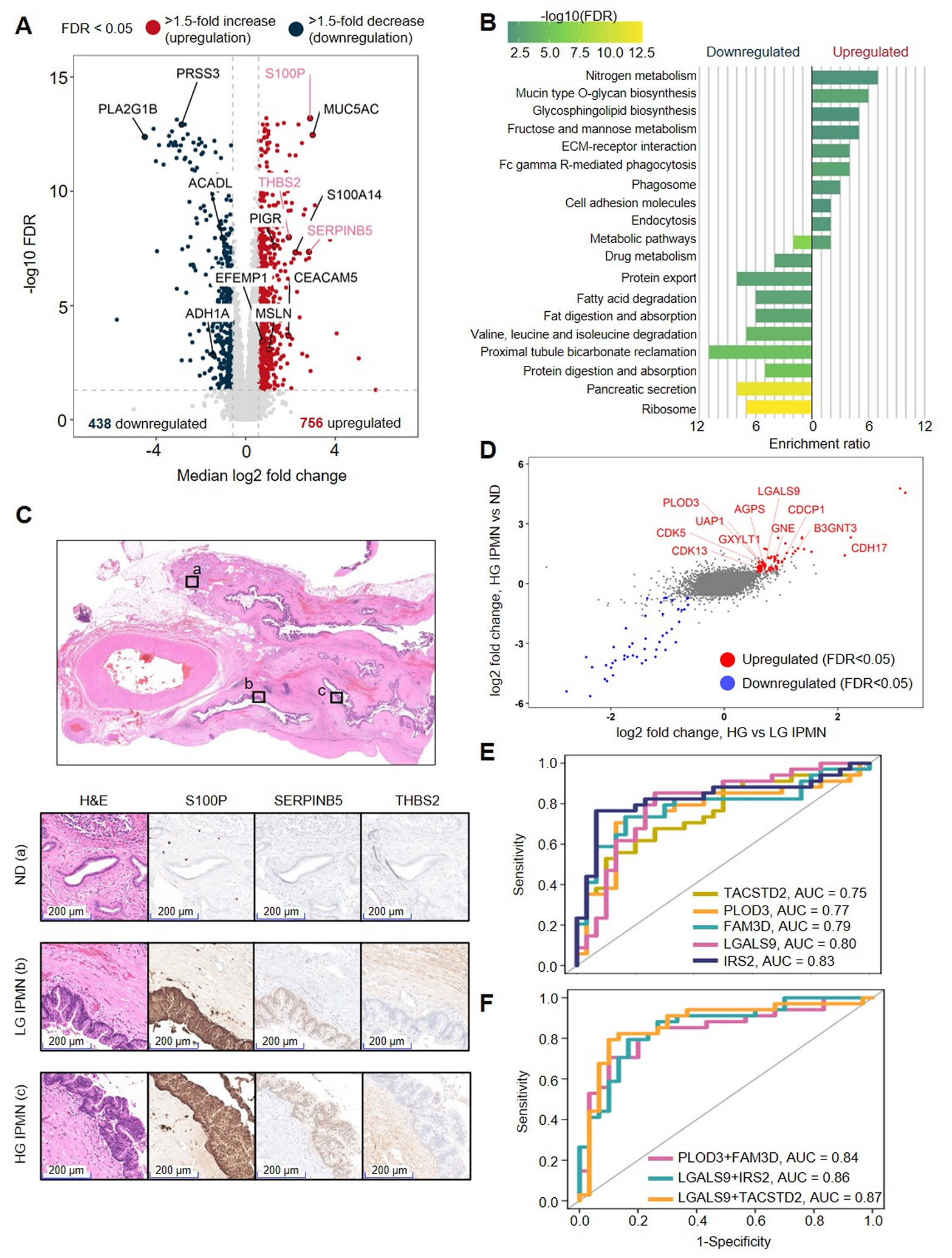
A. Comparison of 64 IPMNs and 76 normal duct tissues (NDs). Proteins with immunochemistry labeling are in pink. The p-values were computed using two-sided Wilcoxon rank sum test and adjusted (false discovery rate, FDR) using Benjamini-Hochberg method. B. KEGG pathway enriched by using upregulated and downregulated proteins in IPMN tissues relative to NDs. C. IHC labeling results of S100P, SERPINB5, and THBS2 in ND, low-grade (LG) IPMN, and high-grade (HG) IPMN. D. Significantly upregulated (red) and downregulated (blue) proteins in 34 HG IPMNs relative 30 to LG IPMNs and 76 NDs. Proteins associate with glycosylation/cancer progression are named in red. E. Individual proteins show potential clinical utilities for HG IPMN detection based on the ROC analysis. F. Multi-protein panels improve the performance of distinguishing HG IPMNs from LG IPMNs. The proteins and multi-protein panels in E and F are selected as examples. A comprehensive ROC results can be found in the corresponding supplementary table. Also see Figure S2 and Table S2.
Notably, 88 of the 756 proteins overexpressed in the IPMNs were also reported as upregulated in PDACs in our previously published study 32 (Supplementary Table S2H). Some proteins previously reported as overexpressed in low-stage PDAC, such as S100P, SERPINB5, and THBS2, were also upregulated in the IPMNs relative to NDs (highlighted in pink in Fig. 2A) 32. Proteins highly abundant in NDs were associated with normal pancreatic functions, including protein and fatty acid digestion and absorption, as well as pancreatic secretion (Fig. 2B).
Localization of protein expression
Samples of IPNs and PDACs contain a mixture of neoplastic and non-neoplastic cells 51,52. Proteins overexpressed by the neoplastic cells are more likely to be released into cyst fluid than those expressed in the stroma. We utilized a previously published database of genes differentially expressed in the neoplastic cells and stroma of PDAC to define the most likely compartment for each overexpressed protein identified in the IPMN tissues53. As shown in Supplementary Table S2I, transcripts such as S100P and SERPINB5 were previously shown to be elevated in PDAC neoplastic cells, whereas transcripts such as thrombospondin 2 (THBS2), and polymeric immunoglobulin receptor (PIGR) were previously identified as elevated in the stromal compartment. The thrombospondins function in cell-matrix interactions, and PIGR has been reported to be a marker of immunologically "hot" tumor nests 53,54.
We next validated the expression of selected proteins by immunolabeling, which not only confirmed their overexpression but also revealed the specific cellular compartments in which they were localized. As shown in Fig. 2C and Supplementary Table S2J, antibodies to S100P and SERPINB5 demonstrated that these proteins were overexpressed by the neoplastic cells, while antibodies to THBS2 labeled the stromal cells.
Proteins identified in the IPMNs can be detected in pancreatic cyst fluid
Given that cyst fluid can be sampled endoscopically, it provides a minimally invasive opportunity for cyst classification, particularly if the proteins expressed by the neoplastic cells are released into the cyst contents22-27. Therefore, we examined whether proteins upregulated in IPMNs are also present in cyst fluid by analyzing 24 samples, including 22 with matched IPMN tissues (discovery cohort; Supplementary Fig. S2A and Table S2K). A number of proteins upregulated in IPMNs also had similar expression patterns in cyst fluid samples. Members of the S100 protein family, including S100A6, S100A11, and S100P, were highly expressed in IPMNs and abundant in the cyst fluid samples. Additionally, MUC5AC, a major carrier protein for CA-19-9, was also highly expressed in cyst fluids (Supplementary Fig. S2B). To further validate our findings, additional 23 cyst fluid samples (10 SCNs, 6 low-grade IPMNs, 7 high-grade IPMNs; validation cohort) from an independent cohort were included (Supplementary Table S2L) and similar expression patterns were observed for the aforementioned proteins (Supplementary Fig. S2B).
Tumor grade/histology subtype associated proteins with potential biomarkers for disease progression
It is clinically important to distinguish IPMNs with low-grade dysplasia from those with high-grade dysplasia, and from IPMNs with an associated invasive carcinoma55. Those with low-grade dysplasia can be safely followed, while the presence of high-grade dysplasia or IPMNs with an associated invasive carcinoma ( “high-grade IPMN” in following analyses refers to both high-grade dysplasia and IPMN with an associated invasive carcinoma together) typically warrants surgical resection55,56. A total of 67 proteins were significantly overexpressed in high-grade IPMNs compared to those with low-grade dysplasia (Supplementary Table S2M). These included proteins related to glycosylation biosynthesis, such as PLOD3, GXYLT1, UAP1, GNE, and B3GNT3. Among these glycan synthetic proteins, GNE (Glucosamine (UDP-N-acetyl)-2-epimerase/N-acetylmannosamine kinase) is a key enzyme required for the modification of sialic acid on glycoproteins, a crucial modification for the stability and recognition of glycoproteins, and implicated in tumor progression57. Other upregulated proteins such as CDH17, AGPS, CDK5, LGALS9, CDCP1, TACSTD2, and CDK13 are involved in pathways and networks that influence tumor invasion and progression. To identify proteins associated with progression risk in high-grade IPMNs, we focused on proteins overexpressed in both high-grade IPMNs relative to low-grade IPMNs and high-grade IPMNs relative to NDs. (Supplementary Table S2M, highlighted in red in Fig. 2D). Some of these upregulated proteins (Supplementary Fig. S2C), such as galectin 9 (LGALS9), multifunctional procollagen lysine hydroxylase and glycosyltransferase LH3 (PLOD3), and insulin receptor substrate 2 (IRS2), have been reported as upregulated in PDAC58-63. To verify our findings, we conducted immunohistochemical labeling of PLOD3, IRS2, and LGALS9, which confirmed their elevated expression in high-grade IPMNs (Supplementary Fig. S2D and Table S2J). We next developed laser microdissection (LMD) based proteomics workflow that enabled deep proteome coverage, identifying over 6,000 proteins in pancreatic tissue 64. PLOD3 and LGALS9 were further validated in an independent LMD analysis of 12 matched pairs of low-grade and high-grade IPMN samples from three patients (Supplementary Fig. S2E and Table S2N). We also observed elevated PLOD3 in low-grade and high-grade IPMN samples compared to SCN samples in cyst fluid (Supplementary Figure S2F and Table S2O).
We further evaluated the potential clinical utilities of the overexpressed proteins in high-grade IPMNs (compared to low-grade IPMNs) as individual protein signature and in different combinations through receiver operating characteristic (ROC) analysis (Supplementary Table S2P). Individually, PLOD3, LGALS9, IRS2, tumor-associated calcium signal transducer 2 (TACSTD2, also known as Trop-2), and family with sequence similarity 3, member D (FAM3D) had good performance in distinguishing high-grade and low-grade IPMNs with area under the curves (AUCs) ranging from 0.75 to 0.83 (Fig. 2E). The performance could be improved by using multi-protein signature panels, the AUC was increased to 0.87 when combining LGALS9 and Trop-2. Therapeutic antibodies targeting LGALS9 and Trop-2 have been reported in clinical trials or are available on the market65-67.
Different histological subtypes of IPMNs show distinct protein expression patterns. In gastric-type IPMNs, we identified 47 proteins that were upregulated compared to other subtypes of IPMNs. Interestingly, 23 of these 47 proteins also showed upregulation in low-grade IPMNs relative to high-grade IPMNs (Supplementary Table S2Q). For the intestinal-type IPMNs, 57 proteins were upregulated, including CEACAM5, MUC2, GNE, and CDH17 (Supplementary Fig. S2G). Of these, 14 were also upregulated in high-grade IPMNs compared to low-grade IPMNs (Supplementary Table S2R). MUC2 involves in the key process of intestinal-type IPMN differentiation and progression68. These results suggest potential biomarkers for tumor grade/histology subtype and progression.
The glycoprotein landscape of intraductal papillary mucinous neoplasms
Comparison of the glycopeptides identified in the 53 IPMNs (among 64 IPMNs, 11 lacked enough digested global peptides for glycopeptide enrichment and the 5 IOPNs were excluded) with available glycopeptide data to those identified in the 66 NDs (among 76 NDs, 10 lacked enough digested global peptides for glycopeptide enrichment) revealed that 2,327 glycopeptides were significantly upregulated more than 1.5-fold and 1,270 glycopeptides were downregulated more than 1.5-fold in the IPMNs (Fig. 3A, Supplementary Table S3A). Cell surface glycoproteins, such as CEACAM569, integrins (ITGA5, ITGB1)70,71, and mucins (including MUC1, MUC2, MUC4, MUC5AC, MUC5B, MUC6, and MUC13)47,72 that were overexpressed are known to facilitate cell adhesion and form protective barriers around the tumor surfaces. Additionally, CD27673,74, CD4775,76, and other immune-related glycoproteins previously discovered as PDAC-associated proteins 73-77, were also found to be upregulated in IPMNs (Supplementary Table S3). Similar patterns of glycoprotein expression were observed when only the IPMNs with a somatic mutation were considered (Supplementary Fig. S3A and Table S3B). The glycoproteins expressed in the IOPNs are separately listed in Supplementary Table S3C.
Figure 3. Altered glycosylation in 53 IPMNs.

A. Comparison of glycopeptides in 53 IPMNs and 66 NDs. The p-values were computed using two-sided Wilcoxon rank sum test and adjusted using Benjamini-Hochberg method. B. Expression changes in glycopeptides in comparison to the changes in global protein levels (IPMN vs NDs). C. Significantly enriched GO biological functions of upregulated and downregulated glycopeptides in instances in which the proteins were unchanged at the global level. D. Examples of individual glycopeptides and combination of glycopeptides capable of differentiating IPMNs from NDs. E. glycopeptides with differential expression in KRAS-mutant IPMNs or both KRAS- and GNAS-mutant IPMNs compared to KRAS-wildtype (WT) and/or GNAS-WT IPMNs. Also see Figure S3 and Table S3.
More than 130 proteins were upregulated at both the global protein and glycoprotein levels (Supplementary Tables S3D). These included mucins (MUC5AC, MUC6, and MUC13) and mucin-type O-glycan synthetic enzymes (C1GALT1C1, GALNT3, GALNT6, and GCNT1). Extracellular matrix (ECM) interaction proteins78 such as CD4776,77, integrins (ITGA2, ITGA9, ITGB4, ITGB6, and ITGB8)79, and laminins (LAMA3, LAMB3, and LAMC2)80, were also upregulated at both the global protein and glycoprotein levels, indicating changes in the tumor microenvironment in IPMNs.
Comparison of glycopeptide expression to global protein expression revealed that some changes in expression were only observed at the glycopeptide level, while others were only observed at the protein level (Fig. 3B, Supplementary S3D). This finding highlights the importance of characterizing both proteins and glycopeptides, as protein expression may not always equate to glycosylation modification81. To reveal the unique pattern of glycoprotein expression compared to protein expression in IPMNs, we analyzed the biological function (GO terms) of upregulated or downregulated glycopeptides whose global protein expression remained unchanged (Supplementary Table S3E). Some upregulated glycoproteins functioned in integrin-mediated signaling and leukocyte migration, indicating changes in the tumor microenvironment (Fig. 3C). Metabolic-related functions were also upregulated in the IPMN glycoproteome in instances where the global protein expression remained unchanged. Downregulated glycoproteins included those involved in cell-cell adhesion mediated by cadherin, an important modulator of epithelial-mesenchymal transition (EMT) during tumor progression82.
A comparison of glycopeptide expression in 53 IPMNs to 69 NDs revealed a number of glycoprotein changes associated with IPMNs (Supplementary Fig. S3B and Table S3F). Several glycopeptides and combinations of glycopeptides produced a mean bootstrap AUC > 0.7 (Supplementary Fig. S3B and Table S3F-S2G) in distinguishing IPMNs from NDs. Including upregulated and downregulated glycopeptides, individual markers, including CADM4-N262, FCGBP-N1317, LMF2-N489 and PIGR-N469, achieved AUCs between 0.71 and 0.87 (Fig. 3D). These AUCs improved to as high as 0.9 when markers were combined (Fig. 3D).
We next compared the patterns of glycopeptide expression in 17 IPMNs that harbored mutations in KRAS and GNAS to the 15 wildtype IPMNs ( “wildtype IPMNs” in following content and figures refers to IPMNs that lacked any detected somatic mutations) (Fig. 3E). There were 71 glycopeptides involving 56 glycoproteins upregulated in IPMNS with both KRAS and GNAS mutations compared to wildtype IPMNs (Supplementary Table S3H-S3I). These included O-glycosylation enzymes such as C1GALT1C1, GALNT3, GALNT5, GCNT1, and ST6GALNAC1. This pattern could be explained by the activation of the PI3K-AKT signaling pathway in the cells with mutations. PI3K-AKT pathway-related glycoproteins, including EPHA2, ERBB3, ITGA6, MET, and YWHAH, were also observed among the upregulated glycoproteins, as were transporter glycoproteins (ATP1A3, ATP6V0A2, CNNM4) related to inorganic ions, such as Na+/K+, H+, and Mg2+. These findings suggest that the neoplastic cells in IPMNs with mutations in KRAS or GNAS undergo significant adjustments in ion balance and reprogram metabolic processes to meet high metabolic demand.
ECM related proteins upregulated during neoplastic progression
We selected 104 of the most cellular (tumor cellularity >15%) PDACs and 43 of their matched NATs from a previously reported series of PDACs and reanalyzed them using DIA-MS 32 (Fig. 4). In principal component analysis (PCA), the PDACs, IPMNs, and normal samples (NDs and NATs) clustered separately (Fig. 4A). The IPMN samples clustered between PDACs and normal samples, supporting the transitional stage that IPMNs occupy between normal ductal tissue and invasive cancer83,84. Comparing the protein expression in the 104 PDACs to the matched 43 NATs revealed 1,539 proteins significantly upregulated more than 1.5-fold, and 902 proteins significantly downregulated more than 1.5-fold in the cancers (Supplementary Fig. 4A and Table S4A). The vast majority of these proteins have been reported previously, and a number of them, such as S100P, THBS2, and SERPINB5, were also overexpressed in IPMNs (Figs. 2A, Supplementary S4A). To determine whether these proteins were expressed by neoplastic cell or stroma components, we first utilized a previously published spatial database (Supplementary Table S2I)53. We then validated the expression and cellular localization of select proteins (S100P, SERPINB5, and THBS2) in PDAC tissues using immunohistochemistry (Fig. 4B, Supplementary Table S2J)51,52. Specifically, S100P and SERPINB5 were expressed by invasive cancer cells, while THBS2 was predominantly expressed by stromal cells. To further investigate which IPMNs are more associated with PDACs, we identified 1,670 proteins significantly changed in PDACs compared to NATs and normal ducts and calculated an association score between PDACs and IPMNs based on these proteins (Supplementary Table S4B-S4C). Eight IPMNs clustered with PDACs (Fig. 4C), each having a relatively high association score (≥ 0.88). We further examined the 1,670 proteins and found 351 proteins that were overexpressed in PDACs and in some IPMNs that grouped with PDACs compared to the remaining IPMNs (Supplementary Table S4D). These proteins are potential markers of IPMN progression since they were elevated in IPMNs with higher PDAC association scores. Among these 351 proteins, those related to invasion and metastasis, such as cell adhesion, cytoskeletal dynamics, cell motility, and ECM proteins warrant more investigation (Fig. 4D, Supplementary Table S4E). Upregulated proteins included ECM regulators and collagen-modifying enzymes such as PLOD3, ECM glycoproteins such as fibronectin (FN1) and tenascin (TNC) expressed by fibroblasts, and proteoglycans including lumican (LUM) involved in collagen fibril organization, all of which were associated with invasive tumor progression (Fig. 4E). About 60 ECM proteins showed notable changes during the transition from IPMN to PDAC, including ECM-affiliated proteins, ECM glycoproteins, ECM regulators, proteoglycans, and secreted factors (Fig. 4F, Supplementary Table S4F). We found 106 proteins that were downregulated in PDACs and IPMNs with high association scores relative to remaining IPMNs, and these were enriched in metabolic processes (Fig. 4D). These 351 upregulated and 106 down regulated proteins are potential markers for the early detection of IPMN with high progression potential.
Figure 4. Proteomic comparison between IPMNs and PDACs with high tumor cellularity.

A. PCA analysis of the cohort. B. IHC labeling results of S100P, SERPINB5, and THBS2 in PDAC tissue. C. Hierarchical clustering of 104 PDACs and 64 IPMNs, where 8 IPMNs with high association scores group with PDACs. D. Enriched GO biological processes using overexpressed and downregulated proteins in PDACs and IPMNs grouped with PDACs compared to the remaining IPMNs. E. Examples of the proteins showing significant changes between PDAC-associated IPMNs (n=8) grouped with PDACs (n=104) relative to non-PDAC associated IPMNs (n=56). F. PDAC-associated IPMNs and PDAC had abundant ECM proteins compared to non-PDAC associated IPMNs. The ECM proteins were also differentially expressed in PDAC-associated IPMNs and PDAC relative to non-PDAC associated IPMNs. G. ECM proteins differentially expressed in one of the NMF clusters that are disease-related and/or potential drug targets based on Human Protein Atlas. Also see Figure S4 and Table S4.
Proteomic subtyping highlights the heterogeneity of intraductal papillary mucinous neoplasms
IPMNs can be morphologically classified into three subtypes: gastric-type, intestinal-type, and pancreatobiliary-type85,86. Furthermore, IPMNs can be categorized as having low-grade dysplasia, high-grade dysplasia, and as having an associated invasive cancer, based on the degree of cytoarchitectural atypia and the presence or absence of an associated invasive cancer85,86. However, these subtypes or classifications are not based on molecular characterization. We applied proteomics based NMF subtyping strategies to the IPMNs and PDACs to explore tumor heterogeneities and reveal progression features87. This analysis showed three clusters (Supplementary Fig. 4B and Table S4G-S4H), NMF 1 was entirely composed of PDACs. NMF 2 included some PDACs and some IPMNs, while NMF 3 was almost entirely composed of IPMNs with only one PDAC. Most (75%) IPMNs with an associated PDAC were clustered in NMF 2. KEGG pathway enrichment using signature proteins distinguished these three clusters (Supplementary Fig. 4C and Table S4I). Notably, NMF 3 was enriched in amino sugar metabolism, metabolic processes, and pancreatic secretion. Several mucin glycosylation related enzymes in NMF 3, such as UDP-galactose-4-epimerase (GALE), Glutamine-fructose-6-phosphate aminotransferase 1 (GFPT1), GNE, and Glucosamine-phosphate N-acetyltransferase 1 (GNPNAT1), are involved in amino sugar metabolism. The sodium/potassium-transporting ATPase (ATP1A1, ATP1B1) and ADP/ATP translocase (SLC25A4) found in NMF 3 are key players in metabolic processes. Ras-related proteins (RAB27B, RAB3D) found in NMF 3, which control the maturation, trafficking, and exocytosis of secretory vesicles are highlighted in pancreatic secretion. These unique features of NMF 3 indicate reprogrammed metabolic processes associated with increased mucin glycan synthesis and extracellular vesicle secretion.
Major differences between NMF 2 and NMF 3 include elevated collagen and matrix proteins (COL4A1, COL4A2, COL4A5, COL6A1, COL6A2, COL6A3, TNXB) in NMF 2, which are enriched in the pathways of ECM-receptor interaction, PI3K-Akt signaling, and others (Fig.4G). These findings highlight the reorganization of the ECM interactions during the progression from IPMNs to PDACs. In NMF1, Gelatinase A (MMP2) and FN1, along with glycoprotein laminins (LAMB3, LAMA3) and membrane-related regulator proteins (ANXA2, ANXA5), highlight cell adhesion and migration pathways and proteoglycan interactions in cancer (Fig.4G, Supplementary Table S4J). Clustering analysis provides new insights into the progression from non-invasive precursor lesions to invasive pancreatic cancer.
Intraductal papillary mucinous neoplasms immune protein signatures
To better understand the dynamics and features of the microenvironment in different NMF clusters, we classified microenvironment protein signatures, particularly focusing on immune protein signatures and the degree of immune infiltration (Supplementary Fig. S4D)88. We annotated the samples in the NMF 3 as “immune hot” neoplasms due to the infiltration of various CD8+ T cell subtypes. The NMF 1 cluster, entirely composed of PDACs, exhibits “cold” signatures with CD8+ naïve T-cells and CD8+ central memory T cells (CD8+ Tcm), which suggests an exhausted immune response and could lead to immune evasion by the invasive cancer89,90. These immune protein signatures add additional value to the molecular level clustering and help to understand cancer progression.
Discussion
The mortality rate of invasive pancreatic cancer remains extremely high1,91. Although the detection and surgical resection of non-invasive precursor lesions, including IPMNs, ITPNs, and IPONs (collectively IPNs), offers a hope to cure but also carries risks of overtreatment 18,19. Even with modern imaging and somatic mutation testing, many surgically resected lesions are ultimately diagnosed as other types of neoplasms or low-grade IPMNs18,19,92.
To better understand IPNs and identify clinically useful markers, we characterized deep proteomic and glycoproteomic profiling using MS on normal pancreatic ducts and IPNs of different genomic backgrounds, grades, and histologic subtypes (Fig. 1). We focused on IPMNs, the most prevalent IPN subtype, and identified a number of upregulated proteins and glycoproteins (Figs. 2A and 3A, Supplementary Tables S2A and S3A), such as CEACAM5, MUC1, MUC2, MUC4, MUC5AC, MUC6, and MUC1372,83. The various overexpressed proteins and glycoproteins identified have clinical significance as many can be detected in clinically obtainable cyst fluid (Supplementary Figs. S2A and S2B). Several markers such as PLOD3, LGALS9, and IRS2 were validated by immunolabeling and LMD (Supplementary Figs. S2D and S2E), and a multi-marker panel associated with high-grade IPMNs achieved an AUC reached 0.87 (Figs. 2E and 2F).
Two methods, mining a previously reported spatial database and immunolabeling, were employed in this study to classify the cellular compartment (neoplastic cells or stroma) in which the various proteins and glycoproteins were likely expressed (Figs. 2C and 4B, Supplementary Tables S2J)93,94.
To investigate IPMN in the boarder context of tumor progression, we re-analyzed proteomic profiles of PDACs and NATs using the same MS platform32. PCA clustering positioned IPMNs between PDACs and normal samples (NDs and NATs) (Fig. 4A), supporting the hypothesis that IPMNs represent a transitional stage in pancreatic carcinogenesis83,84,95,96. Among the 1,670 proteins significantly changed in PDACs compared to normal samples, 351 proteins were overexpressed in both PDACs and the 8 IPMN that clustered PDACs with significant ECM proteins involved (Fig. 4F).
NMF clustering within IPMNs and PDACs revealed three clusters, NMF 1 (PDACs), NMF 2 (mixed), and NMF 3 (mostly IPMNs) (Supplementary Fig. S4B), that reflect key biological transitions (Fig. 4C). NMF 3 was enriched in metabolic processes, N-glycosylation processes and pancreatic secretion. NMF 2 showed ECM remodeling, while NMF 1 showed invasive features. The transition from IPMNs to PDACs can be distinguished by N-glycosylation enzymes (GFPT1, GNE, GNPNAT1, PMM2, and UAP1), ECM interaction proteins (CD47, integrins, and laminins), and ECM proteins such as collagen proteins and matrix proteins (Fig. 4G). Cancer invasion and metastasis related proteins, such as ITGA5, PLOD3, ELMO1, MMP2, and FN1, are overexpressed as disease progresses
In summary, we present protein and glycoprotein changes from NDs to IPMNs and invasive pancreatic cancer, providing evidence-based approaches for early detection and the development of potential treatment targets. Integrating these biomarkers with genomic data to develop a multi-parameter diagnostic model could enhance the accuracy of early detection. Further studies explore the potential of these markers in clinical cyst fluid analysis for personalized management of patients with a pancreatic cyst 27.
Limitations of the study
There are several potential limitations of this study that should be acknowledged. First, we relied on surgically resected tumors, and many of the neoplasms included in this study were low-grade tumors. We therefore paired high-grade IPMNs with IPMNs with an associated invasive cancer in this study. Further studies focusing on purely high-grade IPMNs and, in particular, on the changes in expression that occur early in the transition from high-grade dysplasia to invasive carcinoma are warranted. Second, while the use of surgically resected tumors enabled the analysis of more than two hundred samples together, the bulk sampling approach employed is unable to provide cell type specific and spatial resolution. To overcome this limitation, we developed an LMD based spatial proteomics approach 64 and applied it to validate the grade associated proteins in this study (Supplementary Fig. S2E). Given the limited throughput of patient cases for the single-cell and LMD analyses, future studies integrating the single-cell data with bulk profiling, such as through cell state and ecotype analyses, will be critical for achieving a more comprehensive understanding.
STAR★Methods
EXPERIMENTAL MODEL AND STUDY PARTICIPANT DETAILS
Clinical specimens
Fresh tissue samples from adult patients with IPMN and other pancreatic diseases (including SCN, MCN, and ND) who underwent surgical resection were collected under ethical approval from the Johns Hopkins University Institutional Review Board (IRB 00282409). Consent was waived for the acquisition of tissue under this protocol. Cyst fluid samples were collected under Johns Hopkins IRB protocol (NA _00001584). For this latter protocol written informed consent was obtained from all patients prior to sample collection. Reanalyzed PDAC tumor and NAT samples were derived from leftover peptides generated in a previous study32, in accordance with CPTAC guidelines.
Fresh tissue, including 76 macrodissected normal main pancreatic ducts and 69 IPNs (64 IPMNs and 5 IOPNs), 5 SCNs, 4 mucinous cystic neoplasms (MCNs), and 32 cyst fluid samples (22 matched with analyzed IPMNs), was harvested from 126 patients (59 males, 67 females, age range 21 to 87) from five different countries who underwent surgical resection for a pancreatic lesion. Cyst fluid was aspirated at the surgical pathology bench from 22 of the analyzed IPMN-matched patients, 2 were from other IPMN patients, 3 IOPN patients, and 5 other IPMN cyst samples. The other 5 cyst fluid samples were from other pancreatic neoplasms including 2 MCNs, 2 SCNs and 1 solid pseudopapillary neoplasm. Additional 23 cyst fluid samples were analyzed as validation cohort, 10 were from SCN patients, 6 were from low-grade IPMN patients, and 7 were from high-grade IPMN patients. Of the 76 main pancreatic duct specimens, 32 were harvested from the 64 patients with an IPMN, and 44 were harvested from patients who underwent surgery for a neoplasm that does not involve the duct system. In addition, 104 PDAC fresh-frozen samples with >15% neoplastic cellularity and 43 PDAC matched NATs were obtained from a previous multi-omics study of 144 PDACs cohort and rerun on the same platform as the normal duct, IPMN and cyst fluid samples (DIA-MS technology) 32. The hematoxylin and eosin-stained sections of all IPMNs were reviewed by one pathologist (T.F.) and the diagnosis, direction of differentiation, and histologic grade confirmed. 16 independent formalin-fixed and paraffin-embedded IPMNs were selected from the files of the Johns Hopkins Hospital for immunolabeling (Supplementary Table S2J).
METHOD DETAILS
DNA extraction, library preparation, and targeted next-generation sequencing
DNA was extracted from cryo-pulverized fresh frozen tissue using the QIAamp DNA FFPE Tissue Kit (Qiagen, Hilden, Germany) and a modified protocol98. In brief, tissue was enzymatically digested overnight, mechanically sheared (M220 Focused-ultrasonicator, Covaris, Woburn, MA), and DNA extracted following the manufacturer’s instructions. DNA concentration and base-pair length were quantified using an electrophoresis device (TapeStation System, Agilent, Santa Clara, CA).
Library preparation was performed using the SureSelect XT HS2 DNA System (Agilent, Santa Clara, CA) as suggested, with the modification of using half the probe volume that is indicated in the original protocol for preparing the probe hybridization mix in some samples. A customized panel of 12 established pancreatic driver genes (BRAF, CDKN2A, CTNNB1, GNAS, KLF4, KRAS, PIK3CA, PTEN, RNF43, SMAD4, TP53, VHL) was used for capture (Supplementary Table S1C). In total, our gene panel contained 1,115 probes across 142 genomic regions (Supplementary Table S1D). Prepared libraries were stored at −20 °C until sequencing. Libraries were pooled and sequenced on a MiSeq instrument (Illumina, San Diego, CA) using the MiSeq Reagent Kit v2 and generating 2x 150 base-paired reads.
Sample processing for protein extraction from tissues, tryptic digestion, and global proteomic sample preparation
All tissue samples for this study were processed for mass spectrometry (MS) analysis at Johns Hopkins University. The sample preparation for global proteomic analysis followed the previous described approach in PDAC study, and glycoproteomic analysis was carried out by liquid handing systems as previous published work32. All tumor and normal ductal tissue samples were cryo-pulverized and lysed in urea lysis buffer as previously published standard protocol 99 (8 M urea, 75 mM NaCl, 50 mM Tris pH 8.0, 1 mM EDTA, 2 μg/mL aprotinin, 10 μg/mL leupeptin, 1 mM PMSF, 10 mM NaF, phosphatase inhibitor cocktail 2 [1:100 dilution], phosphatase inhibitor cocktail 3 [1:100 dilution], and 20 μM PUGNAc) by sonicating for 30s x 3 in ice water). Tissue debris was removed by centrifugation at 16,000 x g for 15 min at 4 °C. The lyzed protein supernatant was collected, the concentration was measured by BCA assay and adjusted to 8 mg/mL in 8M urea lysis buffer. The lyzed proteins were reduced with dithiothreitol (6 mM, 37 °C, 1h) and alkylated by iodoacetamide (12 mM, room temperature in dark, 45 min). After that, the reduced proteins were diluted to 2M urea concentration with 50 mM Tris-HCl pH 8.0 buffer, digested by Lys-C (enzyme to protein ratio is 1 mAU:50 mg, 2h at room temperature) and trypsin (enzyme to protein ratio is 1 mg:50 mg, overnight incubation at room temperature), respectively. The proteolytic reactions were quenched by 50% formic acid to adjust pH < 3. About 5 μg digested peptides were aliquoted for global proteomics analysis by stage tip desalting and dried using Speed-Vac (Thermo Scientific). 1 μg peptides were loaded on Evotip (Evosep Biosystems) according to the EvosepOne (Evosep Biosystems) protocol for global proteomic analysis on timsTOF-HT (Bruker). The remaining digested peptides were desalted on reverse phase C18 96-well plate and dried using Speed-Vac for glycopeptide enrichment.
Enrichment of glycopeptides by liquid handing systems from global peptides
As previously reported, C18/MAX-Tips were conditioned using acetonitrile, 100 mM triethylammonium acetate, 95% acetonitrile in 1% TFA, and 0.1% TFA, respectively in Versette Liquid Handling System (Thermo Scientific). The remaining digested peptides were reconstituted in 300 μL 0.1% TFA (trifluoroacetic acid), about 200 μg global peptides bound onto the C18/MAX-Tips (20 cycles) and washed with 0.1% TFA (10 cycles). After that, the non-glycopeptides were eluted from the C18/MAX-Tips with 200 μL 95% acetonitrile in 1% TFA (3 x 10 cycles), and glycopeptides were sequentially eluted with 200 μL 50% acetonitrile in 1% TFA (3 x 10 cycles). Samples were dried using Speed-Vac. The dried glycopeptide samples were resuspended in 40 μL 0.1% TFA and aliquoted 20 μL glycopeptide out into a 96-well plate. PNGaseF digestion buffer (2μL 1000 units PNGaseF added to 98 μL 100mM triethylammonium bicarbonate, TEAB) was added to the 96-well plate and reacted at 37 °C overnight. The reaction was quenched by formic acid to adjust pH < 3 and cleaned up by stage-tip. The samples were dried and prepared for five injections and loaded one injection on Evotip (Evosep Biosystems) for glyco proteomic analysis on timsTOF-HT (Bruker).
Deparaffinization and Staining of FFPE Tissue Sections for LMD Analysis
Pancreatic cancer FFPE tissue sections mounted on PEN membrane slides were deparaffinized to remove residual paraffin. Slides were immersed in 100% xylene for 10 minutes, followed by transfer to a fresh xylene solution for an additional 10-minute incubation. For rehydration, the slides were sequentially immersed in 100%, 70%, and 50% ethanol, and then in distilled water, each for 5 minutes. Prior to staining, slides were equilibrated in 1× phosphate-buffered saline (PBS). PBS was gently removed by tapping the slide onto a paper towel. A total of 2 mL of hematoxylin was applied to cover the tissue section, followed by a 3-minute incubation. After rinsing with distilled water, slides were briefly immersed in 0.5% ammonium hydroxide for 1 minute to achieve bluing and then rinsed again with distilled water.
LMD tissue dissection
FFPE tissue slides were thoroughly air-dried at room temperature before microdissection. Slides were mounted onto the stage of the LMD7000 system (Leica, US), and regions of interest (ROIs) were identified under 20× magnification. Laser parameters were optimized for precise tissue dissection: power 54, aperture 1, speed 5, specimen balance 50, head current 100%, pulse frequency 773 Hz, and offset 110. Dissected tissue voxels were collected into the flat caps of 0.2 mL PCR tubes (Cat# 6571, Corning, Tamp, MEX) containing 20 μL of DMSO. Caps were carefully inspected after each LMD procedure to confirm successful collection of tissue fragments. Tubes were centrifuged at 15,000 × g for 1 minute and then subjected to vacuum centrifugation for 4 hours to ensure complete solvent removal.
Proteomic Sample Preparation of LMD samples
Dried tissue samples were reconstituted in 1.5 μL of lysis buffer composed of 0.1% n-Dodecyl-β-D-Maltoside (DDM), 0.02% Lauryl Maltose Neopentyl Glycol (LMNG), and 5 mM tris(2-carboxyethyl)phosphine (TCEP), all prepared in 100 mM TEAB. Samples were incubated at 80°C for 1 hour with a heated lid set to 100°C. After a 5-minute sonication, samples were cooled to room temperature. Proteolytic digestion was performed by addition of 0.5 μL of Lys-C (50 ng/μL) and 0.5 μL of trypsin (50 ng/μL), followed by overnight incubation at 37°C with a lid temperature of 57°C. Digestion was quenched by adding 0.5 μL of 5% formic acid and incubating at room temperature for 10 minutes. The resulting peptides were then transferred and loaded onto pre-conditioned Evotips (Evosep Biosystems) in accordance with the manufacturer’s protocol.
EVOSEP-timsTOF for global and glycoproteomic analysis
EvosepOne (Evosep Biosystems) LC system was coupled with timsTOF-HT mass spectrometry. Global peptides and glycopeptides were loaded on Evotip and separated on PepSep C18 column of 15 cm x 150 μm, 1.5 μm (Bruker) in Bruker column toaster (50 °C) at a 30 SPD gradient. The global proteomic data was acquired using the DIA-PASEF mode on timsTOF-HT with settings as follows: MS1 scan range of 100-1700 m/z; MS2 scan range of 338-1338 m/z, mass width 25.0 Da without mass overlap, 1 mobility window, 1/K0 range of 0.70-1.45 V·s/cm2, ramp time 85.0 ms. The glycoproteomic data was acquired using the DIA-PASEF mode on timsTOF-HT with settings as follows: MS1 scan range of 100-1700 m/z; MS2 scan range of 338-1488 m/z, mass width 25.0 Da without mass overlap, 1 mobility window, 1/K0 range of 0.70-1.45 V·s/cm2, ramp time 85.0 ms. The samples were randomized and blinded to the individual generating the data. Replications of pooled samples were used as quality control throughout the entire data generation process.
Spectral library generation for DIA-MS analysis of global proteomics and glycoproteomics
Spectral library was generated in Spectronaut® 18.4 (Biognosys AG) by combination of all search archives from semi- specific and full-specific tryptic searches, which contained entire patient sample cohort. The Pulsar search settings for the global proteomic search archive generation were selected semi-specific (or full-specific) tryptic digestion with up to two missed cleavages within the length range of 7–52 amino acids. The search was perfomed against the UniProtKB reviewed human proteome (20,426 entries; FASTA file was downloaded on 09/15/2023). Carbamidomethylation of cysteine (C) was set as the fixed modification. Oxidation of methionine (M) and acetylation of protein N-terminal were set as the variable modifications. The library generation settings were followed BGS factory settings with all PSM FDR, peptide FDR and protein FDR below 0.01. The settings for the glycosite-containing peptide library generation were similar to those for the global proteomic library generation, with deamidation of asparagine (N) to aspartic acid (D) added as a variable modification.
Immunohistochemistry
FFPE tissue blocks containing human primary tumors were sectioned at 4 mm onto Superfrost Plus microscope slides (VWR International, catalog 48311-703). Automated immunohistochemistry was performed at the Oncology Tissue and Imaging Services Core of the Johns Hopkins University School of Medicine using a Ventana Discovery Ultra automated slide staining system (Roche). Reagents used for deparaffinization, heat-induced epitope retrieval, and chromogenic signal detection were obtained from Roche and used according to the manufacturer’s protocol. Heat induced epitope retrieval (HIER) was performed using Ventana Ultra CC1 buffer (Roche, catalog 6414575001) at 96°C for 64 minutes. Following HIER, primary antibodies were at incubated at 37°C for 60 minutes under the following conditions: anti-S100P antibody, anti-SERPINB5 antibody, anti-THBS2 antibody, anti-IRS2 antibody, anti-Galectin 9 antibody, and anti-PLOD3 antibody. Primary antibodies were detected using an anti-rabbit HQ and anti-HQ HRP detection system (Roche, catalog 7017812001 and 7017936001) followed by Chromomap DAB IHC detection (Roche, catalog 5266645001) according to the manufacturer’s protocol.
QUANTIFICATION AND STATISTICAL ANALYSIS
Genomic data analysis
Data processing and mutation call
Following removal of duplicate reads, sequence reads were aligned to human genome 38 (hg38; Human_GRCh38.p13_MajChr) using NextGENe (SoftGenetics, State College, PA). After alignment, putative somatic mutations were filtered based on the following criteria: 1) a total coverage of at least 6 distinct reads at the mutation position; 2) at least 4 distinct reads supporting the mutation; 3) mutation allele frequency (MAF) of >5% for single base substitutions (SBSs), >10% for indels, and >20% for homopolymer indels. Software-based mutation calls were inspected with NextGENe Viewer (SoftGenetics, State College, PA) and further processed using Excel (Microsoft, Redmond, WA). Putative somatic mutations in genes covered in our targeted panel listed above were selected and alterations designated by NextGENe as ‘noncoding’, ‘synonymous’, or ‘none’ removed.
With the goal to identify somatic mutations in our tumor samples, 17 unmatched normal ductal samples that lacked KRAS and/or GNAS somatic mutations served as normal tissue for reference. Putative somatic mutations identified in normal samples were classified as germline variants. Putative somatic mutations unique to the tumor samples were visually inspected using Integrative Genomics Viewer (IGV; Broad Institute, Cambridge, MA) and compared to the reference genome hg38 to remove sequencing artifacts. In addition, hotspots for KRAS (codons G12, G13, Q61) and GNAS (codon R201) were visually inspected in all samples using IGV, irrespective of software-based mutation call by NextGENe. After visual inspection putative somatic mutations in genes other than KRAS or GNAS, that were not present in the Genome Aggregation Database (gnomAD, Broad Institute, Cambridge, MA; datasets GRCh38 gnomAD v4.0.0; gnomAD v3.1.2; gnomAD v3.1.2 non-cancer) or present in with an allele frequency <0.1% in all populations, were classified as somatic mutations. Putative somatic mutations present in these databases in any population at an allele frequency >0.1% were classified as germline variants.
MS Data Interpretation
Global proteomic DIA data
All DIA raw files were searched against the spectral library described above with BGS default factory setting in Spectronaut, where mass tolerance of MS and MS/MS was set as dynamic with a correction factor of one. PSM FDR, peptide FDR and protein FDR were all set below 0.01. Crossrun normalization was enabled. Protein abundances were computed from the mean of the quantity of its top 3 peptides (stripped sequences), whereas the quantity of a peptide was the mean of the quantity of its top 3 precursors. Median normalization was further applied to generate the final protein expression matrix used in this study.
Glycoproteomic DIA data
All DIA raw were searched against the glycosite-containing peptide spectral library described above with BGS default factory setting (cross-run normalization was disabled). The peptides were identified and quantified by modified sequence Median normalization was applied to generate the final glyco-site containing peptide expression matrix used in this study.
Other proteomic analysis
Differential analysis
The differential analysis was carried out by calculating the median log2 fold changes for the following: (i) IPMNs vs NDs, (ii) HG vs LG IPMNs, (iii) HG IPMNs vs NDs, (iv) KRAS- and/or GNAS-mutant IPMNs vs KRAS- and/or GNAS-WT IPMNs, (v) Gastric-type IPMNs vs remaining subtypes of IPMNs, (vi) Intestinal-type IPMNs vs remaining subtypes, (vii) PDACs vs NATs, (viii) PDACs vs NDs, (ix) IPMNs (with high association score) and PDACs vs remaining IPMNs, and (x) one NMF cluster vs another NMF cluster on global proteomic or glycoproteomic level when applicable. The p-values were computed using two-sided Wilcoxon rank sum test and adjusted (false discovery rate, FDR) using Benjamini-Hochberg method.
Enrichment analysis for KEGG pathway and GO terms
KEGG pathways and GO enrichment analyses were performed using the over-representation analysis on the WebGestalt (version 2019) with default setting and top 10 enriched terms were exported97. Only significantly upregulated and/or downregulated proteins/glycopeptides were used in the analyses.
Protein abundance ranking for tissues and cyst fluids
Significantly upregulated proteins in IPMNs (vs NDs) with less than 75% missing values across all the cyst fluid samples were used to investigate the relation between IPMN tissues and cyst fluids. The protein abundances were z-score transformed and then ranked within each sample.
Association score calculation to determine whether an IPMN was more associated with PDAC
A total of 1,670 proteins were differentially expressed in PDACs compared to NDs and NATs, which were used for calculating the association between PDACs and IPMNs. In brief, median abundance was computed for each protein across 104 PDAC tissue samples. Association score was determined by calculating the Spearman correlation between abundances of the aforementioned 1,670 proteins in an IPMN tissue sample and the median abundances of those 1670 proteins in PDAC.
ROC analysis for differentially expressed proteins and glycopeptides
We performed the ROC analysis following a similar approach to our previous study100. In brief, the performance of each protein/glycopeptide signature panel (either composed of one or multiples) through logistic regression was evaluated using ROC analysis. The data were log-transformed followed by z-score (missing values were median imputed) prior to ROC analysis. We used bootstrap resampling (n = 500) of the data to construct and evaluate the predictive model of a panel to ensure statistical stability of the result. The mean ROC curves were depicted based on bootstrap resampling results and an AUC was computed for the mean ROC curve. The predictive models were built using caret (version 6.0–85) and ROC curves were generated using pROC (version 1.13).
ECM protein analysis
The ECM proteins were identified based on the list in a literature101. The abundance percentage was calculated by dividing the sum of abundances of proteins in an ECM category from the sum of the abundances of all ECM proteins. Information on whether an ECM protein was disease-related and/or a drug target that was obtained from the Human Protein Atlas (https://www.proteinatlas.org/).
Non-negative matrix factorization (NMF)-based clustering analysis
To further analyze the heterogeneity of IPMNs, we utilized NMF to perform proteomic clustering, including both IPMN and PDAC tissue samples. The clustering approach was conducted similar to our previous works32,35. Briefly, NMF was used to perform unsupervised clustering of tumor samples based on the abundances of proteins (only proteins with CVs in >10% quantile were used in the analysis). The feature matrix was scaled and standardized, thus all features were represented as z-scores. Since NMF requires a non-negative input matrix, the feature matrix was further converted as follows: (i) create one data matrix with all negative numbers zeroed, (ii) create another data matrix with all positive numbers zeroed and the signs of all negative numbers removed, and (iii) concatenate both matrices resulting in a data matrix with positive values and zeros only. The resulting matrix was then subjected to NMF analysis leveraging the NMF R-package87. To determine the optimal factorization rank k (i.e., number of clusters), a range of k from 2 to 5 was tested using default settings with 50 iterations. The optimal factorization rank k=3 (i.e., NMF 1, NMF 2, and NMF 3) was selected since the product of cophenetic correlation coefficient and dispersion coefficient of the consensus matrix was the maximum compared to other tested ks. The NMF analysis was repeated using 500 iterations for the optimal factorization rank. A list of representative features for each NMF cluster was derived that differential analysis was carried out using cluster-specific features by comparing one NMF cluster to the remaining NMF clusters as described in the Differential analysis section. Heatmap of NMF clusters was generated using ComplexHeatmap (version 2.4.3).
Immune protein signatures of each NMF cluster
The cell type gene signatures were downloaded from xCell 88 and we extracted protein abundances of these gene signatures from our global proteomic data. In this study, we focused on the cell types that were enriched in the immune-hot PDAC samples in our previous publication to examine differences among NMF clusters due to the degree of immune infiltration for the IPMN32. We found the association between cell type protein signatures and each NMF cluster. Based on the differential abundance (i.e., log2 fold change) between a NMF cluster and the remaining NMF clusters, a total of 112 protein signatures were obtained. Among the 112 protein signatures, 33, 41, and 38 proteins were significantly changed in NMF 1, NMF 2, and NMF 3, respectively. The abundance of each protein signature in a NMF cluster was weighted and signed by multiplying the protein abundances to the aforementioned log2 fold change. For each cell type in each NMF cluster, a cell type association score was calculated by summing up the weighted and signed abundances of the protein signatures. The cell type associated scores for each cell type were z-score normalized (i.e., normalized scores) among the NMF cluster. Sample processing for somatic mutation analyses
Analysis of location of proteins overexpressed by IPMNs
A list of genes that are enriched in PDAC cells compared to adjacent stromal cells was obtained from a previously published study 53. Using this list, we searched for genes that corresponded proteins that were found to be upregulated in IPMNs compared to normal ducts and classified them as likely expressed in neoplastic cells or as likely expressed in stromal cells. Filtered results are summarized in Supplementary Table S2I.
Supplementary Material
Table S1. Clinical information and genomic analysis in this study, related to Figures 1 and S1
Table S2. IPMN- and high grade-associated proteins and their validations in translational purpose, related to Figures 2 and S2
Table S4. Proteomic analysis of IPMNs with their progression features, related to Figures 4 and S4
Key Resource Table
| REAGENT or RESOURCE | SOURCE | IDENTIFIER |
|---|---|---|
| Antibodies | ||
| S100P | Abcam | ab124743 (RRID:AB_10976321) |
| SERPINB5 | Abcam | ab182785 |
| THBS2 | Abcam | ab112543 (RRID:AB_10863103) |
| PLOD3 | Thermo Fisher | 11027-1-AP (RRID:AB_2165781) |
| IRS2 | Abcam | ab134101 (RRID:AB_2810948) |
| LGALS9 | Cell Signaling | 54330S |
| Biological Samples | ||
| Primary tumor samples | See Experimental Model and Subject Details | N/A |
| FFPE tissue blocks | Johns Hopkins University | N/A |
| Chemicals, Peptides, and Recombinant Proteins | ||
| Superfrost Plus microscope slides | VWR International | 48311-703 |
| Ventana Cell Conditioning 1 (CC1) buffer | Roche | 05279801001 |
| PEN membrane slides | Zeiss | 415190-9081-000 |
| Sodium chloride | Santa Cruz Biotechnology | Catalog: sc-295833 |
| Tris(hydroxymethyl)amino methane (Tris) | Invitrogen | Catalog: AM9855G |
| Ethylenediaminetetraacetic acid (EDTA) | Sigma | Catalog: E7889 |
| Aprotinin | Sigma | Catalog: A6103 |
| Leupeptin | Roche | Catalog: 11017101001 |
| Phenylmethylsulfonyl fluoride | Sigma | Catalog: 93482 |
| Sodium fluoride | Sigma | Catalog: S7920 |
| Phosphatase Inhibitor Cocktail 2 | Sigma | Catalog: P5726 |
| Phosphatase Inhibitor Cocktail 3 | Sigma | Catalog: P0044 |
| Urea | Sigma | Catalog: U0631 |
| PUGNAc | Sigma | Catalog: A7229 |
| Dithiothretiol | Fisher Scientific | Catalog: 20291 |
| Iodoacetamide | Fisher Scientific | Catalog: A3221 |
| Lysyl endopeptidase (Lys-C), Mass Spectrometry Grade | Wako Chemicals | Catalog: 125-05061 |
| Sequencing grade modified trypsin | Promega | Catalog: V511X |
| Formic acid | Fisher Scientific | Catalog: A117-50 |
| Sep-Pak tC18 96-well Plate, 100 mg Sorbent per Well | Waters | Catalog: 186002321 |
| Oasis MAX 1 cc Vac Cartridge, 30 mg Sorbent per Cartridge | Waters | Catalog: 186000366 |
| Acetonitrile, Optima LC/MS | Fisher Scientific | Catalog: A955-4 |
| Water, Optima LC/MS | Fisher Scientific | Catalog: W6-4 |
| Anhydrous acetonitrile | Sigma | Catalog: 271004 |
| Trifluoroacetic acid (TFA) | Sigma | Catalog: 302031 |
| Triethylammonium acetate buffer | Sigma | Catalog: 90358 |
| PNGaseF | New England Biolabs | Catalog:P0705L |
| Triethylammonium bicarbonate (TEAB) | Fisher Scientific | Catalog: 90114 |
| Methanol | Fisher Scientific | Catalog: A452-4 |
| Xylene | Fisher Scientific | Catalog: X3P-1GAL |
| Ethanol | Sigma | Catalog: 277649-2L |
| Phosphate-buffered saline (PBS) | Fisher Scientific | Catalog: 10010-023 |
| Hematoxylin | Sigma | Catalog: MHS1-100ML |
| Ammonium hydroxide solution | Sigma | Catalog: 338818 |
| Dimethyl sulfoxide (DMSO) | Fisher Scientific | Catalog: 85190 |
| n-Dodecyl-β-D-Maltoside (DDM) | Fisher Scientific | Catalog: 89903 |
| Lauryl Maltose Neopentyl Glycol (LMNG) | Anatrace | Catalog: 4219002 |
| Tris(2-carboxyethyl) phosphine (TCEP) | Fisher Scientific | Catalog: 77720 |
| Critical Commercial Assays | ||
| DNA FFPE Tissue Kit for DNA Extraction | Qiagen | Cat. No: 56404 |
| SureSelect XT HS2 DNA System | Agilent | Part number: G9983A |
| MiSeq Reagent Kit v2 (300-cycles) | Illumina | MS-102-2002 |
| BCA Protein Assay Kit | Thermo Fisher Scientific | Catalog: 23225 |
| Deposited Data | ||
| Proteomic Data Commons | This paper | Proteomic Data Commons (PDC, https://pdc.cancer.gov/pdc/) under accession numbers PDC000629, PDC000630, PDC000631, PDC000632, PDC000633, and PDC000634. |
| Software and Algorithms | ||
| Spectronaut® v18.4 | Biognosys AG45 | https://biognosys.com/software/spectronaut/ |
| R v3.6 | R Development Core Team | https://www.R-project.org |
| NMF (R-package) | Gaujoux, R. et al.87 | https://cran.r-project.org/web/packages/NMF/index.html |
| Webgestalt | Liao, Y. et al.97 | http://www.webgestalt.org/ |
| Next GENe and Next GENe Viewer | SoftGenetics | https://softgenetics.com/products/nextgene/ |
| Integrated Genomics Viewer | Broad Institute | https://igv.org |
| Genome Aggregation Database (gnomAD) | Broad Institute | https://gnomad.broadinstitute.org |
| Instrument | ||
| Versette Liquid Handling System | Thermo Fisher Scientific | N/A |
| timsTOF-HT | Bruker | https://www.bruker.com/en/products-and-solutions/mass-spectrometry/timstof/timstof-ht.html |
| EVOSEP One | EVOSEP | https://www.evosep.com |
| MiSeq Instrument | Illumina | https://www.illumina.com/systems/sequencing-platforms/miseq.html |
| Ventana Discovery Ultra Research Staining System | Roche | N/A |
| LMD7000 system | Leica | N/A |
Acknowledgments
We thank the Dr. Masamichi Mizuma (Department of Surgery), Dr. Michiaki Unno (Department of Surgery), and Dr. Yuko Omori from (Department of Investigative Pathology) from Tohoku University Graduate School of Medicine for collecting tissues and clinical information. This study was generously funded by Susan Wojcicki and Dennis Troper. This work was also supported by the Rolfe Foundation, the Clinical Proteomic Tumor Analysis Consortium (CPTAC) (U24CA210985 and U24CA271079) and Pancreatic Cancer Detection Consortium (U01CA274514) from the National Cancer Institute (NCI), National Institutes of Health (NIH). Associazione Italiana Ricerca sul Cancro (AIRC IG n. 26343) and Fondazione Italiana Malattie Pancreas (FIMP-Ministero Salute J38D19000690001) supported this project as well.
Footnotes
Resource Availability
Lead Contact
Further information and requests for resources and reagents should be directed to and will be fulfilled by the Lead Contact, Ralph H. Hruban (rhruban@jhmi.edu).
Materials Availability
This study did not generate new unique reagents.
Data and Code Availability
All the raw proteomic and glycoproteomic data files (.d files) can be browsed and downloaded from Proteomic Data Commons (PDC, https://pdc.cancer.gov/pdc/) under accession numbers PDC000629, PDC000630, PDC000631, PDC000632, and PDC000633. Any additional information required to reanalyze the data reported in this paper is available from the Lead Contact upon request.
Declaration of Interests
Dr. Hruban has the potential to receive royalty payments from Thrive Diagnostics for the invention “identification of GNAS mutations in pancreatic cystic lesions” in a relationship overseen by the Johns Hopkins University. The remaining authors declare no competing interests. A patent related to this work, titled “Biomarkers for Early Detection of Pancreatic Cancer and Use Thereof,” has been filed through Johns Hopkins University under case reference JHU Ref: C18948.
References
- 1.Siegel RL, Giaquinto AN, and Jemal A (2024). Cancer statistics, 2024. CA Cancer J Clin 74, 12–49. 10.3322/caac.21820. [DOI] [PubMed] [Google Scholar]
- 2.Rahib L, Smith BD, Aizenberg R, Rosenzweig AB, Fleshman JM, and Matrisian LM (2014). Projecting cancer incidence and deaths to 2030: the unexpected burden of thyroid, liver, and pancreas cancers in the United States. Cancer Res 74, 2913–2921. 10.1158/0008-5472.CAN-14-0155. [DOI] [PubMed] [Google Scholar]
- 3.Rahib L, Wehner MR, Matrisian LM, and Nead KT (2021). Estimated Projection of US Cancer Incidence and Death to 2040. JAMA Netw Open 4, e214708. 10.1001/jamanetworkopen.2021.4708. [DOI] [PMC free article] [PubMed] [Google Scholar]
- 4.Quante AS, Ming C, Rottmann M, Engel J, Boeck S, Heinemann V, Westphalen CB, and Strauch K (2016). Projections of cancer incidence and cancer-related deaths in Germany by 2020 and 2030. Cancer Med 5, 2649–2656. 10.1002/cam4.767. [DOI] [PMC free article] [PubMed] [Google Scholar]
- 5.Huang J, Lok V, Ngai CH, Zhang L, Yuan J, Lao XQ, Ng K, Chong C, Zheng ZJ, and Wong MCS (2021). Worldwide Burden of, Risk Factors for, and Trends in Pancreatic Cancer. Gastroenterology 160, 744–754. 10.1053/j.gastro.2020.10.007. [DOI] [PubMed] [Google Scholar]
- 6.Bretthauer M, Loberg M, Wieszczy P, Kalager M, Emilsson L, Garborg K, Rupinski M, Dekker E, Spaander M, Bugajski M, et al. (2022). Effect of Colonoscopy Screening on Risks of Colorectal Cancer and Related Death. N Engl J Med 387, 1547–1556. 10.1056/NEJMoa2208375. [DOI] [PubMed] [Google Scholar]
- 7.Mazer BL, Lee JW, Roberts NJ, Chu LC, Lennon AM, Klein AP, Eshleman JR, Fishman EK, Canto MI, Goggins MG, and Hruban RH (2023). Screening for pancreatic cancer has the potential to save lives, but is it practical? Expert Rev Gastroenterol Hepatol 17, 555–574. 10.1080/17474124.2023.2217354. [DOI] [PMC free article] [PubMed] [Google Scholar]
- 8.Hur C, Tramontano AC, Dowling EC, Brooks GA, Jeon A, Brugge WR, Gazelle GS, Kong CY, and Pandharipande PV (2016). Early Pancreatic Ductal Adenocarcinoma Survival Is Dependent on Size: Positive Implications for Future Targeted Screening. Pancreas 45, 1062–1066. 10.1097/MPA.0000000000000587. [DOI] [PMC free article] [PubMed] [Google Scholar]
- 9.Egawa S, Takeda K, Fukuyama S, Motoi F, Sunamura M, and Matsuno S (2004). Clinicopathological aspects of small pancreatic cancer. Pancreas 28, 235–240. 10.1097/00006676-200404000-00004. [DOI] [PubMed] [Google Scholar]
- 10.Pollini T, Wong P, and Maker AV (2023). The Landmark Series: Intraductal Papillary Mucinous Neoplasms of the Pancreas-From Prevalence to Early Cancer Detection. Ann Surg Oncol 30, 1453–1462. 10.1245/s10434-022-12870-w. [DOI] [PMC free article] [PubMed] [Google Scholar]
- 11.Choi SH, Park SH, Kim KW, Lee JY, and Lee SS (2017). Progression of Unresected Intraductal Papillary Mucinous Neoplasms of the Pancreas to Cancer: A Systematic Review and Meta-analysis. Clin Gastroenterol Hepatol 15, 1509–1520 e1504. 10.1016/j.cgh.2017.03.020. [DOI] [PubMed] [Google Scholar]
- 12.Oyama H, Tada M, Takagi K, Tateishi K, Hamada T, Nakai Y, Hakuta R, Ijichi H, Ishigaki K, Kanai S, et al. (2020). Long-term Risk of Malignancy in Branch-Duct Intraductal Papillary Mucinous Neoplasms. Gastroenterology 158, 226–237 e225. 10.1053/j.gastro.2019.08.032. [DOI] [PubMed] [Google Scholar]
- 13.Fischer CG, Beleva Guthrie V, Braxton AM, Zheng L, Wang P, Song Q, Griffin JF, Chianchiano PE, Hosoda W, Niknafs N, et al. (2019). Intraductal Papillary Mucinous Neoplasms Arise From Multiple Independent Clones, Each With Distinct Mutations. Gastroenterology 157, 1123–1137 e1122. 10.1053/j.gastro.2019.06.001. [DOI] [PMC free article] [PubMed] [Google Scholar]
- 14.Paolino G, Esposito I, Hong SM, Basturk O, Mattiolo P, Kaneko T, Veronese N, Scarpa A, Adsay V, and Luchini C (2022). Intraductal tubulopapillary neoplasm (ITPN) of the pancreas: a distinct entity among pancreatic tumors. Histopathology 81, 297–309. 10.1111/his.14698. [DOI] [PMC free article] [PubMed] [Google Scholar]
- 15.Laffan TA, Horton KM, Klein AP, Berlanstein B, Siegelman SS, Kawamoto S, Johnson PT, Fishman EK, and Hruban RH (2008). Prevalence of unsuspected pancreatic cysts on MDCT. AJR Am J Roentgenol 191, 802–807. 10.2214/AJR.07.3340. [DOI] [PMC free article] [PubMed] [Google Scholar]
- 16.Wood LD, Adsay NV, Basturk O, Brosens LAA, Fukushima N, Hong SM, Kim SJ, Lee JW, Luchini C, Noe M, et al. (2023). Systematic review of challenging issues in pathology of intraductal papillary mucinous neoplasms. Pancreatology 23, 878–891. 10.1016/j.pan.2023.08.002. [DOI] [PubMed] [Google Scholar]
- 17.Salvia R, Burelli A, Nepi A, Caravati A, Tomelleri C, Dall'Olio T, Casciani F, Crino SF, Perri G, and Marchegiani G (2023). Pancreatic cystic neoplasms: Still high rates of preoperative misdiagnosis in the guidelines and endoscopic ultrasound era. Surgery 174, 1410–1415. 10.1016/j.surg.2023.07.016. [DOI] [PubMed] [Google Scholar]
- 18.Tanaka M, Fernandez-del Castillo C, Adsay V, Chari S, Falconi M, Jang JY, Kimura W, Levy P, Pitman MB, Schmidt CM, et al. (2012). International consensus guidelines 2012 for the management of IPMN and MCN of the pancreas. Pancreatology 12, 183–197. 10.1016/j.pan.2012.04.004. [DOI] [PubMed] [Google Scholar]
- 19.Hasan A, Visrodia K, Farrell JJ, and Gonda TA (2019). Overview and comparison of guidelines for management of pancreatic cystic neoplasms. World J Gastroenterol 25, 4405–4413. 10.3748/wjg.v25.i31.4405. [DOI] [PMC free article] [PubMed] [Google Scholar]
- 20.Wilson GC, Maithel SK, Bentrem D, Abbott DE, Weber S, Cho C, Martin RC, Scoggins CR, Kim HJ, Merchant NB, et al. (2017). Are the Current Guidelines for the Surgical Management of Intraductal Papillary Mucinous Neoplasms of the Pancreas Adequate? A Multi-Institutional Study. J Am Coll Surg 224, 461–469. 10.1016/j.jamcollsurg.2016.12.031. [DOI] [PubMed] [Google Scholar]
- 21.Srivastava S, Koay EJ, Borowsky AD, De Marzo AM, Ghosh S, Wagner PD, and Kramer BS (2019). Cancer overdiagnosis: a biological challenge and clinical dilemma. Nature Reviews Cancer 19, 349–358. 10.1038/s41568-019-0142-8. [DOI] [PMC free article] [PubMed] [Google Scholar]
- 22.McIntyre CA, Rodrigues C, Santharaman AV, Goldman DA, Javed AA, Ciprani D, Pang N, Lokshin A, Gonen M, Al Efishat MA, et al. (2022). Multiinstitutional Validation Study of Cyst Fluid Protein Biomarkers in Patients With Cystic Lesions of the Pancreas. Ann Surg 276, e129–e132. 10.1097/SLA.0000000000005314. [DOI] [PMC free article] [PubMed] [Google Scholar]
- 23.Levink IJM, Jaarsma SC, Koopmann BDM, van Riet PA, Overbeek KA, Meziani J, Sprij M, Casadei R, Ingaldi C, Polkowski M, et al. (2023). The additive value of CA19.9 monitoring in a pancreatic cyst surveillance program. United European Gastroenterol J 11, 601–611. 10.1002/ueg2.12422. [DOI] [Google Scholar]
- 24.Barutcuoglu B, Oruc N, Ak G, Kucukokudan S, Aydin A, Nart D, and Harman M (2022). Co-analysis of pancreatic cyst fluid carcinoembryonic antigen and glucose with novel cut-off levels better distinguishes between mucinous and non-mucinous neoplastic pancreatic cystic lesions. Ann Clin Biochem 59, 125–133. 10.1177/00045632211053998. [DOI] [PubMed] [Google Scholar]
- 25.Carr RA, Yip-Schneider MT, Dolejs S, Hancock BA, Wu H, Radovich M, and Schmidt CM (2017). Pancreatic Cyst Fluid Vascular Endothelial Growth Factor A and Carcinoembryonic Antigen: A Highly Accurate Test for the Diagnosis of Serous Cystic Neoplasm. J Am Coll Surg. 10.1016/j.jamcollsurg.2017.05.003. [DOI] [Google Scholar]
- 26.Pfluger MJ, Jamouss KT, Afghani E, Lim SJ, Rodriguez Franco S, Mayo H, Spann M, Wang H, Singhi A, Lennon AM, and Wood LD (2023). Predictive ability of pancreatic cyst fluid biomarkers: A systematic review and meta-analysis. Pancreatology 23, 868–877. 10.1016/j.pan.2023.05.005. [DOI] [PubMed] [Google Scholar]
- 27.Springer S, Masica DL, Dal Molin M, Douville C, Thoburn CJ, Afsari B, Li L, Cohen JD, Thompson E, Allen PJ, et al. (2019). A multimodality test to guide the management of patients with a pancreatic cyst. Sci Transl Med 11. 10.1126/scitranslmed.aav4772. [DOI] [Google Scholar]
- 28.Kuboki Y, Shimizu K, Hatori T, Yamamoto M, Shibata N, Shiratori K, and Furukawa T (2015). Molecular biomarkers for progression of intraductal papillary mucinous neoplasm of the pancreas. Pancreas 44, 227–235. 10.1097/mpa.0000000000000253. [DOI] [PubMed] [Google Scholar]
- 29.Li Y, Lih TM, Dhanasekaran SM, Mannan R, Chen L, Cieslik M, Wu Y, Lu RJ, Clark DJ, Kolodziejczak I, et al. (2023). Histopathologic and proteogenomic heterogeneity reveals features of clear cell renal cell carcinoma aggressiveness. Cancer Cell 41, 139–163 e117. 10.1016/j.ccell.2022.12.001. [DOI] [PMC free article] [PubMed] [Google Scholar]
- 30.Zhang H, Liu T, Zhang Z, Payne SH, Zhang B, McDermott JE, Zhou JY, Petyuk VA, Chen L, Ray D, et al. (2016). Integrated Proteogenomic Characterization of Human High-Grade Serous Ovarian Cancer. Cell 166, 755–765. 10.1016/j.cell.2016.05.069. [DOI] [PMC free article] [PubMed] [Google Scholar]
- 31.Satpathy S, Krug K, Jean Beltran PM, Savage SR, Petralia F, Kumar-Sinha C, Dou Y, Reva B, Kane MH, Avanessian SC, et al. (2021). A proteogenomic portrait of lung squamous cell carcinoma. Cell 184, 4348–4371 e4340. 10.1016/j.cell.2021.07.016. [DOI] [PMC free article] [PubMed] [Google Scholar]
- 32.Cao L, Huang C, Cui Zhou D, Hu Y, Lih TM, Savage SR, Krug K, Clark DJ, Schnaubelt M, Chen L, et al. (2021). Proteogenomic characterization of pancreatic ductal adenocarcinoma. Cell 184, 5031–5052 e5026. 10.1016/j.cell.2021.08.023. [DOI] [PMC free article] [PubMed] [Google Scholar]
- 33.Clark DJ, Dhanasekaran SM, Petralia F, Pan J, Song X, Hu Y, da Veiga Leprevost F, Reva B, Lih TM, Chang HY, et al. (2019). Integrated Proteogenomic Characterization of Clear Cell Renal Cell Carcinoma. Cell 179, 964–983 e931. 10.1016/j.cell.2019.10.007. [DOI] [PMC free article] [PubMed] [Google Scholar]
- 34.Huang C, Chen L, Savage SR, Eguez RV, Dou Y, Li Y, da Veiga Leprevost F, Jaehnig EJ, Lei JT, Wen B, et al. (2021). Proteogenomic insights into the biology and treatment of HPV-negative head and neck squamous cell carcinoma. Cancer Cell 39, 361–379 e316. 10.1016/j.ccell.2020.12.007. [DOI] [PMC free article] [PubMed] [Google Scholar]
- 35.Lih TM, Cho KC, Schnaubelt M, Hu Y, and Zhang H (2023). Integrated glycoproteomic characterization of clear cell renal cell carcinoma. Cell Rep 42, 112409. 10.1016/j.celrep.2023.112409. [DOI] [PMC free article] [PubMed] [Google Scholar]
- 36.Pan J, Hu Y, Sun S, Chen L, Schnaubelt M, Clark D, Ao M, Zhang Z, Chan D, Qian J, and Zhang H (2020). Glycoproteomics-based signatures for tumor subtyping and clinical outcome prediction of high-grade serous ovarian cancer. Nature Communications 11, 6139. 10.1038/s41467-020-19976-3. [DOI] [Google Scholar]
- 37.Pinho SS, and Reis CA (2015). Glycosylation in cancer: mechanisms and clinical implications. Nat Rev Cancer 15, 540–555. 10.1038/nrc3982. [DOI] [PubMed] [Google Scholar]
- 38.Nikiforova MN, Wald AI, Spagnolo DM, Melan MA, Grupillo M, Lai YT, Brand RE, O'Broin-Lennon AM, McGrath K, Park WG, et al. (2023). A Combined DNA/RNA-based Next-Generation Sequencing Platform to Improve the Classification of Pancreatic Cysts and Early Detection of Pancreatic Cancer Arising From Pancreatic Cysts. Ann Surg 278, e789–e797. 10.1097/SLA.0000000000005904. [DOI] [PMC free article] [PubMed] [Google Scholar]
- 39.Sohn TA, Yeo CJ, Cameron JL, Hruban RH, Fukushima N, Campbell KA, and Lillemoe KD (2004). Intraductal papillary mucinous neoplasms of the pancreas: an updated experience. Ann Surg 239, 788–797; discussion 797-789. 10.1097/01.sla.0000128306.90650.aa. [DOI] [PMC free article] [PubMed] [Google Scholar]
- 40.Valsangkar NP, Morales-Oyarvide V, Thayer SP, Ferrone CR, Wargo JA, Warshaw AL, and Fernandez-del Castillo C (2012). 851 resected cystic tumors of the pancreas: a 33-year experience at the Massachusetts General Hospital. Surgery 152, S4–12. 10.1016/j.surg.2012.05.033. [DOI] [PMC free article] [PubMed] [Google Scholar]
- 41.Springer S, Wang Y, Dal Molin M, Masica DL, Jiao Y, Kinde I, Blackford A, Raman SP, Wolfgang CL, Tomita T, et al. (2015). A combination of molecular markers and clinical features improve the classification of pancreatic cysts. Gastroenterology 149, 1501–1510. 10.1053/j.gastro.2015.07.041. [DOI] [PMC free article] [PubMed] [Google Scholar]
- 42.Wu J, Jiao Y, Dal Molin M, Maitra A, de Wilde RF, Wood LD, Eshleman JR, Goggins MG, Wolfgang CL, Canto MI, et al. (2011). Whole-exome sequencing of neoplastic cysts of the pancreas reveals recurrent mutations in components of ubiquitin-dependent pathways. Proc Natl Acad Sci U S A 108, 21188–21193. 10.1073/pnas.1118046108. [DOI] [PMC free article] [PubMed] [Google Scholar]
- 43.Gillet LC, Navarro P, Tate S, Röst H, Selevsek N, Reiter L, Bonner R, and Aebersold R (2012). Targeted data extraction of the MS/MS spectra generated by data-independent acquisition: a new concept for consistent and accurate proteome analysis. Mol Cell Proteomics 11, O111.016717. 10.1074/mcp.O111.016717. [DOI] [Google Scholar]
- 44.Meier F, Brunner AD, Frank M, Ha A, Bludau I, Voytik E, Kaspar-Schoenefeld S, Lubeck M, Raether O, Bache N, et al. (2020). diaPASEF: parallel accumulation-serial fragmentation combined with data-independent acquisition. Nat Methods 17, 1229–1236. 10.1038/s41592-020-00998-0. [DOI] [PubMed] [Google Scholar]
- 45.Bruderer R, Bernhardt OM, Gandhi T, Miladinović SM, Cheng LY, Messner S, Ehrenberger T, Zanotelli V, Butscheid Y, Escher C, et al. (2015). Extending the limits of quantitative proteome profiling with data-independent acquisition and application to acetaminophen-treated three-dimensional liver microtissues. Mol Cell Proteomics 14, 1400–1410. 10.1074/mcp.M114.044305. [DOI] [PMC free article] [PubMed] [Google Scholar]
- 46.Furukawa T. (2022). Intraductal Neoplasms of the Pancreas. In The IASGO Textbook of Multi-Disciplinary Management of Hepato-Pancreato-Biliary Diseases, Makuuchi M, Kokudo N, Popescu I, Belghiti J, Han H-S, Takaori K, and Duda DG, eds. (Springer Nature; Singapore: ), pp. 77–84. 10.1007/978-981-19-0063-1_10. [DOI] [Google Scholar]
- 47.Nagata K, Horinouchi M, Saitou M, Higashi M, Nomoto M, Goto M, and Yonezawa S (2007). Mucin expression profile in pancreatic cancer and the precursor lesions. J Hepatobiliary Pancreat Surg 14, 243–254. 10.1007/s00534-006-1169-2. [DOI] [PubMed] [Google Scholar]
- 48.Kaur S, Kumar S, Momi N, Sasson AR, and Batra SK (2013). Mucins in pancreatic cancer and its microenvironment. Nature Reviews Gastroenterology & Hepatology 10, 607–620. 10.1038/nrgastro.2013.120. [DOI] [PMC free article] [PubMed] [Google Scholar]
- 49.Gautam SK, Khan P, Natarajan G, Atri P, Aithal A, Ganti AK, Batra SK, Nasser MW, and Jain M (2023). Mucins as Potential Biomarkers for Early Detection of Cancer. Cancers 15, 1640. [DOI] [PMC free article] [PubMed] [Google Scholar]
- 50.Pollini T, Adsay V, Capurso G, Dal Molin M, Esposito I, Hruban R, Luchini C, Maggino L, Matthaei H, Marchegiani G, et al. (2022). The tumour immune microenvironment and microbiome of pancreatic intraductal papillary mucinous neoplasms. Lancet Gastroenterol Hepatol 7, 1141–1150. 10.1016/S2468-1253(22)00235-7. [DOI] [PMC free article] [PubMed] [Google Scholar]
- 51.Iacobuzio-Donahue CA, Maitra A, Olsen M, Lowe AW, van Heek NT, Rosty C, Walter K, Sato N, Parker A, Ashfaq R, et al. (2003). Exploration of global gene expression patterns in pancreatic adenocarcinoma using cDNA microarrays. Am J Pathol 162, 1151–1162. 10.1016/s0002-9440(10)63911-9. [DOI] [PMC free article] [PubMed] [Google Scholar]
- 52.Iacobuzio-Donahue CA, Maitra A, Shen-Ong GL, van Heek T, Ashfaq R, Meyer R, Walter K, Berg K, Hollingsworth MA, Cameron JL, et al. (2002). Discovery of novel tumor markers of pancreatic cancer using global gene expression technology. Am J Pathol 160, 1239–1249. 10.1016/s0002-9440(10)62551-5. [DOI] [PMC free article] [PubMed] [Google Scholar]
- 53.Li Y, Chang RB, Stone ML, Delman D, Markowitz K, Xue Y, Coho H, Herrera VM, Li JH, Zhang L, et al. (2024). Multimodal immune phenotyping reveals microbial-T cell interactions that shape pancreatic cancer. Cell Rep Med 5, 101397. 10.1016/j.xcrm.2024.101397. [DOI] [PMC free article] [PubMed] [Google Scholar]
- 54.Turula H, and Wobus CE (2018). The Role of the Polymeric Immunoglobulin Receptor and Secretory Immunoglobulins during Mucosal Infection and Immunity. Viruses 10. 10.3390/v10050237. [DOI] [Google Scholar]
- 55.Ohtsuka T, Fernandez-Del Castillo C, Furukawa T, Hijioka S, Jang JY, Lennon AM, Miyasaka Y, Ohno E, Salvia R, Wolfgang CL, and Wood LD (2024). International evidence-based Kyoto guidelines for the management of intraductal papillary mucinous neoplasm of the pancreas. Pancreatology 24, 255–270. 10.1016/j.pan.2023.12.009. [DOI] [PubMed] [Google Scholar]
- 56.European evidence-based guidelines on pancreatic cystic neoplasms. (2018). Gut 67, 789–804. 10.1136/gutjnl-2018-316027. [DOI] [PMC free article] [PubMed] [Google Scholar]
- 57.Büll C, Stoel MA, den Brok MH, and Adema GJ (2014). Sialic acids sweeten a tumor's life. Cancer Res 74, 3199–3204. 10.1158/0008-5472.Can-14-0728. [DOI] [PubMed] [Google Scholar]
- 58.Ahmed M, Biswas T, and Mondal S (2023). The strategic involvement of IRS in cancer progression. Biochem Biophys Res Commun 680, 141–160. 10.1016/j.bbrc.2023.09.036. [DOI] [PubMed] [Google Scholar]
- 59.Ferreira IG, Carrascal M, Mineiro AG, Bugalho A, Borralho P, Silva Z, Dall'olio F, and Videira PA (2019). Carcinoembryonic antigen is a sialyl Lewis x/a carrier and an E-selectin ligand in non-small cell lung cancer. Int J Oncol 55, 1033–1048. 10.3892/ijo.2019.4886. [DOI] [PMC free article] [PubMed] [Google Scholar]
- 60.Gao HF, Wang QY, Zhang K, Chen LY, Cheng CS, Chen H, Meng ZQ, Zhou SM, and Chen Z (2019). Overexpressed N-fucosylation on the cell surface driven by FUT3, 5, and 6 promotes cell motilities in metastatic pancreatic cancer cell lines. Biochem Biophys Res Commun 511, 482–489. 10.1016/j.bbrc.2019.02.092. [DOI] [PubMed] [Google Scholar]
- 61.Zhou H, Zhao J, Yang X, Liu J, and Huang W (2022). Study on the Expression of beta-1,3-N-acetylglucosaminyltransferase 3 in Gastric Cancer and the Mechanism Promoting Gastric Cancer Progression Based on the Extraction Method of Nanomagnetic Beads. J Biomed Nanotechnol 18, 677–692. 10.1166/jbn.2022.3296. [DOI] [PubMed] [Google Scholar]
- 62.Zhang J, Tian Y, Mo S, and Fu X (2022). Overexpressing PLOD Family Genes Predict Poor Prognosis in Pancreatic Cancer. Int J Gen Med 15, 3077–3096. 10.2147/ijgm.S341332. [DOI] [PMC free article] [PubMed] [Google Scholar]
- 63.Seifert AM, Reiche C, Heiduk M, Tannert A, Meinecke AC, Baier S, von Renesse J, Kahlert C, Distler M, Welsch T, et al. (2020). Detection of pancreatic ductal adenocarcinoma with galectin-9 serum levels. Oncogene 39, 3102–3113. 10.1038/s41388-020-1186-7. [DOI] [PMC free article] [PubMed] [Google Scholar]
- 64.Woo J, Sun Z, Hu Y, Hoàng TA, Christine D, Katelyn S, Aatur S, Brand RE, Chan DW, Li QK, et al. (2025). High-Sensitive Spatial Proteomics for Pancreatic Cancer Progression Analysis. bioRxiv, 2025.2005.2001.651678. 10.1101/2025.05.01.651678. [DOI] [Google Scholar]
- 65.Lv Y, Ma X, Ma Y, Du Y, and Feng J (2023). A new emerging target in cancer immunotherapy: Galectin-9 (LGALS9). Genes Dis 10, 2366–2382. 10.1016/j.gendis.2022.05.020. [DOI] [PMC free article] [PubMed] [Google Scholar]
- 66.Qiu S, Zhang J, Wang Z, Lan H, Hou J, Zhang N, Wang X, and Lu H (2023). Targeting Trop-2 in cancer: Recent research progress and clinical application. Biochim Biophys Acta Rev Cancer 1878, 188902. 10.1016/j.bbcan.2023.188902. [DOI] [PubMed] [Google Scholar]
- 67.Mas L, Cros J, Svrcek M, Van Laethem JL, Emile JF, Rebours V, Nicolle R, and Bachet JB (2023). Trop-2 is a ubiquitous and promising target in pancreatic adenocarcinoma. Clin Res Hepatol Gastroenterol 47, 102108. 10.1016/j.clinre.2023.102108. [DOI] [PubMed] [Google Scholar]
- 68.Omori Y, Ono Y, Kobayashi T, Motoi F, Karasaki H, Mizukami Y, Makino N, Ueno Y, Unno M, and Furukawa T (2020). How does intestinal-type intraductal papillary mucinous neoplasm emerge? CDX2 plays a critical role in the process of intestinal differentiation and progression. Virchows Arch 477, 21–31. 10.1007/s00428-020-02806-8. [DOI] [PubMed] [Google Scholar]
- 69.Pan S, Brand RE, Lai LA, Dawson DW, Donahue TR, Kim S, Khalaf NI, Othman MO, Fisher WE, Bronner MP, et al. (2021). Proteome heterogeneity and malignancy detection in pancreatic cyst fluids. Clin Transl Med 11, e506. 10.1002/ctm2.506. [DOI] [PMC free article] [PubMed] [Google Scholar]
- 70.Sawai H, Okada Y, Tanaka M, Funahashi H, Hayakawa T, and Manabe T (2004). Expression of integrins in intraductal papillary-mucinous tumors of the pancreas as an indicator of malignancy. Pancreas 28, 20–24. 10.1097/00006676-200401000-00003. [DOI] [PubMed] [Google Scholar]
- 71.Zhu H, Wang G, Zhu H, and Xu A (2021). ITGA5 is a prognostic biomarker and correlated with immune infiltration in gastrointestinal tumors. BMC Cancer 21, 269. 10.1186/s12885-021-07996-1. [DOI] [PMC free article] [PubMed] [Google Scholar]
- 72.Ishida M, Egawa S, Aoki T, Sakata N, Mikami Y, Motoi F, Abe T, Fukuyama S, Sunamura M, Unno M, et al. (2007). Characteristic clinicopathological features of the types of intraductal papillary-mucinous neoplasms of the pancreas. Pancreas 35, 348–352. 10.1097/mpa.0b013e31806da090. [DOI] [PubMed] [Google Scholar]
- 73.Getu AA, Tigabu A, Zhou M, Lu J, Fodstad Ø, and Tan M (2023). New frontiers in immune checkpoint B7-H3 (CD276) research and drug development. Molecular Cancer 22, 43. 10.1186/s12943-023-01751-9. [DOI] [PMC free article] [PubMed] [Google Scholar]
- 74.Zhou WT, and Jin WL (2021). B7-H3/CD276: An Emerging Cancer Immunotherapy. Front Immunol 12, 701006. 10.3389/fimmu.2021.701006. [DOI] [PMC free article] [PubMed] [Google Scholar]
- 75.Michaels AD, Newhook TE, Adair SJ, Morioka S, Goudreau BJ, Nagdas S, Mullen MG, Persily JB, Bullock TNJ, Slingluff CL Jr., et al. (2018). CD47 Blockade as an Adjuvant Immunotherapy for Resectable Pancreatic Cancer. Clin Cancer Res 24, 1415–1425. 10.1158/1078-0432.Ccr-17-2283. [DOI] [PMC free article] [PubMed] [Google Scholar]
- 76.Hayat SMG, Bianconi V, Pirro M, Jaafari MR, Hatamipour M, and Sahebkar A (2020). CD47: role in the immune system and application to cancer therapy. Cellular Oncology 43, 19–30. 10.1007/s13402-019-00469-5. [DOI] [PMC free article] [PubMed] [Google Scholar]
- 77.Logtenberg MEW, Scheeren FA, and Schumacher TN (2020). The CD47-SIRPα Immune Checkpoint. Immunity 52, 742–752. 10.1016/j.immuni.2020.04.011. [DOI] [PMC free article] [PubMed] [Google Scholar]
- 78.Theocharis AD, Skandalis SS, Gialeli C, and Karamanos NK (2016). Extracellular matrix structure. Adv Drug Deliv Rev 97, 4–27. 10.1016/j.addr.2015.11.001. [DOI] [PubMed] [Google Scholar]
- 79.Barczyk M, Carracedo S, and Gullberg D (2010). Integrins. Cell and Tissue Research 339, 269–280. 10.1007/s00441-009-0834-6. [DOI] [PMC free article] [PubMed] [Google Scholar]
- 80.Domogatskaya A, Rodin S, and Tryggvason K (2012). Functional diversity of laminins. Annu Rev Cell Dev Biol 28, 523–553. 10.1146/annurev-cellbio-101011-155750. [DOI] [PubMed] [Google Scholar]
- 81.Moremen KW, Tiemeyer M, and Nairn AV (2012). Vertebrate protein glycosylation: diversity, synthesis and function. Nat Rev Mol Cell Biol 13, 448–462. 10.1038/nrm3383. [DOI] [PMC free article] [PubMed] [Google Scholar]
- 82.Ribatti D, Tamma R, and Annese T (2020). Epithelial-Mesenchymal Transition in Cancer: A Historical Overview. Transl Oncol 13, 100773. 10.1016/j.tranon.2020.100773. [DOI] [PMC free article] [PubMed] [Google Scholar]
- 83.Assarzadegan N, Thompson E, Salimian K, Gaida MM, Brosens LAA, Wood L, Ali SZ, and Hruban RH (2021). Pathology of intraductal papillary mucinous neoplasms. Langenbecks Arch Surg 406, 2643–2655. 10.1007/s00423-021-02201-0. [DOI] [PMC free article] [PubMed] [Google Scholar]
- 84.Noë M, Niknafs N, Fischer CG, Hackeng WM, Beleva Guthrie V, Hosoda W, Debeljak M, Papp E, Adleff V, White JR, et al. (2020). Genomic characterization of malignant progression in neoplastic pancreatic cysts. Nat Commun 11, 4085. 10.1038/s41467-020-17917-8. [DOI] [PMC free article] [PubMed] [Google Scholar]
- 85.Furukawa T, Klöppel G, Volkan Adsay N, Albores-Saavedra J, Fukushima N, Horii A, Hruban RH, Kato Y, Klimstra DS, Longnecker DS, et al. (2005). Classification of types of intraductal papillary-mucinous neoplasm of the pancreas: a consensus study. Virchows Arch 447, 794–799. 10.1007/s00428-005-0039-7. [DOI] [PubMed] [Google Scholar]
- 86.Adsay V, Mino-Kenudson M, Furukawa T, Basturk O, Zamboni G, Marchegiani G, Bassi C, Salvia R, Malleo G, Paiella S, et al. (2016). Pathologic Evaluation and Reporting of Intraductal Papillary Mucinous Neoplasms of the Pancreas and Other Tumoral Intraepithelial Neoplasms of Pancreatobiliary Tract: Recommendations of Verona Consensus Meeting. Ann Surg 263, 162–177. 10.1097/sla.0000000000001173. [DOI] [PMC free article] [PubMed] [Google Scholar]
- 87.Gaujoux R, and Seoighe C (2010). A flexible R package for nonnegative matrix factorization. BMC Bioinformatics 11, 367. 10.1186/1471-2105-11-367. [DOI] [PMC free article] [PubMed] [Google Scholar]
- 88.Aran D, Hu Z, and Butte AJ (2017). xCell: digitally portraying the tissue cellular heterogeneity landscape. Genome Biol 18, 220. 10.1186/s13059-017-1349-1. [DOI] [PMC free article] [PubMed] [Google Scholar]
- 89.Wherry EJ (2011). T cell exhaustion. Nat Immunol 12, 492–499. 10.1038/ni.2035. [DOI] [PubMed] [Google Scholar]
- 90.Goronzy JJ, and Weyand CM (2019). Mechanisms underlying T cell ageing. Nat Rev Immunol 19, 573–583. 10.1038/s41577-019-0180-1. [DOI] [PMC free article] [PubMed] [Google Scholar]
- 91.Pishvaian MJ, Blais EM, Brody JR, Lyons E, DeArbeloa P, Hendifar A, Mikhail S, Chung V, Sahai V, Sohal DPS, et al. (2020). Overall survival in patients with pancreatic cancer receiving matched therapies following molecular profiling: a retrospective analysis of the Know Your Tumor registry trial. Lancet Oncol 21, 508–518. 10.1016/s1470-2045(20)30074-7. [DOI] [PMC free article] [PubMed] [Google Scholar]
- 92.Khoury RE, Kabir C, Maker VK, Banulescu M, Wasserman M, and Maker AV (2018). What is the Incidence of Malignancy in Resected Intraductal Papillary Mucinous Neoplasms? An Analysis of Over 100 US Institutions in a Single Year. Ann Surg Oncol 25, 1746–1751. 10.1245/s10434-018-6425-6. [DOI] [PubMed] [Google Scholar]
- 93.Maitra A, Iacobuzio-Donahue C, Rahman A, Sohn TA, Argani P, Meyer R, Yeo CJ, Cameron JL, Goggins M, Kern SE, et al. (2002). Immunohistochemical validation of a novel epithelial and a novel stromal marker of pancreatic ductal adenocarcinoma identified by global expression microarrays: sea urchin fascin homolog and heat shock protein 47. Am J Clin Pathol 118, 52–59. 10.1309/3pam-p5wl-2lv0-r4eg. [DOI] [PubMed] [Google Scholar]
- 94.Iacobuzio-Donahue CA, Ryu B, Hruban RH, and Kern SE (2002). Exploring the host desmoplastic response to pancreatic carcinoma: gene expression of stromal and neoplastic cells at the site of primary invasion. Am J Pathol 160, 91–99. 10.1016/s0002-9440(10)64353-2. [DOI] [PMC free article] [PubMed] [Google Scholar]
- 95.Basturk O, Hong SM, Wood LD, Adsay NV, Albores-Saavedra J, Biankin AV, Brosens LA, Fukushima N, Goggins M, Hruban RH, et al. (2015). A Revised Classification System and Recommendations From the Baltimore Consensus Meeting for Neoplastic Precursor Lesions in the Pancreas. Am J Surg Pathol 39, 1730–1741. 10.1097/pas.0000000000000533. [DOI] [PMC free article] [PubMed] [Google Scholar]
- 96.Rezaee N, Barbon C, Zaki A, He J, Salman B, Hruban RH, Cameron JL, Herman JM, Ahuja N, Lennon AM, et al. (2016). Intraductal papillary mucinous neoplasm (IPMN) with high-grade dysplasia is a risk factor for the subsequent development of pancreatic ductal adenocarcinoma. HPB (Oxford) 18, 236–246. 10.1016/j.hpb.2015.10.010. [DOI] [PMC free article] [PubMed] [Google Scholar]
- 97.Liao Y, Wang J, Jaehnig EJ, Shi Z, and Zhang B (2019). WebGestalt 2019: gene set analysis toolkit with revamped UIs and APIs. Nucleic Acids Res 47, W199–w205. 10.1093/nar/gkz401. [DOI] [PMC free article] [PubMed] [Google Scholar]
- 98.Braxton AM, Kiemen AL, Grahn MP, Forjaz A, Parksong J, Mahesh Babu J, Lai J, Zheng L, Niknafs N, Jiang L, et al. (2024). 3D genomic mapping reveals multifocality of human pancreatic precancers. Nature 629, 679–687. 10.1038/s41586-024-07359-3. [DOI] [PubMed] [Google Scholar]
- 99.Mertins P, Tang LC, Krug K, Clark DJ, Gritsenko MA, Chen L, Clauser KR, Clauss TR, Shah P, Gillette MA, et al. (2018). Reproducible workflow for multiplexed deep-scale proteome and phosphoproteome analysis of tumor tissues by liquid chromatography–mass spectrometry. Nature Protocols 13, 1632–1661. 10.1038/s41596-018-0006-9. [DOI] [PMC free article] [PubMed] [Google Scholar]
- 100.Lih TM, Cao L, Minoo P, Omenn GS, Hruban RH, Chan DW, Bathe OF, and Zhang H (2024). Detection of Pancreatic Ductal Adenocarcinoma-Associated Proteins in Serum. Mol Cell Proteomics 23, 100687. 10.1016/j.mcpro.2023.100687. [DOI] [PMC free article] [PubMed] [Google Scholar]
- 101.Tian C, Clauser KR, Öhlund D, Rickelt S, Huang Y, Gupta M, Mani DR, Carr SA, Tuveson DA, and Hynes RO (2019). Proteomic analyses of ECM during pancreatic ductal adenocarcinoma progression reveal different contributions by tumor and stromal cells. Proc Natl Acad Sci U S A 116, 19609–19618. 10.1073/pnas.1908626116. [DOI] [PMC free article] [PubMed] [Google Scholar]
Associated Data
This section collects any data citations, data availability statements, or supplementary materials included in this article.
Supplementary Materials
Table S1. Clinical information and genomic analysis in this study, related to Figures 1 and S1
Table S2. IPMN- and high grade-associated proteins and their validations in translational purpose, related to Figures 2 and S2
Table S4. Proteomic analysis of IPMNs with their progression features, related to Figures 4 and S4