



Abstract
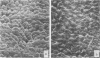
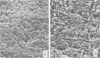
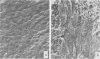
Autogenous canine jugular veins were stored in 15% dimethyl sulfoxide (DMSO) in liquid nitrogen vapor for one to 28 days and then implanted in the carotid artery as autografts. The patency rate at one year was 62.5-87.5%. The patency rate of fresh jugular vein autografts placed in the carotid artery for one year was 75%. Similar autografts stored in liquid nitrogen vapor for one to 28 days without the cryopreservative DMSO exhibited a zero to 12.5% patency rate at one year. Scanning electron microscope studies revealed preservation of theendothelium in DMSO protected veins and a damaged or sloughed endothelium in veins frozen without DMSO cryopreservation.
Full text
PDF


Images in this article
Selected References
These references are in PubMed. This may not be the complete list of references from this article.
- DeWeese J. A., Terry R., Barner H. B., Rob C. G. Autogenous venous femoropopliteal bypass grafts. Surgery. 1966 Jan;59(1):28–39. [PubMed] [Google Scholar]
- Dent T. L., Weber T. R., Lindenauer S. M., Ascher N., Weatherbee L., Allen E., Spencer H. H. Cryopreservation of vein grafts. Surg Forum. 1974;25(0):241–243. [PubMed] [Google Scholar]
- Jackson D. R. Living homologous saphenous vein in geriatric femoropopliteal bypass grafting--report of a case. Vasc Surg. 1971 Jan-Feb;5(1):6–11. doi: 10.1177/153857447100500102. [DOI] [PubMed] [Google Scholar]
- Litvan G. G. Mechanism of cryoinjury in biological systems. Cryobiology. 1972 Jun;9(3):182–191. doi: 10.1016/0011-2240(72)90030-2. [DOI] [PubMed] [Google Scholar]
- MERYMAN H. T. Preservation of living cells. Fed Proc. 1963 Jan-Feb;22:81–89. [PubMed] [Google Scholar]
- Ochsner J. L., DeCamp P. T., Leonard G. L. Experience with fresh venous allografts as an arterial substitute. Ann Surg. 1971 Jun;173(6):933–939. doi: 10.1097/00000658-197106010-00011. [DOI] [PMC free article] [PubMed] [Google Scholar]
- Reul G. J., Jr, Cooley D. A., Wukasch D. C., Kyger E. R., 3rd, Sandiford F. M., Hallman G. L., Norman J. C. Long-term survival following coronary artery bypass. Analysis of 4,522 consecutive patients. Arch Surg. 1975 Nov;110(11):1419–1424. doi: 10.1001/archsurg.1975.01360170159025. [DOI] [PubMed] [Google Scholar]
- Schwartz S. I., Kutner F. R., Neistadt A., Barner H., Resnicoff S., Vaughan J. Antigenicity of homografted veins. Surgery. 1967 Mar;61(3):471–477. [PubMed] [Google Scholar]
- Szilagyi D. E., Elliott J. P., Hageman J. H., Smith R. F., Dall'olmo C. A. Biologic fate of autogenous vein implants as arterial substitutes: clinical, angiographic and histopathologic observations in femoro-popliteal operations for atherosclerosis. Ann Surg. 1973 Sep;178(3):232–246. doi: 10.1097/00000658-197309000-00002. [DOI] [PMC free article] [PubMed] [Google Scholar]
- Tice D. A., Santoni E. Use of saphenous vein homografts for arterial reconstruction: a preliminary report. Surgery. 1970 Mar;67(3):493–498. [PubMed] [Google Scholar]
- Weber T. R., Dent T. L., Lindenauer S. M., Allen E., Weatherbee L., Spencer H. H., Gleich P. Viable vein graft preservation. J Surg Res. 1975 Mar;18(3):247–255. doi: 10.1016/0022-4804(75)90148-1. [DOI] [PubMed] [Google Scholar]