



Abstract
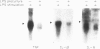
Like blood monocytes, the human monocytic cell line Mono Mac 6 can be stimulated by lipopolysaccharide (LPS) at 1 microgram/ml to produce high levels of cytokines. When Mono Mac 6 cells are stimulated for 4-6 hr at 1 x 10(6)/ml, supernatants contain tumour necrosis factor (TNF) at an average of 60 U/ml and interleukin-6 (IL-6) at an average of 1000 U/ml. IL-1 is not detected in the supernatant, but after three freeze-thaw cycles cell-associated IL-1 can be detected (100 U/ml) and with similar amounts of IL-alpha and -beta. Preculture of Mono Mac 6 cells with LPS at 10 ng/ml for 3 days results in cells refractory to subsequent stimulation by LPS at 1 microgram/ml. In the refractory desensitized cells, production of all three cytokines is down-regulated, with a more than 10-fold reduction in protein production. For all three cytokines, this desensitization appears to be regulated at the transcript level, with a strong reduction in specific mRNA as detected by Northern blot analysis. Furthermore, Mono Mac 6 cells can be stimulated by Staphylococcus aureus (LPS contamination less than 10 pg/ml) to produce cytokines. This type of stimulus is unable to overcome desensitization, in that the secretion of TNF in LPS-precultured Mono Mac 6 cells was 10- to 100-fold lower than in Mono Mac 6 cells without LPS preculture. These data show that desensitization in Mono Mac 6 cells affects all three cytokines tested and that it extends to other activating signals, such as staphylococci.
Full text
PDF


Images in this article

Selected References
These references are in PubMed. This may not be the complete list of references from this article.
- Bailly S., Ferrua B., Fay M., Gougerot-Pocidalo M. A. Differential regulation of IL 6, IL 1 A, IL 1 beta and TNF alpha production in LPS-stimulated human monocytes: role of cyclic AMP. Cytokine. 1990 May;2(3):205–210. doi: 10.1016/1043-4666(90)90017-n. [DOI] [PubMed] [Google Scholar]
- Blumenstein M., Schmidt B., Ward R. A., Ziegler-Heitbrock H. W., Gurland H. J. Altered interleukin-1 production in patients undergoing hemodialysis. Nephron. 1988;50(4):277–281. doi: 10.1159/000185187. [DOI] [PubMed] [Google Scholar]
- Burchett S. K., Weaver W. M., Westall J. A., Larsen A., Kronheim S., Wilson C. B. Regulation of tumor necrosis factor/cachectin and IL-1 secretion in human mononuclear phagocytes. J Immunol. 1988 May 15;140(10):3473–3481. [PubMed] [Google Scholar]
- Cavaillon J. M., Haeffner-Cavaillon N. Signals involved in interleukin 1 synthesis and release by lipopolysaccharide-stimulated monocytes/macrophages. Cytokine. 1990 Sep;2(5):313–329. doi: 10.1016/1043-4666(90)90061-w. [DOI] [PubMed] [Google Scholar]
- Dinarello C. A. Interleukin-1 and its biologically related cytokines. Adv Immunol. 1989;44:153–205. doi: 10.1016/s0065-2776(08)60642-2. [DOI] [PubMed] [Google Scholar]
- Endres S., Fülle H. J., Sinha B., Stoll D., Dinarello C. A., Gerzer R., Weber P. C. Cyclic nucleotides differentially regulate the synthesis of tumour necrosis factor-alpha and interleukin-1 beta by human mononuclear cells. Immunology. 1991 Jan;72(1):56–60. [PMC free article] [PubMed] [Google Scholar]
- Frost H., Murray J. L., Chaudri H. A., Van Damme J. Interleukin-6 induction by a muramyltripeptide derivative in cancer patients. J Biol Response Mod. 1990 Apr;9(2):160–166. [PubMed] [Google Scholar]
- Haas J. G., Baeuerle P. A., Riethmüller G., Ziegler-Heitbrock H. W. Molecular mechanisms in down-regulation of tumor necrosis factor expression. Proc Natl Acad Sci U S A. 1990 Dec;87(24):9563–9567. doi: 10.1073/pnas.87.24.9563. [DOI] [PMC free article] [PubMed] [Google Scholar]
- Haas J. G., Thiel C., Blömer K., Weiss E. H., Riethmüller G., Ziegler-Heitbrock H. W. Downregulation of tumor necrosis factor expression in the human Mono-Mac-6 cell line by lipopolysaccharide. J Leukoc Biol. 1989 Jul;46(1):11–14. doi: 10.1002/jlb.46.1.11. [DOI] [PubMed] [Google Scholar]
- Izbicki J. R., Raedler C., Anke A., Brunner P., Siebeck M., Leinisch E., Lüttiken R., Ruckdeschel G., Wilker D. K., Schweiberer L. Beneficial effect of liposome-encapsulated muramyl tripeptide in experimental septicemia in a porcine model. Infect Immun. 1991 Jan;59(1):126–130. doi: 10.1128/iai.59.1.126-130.1991. [DOI] [PMC free article] [PubMed] [Google Scholar]
- Kovacs E. J., Radzioch D., Young H. A., Varesio L. Differential inhibition of IL-1 and TNF-alpha mRNA expression by agents which block second messenger pathways in murine macrophages. J Immunol. 1988 Nov 1;141(9):3101–3105. [PubMed] [Google Scholar]
- Kunkel S. L., Spengler M., May M. A., Spengler R., Larrick J., Remick D. Prostaglandin E2 regulates macrophage-derived tumor necrosis factor gene expression. J Biol Chem. 1988 Apr 15;263(11):5380–5384. [PubMed] [Google Scholar]
- Lepe-Zuniga J. L., Klostergaard J. Tolerance to endotoxin in vitro: independent regulation of interleukin-1, tumor necrosis factor and interferon alpha production during in vitro differentiation of human monocytes. Lymphokine Res. 1990 Fall;9(3):309–319. [PubMed] [Google Scholar]
- March C. J., Mosley B., Larsen A., Cerretti D. P., Braedt G., Price V., Gillis S., Henney C. S., Kronheim S. R., Grabstein K. Cloning, sequence and expression of two distinct human interleukin-1 complementary DNAs. Nature. 1985 Jun 20;315(6021):641–647. doi: 10.1038/315641a0. [DOI] [PubMed] [Google Scholar]
- Mathison J. C., Virca G. D., Wolfson E., Tobias P. S., Glaser K., Ulevitch R. J. Adaptation to bacterial lipopolysaccharide controls lipopolysaccharide-induced tumor necrosis factor production in rabbit macrophages. J Clin Invest. 1990 Apr;85(4):1108–1118. doi: 10.1172/JCI114542. [DOI] [PMC free article] [PubMed] [Google Scholar]
- Nedwin G. E., Naylor S. L., Sakaguchi A. Y., Smith D., Jarrett-Nedwin J., Pennica D., Goeddel D. V., Gray P. W. Human lymphotoxin and tumor necrosis factor genes: structure, homology and chromosomal localization. Nucleic Acids Res. 1985 Sep 11;13(17):6361–6373. doi: 10.1093/nar/13.17.6361. [DOI] [PMC free article] [PubMed] [Google Scholar]
- Rich E. A., Panuska J. R., Wallis R. S., Wolf C. B., Leonard M. L., Ellner J. J. Dyscoordinate expression of tumor necrosis factor-alpha by human blood monocytes and alveolar macrophages. Am Rev Respir Dis. 1989 Apr;139(4):1010–1016. doi: 10.1164/ajrccm/139.4.1010. [DOI] [PubMed] [Google Scholar]
- Scales W. E., Chensue S. W., Otterness I., Kunkel S. L. Regulation of monokine gene expression: prostaglandin E2 suppresses tumor necrosis factor but not interleukin-1 alpha or beta-mRNA and cell-associated bioactivity. J Leukoc Biol. 1989 May;45(5):416–421. [PubMed] [Google Scholar]
- Shakhov A. N., Collart M. A., Vassalli P., Nedospasov S. A., Jongeneel C. V. Kappa B-type enhancers are involved in lipopolysaccharide-mediated transcriptional activation of the tumor necrosis factor alpha gene in primary macrophages. J Exp Med. 1990 Jan 1;171(1):35–47. doi: 10.1084/jem.171.1.35. [DOI] [PMC free article] [PubMed] [Google Scholar]
- Tannenbaum C. S., Hamilton T. A. Lipopolysaccharide-induced gene expression in murine peritoneal macrophages is selectively suppressed by agents that elevate intracellular cAMP. J Immunol. 1989 Feb 15;142(4):1274–1280. [PubMed] [Google Scholar]
- Van Snick J., Cayphas S., Vink A., Uyttenhove C., Coulie P. G., Rubira M. R., Simpson R. J. Purification and NH2-terminal amino acid sequence of a T-cell-derived lymphokine with growth factor activity for B-cell hybridomas. Proc Natl Acad Sci U S A. 1986 Dec;83(24):9679–9683. doi: 10.1073/pnas.83.24.9679. [DOI] [PMC free article] [PubMed] [Google Scholar]
- Virca G. D., Kim S. Y., Glaser K. B., Ulevitch R. J. Lipopolysaccharide induces hyporesponsiveness to its own action in RAW 264.7 cells. J Biol Chem. 1989 Dec 25;264(36):21951–21956. [PubMed] [Google Scholar]
- Wewers M. D., Rennard S. I., Hance A. J., Bitterman P. B., Crystal R. G. Normal human alveolar macrophages obtained by bronchoalveolar lavage have a limited capacity to release interleukin-1. J Clin Invest. 1984 Dec;74(6):2208–2218. doi: 10.1172/JCI111647. [DOI] [PMC free article] [PubMed] [Google Scholar]
- Yasukawa K., Hirano T., Watanabe Y., Muratani K., Matsuda T., Nakai S., Kishimoto T. Structure and expression of human B cell stimulatory factor-2 (BSF-2/IL-6) gene. EMBO J. 1987 Oct;6(10):2939–2945. doi: 10.1002/j.1460-2075.1987.tb02598.x. [DOI] [PMC free article] [PubMed] [Google Scholar]
- Yoshimura K., Toibana A., Nakahama K. Human lysozyme: sequencing of a cDNA, and expression and secretion by Saccharomyces cerevisiae. Biochem Biophys Res Commun. 1988 Jan 29;150(2):794–801. doi: 10.1016/0006-291x(88)90461-5. [DOI] [PubMed] [Google Scholar]
- Ziegler-Heitbrock H. W., Thiel E., Fütterer A., Herzog V., Wirtz A., Riethmüller G. Establishment of a human cell line (Mono Mac 6) with characteristics of mature monocytes. Int J Cancer. 1988 Mar 15;41(3):456–461. doi: 10.1002/ijc.2910410324. [DOI] [PubMed] [Google Scholar]