



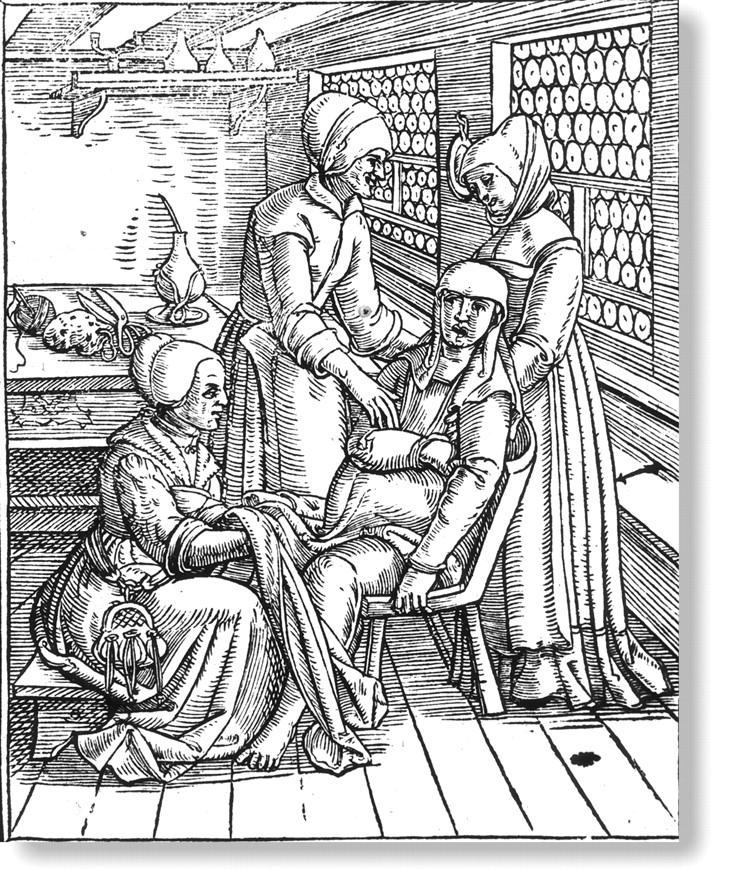
THIS 16TH-CENTURY WOODCUT shows a pregnant woman sitting in a birthing chair, attended by 3 women, at least 1 of whom (seated, at left) is a midwife. This image was published in Ein schön lustig Trostbüchle von den Empfengknussen und Geburten der Menschen (A Very Cheerful Booklet of Encouragement Concerning the Conception and Birth of Man) in 1554.1 The book was written by Jacob Rueff (1500–1558), a surgeon and obstetrician in Zurich. Rueff was responsible for the instruction and examination of midwives in Zurich and, indeed, had copies of his book sent to all the midwives in the region.
Much of Rueff’s book is essentially copied from Eucharius Rösslin’s Der Swangern Frauwen und Hebammen Rosegarten (The Rose Garden for Pregnant Women and Midwives), 1513, the first printed work dealing exclusively with obstetrics—and also intended as an instruction guide for midwives.2 In the later work, Rueff added some new material from his own experiences and placed more emphasis on the use of instruments as aids to childbirth. In this image, for example, one can see the obstetrical instruments and equipment on the table behind the women, whereas in Rösslin’s almost identical image, the background is plain. Rueff advocated new obstetrical instruments such as the toothed duck beak forceps and the use of internal and external manipulation for footling (feet first) presentations.
Some version of the birthing stool or chair had been used for millennia, there being evidence of its use in Egyptian papyri and the Old Testament.3,4 The chair shown here incorporates certain early modern technical innovations, such as the sloping back that allows the birthing woman to recline slightly during contractions. One scholar even argues that this birthing chair was itself a technical innovation inspired by male professionals as a way to gain control over the birthing process and to displace earlier practices in which pregnant women sat on the laps of their birth attendants.5 As male midwives and obstetrical attendants gradually wrested control of the birth process from female midwives and from women themselves, the birthing chairs would be replaced by flat beds, these being more convenient to the person in charge of the “delivery.”
Birthing chairs are now making something of a comeback in modern obstetrics as case– control studies are finding that their use may reduce the pain of childbirth, diminish perineal trauma, decrease the need for episiotomies, and increase the mother’s satisfaction with her birthing experience.6–9
Figure 1.
Source. Prints and Photographs Collection, History of Medicine Division, National Library of Medicine. Courtesy of the Pan American Health Organization, circa 1960s, Bolivia. Photographer: Dana Downie
Note. Most of the Prints and Photographs Collection of the History of Medicine Division of the National Library of Medicine may be viewed through the on-line database “Images From the History of Medicine” at http://wwwihm.nlm.nih.gov/. The Web site also provides information on ordering reproductions of images. If you have a print, photograph, or other visual item that might be appropriate for this collection, please contact the History of Medicine Division.
References
- 1.Rueff J. Ein schön lustig Trostbüchle von den Empfengknussen und Geburten der Menschen. Zurich, Switzerland: Christoffel Froschover; 1554.
- 2.Rösslin E. Der Swangern Frauwen und Hebammen Rosegarten. 1513. Reprint. Zurich, Switzerland: Verlag Bibliophile Drucke; 1976.
- 3.Morice P, Josset P, Colau JC. La gynécologie et l’obstétrique en Egypt antique. J Gynecol Obstet Biol Reprod (Paris). 1994;23:131–136. [PubMed] [Google Scholar]
- 4.O’Dowd MJ, Philipp EE. The History of Obstetrics and Gynaecology. New York, NY: Parthenon; 1994:7.
- 5.Gélis J. History of Childhood: Fertility, Pregnancy and Birth in Early Modern Europe. Boston, Mass: Northeastern University Press; 1991:127–130.
- 6.Shannahan MK, Cottrel BH. The effects of birth chair delivery on maternal perceptions. J Obstet Gynecol Nurs. 1989;18:323–326. [DOI] [PubMed] [Google Scholar]
- 7.Olson R, Olson C, Cox NS. Maternal birthing positions and perineal injury. J Fam Pract. 1990;30:553–557. [PubMed] [Google Scholar]
- 8.Waldenstrom U, Gottvall K. A randomized trial of birthing stool or conventional semirecumbent position for second-stage labor. Birth. 1991;18:5–10. [DOI] [PubMed] [Google Scholar]
- 9.Scholz HS, Benedicic C, Arikan MG, Haas J, Petru E. Spontaneous vaginal delivery in the birth-chair versus in the conventional dorsal position: a matched controlled comparison. Wien Klin Wochenschr. 2001;113:695–697. [PubMed] [Google Scholar]