



Abstract
Staff turnover in mental health service organizations is an ongoing problem with implications for staff morale, productivity, organizational effectiveness, and implementation of innovation. Recent studies in public sector services have examined the impact of organizational culture and climate on work attitudes (i.e., job satisfaction and organizational commitment) and, ultimately, staff turnover. However, mediational models of the impact of culture and climate on work attitudes have not been examined. The present study examined full and partial mediation models of the effects of culture and climate on work attitudes and the subsequent impact of work attitudes on staff turnover. Multilevel structural equation models supported a partial mediation model in which organizational culture had both direct influence on work attitudes and indirect influence through organizational climate. Work attitudes significantly predicted one-year staff turnover rates. These findings support the contention that both culture and climate impact work attitudes and subsequent staff turnover.
Keywords: organizational culture, climate, work attitudes, turnover, mental health
Across organizational types, staff turnover increases costs and limits optimal organizational functioning. For example, turnover negatively impacts staff morale, short and long-term productivity, and organizational effectiveness (Gray, Phillips, & Normand, 1996; Jayaratne & Chess, 1984; Mowday, Porter, & Steers, 1982). Turnover can be a particularly serious problem in mental health and human service agencies (Howard & Gould, 2000) where annual rates often exceed 25% (Gallon, Gabriel, & Knudsen, 2003) and can exceed 50% (Glisson, Dukes, & Green, in press; Glisson & James, 2002).
Staff turnover in public sector mental health services is an ongoing concern, impacting not only the costs of recruitment and training, but also the quality of services provided (Glisson, 2002; Knudsen, Johnson, & Roman, 2003). Turnover leads to poor work-team performance and production (Argote, Insko, Yovetich, & Romero, 1995). In mental health settings, turnover has been attributed to factors such as the high stress environment, lack of support, and low pay. Conversely, the effects of turnover on the mental health organization includes poor staff morale, ineffectiveness of staff, reduced productivity, weaker work teams, and increased costs of training new employees (Bingley & Westergaard-Nielsen, 2004), as well as inconsistent services provided to clients and weaker therapist–client relationships (Albizu-Garcã-a, Rã-Os, Juarbe, & Alegrã-a, 2004).
In order to reduce turnover in organizations, it is important to identify factors that predict work attitudes (i.e., job satisfaction, organizational commitment) and subsequent staff turnover. Research to date has revealed a variety of possible predictors of turnover including organizational culture, organizational climate, and work attitudes. However, these factors are interrelated and organizational culture and climate may directly or indirectly affect work attitudes and, in turn, staff turnover. Further, recent studies have used separate regression analyses that did not allow for examining the potential role of organizational climate as a mediator of the effects of organizational culture on work attitudes (Glisson & James, 2002; Morris & Bloom, 2002). The present study examines partial and full mediational models for these predictors of work attitudes and subsequent staff turnover in mental health service organizations.
For the purposes of the present study, organizational culture is defined as the organizational norms and expectations regarding how people behave and how things are done in an organization (Glisson & James, 2002; Verbeke, Volgering, & Hessels, 1998) and includes implicit norms, values, shared behavioral expectations, and assumptions that guide the behaviors of members of a work unit (Cooke & Rousseau, 1988). Organizational culture is important because shared beliefs and norms affect employee perceptions, behaviors, and emotional responses to the workplace. For example, culture has been found to influence organizational climate and provider attitudes including work attitudes (Aarons & Sawitzky, 2006; Carmazzi & Aarons, 2003; Glisson & Hemmelgarn, 1998; Glisson & James, 2002), as well as employee behaviors that contribute to the success or failure of an organization (Ashkanasy, Wilderom, & Peterson, 2000).
Two broad dimensions of organizational culture have been identified in mental health services organizations: constructive culture and defensive culture (Cooke & Szumal, 2000; Glisson & James, 2002). Constructive cultures are characterized by organizational norms of supportiveness and individualism that encourage positive interactions with others and approaches to tasks that will enable staff to meet their higher-order satisfaction needs. Defensive cultures, on the other hand, are characterized by norms of conformity and submissiveness that encourage or implicitly require interaction with others in ways that are self-protective and will not threaten perceived personal security (Cooke & Szumal, 2000).
Organizational climate represents a global impression of one’s organization and personal impact of the work environment, which influences the individual’s work behaviors and job-related attitudes (Pritchard & Karasick, 1973). Organizational climate includes employee perceptions of and affective response to the workplace and work tasks. More positive organizational climates are characterized by low levels of emotional exhaustion and depersonalization. Emotional exhaustion is the extent to which an employee feels fatigued or burned out due to the demands of their job. Depersonalization is the extent to which an employee feels hardened, distant, or removed from those they serve (Lawler, Hall, & Oldman, 1974). Along with a diminished sense of personal accomplishment, these constructs have been conceptualized as components of burnout (Maslach, Schaufeli, & Leiter, 2001). Emotional exhaustion and depersonalization have also been examined in relation to staff turnover (Drake & Yadama, 1996). However, there is precedent for specifying emotional exhaustion and depersonalization as indictors for organizational climate (Glisson & James, 2002) and, in particular, suboptimal organizational climate.
Organizational culture and climate have been found to be distinct, multi-dimensional constructs (Glisson & James, 2002). While culture reflects behaviors, norms, and expectations, organizational climate reflects workers’ perceptions of and emotional responses to the characteristics of the work environment (Glisson & James, 2002; James, Hater, Gent, & Bruni, 1978; James & Sells, 1981). Organizational level constructs of culture and climate are proposed to influence individual level attitudes (e.g., work attitudes) and behavior (e.g., turnover). Such cross level effects, linking organizational constructs to individual outcomes, have been supported in previous studies (Glisson & James, 2002; Schoenwald, Sheidow, Letourneau, & Liao, 2003). Inference regarding cross-level effects can be supported by empirically examining whether constructs held to operate at the organizational level indeed represent organizational level constructs. One approach to determining appropriate level of aggregation is to examine the correlation within-groups or rwg, intra-class correlations (ICC), and eta-square. This approach is taken in the present study and is described in greater detail in the analysis section.
Organizational culture and climate are both crucial characteristics of organizations that influence employees’ attitudes (Aarons & Sawitzky, 2006; Carmazzi & Aarons, 2003; Glisson & Hemmelgarn, 1998) and work attitudes, in particular, predict staff turnover (Van Breukelen, Van Der Vlist, & Steensma, 2004). Work attitudes include employee evaluations and opinions of jobs and their commitment to the organization (Verquer, Beehr, & Wagner, 2003). Two of the most commonly assessed dimensions of work attitudes are job satisfaction and organizational commitment (Glisson & Durick, 1988). Job satisfaction is an employee’s internalized appraisal of one’s job, job experiences, or job situation (Locke, 1990). Organizational commitment is the extent to which an employee is committed to his or her organization (Lease, 1998). Work attitudes have been shown to be associated with organizational culture and climate, employee behaviors, and turnover. Specifically, job satisfaction and organizational commitment are significant determinants of turnover (Martin, 1981; Mowday et al., 1982). In separate regression analyses, organizational culture and climate have both been found to influence an employees’ job satisfaction and organizational commitment (Glisson & James, 2002; Morris & Bloom, 2002). Constructive culture has been found to be an important predictor of work attitudes, and work groups with constructive cultures have more positive work attitudes (Glisson & James, 2002). More positive organizational climates also predict more positive work attitudes (Glisson & James, 2002; Morris & Bloom, 2002). Employees working in organizations with more positive cultures and climates are more likely to be satisfied with their jobs and more committed to their organizations and, hence, should be less likely to leave. While these associations in human service organizations have been tested in separate analyses, the present study provides more comprehensive analyses to examine how these factors impact work attitudes and subsequent turnover.
The purpose of the present study was to assess whether or not organizational climate mediated the effects of organizational culture on work attitudes in mental health organizations. The subsequent effects of work attitudes on staff turnover were also examined. Previous studies have used approaches that limit understanding of the relationships of culture and climate in predicting work attitudes. For example, Morris and Bloom (2002) examined the effects of culture and climate on job satisfaction and organizational commitment, but defined culture and climate as a combined construct. Other researchers have examined culture and climate as simultaneous predictors of work attitudes. For example, Glisson and James (2002) analyzed two separate models: one that tested the relationship between organizational culture and climate on work attitudes and one that tested the effects of organizational culture and climate on staff turnover. In the former study, culture and climate were merged, while in the latter study the potential mediation of culture by climate was not examined. Neither of the studies noted above allow for disentangling the effects of culture and climate on work attitudes. Further, Michaels and Spector (1982) tested a theoretical model examining the impact of job satisfaction and organizational commitment on turnover, however the impact of culture and climate on work attitudes was not assessed. The present study addresses issues in the three studies noted above by including culture and climate as separate constructs, testing the mediation hypothesis on work attitudes, and including the subsequent prediction of staff turnover in the same set of structural models. The present study also analyzes multiple models to test whether a no mediation, full mediation, or partial mediation model best fits the data.
Within the proposed model for this study, there are six hypotheses: (1) constructive culture will be negatively associated with organizational climate; (2) defensive culture will be positively associated with organizational climate; (3) organizational climate will be negatively associated with more positive work attitudes; (4) more positive work attitudes will be associated with decreased turnover; (5) a partial mediation model which allows for both direct and indirect effects of culture on work attitudes will best fit the data, and (6) more positive work attitudes will predict lower staff turnover at one year. Please note that, because organizational climate is measured by emotional exhaustion and depersonalization, higher climate scores indicate poorer organizational climate.
METHOD
Participants
Participants were 322 clinical and case management service providers who participated in a study of organizational issues within 49 public-sector mental-health programs providing services for children, adolescents, and their families in San Diego County, CA (Aarons, 2004). Organizational and individual participation rates were high in the larger study (94.4% and 96%, respectively). Seventy-six percent of respondents were female and the mean age was 35.57 (SD = 10.16) years. Race/ethnicity was 64.8% Caucasian, 14.8% Hispanic, 7.1% African-American, 5.8% Asian-Pacific Islander, and 7.4% mixed-race or “other.” Eighty percent of respondents were full-time employees, and primary disciplines included marriage and family therapy (33.9%), social work (32.3%), psychology (22.4%), psychiatry (1.6%), and “other” (9.9%; e.g., criminology, drug rehabilitation, education, public health). Interns were less prevalent in the service system (24.9%) relative to fully employed staff (75.1%), and interns represented disciplines of marriage and family therapy (46.8%), social work (24.7%), psychology (20.8%), psychiatry (1.3%), and “other” (6.5%). Mean job-tenure for respondents was 2.58 (SD = 3.49) years working at their present agency.
Measures
Provider Demographics
A provider survey incorporated questions regarding provider demographics including provider age, sex, education level, professional status (intern vs. professional), and job tenure (Aarons, 2004). Provider education level was assessed with the ordered categories (from low to high) of attainment of some college, college graduate, some graduate work, master’s degree, and doctoral degree (Ph.D., M.D. or equivalent).
Organizational Culture and Climate
The Children’s Services Survey (Glisson, 2002) was used to assess both organizational culture and climate. Dimensions of culture and climate were selected for the present study based on previous studies using these measures (Aarons, Woodbridge, & Carmazzi, 2003) and recent work clarifying the unique domains of these constructs (Glisson & James, 2002). The culture and climate measures used in the present study were recently examined in regard to factor structure, discriminant validity, reliability, and psychometric characteristics, and are associated with important work-related outcomes including work attitudes, staff turnover, and service quality in human service organizations (Glisson & James, 2002). The organizational culture scales used in the present study were derived from the Organizational Culture Inventory (Cooke & Rousseau, 1988; Farmer, Compton, Burns, & Robertson, 2002; Rousseau, 1990) and adapted for use in mental health services (Glisson & James, 2002). The scales comprise two global culture dimensions of constructive and defensive cultures. Constructive cultures are those characterized by organizational norms of individualism and supportiveness. Constructive cultures encourage interactions with people and approaches to tasks that will enable staff to meet their higher-order satisfaction needs. In contrast, defensive cultures are characterized by norms of conformity and submissiveness. Defensive cultures encourage or implicitly require interaction with people in ways that will not threaten personal security (Farmer et al., 2002). Reliabilities for constructive culture subscales range from .86 to .89 and defensive culture subscales from .75 to .86 (Glisson & James, 2002).
The organizational climate scales used in the present study were developed based on organizational studies in diverse workplace settings (Hackman & Oldham, 1980; Mowday et al., 1982). The scales, as adapted for children’s services and used in previous studies, have good psychometric characteristics (Aarons et al., 2003; Glisson & Durick, 1988; Glisson & Hemmelgarn, 1998; Glisson & James, 2002; Glisson & Martin, 1980). The organizational climate subscales used here assess dimensions of depersonalization and emotional exhaustion and have been validated in previous work with subscale reliabilities ranging from .69 to .92 (Glisson & James, 2002). Lower scores on these scales indicate more positive organizational climate and higher scores indicate a more negative organizational climate. For the present study, the term “demoralizing climate” is used to describe climates characterized by high levels of depersonalization and emotional exhaustion.
Work Attitudes
Work Attitudes were assessed with two scales adapted from the Children’s Services Survey (described above) that assess job satisfaction and organizational commitment. These scales have been used in multiple studies, including those focused on children’s services (Glisson & James, 2002; Schoenwald et al., 2003) and mental health organizations. The scales have been shown to be related to organizational climate and culture and staff turnover (Glisson & James, 2002). In a study of cross-level effects in human service organizations, coefficient alphas for job satisfaction and organizational commitment scales were good (.84 and .89 respectively) (Glisson & James, 2002).
Turnover
Staff turnover was prospectively assessed one year after the organizational assessments were completed. After one year, each program manager was contacted to determine which participants from the original sample had either quit or been terminated during that year. The annual turnover rate in the present study was 28%. Participants who left a job for another position at the same program or within the same agency were not counted in the turnover rate.
Survey Procedure
A program manager was contacted at each program, and the study was described in detail. Permission was sought to interview each program manager and to survey service providers who worked directly with youth and families. For participant programs, interviews and provider survey sessions were scheduled at the program site at a time designated by the program manager. Interviews were conducted with each program manager individually and surveys were administered to groups of providers. The principal investigator and/or project coordinator conducted program manager interviews. The project coordinator and/or a trained research assistant administered provider surveys and were available during the survey session to answer any questions that arose. Upon completion, providers handed in the survey packet to the administrator, who then checked the surveys for completeness. The respondent then completed any missing responses, if possible. Extra surveys were left for providers who were not in attendance at the survey sessions. Such surveys were either mailed back in a prepaid envelope or picked up by a research assistant. Participants received a verbal and written description of the study and informed consent was obtained prior to the survey. This study was approved by the appropriate institutional review boards.
Analyses
Confirmatory factor analysis (CFA) and structural equation modeling (SEM) were used to examine measurement and structural models, respectively. Because providers were nested within mental health programs resulting in potential dependency of responses within programs, multilevel SEM analyses were conducted to control for the effects of the nested data structure (Hedeker, Gibbons, & Davis, 1991; Raudenbush & Bryk, 2002; Snijders & Bosker, 1999). Individual level variables of work attitudes and turnover are considered to be Level 1 constructs. However, providers are nested within mental health programs (i.e., Level 2). Recent work in human services supports the contention that culture and climate represent organizational level constructs and represent measurement at Level 2 (Glisson & James, 2002; Schoenwald et al., 2003). Because individual participants provided data regarding culture and climate in the present study, rwg analyses (James, Demaree, & Wolf, 1993) and examination of ICCs and eta-square were completed to examine level of aggregation. The rwg assesses the consistency of responses within groups, and higher consistency (i.e., ≥.70) suggests that responses represent the properties of the group or organizational unit (Klein et al., 2000). However, if all responses are consistent across units then it is difficult to infer that the consistency is not an artifact of more widespread agreement across organizational groups (Glisson & James, 2002). The ICC and eta-square represent the proportion of variance between organizational units (Raudenbush & Bryk, 2002). A significant F test for the ICC and eta-square suggests that the between group variance is significantly greater than the within-group variance (Klein et al., 2000). Thus, a significant ICC and eta-square suggests that responses within the organizational unit are more likely to differ across organizational units (James, 1982; Ostroff & Schmitt, 1993). The combination of high rwg and significant ICC and eta-square support the inference of a higher level of aggregation (in this case at Level 2).
All SEM analyses were conducted using the Mplus analytic software (Muthén & Muthén, 1998–2004) with observations nested within organizations and using maximum likelihood estimation with robust standard errors (MLR). The MLR estimator is appropriate for models with categorical outcomes such as staff turnover. A series of analyses were conducted to examine the hypothesis that climate partially mediates the effect of culture on work attitudes, and that work attitudes, in turn, predict staff turnover at one year. Values were estimated for missing turnover outcome data (n = 39 cases) under the assumption of data missing at random (Little & Rubin, 2002). The outcome was modeled conditional on covariates in the analysis (Muthén & Muthén, 1998–2004), and standard errors for parameter estimates were computed using the observed rather than estimated information matrix (Kenward & Molenberghs, 1998).
Results are presented for four models: a measurement model, a mediation only model (effects of culture on work attitudes fully mediated by climate), a direct effects only model (direct effects of culture on work attitudes), and a full model with partial mediation (both indirect effects of culture on work attitudes through climate, and direct effects of culture on work attitudes). Indicators of model fit were assessed according to cutoffs recommended by Hu and Bentler (1999) including the chi-square statistic, a comparative fit index (CFI) near .95 or greater, a Tucker–Lewis index (TLI) near .95 or greater, a root-mean-square error of approximation (RMSEA) close to .06 or less, and a standardized root mean residual (SRMR) close to .08 or less. These cutoff values result in lower Type II error rates with acceptable costs of Type I error rates (Hu & Bentler, 1999). The χ2/df ratio was also examined in which a value of 3 or greater indicates poor fit (Mueller, 1996). Finally, chi-square difference tests were conducted comparing the partial mediation model with the mediation only and no mediation models (Satorra & Bentler, 2001). Each model was estimated and evaluated based on the fit indices noted above and chi-square difference tests for nested structural models. Fit indices for all models are shown in Table 1 to facilitate model comparison.
Table 1.
Fit Indices for Measurement and Structural Equation Models and Chi-Square Difference Tests for Structural Models
| Model | Figure | χ2 | df | p | χ2/df | CFI | TLI | RMSEA | SRMR | χ2diff |
|---|---|---|---|---|---|---|---|---|---|---|
| Measurement model | 1 | 16.722 | 14 | .271 | 1.19 | .998 | .997 | .025 | .015 | |
| Mediation only model | 2 | 85.95 | 23 | <.001 | 3.74 | .957 | .933 | .092 | .052 | 62.49*** |
| No mediation model | 3 | 69.065 | 23 | <.001 | 3.00 | .969 | .951 | .079 | .129 | 72.70*** |
| Partial mediation model | 4 | 25.555 | 21 | .224 | 1.22 | .997 | .995 | .026 | .025 |
Note: K=49; N=322; χ2 = chi-square value; df = degrees of freedom; χ2/df = ratio of chi-square to degrees of freedom; CFI = comparative fit index; TLI = Tucker–Lewis index; RMSEA = Root mean square error of approximation; SRMR = standardized root mean residual; χ2 diff = chi-square difference test compared partial mediation model with mediation only and no-mediation models (2 degrees of freedom for all comparisons) and were conducted using the Satorra–Bentler scaled chi-square statistic (Satorra & Bentler, 2001);
p<.01,
p<.001,
p<.001.
RESULTS
Level of aggregation analyses supported characterizing culture and climate as characteristics of the organization at Level 2. This held for all of the proposed Level 2 variables including constructive culture (rwg = .90, ICC = .163, eta-square = .297, p < .001), defensive culture (rwg = .88, ICC = .203, eta-square = .322, p < .001), and organizational climate (rwg = .89, ICC = .133, eta-square = .267, p < .001). These results are consistent with other studies (Glisson & James, 2002).
Next CFA and SEM model tests were conducted. Fit indices for all models are summarized in Table 1. As shown in Figure 1, the measurement model demonstrated excellent fit (χ2(14) = 16.72, p = .271, χ2/df = 1.19, CFI = .998, TLI = .997, RMSEA = .025, SRMR = .015) indicating that items loaded on the appropriate latent variables. All factor loadings were significant (p < .001) and ranged from .70 to .94.
Fig. 1.
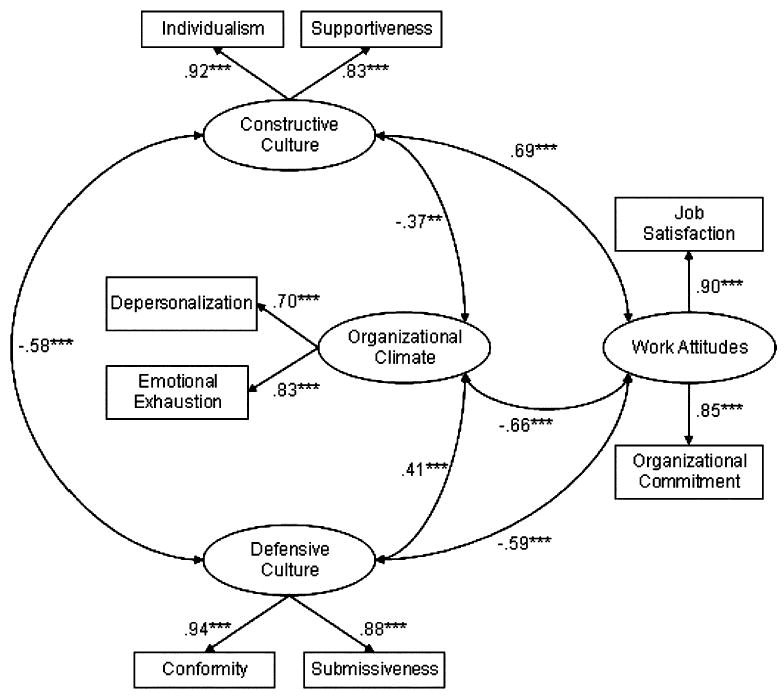
Measurement model of organizational culture, climate, and work attitudes (X2(14)=16.72, p=.271, CFI = .998, TLI = .997, RMSEA = .025, SRMR = .015); *p<.01, **p<.001, ***p<.001.
Tests of the three different structural models were conducted next. All three models included a final direct path from work attitudes predicting staff turnover. As shown in Figure 2, the mediation only model was tested in which it was specified that organizational climate fully mediates the effect of organizational culture on work attitudes. The mediation model showed adequate fit (χ2(23) = 85.95, p < .001, χ2/df = 3/00, CFI = .957, TLI = .933, RMSEA = .092, SRMR = .052), and all structural path coefficients were statistically significant.
Fig. 2.

Mediation only structural model of effects of organizational culture and climate on work attitudes and turnover (X2(23)=85.95, p < .001, CFI = .957, TLI = .933, RMSEA = .092, SRMR = .052); *p<.01, **p<.001, ***p<.001.
As shown in Figure 3, the direct effects only model was tested in which direct effects of organizational culture and climate on work attitudes were specified, but with no mediated relationships among the variables predicting work attitudes. The model demonstrated somewhat poorer fit than the mediation only model (χ2(23) = 69.07, p<.001, χ2/df = 3.74, CFI = .969, TLI = .951, RMSEA = .079, SRMR = .129) with significant structural path coefficients.
Fig. 3.
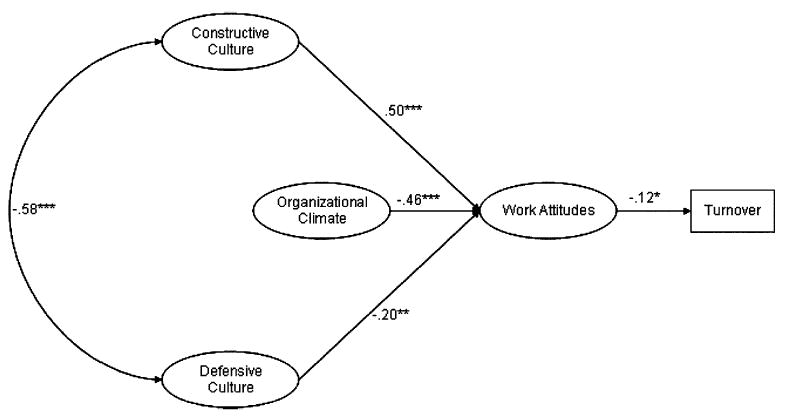
Direct effects only structural model of effects of organizational culture, climate, work attitudes and turnover (X2(23)=69.07, p < .001, CFI = .969, TLI = .951, RMSEA=.079, SRMR=.129); *p<.01, **p<.001, ***p<.001.
As shown in Figure 4, the final model tested the partial mediation hypothesis and allowed for both direct effects of culture on work attitudes and indirect effects of culture on work attitudes mediated by climate. The model demonstrated excellent fit (χ2(21) = 25.56, p = .224, χ2/df = 1.22, CFI = .997, TLI = .995, RMSEA = .026, SRMR = .025) with all structural paths being statistically significant and in the hypothesized directions.
Fig. 4.
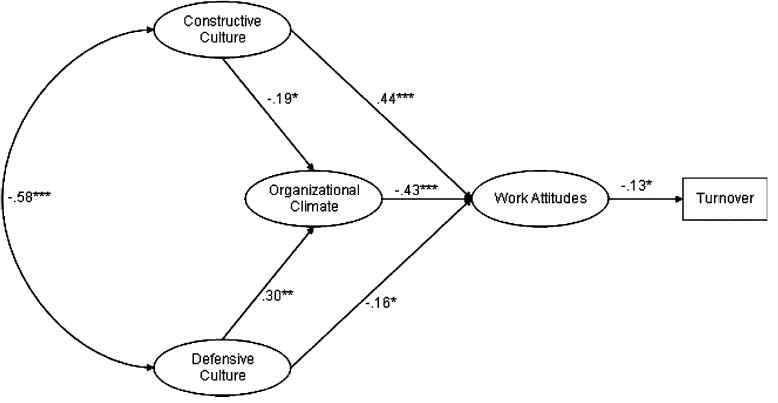
Full structural model with partial mediation of effects of organizational culture, climate, work attitudes, and staff turnover (X2(21)=25.56, p=.224, CFI = .997, TLI = .995, RMSEA = .026, SRMR = .025). *p<.01, **p<.001, ***p<.001.
Chi-square difference tests for nested models were conducted comparing the final partial mediation model to the mediation only and direct effects only models, respectively. The difference tests indicated that the partial mediation model fit the data significantly better than the mediation only model (χ2diff(2) = 62.49, p<.001) or the direct effects only model (χ2diff(2) = 72.70, p<.001). This series of analyses indicates strong support for the mediational role of organizational climate in the effect of organizational culture on work attitudes. The analyses also provide support for the impact of these variables on subsequent staff turnover. Path coefficients for structural parameters in the final model ranged from −.13 to .44 representing small to large effect sizes (Cohen, 1988), with the final path coefficient from work attitudes to turnover representing a small effect size in all structural models (p <.05). Considering model fit, chi-square difference tests, the pattern of results, and fit with theory, the partial mediation structural model was best supported by this set of analyses.
DISCUSSION
The proposed hypotheses were supported in the present study. Constructive culture was significantly negatively associated with poor organizational climate; defensive culture was significantly positively associated with poor organizational climate; more negative organizational climate was negatively associated with more positive work attitudes; and more positive work attitudes were associated with decreased turnover. The proposed partial mediation model, which allows for both direct and indirect effects of culture on work attitudes, best fit the data. This supports the notion that culture impacts climate and climate, in turn, impacts work attitudes. More positive work attitudes significantly predicted lower turnover at one year.
While both organizational culture and climate had direct associations with work attitudes, organizational climate partially mediated the effect of organizational culture on work attitudes. That is, organizational culture not only impacts work attitudes directly, but also indirectly through its effect on organizational climate. This finding is consistent with the theory that organizational culture is a significant contextual influence on employees’ perceptions and emotional responses to the workplace (Glisson, 2002). This is important in considering how best to improve work attitudes and reduce turnover in mental health organizations and differs from previous work in two ways. First, organizational culture is likely to be more deeply embedded and less malleable than climate (Glisson et al., in press). Thus, while both culture and climate had direct associations with work attitudes, it is likely that working to directly improve climate may prove an easier task than culture change. Conversely, successful culture change might be more likely to filter down through the organization and promote more positive climate and work attitudes. Culture is likely to be driven by policies and deeply ingrained norms perpetuated by top management. An organizational assessment can provide data regarding where to intervene and on which factors to focus (Burke, 1994). Targeted culture change may impact multiple organizational processes and result in positive change.
In the present study, employee responses to the workplace predicted work attitudes and, ultimately, leaving the organization. The workforce crisis in mental health services is serious in that there is a shortage of well-trained workers and staff turnover rates are high (Clay, 2004). The results of the present analyses suggest that improvements in organizational culture and climate are likely to improve job satisfaction and organizational commitment, and, subsequently, reduce staff turnover. However, prospective studies are needed to more rigorously test hypotheses about such mechanisms.
Reductions in staff turnover can benefit agencies and programs in a number of ways. Staff turnover can affect clinical service delivery and negatively impact implementation of new service models, including use of evidence-based practices. First, money invested in training staff will be less likely to be wasted on those who leave the agency. Training is expensive and requires a commitment from the agency to develop staff that will then provide higher quality and more effective services with a high level of professionalism. When staff are trained but then leave the organization, they are taking those marketable new skills to another employer. Although agencies and programs cannot always be competitive in regard to salary and/or benefits, having a positive culture and climate can still influence staff to stay at the organization. Second, relationships are important in the workplace and this is especially so in the human services. High turnover negatively impacts the development of long-term occupational relationships and this can have detrimental effects in reducing camaraderie and perceived peer supports. Finally, turnover has been found to increase during times of organizational change (Gill, Greenberg, & Vazquez, 2002) and organizations should consider how to bolster staff retention during implementation of new technologies or service models (Aarons, 2005).
High turnover settings are characterized by high levels of stress and burnout. Indeed, workers who stay on the job may have to take over tasks and cover the caseloads of staff who leave (Mobley, 1982; Tai, Bame SI, & Robinson, 1998). Conversely, high turnover can negatively impact attitudes, cognitions, and morale of remaining workers. The effects of turnover on remaining staff include reduced staff morale, ineffectiveness of staff, reduced productivity, weaker work teams, and increased costs of training new employees (Bingley & Westergaard-Nielsen, 2004). When remaining workers attribute staff turnover to the nature of the workplace, work attitudes may suffer (Hom, 1995). Because turnover can affect staff attitudes, it is critical that turnover, organizational culture and climate, and work attitudes be addressed concurrently as retaining staff is a priority in health and mental health care (Buckingham & Coffman, 1999).
The findings presented here suggest a number of implications for programs providing mental health services. First, promoting positive culture has the potential to improve the climate of mental health programs as well as staff attitudes. A word of caution is appropriate here. As in other types of organizations, the culture of mental health agencies and programs is likely to be a “top down” process and thus may be resistant to change if multiple approaches and levels of the organization are not considered. Concerted and ongoing planning, engagement of staff in the change process, and change management at all levels of the organization will likely be needed to promote change in organizational culture (Barriere, Anson, Ording, & Rogers, 2002). Based on the findings here regarding constructive cultures, culture change might focus on norms of positive participation and supportive staff autonomy and development.
Further, effective leadership can play a key role in the success of culture change initiatives (George, Sleeth, & Siders, 1999). A potential approach to address workforce issues lies in improving “first-level leadership” (Priestland & Hanig, 2005). First-level leaders are those who supervise others, who in turn do not supervise others. This aptly describes the many mental health program managers who have administrative, management, and human resource functions, and are also responsible for leading, implementing, and supervising change in practice including implementing innovations such as evidence-based practices. Leadership has been demonstrated to have strong and significant effects on organizational climate (Aarons et al., 2003). Thus, where a team intervention is not practical, focusing on improving leadership is likely to lead to improved climate and subsequent work attitudes.
In contrast to culture, climate may be more malleable. The work of mental health clinicians and case managers is often stressful and challenging. However, strategies to improve climate can be implemented with an understanding of the organizational culture, including what is likely or unlikely to be modifiable. Recent advances in organizational development strategies in human services show great promise in improving the climate of human service teams and in decreasing staff turnover (Glisson et al., in press). The results of the present study suggest that both culture and climate should be considered for workplace improvement strategies. However, there is a great need for further work in developing targeted and effective organizational interventions to improve mental health agency and program culture and climate.
Anecdotal reports from agency directors and program managers indicate a high degree of concern with turnover, but there is little empirical guidance about how to mitigate the problem. This concern is present across mental health, child-welfare, and substance abuse agencies and programs. Agencies and programs partnering with academic researchers working in this area may help to develop an empirical approach to the problem, defray some of the costs of turnover reduction strategies, and build public–academic partnerships and collaborations that will make research more relevant while addressing mental health workforce issues. For example, recent work in structured organizational interventions in case management teams has demonstrated significant reductions in staff turnover of about fifty percent (Glisson et al., in press). This finding represents a moderate effect size, but, more importantly, it has very strong practical utility in that it provides some guidance regarding potential ways to intervene to improve workforce functioning and retention.
Although the costs of organizational interventions can be substantial, the potential for turnover reduction and improvements in organizational climate, work attitudes, staff retention, and improved quality of care offer hope of improving the workforce for mental health and social services. The relative costs and benefits must be considered. There is no simple formula for decision making about how, when, and where to intervene, and there are few empirically tested strategies for turnover reduction. Where turnover rates are high, the potential for improvement in service continuity and reduction in recruitment and training costs are more likely to outweigh the costs.
Some limitations of the present study should be noted. First, because the goal of this study was to examine mediation of culture by climate, other variables that might also influence work attitudes, such as provider demographics and job characteristics were not examined. Further, organizational change may lead to role changes inconsistent with professional identity and result in lowered job satisfaction (Neuman, 2003) and job satisfaction is one component of work attitudes. However, organizational change was not assessed in the present study. Second, perceived equitable pay and benefits are likely to impact staff turnover. However, compensation and benefits were not assessed with this group of service providers. Finally, this study took place in public sector mental health services and results may not generalize to other service sectors or workers. However, to the extent that workforce issues are common across service sectors and service types these results may inform studies in other sectors.
Previous research has demonstrated a link between organizational climate and client outcomes (Glisson & Hemmelgarn, 1998). Based on the associations between organizational culture, climate and turnover, and climate and outcomes, it would not be unwarranted to expect associations between turnover and client outcomes as well. The expected effect sizes will likely vary, but the moderate effect size for turnover reduction found by Glisson et al. (in press) suggests that well-designed and comprehensive organizational interventions delivered by credible people, with the right training and adequate resources, can improve turnover and, potentially, client outcomes. Empirically based development and evaluation of organizational interventions to improve both mental health workforce concerns and consumer concerns is needed. As noted above, public-academic collaboration should facilitate the development and deployment of new and potentially effective organizational interventions to improve workforce concerns for mental health and social services.
The results presented here provide some suggestions for the improvement of mental health workplace context. First, improvements in staff work attitudes and decreases in turnover may be facilitated by addressing both the culture and climate of the organization as culture has both direct and indirect associations with work attitudes. Combining this finding with the results of studies supporting climate improvement (Glisson et al., in press) suggests a multi-target approach. Focusing on improving both culture and climate may provide greater gains in staff work attitudes and staff retention. It is also likely that job and personal characteristics are associated work attitudes (Michaels & Spector, 1982), and the association of these variables with culture, climate, and work attitudes is another area for further exploration in complex organizational models. However, empirically driven staff selection procedures and working to make job and organizational characteristics more positive and desirable should improve workforce retention. Although problems of staff retention are not new, with increased attention to implementation of evidence-based practices in real-world service settings, there is ample reason for a renewal of interest in developing effective solutions to this continuing concern.
References
- Aarons GA. Mental health provider attitudes toward adoption of evidence-based practice: The Evidence-Based Practice Attitude Scale. Mental Health Services Research. 2004;6(2):61–72. doi: 10.1023/b:mhsr.0000024351.12294.65. [DOI] [PMC free article] [PubMed] [Google Scholar]
- Aarons GA. Measuring provider attitudes toward adoption of evidence-based practice: Consideration of organizational context and individual differences. Child and Adolescent Psychiatric Clinics of North America. 2005;14(2):255–271. doi: 10.1016/j.chc.2004.04.008. [DOI] [PMC free article] [PubMed] [Google Scholar]
- Aarons GA, Sawitzky AC. Organizational culture and climate and mental health provider attitudes toward evidence-based practice. Psychological Services. 2006;3(1):61–72. doi: 10.1037/1541-1559.3.1.61. [DOI] [PMC free article] [PubMed] [Google Scholar]
- Aarons, G. A., Woodbridge, M., & Carmazzi, A. (2003). Examining leadership, organizational climate and service quality in a children’s system of care. In C. Newman, C. Liberton, K. Kutash, & R. Friedman (Eds.), The 15th Annual Research Conference Proceedings, A System of Care for Children’s Mental Health: Expanding the Research Base (pp. 15–18). Tampa: University of South Florida, Louis de la Parte Florida Mental Health Institute.
- Albizu-Garcã-a CE, Rã-Os R, Juarbe D, Alegrã-a M. Provider turnover in public sector managed mental health care. Journal of Behavioral Health Services & Research. 2004;31(3):255–265. doi: 10.1007/BF02287289. [DOI] [PubMed] [Google Scholar]
- Argote L, Insko CA, Yovetich N, Romero AA. Group learning curves: The effects of turnover and task complexity on group performance. Journal of Applied Social Psychology. 1995;25(6):512–529. [Google Scholar]
- Ashkanasy, N. M., Wilderom, C. P. M., & Peterson, M. F. (2000). Handbook of organizational culture and climate. Thousand Oaks, CA: Sage.
- Barriere MT, Anson BR, Ording RS, Rogers E. Culture transformation in a health care organization: A process for building adaptive capabilities through leadership development. Consulting Psychology Journal: Practice & Research. 2002;54(2):116–130. [Google Scholar]
- Bingley P, Westergaard-Nielsen N. Personnel policy and profit. Journal of Business Research. 2004;57(5):557–563. [Google Scholar]
- Buckingham M, Coffman C. How great managers develop top people. Workforce. 1999;78(6):102–104. [Google Scholar]
- Burke, W. W. (1994). Diagnostic models for organization development. In A. Howard (Ed.), Diagnosis for organizational change: Methods and models (pp. 53–84). New York: Guilford Press.
- Carmazzi, A., & Aarons, G. A. (2003). Organizational culture and attitudes toward adoption of evidence-based practice. Paper presented at the NASMHPD Research Institute’s 2003 Conference on State Mental Health Agency Services Research, Program Evaluation, and Policy, Baltimore, MD.
- Clay R. The workforce crisis: SAMHSA’s response. SAMHSA News. 2004 November/December;12(6):5–7. [Google Scholar]
- Cohen, J. (1988). Statistical power analysis for the behavioral sciences (2nd ed.). Hillsdale, NJ: Lawrence Erlbaum Associates.
- Cooke, R. A., & Szumal, J. L. (2000). Using the Organizational Culture Inventory to understand the operating cultures of organizations. In N. M. Ashkanasy, C. P. M. Wilderom & M. F. Peterson (Eds.), Handbook of organizational culture and climate (pp. 147–162). Thousand Oaks, CA: Sage.
- Cooke RA, Rousseau DM. Behavioral norms and expectations: A quantitative approach to the assessment of organizational culture. Group & Organization Studies. 1988;13(3):245–273. [Google Scholar]
- Drake B, Yadama GN. A structural equation model of burnout and job exit among Child Protective Services workers. Social Work Research. 1996;20(3):179–187. [Google Scholar]
- Farmer EM, Compton SN, Burns BJ, Robertson E. Review of the evidence base for treatment of childhood psychopathology: Externalizing disorders. Journal of Consulting and Clinical Psychology. 2002;70(6):1267–1302. doi: 10.1037//0022-006x.70.6.1267. [DOI] [PubMed] [Google Scholar]
- Gallon SL, Gabriel RM, Knudsen JRW. The toughest job you’ll ever love: A Pacific Northwest treatment workforce survey. Journal of Substance Abuse Treatment. 2003;24(3):183–196. doi: 10.1016/s0740-5472(03)00032-1. [DOI] [PubMed] [Google Scholar]
- George G, Sleeth RG, Siders MA. Organizing culture: Leader roles, behaviors, and reinforcement mechanisms. Journal of Business & Psychology. 1999;13(4):545–560. [Google Scholar]
- Gill S, Greenberg MT, Vazquez A. Changes in the service delivery model and home visitors’ job satisfaction and turnover in an Early Head Start program. Infant Mental Health Journal. Special Issue: Early Head Start. 2002;23(1–2):182–196. [Google Scholar]
- Glisson C. The organizational context of children’s mental health services. Clinical Child and Family Psychology Review. 2002;5(4):233–253. doi: 10.1023/a:1020972906177. [DOI] [PubMed] [Google Scholar]
- Glisson, C., Dukes, D., & Green, P. (in press). The effects of the ARC organizational intervention on caseworker turnover, climate, and culture in children’s service systems. Child Abuse & Neglect. [DOI] [PubMed]
- Glisson C, Durick M. Predictors of job satisfaction and organizational commitment in human service organizations. Administrative Science Quarterly. 1988;33(1):61–81. [Google Scholar]
- Glisson C, Hemmelgarn A. The effects of organizational climate and interorganizational coordination on the quality and outcomes of children’s service systems. Child Abuse and Neglect. 1998;22(5):401–421. doi: 10.1016/s0145-2134(98)00005-2. [DOI] [PubMed] [Google Scholar]
- Glisson C, James LR. The cross-level effects of culture and climate in human service teams. Journal of Organizational Behavior. 2002;23:767–794. [Google Scholar]
- Glisson CA, Martin PY. Productivity and efficiency in human service organizations as related to structure, size, and age. Academy of Management Journal. 1980;23(1):21–37. [PubMed] [Google Scholar]
- Gray A, Phillips V, Normand C. The costs of turnover: Evidence from the British National Health Service. Health Policy. 1996;38:117–128. doi: 10.1016/0168-8510(96)00854-8. [DOI] [PubMed] [Google Scholar]
- Hackman, J. R., & Oldham, G. R. (1980). Work redesign. Reading, MA: Addison-Wesley.
- Hedeker DR, Gibbons RD, Davis JM. Random regression models for multicenter clinical trials data. Psychopharmacology Bulletin. 1991;27(1):73–77. [PubMed] [Google Scholar]
- Hom, P. G. R. (1995). Employee turnover. Cincinnati, OH: SouthWestern.
- Howard B, Gould KE. Strategic planning for employee happiness: A business goal for human service organizations. American Journal on Mental Retardation. 2000;105(5):377–386. doi: 10.1352/0895-8017(2000)105<0377:SPFEHA>2.0.CO;2. [DOI] [PubMed] [Google Scholar]
- Hu L, Bentler PM. Cutoff criteria for fit indexes in covariance structure analysis: Conventional criteria versus new alternatives. Structural Equation Modeling. 1999;6(1):1–55. [Google Scholar]
- James LR. Aggregation bias in estimates of perceptual agreement. Journal of Applied Psychology. 1982;67(2):219–229. [Google Scholar]
- James LR, Demaree RG, Wolf G. rwg: An assessment of within-group interrater agreement. Journal of Applied Psychology. 1993;78(2):306–309. [Google Scholar]
- James LR, Hater JJ, Gent MJ, Bruni JR. Psychological climate: Implications from cognitive social learning theory and interactional psychology. Personnel Psychology. 1978;31:783–813. [Google Scholar]
- James, L. R., & Sells, S. B. (1981). Psychological climate: Theoretical perspectives and empirical research. In D. Magnusson (Ed.), Toward a psychology of situations: An interactional perspective (pp. 275–450). Hillsdale, NJ: Lawrence Erlbaum Associates.
- Jayaratne S, Chess WA. Job satisfaction, burnout, and turnover: A national study. Social Work. 1984;29(5):448–453. doi: 10.1093/sw/29.5.448. [DOI] [PubMed] [Google Scholar]
- Kenward MG, Molenberghs G. Likelihood based frequentist inference when data are missing at random. Statistical Science. 1998;13:236–247. [Google Scholar]
- Klein, K. J., Bliese, P. D., Kozolowski, S. W. J., Dansereau, F., Gavin, M. B., Griffin, M. A., et al., (2000). Multilevel analytical techniques: Commonalities, differences, and continuing questions. In K. J. Klein & S. W. J. Kozlowski (Eds.), Multilevel theory, research, and methods in organizations: Foundations, extensions, and new directions (pp. 512–553). San Francisco: Jossey-Bass.
- Knudsen HK, Johnson JA, Roman PM. Retaining counseling staff at substance abuse treatment centers: Effects of management practices. Journal of Substance Abuse Treatment. 2003;24(2):129–135. doi: 10.1016/s0740-5472(02)00357-4. [DOI] [PubMed] [Google Scholar]
- Lawler EE, Hall DT, Oldman GR. Organizational climate: Relationship to organizational structure, process, and performance. Organizational Behavior and Human Performance. 1974;11(1):139–155. [Google Scholar]
- Lease SH. Annual review, 1993–1997: Work attitudes and outcomes. Journal of Vocational Behavior. 1998;53(2):154–183. [Google Scholar]
- Little, R. J., & Rubin, D. B. (2002). Statistical analysis with missing data (2nd ed.). New York: John Wiley & Sons.
- Locke, E. A. (1990). The nature and causes of job satisfaction. In M. D. Dunnette (Ed.), Handbook of industrial and organizational psychology (pp. 1297–1349). Chicago: Rand McNalley College.
- Martin TN. A path analytic investigation of Price’s turnover model. Managerial Psychology. 1981;2(1):1–14. [Google Scholar]
- Maslach C, Schaufeli WB, Leiter MP. Job burnout. Annual Revue of Psychology. 2001;52:397–422. doi: 10.1146/annurev.psych.52.1.397. [DOI] [PubMed] [Google Scholar]
- Michaels CE, Spector PE. Causes of employee turnover: A test of the Mobley, Griffeth, Hand, and Meglino model. Journal of Applied Psychology. 1982;67(1):53–59. [Google Scholar]
- Mobley W. Some unanswered questions in turnover and withdrawal research. Academy of Management Review. 1982;7(1):111–116. [Google Scholar]
- Morris A, Bloom JR. Contextual factors affecting job satisfaction and organizational commitment in community mental health centers undergoing system changes in the financing of care. Mental Health Services Research. 2002;4(2):71–83. doi: 10.1023/a:1015248116246. [DOI] [PubMed] [Google Scholar]
- Mowday, R. T., Porter, L. W., & Steers, R. M. (1982). Employee-organization linkages: The psychology of commitment, absenteeism and turnover. New York: Academic Press.
- Mueller, R. O. (1996). Basic principles of structural equation modeling. New York: Springer.
- Muthén, L. K., & Muthén, B. O. (1998–2004). Mplus user’s guide (3rd ed.). Los Angeles: Muthén & Muthén.
- Neuman K. The effect of organizational reengineering on job satisfaction for staff in hospital social work departments. Social Work in Health Care. 2003;36(4):19–33. doi: 10.1300/J010v36n04_02. [DOI] [PubMed] [Google Scholar]
- Ostroff C, Schmitt N. Configurations of organizational effectiveness and efficiency. Academy of Management Journal. 1993;36(6):1345–1361. [Google Scholar]
- Priestland A, Hanig R. Developing first-level leaders. Harvard Business Review. 2005;83:112–120. [PubMed] [Google Scholar]
- Pritchard RD, Karasick BW. The effects of organizational climate on managerial job performance and job satisfaction. Organizational Behavior & Human Decision Processes. 1973;9(1):126–146. [Google Scholar]
- Raudenbush, S. W., & Bryk, A. S. (2002). Hierarchical linear models: Applications and data analysis methods (2nd ed.). Thousand Oaks, CA: Sage.
- Rousseau DM. Normative beliefs in fund-raising organizations: Linking culture to organizational performance and individual responses. Group & Organization Studies. 1990;15:448–460. [Google Scholar]
- Satorra A, Bentler PM. A scaled difference chi-square test statistic for moment structure analysis. Psychometrika. 2001;66(4):507–514. doi: 10.1007/s11336-009-9135-y. [DOI] [PMC free article] [PubMed] [Google Scholar]
- Schoenwald SK, Sheidow AJ, Letourneau EJ, Liao JG. Transportability of multisystemic therapy: Evidence for multilevel influences. Mental Health Services Research. 2003;5(4):223–239. doi: 10.1023/a:1026229102151. [DOI] [PubMed] [Google Scholar]
- Snijders, T., & Bosker, R. (1999). Multilevel analysis: An introduction to basic and advanced multilevel modeling. London: Sage.
- Tai T, Bame SI, Robinson C. Review of nursing turnover research, 1977–1996. Social Science & Medicine. 1998;47(12):1905–1924. doi: 10.1016/s0277-9536(98)00333-5. [DOI] [PubMed] [Google Scholar]
- Van Breukelen W, VanDer Vlist R, Steensma H. Voluntary employee turnover: Combining variables from the ‘traditional’ turnover literature with the theory of planned behavior. Journal of Organizational Behavior. 2004;25(7):893–914. [Google Scholar]
- Verbeke W, Volgering M, Hessels M. Exploring the conceptual expansion within the field of organizational behaviour: Organizational climate and organizational culture. Journal of Management Studies. 1998;35(3):303–330. [Google Scholar]
- Verquer ML, Beehr TA, Wagner SH. A meta-analysis of relations between person-organization fit and work attitudes. Journal of Vocational Behavior. 2003;63(3):473–489. [Google Scholar]