



Abstract
The effects of mitoxantrone (MTO), an anticancer drug, on the membrane electrical properties of cardiac myocytes were investigated using the whole-cell clamp technique.
In isolated guinea-pig ventricular myocytes, 30 μM MTO induced a time-dependent prolongation of action potential duration (APD) which was occasionally accompanied by early afterdepolarizations. APD prolongation was preserved in the presence of 10 μM tetrodotoxin and showed reverse rate-dependence.
Both the inward rectifier K+ current (IK1) and the delayed rectifier K+ current (IK) of guinea-pig ventricular myocytes were significantly depressed by 30 μM MTO. The rapidly activating component of IK (IKr) seemed to be preferentially blocked by MTO. The transient outward current was not affected by MTO in rat ventricular myocytes.
Thirty μM MTO had no direct effect on the L-type Ca2+ current (ICa(L)), but reversed the inhibitory effect of 1 μM carbamylcholine but not the A1-adenosine receptor agonist (−)-N6-phenylisopropyladenosine (1 μM) on ICa(L) enhanced by 50 nM isoprenaline in guinea-pig ventricular myocytes. In guinea-pig atrial mycotyes, 30 μM MTO inhibited by 93% the muscarinic receptor gated K+ current (IK,ACh) evoked by 1 μM carbamylcholine, whereas IK,ACh elicited by 100 μM GTPγS, a nonhydrolysable GTP analogue, was only decreased by 12%.
The specific binding of [3H]QNB, a muscarinic receptor ligand, to human atrial membranes was concentration-dependently displaced by MTO (1–1000 μM).
In conclusion, MTO blocks cardiac muscarinic receptors and prolongs APD by inhibition of IK1 and IKr. The occasionally observed early afterdepolarizations may signify a potential cardiac hazard of the drug.
Keywords: Cardiac effects, ventricular myocytes, atrial myocytes, mitoxantrone, membrane currents, action potential, muscarinic receptors, early afterdepolarization
Introduction
Mitoxantrone (MTO) is an anthracene-based antineoplastic agent that was developed as an alternative to cardiotoxic anthracyclines (Johnson et al., 1979; Murdock et al., 1979). Its therapeutic efficacy has been demonstrated in patients with advanced breast cancer, non-Hodgkin's lymphoma and several forms of leukaemia (Weiss, 1989; Faulds et al., 1991; Wiseman & Spencer, 1997). Although MTO displays a more favourable tolerability profile than anthracyclines, cardiotoxic effects have been clearly documented with this drug. Described cardiac effects include decreases in left ventricular ejection fraction, congestive heart failure and dysrhythmias (Shenkenberg & von Hoff, 1986; Gams & Wesler, 1984). The incidence of cardiotoxicity was increased in patients receiving cumulative MTO doses (Henderson et al., 1989) and in patients with a history of anthracycline therapy, mediastinal irradiation or cardiovascular diseases (for review see Wiseman & Spencer, 1997). Although at clinically equivalent doses, cardiotoxicity has been considered to be significantly less severe than that of doxorubicin (Posner et al., 1985; Dorr et al., 1991; Alderton et al., 1992), cardiac ultrastructural changes are similar to those of anthracyclines (Unverferth et al., 1983; Benjamin, 1995; Herman et al., 1997). Myofibrillar loss and dilatation of sarcotubular structures are regularly observed in cardiomyopathic animals chronically treated with either doxorubicin or MTO, while mitochondrial swelling appeared to be more specific for the anthracene derivative (Dodd et al., 1993; Herman et al., 1997).
In the present study we investigated, for the first time, the acute effects of MTO on isolated cardiac preparations. The whole-cell clamp technique was used to record action potentials and membrane currents in guinea-pig and rat cardiomyocytes. Furthermore, the effect of MTO on cardiac muscarinic receptors was assessed by radioligand binding experiments in human atrial membranes.
Methods
Action potentials in multicellular preparations
Guinea-pigs of either sex weighing 250–350 g were anaesthetized with ether and subsequently killed by cervical dislocation. Right ventricular papillary muscles (diameter, 0.5–0.8 mm) were rapidly excised from the isolated heart and mounted horizontally in a two-cambered organ bath with internal circulation of the bath solution (volume, 50 ml). The bath solution was constantly gassed and kept in circulation by 95% O2/5% CO2; the temperature was maintained at 35°C, pH 7.4. The bath solution was a modified Krebs-Henseleit solution of the following composition (mM): NaCl 115, KCl 4.7, MgSO4 1.2, CaCl2 2.0, NaHCO3 25, KH2PO4 1.2, and glucose 10. Transmembrane electrical activity was recorded with conventional glass microelectrodes, which were filled with 3 M KCl and had tip resistance of 10–20 MΩ. Transmembrane potentials were measured by means of an electrometer amplifier (model 773, World Precision Instruments), stored on a DAT-recorder (DTR-1202, Bio-Logic) and subsequently evaluated by a computer. Only experiments with microelectrode impalements lasting throughout the experimental period were accepted for evaluation.
Single-cell isolation
Isolated myocytes were prepared from ventricles or atria of adult guinea-pigs or rats by enzymatic dissociation according to Powell et al. (1980) with small modifications. Briefly, the heart was retrogradely perfused at 37°C and at a constant rate of 10 ml min−1 with the following solutions: 5 min with a nominally Ca2+-free Joklik solution (Joklik-MEM, Biochrom) supplemented with NaHCO3 and then, 5–15 min with the same solution to which had been added 50 μM CaCl2, collagenase (Worthington type II, 25 mg 50 ml−1, Biochrom), protease (type XIV, 10 mg 50 ml−1, Sigma), and 0.1% bovine serum albumin (fraction V, Sigma). All solutions were gassed with 5% CO2 in O2; the pH was 7.4. After perfusion, the ventricles or the atria were separated, minced and incubated in fresh enzyme solution. The cells were then disaggregated by gentle mechanical agitation. After filtration through a nylon mesh, the cells were centrifuged at 37×g for 3 min and then resuspended in Joklik solution containing 300 μM CaCl2 and 1% bovine serum albumin and kept for use at room temperature under a continuous stream of 5% CO2 in O2.
Whole-cell voltage clamp
A drop of cell suspension was added to a Tyrode solution in the recording chamber (volume, 0.5 ml) mounted on an inverted microscope (Zeiss Axiovert). The Tyrode solution contained (mM): NaCl 138, MgSO4 1.2, CaCl2 2, KCl 5, Glucose 10, HEPES 5; the pH was 7.4. After the cells had attached to the bottom, the bath was perfused at a flow rate of 4 ml min−1 with prewarmed Tyrode solution continuously gassed with O2. The temperature in the bath (34–35°C) was continuously monitored.
Voltage-clamp experiments were performed in the whole-cell clamp configuration (Hamill et al., 1981). Patch electrodes were fabricated from borosilicate glass capillaries (World Precision Instruments) and filled with prefiltered solutions of different composition (see below). The resistance of the electrodes ranged from 1.5–3 MΩ. The whole-cell voltage clamp was achieved by the use of a patch-clamp amplifier (EPC7, List Medical Electronics), connected via a 16 bit A/D interface to a pentium IBM clone computer. The data were sampled at 3 kHz, data acquisition and analysis was performed with an ISO-3 multitasking patch-clamp program (MFK, Neidernhausen). To determine current densities, membrane capacitance (Cm) was calculated as the area under the uncompensated capacitative transient divided by the amplitude of a hyperpolarizing pulse of 5 mV. The L-type Ca2+ current (ICa(L)) was recorded by applying a test pulse of 300 ms every 5 s from a holding potential of −40 mV. The amplitude of ICa(L) was measured as peak inward current with respect to the zero current level. To eliminate interfering K+ current, KCl of the Tyrode solution was replaced by equimolar CsCl. Steady-state membrane K+ currents were obtained by applying hyperpolarizing and depolarizing test pulses for 1 s from a holding potential of −40 mV at a rate of 0.1 Hz. The steady-state membrane K+ current was measured as the net current at the end of the clamp set with respect to the zero current level. In some cases the inward rectifier K+ current (IK1) was blocked by 1 mM BaCl2 in order to measure other background currents activated by 100-ms test pulses to potentials between −100 and 0 mV. Delayed rectifier K+ (IK) was determined by measuring the outward tail currents elicited on repolarization to −40 mV at the end of 1-s or 250-ms depolarizing clamp steps. The amplitude of the deactivating IK tail was measured as the difference between the peak outward tail current and the steady-state current at −40 mV. In some experiments nominally Ca2+-free Tyrode solution was used to allow measurement of the rapidly activating IK (IKr) without contamination of the slowly activating IK (IKs) (Sanguinetti & Jurkiewicz, 1990b; Jurkiewicz & Sanguinetti, 1993). In this case, cells were depolarized to −10 mV for 500 ms from a holding potential of −40 mV. Both the steady-state current at the end of depolarization and the tail current upon repolarization were evaluated. The transient outward current (Ito) was measured in single rat myocytes by applying test pulses of 500 ms every 5 s from a holding potential of −80 mV. To inactivate interfering Na+ current, a prepulse of 100 ms to −60 mV preceded each test pulse. When measuring K+ currents or background currents, the external bath solution contained 0.3 μM nisoldipine in order to block interfering ICa(L). For the measurement of muscarinic receptor gated K+ currents (IK,ACh), rat atrial myocytes were clamped at −50 mV. Action potentials of single cells were measured in the current-clamp mode at a frequency of 0.5 Hz.
Electrode filling solutions
The electrode filling solutions contained (a) for single cell action potential recordings (mM): KCl 125, NaCl 5, MgSO4 2, K2ATP 5, HEPES 5; pH 7.3 adjusted by adding KOH; (b) for ICa(L): CsCl 125, TEA-Cl 20, MgATP 5, EGTA 10, HEPES 5; pH 7.3 adjusted with CsOH; (c) for K+ currents or background currents: KCl 125, MgSO4 2, K2ATP 5, EGTA 5, HEPES 5; pH 7.3 adjusted with KOH; for the measurement of IK,ACh either 100 μM GTP or 100 μM guanosine-5′-O-(3-thiotriphosphate((GTPγS) was added to the pipette solution.
Membrane preparation
Washed 100,000×g membranes were prepared from frozen left atrial tissue from a patient with dilated cardiomyopathy who underwent cardiac transplantation. Tissue homogenization and membrane preparation was as described previously (Abi-Gerges et al., 1997). Membranes were stored in aliquots at −80°C. Protein yield was 9.92 mg g−1 wet weight.
Radioligand binding
The density of M-cholinoceptors was determined by saturation binding experiments with the nonselective M-cholinoceptor antagonist [3H]-QNB (42 Ci mmol−1; DuPont-New England Nuclear; Boston, MA, U.S.A.) at room temperature (22–24°C), using 40–80 μg membrane protein in an assay buffer of Tris 20 mM, NaCl 100 mM, EDTA 0.5 mM, pH 7.4, as described previously (Abi-Gerges et al., 1997). To test whether MTO competes with [3H]-QNB for binding to human atrial membranes, two sets of experiments were performed. First, saturation experiments with [3H]-QNB were performed in the absence and presence of 30 μM MTO. Second, binding of several fixed concentrations of [3H]-QNB (0.70–2.91 nM) was displaced by MTO (0.1–1000 μM). All reactions were performed at least twice in triplicate. The software GraphPads® was used to fit displacement curves and to calculate dissociation constants.
Drugs
Mitoxantrone hydrochloride (batch 331110) was kindly provided by Lederle GmbH (Münster, Germany) and was dissolved in distilled water to give a 30 mM stock solution. Appropriate portions of this stock solution were added to the bath solution just before use to achieve final concentrations. Tetrodotoxin, (−)-N6-phenylisopropyladenosine (R-PIA), GTPγS, carbamylcholine and isoprenaline were obtained from Sigma (Deisenhofen, Germany). d-sotalol and nisoldipine were kindly provided by Bristol-Myers Co. (Wallingford, CT, U.S.A.) and Bayer AG (Wuppertal, Germany), respectively.
Statistics
Where appropriate, results are presented as means±s.e.mean. Significance tests were performed using Student's t-test for paired or unpaired observations. Differences between means were regarded statistically significant at P<0.05.
Results
Action potential duration
The effect of MTO on action potential duration (APD) was investigated in isolated ventricular myocytes that had been current-clamped in the whole-cell clamp configuration (Figure 1a). In the absence of MTO, cells stimulated at 0.5 Hz had resting potentials in the range of −76 to −85 mV (mean of thirteen cells −79.3±0.7 mV) and displayed action potentials with a mean duration of 260.7±7.7 ms (n=13, control in Figure 1d) when measured at 90% repolarization (APD90). As shown in Figure 1c, without drug-intervention APD90 shortened under continuous stimulation within 1 h by 19.3% (n=5), whereas MTO prolonged APD90 after 1 h by 60.6% (n=8). In three other cell groups, APD90 was determined after 1 h of incubation with either 30 μM MTO, 10 μM tetrodotoxin, or 10 μM tetrodotoxin plus 30 μM MTO. As shown in Figure 1d, APD90 of six cells treated with 30 μM MTO was 500.5±36.5 ms and thus significantly longer than APD in untreated cells (P<0.01). The ability of MTO to prolong APD was preserved in the presence of tetrodotoxin. Although tetrodotoxin significantly shortened APD90 as has previously been observed (Kiyosue & Arita, 1989), MTO prolonged APD90 in the presence of tetrodotoxin to 463.2±22.9 ms (n=8; Figure 1d). There was no significant difference in the prolongation of APD by MTO when tetrodotoxin was present; MTO increased APD90 by 91.8% in the absence and by 100.4% in the presence of 10 μM tetrodotoxin. The results clearly exclude the possibility of a tetrodotoxin-sensitive Na+ window current contributing to the APD prolongation produced by MTO. Other parameters of the action potential, such as resting potential and action potential amplitude, were not significantly affected by MTO. Not surprisingly for cells with such a pronounced prolongation of APD, some cells exposed for more than 1 h to 30 μM MTO displayed early after depolarization (Figure 1b).
Figure 1.
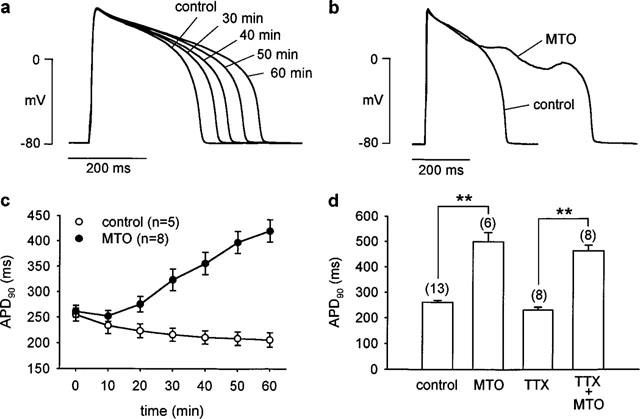
Effect of MTO on the action potential duration (APD) in guinea-pig ventricular myocytes. Action potentials were evoked with current-clamp at a frequency of 0.5 Hz. (a) Recording showing time-dependent prolongation of APD induced by 30 μM MTO. All action potentials were continuously recorded from one cell. (b) Superimposed recordings showing early afterdepolarization caused by superfusion of a myocyte with 30 μM MTO for 1 h. (c) Time-dependent change of APD90 in control cells and in cells superfused with 30 μM MTO. (d) Failure of tetrodotoxin (TTX) to prevent the prolongation of APD90 induced by superfusion of myocytes with 30 μM MTO for 60 min. APD90 was measured in the absence (control) and in the presence of either 30 μM MTO, 10 μM TTX, or 30 μM MTO plus 10 μM TTX. Data from four different cell groups are compared. Numbers of cells in each group are given in parentheses. **P<0.01.
Voltage-dependent K+ currents
To test for a possible interaction of MTO with K+ currents, myocytes were clamped from a holding potential of −40 mV to voltages between −100 and +40 mV in 10-mV steps for 1 s. As shown by the current-voltage relations in Figure 2, pretreatment of cells with 30 μM MTO for 1 h produced a significant decrease of IK1. When IK1 was blocked by 1 mM BaCl2, the residual background currents activated between −100 to 0 mV were not significantly influenced by MTO (data not shown). K+ currents activated at potentials positive to −30 mV, i.e., potentials at which IK activates, were likewise suppressed by 30 μM MTO. Currents elicited by clamp steps to voltages positive to +20 mV, however, were not inhibited by MTO. The effect of MTO on IK was therefore investigated in more detail by measuring the outward tail currents elicited on repolarization to −40 mV after depolarizing step potentials from a holding potential of −40 mV to +70 mV in 10 mV increments for 1 s. Typical recordings obtained from two different cells clamped from −40 to +60 mV in several steps are shown in Figure 3a; peak tail currents are clearly suppressed at all potentials in the MTO-pretreated cells whereas time-dependent IK was not affected at potentials positive to +20 mV. In Figure 3b, tail currents were plotted as a function of membrane potential, and it can be seen that currents in the presence of MTO (closed circles) were suppressed at all voltages. Inspection of Figure 3b reveals that the current-voltage relations in the absence and in the presence of MTO are characterized by an outward hump which indicates that IK is composed of a low (−30 to +10 mV) and a high voltage (>+20 mV) component. Figure 4a (open circles) demonstrates that inhibition of IK tail currents by MTO is largest at lower voltages (by 50–60% at −30 to +10 mV) and decreases at more positive potentials. When IK tail currents were elicited by short voltage pulses of 250 ms, inhibition by MTO did not differ from long pulses in the lower voltage range but was more sustained at more positive potentials (Figure 4a, closed circles). These results suggested that MTO preferentially inhibited the rapid activating component of IK, i.e., IKr. When IKr was measured directly in cells bathed in nominally Ca2+-free solution, both the steady-state current evoked by a 500-ms depolarizing step to −10 mV and the tail current elicited upon repolarization to a holding potential of −40 mV were significantly inhibited by 64% after 1 h treatment with 30 μM MTO (Figure 4b). The voltage dependence of IKr activation was not significantly influenced by MTO (data not shown). Class III antiarrhythmic drugs, specifically those which inhibit predominantly IKr, are known to exhibit reverse rate-dependence (Hondeghem & Snyders, 1990). Figure 5 shows that 30 μM MTO resembled d-sotalol in that APD prolongation was successively reduced by increasing the stimulation frequency. As shown by the original action potentials in Figure 5a, MTO completely lost its APD-prolonging effect at a stimulation frequency of 4 Hz. Note that the experiments shown in Figure 5 were carried out in guinea-pig papillary muscles.
Figure 2.
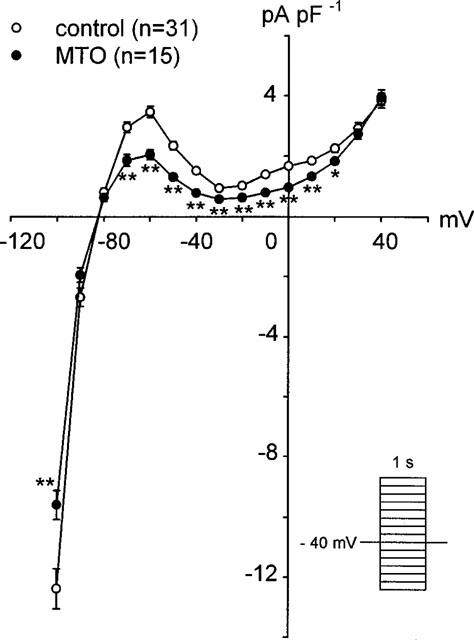
Current-voltage relation of the steady-state K+ currents of guinea-pig ventricular myocytes in the absence (control) and in the presence of 30 μM MTO. The drug effect was measured 1 h after its addition to the cells. Currents were evoked by applying 1-s depolarizing or hyperpolarizing pulses in 10 mV steps from a holding potential of −40 mV every 10 s. The mean current densities are plotted against the respective test potentials. Data from two different cell groups are compared. *P<0.05 and **P<0.01 vs control.
Figure 3.
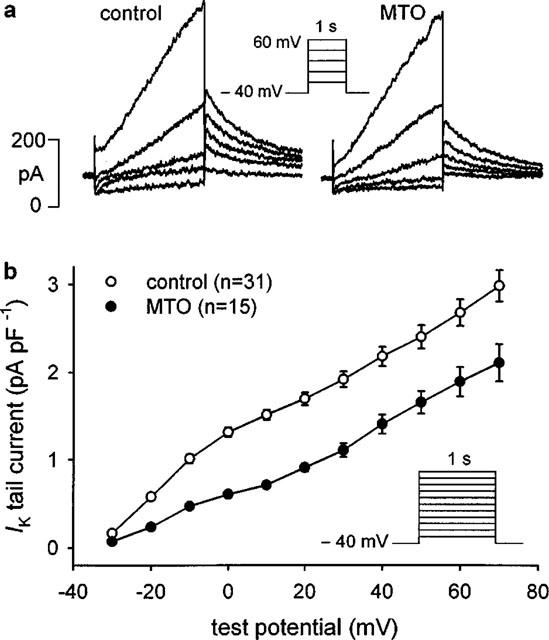
Inhibition of Ik by MTO in guinea-pig ventricular myocytes. Ik was elicited every 10 s by voltage protocols indicated in the inset of panel (a) and (b). The drug effect was determined 60 min after its addition to the myocytes. (a) Superimposed traces showing Ik steady-state currents and tail currents of a control cell (Cm=80 pF) and of a cell superfused with 30 μM MTO (Cm=83 pF). (b) Ik tail current-voltage relation in the absence (control) and in the presence of 30 μM MTO. The mean Ik tail current densities from two different cell groups at the respective test potentials are compared.
Figure 4.
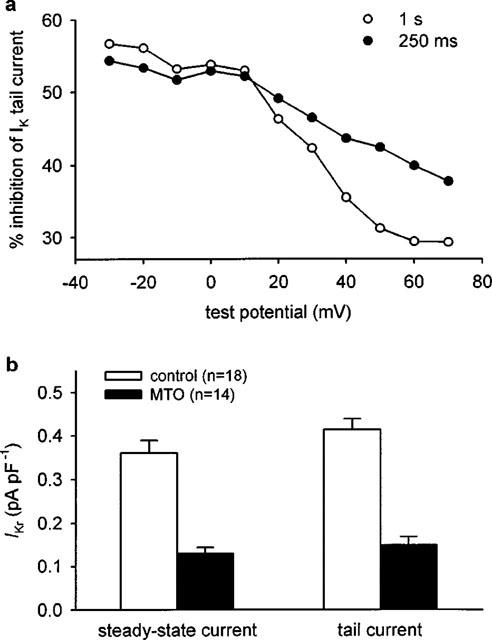
(a) Effect of test pulse duration on the voltage-dependent inhibition of Ik tail currents by 30 μM MTO. Guinea-pig ventricular myocytes were clamped every 10 s from a holding potential of −40 mV to test potentials up to +70 mV in 10 mV increments. Test pulses of 1-s and 250-ms were applied to every cell. Per cent inhibition of the Ik tail current was calculated by dividing the mean current densities of the cells pretreated with 30 μM MTO for 1 h (n=15) by that of control cells (n=31) at the respective test potential and test pulse duration. (b) Inhibition of Ikr by 30 μM MTO. Myocytes were superfused with nominally Ca2+-free bath solution. Ikr steady-state current was evoked by a 500-ms depolarization pulse to −10 mV at 0.5 Hz, and Ikr tail current was elicited upon repolarization to a holding potential of −40 mV. The effect of MTO was measured after cells had been treated with the drug for 1 h. The mean current densities of two different cell groups are compared.
Figure 5.
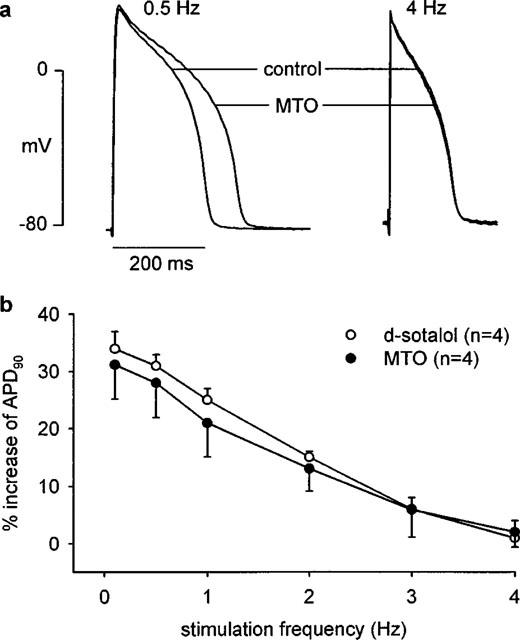
Reverse rate-dependence of the prolongation of action potential duration (APD) by MTO in guinea-pig ventricular papillary muscles. The effect of MTO was measured 2 h after its addition to the bath. (a) Superimposed recordings showing the effect of 30 μM MTO on APD in the same muscle at two different stimulation frequencies. (b) Comparison of the reverse rate-dependence of the prolongation of APD90 by 30 μM MTO and 30 μM d-sotalol. The effect of d-sotalol was evaluated 30 min after its addition to the bath. Two different groups are compared.
In some tissues such as rat and human heart, Ito plays an important role in determining APD. Because Ito is functionally absent in guinea-pig ventricular myocytes (Josephson et al., 1984), experiments were also carried out on isolated rat cardiomyocytes. Cells were depolarized from a holding potential of −80 mV by a prepulse to −60 mV and then clamped to test potentials ranging from −30 to +60 mV for 500 ms. As shown by the original recordings in Figure 6a (inset), and verified in additional 19 control and ten cells pretreated with 30 μM MTO for 1 h, no significant effect on Ito at any of the test potentials could be detected by the drug. The lack of MTO to affect Ito is also demonstrated by continuous action potential measurements in current-clamped rat ventricular myocytes as shown in Figure 6b. In the voltage range where Ito is dominant, no influence on action potential repolarization can be detected. However, when IK1 becomes activated at around −30 mV, MTO produced a time-dependent slowing of repolarization which eventually led to early afterdepolarizations. As shown before in guinea-pig cells, MTO also inhibited IK1 of rat cardiomyocytes (not shown) and this effect can explain the pronounced prolongation of the late phase of the action potential in the rat.
Figure 6.
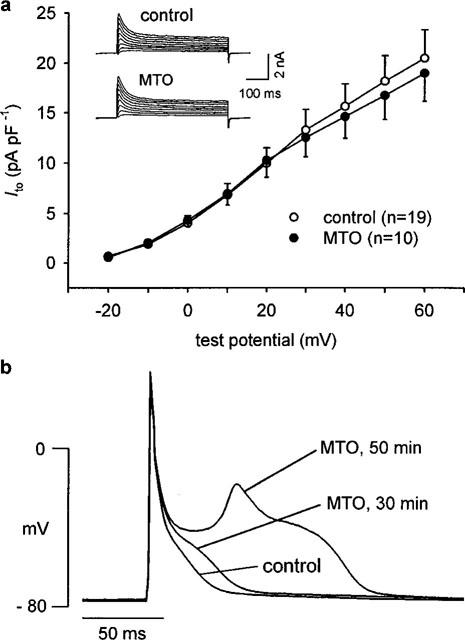
(a) Failure of 30 μM MTO to influence Ito of rat ventricular myocytes. Ito was elicited by depolarization to various test potentials for 500 ms after a 100 ms prepulse to −60 mV from a holding potential of −80 mV every 10 s. Current-voltage relation of Ito in control cells and in cells pretreated with 30 μM MTO for 1 h are compared. The inset shows representative Ito recordings of a control cell (Cm=135 pF) and of a MTO-treated cell (Cm=129 pF). (b) Superimposed traces showing the time-dependent effect of 30 μM MTO on the action potential of a rat ventricular myocyte, current-clamped at 0.5 Hz.
L-type Ca2+ current
When ICa(L) was measured at various potentials in guinea-pig ventricular myocytes either in the absence or in the presence of 30 μM MTO, no significant difference in the peak or the inactivation kinetics of the current was observed (data not shown). In the experiment shown in Figure 7a and b, ICa(L) was enhanced from 0.7–2.0 nA by superfusing the myocyte with 50 nM isoprenaline. The isoprenaline-stimulated ICa(L) was then inhibited by 1 μM carbamylcholine to 1.3 nA. Adding 30 μM MTO to the isoprenaline- and carbamylcholine containing bath solution partially reversed ICa(L) to 1.9 nA. After washing out all three drugs, ICa(L) returned to the predrug control level. In Figure 7a, the original current traces of the experiment depicted in Figure 7b are superimposed at times when the respective effects were maximal. Results similar to those shown in Figure 7a and b were obtained in eleven other cells (Figure 7c). In order to investigate whether MTO antagonized the effect of carbamylcholine by blocking muscarinic receptors or by interfering with mechanisms downstream to receptor activation, experiments with the A1-adenosine receptor agonist R-PIA were carried out. As shown in Figure 7d, addition of 1 μM R-PIA to myocytes stimulated by 50 nM isoprenaline induced a signfiicant decrease of ICa(L) from 2.2±0.2 (ISO; n=7) to 1.4±0.2 nA (ISO+R-PIA). Contrary to carbamylcholine, the enhancing effect of additional MTO on ICa(L) was not observed in the presence of isoprenaline and R-PIA (Figure 7d ISO+R-PIA+MTO). These findings indicate that MTO enhanced ICa(L) most likely by blocking muscarinic receptors.
Figure 7.
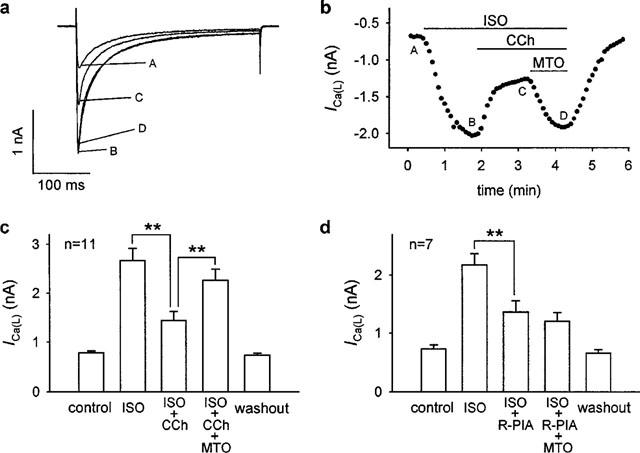
Reversal by MTO of the inhibitory effect of carbamylcholine on ICa(L) activated by isoprenaline in guinea-pig ventricular myocytes. ICa(L) was elicited by depolarizing steps from a holding potential of −40 mV to 0 mV for 300 ms at a frequency of 0.2 Hz. MTO: 30 μM mitoxantrone; ISO: 50 nM isoprenaline; CCh: 1 μM carbamylcholine; R-PIA: 1 μM (−)-N6-(2-phenylisopropyl)-adenosine. (a) Superimposed current recordings showing the reversing effect of MTO on peak ICa(L) inhibited by CCh. The current traces were recorded at the times indicated by the corresponding letters in panel (b). (b) Time course of the change of peak ICa in the same cell as in (a). (c) and (d) Summary of the effect of MTO on peak ICa(L) inhibitited by CCh and R-PIA, respectively. **P<0.01.
Muscarinic receptor gated K+ current
Cardiac muscarinic receptor gated K+ channels (KACh channels) are present in high density in the atria, sinoatrial- and atrioventricular node, and are a major target of the vagal autonomic system in the heart. The effect of MTO on IK,ACh induced by carbamylcholine in GTP (100 μM)-loaded guinea-pig atrial cells was therefore investigated. When 1 μM carbamylcholine was added to the superfusion medium, an outward K+ current was rapidly activated at a holding potential of −50 mV (Figure 8a). After activation, the current slowly declined, possibly due to desensitization (Kurachi et al., 1987). Addition of 30 μM MTO after 1 min superfusion of carbamylcholine induced within a few seconds a marked depression of IK,ACh (Figure 8a),. In eight cells, 1 μM carbamylcholine evoked an IK,ACh which amounted after 1 min to 188.3±35.0 pA and was markedly depressed to 13.3±3.5 pA, i.e. by 93%, when 30 μM MTO was added. Muscarinic receptors couple with KACh channels through a pertussis toxin-sensitive class of GTP-binding proteins in atrial cells (Pfaffinger et al., 1985). When a nonhydrolysable GTP analogue such as GTPγS is applied intracellularly, activation of GTP-binding proteins occurs and induces a persistent activation of KACh channels which is resistant to inhibition by muscarinic receptor antagonists (Breitwieser & Szabo, 1985). With 100 μM GTPγS in the recording pipette, there was a continuous rise of a K+ outward current in guinea-pig atrial cells clamped at −50 mV (Figure 8c). This current reached its maximum in 10 min and remained stable thereafter. MTO induced only a very weak (9%) but reversible inhibition of the current evoked by GTPγS. In five cells loaded with GTPγS, the K+ current increased to 361.4±29.3 pA and 30 μM MTO reversed this current to 314.4±47.5 pA, i.e. by 12.6%. Although the experiment clearly shows that the predominant action of MTO on IK,ACh is via muscarinic receptors, a small direct inhibitory effect on KACh channels seems to contribute.
Figure 8.
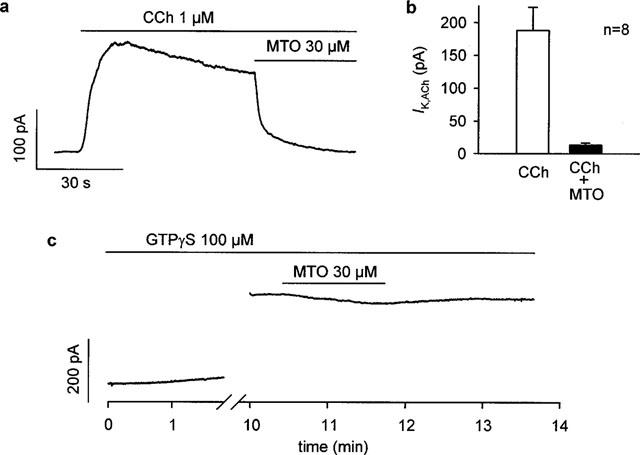
Effect of MTO on IK,ACh of guinea-pig atrial myocytes. The cells were continuously clamped at −50 mV. (a) Typical current recording showing the inhibitory effect of MTO on IK,ACh induced by carbamylcholine (CCh). (b) Summary of the inhibitory effect of 30 μM MTO on IK,ACh induced by 1 μM CCh. Data from the same cell group are compared. (c) Typical recording showing the effect of MTO on IK,ACh activated by loading the cell with GTPγS through a patch pipette.
[3H]-QNB binding study
Binding of [3H]-QNB to two preparations of human atrial membranes was saturable between 500 and 1000 pM. Scatchard analysis indicated a homogenous population of binding sites, a Bmax of 218 and 434 fmol mg−1 protein and a KD of 104 and 234 pM, respectively. In the presence of 30 μM MTO, binding of [3H]-QNB was almost completely abolished (not shown). MTO concentration-dependently displaced [3H]-QNB from its binding sites with calculated equilibrium dissociation constants (Ki) of 1.29, 1.10 and 1.02 μM at 0.70, 1.48 and 2.91 nM [3H]-QNB, respectively (Figure 9).
Figure 9.
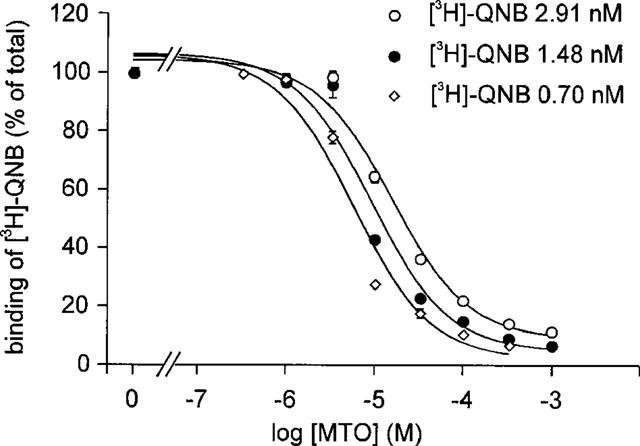
Displacement of specific [3H]-QNB binding by MTO. MTO was added at concentrations ranging from 0.1–1000 μM in the presence of three different [3H]-QNB concentrations. Fitted curves are representative of two independent experiments carried out in triplicate. Correlation coefficients of the fits are 0.99, 0.96 and 0.97 in the presence of 0.7, 1.48 and 2.91 nM [3H]-QNB, respectively.
Discussion
The present study describes the acute effects of the anticancer drug MTO on the membrane electrical properties and the muscarinic receptor of isolated cardiac preparations.
The most prominent effect of MTO was a prolongation of APD which occurred in multicellular preparations as well as in single myocytes. Prolongation of APD might have arisen from the elevation of depolarizing plateau currents, but it appears that enhancement by MTO either of fast Na+ or of Ca2+ currents is not involved, since prolongation of APD persisted in the presence of tetrodotoxin and ICa(L) remained unaffected in voltage-clamp experiments.
Delayed rectifier potassium channels play a key role in regulating cardiac APD. In guinea-pig ventricular myocytes, IK is composed of two components, a rapidly activating, inwardly rectifying component, IKr, and a slowly activating component, IKs (Sanguinetti & Jurkiewicz, 1990a). At normal heart rates, both components of IK seem to contribute to repolarization of the cardiac action potentials (Sanguinetti & Jurkiewicz, 1990a; Heath & Terrar, 1996). IKs has been shown to be more dominant than IKr during the plateau phase of action potential, whereas IKr is more important than IKs during phase 3 of the action potential (Sanguinetti & Jurkiewicz, 1990a; Zeng et al., 1995). Although IKr is the target of most clinically used class III antiarrhythmic drugs (Sanguinetti & Jurkiewicz, 1990a; Katritsis & Camm, 1993), selective blockers of the IKs channel complex have been developed recently and their APD prolonging effect has been clearly demonstrated (Busch et al., 1996; Salata et al., 1996; Schreieck et al., 1997). Although both components of IK were present in most of our experiments, some of the findings are compatible with the view that MTO preferentially blocked IKr. Because IKr, by very fast inactivation of channels from open state (Shibasaki, 1987; Spector et al., 1996; Yang et al., 1997), exhibits inward rectification at positive potentials (0 to +40 mV), a specific IKr blocker should have no effect on time-dependent outward currents elicited at voltages above +40 mV when IKr is almost completely inactivated (Sanguinetti & Jurkiewicz, 1990a). This is exactly what was found with MTO, the time-dependent outward current measured at the end of 1 s pulses was only suppressed at voltages during which IKr was measurably activated (see Figure 2). Analysis of activation of IK is difficult because of additional currents which may be simultaneously activated by depolarizing pulses. Upon repolarization from activating voltage steps, an outward tail current is observed which is thought to represent the slow deactivation of IK and serves as a more reliable index of the IK current (Heath & Terrar, 1996). With repolarizing steps, inactivated channels conducting IKr rapidly enter the open state, from which channels close slowly, thereby contributing to the peak and the decay of IK tail currents also at very positive potentials (Shibasaki, 1987). Because IKs slowly activates with depolarization over a time course of many seconds, its contribution to IK tail current increases over time and should therefore render peak IK tail current more resistant to blockers of IKr at longer pulse durations. MTO suppressed IK tail currents at all voltages (−30 to +70 mV) and, consistent with IKr block, suppression decreased at voltages above +20 mV and this decrease was more pronounced with long (1 s) as compared with short pulses (250 ms). Although the above results strongly suggested that MTO preferentially inhibited IKr, direct proof for this inhibition came from experiments carried out in nominally Ca2+-free bath solution. It has been demonstrated that under this condition, IKr could be separated from IKs because the activating potentials of both currents were shifted in opposite direction (Sanguinetti & Jurkiewicz, 1990b; Jurkiewicz & Sanguinetti, 1993). When IKr was elicited by a 500-ms depolarizing pulse to −10 mV from a holding potential of −40 mV, MTO significantly inhibited both the steady-state- and the tail current. Specific blockers of IKr such as d-sotalol or dofetilide have been reported to display reverse rate-dependent effects, i.e., they prolong APD more at long than at short cycle lengths (Tande et al., 1990; Gwilt et al., 1991; Jurkiewicz & Sanguinetti, 1993; Gjini et al., 1996). In the present study we found that MTO also displayed reverse rate-dependence, its APD prolonging action in guinea-pig papillary muscle was almost completely abolished by increasing the stimulation frequency to 4 Hz. In this context, it is interesting to note that specific inhibitors of IKs and unspecific blockers of IK such as ambasilide or amiodarone produced frquency-independent effects on APD (Bosch et al., 1997; Salata et al., 1996; Schreieck et al., 1997), indicating that reverse rate-dependence of APD is a characteristic feature of pure IKr blocking drugs. There are several explanations for reverse rate-dependence such as accumulation of IKs at high frequencies when cycle length becomes shorter than IKs deactivation time (Sanguinetti & Jurkiewicz, 1990a; 1993), [Ca2+]i-dependent increase in IKs at high stimulation rates (Hiraoka et al., 1995) and a decreased sensitivity of IKr at high [K+]o, due to accumulation of K+ close to the outer cell membrane during rapid stimulation (Attwell et al., 1981; Yang & Roden, 1996). It should be noted, however, that none of these mechanisms has been firmly established as the cause of reverse rate-dependence of APD by IKr blockers.
The observation that MTO did not alter resting membrane potential does not by itself exclude an inhibitory effect on IK1 because only a fraction of the normal IK1 is required to maintain the membrane potential near EK during diastole. Indeed, current-voltage relations disclosed a significant reduction by MTO of the outward current hump observed at potentials between −70 and −30 mV. This effect was probably due to inhibition of IK1 because this current is primarily activated over this voltage range in guinea-pig ventricular myocytes (Backx & Marban, 1993), and MTO had no influence on the residual background currents when IK1 was blocked by 1 mM BaCl2. During the plateau of the cardiac action potential, channels conducting IK1 allow either no or very little current to pass. However, when the cell repolarizes and especially during the final repolarization, IK1 becomes important and is responsible for the regenerative increase in repolarization rate (Shimoni et al., 1992; Zeng et al., 1995). Whether blockade of IK1 induces action potential prolongation is an unsettled issue because ‘pure' IK1 blockers such as the benzopyran compounds RP 58866 and its active enantiomer terikalant, turned out to be also potent blockers of IKr (Jurkiewicz et al., 1996). Interestingly, in the rat cardiomyocyte where rapid repolarization of action potential is due to activation of the transient outward current, Ito, (Josephson et al., 1984; Dukes & Morad, 1991) MTO had no influence on APD as long as this outward current was dominant. During late repolarization, however, when IK1 becomes activated, MTO markedly delayed final repolarization which eventually resulted in early afterdepolrizations. To what extent inhibition of IK1 by MTO contributes to APD prolongation in guinea-pig myocytes is presently not known.
A striking property of IKr is its unusual sensitivity to changes in [K+]o (Yang & Roden, 1996; Yang et al., 1997). Thus IKr plays a major role causing shortening of APD when [K+]o is elevated or, conversely, prolongation of APD when [K+]o is reduced. Accumulation of [K+]o in extracellular clefts of contracting guinea-pig papillary muscles may therefore be responsible for the smaller effect of MTO on APD in multicellular preparations as compared with single cells (see Figures 1 and 5). APD prolongation by block of IKr is an important factor in arrhythmogenesis (for review, see Sanguinetti & Salata, 1996). Although early afterdepolarizations by MTO were only observed in single cardiomyocytes, IKr block may also cause undesirable proarrhythmic effects in multicellular heart preparations, especially when [K+]o is low.
Normally the heart is under the steady control of the sympathetic and parasympathetic autonomic nervous system. Vagal activation inhibits release and antagonises the effects of released catecholamines on force of contraction, heart rate and AV-conduction. One important mechanism by which catecholamines and acetylchline exert their antagonistic effects is by modulating ICa(L). Although MTO had no direct effect on ICa(L), it influenced the current indirectly by reversing the inhibitory action of carbamylcholine on isoprenaline-stimulated ICa(L). This effect could have been due to inhibition of muscarinic receptors or to a mechanism downstream to receptor activation. The A1-adenosine receptor agonist R-PIA utilizes the same pertussis toxin-sensitive intracellular signal transduction pathway as carbamylcholine to inhibit the catecholamine-enhanced ICa(L) (for review see Belardinelli et al., 1989). Since MTO did not affect ICa(L) in the presence of R-PIA plus isoprenaline, inhibition of muscarinic receptors was very likely the mechanism of MTO's indirect effect on ICa(L). In atrial cells as well as in sinoatrial- and atrioventricular node, activation of KACh channels by an increased vagal tone plays an important role in slowing sinus rate, prolonging A-V conduction and shortening atrial refractoriness. KACh channels are linked to muscarinic or adenosine receptors through pertussis-toxin sensitive GTP-binding proteins (Pfaffinger et al., 1985) and it has been shown that GTPγS, a nonhydrolysable GTP analogue, can activate GTP-binding proteins irreversibly, resulting in persistent activation of KACh channels (Kurachi et al., 1986). MTO (30 μM) decreased the carbamylcholine-activated IK,ACh in control cells by more than 90% but reversed the IK,ACh activated by GTPγS by only 12%. This finding suggests that MTO may act primarily through its blocking action on muscarinic receptors and only to a small extent by blocking the KACh channel itself and/or by interfering with the regulatory functions of GTP-binding proteins coupled to the channel. The blocking effect of MTO on cardiac muscarinic receptors was further confirmed by radioligand binding experiments which showed that MTO displaced [3H]-QNB binding concentration-dependently (1–1000 μM). The slightly different Ki values obtained at various [3H]-QNB concentrations indicate that this antagonistic effect was not strictly competitive. The heart rate is normally under tonic parasympathetic control. Thus administration of MTO which blocks the muscarinic receptors of the parasympathetic transmitter acetylcholine, can be expected to raise the heart rate. This effect should on the one hand alleviate APD prolongation of ventricular myocytes due to reverse rate-dependence but could on the other hand induce early afterdepolarizations due to the dominance of catecholamines released from sympathetic nerve endings.
In summary, MTO is a potent blocker of inward rectifier- and of delayed rectifier K+ channels. The resulting APD prolongation might cause undesirable proarrhythmic effects which may be alleviated or accentuated by the anticholinergic action of MTO.
Acknowledgments
This work was supported by a grant from the Deutsche Forschungsgemeinschaft to M.Korth (Ko 659/5-1).
Abbreviations
- APD
action potential duration
- APD90
action potential duration measured at 90% repolarization
- CCh
carbamylcholine
- Cm
membrane capacitance
- GTPγS
guanosine-5′-O-(3-thiotriphosphate)
- ICa(L)
L-type Ca2+ current
- IK
delayed rectifier K+ current
- IK,ACh
muscarinic receptor gated K+ current
- IKr
rapidly activating delayed rectifier K+ current
- IKs
slowly activating delayed rectifier K+ current
- ISO
isoprenaline
- MTO
mitoxantrone
- R-PIA
(−)-N6-phenylisopropyladenosine
- TTX
tetrodotoxin
References
- ABI-GERGES N., ESCHENHAGEN T., HOVE-MADSEN L., FISCHMEISTER R., MÉRY P.-F. Methylene blue is a muscarinic antagonist in cardiac myocytes. Mol. Pharmacol. 1997;52:482–490. doi: 10.1124/mol.52.3.482. [DOI] [PubMed] [Google Scholar]
- ALDERTON P.M., GROSS J., GREEN M.D. Comparative study of doxorubicin, mitoxantrone, and epirubicin in combination with ICRF-187 (ADR-529) in chronic cardiotoxicity animal model. Cancer Res. 1992;52:194–201. [PubMed] [Google Scholar]
- ATTWELL D., COHEN I., EISNER D. The effects of heart rate on the action potential of guinea-pig and human ventricular muscle. J. Physiol. (Lond.) 1981;313:439–461. doi: 10.1113/jphysiol.1981.sp013675. [DOI] [PMC free article] [PubMed] [Google Scholar]
- BACKX P.H., MARBAN E. Background potassium current active during the plateau of the action potential in guinea pig ventricular myocytes. Circ. Res. 1993;72:890–900. doi: 10.1161/01.res.72.4.890. [DOI] [PubMed] [Google Scholar]
- BELARDINELLI L., LINDEN J., BERNE R.M. The carciac effects of adenosine. Prog. Cardiovasc. Dis. 1989;32:73–97. doi: 10.1016/0033-0620(89)90015-7. [DOI] [PubMed] [Google Scholar]
- BENJAMIN R.S. Rationale for the use of mitoxantrone in the older patient: cardiac toxicity. Semin. Oncol. 1995;22:11–13. [PubMed] [Google Scholar]
- BOSCH R.F., GASPO R., BUSCH A.E., LANG H.-J., LI G.R., NATTEL S.Effects on repolarization of the chromanol 293B, a highly selective blocker of the slow component of the delayed rectifier K+ (IKs) in human and guinea pig ventricle J. Am. Coll. Cardiol. 199729suppl A512A(abstract) [DOI] [PubMed] [Google Scholar]
- BREITWIESER G.E., SZABO G. Uncoupling of cardiac muscarinic and β-adrenergic receptors from ion channels by a guanine nucleotide analogue. Nature. 1985;317:538–450. doi: 10.1038/317538a0. [DOI] [PubMed] [Google Scholar]
- BUSCH A.E., SUESSBRICH H., WALDEGGER S., SAILER E., GREGER R., LANG H., LANG F., GIBSON K.J., MAYLIE J.G. Inhibition of IKs in guinea pig cardiac myocytes and guinea pig IsK channels by the chromanol 293B. Pflügers Arch. 1996;432:1094–1096. doi: 10.1007/s004240050240. [DOI] [PubMed] [Google Scholar]
- DODD D.A., ATKINSON J.B., OLSON R.D., BUCK S., CUSACK B.J., FLEISCHER S., BOUCEK R.J. Doxorubicin cardiomyopathy is associated with a decrease in calcium release channel of the sarcoplasmic reticulum in a chronic rabbit model. J. Clin. Invest. 1993;91:1697–1705. doi: 10.1172/JCI116379. [DOI] [PMC free article] [PubMed] [Google Scholar]
- DORR R.T., SHIP N.G., LEE K.M. Comparison of cytotoxicity in heart cells and tumor cells exposed to DNA intercalating agents in vitro. Anti-Cancer Drugs. 1991;2:27–33. doi: 10.1097/00001813-199102000-00003. [DOI] [PubMed] [Google Scholar]
- DUKES I.D., MORAD M. The K+ current in rat ventricular myocytes: evaluation of its Ca2+ and Na+ dependence. J. Physiol. (Lond.) 1991;435:395–420. doi: 10.1113/jphysiol.1991.sp018516. [DOI] [PMC free article] [PubMed] [Google Scholar]
- FAULDS D., BALFOUR J.A., CHRISP P., LANGTRY H.D. Mitoxantrone. A review of its pharmacodynamic and pharmacokinetic properties, and therapeutic potential in the chemotherapy of cancer. Drugs. 1991;41:400–449. doi: 10.2165/00003495-199141030-00007. [DOI] [PubMed] [Google Scholar]
- GAMS R.A., WESLER M.J. Mitoxantrone cardiotoxicity: results from Southeastern Cancer Study Group. Cancer Treat. Symp. 1984;3:31–33. [Google Scholar]
- GJINI V., KORTH M., SCHREIECK J., WEYERBROCK S., SCHÖMIG A., SCHMITT C. Differential class III antiarrhythmic effects of ambasilide and dofetilide at different extracellular potassium and pacing frequencies. J. Cardiovasc. Pharmacol. 1996;28:314–320. doi: 10.1097/00005344-199608000-00019. [DOI] [PubMed] [Google Scholar]
- GWILT M., ARROWSMITH J.E., BLACKBURN K.J., BURGES R.A., CROSS P.E., DALRYMPLE H.W., HIGGINS A.J. UK-68,798: A novel, potent and highly selective class III antiarrhythmic agent which blocks potassium channels in cardiac cells. J. Pharmacol. Exp. Ther. 1991;256:318–324. [PubMed] [Google Scholar]
- HAMILL O.P., MARTY A., NEHER E., SAKMANN B., SIGWORTH F.J. Improved patch-clamp techniques for high-resolution current recording from cells and cell-free membrane patches. Pflügers Arch. 1981;391:85–100. doi: 10.1007/BF00656997. [DOI] [PubMed] [Google Scholar]
- HEATH B.M., TERRAR D.A. Separation of the components of the delayed rectifier potassium current using selective blockers of IKr and IKs in guinea-pig isolated ventricular myocytes. Exp. Physiol. 1996;81:587–603. doi: 10.1113/expphysiol.1996.sp003961. [DOI] [PubMed] [Google Scholar]
- HENDERSON I.C., ALLEGRA J.C., WOODCOCK T., WOLFF S., BRYAN S., CARTWRIGHT K., DUKART G., HENRY D. Randomized clinical trial comparing mitoxantrone with doxorubicin in previously treated patients with metastatic breast cancer. J. Clin. Oncol. 1989;7:560–571. doi: 10.1200/JCO.1989.7.5.560. [DOI] [PubMed] [Google Scholar]
- HERMAN E.H., ZHANG J., HASINOFF B.B., CLARK J.R., FERRANS V.J. Comparison of the structural changes induced by doxorubicin and mitoxantrone in the heart, kidney and intestine and characterization of the Fe (III)-mitoxantrone complex. J. Mol. Cell. Cardiol. 1997;29:2415–2430. doi: 10.1006/jmcc.1997.0477. [DOI] [PubMed] [Google Scholar]
- HIRAOKA M., FURUKAWA T., SAWANOBORI T., YAMANE T.Regulation of delayed rectifier K+ channels and ATP-sensitive K+ channels by intracellular factors Potassium channels in normal and pathological conditions 1995Leuven: Leuven University Press; 103–117.eds. Vereecke, J., van Bogaert, P., Verdonck, F. pp [Google Scholar]
- HONDEGHEM L., SNYDERS D. Class III antiarrhythmic agents have a lot of potential but a long way to go: reduced effectiveness and dangers of reverse use dependence. Circulation. 1990;81:686–690. doi: 10.1161/01.cir.81.2.686. [DOI] [PubMed] [Google Scholar]
- JOHNSON R.K., ZEE-CHENG R.K.-Y., LEE W.W., ACTON E.M., HENRY D.W., CHENG C.C. Experimental antitumor activity of aminoanthraquinones. Cancer Treat. Rep. 1979;63:425–439. [PubMed] [Google Scholar]
- JOSEPHSON I.R., SANCHEZ-CHAPULA J., BROWN A.M. Early outward current in rat single ventricular cells. Circ. Res. 1984;54:157–162. doi: 10.1161/01.res.54.2.157. [DOI] [PubMed] [Google Scholar]
- JURKIEWICZ N.K., SANGUINETTI M.C. Rate-dependent prolongation of cardiac action potentials by a methanesulfonanilide class III antiarrhythmic agent. Specific block of rapidly activating delayed rectifier K+ current by dofetilide. Circ. Res. 1993;72:75–83. doi: 10.1161/01.res.72.1.75. [DOI] [PubMed] [Google Scholar]
- JURKIEWICZ N.K., WANG J., FERMINI B., SANGUINETTI M.C., SALATA J.J. Mechanism of action potential prolongation by RP 58866 and its active enantiomer, terikalant. Block of the rapidly activating delayed rectifier K+ current, Ikr. Circulation. 1996;94:2938–2946. doi: 10.1161/01.cir.94.11.2938. [DOI] [PubMed] [Google Scholar]
- KATRITSIS D., CAMM A.J. New class III antiarrhythmic drugs. Eur. Heart J. 1993;14:93–99. doi: 10.1093/eurheartj/14.suppl_h.93. [DOI] [PubMed] [Google Scholar]
- KIYOSUE T., ARITA M. Late sodium current and its contribution to action potential configuration in guinea pig ventricular myocytes. Circ. Res. 1989;64:389–397. doi: 10.1161/01.res.64.2.389. [DOI] [PubMed] [Google Scholar]
- KURACHI Y., NAKAJIMA T., SUGIMOTO T. On the mechanism of activation of muscarinic K+ channels by adenosine in isolated atrial cells: involvement of GTP-binding proteins. Pflügers Arch. 1986;407:264–274. doi: 10.1007/BF00585301. [DOI] [PubMed] [Google Scholar]
- KURACHI Y., NAKAJIMA T., SUGIMOTO T. Short-term desensitisation of muscarinic K+ channel current in isolated atrial myocytes and possible role of GTP-binding proteins. Pflügers Arch. 1987;410:227–233. doi: 10.1007/BF00580270. [DOI] [PubMed] [Google Scholar]
- MURDOCK K.C., CHILD R.G., FABIO P.F., ANGIER R.B., WALLACE R.E., DURR F.E., CITARELLA R.V. Antitumor agents. I. 1,4-bis[(aminoalkyl)amino]-9,10-anthracenediones. J. Med. Chem. 1979;22:1024–1030. doi: 10.1021/jm00195a002. [DOI] [PubMed] [Google Scholar]
- PFAFFINGER P.J., MARTIN J.M., HUNTER D.D., NATHANSON N.M., HILLE B. GTP-binding proteins couple cardiac muscarinic receptors to a K channel. Nature. 1985;317:536–538. doi: 10.1038/317536a0. [DOI] [PubMed] [Google Scholar]
- POSNER L.E., DUKART G., GOLDBERG J., BERNSTEIN T., CARTWRIGHT K. Mitoxantrone: an overview of safety and toxicity. Invest. New Drugs. 1985;3:123–132. doi: 10.1007/BF00174159. [DOI] [PubMed] [Google Scholar]
- POWELL T., TERRAR D.A., TWIST V.W. Electrical properties of individual cells isolated from adult rat ventricular myocardium. J. Physiol. (Lond.) 1980;302:131–153. doi: 10.1113/jphysiol.1980.sp013234. [DOI] [PMC free article] [PubMed] [Google Scholar]
- SALATA J.J., JURKIEWICZ N.K., SANGUINETTI M.C., SIEGL P.K., CLAREMON D.A., REMY D.C., ELLIOTT J.M., LIBBY B.E.The novel class III antiarrhythmic agent, L-735,821 is a potent and selective blocker of IKs in guinea pig ventricular myocytes Circulation 199694suppl II-529(abstract) [Google Scholar]
- SANGUINETTI M.C., JURKIEWICZ N.K. Two components of cardiac delayed rectifier K+ current: differential sensitivity to block by class III antiarrhythmic agents. J. Gen. Physiol. 1990a;96:195–215. doi: 10.1085/jgp.96.1.195. [DOI] [PMC free article] [PubMed] [Google Scholar]
- SANGUINETTI M.C., JURKIEWICZ N.K. Lanthanum blocks a specific component of IK and screens membrane surface charge in cardiac cells. Am. J. Physiol. 1990b;259:H1881–H1889. doi: 10.1152/ajpheart.1990.259.6.H1881. [DOI] [PubMed] [Google Scholar]
- SANGUINETTI M.C., SALATA J.J.Cardiac potassium channel modulators: potential for antiarrhythmic therapy Potassium channels and their modulators 1996London: Taylor & Francis Ltd; 221–256.eds. Evans, J.M., Hamilton, T.C., Longman, S.D. & Stemp, G. pp [Google Scholar]
- SCHREIECK J., WANG Y., GJINI V., KORTH M., ZRENNER B., SCHÖMIG A., SCHMITT C. Differential effect of β-adrenergic stimulation on the frequency-dependent electrophysiologic actions of the new class III antiarrhythmics dofetilide, ambasilide and chromanol 293B. J. Cardiovasc. Electrophysiol. 1977;8:1420–1430. doi: 10.1111/j.1540-8167.1997.tb01039.x. [DOI] [PubMed] [Google Scholar]
- SHENKENBERG T.D., VON HOFF D.D. Mitoxantrone: a new anticancer drug with significant clinical activity. Ann. Intern. Med. 1986;105:67–81. doi: 10.7326/0003-4819-105-1-67. [DOI] [PubMed] [Google Scholar]
- SHIBASAKI T. Conductance and kinetics of delayed rectifier potassium channels in nodal cells of the rabbit heart. J. Physiol. (Lond.) 1987;387:227–250. doi: 10.1113/jphysiol.1987.sp016571. [DOI] [PMC free article] [PubMed] [Google Scholar]
- SHIMONI Y., CLARK R.B., GILES W.R. Role of inwardly rectifying potassium current in rabbit ventricular action potential. J. Physiol. (Lond.) 1992;448:709–728. doi: 10.1113/jphysiol.1992.sp019066. [DOI] [PMC free article] [PubMed] [Google Scholar]
- SPECTOR P.S., CURRAN M.E., ZOU A., KEATING M.T., SANGUINETTI M.C. Fast inactivation causes rectification of the IKr channel. J. Gen. Physiol. 1996;107:611–619. doi: 10.1085/jgp.107.5.611. [DOI] [PMC free article] [PubMed] [Google Scholar]
- TANDE P.M., BJORNSTAD H., YANG T., REFSUM H. Rate-dependent class III antiarrhythmic action, negative chronotropy, and positive inotropy of a novel IK blocking drug, UK-68,798: potent in guinea pig but no effect in rat myocardium. J. Cardiovasc. Pharmacol. 1990;16:401–410. doi: 10.1097/00005344-199009000-00008. [DOI] [PubMed] [Google Scholar]
- UNVERFERTH D.V., UNVERFERTH B.J., BALCERZAK S.P., BASHORE T.A., NEIDHART J.A. Cardiac evaluation of mitoxantrone. Cancer Treat. Rep. 1983;67:343–350. [PubMed] [Google Scholar]
- WEISS R.B. Mitoxantrone: its development and role in clinical practice. Oncology. 1989;3:135–147. [PubMed] [Google Scholar]
- WISEMAN L.R., SPENCER C.M. Mitoxantrone. A review of its pharmacology and clinical efficacy in the management of hormone-resistant advanced prostate cancer. Drugs & Aging. 1997;10:473–485. doi: 10.2165/00002512-199710060-00007. [DOI] [PubMed] [Google Scholar]
- YANG T., RODEN D.M. Extracellular potassium modulation of drug block of IKr: implications for torsades de pointes and reverse use-dependence. Circulation. 1996;93:407–411. doi: 10.1161/01.cir.93.3.407. [DOI] [PubMed] [Google Scholar]
- YANG T., SNYDERS D.J., RODEN D.M. Rapid inactivation determines the rectification and [K+]o dependence of the rapid component of the delayed rectifier K+ current in cardiac cells. Circ. Res. 1997;80:782–789. doi: 10.1161/01.res.80.6.782. [DOI] [PubMed] [Google Scholar]
- ZENG J., LAURITA K.R., ROSENBAUM D.S., RUDY Y. Two components of the delayed rectifier K current in ventricular myocytes of the guinea pig type: theoretical formulation and their role in repolarization. Circ. Res. 1995;77:140–152. doi: 10.1161/01.res.77.1.140. [DOI] [PubMed] [Google Scholar]