


Figure 4.
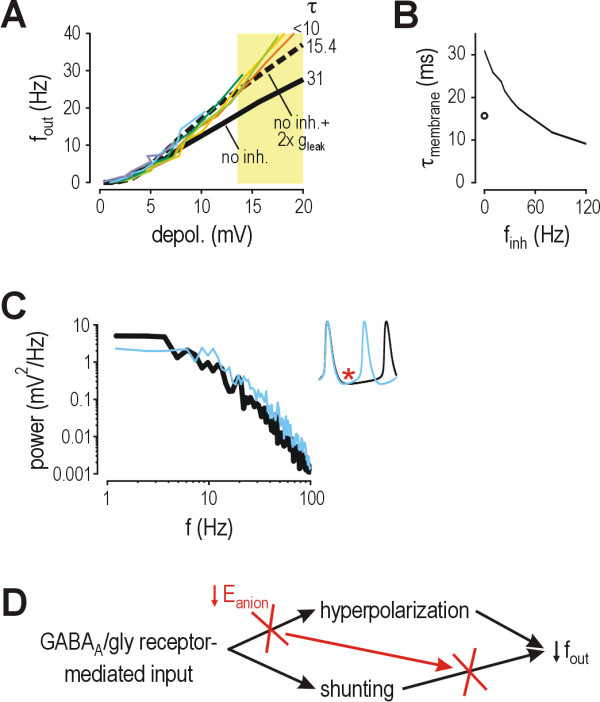
Reduction of the membrane time constant (τmembrane) caused by increased membrane conductance allows for faster spiking. (A) For this graph, fout produced by a given value of fexc (based on simulations with HH channels; Fig. 2A, α = 1) was plotted against depolarization produced by the same value of fexc (based on simulations without HH channels; Fig. 3). The results reveal that, for a given level of depolarization, faster spiking is produced with inhibition than without (compare colored curves with solid black curve). This tendency is unaffected by the value of Eanion and becomes more pronounced with greater depolarization. Yellow shading shows suprathreshold voltages. The increased spiking caused by inhibition is explained by inhibition's reduction of τmembrane (see part B); values of τmembrane for depol ≈ 20 mV are shown along right edge of graph. Indeed, if τmembrane is reduced to an intermediate value by doubling the passive leak conductance in the model neuron, an intermediate relationship between depolarization and fout is found (dashed black curve). (B) Line shows trend in τmembrane as finh increases. Dot shows τmembrane in model neuron after doubling the passive leak conductance. (C) Comparison of power spectra with and without inhibition (blue and black lines, respectively; finh = 80 Hz) reveals the reduced low pass filtering that occurs when τmembrane is shortened; specifically, frequencies greater than ~7 Hz are associated with higher power when the model neuron is shunted. Inset shows that decreased filtering allows faster membrane recharging between spikes, thereby allowing faster spiking. For this example, stimulus intensity was adjusted to produce equal depolarization (based on simulations without HH channels) with and without inhibition, meaning the difference in interspike interval is attributable solely to a change in τmembrane. (D) Reduction of Eanion directly compromises glycine/GABAA receptor-mediated hyperpolarization. Although shunting itself is unaffected by reduction of Eanion, the ability of shunting to modulate firing rate can be indirectly compromised if, because of reduced glycine/GABAA receptor-mediated hyperpolarization, average depolarization remains suprathreshold. In that case, the shunting-induced shortening of τmembrane paradoxically yields faster spiking.