


Figure 2. Encoding of Temporal Patterns.
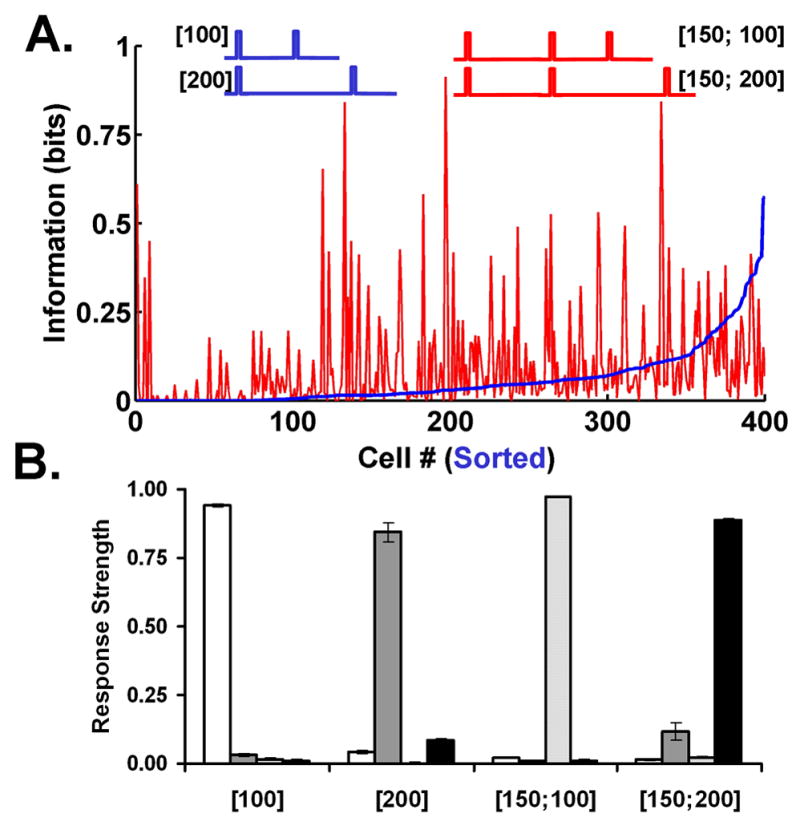
(A) Information per neuron. The blue trace displays the mutual information that each Ex unit provides for the discrimination of a 100 versus 200 ms interval (sorted). The red line shows the information for the same intervals preceded by a 150 ms interval, that is discrimination of the pattern [150;100] versus [150;200]. While individual neurons contain significant information for both stimuli, a different population of neurons encodes each one.
(B) Discrimination of all four stimuli. All Ex units were connected to four output neurons trained to recognize the network activity produced by the last pulse of all four stimuli. Average responses were calculated from six independent (different random number generator seeds) simulations. Note that a mutual information measure based on total spike count to each stimulus, as in panel A, would introduce a confound because the number of spikes is also a function of the number of events (see Experimental Procedures).