


Figure 5. Short interstimulus intervals impair interval, but not frequency, discrimination.
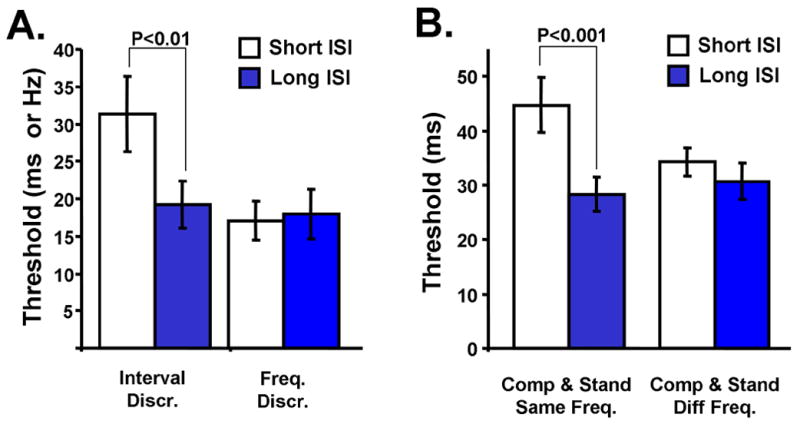
(A) Bars on the left show the thresholds for a two-interval forced-choice discrimination with a 100 ms target. When the interval between the stimuli was short (250 ms) performance was significantly worse compared to the long interstimulus interval (750 ms). In contrast, performance on a frequency discrimination task was unaltered by the interstimulus interval.
(B) Bars on the left illustrate the results for short (250 ms) and long (750 ms) ISI when both the standard and comparison intervals were presented at the same frequency. Bars on the right represent the interval discrimination thresholds when the standard and comparison stimuli were presented at different frequencies. We believe the difference in absolute interval discrimination between both studies (right bars in panels A and B) reflects interference between the different task and stimulus sets in both studies, as well as the inherent subject variability observed in timing tasks.