Abstract
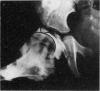
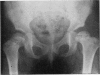
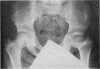
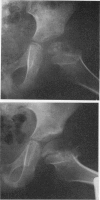
Congenital hip displacement in the newborn presents in two forms: (1) Those babies in whom the capsule of the hip-joint is mechanically stretched. Spontaneous reduction and recovery is high in this group, if the babies are nursed in the prone posture with double nappies (Fig 5). (2) One in a thousand babies is born with infolding of the posterior capsule and secondary contracture of the anterior capsule. This soft tissue deformation occurs in varying degrees, but it frequently prevents spontaneous reduction. Most of these cases are missed and present as infantile congenital hip displacements, when the child is 12-18 months old. In those who are unfortunate enough to be detected and treated conservatively, in the first year of life, there is a high risk of iatrogenic bony deformation. For, as in talipes equinovarus, the bony components of the neonatal hip-joint are more susceptible to mechanical compression than the soft tissue structures.
Full text
PDF