



Abstract
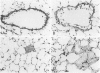
The effects of the pulmonary toxicant, 4-ipomeanol (4-IP), on Sendai viral pneumonia was examined in young adult female C57BL/6J mice. The histologic severity of the pneumonia was closely correlated with increasing doses of the compound. The more severe pneumonia observed in the 4-IP-treated animals was associated with higher pulmonary viral titers and a more diffuse distribution of viral antigen in bronchioles and alveolar parenchyma. There was no difference in the systemic humoral immune response against Sendai virus or pulmonary interferon production in animals that had received 4-IP or vehicle pretreatment. Classification of the antigen-positive cell types in the alveolar parenchyma resulted in a marked relative increase in the numbers of antigen-positive macrophages, as compared with other antigen-positive cell types.
Full text
PDF


Images in this article


Selected References
These references are in PubMed. This may not be the complete list of references from this article.
- Allen A. L., Koller L. D., Pollock G. A. Effect of toxaphene exposure on immune responses in mice. J Toxicol Environ Health. 1983 Jan;11(1):61–69. doi: 10.1080/15287398309530320. [DOI] [PubMed] [Google Scholar]
- Appell L. H., Kovatch R. M., Reddecliff J. M., Gerone P. J. Pathogenesis of Sendai virus infection in mice. Am J Vet Res. 1971 Nov;32(11):1835–1841. [PubMed] [Google Scholar]
- Appleyard G., Davis G. B. Activation of Sendai virus infectivity by an enzyme in chicken amniotic fluid. J Gen Virol. 1983 Apr;64(Pt 4):813–823. doi: 10.1099/0022-1317-64-4-813. [DOI] [PubMed] [Google Scholar]
- Bolton D. C., Zee Y. C., Osebold J. W. The biological effects of ozone on representative members of five groups of animal viruses. Environ Res. 1982 Apr;27(2):476–484. doi: 10.1016/0013-9351(82)90102-5. [DOI] [PubMed] [Google Scholar]
- Bouley G., Chaumard C., Quero A. M., Girard F., Boudene C. Opposite effects of inhaled cadmium microparticles on mouse susceptibility to an airborne bacterial and an airborne viral infection. Sci Total Environ. 1982 Apr;23:185–188. doi: 10.1016/0048-9697(82)90134-6. [DOI] [PubMed] [Google Scholar]
- Boyd M. R. Biochemical mechanisms in chemical-induced lung injury: roles of metabolic activation. Crit Rev Toxicol. 1980 Aug;7(2):103–176. doi: 10.3109/10408448009037487. [DOI] [PubMed] [Google Scholar]
- Boyd M. R., Burka L. T., Harris T. M., Wilson B. J. Lung-toxic furanoterpenoids produced by sweet potatoes (Ipomoea batatas) following microbial infection. Biochim Biophys Acta. 1974 Feb 25;337(2):184–195. doi: 10.1016/0005-2760(74)90200-8. [DOI] [PubMed] [Google Scholar]
- Boyd M. R. Evidence for the Clara cell as a site of cytochrome P450-dependent mixed-function oxidase activity in lung. Nature. 1977 Oct 20;269(5630):713–715. doi: 10.1038/269713a0. [DOI] [PubMed] [Google Scholar]
- Brownstein D. G., Smith A. L., Johnson E. A. Sendai virus infection in genetically resistant and susceptible mice. Am J Pathol. 1981 Nov;105(2):156–163. [PMC free article] [PubMed] [Google Scholar]
- Buckley R. D., Loosli C. G. Effects of nitrogen dioxide inhalation on germfree mouse lung. Arch Environ Health. 1969 Apr;18(4):588–595. doi: 10.1080/00039896.1969.10665457. [DOI] [PubMed] [Google Scholar]
- Charlton D., Blandford G. Immunoglobulin class-specific antibody response in serum, spleen, lungs, and bronchoalveolar washings after primary and secondary sendai virus infection of germfree mice. Infect Immun. 1977 Sep;17(3):521–527. doi: 10.1128/iai.17.3.521-527.1977. [DOI] [PMC free article] [PubMed] [Google Scholar]
- Choppin P. W., Scheid A. The role of viral glycoproteins in adsorption, penetration, and pathogenicity of viruses. Rev Infect Dis. 1980 Jan-Feb;2(1):40–61. doi: 10.1093/clinids/2.1.40. [DOI] [PubMed] [Google Scholar]
- Degré M., Rollag H., Jr Pathogenesis of Sendasi virus infection in mice. On the possible role of interferon on the development of disease. Acta Pathol Microbiol Scand B. 1980 Jun;88(3):177–181. [PubMed] [Google Scholar]
- Durham S. K., Boyd M. R., Castleman W. L. Pulmonary endothelial and bronchiolar epithelial lesions induced by 4-ipomeanol in mice. Am J Pathol. 1985 Jan;118(1):66–75. [PMC free article] [PubMed] [Google Scholar]
- Exon J. H., Koller L. D., Kerkvliet N. I. Lead-cadmium interaction: effects on viral-induced mortality and tissue residues in mice. Arch Environ Health. 1979 Nov-Dec;34(6):469–475. doi: 10.1080/00039896.1979.10667452. [DOI] [PubMed] [Google Scholar]
- Fairchild G. A., Roan J., McCarroll J. Atmospheric pollutants and the pathogenesis of viral respiratory infection. Sulfur dioxide and influenza infection in mice. Arch Environ Health. 1972 Sep;25(3):174–182. doi: 10.1080/00039896.1972.10666157. [DOI] [PubMed] [Google Scholar]
- Fenters J. D., Bradof J. N., Aranyi C., Ketels K., Ehrlich R., Gardner D. E. Health effects of long-term inhalation of sulfuric acid mist-carbon particle mixtures. Environ Res. 1979 Aug;19(2):244–257. doi: 10.1016/0013-9351(79)90052-5. [DOI] [PubMed] [Google Scholar]
- Goldring I. P., Cooper P., Ratner I. M., Greenburg L. Pulmonary effects of sulfur dioxide exposure in the Syrian hamster. I. Combined with viral respiratory disease. Arch Environ Health. 1967 Aug;15(2):167–176. doi: 10.1080/00039896.1967.10664898. [DOI] [PubMed] [Google Scholar]
- Goldstein E., Eagle M. C., Hoeprich P. D. Effect of nitrogen dioxide on pulmonary bacterial defense mechanisms. Arch Environ Health. 1973 Apr;26(4):202–204. doi: 10.1080/00039896.1973.10666256. [DOI] [PubMed] [Google Scholar]
- Henry M. C., Findlay J., Spangler J., Ehrlich R. Chronic toxicity of NO2 in squirrel monkeys. 3. Effect on resistance to bacterial and viral infection. Arch Environ Health. 1970 May;20(5):566–570. doi: 10.1080/00039896.1970.10665663. [DOI] [PubMed] [Google Scholar]
- Heyderman E. Immunoperoxidase technique in histopathology: applications, methods, and controls. J Clin Pathol. 1979 Oct;32(10):971–978. doi: 10.1136/jcp.32.10.971. [DOI] [PMC free article] [PubMed] [Google Scholar]
- Homma M., Ouchi M. Trypsin action on the growth of Sendai virus in tissue culture cells. 3. Structural difference of Sendai viruses grown in eggs and tissue culture cells. J Virol. 1973 Dec;12(6):1457–1465. doi: 10.1128/jvi.12.6.1457-1465.1973. [DOI] [PMC free article] [PubMed] [Google Scholar]
- Huber G. L., LaForce F. M. Comparative effects of ozone and oxygen on pulmonary antibacterial defense mechanisms. Antimicrob Agents Chemother (Bethesda) 1970;10:129–136. [PubMed] [Google Scholar]
- Iwai H., Goto Y., Ueda K. Response of athymic nude mice to Sendai virus. Jpn J Exp Med. 1979 Apr;49(2):123–130. [PubMed] [Google Scholar]
- Jakab G. J., Warr G. A. Immune-enhanced phagocytic dysfunction in pulmonary macrophages infected with parainfluenza 1 (Sendai) virus. Am Rev Respir Dis. 1981 Nov;124(5):575–581. doi: 10.1164/arrd.1981.124.5.575. [DOI] [PubMed] [Google Scholar]
- Koller L. D. Methylmercury: effect on oncogenic and nononcogenic viruses in mice. Am J Vet Res. 1975 Oct;36(10):1501–1504. [PubMed] [Google Scholar]
- Lobodzińska M., Albin M. Interferon and humoral immune response in experimental influenza: infection with A/PR8 virus adapted to the mouse. Arch Immunol Ther Exp (Warsz) 1980;28(2):323–328. [PubMed] [Google Scholar]
- Mills J. Effects of Sendai virus infection on function of cultured mouse alveolar macrophages. Am Rev Respir Dis. 1979 Dec;120(6):1239–1244. doi: 10.1164/arrd.1979.120.6.1239. [DOI] [PubMed] [Google Scholar]
- Mims C. A., Murphy F. A. Parainfluenza virus Sendai infection in macrophages, ependyma, choroid plexus, vascular endothelium and respiratory tract of mice. Am J Pathol. 1973 Mar;70(3):315–328. [PMC free article] [PubMed] [Google Scholar]
- Morahan P. S., Klykken P. C., Smith S. H., Harris L. S., Munson A. E. Effects of cannabinoids on host resistance to Listeria monocytogenes and herpes simplex virus. Infect Immun. 1979 Mar;23(3):670–674. doi: 10.1128/iai.23.3.670-674.1979. [DOI] [PMC free article] [PubMed] [Google Scholar]
- Muramatsu M., Homma M. Trypsin action on the growth of Sendai virus in tissue culture cells. V. An activating enzyme for Sendai virus in the chorioallantoic fluid of the embryonated chicken egg. Microbiol Immunol. 1980;24(2):113–122. doi: 10.1111/j.1348-0421.1980.tb00569.x. [DOI] [PubMed] [Google Scholar]
- Parker J. C., O'Beirne A. J., Collins M. J., Jr Sensitivity of enzyme-linked immunosorbent assay, complement fixation, and hemagglutination inhibition serological tests for detection of Sendai virus antibody in laboratory mice. J Clin Microbiol. 1979 Mar;9(3):444–447. doi: 10.1128/jcm.9.3.444-447.1979. [DOI] [PMC free article] [PubMed] [Google Scholar]
- Parker J. C., Whiteman M. D., Richter C. B. Susceptibility of inbred and outbred mouse strains to Sendai virus and prevalence of infection in laboratory rodents. Infect Immun. 1978 Jan;19(1):123–130. doi: 10.1128/iai.19.1.123-130.1978. [DOI] [PMC free article] [PubMed] [Google Scholar]
- SAWICKI L. Influence of age of mice on the recovery from experimental Sendal virus infection. Nature. 1961 Dec 30;192:1258–1259. doi: 10.1038/1921258a0. [DOI] [PubMed] [Google Scholar]
- Salvin S. B., Youngner J. S., Lederer W. H. Migration inhibitory factor and interferon in the circulation of mice with delayed hypersensitivity. Infect Immun. 1973 Jan;7(1):68–75. doi: 10.1128/iai.7.1.68-75.1973. [DOI] [PMC free article] [PubMed] [Google Scholar]
- Scheid A., Choppin P. W. Identification of biological activities of paramyxovirus glycoproteins. Activation of cell fusion, hemolysis, and infectivity of proteolytic cleavage of an inactive precursor protein of Sendai virus. Virology. 1974 Feb;57(2):475–490. doi: 10.1016/0042-6822(74)90187-1. [DOI] [PubMed] [Google Scholar]
- Scheid A., Choppin P. W. Protease activation mutants of sendai virus. Activation of biological properties by specific proteases. Virology. 1976 Jan;69(1):265–277. doi: 10.1016/0042-6822(76)90213-0. [DOI] [PubMed] [Google Scholar]
- Schuyler M., Forman W. Alveolar macrophage plasminogen activator. Exp Lung Res. 1984;6(2):159–169. doi: 10.3109/01902148409087903. [DOI] [PubMed] [Google Scholar]
- Sternberger L. A., Hardy P. H., Jr, Cuculis J. J., Meyer H. G. The unlabeled antibody enzyme method of immunohistochemistry: preparation and properties of soluble antigen-antibody complex (horseradish peroxidase-antihorseradish peroxidase) and its use in identification of spirochetes. J Histochem Cytochem. 1970 May;18(5):315–333. doi: 10.1177/18.5.315. [DOI] [PubMed] [Google Scholar]
- Tashiro M., Homma M. Evidence of proteolytic activation of Sendai virus in mouse lung. Arch Virol. 1983;77(2-4):127–137. doi: 10.1007/BF01309262. [DOI] [PubMed] [Google Scholar]
- Tashiro M., Homma M. Pneumotropism of Sendai virus in relation to protease-mediated activation in mouse lungs. Infect Immun. 1983 Feb;39(2):879–888. doi: 10.1128/iai.39.2.879-888.1983. [DOI] [PMC free article] [PubMed] [Google Scholar]
- Thigpen J. E., Faith R. E., McConnell E. E., Moore J. A. Increased susceptibility to bacterial infection as a sequela of exposure to 2,3,7,8-tetrachlorodibenzo-p-dioxin. Infect Immun. 1975 Dec;12(6):1319–1324. doi: 10.1128/iai.12.6.1319-1324.1975. [DOI] [PMC free article] [PubMed] [Google Scholar]
- Valle M. J., Jordan G. W., Haahr S., Merigan T. C. Characteristics of immune interferon produced by human lymphocyte cultures compared to other human interferons. J Immunol. 1975 Jul;115(1):230–233. [PubMed] [Google Scholar]
- Ward J. M., Houchens D. P., Collins M. J., Young D. M., Reagan R. L. Naturally-occurring Sendai virus infection of athymic nude mice. Vet Pathol. 1976;13(1):36–46. doi: 10.1177/030098587601300105. [DOI] [PubMed] [Google Scholar]
- Werb Z., Gordon S. Elastase secretion by stimulated macrophages. Characterization and regulation. J Exp Med. 1975 Aug 1;142(2):361–377. doi: 10.1084/jem.142.2.361. [DOI] [PMC free article] [PubMed] [Google Scholar]
- Werb Z., Gordon S. Secretion of a specific collagenase by stimulated macrophages. J Exp Med. 1975 Aug 1;142(2):346–360. doi: 10.1084/jem.142.2.346. [DOI] [PMC free article] [PubMed] [Google Scholar]
- Wolcott J. A., Zee Y. C., Osebold J. W. Exposure to ozone reduces influenza disease severity and alters distribution of influenza viral antigens in murine lungs. Appl Environ Microbiol. 1982 Sep;44(3):723–731. doi: 10.1128/aem.44.3.723-731.1982. [DOI] [PMC free article] [PubMed] [Google Scholar]
- Zurcher C., Burek J. D., Van Nunen M. C., Meihuizen S. P. A naturally occurring epizootic caused by Sendai virus in breeding and aging rodent colonies. I. Infection in the mouse. Lab Anim Sci. 1977 Dec;27(6):955–962. [PubMed] [Google Scholar]