



Abstract
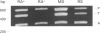
1. The biological activities of the proteinase-activated receptor number 2 (PAR-2)-derived peptides, SLIGRL (PP6) SLIGRL-NH2 (PP6-NH2) and SLIGR-NH2 (PP5-NH2) were measured in mouse and rat gastric longitudinal muscle (LM) tissue and in a rat aortic ring preparation and the actions of the PAR-2-derived peptides were compared with trypsin and with the actions of the thrombin receptor activating peptide, SFLLR-NH2 (TP5-NH2). 2. From a neonatal rat intestinal cDNA library, and from intestinal and kidney-derived cDNA, the coding region of the rat PAR-2 receptor was cloned and sequenced, thereby establishing its close sequence identity with the previously described mouse PAR-2 receptor; and this information, along with a reverse-transcriptase (RT) polymerase chain reaction (PCR) analysis of cDNA derived from gastric and aortic tissue was used to establish the concurrent presence of PAR-2 and thrombin receptor mRNA in both tissues. 3. In the mouse and rat gastric preparations, the PAR-2-derived polypeptides, PP6, PP6-HN2 and PP5-NH2 caused contractile responses that mimicked the contractile actions of low concentrations of trypsin (5 u/ml-1; 10 nM) and that were equivalent to contractions caused by TP5-NH2. 4. The cumulative exposure of the rat LM tissue to PP6-NH2 led to a desensitization of the contractile response to this polypeptide, but not to TP5-NH2 and vice versa, so as to indicate a lack of cross-desensitization between the receptors responsive to the PAR-2 and thrombin receptor-derived peptides. 5. In the rat gastric preparation, the potencies of the PAR-2-activating peptides were lower than the potency of TP5-NH2 (potency order: TP5-NH2 > > PP6-NH2 > or = PP6 > PP5-NH2); PP6 was a partial agonist in this preparation. 6. The contractile actions of PP6 and PP6-NH2 in the rat gastric preparation required the presence of extracellular calcium, were inhibited by nifedipine and were blocked by the cyclo-oxygenase inhibitor, indomethacin and by the tyrosine kinase inhibitor, genistein, but not by the kinase C inhibitor, GF109203X. The contractile responses were not blocked by atropine, chlorpheniramine, phenoxybenzamine, propranolol, ritanserin or tetrodotoxin. 7. In a precontracted rat aortic ring preparation, with an intact endothelium, all of the PAR-2-derived peptides caused a prompt relaxation response that was blocked by the nitric oxide synthase inhibitor, N omega-nitro-L-arginine-methyl ester (L-NAME) but not by D-NAME; in an endothelium-free preparation, which possessed mRNA for both the PAR-2 and thrombin receptors, the PAR-2-activating peptides caused neither a relaxation nor a contraction, in contrast with the contractile action of TP5-NH2. The relaxation response to PP6-NH2 was not blocked by atropine, chlorpheniramine, genistein, indomethacin, propranolol or ritanserin. 8. In the rat aortic preparation, the potencies of PP6, PP6-NH2 and PP5-NH2 were greater than those of the thrombin receptor activating peptide, TP5-NH2 (potency order: PP6-NH2 > or = PP6 > PP5-NH2 > TP5-NH2). 9. In the rat aortic preparation, the relaxant actions of the PAR-2-derived peptides were mimicked by trypsin, at concentrations (0.5-1 u ml-1; 1-2 nM) lower than those that can activate the thrombin receptor. 10. The bioassay data obtained with the PAR-2 peptides and with trypsin, along with the molecular cloning/RT-PCR analysis, point to the presence of functional PAR-2 receptors that can activate distinct responses in the gastric and vascular smooth muscle preparations. These responses were comparable to those resulting from thrombin receptor activation in the same tissues, so as to suggest that the receptor for the PAR-2-activating peptides may play a physiological role as far reaching as the one proposed for the thrombin receptor.
Full text
PDF


Images in this article
Selected References
These references are in PubMed. This may not be the complete list of references from this article.
- Antonaccio M. J., Normandin D., Serafino R., Moreland S. Effects of thrombin and thrombin receptor activating peptides on rat aortic vascular smooth muscle. J Pharmacol Exp Ther. 1993 Jul;266(1):125–132. [PubMed] [Google Scholar]
- Chao B. H., Kalkunte S., Maraganore J. M., Stone S. R. Essential groups in synthetic agonist peptides for activation of the platelet thrombin receptor. Biochemistry. 1992 Jul 14;31(27):6175–6178. doi: 10.1021/bi00142a001. [DOI] [PubMed] [Google Scholar]
- Coughlin S. R., Vu T. K., Hung D. T., Wheaton V. I. Characterization of a functional thrombin receptor. Issues and opportunities. J Clin Invest. 1992 Feb;89(2):351–355. doi: 10.1172/JCI115592. [DOI] [PMC free article] [PubMed] [Google Scholar]
- De Mey J. G., Claeys M., Vanhoutte P. M. Endothelium-dependent inhibitory effects of acetylcholine, adenosine triphosphate, thrombin and arachidonic acid in the canine femoral artery. J Pharmacol Exp Ther. 1982 Jul;222(1):166–173. [PubMed] [Google Scholar]
- Haver V. M., Namm D. H. Characterization of the thrombin-induced contraction of vascular smooth muscle. Blood Vessels. 1984;21(2):53–63. [PubMed] [Google Scholar]
- Hollenberg M. D., Laniyonu A. A., Saifeddine M., Moore G. J. Role of the amino- and carboxyl-terminal domains of thrombin receptor-derived polypeptides in biological activity in vascular endothelium and gastric smooth muscle: evidence for receptor subtypes. Mol Pharmacol. 1993 Jun;43(6):921–930. [PubMed] [Google Scholar]
- Hollenberg M. D., Yang S. G., Laniyonu A. A., Moore G. J., Saifeddine M. Action of thrombin receptor polypeptide in gastric smooth muscle: identification of a core pentapeptide retaining full thrombin-mimetic intrinsic activity. Mol Pharmacol. 1992 Aug;42(2):186–191. [PubMed] [Google Scholar]
- Hui K. Y., Jakubowski J. A., Wyss V. L., Angleton E. L. Minimal sequence requirement of thrombin receptor agonist peptide. Biochem Biophys Res Commun. 1992 Apr 30;184(2):790–796. doi: 10.1016/0006-291x(92)90659-9. [DOI] [PubMed] [Google Scholar]
- Ku D. D., Zaleski J. K. Receptor mechanism of thrombin-induced endothelium-dependent and endothelium-independent coronary vascular effects in dogs. J Cardiovasc Pharmacol. 1993 Oct;22(4):609–616. doi: 10.1097/00005344-199310000-00015. [DOI] [PubMed] [Google Scholar]
- Laniyonu A. A., Hollenberg M. D. Vascular actions of thrombin receptor-derived polypeptides: structure-activity profiles for contractile and relaxant effects in rat aorta. Br J Pharmacol. 1995 Apr;114(8):1680–1686. doi: 10.1111/j.1476-5381.1995.tb14957.x. [DOI] [PMC free article] [PubMed] [Google Scholar]
- Muramatsu I., Laniyonu A., Moore G. J., Hollenberg M. D. Vascular actions of thrombin receptor peptide. Can J Physiol Pharmacol. 1992 Jul;70(7):996–1003. doi: 10.1139/y92-137. [DOI] [PubMed] [Google Scholar]
- Natarajan S., Riexinger D., Peluso M., Seiler S. M. 'Tethered ligand' derived pentapeptide agonists of thrombin receptor: a study of side chain requirements for human platelet activation and GTPase stimulation. Int J Pept Protein Res. 1995 Feb;45(2):145–151. doi: 10.1111/j.1399-3011.1995.tb01033.x. [DOI] [PubMed] [Google Scholar]
- Nystedt S., Emilsson K., Wahlestedt C., Sundelin J. Molecular cloning of a potential proteinase activated receptor. Proc Natl Acad Sci U S A. 1994 Sep 27;91(20):9208–9212. doi: 10.1073/pnas.91.20.9208. [DOI] [PMC free article] [PubMed] [Google Scholar]
- Nystedt S., Larsson A. K., Aberg H., Sundelin J. The mouse proteinase-activated receptor-2 cDNA and gene. Molecular cloning and functional expression. J Biol Chem. 1995 Mar 17;270(11):5950–5955. doi: 10.1074/jbc.270.11.5950. [DOI] [PubMed] [Google Scholar]
- Rapoport R. M., Draznin M. B., Murad F. Mechanisms of adenosine triphosphate-, thrombin-, and trypsin-induced relaxation of rat thoracic aorta. Circ Res. 1984 Oct;55(4):468–479. doi: 10.1161/01.res.55.4.468. [DOI] [PubMed] [Google Scholar]
- Rasmussen U. B., Vouret-Craviari V., Jallat S., Schlesinger Y., Pagès G., Pavirani A., Lecocq J. P., Pouysségur J., Van Obberghen-Schilling E. cDNA cloning and expression of a hamster alpha-thrombin receptor coupled to Ca2+ mobilization. FEBS Lett. 1991 Aug 19;288(1-2):123–128. doi: 10.1016/0014-5793(91)81017-3. [DOI] [PubMed] [Google Scholar]
- Sabo T., Gurwitz D., Motola L., Brodt P., Barak R., Elhanaty E. Structure-activity studies of the thrombin receptor activating peptide. Biochem Biophys Res Commun. 1992 Oct 30;188(2):604–610. doi: 10.1016/0006-291x(92)91099-c. [DOI] [PubMed] [Google Scholar]
- Sanger F., Nicklen S., Coulson A. R. DNA sequencing with chain-terminating inhibitors. Proc Natl Acad Sci U S A. 1977 Dec;74(12):5463–5467. doi: 10.1073/pnas.74.12.5463. [DOI] [PMC free article] [PubMed] [Google Scholar]
- Scarborough R. M., Naughton M. A., Teng W., Hung D. T., Rose J., Vu T. K., Wheaton V. I., Turck C. W., Coughlin S. R. Tethered ligand agonist peptides. Structural requirements for thrombin receptor activation reveal mechanism of proteolytic unmasking of agonist function. J Biol Chem. 1992 Jul 5;267(19):13146–13149. [PubMed] [Google Scholar]
- Simonet S., Bonhomme E., Laubie M., Thurieau C., Fauchère J. L., Verbeuren T. J. Venous and arterial endothelial cells respond differently to thrombin and its endogenous receptor agonist. Eur J Pharmacol. 1992 May 27;216(1):135–137. doi: 10.1016/0014-2999(92)90222-p. [DOI] [PubMed] [Google Scholar]
- Vassallo R. R., Jr, Kieber-Emmons T., Cichowski K., Brass L. F. Structure-function relationships in the activation of platelet thrombin receptors by receptor-derived peptides. J Biol Chem. 1992 Mar 25;267(9):6081–6085. [PubMed] [Google Scholar]
- Vu T. K., Hung D. T., Wheaton V. I., Coughlin S. R. Molecular cloning of a functional thrombin receptor reveals a novel proteolytic mechanism of receptor activation. Cell. 1991 Mar 22;64(6):1057–1068. doi: 10.1016/0092-8674(91)90261-v. [DOI] [PubMed] [Google Scholar]
- Walz D. A., Anderson G. F., Ciaglowski R. E., Aiken M., Fenton J. W., 2nd Thrombin-elicited contractile responses of aortic smooth muscle. Proc Soc Exp Biol Med. 1985 Dec;180(3):518–526. doi: 10.3181/00379727-180-42211. [DOI] [PubMed] [Google Scholar]
- Watson A. J., Hogan A., Hahnel A., Wiemer K. E., Schultz G. A. Expression of growth factor ligand and receptor genes in the preimplantation bovine embryo. Mol Reprod Dev. 1992 Feb;31(2):87–95. doi: 10.1002/mrd.1080310202. [DOI] [PubMed] [Google Scholar]
- White R. P., Shirasawa Y., Robertson J. T. Comparison of responses elicited by alpha-thrombin in isolated canine basilar, coronary, mesenteric, and renal arteries. Blood Vessels. 1984;21(1):12–22. doi: 10.1159/000158490. [DOI] [PubMed] [Google Scholar]
- Williams J. C., Falcone R. C., Do M. L., Lindstrom D. D., Howe B. B. Acute blood pressure effects of selected serine proteases in normotensive rats and dogs. Pharmacology. 1991;43(4):199–209. doi: 10.1159/000138846. [DOI] [PubMed] [Google Scholar]
- Yang S. G., Laniyonu A., Saifeddine M., Moore G. J., Hollenberg M. D. Actions of thrombin and thrombin receptor peptide analogues in gastric and aortic smooth muscle: development of bioassays for structure-activity studies. Life Sci. 1992;51(17):1325–1332. doi: 10.1016/0024-3205(92)90631-x. [DOI] [PubMed] [Google Scholar]
- Zhong C., Hayzer D. J., Corson M. A., Runge M. S. Molecular cloning of the rat vascular smooth muscle thrombin receptor. Evidence for in vitro regulation by basic fibroblast growth factor. J Biol Chem. 1992 Aug 25;267(24):16975–16979. [PubMed] [Google Scholar]
- deBlois D., Drapeau G., Petitclerc E., Marceau F. Synergism between the contractile effect of epidermal growth factor and that of des-Arg9-bradykinin or of alpha-thrombin in rabbit aortic rings. Br J Pharmacol. 1992 Apr;105(4):959–967. doi: 10.1111/j.1476-5381.1992.tb09085.x. [DOI] [PMC free article] [PubMed] [Google Scholar]