


Figure 7. Noradrenergic axon terminals in parkin knockout mice do not show increased sensitivity to DSP-4 intoxication.
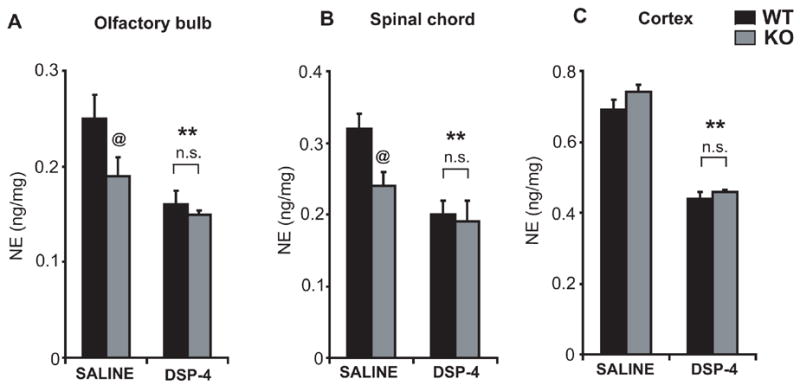
Eighteen-month-old wild-type and parkin knockout mice received a single injection of DSP-4 (10 mg/kg), and noradrenaline levels were measured after 7 days in (A) olfactory bulb, (B) spinal cord, and (C) cortex. While saline-treated parkin knockout mice, compared to wild-type control animals, show a significant reduction in noradrenaline levels in olfactory bulb and spinal cord, DSP-4 treatment causes a significant reduction in noradrenaline levels in all brain regions of both wild-type and parkin knockout mice. No significant differences in noradrenaline levels are observed between wild-type and parkin knockout mice receiving the same amount of DSP-4. Data represent mean ± SEM.*p< 0.05, statistical significance versus saline controls and @p< 0.05, statistical significance compared to wild-type using ANOVA followed by Student-Newman-Keuls test, n=5–6 per group, n.s not significant.