


Figure 2.
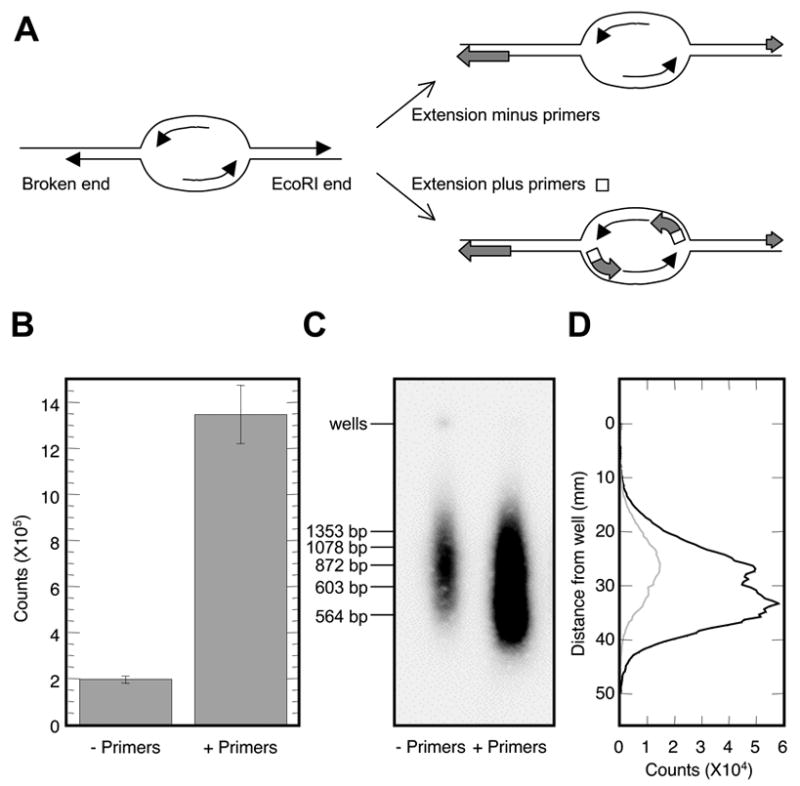
Specificity of the random-primed labeling reactions. (A) Schematic representation of different types of genomic ssDNA and their potential to act as templates during primed and non-primed in vitro synthesis. (B) A rad53 S phase DNA sample isolated at 2 hr post release from alpha factor arrested into medium containing HU was used as template and labeled with 5’-[α-32P]-dATP in the presence (+ Primers) or the absence (− Primers) of random hexameric primers. (C) Agarose gel electrophoresis of heat-denatured, labeled ssDNA in (B) with and without primers. The gel image was produced on an autoradiographic Instant Imager (Packard). Positions of dsDNA markers are as indicated. (D) Quantification of the relative abundance of DNA fragments in the agarose gel image for reaction without primers (gray profile) and with primers (black profile). The profiles were generated by ImageQuant (Packard).