



Abstract
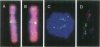
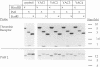
BACKGROUND: Thrombin is a serine protease that elicits a variety of cellular responses. Molecular cloning of a thrombin receptor revealed a G protein-coupled receptor that is activated by a novel proteolytic mechanism. Recently, a second protease-activated receptor was discovered and dubbed PAR2. PAR2 is highly related to the thrombin receptor by sequence and, like the thrombin receptor, is activated by cleavage of its amino terminal exodomain. Also like the thrombin receptor, PAR2 can be activated by the hexapeptide corresponding to its tethered ligand sequence independent of receptor cleavage. Thus, functionally, the thrombin receptor and PAR2 constitute a fledgling receptor family that shares a novel proteolytic activation mechanism. To further explore the relatedness of the two known protease-activated receptors and to examine the possibility that a protease-activated gene cluster might exist, we have compared the structure and chromosomal locations of the thrombin receptor and PAR2 genes. MATERIALS AND METHODS: The genomic structures of the two protease-activated receptor genes were determined by analysis of lambda phage, P1 bacteriophage, and bacterial artificial chromosome (BAC) genomic clones. Chromosomal location was determined with fluorescent in situ hybridization (FISH) on metaphase chromosomes, and the relative distance separating the two genes was evaluated both by means of two-color FISH and analysis of YACs and BACs containing both genes. RESULTS: Analysis of genomic clones revealed that the two protease-activated receptor genes share a two-exon genomic structure in which the first exon encodes 5'-untranslated sequence and signal peptide, and the second exon encodes the mature receptor protein and 3'-untranslated sequence. The two receptor genes also share a common locus with the two human genes located at 5q13 and the two mouse genes at 13D2, a syntenic region of the mouse genome. These techniques also suggest that the physical distance separating these two genes is less than 100 kb. CONCLUSIONS: The fact that the thrombin receptor and PAR2 genes share an identical structure and are located within approximately 100 kb of each other in the genome demonstrates that these genes arose from a gene duplication event. These results define a new protease-activated receptor gene cluster in which new family members may be found.
Full text
PDF


Images in this article
Selected References
These references are in PubMed. This may not be the complete list of references from this article.
- Ahuja S. K., Ozçelik T., Milatovitch A., Francke U., Murphy P. M. Molecular evolution of the human interleukin-8 receptor gene cluster. Nat Genet. 1992 Sep;2(1):31–36. doi: 10.1038/ng0992-31. [DOI] [PubMed] [Google Scholar]
- Arai H., Nakao K., Takaya K., Hosoda K., Ogawa Y., Nakanishi S., Imura H. The human endothelin-B receptor gene. Structural organization and chromosomal assignment. J Biol Chem. 1993 Feb 15;268(5):3463–3470. [PubMed] [Google Scholar]
- Bahou W. F., Coller B. S., Potter C. L., Norton K. J., Kutok J. L., Goligorsky M. S. The thrombin receptor extracellular domain contains sites crucial for peptide ligand-induced activation. J Clin Invest. 1993 Apr;91(4):1405–1413. doi: 10.1172/JCI116344. [DOI] [PMC free article] [PubMed] [Google Scholar]
- Bao L., Gerard N. P., Eddy R. L., Jr, Shows T. B., Gerard C. Mapping of genes for the human C5a receptor (C5AR), human FMLP receptor (FPR), and two FMLP receptor homologue orphan receptors (FPRH1, FPRH2) to chromosome 19. Genomics. 1992 Jun;13(2):437–440. doi: 10.1016/0888-7543(92)90265-t. [DOI] [PubMed] [Google Scholar]
- Chen J., Bernstein H. S., Chen M., Wang L., Ishii M., Turck C. W., Coughlin S. R. Tethered ligand library for discovery of peptide agonists. J Biol Chem. 1995 Oct 6;270(40):23398–23401. doi: 10.1074/jbc.270.40.23398. [DOI] [PubMed] [Google Scholar]
- Chen J., Ishii M., Wang L., Ishii K., Coughlin S. R. Thrombin receptor activation. Confirmation of the intramolecular tethered liganding hypothesis and discovery of an alternative intermolecular liganding mode. J Biol Chem. 1994 Jun 10;269(23):16041–16045. [PubMed] [Google Scholar]
- Copeland R. A. Reverse fluorescence staining of proteins in polyacrylamide gels using terbium chloride. Anal Biochem. 1994 Jul;220(1):218–219. doi: 10.1006/abio.1994.1325. [DOI] [PubMed] [Google Scholar]
- Fu D., Skryabin B. V., Brosius J., Robakis N. K. Molecular cloning and characterization of the mouse dopamine D3 receptor gene: an additional intron and an mRNA variant. DNA Cell Biol. 1995 Jun;14(6):485–492. doi: 10.1089/dna.1995.14.485. [DOI] [PubMed] [Google Scholar]
- Gerard N. P., Eddy R. L., Jr, Shows T. B., Gerard C. The human neurokinin A (substance K) receptor. Molecular cloning of the gene, chromosome localization, and isolation of the cDNA from tracheal and gastric tissues. J Biol Chem. 1991 Jan 15;266(2):1354–1354. [PubMed] [Google Scholar]
- Hartmann T., Ruoss S. J., Raymond W. W., Seuwen K., Caughey G. H. Human tryptase as a potent, cell-specific mitogen: role of signaling pathways in synergistic responses. Am J Physiol. 1992 May;262(5 Pt 1):L528–L534. doi: 10.1152/ajplung.1992.262.5.L528. [DOI] [PubMed] [Google Scholar]
- Hosoda K., Nakao K., Tamura N., Arai H., Ogawa Y., Suga S., Nakanishi S., Imura H. Organization, structure, chromosomal assignment, and expression of the gene encoding the human endothelin-A receptor. J Biol Chem. 1992 Sep 15;267(26):18797–18804. [PubMed] [Google Scholar]
- Nystedt S., Emilsson K., Larsson A. K., Strömbeck B., Sundelin J. Molecular cloning and functional expression of the gene encoding the human proteinase-activated receptor 2. Eur J Biochem. 1995 Aug 15;232(1):84–89. doi: 10.1111/j.1432-1033.1995.tb20784.x. [DOI] [PubMed] [Google Scholar]
- Nystedt S., Emilsson K., Wahlestedt C., Sundelin J. Molecular cloning of a potential proteinase activated receptor. Proc Natl Acad Sci U S A. 1994 Sep 27;91(20):9208–9212. doi: 10.1073/pnas.91.20.9208. [DOI] [PMC free article] [PubMed] [Google Scholar]
- Nystedt S., Larsson A. K., Aberg H., Sundelin J. The mouse proteinase-activated receptor-2 cDNA and gene. Molecular cloning and functional expression. J Biol Chem. 1995 Mar 17;270(11):5950–5955. doi: 10.1074/jbc.270.11.5950. [DOI] [PubMed] [Google Scholar]
- Rasmussen U. B., Vouret-Craviari V., Jallat S., Schlesinger Y., Pagès G., Pavirani A., Lecocq J. P., Pouysségur J., Van Obberghen-Schilling E. cDNA cloning and expression of a hamster alpha-thrombin receptor coupled to Ca2+ mobilization. FEBS Lett. 1991 Aug 19;288(1-2):123–128. doi: 10.1016/0014-5793(91)81017-3. [DOI] [PubMed] [Google Scholar]
- Rozen F., Russo C., Banville D., Zingg H. H. Structure, characterization, and expression of the rat oxytocin receptor gene. Proc Natl Acad Sci U S A. 1995 Jan 3;92(1):200–204. doi: 10.1073/pnas.92.1.200. [DOI] [PMC free article] [PubMed] [Google Scholar]
- Selak M. A. Cathepsin G and thrombin: evidence for two different platelet receptors. Biochem J. 1994 Jan 15;297(Pt 2):269–275. doi: 10.1042/bj2970269. [DOI] [PMC free article] [PubMed] [Google Scholar]
- Senger G., Jones T. A., Fidlerová H., Sanséau P., Trowsdale J., Duff M., Sheer D. Released chromatin: linearized DNA for high resolution fluorescence in situ hybridization. Hum Mol Genet. 1994 Aug;3(8):1275–1280. doi: 10.1093/hmg/3.8.1275. [DOI] [PubMed] [Google Scholar]
- Stokke T., Collins C., Kuo W. L., Kowbel D., Shadravan F., Tanner M., Kallioniemi A., Kallioniemi O. P., Pinkel D., Deaven L. A physical map of chromosome 20 established using fluorescence in situ hybridization and digital image analysis. Genomics. 1995 Mar 1;26(1):134–137. doi: 10.1016/0888-7543(95)80092-z. [DOI] [PubMed] [Google Scholar]
- Trask B., Pinkel D., van den Engh G. The proximity of DNA sequences in interphase cell nuclei is correlated to genomic distance and permits ordering of cosmids spanning 250 kilobase pairs. Genomics. 1989 Nov;5(4):710–717. doi: 10.1016/0888-7543(89)90112-2. [DOI] [PubMed] [Google Scholar]
- Vu T. K., Hung D. T., Wheaton V. I., Coughlin S. R. Molecular cloning of a functional thrombin receptor reveals a novel proteolytic mechanism of receptor activation. Cell. 1991 Mar 22;64(6):1057–1068. doi: 10.1016/0092-8674(91)90261-v. [DOI] [PubMed] [Google Scholar]
- Vu T. K., Wheaton V. I., Hung D. T., Charo I., Coughlin S. R. Domains specifying thrombin-receptor interaction. Nature. 1991 Oct 17;353(6345):674–677. doi: 10.1038/353674a0. [DOI] [PubMed] [Google Scholar]
- Yang-Feng T. L., Xue F. Y., Zhong W. W., Cotecchia S., Frielle T., Caron M. G., Lefkowitz R. J., Francke U. Chromosomal organization of adrenergic receptor genes. Proc Natl Acad Sci U S A. 1990 Feb;87(4):1516–1520. doi: 10.1073/pnas.87.4.1516. [DOI] [PMC free article] [PubMed] [Google Scholar]
- Zhou Q. Y., Li C., Civelli O. Characterization of gene organization and promoter region of the rat dopamine D1 receptor gene. J Neurochem. 1992 Nov;59(5):1875–1883. doi: 10.1111/j.1471-4159.1992.tb11023.x. [DOI] [PubMed] [Google Scholar]
- von Heijne G. A new method for predicting signal sequence cleavage sites. Nucleic Acids Res. 1986 Jun 11;14(11):4683–4690. doi: 10.1093/nar/14.11.4683. [DOI] [PMC free article] [PubMed] [Google Scholar]
- von Heijne G. Patterns of amino acids near signal-sequence cleavage sites. Eur J Biochem. 1983 Jun 1;133(1):17–21. doi: 10.1111/j.1432-1033.1983.tb07424.x. [DOI] [PubMed] [Google Scholar]