


Fig. (2).
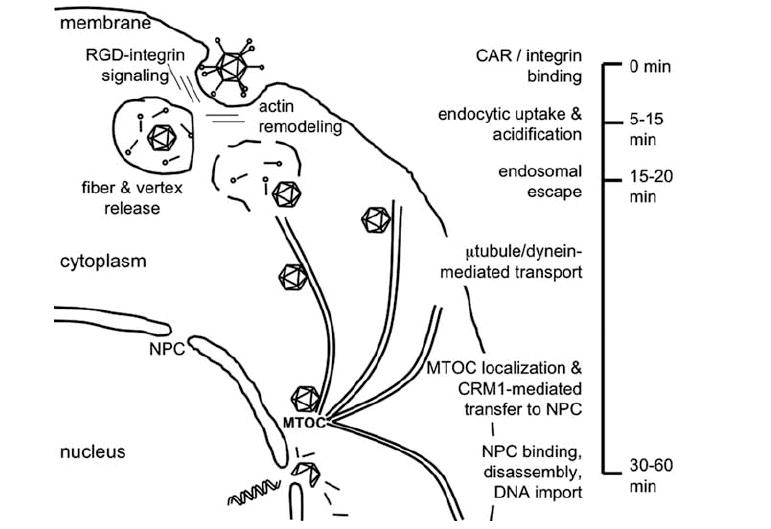
Timeline of the Ad5 binding, entry, and trafficking pathway. Initial attachment is mediated through the fiber-CAR interaction. Subsequent binding of the penton base RGD motifs to integrins results in signaling cascades and endocytic uptake. Endosomal acidification is sensed by the incoming virion, resulting in fiber release, vertex disassembly, exposure of protein VI, and lysis of the endosomal membrane. Cytoplasmic virions can then interact with dynein for transport along microtubules to the microtubule organizing center (MTOC). Cellular export factor CRM1 then mediates transfer to the nuclear pore complex (NPC) where the virion binds, disassembles, and releases its genome into the host cell nucleus.