



Abstract
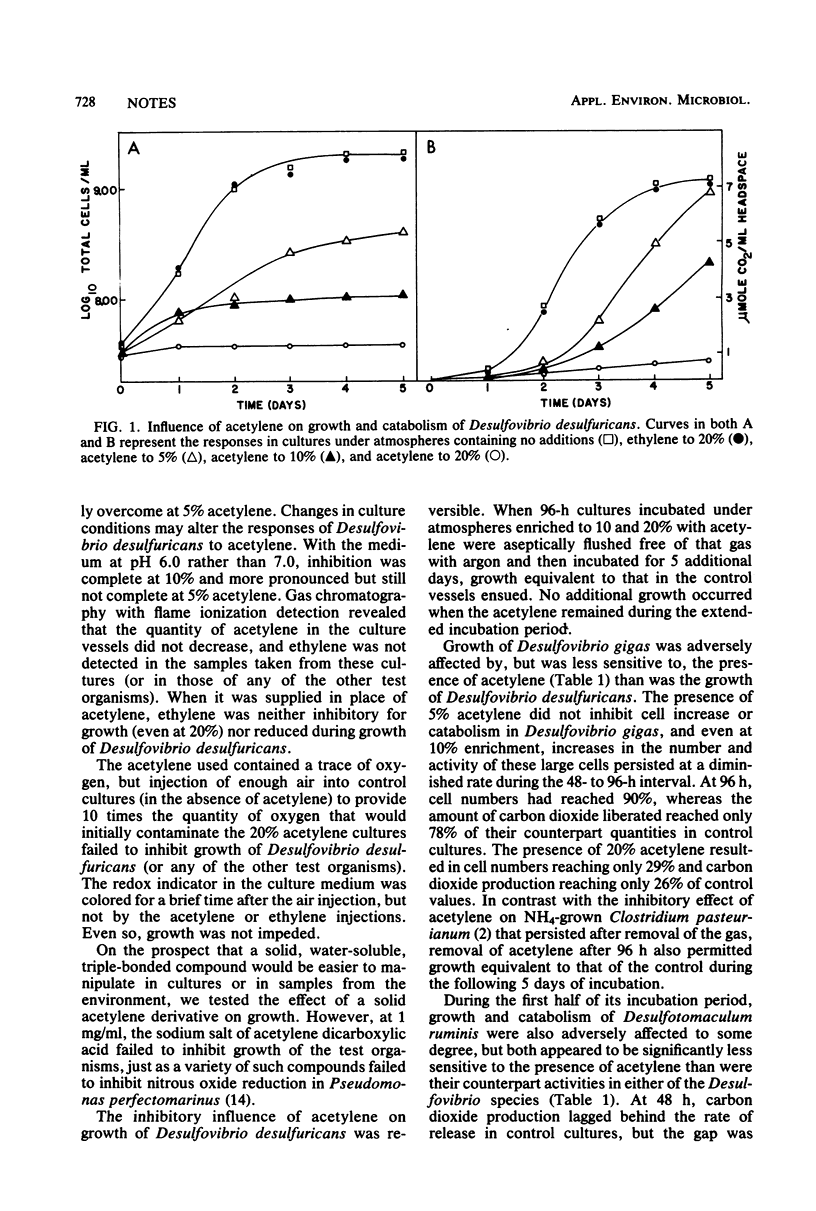
At a concentration of 20% of the atmosphere of the culture flasks, acetylene inhibited growth and carbon dioxide production by Desulfovibrio desulfuricans and Desulfovibrio gigas. The bacteria did not reduce acetylene to ethylene, and neither acetylene dicarboxylic acid nor ethylene was inhibitory. At 10%, acetylene was partially inhibitory for the desulfovibrios. At 5%, acetylene impeded the rate but did not limit the extent of growth and catabolism of the desulfovibrios. Desulfotomaculum ruminis was affected only negligibly, if at all, by acetylene and ethylene at any of these concentrations.
Full text
PDF


Selected References
These references are in PubMed. This may not be the complete list of references from this article.
- Balderston W. L., Sherr B., Payne W. J. Blockage by acetylene of nitrous oxide reduction in Pseudomonas perfectomarinus. Appl Environ Microbiol. 1976 Apr;31(4):504–508. doi: 10.1128/aem.31.4.504-508.1976. [DOI] [PMC free article] [PubMed] [Google Scholar]
- Brouzes R., Knowles R. Inhibition of growth of Clostridium pasteurianum by acetylene: implication for nitrogen fixation assay. Can J Microbiol. 1971 Dec;17(12):1483–1489. doi: 10.1139/m71-238. [DOI] [PubMed] [Google Scholar]
- Chan Y. K., Knowles R. Measurement of denitrification in two freshwater sediments by an in situ acetylene inhibition method. Appl Environ Microbiol. 1979 Jun;37(6):1067–1072. doi: 10.1128/aem.37.6.1067-1072.1979. [DOI] [PMC free article] [PubMed] [Google Scholar]
- Culbertson C. W., Zehnder A. J., Oremland R. S. Anaerobic oxidation of acetylene by estuarine sediments and enrichment cultures. Appl Environ Microbiol. 1981 Feb;41(2):396–403. doi: 10.1128/aem.41.2.396-403.1981. [DOI] [PMC free article] [PubMed] [Google Scholar]
- De Bont J. A., Mulder E. G. Invalidity of the acetylene reduction assay in alkane-utilizing, nitrogen-fixing bacteria. Appl Environ Microbiol. 1976 May;31(5):640–647. doi: 10.1128/aem.31.5.640-647.1976. [DOI] [PMC free article] [PubMed] [Google Scholar]
- Hardy R. W., Holsten R. D., Jackson E. K., Burns R. C. The acetylene-ethylene assay for n(2) fixation: laboratory and field evaluation. Plant Physiol. 1968 Aug;43(8):1185–1207. doi: 10.1104/pp.43.8.1185. [DOI] [PMC free article] [PubMed] [Google Scholar]
- Oremland R. S., Taylor B. F. Inhibition of methanogenesis in marine sediments by acetylene and ethylene: validity of the acetylene reduction assay for anaerobic microcosms. Appl Microbiol. 1975 Oct;30(4):707–709. doi: 10.1128/am.30.4.707-709.1975. [DOI] [PMC free article] [PubMed] [Google Scholar]
- Sørensen J. Denitrification rates in a marine sediment as measured by the acetylene inhibition technique. Appl Environ Microbiol. 1978 Jul;36(1):139–143. doi: 10.1128/aem.36.1.139-143.1978. [DOI] [PMC free article] [PubMed] [Google Scholar]
- Tam T. Y., Knowles R. Effects of sulfide and acetylene on nitrous oxide reduction by soil and by Pseudomonas aeruginosa. Can J Microbiol. 1979 Oct;25(10):1133–1138. doi: 10.1139/m79-176. [DOI] [PubMed] [Google Scholar]
- Yoshinari T., Knowles R. Acetylene inhibition of nitrous oxide reduction by denitrifying bacteria. Biochem Biophys Res Commun. 1976 Apr 5;69(3):705–710. doi: 10.1016/0006-291x(76)90932-3. [DOI] [PubMed] [Google Scholar]