



Abstract
Forty-seven of 61 bacterial cultures, including strains of Pseudomonas, Xanthomonas, Erwinia, Agrobacterium, Corynebacterium, Serratia, Klebsiella, and Escherichia, remained viable after storage in frozen methylcellulose or in dried methylcellulose for up to 38 months. Pathogenicity remained intact for those strains tested. Bacteria were grown on a solid medium and then removed and placed in 1.0% methylcellulose (cellulose methyl ether) to make a final suspension of 108 colony-forming units (CFU) per ml. For storage in dried form, the bacteria-methylcellulose suspension was placed in a petri dish and dried in a forced-air incubator. After 24 h of storage at 25°C, viable populations of 105 CFU/mg (equivalent to 106 CFU/ml) were recovered. Populations of 102 to 104 CFU/mg were recovered after storage of up to 38 months. Similar results were obtained in frozen methylcellulose. Survival was greatly enhanced when the growth medium for the bacteria was potato dextrose peptone rather than nutrient agar, yeast dextrose calcium carbonate peptone, or King's medium B. Addition of 0.1 M MgSO4 to the methylcellulose suspension and to the resuspending liquid also increased survival and recovery from storage for some strains. Methylcellulose storage should be a simple, inexpensive, and reliable method of maintaining cultures for short or long periods of time.
Full text
PDF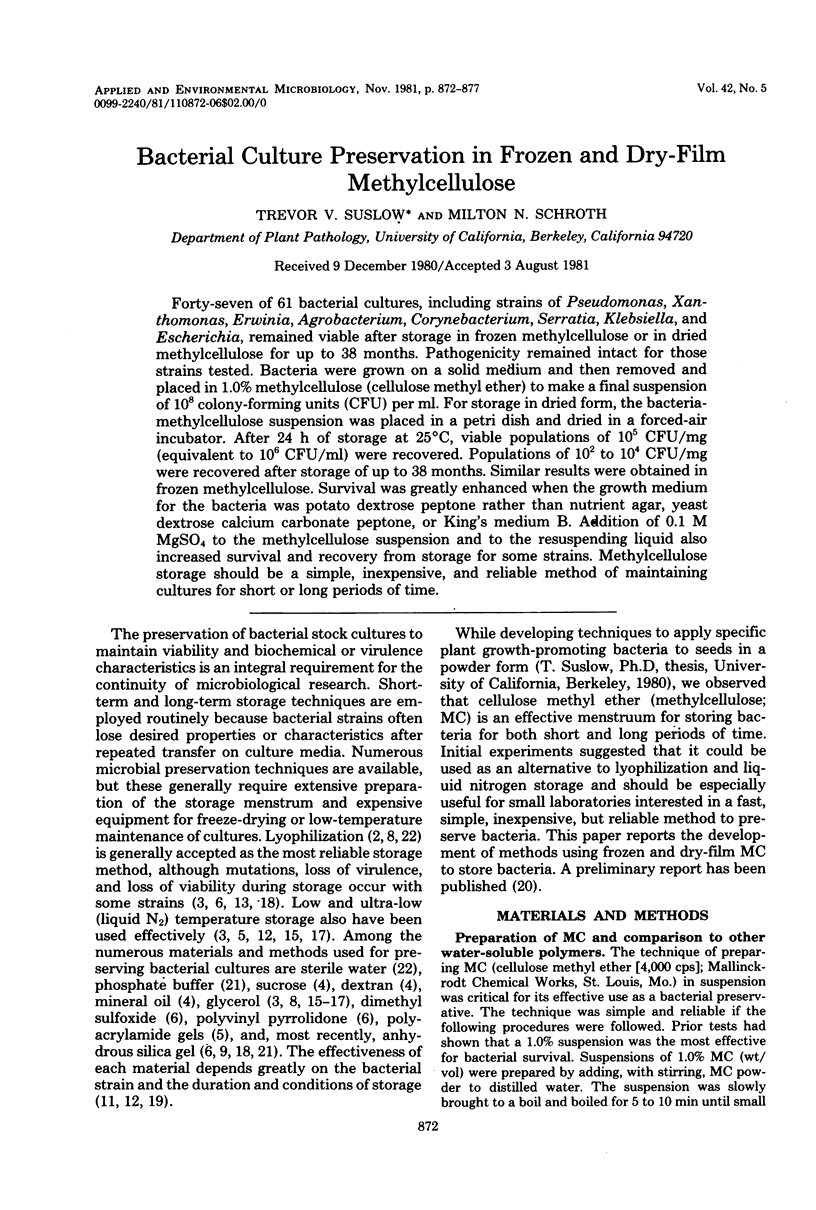


Selected References
These references are in PubMed. This may not be the complete list of references from this article.
- CLEMENT M. T. A SIMPLE METHOD OF MAINTAINING STOCK CULTURES BY LOW-TEMPERATURE STORAGE. Can J Microbiol. 1964 Aug;10:613–615. doi: 10.1139/m64-077. [DOI] [PubMed] [Google Scholar]
- CLEMENT M. T. Effects of freezing, freeze-drying, and storage in the freeze-dried and frozen state on viability of Escherichia coli cells. Can J Microbiol. 1961 Feb;7:99–106. doi: 10.1139/m61-012. [DOI] [PubMed] [Google Scholar]
- Davidson F., Reuszer H. W. Persistence of Rhizobium japonicum on the Soybean Seed Coat Under Controlled Temperature and Humidity. Appl Environ Microbiol. 1978 Jan;35(1):94–96. doi: 10.1128/aem.35.1.94-96.1978. [DOI] [PMC free article] [PubMed] [Google Scholar]
- Dommergues Y. R., Diem H. G., Divies C. Polyacrylamide-entrapped Rhizobium as an inoculant for legumes. Appl Environ Microbiol. 1979 Apr;37(4):779–781. doi: 10.1128/aem.37.4.779-781.1979. [DOI] [PMC free article] [PubMed] [Google Scholar]
- Gilmour M. N., Turner G., Berman R. G., Krenzer A. K. Compact liquid nitrogen storage system yielding high recoveries of gram-negative anaerobes. Appl Environ Microbiol. 1978 Jan;35(1):84–88. doi: 10.1128/aem.35.1.84-88.1978. [DOI] [PMC free article] [PubMed] [Google Scholar]
- Grivell A. R., Jackson J. F. Microbial culture preservation with silica gel. J Gen Microbiol. 1969 Nov;58(3):423–425. doi: 10.1099/00221287-58-3-423. [DOI] [PubMed] [Google Scholar]
- HECKLY R. J. Preservation of bacteria by lyophilization. Adv Appl Microbiol. 1961;3:1–76. doi: 10.1016/s0065-2164(08)70506-9. [DOI] [PubMed] [Google Scholar]
- HOWARD D. H. The preservation of bacteria by freezing in glycerol broth. J Bacteriol. 1956 May;71(5):625–625. doi: 10.1128/jb.71.5.625-625.1956. [DOI] [PMC free article] [PubMed] [Google Scholar]
- QUADLING C. Preservation of Xanthomonas by freezing in glycerol broth. Can J Microbiol. 1960 Aug;6:475–477. doi: 10.1139/m60-053. [DOI] [PubMed] [Google Scholar]
- Trollope D. R. The preservation of bacteria and fungi on anhydrous silica gel: an assessment of survival over four years. J Appl Bacteriol. 1975 Apr;38(2):115–120. doi: 10.1111/j.1365-2672.1975.tb00511.x. [DOI] [PubMed] [Google Scholar]