



Abstract
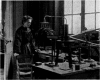
Marie Curie was a remarkable woman whose discoveries broke new ground in physics and chemistry and also opened the door for advances in engineering, biology, and medicine. She broke new ground for women in science: she was, for example, the first woman to receive a doctor of science degree in France, the first woman to win Nobel Prize, the first woman to lecture at the Sorbonne, the first person to win two Nobel Prizes, and the first Nobel Laureate whose child also won a Nobel Prize. Her life offers insights into the changing role of women in science and academia over the past century. It also offers examples of many ways in which scientists can, and should, work to improve the educational programs and career opportunities available to those who follow in their footsteps.
Full text
PDF


Images in this article


Selected References
These references are in PubMed. This may not be the complete list of references from this article.
- Langevin-Joliot H. Radium, Marie Curie and modern science. Radiat Res. 1998 Nov;150(5 Suppl):S3–S8. [PubMed] [Google Scholar]