



Abstract
The ability of alcohol-related cues to promote craving can be attenuated independently by giving the opioid antagonist naltrexone (NTX) or by subjecting alcohol-dependent patients to a cue exposure treatment. The effects of cue exposure treatment may be enhanced if conducted in the presence of NTX. The purpose of these experiments was to determine if NTX given during extinction of responding for alcohol in rats would alter cue-conditioned reinstatement of responding and to determine if NTX, paired with repeated cue-conditioned reinstatement, would reduce subsequent cue-conditioned reinstatement or reacquisition of self-administration in the absence of NTX. Rats lever-pressed for alcohol in the presence of an olfactory cue. Visual and auditory stimuli were presented during alcohol delivery. In the first experiment, rats were injected with saline or 3 mg/kg NTX prior to extinction sessions followed by cue-conditioned reinstatement tests. In the second experiment, extinction was followed by cue-conditioned reinstatement sessions presented twice per week. The rats received saline or NTX (3 and 10 mg/kg) prior to several sessions. All rats received reinstatement tests with and without a pretreatment of NTX followed by reacquisition of alcohol self-administration. NTX had no effect on responding during extinction or on subsequent cue-conditioned reinstatement. Only 10 mg/kg NTX reduced responding during the twice weekly reinstatement sessions. The twice weekly NTX treatment had no effect on subsequent cue-conditioned reinstatement in the absence of NTX. Reacquisition of responding for alcohol was reduced in the group receiving saline during repeated reinstatement sessions while this effect was blocked in the NTX group. These findings support the notion that NTX given during a brief abstinence period (i.e., extinction) has minimal effects on future sensitivity to alcohol cues and alcohol consumption. NTX given during repeated alcohol cue exposure does not alter the subsequent incentive value of alcohol cues in the absence of naltrexone or enhance the beneficial effects of cue exposure treatment.
Keywords: self-administration, ethanol, naltrexone, reinstatement, antagonists
Introduction
In early clinical trials with alcohol-dependent patients, the opioid antagonist naltrexone (NTX) effectively reduced alcohol craving and relapse rates (O’Malley et al., 1992; Volpicelli et al., 1992). Since then, one of the largest, multi-center clinical trials (COMBINE study) confirmed that alcohol-dependent individuals benefit from treatment with NTX (Anton et al., 2006). A recent meta-analysis examined 27 published randomized placebo-controlled trials of opioid antagonists to treat alcohol dependence (Pettinati et al., 2006) and found reductions in heavy or excessive drinking in 70% of those trials. In contrast to the above clinical findings, some studies suggest that NTX is not as effective as originally indicated. For example, two multi-center trials showed that NTX was no better than placebo on various measures of relapse, drinking, and craving (Gastpar et al., 2002; Krystal et al., 2001). Furthermore, even though the COMBINE study cited above showed that NTX was more effective than placebo, NTX was no more effective than a behavioral intervention alone and the beneficial effects were not augmented when the two therapies were combined.
The NTX dosing regimen may be an important variable influencing the effectiveness of NTX. For example, NTX had beneficial effects in early problem drinkers and alcohol-dependent individuals when the subjects were instructed to take NTX only when they anticipated a high risk of sampling alcohol (Heinala et al., 2001; Hernandez-Avila et al., 2006; Kranzler et al., 2003). This “targeted” medication protocol may be effective because it reduces alcohol craving during high risk situations and thereby increases abstinence. On the other hand, the subjects may consume alcohol in the presence of NTX and thus allow NTX to exert its effects in a different manner. In the study by Volpicelli et al. (1992), the sampling of alcohol was unaffected by daily NTX administration, but the number of drinks following consumption of a small amount of alcohol was reduced. The authors indicated that NTX prevented full-blown relapse after sampling alcohol. Thus, some benefits of NTX may emerge only after patients have consumed alcohol in the presence of the NTX medication. The mechanism of action for this effect may be extinction of the behaviors that lead to alcohol intoxication (Sinclair, 1998, 2001).
The behaviors and subjective effects that lead to alcohol consumption can be elicited by stimulus cues that have been associated with alcohol-related responses and intoxication. In rats, previously extinguished responding for alcohol was reinstated when rats were re-exposed to the smell of alcohol (Katner et al. 1999) or other olfactory, visual, and auditory cues specifically paired with alcohol self-administration (Burattini et al., 2006; Ciccocioppo et al., 2002; 2003; Katner and Weiss, 1999; Liu and Weiss, 2002). In these studies, NTX blocked the cue-conditioned reinstatement of responding. In human alcoholics, alcohol cues increased urges to drink and increased some physiological responses such as salivation, galvanic skin response, skin temperature, and heart rate (Monti et al., 1987; Pomerleau et al., 1983; Turkkan et al., 1989). Alcohol cue reactivity, both physiological and subjective, may be used therapeutically as a predictor for drinking or relapse in alcoholics (Rohsenow et al., 1994).
If sensitivity to alcohol cues predicts future consumption of alcohol in alcoholics, then an important goal during therapy for alcoholism would be to reduce the response to alcohol cues. This goal may be achieved by NTX therapy. For example, cue-elicited craving or urge to drink was attenuated in alcoholics or heavy drinkers treated with NTX (Monti et al., 1999; Palfai et al., 1999; Rohsenow et al., 2000). Reduced response to alcohol cues may also be achieved by cue exposure treatment. Two early studies with a small number of subjects found that cue exposure treatment increased abstinence and decreased desire to drink (Blakely and Baker, 1980) as well as enhanced the ability to resist a drink (Rankin et al., 1983). The theoretical background and therapeutic implications of cue reactivity on cue exposure treatment have been explored in review articles that called for more experiments on cue exposure treatment (Heather and Greeley, 1990; Niaura et al., 1988). Since then, only one study has sought to combine the beneficial effects of NTX and cue exposure treatment (Monti et al., 2001). In that study, cue exposure treatment combined with coping skills training was administered daily for 1–2 weeks prior to 12 weeks of NTX. Although the cue exposure and coping skills training was more effective than the control therapy (educational discussion and relaxation training), NTX failed to increase beneficial outcomes further. The authors indicated that the cue exposure sessions were completed prior to NTX treatment so that the NTX would not block responses elicited by alcohol cues and thereby reduce the effectiveness of the cue exposure treatment. However, if NTX improves treatment outcomes by blocking the reinforcing effects of alcohol consumption and extinguishing alcohol-related behaviors, then NTX may also reduce the rewarding properties or incentive value of stimuli associated with alcohol consumption. Stimulus cues associated with many reinforcing drugs can acquire incentive value and animals will respond vigorously for cues that have been previously paired with drug consumption (see review on second order conditioning, Schindler et al., 2002). Thus, if NTX is used to attenuate the reinforcing properties of alcohol, then NTX may be used to reduce the reinforcing properties of alcohol-paired cues, thereby reducing sensitivity to alcohol cues and reducing the likelihood that the cues will stimulate relapse to drinking.
The purpose of our experiments was to use a rat model to determine if extinction of responding for an alcohol solution would be accelerated by repeated NTX administration prior to extinction sessions and to determine if subsequent cue-conditioned reinstatement of responding in the absence of NTX would be reduced. We also wanted to determine if NTX, repeatedly administered prior to cue-conditioned reinstatement sessions across several weeks, would reduce subsequent reinstatement of responding to alcohol cues in the absence of NTX and reduce reacquisition of alcohol self-administration.
In the current experiments, the rat model involved self-administration of an alcohol solution (10% w/v) that was sweetened with 0.1% saccharin. Although the addition of saccharin confounds our ability to draw conclusions about manipulations that are specific to alcohol alone, several benefits result from using a saccharin-sweetened alcohol solution. First, intakes (g/kg) remain high. Some researchers suggest that removal of the sweetener from an alcohol solution results in intakes that do not adequately model excessive human alcohol use (Czachowski et al., 1999). The average intakes in the current experiments were close to 1 g/kg in an out-bred strain of rats that had free access to food and water in the home cage. Although one may argue that the rats consumed the solution due to the enhanced palatability rather than ethanol’s pharmacological effects, studies using a behavioral economics approach show otherwise (Heyman, 1997; Heyman et al., 1999). In experiments in which rats had a choice between an alcohol/saccharin solution and a sweet solution of equal calories, the rats allocated their responses toward the alcohol solution as response requirements increased even if the alcohol solution was the non-preferred solution under baseline conditions (for review, see Heyman, 2000). Thus, the sweetener may allow the animals to overcome the bitter taste of alcohol when mixed in water. A second benefit of using a sweetened alcohol solution is the reduced training time by avoiding the time spent “fading out” the sweetener. A third benefit is that the model has face validity when compared to the human condition. Humans don’t consume 10% alcohol mixed in water. Alcohol is consumed usually in beer, wine, or mixed drinks which allow palatability to play a role in alcohol consumption and therefore, should also be considered when discussing pharmacotherapy.
Materials and Methods
Animals and Housing
Male Long-Evans rats weighing 151 – 175 g at the beginning of the studies (Charles River, Wilmington, MA) were individually housed and maintained in a temperature and humidity controlled room with a 12-hr light/dark cycle. Initially, lights were turned on at 7:00 AM. Later, the lights were turned on at 9:00 AM to accommodate a different experiment involving locomotor activity. Operant experiments were conducted six days per week during the light cycle between 10:00 AM and 2:00 PM. The rats had free access to food and water in their home cages except during initial training for the lever-press response. The experimental protocol was approved by Institutional Animal Care and Use Committee and the animals were treated in accordance with the Guide for the Care and Use of Laboratory Animals(National Research Council, 1996).
Apparatus
Experiments were conducted in standard operant chambers (Med Associates, St. Albans, VT) housed in melamine sound-attenuated cubicles. Each chamber (30.5 × 24.2 × 29.2 cm) contained a rolled-edge standard lever approximately 7 cm from the grid floor on the right wall near the rear of the chamber. A single-cup receptacle, placed on the center of the right wall approximately 3 cm from the grid floor, was fitted to receive food pellets from a modular dispenser and fluid deliveries from a syringe pump via 18 gauge stainless steel tubing connected to the receptacle. A white stimulus light was located above the cup receptacle. The house light was on the center of the left wall near the top of the chamber. Operant chambers were controlled with programs written in Med-PC Medstate Notation version IV (Med Associates).
Training
Training for the lever-press response started after food depriving the rats for 24 hrs. Rats began lever-pressing for 45 mg food pellets (Bio-Serv#F0021, Frenchtown, NJ) during shaping sessions that lasted 10 – 20 min and were conducted twice per day for up to four days. When the rats acquired the lever-press response, 20% sucrose was substituted for the food pellets for a single 20 min session to allow the rats to transition from solid food reinforcers to fluid reinforcers. On the following day, the rats responded for 5% ethanol (w/v) mixed in 0.1% saccharin (w/v). Thirty seconds prior to the start of the session, the rats were placed in the operant chamber during which the chamber was dark and responses on the lever had no consequence. When the operant session began, the house light was illuminated and the rats could earn fluid reinforcers by responding on a continuous reinforcement schedule such that every response resulted in a reinforcer. The session duration was 20 min. Fluid reinforcers were delivered by activating the syringe pump for 2.5 sec fitted with a 30 ml syringe to allow a fluid volume of 0.1 ml per reinforcer. Accuracy of volume delivery was confirmed during all sessions by measuring the fluid remaining in the syringe at the end of the session. During the fluid delivery, an additional 1.5 sec (total 4 sec), the house light was turned off and responding had no consequence. As the ethanol delivery began, a clicking sound was presented and the stimulus light over the receptacle cup flashed until the end of the 4 sec interval (CS+). Just prior to placing the rat in the chamber, six drops of peppermint extract (McCormick, Sparks, MD) were put into the bottom the waste pan inside the chamber to serve as an olfactory discriminative stimulus signaling ethanol availability (S+) for the session. Over the next couple weeks, the ethanol concentration was gradually increased such that the final operant schedule consisted of a 20 min response period during which 10% ethanol mixed in 0.1% saccharin was available under an FR1 schedule of reinforcement. Under the final operant schedule, the rats were placed in the chamber 10 min prior to the start of the session. A minimum average of 0.5 g/kg ethanol consumption was required for the rats to be included in the studies below.
Experiment 1: Naltrexone Administration During Extinction of Ethanol-Reinforced Responding
Rats (n=12) were allowed to self-administer the ethanol solution for 4 weeks under the above conditions. These conditions allowed a stimulus complex (olfactory, auditory, and visual) to be specifically paired with ethanol self-administration. On 3 occasions, the ethanol solution was replaced with a bitter tasting non-ethanol solution containing 0.15% (w/v) quinine (i.e., nonreward). The discriminative stimulus signaling a quinine session (S−) was 6 drops of lemon extract (McCormick, Sparks, MD) delivered into the waste pan just prior to placing the rat in the chamber. During reinforcer delivery, an intermittent beeper was activated and the stimulus light over the receptacle cup was constantly illuminated (CS−). The stimuli used in the current experiments during the conditioning phase are similar to the predictive olfactory cues and response-contingent visual and auditory cues used in previously mentioned studies (e.g., Ciccocioppo et al., 2002; 2003; Liu and Weiss, 2002). Although some researchers have used water (nonreward) during S−/CS− sessions (Ciccocioppo et al., 2002; 2003), other researchers have used a quinine solution (Backstrom and Hyytia, 2004; 2005; Katner and Weiss, 1999). Quinine was chosen in the current experiments to enhance discrimination between the S+/CS+ sessions and the S−/CS− sessions. Discrimination between the sessions was clear after only 3 S−/CS− sessions. By the third S−/CS− session, the consumption of quinine averaged less than 0.5 ml while the average ethanol consumption on both the day prior to and after the third S−/CS− session exceeded 4.5 ml. The rats were pair-matched into 2 groups (n=6) based on responding for ethanol during the last 7 days of baseline ethanol self-administration. Following the 4 weeks of ethanol self-administration, the rats were exposed to 5 consecutive daily extinction sessions during which only the house light was illuminated. All discriminative stimuli and solution-paired cues were omitted during these sessions as in the previously mentioned studies. Responding on the lever had no consequence. For each of the 5 extinction sessions, one group of rats received injections of saline (Saline group) 10 min prior to the start of the session while the other group of rats received 3 mg/kg NTX (NTX group). Following the extinction sessions, the rats were exposed to 4 consecutive daily sessions of cue exposure in the absence of saline or NTX injections to examine cue-conditioned reinstatement of responding. The S+/CS+ were presented on the first and third days while the S−/CS− were presented on the second and fourth days. All reinstatement sessions began with the appropriate olfactory cue put in the pan 10 min prior to the start of the session just as the rats were put into the chamber. During the response period, the house light was illuminated and a response on the lever resulted in the presentation of the auditory stimulus and the visual stimulus. During the S+/CS+ sessions, the first 2 lever presses resulted in ethanol fluid delivery to provide an additional taste cue and to act as a primer which has been shown to further enhance reinstatement responding (Backstrom and Hyytia, 2004). After the first 2 lever presses, only the ethanol-paired auditory and visual stimuli were presented following lever presses. During the S−/CS− sessions, a response resulted in the presentation of the quinine-paired auditory and visual stimuli. To provide an additional S−/CS− auditory stimulus, the syringe pump was also activated following a response on the lever (Backstrom and Hyytia, 2004). No fluid was delivered during the S−/CS− sessions; the syringe pump was empty. The differences between each type of session are illustrated in Fig 1.
Fig. 1.

Diagrams illustrating conditions and parameters for each operant session: a) self-administration, b) extinction, c) S+/CS+ cue-conditioned reinstatement, and d) S−/CS− cue-conditioned reinstatement.
Experiment 2: Naltrexone Administration During Repeated Ethanol Cue Exposure Treatment
Rats (n=14) were subjected to the same procedure as the rats in Experiment 1 except that none of the rats received injections prior to extinction sessions. Following the final S−/CS− day, the rats were pair-matched into 2 groups (n=7) based on average responding during both days of S+/CS+. During the next several weeks, the rats were subjected to the ethanol cue exposure treatment. The cue exposure treatment involved exposing the rats to operant sessions with S+/CS+ as described above twice per week (Mon and Thurs) while remaining in their home cages on all other days. One group of rats received saline injections at the beginning of each session (Saline group) while the other group received 3 mg/kg NTX (NTX group) for a total of 8 sessions. A preliminary data analysis showed that 3 mg/kg NTX failed to reduce responding in the presence of the S+/CS+. Therefore, the NTX dose was increased to 10 mg/kg and both groups exposed to another 8 sessions with either NTX or saline injections.
After these 16 sessions of exposure to ethanol cues, all rats received similar treatment for the rest of the experiment. Two days after the last cue exposure treatment session, the rats received a S+/CS+ session followed by a S−/CS− session on the next day; no injections were given on either day. Three days later, the rats were injected with 10 mg/kg NTX at the beginning of a S+/CS+ session. Reacquisition of ethanol-reinforced responding was allowed for the next 11 days. On the final 2 days of the experiment, the rats received injections at the beginning of the experiment; saline was given prior to the session on the first day while 3 mg/kg NTX was given prior to the session on the second day. To clarify the experimental manipulations, the timelines for Experiment 1 and Experiment 2 are depicted in Fig 2.
Fig. 2.

Diagrams illustrating the timeline of experimental manipulations during Experiment 1 and Experiment 2.
Drugs
Ethanol solutions were prepared by mixing appropriate volumes of 95% w/v ethanol (Pharmco Products Inc., Brookfield, CT) and distilled water. Ethanol solutions were sweetened by adding 0.1% w/v sodium saccharin (Sigma Aldrich, St. Louis, MO). Sucrose solution (20% w/v) was made by dissolving granulated cane sugar in distilled water. Quinine solution (0.15% w/v) was made by dissolving quinine hydrochloride (Sigma Aldrich, St. Louis, MO) in distilled water. All solutions were presented at room temperature. Naltrexone HCl was supplied NIDA and dissolved in 0.9% saline. Naltrexone and saline were given as intraperitoneal injections each in a fluid volume of 1 ml/kg.
Data Analysis
For Experiment 1, the initial pair-wise sort was conducted using the average number of responses during the last 7 days of ethanol self-administration. A two-tailed, between-groups t-test was applied to confirm that the group averages were not significantly different. A similar analysis was performed on the ethanol intake (g/kg). Significance level for this test and all others was set at p < 0.05 and all data are displayed as the mean ± standard error (SEM). To test the effect of NTX on extinction, the number of responses was analyzed using a two-way repeated measures mixed model ANOVA. The between-groups variable was the “group” (NTX vs saline) and the within-groups variable was “days” (5 days of extinction). If the F values were statistically significant, a Tukey’s HSD test was applied as a post-hoc test for this ANOVA and all other ANOVAs. To test the effect of NTX during extinction on subsequent cue-conditioned reinstatement of responding elicited by S+/CS+ and S−/CS−, the number of responses was analyzed using a two-way repeated measures mixed model ANOVA (group×days). The data included the average of the last 3 extinction days, the average of the 2 S+/CS+ days, and the average of the 2 S−/CS− days.
For Experiment 2, the initial pair-wise sort was conducted using the average number of responses during reinstatement testing with S+/CS+. A two-tailed, between-groups t-test was applied to confirm that the group averages were not significantly different. A similar analysis was performed on the number of responses and ethanol intake (g/kg) during the last 7 days of ethanol self-administration. Even though the rats in Experiment 2 were not treated differently during the extinction phase and initial reinstatement testing, analyses similar to those already described for Experiment 1 were used to demonstrate the validity of the initial reinstatement testing. The responding during the 8 sessions of cue exposure treatment with 3 mg/kg NTX or saline was analyzed using a two-way repeated measures mixed model ANOVA (group × days). The average number of responses across all 8 sessions was analyzed using a two-tailed, between-groups t-test. Similar analyses were applied to the responding data for the next 8 sessions of cue exposure treatment with 10 mg/kg NTX or saline. A two-way repeated measures mixed model ANOVA (group × days) was used to analyze the responding during the subsequent no-injection S+/CS+ and S−/CS− sessions as well as the S+/CS+ session with the 10 mg/kg NTX pretreatment and compare those data to the average of the last 3 days of extinction. Average responding during the last 7 days of the original ethanol self-administration was also included in this analysis. To assess ethanol self-administration before and after the cue exposure phase, a mixed model ANOVA similar to the above was applied to the average responding during the last 7 days of the original self-administration and the last 7 days of reacquisition of ethanol self-administration. Because the interaction effect was significant, we conducted repeated two-tailed t-tests with Bonferroni Correction for planned within-group and between group comparisons. A similar ANOVA was conducted using the ethanol intake (g/kg) data.
Results
Experiment 1: Naltrexone Administration During Extinction of Ethanol-Reinforced Responding
The acute effects of NTX given just prior to five daily extinction sessions are shown in Fig 3. The baseline number of responses during the last 7 days of ethanol self-administration was 41± 4 for the NTX group and 46 ± 7 for the Saline group which resulted in ethanol intakes of 0.87 ± 0.08 g/kg and 1.01± 0.14 g/kg, respectively. The groups were pair-matched on baseline number of responses for ethanol and the groups did not differ significantly on responding [t(10) = −0.58, p=0.57] or ethanol intake [t(10) = −0.92, p=0.38]. NTX 3 mg/kg, given prior to each of the sessions on the extinction days, failed to reduce responding compared to the Saline group [main effect of group, F(1,10) = 0.11, p=0.75]. NTX given during the extinction period failed to affect subsequent reinstatement of responding in the presence of the ethanol cues; the main effect of group was not significant [F(1,10) = 0.53, p=0.48]. However, the S+/CS+ increased responding in both groups combined [main effect of days, F(2,20) = 47.36, p<0.001]. Responding in presence of S+/CS+ was significantly higher than the average responding during the last 3 extinction days (p<0.001) and the responding in the presence of S−/CS− (p<0.001). Average responding during the 2 S−/CS− days was similar to the average responding the last 3 extinction days (p=0.34).
Fig. 3.
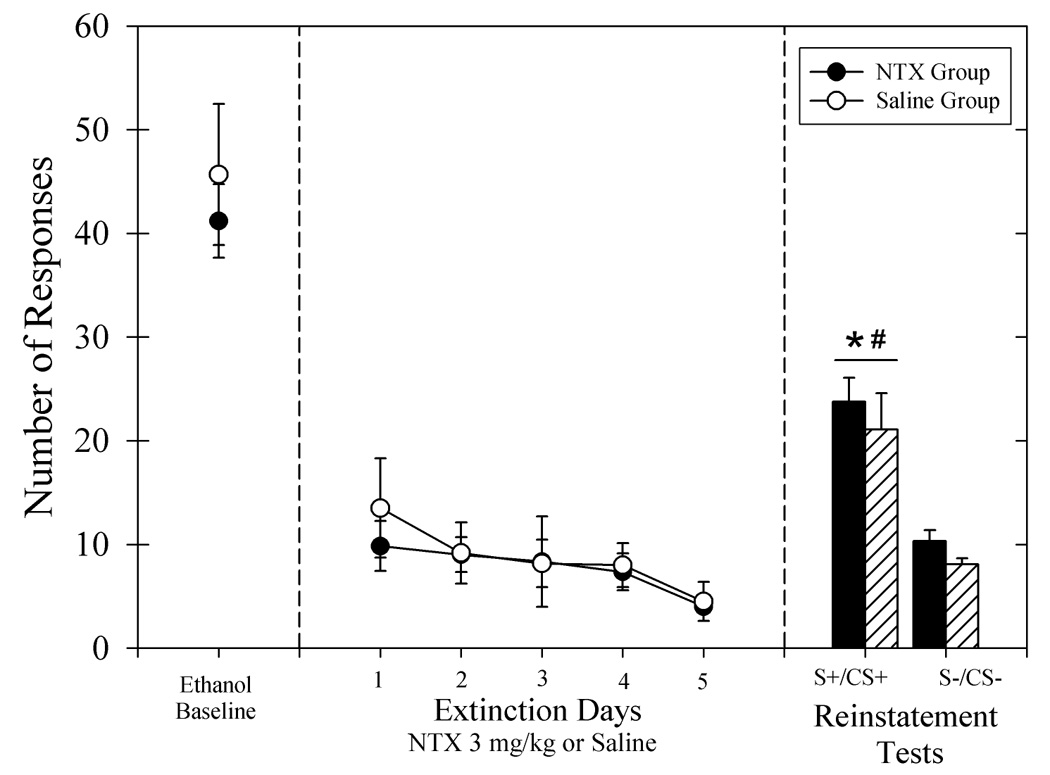
Average number of responses is shown during the last 7 days of ethanol self-administration baseline, during 5 days of extinction with pretreatment injections of 3 mg/kg NTX or saline, and the average number of responses during the 2 days of reinstatement tests under the S+/CS+ (ethanol) condition and the 2 days of S−/CS− (quinine) stimulus conditions for the groups of rats in Experiment 1. Data for both groups (n=6) are shown as means ± SEM. *Indicates p<0.05 compared to average of the last 3 days of extinction for both groups combined. #Indicates p<0.05 compared to the average of the S−/CS− days for both groups combined.
Experiment 2: Naltrexone Administration During Repeated Ethanol Cue Exposure Treatment
In Experiment 2, the rats were exposed to the same initial procedure as in Experiment 1. The results from this first phase of Experiment 2 were comparable to those of Experiment 1. The baseline number of responses during the last 7 days of ethanol self-administration was 52 ± 3 for the NTX group and 46 ± 5 for the Saline group which resulted in ethanol intakes of 1.17 ± 0.05 g/kg and 1.03± 0.13 g/kg, respectively. The groups did not differ significantly on responding [t(12) = 1.15, p=0.27] or ethanol intake [t(12) = 1.03, p=0.32].The groups were pair-matched based on the average number of responses during the 2 S+/CS+ sessions; 25 ± 3 for the NTX group and 27 ± 3 for the Saline group [t(12) = −0.50, p=0.62]. The average responding during the last 3 extinction days was similar to the average responding during the same period of the first experiment; in both experiments, the average number of responses during the last 3 days of extinction was less than 8 responses for all rats. The analysis of the initial reinstatement testing showed a main effect of days [F(2,24) = 61.72, p<0.001]. Similar to the results from Experiment 1, the results from Experiment 2 show that responding in presence of S+/CS+ was significantly higher than the average responding during the last 3 extinction days (p<0.001) and the responding in the presence of S−/CS− (p<0.001). Average responding during the 2 S−/CS− days was similar to the average responding the last 3 extinction days (p=0.07).
Following the extinction period and reinstatement testing, the rats experienced several twice weekly sessions wherein NTX or saline was injected prior to ethanol cue exposure sessions (S+/CS+). Fig 4 shows the effects of 3 mg/kg NTX or saline across the 8 individual sessions as well as the average. This dose of NTX did not significantly reduce responding as compared to saline injections [main effect of group, F(1,12) = 0.54, p=0.47]. The average number of responses across all 8 sessions was 9 ± 2 for the NTX group and 11 ± 1 for the Saline group [t(12) = −0.74, p=0.47]. Because this preliminary data analysis showed no effect of the NTX treatment, the rats were subjected to another 8 sessions with 10 mg/kg NTX or saline given just prior to ethanol cue exposure sessions. The higher NTX dose significantly decreased responding [main effect of group, F(1,12) = 9.03, p<0.05]. The average number of responses across all 8 injections was 6 ± 1 for the NTX group and 12 ± 1 for the Saline group [t(12) = −3.00, p<0.05]. Fig 5 shows the average responding on the subsequent no-injection S+/CS+ day, S−/CS− day, the S+/CS+ day with the 10 mg/kg NTX pretreatment. For comparison purposes, all data are presented in the context of the average of the last 7 days of the original ethanol self-administration baseline and the average of the last 3 days of extinction. In general, responding did not differ between the treatment groups [main effect of group, F(1,12) = 0.32, p=0.58]. The analysis showed a significant effects of days [F(4,48) = 131.27, p<0.001] and a nonsignficant interaction effect [F(4,48) = 1.30, p<0=0.28]. Post-hoc analyses for the effect of days demonstrated that the rats continued to respond more in the presence of cues that formerly signaled ethanol availability compared to the cues that formerly signaled quinine availability (p<0.001). The NTX group generated 18 ± 3 responses during the S+/CS+ session and 9 ± 2 responses during the S−/CS− session while the Saline group generated 16 ± 3 responses during the S+/CS+ session and 9 ± 2 responses during the S−/CS− session. NTX suppressed responding in the presence of the ethanol-paired cues in that responding during the S+/CS+ session with the 10 mg/kg NTX pretreatment was similar to responding during the S−/CS− session (p=0.99).
Fig. 4.
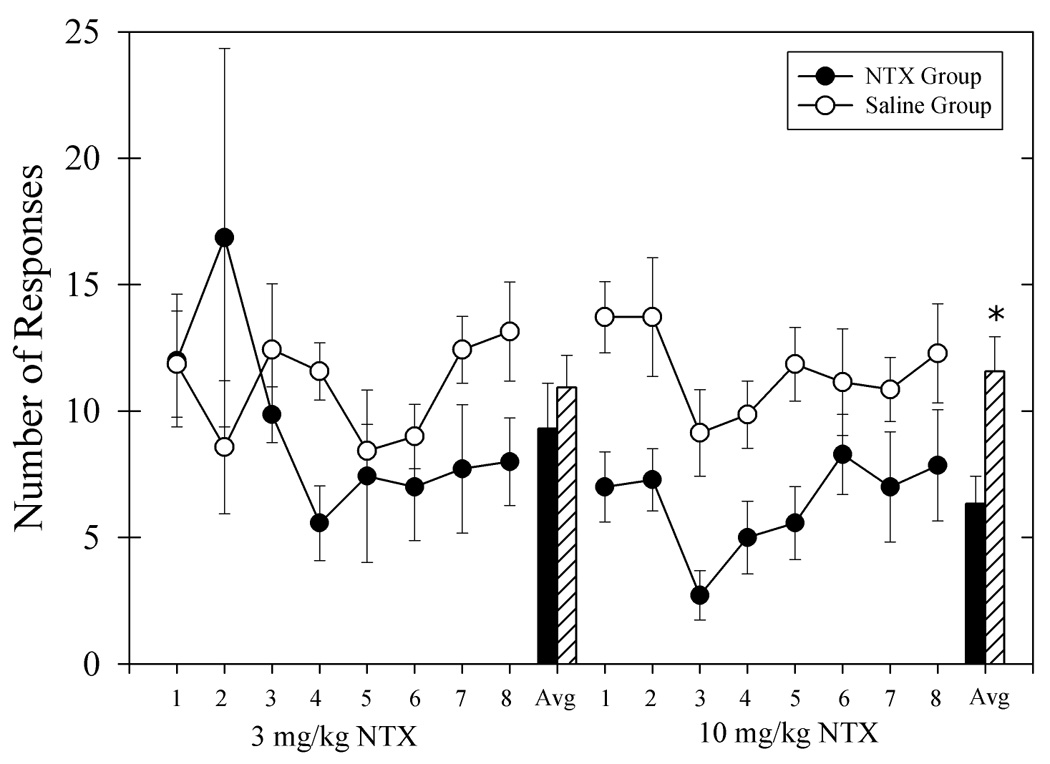
Average number of responses for each session is shown during the 8 cue exposure sessions (S+/CS+) with rats receiving intraperitoneal pretreatment injections of either 3 mg/kg NTX or saline in Experiment 2. The average number of responses across all 8 sessions is depicted for the NTX Group (solid bars) and the Saline Group (lined bars). Similar data is shown for the subsequent treatment with 10 mg/kg NTX. *Indicates p<0.05 for between-groups comparison for average responding across the 8 sessions.
Fig. 5.
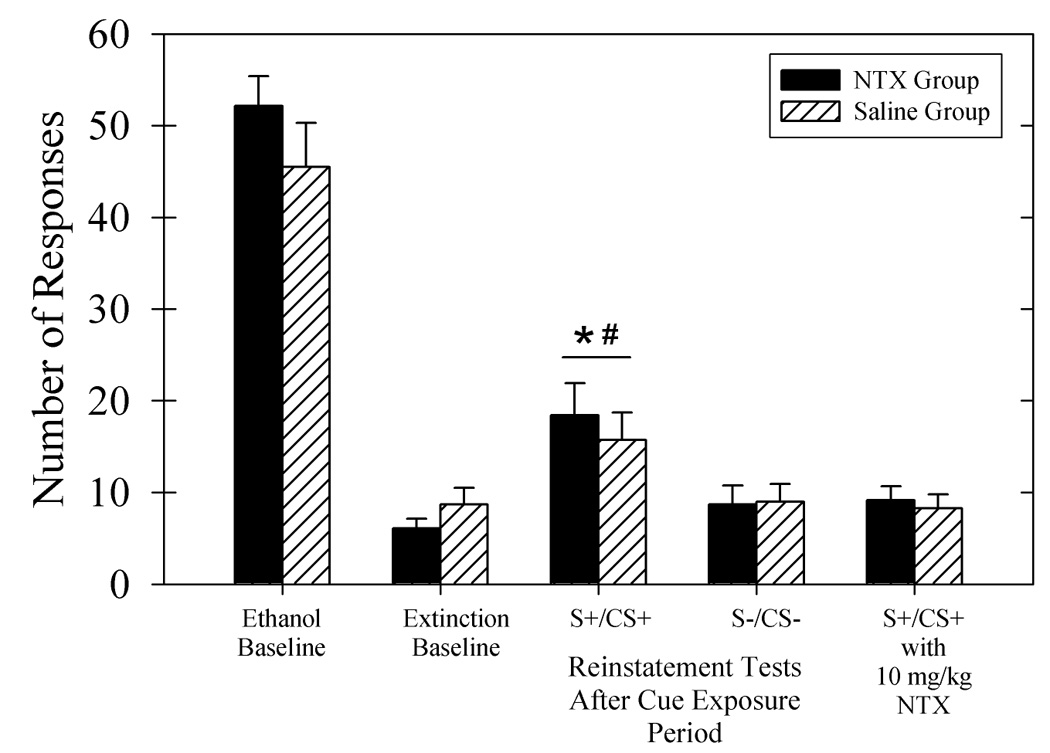
Average number of responses is shown for the last 7 days of the original ethanol baseline, last 3 days of extinction, as well as the average number of responses on a single S+/CS+ session, a single S−/CS− session, and an S+/CS+ session with a pretreatment injection of 10 mg/kg NTX. *Indicates p<0.05 for comparison to extinction baseline. #Indicates p<0.05 for comparison to S−/CS− session and S+/CS+ session with a pretreatment injection of 10 mg/kg NTX.
During the ethanol reacquisition period, the average number of responses per session for the NTX group was 54 ± 3 compared to 52 ± 3 responses during the original baseline measured almost 10 weeks earlier. For the Saline group, the average number of responses during reacquisition was 38 ± 4 compared to 46 ± 5 during the original baseline. The statistical analysis showed a trend toward significance for the main effect of group [F(1,12) = 3.87, p=0.07] and no main effect of days [F(1,12) = 2.74, p=0.12]. However, the interaction effect was significant [F(1,12) = 9.33, p<0.05] and the planned post-hoc tests showed that ethanol responding during the reacquisition period in the Saline group was significantly less than that in the NTX group [t(12) = 2.62, p<0.05]. The Saline group’s responding during the reacquisition period was less than the responding during the original baseline [t(6) = 3.46, p<0.05]. The results of the analysis of ethanol intake (g/kg) were slightly different. Only the main effect of days was significant [F(1,12) = 54.13, p<0.001] whereas a trend toward significance was observed with the main effect of group [F(1,12) = 3.28, p=0.09] and the interaction effect [F(1,12) = 3.57, p=0.08]. The differential results for responses versus ethanol intake are likely due to the change in rat weight across the experiment. The average rat weights for all 14 rats increased by approximately 100 g. The average weight before cue exposure was 455 ± 12 g compared to 552 ± 20 g after the cue exposure treatment. For the NTX group, the average intake during reacquisition was 0.97 ± 0.07 g/kg while the average intake during the original baseline was 1.17 ± 0.05 g/kg. For the Saline group, the average ethanol intake during reacquisition was 0.69 ± 0.08 g/kg compared to 1.03 ± 0.13 g/kg during the original baseline.
Discussion
The main findings of these experiments show that NTX, administered during a short extinction period when the rats were abstinent from alcohol, failed to enhance extinction of responding or alter subsequent cue-conditioned reinstatement of responding. When NTX was administered in conjunction with alcohol-paired cues during several weeks of a cue-conditioned reinstatement sessions, subsequent cue-conditioned reinstatement of responding was unaffected and NTX retained its potency to reduce acutely the responding in the presence of alcohol cues. However, reacquisition of ethanol-reinforced responding was affected by the treatment. Contrary to our hypothesis, the group exposed to NTX during the cue exposure treatment emitted more responses for alcohol during the reacquisition period than the control group. These findings have implications for how the NTX medication regimen is used to treat human alcoholics.
Because NTX may be only moderately effective in treating alcohol-dependent patients as shown by some clinical trials (Anton et al., 2006; Gastpar et al., 2002; Krystal et al., 2001) and discussed in review articles (Kranzler et al., 2000; Kranzler and Van Kirk 2001), it is important to define more clearly NTX’s role in treatment or to consider alternative dosing strategies that could increase NTX’s therapeutic effects. Most researchers examine NTX’s therapeutic effects on alcoholics by conducting clinical trials in which NTX is given to individuals participating in outpatient counseling. However, many treatment facilities utilize an inpatient treatment period where patients experience a period of forced abstinence. The period of forced abstinence can either last for a few days to allow the patients to withdraw from alcohol dependence or last for several months. In the current experiments, a rat model was employed to examine the effect of NTX administered during an extinction period (i.e., an abstinence period) on the subsequent ability of alcohol-related cues to stimulate responding. Only one other study clearly tested the effects of NTX during an abstinence period on subsequent alcohol self-administration (Juarez and Eliana, 2007). In that study, rats injected daily with 2 mg/kg NTX during 7 days of forced abstinence consumed more alcohol in a free-access condition than the saline treated control rats upon re-exposure to alcohol. In our experiments, 3 mg/kg NTX was given once daily for 5 days of extinction with response levers available but no availability of alcohol or alcohol-related cues. Responding decreased significantly but NTX did not enhance extinction of responding. Because responding was quite low even on the first day of extinction, a floor effect probably interfered with our ability to observe an effect of NTX. This dramatic decrease of responding on the first day of extinction was unexpected but has been shown in other experiments (see Fig 1A in Backstrom and Hyytia, 2004). Most publications with this paradigm don’t focus on extinction and therefore present only the average of the last 3 days of the extinction phase. Regardless, our findings, in conjunction with those of Juarez and Eliana (2007), are in agreement with the assertion made by Sinclair (2001) that NTX administration during abstinence does not reduce subsequent drinking and may actually tend to increase it.
In addition to examining the effects of NTX during extinction, we used a rat model to determine if repeated exposure to alcohol cues in the presence of NTX could attenuate the sensitivity to alcohol cues. During the prolonged ethanol self-administration phase, the sessions included a stimulus cue complex with an olfactory component used to predict the presence of an ethanol session and an auditory and visual component specifically paired with the ethanol fluid delivery. In rats, exposure to cues specifically paired with alcohol self-administration reinstated responding for alcohol and the cue-induced reinstatement of responding was attenuated by 0.25 – 1 mg/kg NTX (Burattini et al., 2006; Ciccocioppo et al., 2002; 2003; Katner and Weiss, 1999; Liu and Weiss, 2002). In our experiments, we replicated the cue-conditioned reinstatement of responding and found two other effects worth noting. First, in the saline control group, responding during twice weekly cue-conditioned reinstatement sessions (S+/CS+ sessions) was maintained at a similar level across 8 weeks without re-establishing ethanol self-administration. Thus, extinction of responding failed to occur when the alcohol cues were repeatedly presented without the opportunity to self-administer substantial amounts of alcohol. A similar effect was observed in a previous study (Ciccocioppo et al., 2001). In that study, cue-conditioned responding was resistant to extinction for up to 50 days in P and NP rats when exposed to S+/CS+ sessions approximately every 3 days. Similar to that study, our study also demonstrated that the rats retained the ability to discriminate between the S+/CS+ sessions and the S−/CS− sessions as shown by decreased responding during S−/CS− sessions. Our second noteworthy finding is that tolerance did not develop to NTX’s ability to reduce the reinstatement of responding across repeated administration. NTX 10 mg/kg attenuated cue-conditioned reinstatement of responding to the same degree in both the group that received NTX repeatedly with cue exposure and the group that received saline repeatedly with cue exposure. Our hypothesis was that NTX could be used to target the behavioral response during repeated alcohol cue exposure so that responsivity to alcohol cues would be diminished later in the absence of NTX. Thus, we expected responding on the final S+/CS+ session to be similar to that on the final S−/CS− session in the NTX group. However, responding was unaffected by NTX used in this targeted manner.
The inspiration for using NTX to target cue-induced responding came from human studies that compared the simple daily opioid antagonist dosing to a “targeted” dosing strategy. Using this strategy, subjects were instructed to take the opioid antagonist only when they anticipated a high risk of sampling alcohol. Double-blind clinical trials with heavy drinkers and alcoholics showed that both NTX (Heinala et al., 2001; Hernandez-Avila et al., 2006; Kranzler et al., 2003) and nalmefene (Karhuvaara et al., 2007) can be effective using this strategy even with minimal counseling or psychotherapy. If opioid antagonists can be used effectively to target the craving associated with high risk drinking situations, then subjects may experience those drinking situations repeatedly while on NTX and in the absence of the alcohol consumption response. Subjects may become less sensitive to the contextual cues associated with those situations and thus be able to resist drinking at a later time when the medication is unavailable. Specifically intended to decrease sensitivity to cues occurring in situations that may stimulate drinking, cue exposure treatment in conjunction with targeted NTX might further decrease cue sensitivity.
Cue exposure treatment in our experiments consisted of alcohol cue exposure twice weekly for 8 weeks in the context of cue-conditioned reinstatement sessions. In the absence of NTX (saline control group), the cue exposure treatment reduced the reacquisition of responding for alcohol when compared within subjects. This finding is in agreement with human studies that show cue exposure treatment enhanced long-term outcome measures in alcoholics (Drummond and Glautier 1994; Rohsenow et al., 2001) and in heavy drinkers that actually consumed alcohol as part of the cue exposure treatment (Sitharthan et al., 1997). In rats, one study found that cue exposure treatment had the greatest reduction on reacquisition of alcohol self-administration when the treatment allowed the rats to consume the alcohol vehicle (0.1% saccharin) in the original alcohol self-administration context (Krank and Wall, 1990). In our experiments, repeatedly exposing rats to alcohol cues in the absence of NTX failed to decrease subsequent responding in the presence of alcohol cues but did reduce responding for alcohol during the reacquisition phase. The effects of the cue exposure treatment apparently were blocked in the group that received NTX repeatedly in the presence of the alcohol cues. This finding is in accordance with the comments by the authors of the only human study to combine pharmacotherapy with cue exposure treatment (Monti et al., 2001). The authors indicated that the cue exposure treatment was purposefully completed prior to NTX treatment so that the NTX would not block responses elicited by alcohol cues and thereby reduce the effectiveness of the cue exposure treatment. For cue exposure treatment to be most efficient, the subject may need to experience the maximal subjective and physiological effects of alcohol cues followed by an inhibition of the alcohol consumption response. However, if NTX improves treatment outcomes by blocking the reinforcing effects of alcohol consumption and extinguishing alcohol-related behaviors as stated earlier, then NTX should also reduce the rewarding properties or incentive value of stimuli associated with alcohol consumption which was the rationale for combining NTX with repeated cue exposure in the current experiments. One caveat regarding our data is that the effects observed on responding were somewhat different from the effects on ethanol intake. While the effects on responding were statistically significant, they were not robust effects. The analysis of ethanol intake for the original baseline versus the reacquisition phase was not significant likely due to an increase in rat weight across the course of the experiment. Thus, the effects of cue exposure and the effects of NTX during cue exposure may require more exploration.
Although NTX failed to augment cue exposure treatment in our experiments, we need to address the issue of NTX’s potency to decrease cue-conditioned reinstatement of responding and alcohol self-administration. First, the NTX dose in our experiments may be considered quite large initially. NTX 3 mg/kg was used during the initial extinction period because that dose was the threshold dose for significantly reducing operant responding for alcohol in our lab (unpublished observations) and, in another study, that dose reduced alcohol consumption but only after a few days of repeated administration (Bienkowski et al., 1999a). Although a floor effect may have prohibited us from observing an effect of 3 mg/kg on responding during extinction, this dose failed to reduce significantly cue-conditioned reinstatement of responding during the first 4 weeks of the cue exposure treatment. Because 3 mg/kg was ineffective, we continued the experiment for another 4 weeks using 10 mg/kg NTX which is not an opioid receptor-selective dose in rats. A problem with using 10 mg/kg is that high NTX doses are considered to suppress behavior in a general manner. However, the highest dose of NTX used in our experiment may not act by a general suppression of behavior or locomotor activity. First, the literature indicates that rats are able to maintain considerable rates of responding for food or fluid after naloxone or NTX doses at high as 30 mg/kg (Sanger and McCarthy, 1982; Schindler et al., 1990; Williams, 2007). In rats responding for electrical brain stimulation, latency to respond was also unaffected by naloxone or NTX doses as high as 20 mg/kg (Trujillo et al., 1989b). Second, a direct measurement of ambulatory activity alone shows no effect of naloxone doses up to 10 mg/kg (Timar et al., 2005) and NTX 30 mg/kg has conflicting effects where horizontal activity is reduced but a measure of ambulatory activity is unaffected (Schaefer and Michael, 1985). In rats responding for electrical brain stimulation, the degree of rate-suppression was identical for a simple behavioral response (nose poke) as for a more complex behavioral response (lever press) with naloxone doses up to 20 mg/kg (Trujillo et al., 1989a). These data suggest that reduced ability to emit a response is not necessarily the main cause of reduced responding after high doses of opioid antagonists in some paradigms. Although the reduced responding in our study after 10 mg/kg NTX may not be due to a simple suppression of behavior, we still observe a dramatic decrease in NTX potency compared to other studies. This decreased potency of NTX observed in our lab has been discussed in the context of operant procedures vs. free access conditions as well as the food-restricted status of the rats (Williams, 2007). These factors should not influence findings in the current experiments because the rats were not food-restricted and all cue-conditioned reinstatement procedures necessarily observe responding behavior. A more important factor that explains the discrepancy in effective NTX doses across studies is the route of administration. In the cue-conditioned reinstatement studies cited earlier, subcutaneously administered NTX doses as low as 0.25 mg/kg blocked cue-conditioned reinstatement of responding whereas intraperitoneally administered NTX blocked cue-conditioned reinstatement at 3 mg/kg (Bienkowski et al., 1999b). In another study, intraperitoneal injections of naloxone failed to statistically decrease latency to first lever press and rate of responding for ethanol (after 3 mg/kg naloxone) or sucrose (after 10 mg/kg naloxone) during the appetitive phase of an appetitive-consummatory model of self-administration (Sharpe and Samson, 2001). Route of administration is seldom emphasized in experiments regarding the effects of opioid antagonists. In a recent pilot study, we found NTX to be approximately 10-times more potent in reducing alcohol-reinforced responding when administered subcutaneously vs. intraperitoneally (manuscript in preparation). This finding is related to an older study by Lukas et al. (1971) in which the authors showed that drugs administered via intraperitoneal injection attain lower plasma concentrations because the compounds are subject to first-pass metabolism in the liver which can be avoided via the subcutaneous route.
In summary, NTX’s exact role in treating alcoholism needs to be more clearly defined since NTX may not be more effective than therapy alone (Anton et al., 2006) and may be more effective at decreasing heavy drinking following a sampling of alcohol rather than stimulating abstinence (Pettinati et al., 2006). Given the abundant literature focusing on the effects of alcohol-associated cues on subjective and physiological effects as well as brain activation, alcoholism therapy may benefit from a better understanding of how these variables influence or predict relapse. Alcoholism treatment drugs such as naltrexone, acamprosate, or other developing pharmacotherapies may help target the sensitivity to alcohol-associated cues.
Fig. 6.
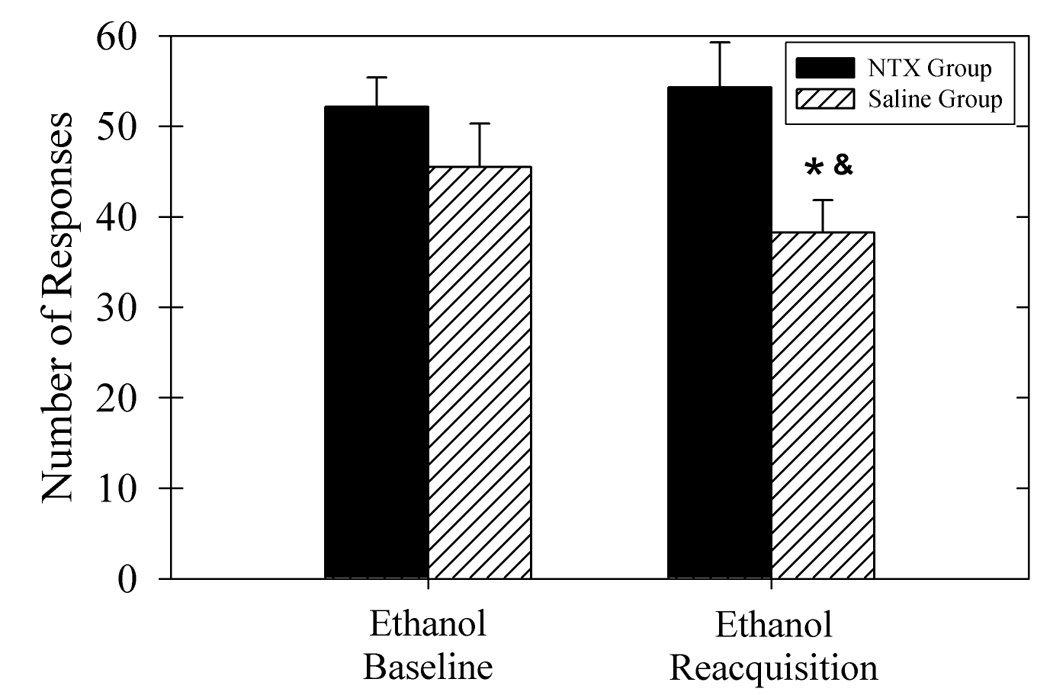
Average number of responses is shown for the last 7 days of the original ethanol baseline and the last 7 days of reacquisition of ethanol self-administration. *Indicates p<0.05 for within-group comparison to original ethanol baseline. &Indicates p<0.05 for between-groups comparison of responding during reacquisition.
Acknowledgments
This study was supported by grant 7 R15 AA015147-01 from the National Institute on Alcohol Abuse and Alcoholism. We thank Carissa Broadbridge for assistance with data collection.
Footnotes
Publisher's Disclaimer: This is a PDF file of an unedited manuscript that has been accepted for publication. As a service to our customers we are providing this early version of the manuscript. The manuscript will undergo copyediting, typesetting, and review of the resulting proof before it is published in its final citable form. Please note that during the production process errors may be discovered which could affect the content, and all legal disclaimers that apply to the journal pertain.
References
- Anton RF, O'Malley SS, Ciraulo DA, Cisler RA, Couper D, Donovan DM, Gastfriend DR, Hosking JD, Johnson BA, LoCastro JS, et al. Combined pharmacotherapies and behavioral interventions for alcohol dependence: the COMBINE study: a randomized controlled trial. JAMA. 2006;295:2003–2017. doi: 10.1001/jama.295.17.2003. [DOI] [PubMed] [Google Scholar]
- Backstrom P, Hyytia P. Ionotropic glutamate receptor antagonists modulate cue-induced reinstatement of ethanol-seeking behavior. Alcohol. Clin. Exp. Res. 2004;28:558–565. doi: 10.1097/01.alc.0000122101.13164.21. [DOI] [PubMed] [Google Scholar]
- Backstrom P, Hyytia P. Suppression of alcohol self-administration and cue-induced reinstatement of alcohol seeking by the mGlu2/3 receptor agonist LY379268 and the mGlu8 receptor agonist (S)-3,4-DCPG. Eur. J. Pharmacol. 2005;528:110–118. doi: 10.1016/j.ejphar.2005.10.051. [DOI] [PubMed] [Google Scholar]
- Bienkowski P, Kostowski W, Koros E. Ethanol-reinforced behaviour in the rat: effects of naltrexone. Eur. J. Pharmacol. 1999;374:321–327. doi: 10.1016/s0014-2999(99)00245-9. [DOI] [PubMed] [Google Scholar]
- Bienkowski P, Kostowski W, Koros E. The role of drug-paired stimuli in extinction and reinstatement of ethanol-seeking behaviour in the rat. Eur. J. Pharmacol. 1999;374:315–319. doi: 10.1016/s0014-2999(99)00244-7. [DOI] [PubMed] [Google Scholar]
- Blakey R, Baker R. An exposure approach to alcohol abuse. Behav. Res. Ther. 1980;18:319–325. doi: 10.1016/0005-7967(80)90090-x. [DOI] [PubMed] [Google Scholar]
- Burattini C, Gill TM, Aicardi G, Janak PH. The ethanol self-administration context as a reinstatement cue: acute effects of naltrexone. Neuroscience. 2006;139:877–887. doi: 10.1016/j.neuroscience.2006.01.009. [DOI] [PubMed] [Google Scholar]
- Ciccocioppo R, Angeletti S, Weiss F. Long-lasting resistance to extinction of response reinstatement induced by ethanol-related stimuli: role of genetic ethanol preference. Alcohol. Clin. Exp. Res. 2001;25:1414–1419. doi: 10.1097/00000374-200110000-00002. [DOI] [PubMed] [Google Scholar]
- Ciccocioppo R, Lin D, Martin-Fardon R, Weiss F. Reinstatement of ethanol-seeking behavior by drug cues following single versus multiple ethanol intoxication in the rat: effects of naltrexone. Psychopharmacology (Berl) 2003;168:208–215. doi: 10.1007/s00213-002-1380-z. [DOI] [PubMed] [Google Scholar]
- Ciccocioppo R, Martin-Fardon R, Weiss F. Effect of selective blockade of m1 or d opioid receptors on reinstatement of alcohol-seeking behavior by drug-associated stimuli in rats. Neuropsychopharmacology. 2002;27:391–399. doi: 10.1016/S0893-133X(02)00302-0. [DOI] [PubMed] [Google Scholar]
- Czachowski CL, Samson HH, Denning CE. Blood ethanol concentrations in rats drinking sucrose/ethanol solutions [see comments] Alcohol. Clin. Exp. Res. 1999;23:1331–1335. [PubMed] [Google Scholar]
- Drummond DC, Glautier S. A controlled trial of cue exposure treatment in alcohol dependence. J. Consult. Clin. Psychol. 1994;62:809–817. doi: 10.1037//0022-006x.62.4.809. [DOI] [PubMed] [Google Scholar]
- Gastpar M, Bonnet U, Boning J, Mann K, Schmidt LG, Soyka M, Wetterling T, Kielstein V, Labriola D, Croop R. Lack of efficacy of naltrexone in the prevention of alcohol relapse: results from a German multicenter study. J. Clin. Psychopharmacol. 2002;22:592–598. doi: 10.1097/00004714-200212000-00009. [DOI] [PubMed] [Google Scholar]
- Heather N, Greeley J. Cue exposure in the treatment of drug dependence: the potential of a new method for preventing relapse. Drug Alcohol. Rev. 1990;9:155–168. doi: 10.1080/09595239000185211. [DOI] [PubMed] [Google Scholar]
- Heinala P, Alho H, Kiinmaa K, Lonnqvist J, Kuoppasamlmi K, Sinclair JD. Targeted use of naltrexone without prior detoxification in the treatment of alcohol dependence: A factorial double-blind, placebo-controlled trial. J. Clin. Psychopharmacol. 2001;21:287–292. doi: 10.1097/00004714-200106000-00006. [DOI] [PubMed] [Google Scholar]
- Hernandez-Avila CA, Song C, Kuo L, Tennen H, Armeli S, Kranzler HR. Targeted versus daily naltrexone: secondary analysis of effects on average daily drinking. Alcohol. Clin. Exp. Res. 2006;30:860–865. doi: 10.1111/j.1530-0277.2006.00101.x. [DOI] [PubMed] [Google Scholar]
- Heyman GM. Preference for saccharin-sweetened alcohol relative to isocaloric sucrose. Psychopharmacology (Berl) 1997;129:72–78. doi: 10.1007/s002130050164. [DOI] [PubMed] [Google Scholar]
- Heyman GM. An economic approach to animal models of alcoholism. Alcohol. Res. Health. 2000;24:132–139. [PMC free article] [PubMed] [Google Scholar]
- Heyman GM, Gendel K, Goodman J. Inelastic demand for alcohol in rats. Psychopharmacology (Berl) 1999;144:213–219. doi: 10.1007/s002130050996. [DOI] [PubMed] [Google Scholar]
- Heyser CJ, Moc K, Koob GF. Effects of naltrexone alone and in combination with acamprosate on the alcohol deprivation effect in rats. Neuropsychopharmacology. 2003;28:1463–1471. doi: 10.1038/sj.npp.1300175. [DOI] [PubMed] [Google Scholar]
- Holter SM, Spanagel R. Effects of opiate antagonist treatment on the alcohol deprivation effect in long-term ethanol-experienced rats. Psychopharmacology (Berl) 1999;145:360–369. doi: 10.1007/s002130051069. [DOI] [PubMed] [Google Scholar]
- Juarez J, Eliana Bde T. Alcohol consumption is enhanced after naltrexone treatment. Alcohol. Clin. Exp. Res. 2007;31:260–264. doi: 10.1111/j.1530-0277.2006.00313.x. [DOI] [PubMed] [Google Scholar]
- Karhuvaara S, Simojoki K, Virta A, Rosberg M, Loyttyniemi E, Nurminen T, Kallio A, Makela R. Targeted nalmefene with simple medical management in the treatment of heavy drinkers: a randomized double-blind placebo-controlled multicenter study. Alcohol. Clin. Exp. Res. 2007;31:1179–1187. doi: 10.1111/j.1530-0277.2007.00401.x. [DOI] [PubMed] [Google Scholar]
- Katner SN, Magalong JG, Weiss F. Reinstatement of alcohol-seeking behavior by drug-associated discriminative stimuli after prolonged extinction in the rat. Neuropsychopharmacology. 1999;20:471–479. doi: 10.1016/S0893-133X(98)00084-0. [DOI] [PubMed] [Google Scholar]
- Katner SN, Weiss F. Ethanol-associated olfactory stimuli reinstate ethanol-seeking behavior after extinction and modify extracellular dopamine levels in the nucleus accumbens. Alcohol Clin Exp Res. 1999;23:1751–1760. [PubMed] [Google Scholar]
- Krank MD, Wall AM. Cue exposure during a period of abstinence reduces the resumption of operant behavior for oral ethanol reinforcement. Behav. Neurosci. 1990;104:725–733. doi: 10.1037//0735-7044.104.5.725. [DOI] [PubMed] [Google Scholar]
- Kranzler HR. Pharmacotherapy of alcoholism: gaps in knowledge and opportunities for research. Alcohol. Alcohol. 2000;35:537–547. doi: 10.1093/alcalc/35.6.537. [DOI] [PubMed] [Google Scholar]
- Kranzler HR, Armeli S, Tennen H, Blomqvist O, Oncken C, Petry N, Feinn R. Targeted naltrexone for early problem drinkers. J. Clin. Psychopharmacol. 2003;23:294–304. doi: 10.1097/01.jcp.0000084030.22282.6d. [DOI] [PubMed] [Google Scholar]
- Kranzler HR, Van Kirk J. Efficacy of naltrexone and acamprosate for alcoholism treatment: a meta-analysis. Alcohol. Clin. Exp. Res. 2001;25:1335–1341. [PubMed] [Google Scholar]
- Krystal JH, Cramer JA, Krol WF, Kirk GF, Rosenheck RA. Naltrexone in the treatment of alcohol dependence. N. Engl. J. Med. 2001;345:1734–1739. doi: 10.1056/NEJMoa011127. [DOI] [PubMed] [Google Scholar]
- Liu X, Weiss F. Additive effect of stress and drug cues on reinstatement of ethanol seeking: exacerbation by history of dependence and role of concurrent activation of corticotropin-releasing factor and opioid mechanisms. J. Neurosci. 2002;22:7856–7861. doi: 10.1523/JNEUROSCI.22-18-07856.2002. [DOI] [PMC free article] [PubMed] [Google Scholar]
- Lukas G, Brindle SD, Greengard P. The route of absorption of intraperitoneally administered compounds. J. Pharmacol. Exp. Ther. 1971;178:562–564. [PubMed] [Google Scholar]
- Monti PM, Binkoff JA, Abrams DB, Zwick WR, Nirenberg TD, Liepman MR. Reactivity of alcoholics and nonalcoholics to drinking cues. J. Abnorm. Psychol. 1987;96:122–126. doi: 10.1037//0021-843x.96.2.122. [DOI] [PubMed] [Google Scholar]
- Monti PM, Rohsenow DJ, Hutchison KE, Swift RM, Mueller TI, Colby SM, Brown RA, Gulliver SB, Gordon A, Abrams DB. Naltrexone's effect on cue-elicited craving among alcoholics in treatment. Alcohol. Clin. Exp. Res. 1999;23:1386–1394. [PubMed] [Google Scholar]
- Monti PM, Rohsenow DJ, Swift RM, Gulliver SB, Colby SM, Mueller TI, Brown RA, Gordon A, Abrams DB, Niaura RS, Asher MK. Naltrexone and cue exposure with coping and communication skills training for alcoholics: treatment process and 1-year outcomes. Alcohol. Clin. Exp. Res. 2001;25:1634–1647. [PubMed] [Google Scholar]
- Myrick H, Anton RF, Li X, Henderson S, Drobes D, Voronin K, George MS. Differential brain activity in alcoholics and social drinkers to alcohol cues: relationship to craving. Neuropsychopharmacology. 2004;29:393–402. doi: 10.1038/sj.npp.1300295. [DOI] [PubMed] [Google Scholar]
- National Research Council. Guide for the care and use of laboratory animals. Washington D.C.: National Academy Press; 1996. [Washington DC] [Google Scholar]
- Niaura RS, Rohsenow DJ, Binkoff JA, Monti PM, Pedraza M, Abrams DB. Relevance of cue reactivity to understanding alcohol and smoking relapse. J. Abnorm. Psychol. 1988;97:133–152. doi: 10.1037//0021-843x.97.2.133. [DOI] [PubMed] [Google Scholar]
- O'Malley SS, Jaffe AJ, Chang G, Shottenfeld R, Meyer RE, Rounsaville B. Naltrexone and coping skills therapy for alcohol dependence. Arch. Gen. Psychiatry. 1992;49:881–887. doi: 10.1001/archpsyc.1992.01820110045007. [DOI] [PubMed] [Google Scholar]
- Overstreet DH, Kampov-Polevoy AB, Rezvani AH, Braun C, Bartus RT, Crews FT. Suppression of alcohol intake by chronic naloxone treatment in P rats: tolerance development and elevation of opiate receptor binding. Alcohol. Clin. Exp. Res. 1999;23:1761–1771. [PubMed] [Google Scholar]
- Palfai T, Davidson D, Swift R. Influence of naltrexone on cue-elicited craving among hazardous drinkers: the moderational role of positive outcome expectancies. Exp. Clin. Psychopharmacol. 1999;7:266–273. doi: 10.1037//1064-1297.7.3.266. [DOI] [PubMed] [Google Scholar]
- Pettinati HM, O'Brien CP, Rabinowitz AR, Wortman SP, Oslin DW, Kampman KM, Dackis CA. The status of naltrexone in the treatment of alcohol dependence: specific effects on heavy drinking. J. Clin. Psychopharmacol. 2006;26:610–625. doi: 10.1097/01.jcp.0000245566.52401.20. [DOI] [PubMed] [Google Scholar]
- Pomerleau OF, Fertig J, Baker L, Cooney N. Reactivity to alcohol cues in alcoholics and non-alcoholics: implications for a stimulus control analysis of drinking. Addict. Behav. 1983;8:1–10. doi: 10.1016/0306-4603(83)90048-5. [DOI] [PubMed] [Google Scholar]
- Rankin H, Hodgson R, Stockwell T. Cue exposure and response prevention with alcoholics: a controlled trial. Behav. Res. Ther. 1983;21:435–446. doi: 10.1016/0005-7967(83)90013-x. [DOI] [PubMed] [Google Scholar]
- Rohsenow DJ, Monti PM, Hutchison KE, Swift RM, Colby SM, Kaplan GB. Naltrexone's effects on reactivity to alcohol cues among alcoholic men. J. Abnorm. Psychol. 2000;109:738–742. [PubMed] [Google Scholar]
- Rohsenow DJ, Monti PM, Rubonis AV, Gulliver SB, Colby SM, Binkoff JA, Abrams DB. Cue exposure with coping skills training and communication skills training for alcohol dependence: 6- and 12-month outcomes. Addiction. 2001;96:1161–1174. doi: 10.1046/j.1360-0443.2001.96811619.x. [DOI] [PubMed] [Google Scholar]
- Rohsenow DJ, Monti PM, Rubonis AV, Sirota AD, Niaura RS, Colby SM, Wunschel SM, Abrams DB. Cue reactivity as a predictor of drinking among male alcoholics. J. Consult. Clin. Psychol. 1994;62:620–626. doi: 10.1037//0022-006x.62.3.620. [DOI] [PubMed] [Google Scholar]
- Sanger DJ, McCarthy PS. A comparison of the effects of opiate antagonists on operant and ingestive behavior. Pharmacol. Biochem. Behav. 1982;16:1013–1015. doi: 10.1016/0091-3057(82)90063-6. [DOI] [PubMed] [Google Scholar]
- Schaefer GJ, Michael RP. Effects of opioid antagonists and their quaternary derivatives on locomotor activity and fixed ratio responding for brain self-stimulation in rats. Pharmacol. Biochem. Behav. 1985;23:797–802. doi: 10.1016/0091-3057(85)90074-7. [DOI] [PubMed] [Google Scholar]
- Schindler CW, Panlilio LV, Goldberg SR. Second-order schedules of drug self-administration in animals. Psychopharmacology (Berl) 2002;163:327–344. doi: 10.1007/s00213-002-1157-4. [DOI] [PubMed] [Google Scholar]
- Schindler CW, Wu X-Z, Su T-P, Goldberg SR, Katz JL. Enhanced sensitivity to behavioral effects of naltrexone in rats. J. Pharmacol. Exp. Ther. 1990;252:8–14. [PubMed] [Google Scholar]
- Sharpe AL, Samson HH. Effect of naloxone on appetitive and consummatory phases of ethanol self-administration. Alcohol. Clin. Exp. Res. 2001;25:1006–1011. [PubMed] [Google Scholar]
- Sinclair JD. New treatment options for substance abuse from a public health viewpoint. Ann. Med. 1998;30:406–411. doi: 10.3109/07853899809029941. [DOI] [PubMed] [Google Scholar]
- Sinclair JD. Evidence about the use of naltrexone and for different ways of using it in the treatment of alcoholism. Alcohol. Alcohol. 2001;36:2–10. doi: 10.1093/alcalc/36.1.2. [DOI] [PubMed] [Google Scholar]
- Sitharthan T, Sitharthan G, Hough MJ, Kavanagh DJ. Cue exposure in moderation drinking: a comparison with cognitive-behavior therapy. J. Consult. Clin. Psychol. 1997;65:878–882. doi: 10.1037//0022-006x.65.5.878. [DOI] [PubMed] [Google Scholar]
- Timar J, Gyarmati Z, Furst Z. The development of tolerance to locomotor effects of morphine and the effect of various opioid receptor antagonists in rats chronically treated with morphine. Brain. Res. Bull. 2005;64:417–424. doi: 10.1016/j.brainresbull.2004.09.005. [DOI] [PubMed] [Google Scholar]
- Turkkan JS, McCaul ME, Stitzer ML. Psychophysiological effects of alcohol-related stimuli: II. Enhancement with alcohol availability. Alcohol. Clin. Exp. Res. 1989;13:392–398. doi: 10.1111/j.1530-0277.1989.tb00341.x. [DOI] [PubMed] [Google Scholar]
- Volpicelli JR, Alterman AI, Hayashida M, O'Brien CP. Naltrexone in treatment of alcohol dependence. Arch. Gen. Psychiatry. 1992;49:876–880. doi: 10.1001/archpsyc.1992.01820110040006. [DOI] [PubMed] [Google Scholar]
- Williams KL. Development of naltrexone supersensitivity during food-maintained responding enhances naltrexone's ability to reduce ethanol-maintained responding. Alcohol. Clin. Exp. Res. 2007;31:39–47. doi: 10.1111/j.1530-0277.2006.00272.x. [DOI] [PubMed] [Google Scholar]