


Figure 3. LBH589 (LBH)-induced acetylation increases B-GA and 17-AAG binding to hsp90α.
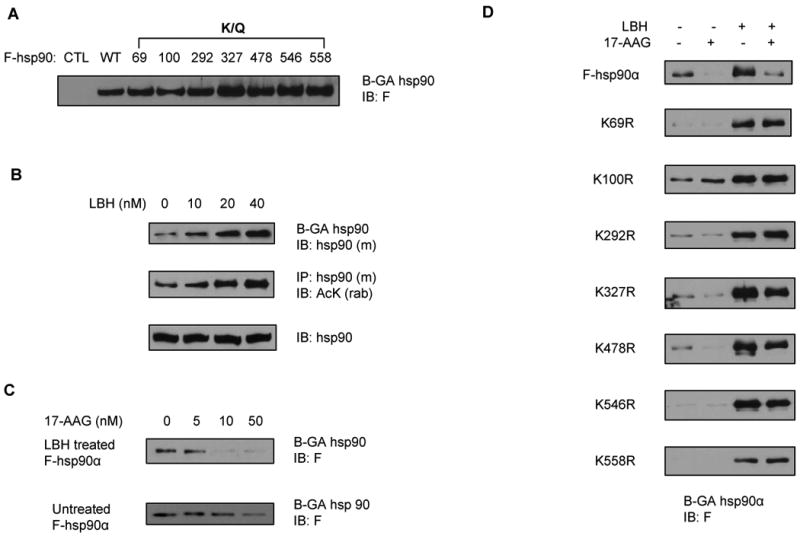
(A) Individual K/Q substitutions increase hsp90α binding to biotinylated (B)-GA. Cell lysates from Figure 2D above were also incubated with B-GA followed by streptavidin coated agarose beads and eluted proteins were analyzed with anti-F antibody. (B) LBH589 increases hsp90 binding to GA and induces hsp90 acetylation dose-dependently. MB-468 cells cultured in DMEM medium containing 10 % FBS were treated with the indicated concentration of LBH589 for 16 hours. Following this, cell lysates were incubated with B-GA followed by streptavidin coated agarose beads and eluted proteins were analyzed with anti-hsp90α antibody. Acetylation and expression level of endogenous hsp90 were detected with anti-AcK and anti-hsp90 antibody, respectively. (C) LBH589 treatment preferentially increases hsp90α binding to 17-AAG. MB-468 cells ectopically expressing F-hsp90α were treated with 100 nM of LBH for 16 hours. Following this, equal amount of cell lysates were incubated with the indicated doses of 17-AAG for 30 min at 4°C, followed by incubation with B-GA and streptavidin-coated agarose beads. Precipitates from streptavidin coated beads were analyzed with anti-F antibody. (D) individual K/R substitution disrupted the affinity of LBH589-treated hsp90α for 17-AAG. Following treatment with either vehicle or 100 nM of LBH, cell lysates from HEK293 cells expressing F-hsp90 or K/R substitutions were incubated with vehicle or 50 nM of 17-AAG followed by incubation with B-GA and streptavidin coated agarose beads. Precipitates from streptavidin coated beads were analyzed with anti-F antibody.