


Figure 2. NO-cGMP signaling requires PKG to enhance GABAergic IPSCs.
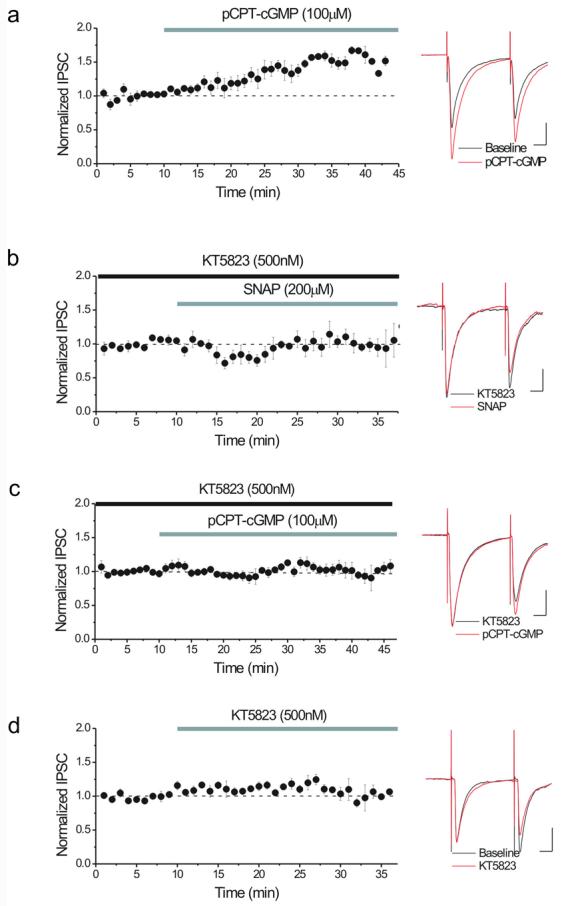
(a) A cGMP analogue, pCPT-cGMP (100 μM), potentiates IPSCs (146 ± 9% of pre-drug values, n=4). Inset: averaged IPSCs recorded during a single such experiment before (black) and after 15 minutes in pCPT-cGMP (red). Calibration for all insets: 10ms, 100 pA.
(b) The PKG inhibitor, KT5823 (500 nM), blocks the enhancement of IPSCs by 200 μM SNAP (101 ± 6% of pre-SNAP values, n=4). KT5823 was applied at least 15 minutes prior to the addition of SNAP. Inset: averaged IPSCs recorded during single experiment in KT5823 (black) and after 15 minutes in SNAP (red).
(c) KT5823 (500 nM) also prevents the potentiation of IPSCs by 100 μM pCPT-cGMP (104 ± 6% of pre-SNAP values, n=6). KT5823 was applied at least 15 minutes prior to the addition of pCPT-cGMP. Inset: averaged IPSCs recorded during single experiment in KT5823 (black) and after 15 minutes in pCPT-cGMP (red).
(d) KT5823 (500 nM) has no effect on basal GABAergic transmission (113 ± 6% of pre-drug values, n=5). Inset: averaged IPSCs recorded during single experiment before (black) and after 10 minutes in KT5823 (red).