


Figure 2. LIRKO mice show quantitative and qualitative defects in bile acid synthesis on a chow diet.
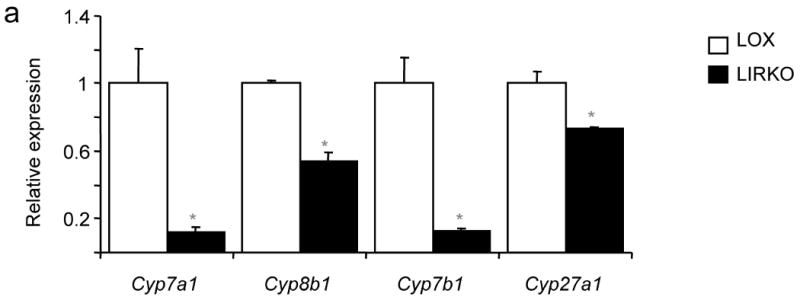
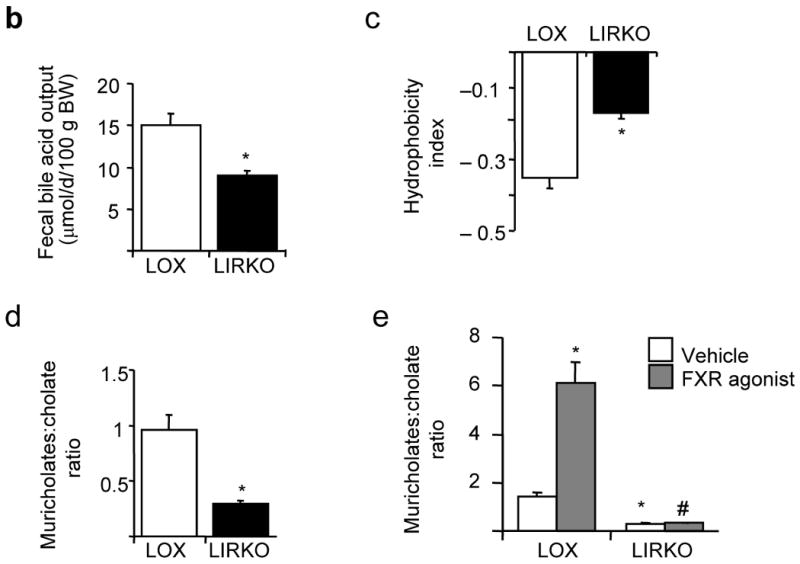
(a) Real-time PCR analysis of cDNA prepared from six-week old mice sacrificed during the light cycle following a 24 hour fast; the expression of each gene was normalized to its value in Lox mice (n=5-8, *p=0.05 versus Lox). (b) Since the synthesis of bile acids is equivalent to fecal excretion in the steady state, we assessed bile acid synthesis by collecting feces from 3 month old Lox and LIRKO mice for 72 hours and measuring total bile acid outputs (n=4, p=0.02). Hepatic bile from 5-6 month old Lox and LIRKO mice was subjected to HPLC analysis as described in Methods (n=4-5). (c) Hydrophobicity indices were calculated as described in Methods (*p=0.002). (d) The ratio of muricholates to cholate was calculated using the molar percentages of tauroα- and tauroβ- muricholate and taurocholate (*p=0.001). (e) Three-month old mice were gavaged with an FXR agonist (GW4064) at 100 mg/kg/d or vehicle for 14 days. Mice were fasted overnight, and sacrificed two hours after the last dose of agonist. Bile was expressed from the gallbladder and ratio of muricholates to cholate was determined as above. *p<0.05 versus Lox untreated; #p<0.05 versus Lox treated.