


Figure 2.
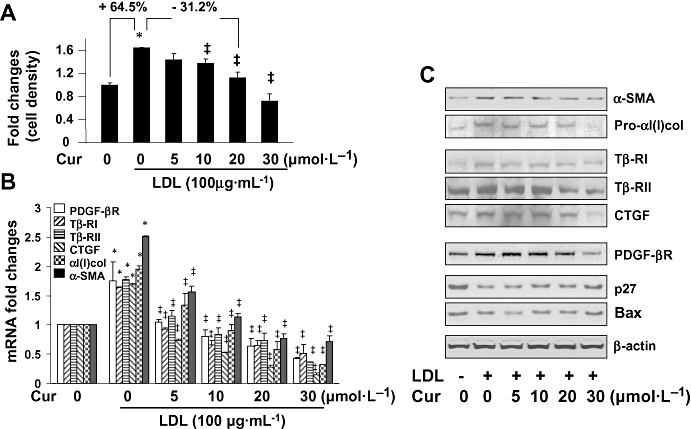
Curcumin attenuated the stimulatory effects of low-density lipoprotein (LDL) on hepatic stellate cell (HSC) activation. Serum-starved HSC were stimulated with or without exogenous LDL (100 µg·mL−1) in the presence of curcumin as shown for 24 h. (A) MTS assays of cell proliferation. Results were expressed as cell density (%), compared with the untreated control [means ± standard deviation (SD)] (n= 3). *P < 0.05 versus cells with no treatment. ‡P < 0.05 versus cells treated with exogenous LDL only. (B) Real-time PCR analyses of the steady state levels of mRNA of genes relevant to HSC activation. The levels of target mRNAs were normalized with glyceraldehyde-3-phosphate dehydrogenase mRNA and were presented as mean ± SD (n= 3). *P < 0.05, compared to the untreated corresponding control. ‡P < 0.05 versus the cells treated with exogenous LDL only. (C) Western blotting analyses of proteins relevant to HSC activation. β-actin was used as an internal control for equal protein loading. Representative results from one of three independent experiments. α-SMA, α-smooth muscle actin; CTGF, connective tissue growth factor; PDGF-βR, platelet-derived growth factor-β receptor.