


Figure 3.
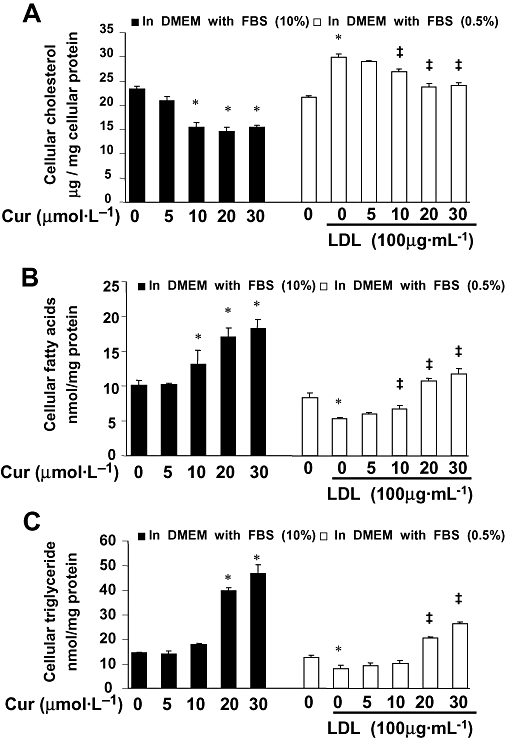
Curcumin significantly reduced intracellular cholesterol and increased the levels of fatty acids and triglyceride (TG) in cultured hepatic stellate cells (HSCs). Cultured HSCs were divided into two groups. One group was treated with curcumin as shown in Dulbecco's modified Eagle's medium (DMEM) with fetal bovine serum (FBS) (10%) for 24 h. The other group was serum-starved for 24 h. Cells were then treated with or without exogenous low-density lipoprotein (LDL) (100 µg·mL−1) and curcumin at indicated concentrations in serum-depleted DMEM containing 0.5% FBS for another 24 h. Cell extracts were prepared as stated in ‘Methods’ for quantitating cellular cholesterol, fatty acids and TG. Each treatment had triplicates. Experiments were repeated three times. *P < 0.05 versus the untreated control. ‡P < 0.05 versus the cells treated with exogenous LDL only. Experiments were repeated three times. Results were expressed as mean ± standard deviatin (n= 3). (A) Quantitation of cellular cholesterol. Cholesterol concentrations were expressed as µg per mg cellular proteins. (B) Determination of cellular fatty acids. Levels of fatty acids were presented as nmol·mg−1 protein. (C) Quantitation of cellular TG. Levels of TG were presented as nmol·mg−1 protein.