


Figure 4.
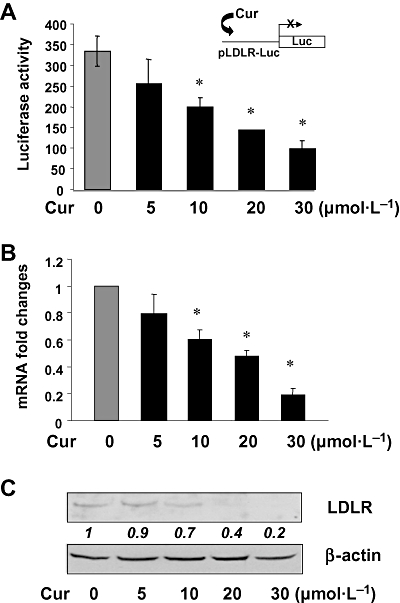
Curcumin dose-dependently suppressed gene expression of low-density lipoprotein (LDL) receptor in activated HSC in vitro. Semi-confluent hepatic stellate cells (HSCs) were treated with curcumin as shown for 24 h. (A) Luciferase assays of cells transiently transfected with the ldlr promoter luciferase reporter pLDLR-Luc. Luciferase activities were expressed as relative units after β-galactosidase normalization [means ± standard deviation (SD); n≥ 6]. *P < 0.05 versus cells with no treatment. The inset denoted the pLDLR-Luc construct in use and the application of curcumin to the system; (B) Real-time PCR analyses of the steady-state levels of LDLR mRNA. Glyceraldehyde-3-phosphate dehydrogenase was used as an invariant control for calculating mRNA fold changes. Values were expressed as means ± SD (n≥ 3). *P < 0.05 versus the untreated control; (C) Western blotting analyses of the abundance of LDLR. β-actin was used as an invariant control for equal loading. Representative results from one of three independent experiments. Italic numbers beneath the blot were fold changes in the densities of the bands compared to the control without treatment in the blot (mean values; n= 3), after normalization with the internal invariable control β-actin. Because of the limited space, standard deviations were not presented. LDLR, low-density lipoprotein receptor.