


TABLE 2.
AUC with 95% C.I. for ABC and BayesFst methods under different scenarios
| 10μθ | σθ | npop | ρZ | N | s |  |
AUC (ABC) | AUC (BayesFst) |
|---|---|---|---|---|---|---|---|---|
| 4 | 0 | 6 | 0.05 | 400 | 0.02 | 0.02 | 0.498 [0.47, 0.525] | 0.499 [0.471, 0.527] |
| 4 | 0 | 6 | 0.05 | 400 | 0.02 | 0.1 | 0.509 [0.485, 0.533] | 0.499 [0.472, 0.525] |
| 4 | 0 | 6 | 0.05 | 400 | 0.1 | 0.02 | 0.646 [0.615, 0.677] | 0.657 [0.624, 0.691] |
| 4 | 0 | 6 | 0.05 | 4000 | 0.02 | 0.02 | 0.82 [0.79, 0.85] | 0.811 [0.781, 0.841] |
| 4 | 0 | 6 | 0.05 | 400 | 0.1 | 0.1 | 0.887 [0.869, 0.905] | 0.887 [0.867, 0.906] |
| 4 | 0 | 6 | 0.05 | 4000 | 0.02 | 0.1 | 0.935 [0.923, 0.947] | 0.94 [0.927, 0.952] |
| 8 | 0.5 | 6 | 0.05 | 4000 | 0.1 | 0.17 | 0.95 [0.939, 0.96] | 0.875 [0.852, 0.897] |
| 4 | 0 | 3 | 0.05 | 4000 | 0.1 | 0.1 | 0.953 [0.942, 0.964] | 0.965 [0.955, 0.974] |
| 8 | 0.5 | 6 | 0.05 | 4000 | 0.1 | 0.1 | 0.958 [0.947, 0.969] | 0.886 [0.863, 0.908] |
| 4 | 0 | 6 | 0.05 | 4000 | 0.1 | 0.1 | 0.959 [0.948, 0.971] | 0.932 [0.917, 0.947] |
| 0.4 | 0 | 6 | 0.05 | 4000 | 0.1 | 0.1 | 0.962 [0.95, 0.974] | 0.972 [0.962, 0.982] |
| 4 | 0 | 6 | 0.01 | 4000 | 0.1 | 0.1 | 0.974 [0.958, 0.989] | 0.983 [0.971, 0.996] |
| 4 | 0 | 6 | 0.05 | 4000 | 0.1 | 0.1 | 0.974 [0.966, 0.982] | 0.981 [0.975, 0.988] |
| 4 | 0 | 6 | 0.1 | 4000 | 0.1 | 0.1 | 0.977 [0.972, 0.983] | 0.985 [0.981, 0.989] |
| 4 | 0 | 6 | 0.05 | 4000 | 0.1 | 0.02 | 0.989 [0.984, 0.994] | 0.992 [0.988, 0.996] |
Nμ, scaled mutation rate; σμ, standard deviation of mutation rate across loci (on log10 scale); npop, number of populations; ρZ, proportion of loci under selection; N, subpopulation size; s, selection coefficient. As noted in the text,  for population j is drawn from a beta distribution with parameters (
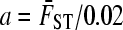 ,
,  ). The immigration rate,
  in the terminology of our model, is then computed by
 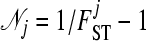 .
.