


Figure 2.
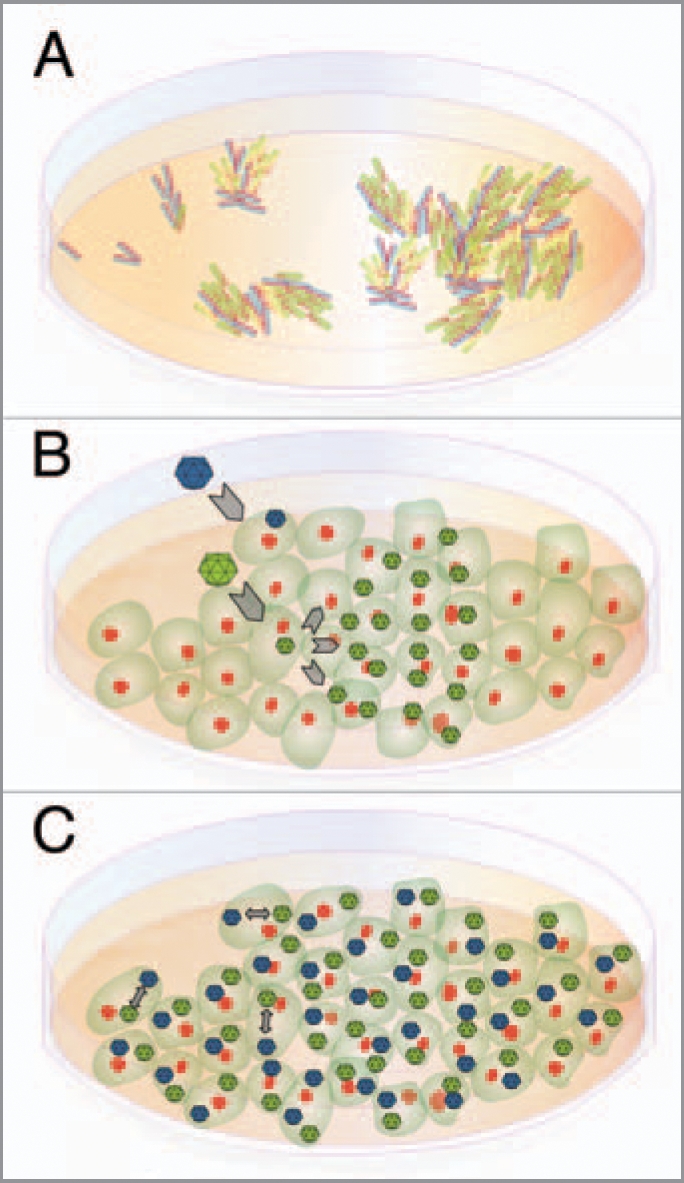
Continuous versus discrete resources. (A) Two bacterial populations growing independently on the top of an agar layer. The agar can be considered a continuous resource. (B) Two viruses (colonizers in green and competitors in blue) infect initially a cell culture. Colonizers complete faster the infection cycle and the released progeny spreads through the unoccupied, susceptible cells. (C) Under high density of viruses almost all cells are coinfected and interaction between viruses takes place inside the single resource (the infected cell); cells can thus be considered a discrete (patchy) resource.