


Figure 2.
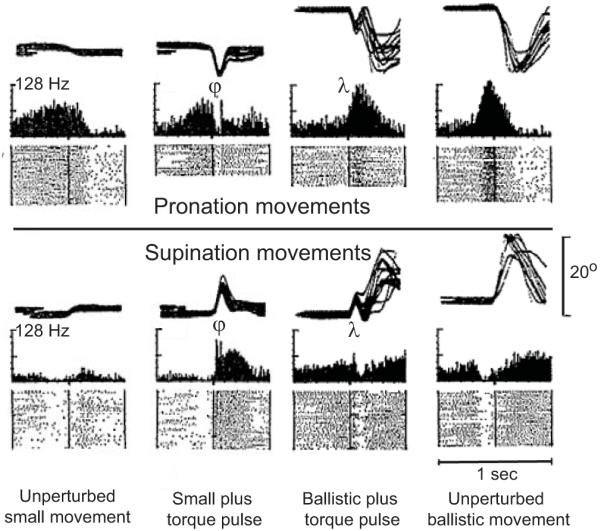
Recordings of pyramidal tract neurons during small corrective pronation/supination movements and larger ballistic movements. Joint position traces, neural histograms and rasters of unit discharge are shown for each condition. Responses are shown with and without the addition of a perturbing torque pulse applied at the onset of the small corrective movements or immediately prior to the ballistic movements. Larger responses (both excitatory and inhibitory) are observable when the perturbation is applied as the monkey makes a small forearm movement (ϕ) compared to responses recorded immediately prior to ballistic movements (λ). Modified with permission from Elsevier B.V., Amsterdam (Evarts and Fromm (1978)).