


Figure 1.
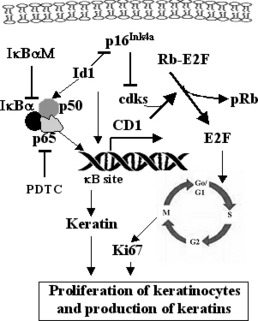
Schematic representation of Id1‐induced cell proliferation and keratin 10 production pathways in keratinocytes. Id1 activates translocation of NF‐κB subunit p65 into the nucleus and increases transcription of cyclin D1 (CD1). CD1, together with cyclin‐dependent kinases (cdk 4/6), phosphorylates retinoblastoma (Rb) protein that releases E2F from the Rb‐E2F complex. E2F, a transcription factor that drives the G0 to S phase transition of cells, promotes cell cycle progression. Ki67 is a proliferating cell antigen active from G1 to M phase; with expression of Ki67, a cell proliferates. In addition, phosphorylation of NF‐κB subunit p65 and transcription of p65 by Id1 increases production of keratins. Id1‐induced down‐regulation of p16Ink4a, an inhibitor of cdks, also promotes cell cycle progression. IκBαM inhibits NF‐κB activity by forming a firm complex with p65 and p50, whereas PDTC inhibits NF‐κB activity by suppressing formation and degradation of IκB (an inhibitor of NF‐κB). NF‐κB, consists of a heterodimer: p65 and p50; T‐bar, indicating inhibition; arrow, symbolizing up‐regulation.