


Figure 4. Modeling the Yin-Yang of proteome balance in health, disease, and in response to proteostasis therapeutics.
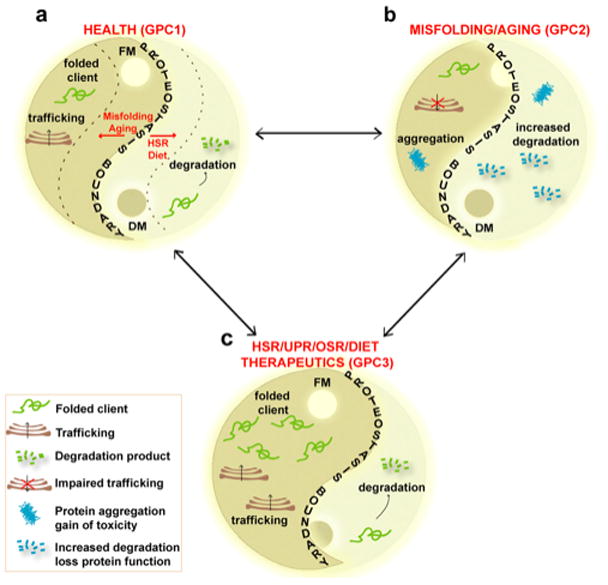
(Panel a) Proteome balance [4] in a healthy cell is determined by the composition of the synthesis and folding modules (FM) (the Yang on the left side of diagram) and degradative module (DM) (the Yin on the right side of diagram). GPC1 determines the position of the PB (the S-shaped curve) and healthspan. The dashed lines illustrate that misfolding and aging can challenge the position of the PB. (Panel b) Aging and unfolding move the PB to the left resulting in compromised proteostasis function (GPC2) and an unhealthy cell by triggering increased degradation and/or accumulation of protein aggregates. (Panel c) Biological signaling pathways including the HSR (HSF1 and IGF1-R/FOXO pathways), UPR, oxidative stress response (OSR), diet, IGF1-R and/or proteostasis targeted therapeutics can move the Yin-Yang balance defined by the PB to the right generating GPC3. GPC3 provides an environment that protects the cell from physiological stress, misfolding and aging, allowing the cell to return to GPC1.