


Fig. 6.
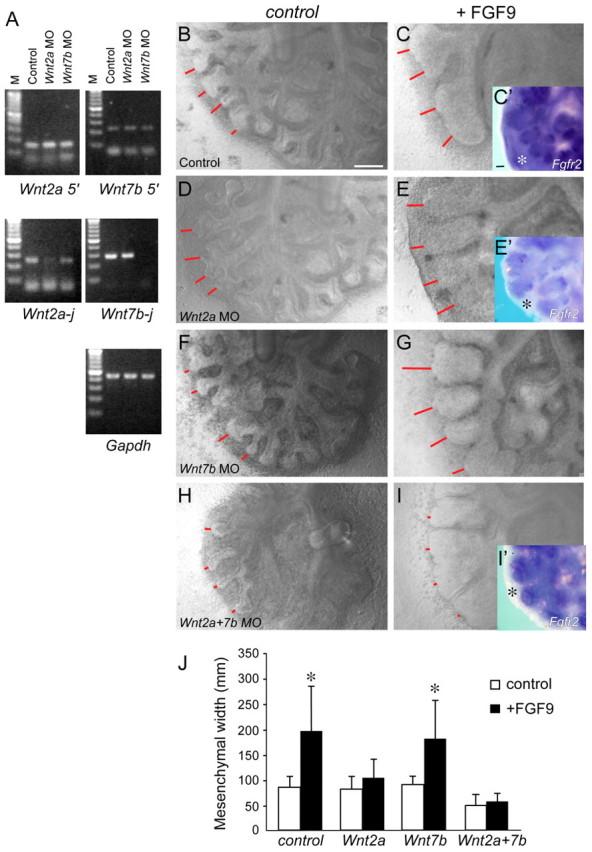
WNT2A and WNT7B are required for mesenchymal expression of Fgfr2 and response to FGF9. (A) PCR detection of Wnt2a and Wnt7b mRNA in mouse lung explants treated with control or splice site morpholinos. Top: amplification of the 5′ end of the transcripts showed normal expression in control, Wnt2a MO and Wnt7b MO treated explants. Middle: amplification of the splice site (j) of the transcripts showed reduced or absent mRNA expression in the corresponding treated explant. (B-I′) Wild-type lung explants were untreated (B,C) or exposed to morpholinos targeting a splice site in the Wnt2a (D,E), Wnt7b (F,G) or both Wnt2a and Wnt7b (H,I) transcripts for 48 hours. Explants were also treated with media (B,D,F,H) or FGF9 (C,E,G,I). Expression of Fgfr2 in control (C′), Wnt2a (E′) and Wnt2a and Wnt7b MO (I′) treated explants showed loss of mesenchymal (asterisks) Fgfr2 expression following knockdown of Wnt2a or Wnt2a and Wnt7b. Red lines indicate mesenchymal thickness. (J) Quantification of mesenchymal width. Explants treated with Wnt2a, or Wnt2a and Wnt7b MO showed no mesenchymal growth response to FGF9. (n=3, *P<0.01, Student's t-test). Error bars represent s.d. Scale bars: 200 μm.