


Fig. 8.
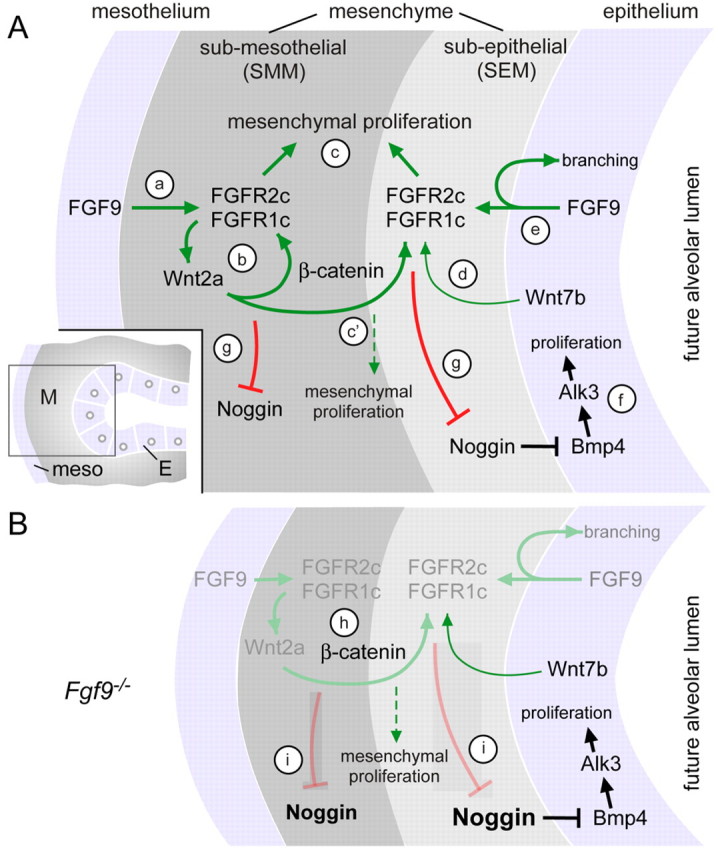
Regulatory mechanisms governing mesenchymal FGF-WNT/β-catenin signaling during early pseudoglandular stages of lung development. (A) (a) Mesothelial FGF9 signals to mesenchymal FGFR1C and FGFR2C to regulate mesenchymal proliferation and Wnt2a expression. (b) Mesenchymal β-catenin signaling is required for mesenchymal FGFR expression and mesenchymal response to FGF9. (c) FGFR signaling primarily regulates mesenchymal proliferation but requires WNT/β-catenin signaling to maintain FGFR expression. (c′) In the absence of mesenchymal FGFR signaling, WNT/β-catenin signaling has a limited capacity to induce mesenchymal expansion. (d) Wnt7b, expressed in airway epithelium, is partially redundant with Wnt2a for regulation of mesenchymal β-catenin signaling. (e) Epithelial FGF9 regulates branching either by direct autocrine activation of epithelial FGFRs or indirectly through regulation of mesenchymal FGF-WNT/β-catenin signaling and their downstream targets. (f) BMP4, primarily expressed in epithelium, acts as an autocrine factor to regulate epithelial proliferation and, secondarily, branching, through activation of BMPR1A (ALK3). (g) FGF-WNT/β-catenin signaling in the SEM and SMM negatively regulates Noggin expression. Inset: Diagram showing the region near the distal epithelial bud in which these signaling interactions occur. (B) When Fgf9 is absent, the FGF-WNT/β-catenin feed-forward signaling loop degenerates (gray) and only Wnt7b signaling remains. (h) In the absence of Fgf9, β-catenin is still present but Fgfr1 and Fgfr2 expression is lost. (i) Loss of mesenchymal FGF-WNT/β-catenin signaling results in increased Noggin expression in both the SEM and SMM. Noggin repression of epithelial BMP signaling is proposed to result in decreased epithelial proliferation. E, epithelium; M, mesenchyme.