


Fig. 4.
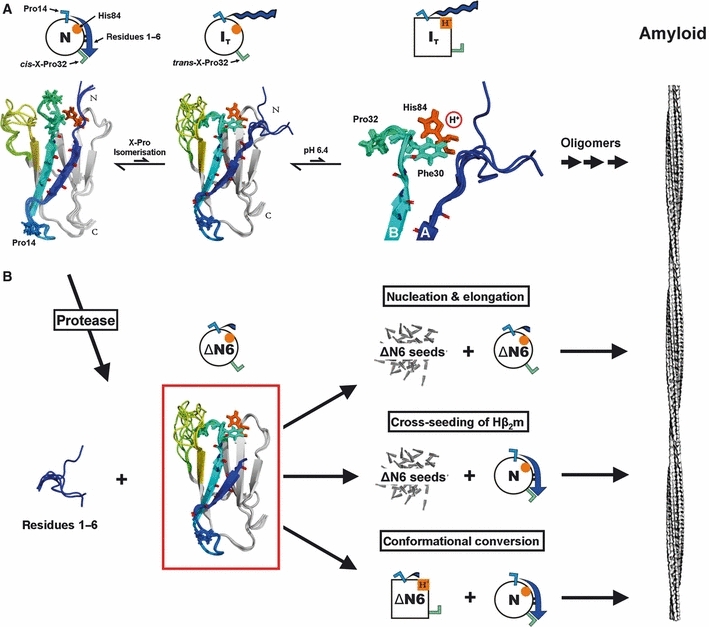
Prion-like conversion during amyloid formation. (A) Summary showing the structures of wild-type β2m (PDB code 2XKS) and a model of IT. Above, keys for these conformational states. Native wild-type β2m (leftmost), shown above as a circle with cis His31-Pro32 (green Γ), trans His13-Pro14 (blue Γ), His84 (orange circle) and the N-terminal region (residues 1–6, blue arrow). Backbone atoms of residues which establish strong hydrogen bonding between β-strands A and B in the native state are shown in sticks. Upon dissociation of the N-terminal region, the His31-Pro32 peptide bond is free to relax into the trans-conformation, causing further conformational changes that lead to the formation of the non-native IT conformer (shown as a circle above a model of its structure). Protonation of His84 under mildly acidic conditions (shown in red ball and stick and as an orange square in the model above), which lies adjacent to Pro32, enhances the amyloid potential of IT further. Oligomerization of these aggregation-prone species then leads to the formation of β2m amyloid fibrils. Assuming that the fibrils formed at neutral pH are structurally similar to those formed at acidic pH, as suggested by FTIR [135] and solid state NMR [133,134], large conformational changes are required in order to transform the anti-parallel β-sheet arrangement of ΔN6 into the parallel in-register arrangement of β-strands characteristic of β2m amyloid fibrils, as reported recently [132] (reproduced, with permission, from [9]). (B) Summary showing the consequences of β2m cleavage of the N-terminal hexapeptide that generates ΔN6 as a persistent IT state (PDB code 2XKU). Once formed ΔN6 is able to nucleate and elongate its own fibrils and also to cross-seed elongation of its fibrillar seeds with the wild-type protein, leading to the development of long straight amyloid-like fibrils (the image of the fibrils was redrawn from the cryo-EM structure of β2m amyloid fibrils from [139]). Furthermore, ΔN6 can transform the innocuous native state of β2m via bimolecular collision. The formation of catalytic amounts of ΔN6 thus has been proposed to be a cataclysmic event during the development of DRA.