


Figure 2.
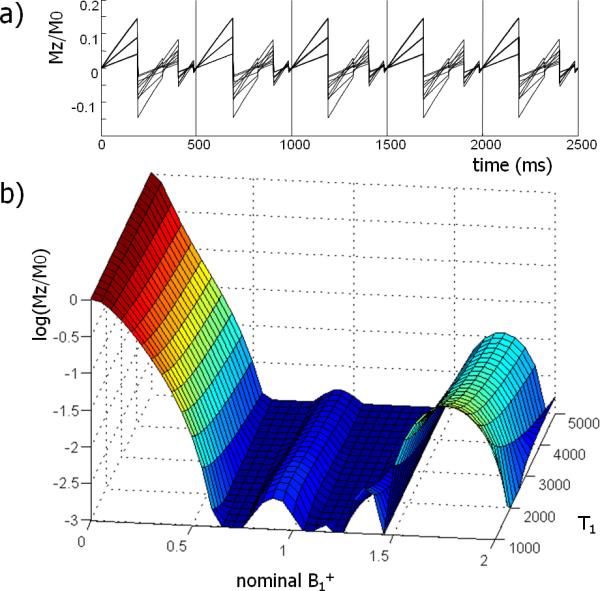
The steady-state water suppression was developed by minimization of the longitudinal magnetization after four suppression pulses in the steady-state. The time evolution of the longitudinal magnetization (Mz) is shown (a) for different T1 (GM, WM, CSF) and B1+ (70%, 100%, 130%) values. Using the steady-state behavior, the magnetization is effectively nulled at the time of the slice-selective excitation. In (b) the suppression factor is shown for a range of T1 and B1+ values at the time of the slice-selective excitation. The suppression is highly effective for a range of B1+ values and nearly insensitive to T1 values of water in the human brain. For B1+ between 60–140% and T1 between 1–5 seconds, the average suppression factor was 980.