


Table 3.
SAR of substituted pyridine compounds

| |||
|---|---|---|---|
| Compd | R-X | hmGlu4 IC50 (μM)a | % Inhibition |
| 2e | cl | 8.2 ± 0.4 | 63.1 ± 6.6 |
| 4a |
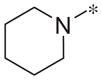
|
Inactive | −5.4 ± 6.1 |
| 4b |
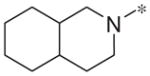
|
Inactive | −7.3 ± 3.9 |
| 4c |
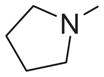
|
Inactive | −7.2 ± 4.8 |
| 4d |
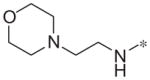
|
Inactive | −7.2 ± 2.3 |
| 4e |
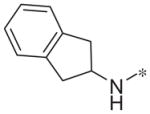
|
Inactive | −9.9 ± 4.9 |
| 4f |
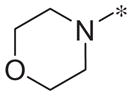
|
Inactive | −2.9 ± 5.8 |
| 4g |
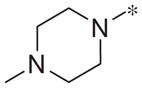
|
Inactive | −15.8 ± 6.1 |
| 4h |
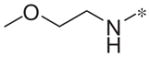
|
Inactive | 2.2 ± 6.0 |
| 4i |
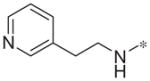
|
>10 | 25.5 ± 9.2 |
| 4j |
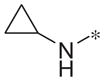
|
Inactive | −4.8 ± 3.0 |
| 4k |
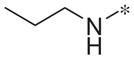
|
Inactive | 0.9 ± 5.4 |
| 4l |
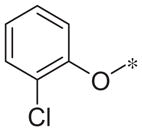
|
Inactive | 14.0 ± 15.5 |
| 4m |
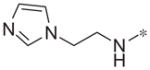
|
Inactive | 4.3 ± 13.9 |
a
Antagonist activity at mGlu4 is assessed by measuring the ability of a compound to concentration-dependently inhibit an EC80 glutamate response. IC50 and % inhibition values are the average of at least three independent determinations performed in triplicate (mean ± SEM shown in table). Compounds were ranked as active if they inhibited the EC80 response by at least 20%.